Calcite& Dolomite
-Vishnuraayan. G.
12410034
Calcite – Introduction
• Most common and widespread mineral on or
near the Earth’s surface.
• Only stable form is CaCO3
• Principal constituent of Sedimentary
limestones
• Occurs in carbonate shells as fine precipitates
and as clastic materials.
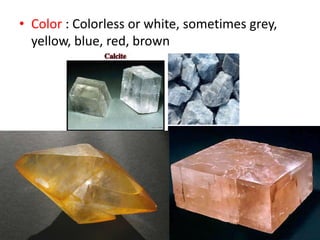
• Color : Colorless or white, sometimes grey,
yellow, blue, red, brown
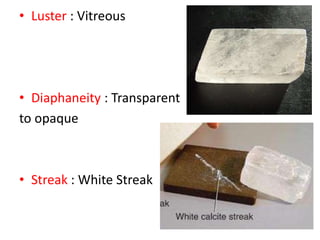
• Luster : Vitreous
• Diaphaneity : Transparent
to opaque
• Streak : White Streak
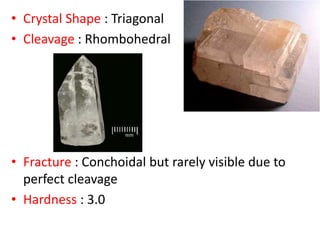
• Crystal Shape : Triagonal
• Cleavage : Rhombohedral
• Fracture : Conchoidal but rarely visible due to
perfect cleavage
• Hardness : 3.0
• Specific Gravity : 2.715(if pure) to 2.94
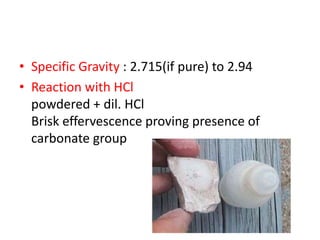
• Reaction with HCl
powdered + dil. HCl
Brisk effervescence proving presence of
carbonate group
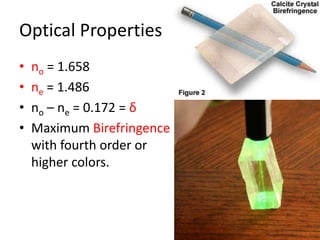
Optical Properties
• no = 1.658
• ne = 1.486
• no – ne = 0.172 = δ
• Maximum Birefringence
with fourth order or
higher colors.
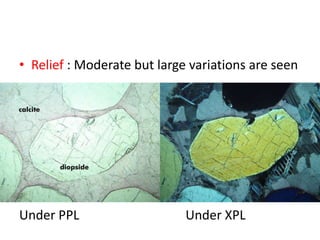
• Relief : Moderate but large variations are seen
Under PPL Under XPL
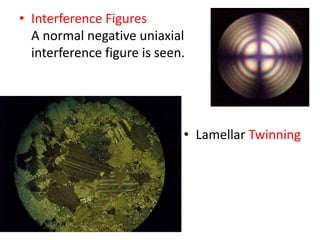
• Interference Figures
A normal negative uniaxial
interference figure is seen.
• Lamellar Twinning
Uses of Calcite
• Many different uses according to its purity and
character.
• Marbles and crystalline limestones –
ornamental stones.
• Calcium Carbonate is used as a flux in smelting
• Certain variety of calcium carbonate is used in
printing
• Lime neutralize the natural acids in the soil.
Dolomite – Introduction
• Occurs in extensive beds at many geological
horizons
• Dolomite may be deposited directly from sea
water, but most dolomite beds have been
formed by the alteration of limestones, the
calcite of which is replaced by dolomite.
• Chemical Composition : (CaMg)(CO3)2
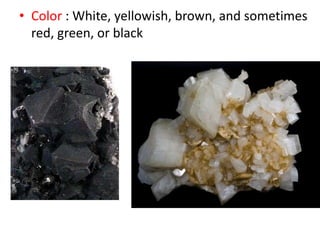
• Color : White, yellowish, brown, and sometimes
red, green, or black
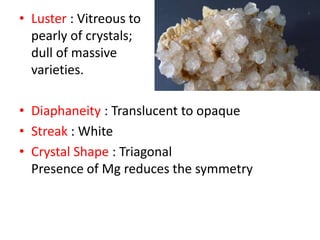
• Luster : Vitreous to
pearly of crystals;
dull of massive
varieties.
• Diaphaneity : Translucent to opaque
• Streak : White
• Crystal Shape : Triagonal
Presence of Mg reduces the symmetry
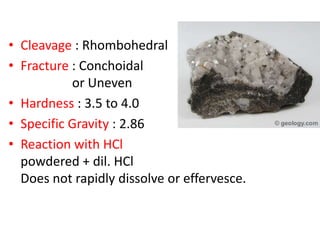
• Cleavage : Rhombohedral
• Fracture : Conchoidal
or Uneven
• Hardness : 3.5 to 4.0
• Specific Gravity : 2.86
• Reaction with HCl
powdered + dil. HCl
Does not rapidly dissolve or effervesce.
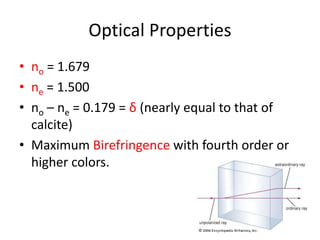
Optical Properties
• no = 1.679
• ne = 1.500
• no – ne = 0.179 = δ (nearly equal to that of
calcite)
• Maximum Birefringence with fourth order or
higher colors.
• Relief : Low to moderate or high
• Interference Figures : A normal negative
uniaxial interference figure is seen.
• Glide Twin lamellae seen on many sections
Uses of Dolomite
• Important Building material.
• Making of Refractory furnace lining and
source of carbon dioxide,
How do we differentiate
Calcite & Dolomite
• Dolomite differs from calcite because of the
presence of MAGNESIUM.
• Calcite reacts quickly with acids and produce
carbon dioxide bubbles. But dolomite, weakly
reacts with acids producing bubbles very slowly.
• Dolomite is slightly harder and denser than
calcite.
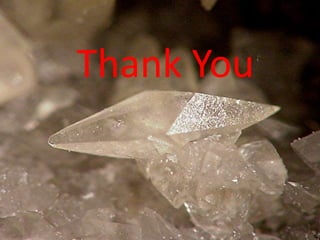
• Calcites form scalenohedrons but dolomites
never form scalenohedrons.
Thank You

Clacite & Dolomite

  • 1.
  • 2.
    Calcite – Introduction •Most common and widespread mineral on or near the Earth’s surface. • Only stable form is CaCO3 • Principal constituent of Sedimentary limestones • Occurs in carbonate shells as fine precipitates and as clastic materials.
  • 3.
    • Color :Colorless or white, sometimes grey, yellow, blue, red, brown
  • 4.
    • Luster :Vitreous • Diaphaneity : Transparent to opaque • Streak : White Streak
  • 5.
    • Crystal Shape: Triagonal • Cleavage : Rhombohedral • Fracture : Conchoidal but rarely visible due to perfect cleavage • Hardness : 3.0
  • 6.
    • Specific Gravity: 2.715(if pure) to 2.94 • Reaction with HCl powdered + dil. HCl Brisk effervescence proving presence of carbonate group
  • 7.
    Optical Properties • no= 1.658 • ne = 1.486 • no – ne = 0.172 = δ • Maximum Birefringence with fourth order or higher colors.
  • 8.
    • Relief :Moderate but large variations are seen Under PPL Under XPL
  • 9.
    • Interference Figures Anormal negative uniaxial interference figure is seen. • Lamellar Twinning
  • 10.
    Uses of Calcite •Many different uses according to its purity and character. • Marbles and crystalline limestones – ornamental stones. • Calcium Carbonate is used as a flux in smelting • Certain variety of calcium carbonate is used in printing • Lime neutralize the natural acids in the soil.
  • 11.
    Dolomite – Introduction •Occurs in extensive beds at many geological horizons • Dolomite may be deposited directly from sea water, but most dolomite beds have been formed by the alteration of limestones, the calcite of which is replaced by dolomite. • Chemical Composition : (CaMg)(CO3)2
  • 12.
    • Color :White, yellowish, brown, and sometimes red, green, or black
  • 13.
    • Luster :Vitreous to pearly of crystals; dull of massive varieties. • Diaphaneity : Translucent to opaque • Streak : White • Crystal Shape : Triagonal Presence of Mg reduces the symmetry
  • 14.
    • Cleavage :Rhombohedral • Fracture : Conchoidal or Uneven • Hardness : 3.5 to 4.0 • Specific Gravity : 2.86 • Reaction with HCl powdered + dil. HCl Does not rapidly dissolve or effervesce.
  • 15.
    Optical Properties • no= 1.679 • ne = 1.500 • no – ne = 0.179 = δ (nearly equal to that of calcite) • Maximum Birefringence with fourth order or higher colors.
  • 16.
    • Relief :Low to moderate or high • Interference Figures : A normal negative uniaxial interference figure is seen. • Glide Twin lamellae seen on many sections
  • 17.
    Uses of Dolomite •Important Building material. • Making of Refractory furnace lining and source of carbon dioxide,
  • 18.
    How do wedifferentiate Calcite & Dolomite • Dolomite differs from calcite because of the presence of MAGNESIUM. • Calcite reacts quickly with acids and produce carbon dioxide bubbles. But dolomite, weakly reacts with acids producing bubbles very slowly. • Dolomite is slightly harder and denser than calcite. • Calcites form scalenohedrons but dolomites never form scalenohedrons.
  • 19.