Sound
Tabassum Ishra
What is sound?
 Sound is produced when something vibrates.
 A sound wave is the movement of alternating
compressions are rarefactions. Sound travels longitudinal
waves.
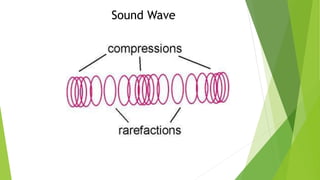
 When air particles are compressed or bunched up together
they are called compressions.
 When the air particles are spread out the are known as
rarefactions.
 l
Sound Wave
Speed of sound
 The more closely particles in a medium,
the faster sound will travel through.
 Sound travels faster through solids than
liquids, and faster in liquids than gases.
 Sound also travels faster in warm air than
cool air because the air is moving with
greater kinetic energy
Speed of sound
Material Speed of Sound (m/s)
Air (at 0 degree Celsius) 331
Air (at 18 degree Celsius) 342
Water 1440
Wood 4500
Steel 5100
Sound
 Hard surfaces reflect sound waves. Reflected
sound waves are called echoes.
 Examples:
 Sonar
 Echolocation
 Soft materials absorb sound was and convert it
to heat. This reduces reverberation.
Frequency and Pitch Sound
 The pitch of sound is related to the
frequency of a sound wave. The greater the
frequency, the higher the pitch
 Volume of a sound is related to the
amplitude of a sound wave The greater the
amplitude the greater the volume.
What is sound intensity?
 Sound intensity is the energy that the sound
wave possesses. The greater the intensity of
sound the farther the sound will travel and
the louder the sound will appear.
 Loudness is very closely related to intensity.
Loudness is the human perception of the
sound intensity. The unit for loudness is
decibels.
What is resonance?
Many objects have a natural frequency
– vibrates in a regular pattern.
Resonance occurs when whenever a
sound wave has the same frequency as
the natural frequency of an object.
The sound will cause the object with
the same natural frequency to vibrate.
Ultrasound and Infrasound
 Ultrasound is the name given to sound
waves with frequencies above our hearing
range. ( 20-20000 Hz)
 Frequencies lower than man hearing range
is infrasound.

Sound

  • 1.
  • 2.
    What is sound? Sound is produced when something vibrates.  A sound wave is the movement of alternating compressions are rarefactions. Sound travels longitudinal waves.  When air particles are compressed or bunched up together they are called compressions.  When the air particles are spread out the are known as rarefactions.  l
  • 3.
  • 4.
    Speed of sound The more closely particles in a medium, the faster sound will travel through.  Sound travels faster through solids than liquids, and faster in liquids than gases.  Sound also travels faster in warm air than cool air because the air is moving with greater kinetic energy
  • 5.
    Speed of sound MaterialSpeed of Sound (m/s) Air (at 0 degree Celsius) 331 Air (at 18 degree Celsius) 342 Water 1440 Wood 4500 Steel 5100
  • 6.
    Sound  Hard surfacesreflect sound waves. Reflected sound waves are called echoes.  Examples:  Sonar  Echolocation  Soft materials absorb sound was and convert it to heat. This reduces reverberation.
  • 7.
    Frequency and PitchSound  The pitch of sound is related to the frequency of a sound wave. The greater the frequency, the higher the pitch  Volume of a sound is related to the amplitude of a sound wave The greater the amplitude the greater the volume.
  • 8.
    What is soundintensity?  Sound intensity is the energy that the sound wave possesses. The greater the intensity of sound the farther the sound will travel and the louder the sound will appear.  Loudness is very closely related to intensity. Loudness is the human perception of the sound intensity. The unit for loudness is decibels.
  • 9.
    What is resonance? Manyobjects have a natural frequency – vibrates in a regular pattern. Resonance occurs when whenever a sound wave has the same frequency as the natural frequency of an object. The sound will cause the object with the same natural frequency to vibrate.
  • 10.
    Ultrasound and Infrasound Ultrasound is the name given to sound waves with frequencies above our hearing range. ( 20-20000 Hz)  Frequencies lower than man hearing range is infrasound.