T- 1-855-694-8886
Email- info@iTutor.com
By iTutor.com
Slope of a Line
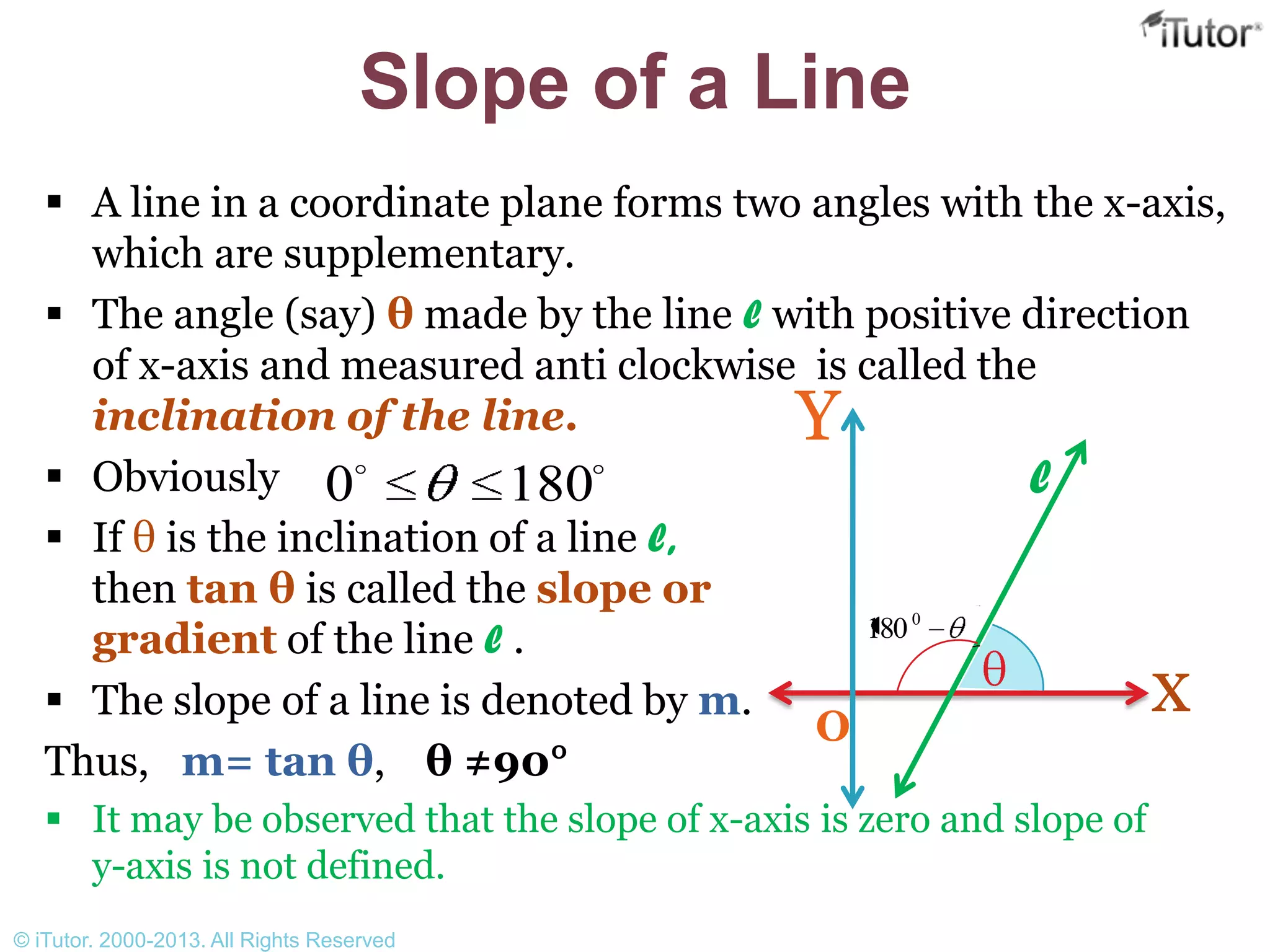
 A line in a coordinate plane forms two angles with the x-axis,
which are supplementary.
 The angle (say) θ made by the line l with positive direction
of x-axis and measured anti clockwise is called the
inclination of the line.
 Obviously
 If θ is the inclination of a line l,
then tan θ is called the slope or
gradient of the line l .
 The slope of a line is denoted by m.
Thus, m= tan θ, θ ≠90°
 It may be observed that the slope of x-axis is zero and slope of
y-axis is not defined.
x
Y
O
0
180
l
1800
© iTutor. 2000-2013. All Rights Reserved
Slope of a line when coordinates of any two
points on the line are given
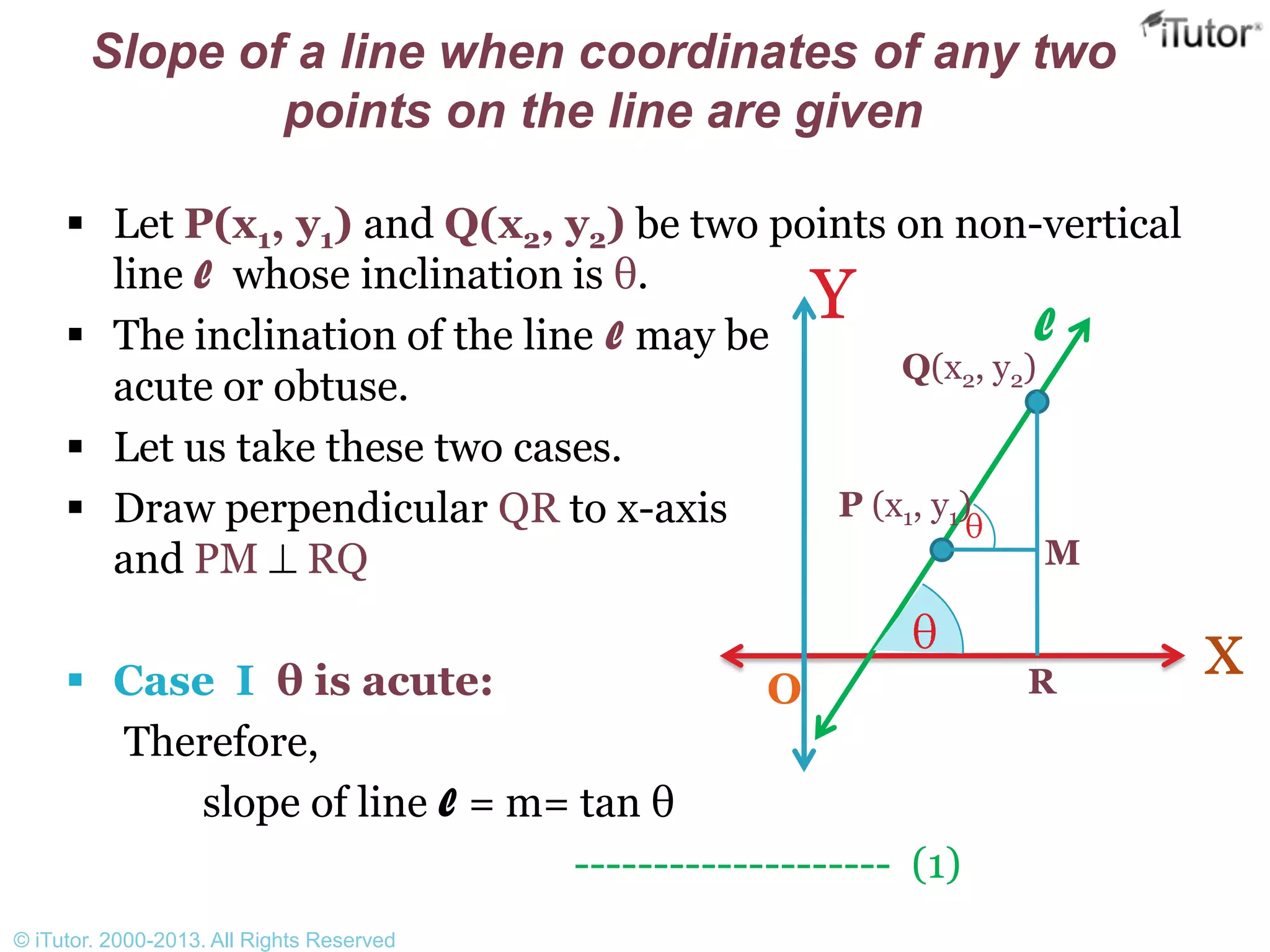
 Let P(x1, y1) and Q(x2, y2) be two points on non-vertical
line l whose inclination is θ.
 The inclination of the line l may be
acute or obtuse.
 Let us take these two cases.
 Draw perpendicular QR to x-axis
and PM RQ
 Case I θ is acute:
Therefore,
slope of line l = m= tan θ
-------------------- (1)
x
Y
O
l
P (x1, y1)
Q(x2, y2)
M
R
© iTutor. 2000-2013. All Rights Reserved
But in ∆MPQ, we have
-------------- (2)
From equation (1) and (2) we have
Case II When angle θ is obtuse:
∠ MPQ = 180° – θ.
Therefore,
θ = 180° – ∠ MPQ.
Now, slope of the line l
m = tan θ
= tan ( 180° – ∠ MPQ)
= – tan ∠ MPQ
12
12
tan
xx
yy
MP
MQ
12
12
xx
yy
m
P (x1, y1)
Q(x2, y2)
M
180° – θ
R
x
Y
O
© iTutor. 2000-2013. All Rights Reserved
12
12
12
12
xx
yy
xx
yy
MP
MQ
Consequently,
we see that in both the cases the slope m of the line
through the points (x1, y1) and (x2, y2) is given by
12
12
xx
yy
m
© iTutor. 2000-2013. All Rights Reserved
Conditions for parallelism and
perpendicularity of lines in terms of their
slopes
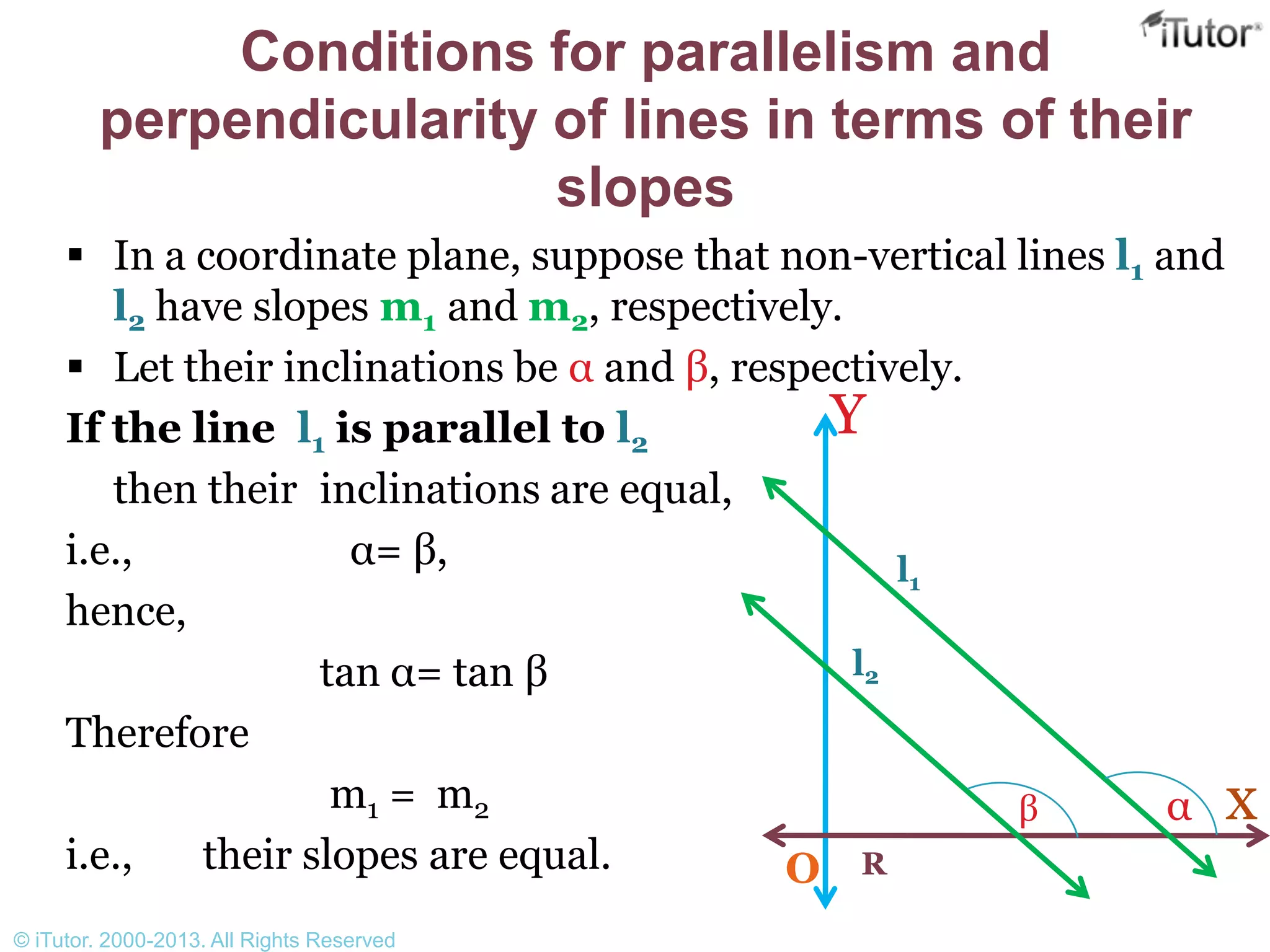
 In a coordinate plane, suppose that non-vertical lines l1 and
l2 have slopes m1 and m2, respectively.
 Let their inclinations be α and β, respectively.
If the line l1 is parallel to l2
then their inclinations are equal,
i.e., α= β,
hence,
tan α= tan β
Therefore
m1 = m2
i.e., their slopes are equal. R
x
Y
O
l1
l2
αβ
© iTutor. 2000-2013. All Rights Reserved
Conversely,
if the slope of two lines l1 and l2 is same, i.e.,
m1 = m2.
Then tan α= tan β.
By the property of tangent function (between 0° and 180°),
α= β.
Therefore,
the lines are parallel.
 Hence, two non vertical lines l1 and l2 are parallel if and
only if their slopes are equal.
© iTutor. 2000-2013. All Rights Reserved
If the lines l1 and l2 are perpendicular then β = α+ 90°.
Therefore,
tan β = tan (α+ 90°)
= – cot α
i.e.,
or m1 m2 = - 1
Conversely,
if m1 m2 = – 1, i.e., tan α tan β= – 1
Then
tan α = – cot β = tan (β+ 90°) or tan (β– 90°)
x
Y
O
l1
l2
α β
tan
1
1
2
1
m
m
© iTutor. 2000-2013. All Rights Reserved
Therefore,
α and β differ by 90°.
Thus, lines l1 and l2 are perpendicular to each other.
Hence,
Two non-vertical lines are perpendicular to each other if
and only if their slopes are negative reciprocals of each
other,
i.e., or
1
2
1
m
m 121mm
© iTutor. 2000-2013. All Rights Reserved
Angle between two lines
x
Y
L2 L1
α2α1
O
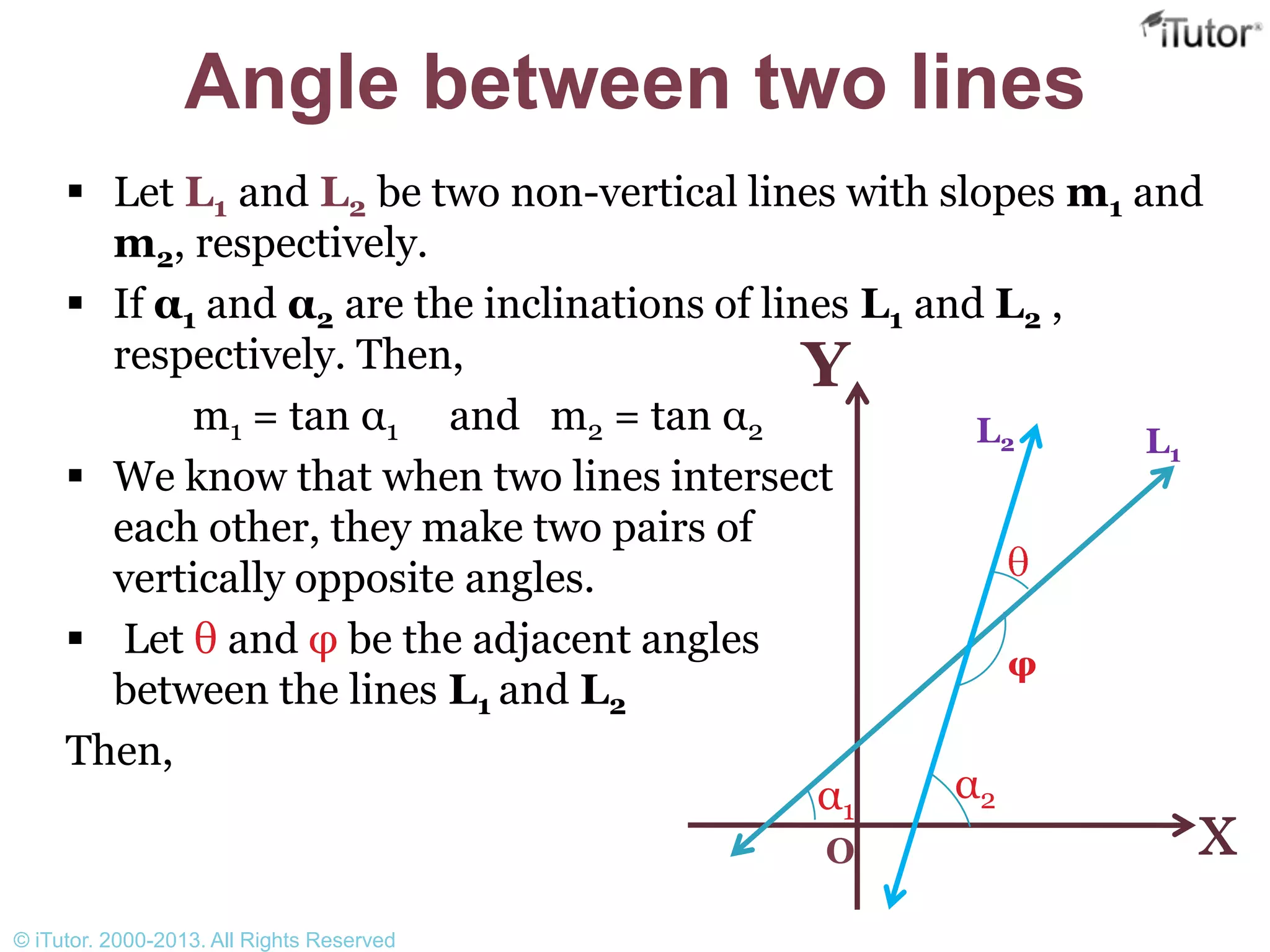
 Let L1 and L2 be two non-vertical lines with slopes m1 and
m2, respectively.
 If α1 and α2 are the inclinations of lines L1 and L2 ,
respectively. Then,
m1 = tan α1 and m2 = tan α2
 We know that when two lines intersect
each other, they make two pairs of
vertically opposite angles.
 Let θ and φ be the adjacent angles
between the lines L1 and L2
Then,
φ
© iTutor. 2000-2013. All Rights Reserved
θ = α2 - α1 and α1 , α2 90°.
Therefore,
and φ = 180° – θ so that
Now,
there arise two cases:
Case I
If is positive, then tan θ will be positive and
tan φ will be negative, which means θ
will be acute and φ will be obtuse.
21
12
21
12
12
1tantan1
tantan
tantan
mm
mm
, As 1 + m1m2 0
12
12
1
tan180tantan
mm
mm
, As 1 + m1m2 0
21
12
1 mm
mm
© iTutor. 2000-2013. All Rights Reserved
Case II
If is negative, then tan θ will be negative and
tan φ will be positive, which means that θ
will be obtuse and φ will be acute.
Thus,
the acute angle (say θ) between lines L1 and L2 with slopes
m1 and m2, respectively, is given by
The obtuse angle (say φ) can be found by using φ=1800– θ.
21
12
1 mm
mm
,
1
tan
21
12
mm
mm
As 1 + m1m2 0
© iTutor. 2000-2013. All Rights Reserved
The End
Call us for more
Information:
www.iTutor.com
Visit
1-855-694-8886

Slops of the Straight lines

  • 1.
  • 2.
    Slope of aLine  A line in a coordinate plane forms two angles with the x-axis, which are supplementary.  The angle (say) θ made by the line l with positive direction of x-axis and measured anti clockwise is called the inclination of the line.  Obviously  If θ is the inclination of a line l, then tan θ is called the slope or gradient of the line l .  The slope of a line is denoted by m. Thus, m= tan θ, θ ≠90°  It may be observed that the slope of x-axis is zero and slope of y-axis is not defined. x Y O 0 180 l 1800 © iTutor. 2000-2013. All Rights Reserved
  • 3.
    Slope of aline when coordinates of any two points on the line are given  Let P(x1, y1) and Q(x2, y2) be two points on non-vertical line l whose inclination is θ.  The inclination of the line l may be acute or obtuse.  Let us take these two cases.  Draw perpendicular QR to x-axis and PM RQ  Case I θ is acute: Therefore, slope of line l = m= tan θ -------------------- (1) x Y O l P (x1, y1) Q(x2, y2) M R © iTutor. 2000-2013. All Rights Reserved
  • 4.
    But in ∆MPQ,we have -------------- (2) From equation (1) and (2) we have Case II When angle θ is obtuse: ∠ MPQ = 180° – θ. Therefore, θ = 180° – ∠ MPQ. Now, slope of the line l m = tan θ = tan ( 180° – ∠ MPQ) = – tan ∠ MPQ 12 12 tan xx yy MP MQ 12 12 xx yy m P (x1, y1) Q(x2, y2) M 180° – θ R x Y O © iTutor. 2000-2013. All Rights Reserved
  • 5.
    12 12 12 12 xx yy xx yy MP MQ Consequently, we see thatin both the cases the slope m of the line through the points (x1, y1) and (x2, y2) is given by 12 12 xx yy m © iTutor. 2000-2013. All Rights Reserved
  • 6.
    Conditions for parallelismand perpendicularity of lines in terms of their slopes  In a coordinate plane, suppose that non-vertical lines l1 and l2 have slopes m1 and m2, respectively.  Let their inclinations be α and β, respectively. If the line l1 is parallel to l2 then their inclinations are equal, i.e., α= β, hence, tan α= tan β Therefore m1 = m2 i.e., their slopes are equal. R x Y O l1 l2 αβ © iTutor. 2000-2013. All Rights Reserved
  • 7.
    Conversely, if the slopeof two lines l1 and l2 is same, i.e., m1 = m2. Then tan α= tan β. By the property of tangent function (between 0° and 180°), α= β. Therefore, the lines are parallel.  Hence, two non vertical lines l1 and l2 are parallel if and only if their slopes are equal. © iTutor. 2000-2013. All Rights Reserved
  • 8.
    If the linesl1 and l2 are perpendicular then β = α+ 90°. Therefore, tan β = tan (α+ 90°) = – cot α i.e., or m1 m2 = - 1 Conversely, if m1 m2 = – 1, i.e., tan α tan β= – 1 Then tan α = – cot β = tan (β+ 90°) or tan (β– 90°) x Y O l1 l2 α β tan 1 1 2 1 m m © iTutor. 2000-2013. All Rights Reserved
  • 9.
    Therefore, α and βdiffer by 90°. Thus, lines l1 and l2 are perpendicular to each other. Hence, Two non-vertical lines are perpendicular to each other if and only if their slopes are negative reciprocals of each other, i.e., or 1 2 1 m m 121mm © iTutor. 2000-2013. All Rights Reserved
  • 10.
    Angle between twolines x Y L2 L1 α2α1 O  Let L1 and L2 be two non-vertical lines with slopes m1 and m2, respectively.  If α1 and α2 are the inclinations of lines L1 and L2 , respectively. Then, m1 = tan α1 and m2 = tan α2  We know that when two lines intersect each other, they make two pairs of vertically opposite angles.  Let θ and φ be the adjacent angles between the lines L1 and L2 Then, φ © iTutor. 2000-2013. All Rights Reserved
  • 11.
    θ = α2- α1 and α1 , α2 90°. Therefore, and φ = 180° – θ so that Now, there arise two cases: Case I If is positive, then tan θ will be positive and tan φ will be negative, which means θ will be acute and φ will be obtuse. 21 12 21 12 12 1tantan1 tantan tantan mm mm , As 1 + m1m2 0 12 12 1 tan180tantan mm mm , As 1 + m1m2 0 21 12 1 mm mm © iTutor. 2000-2013. All Rights Reserved
  • 12.
    Case II If isnegative, then tan θ will be negative and tan φ will be positive, which means that θ will be obtuse and φ will be acute. Thus, the acute angle (say θ) between lines L1 and L2 with slopes m1 and m2, respectively, is given by The obtuse angle (say φ) can be found by using φ=1800– θ. 21 12 1 mm mm , 1 tan 21 12 mm mm As 1 + m1m2 0 © iTutor. 2000-2013. All Rights Reserved
  • 13.
    The End Call usfor more Information: www.iTutor.com Visit 1-855-694-8886