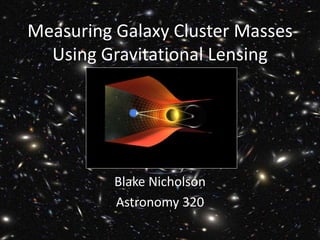
Measuring Galaxy Cluster Masses
Using Gravitational Lensing
Blake Nicholson
Astronomy 320
Overview
I. Introduction
II. Galaxy Clusters
III. Methods to Measure Mass
IV. History: Soldner, Einstein, Zwicky
V. How Gravitational Lensing Works
VI. References
Galaxy Clusters
• Biggest gravitationally-collapsed objects
• Contain between 50 and 1000 galaxies
• Typical diameter of 2-10 Mpc
• Typical masses of 1014 to 1015
• Velocity distributions between 800-1000
km/s
Methods to Measure Mass
Stellar Light
Velocity Dispersion
X-Ray emission from Bresstrahlung
mechanism
Sunyaev-Zel’dovich effect
Weak gravitational Lensing
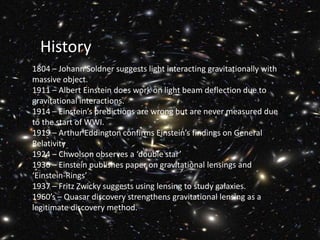
History
1804 – Johann Soldner suggests light interacting gravitationally with
massive object.
1911 – Albert Einstein does work on light beam deflection due to
gravitational interactions.
1914 – Einstein’s predictions are wrong but are never measured due
to the start of WWI.
1919 – Arthur Eddington confirms Einstein’s findings on General
Relativity
1924 – Chwolson observes a ‘double star’
1936 – Einstein publishes paper on gravitational lensings and
‘Einstein-Rings’
1937 – Fritz Zwicky suggests using lensing to study galaxies.
1960’s – Quasar discovery strengthens gravitational lensing as a
legitimate discovery method.
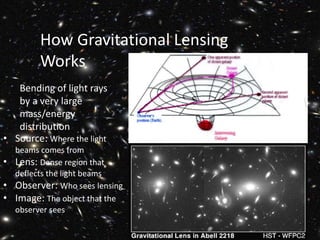
How Gravitational Lensing
Works
Bending of light rays
by a very large
mass/energy
distribution
• Source: Where the light
beams comes from
• Lens: Dense region that
deflects the light beams
• Observer: Who sees lensing
• Image: The object that the
observer sees
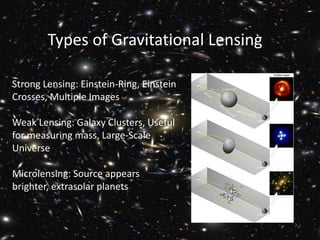
Types of Gravitational Lensing
Strong Lensing: Einstein-Ring, Einstein
Crosses, Multiple Images
Weak Lensing: Galaxy Clusters, Useful
for measuring mass, Large-Scale
Universe
Microlensing: Source appears
brighter, extrasolar planets
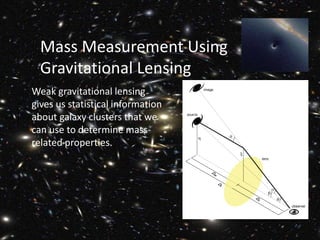
Mass Measurement Using
Gravitational Lensing
Weak gravitational lensing
gives us statistical information
about galaxy clusters that we
can use to determine mass-
related properties.
References
http://www.spacetelescope.org/images/heic0814f/
http://www.spacetelescope.org/static/archives/images/screen/heic0113d.jpg
http://apod.nasa.gov/apod/image/0203/simcluster_hubbleACS_big.jpg
http://astro.berkeley.edu/~jcohn/lens.html
http://epsc.wustl.edu/courses/epsc210a/transparencies/bernard/gravitational_lens001.jpg
http://www.astro.gla.ac.uk/users/martin/outreach/lens_a2218.jpg

Measuring Galaxy Cluster Masses Using Gravitational Lensing