SOUND
Prepared by: Karen Mae Castro
Objectives:
I. Describe the characteristics of sound using the properties of
waves
II. Demonstrate the changes in the pitch and loudness of sound
III. Explain the production of sounds in the human voice box
IV. Discuss how pitch, loudness, and quality of sound vary from one
sound to another
V. Describe how organisms produce, transmit, and receive sounds
of various frequencies
VI. Create harmonious music using recyclable materials
Table of Contents:
 Mediums of Sound transmission
 How we hear sounds
Lesson 1: Transmission
of Sounds
Lesson 2: Properties
of Sound
 Pitch
 Doppler Effect
 Echolocation
 Loudness
 Quality
Lesson 3: Musical
Instruments
 Stringed Instruments
 Wind Instruments
 Percussion Instruments
What is Sound Wave?
Vibrations are back and forth motions that
create sound.
Sound wave is produced when an object
vibrates rapidly in a medium like air.
●Compressions - The close together part of the
wave
●Rarefactions – the spread-out parts of a wave
In which media
does sound travel
fastest?
In Solid? In Liquid? Or In Gas?
 Sounds travel faster in solids than in
liquids and faster in liquid than in
gases.
Sound travels better through
high-density materials.
The closer the molecules are
together, the faster they can
collide and transfer energy.
Hearing and the Human
Ear
The Outer Ear
it is a sound collector. It consists of the
part that you can see and the ear canal.
The visible part is shaped somewhat like
a funnel.
This shape helps the visible part to
collect sound waves and direct them into
the ear canal.
Sound waves that pass through the ear
canal cause the ear drum to vibrate.
These vibrations are transmitted to the
three small bones, which amplify the
vibrations.
The Middle Ear
 - it is a sound amplifier.
 It consists of the ear drum and three tiny bones called
hammer, the anvil, and the stirrup.
The Inner Ear
 it contains the Cochlea. The cochlea
is filled with fluid and is lined with
tiny hair-like cells. Vibrations of the
stirrup bone are transmitted to the
hair cells. The movement of the hair
cells produce signals that travel to
your brain, where they are
interpreted as sound.
Properties of
Sound
Properties of
Sound
Pitch
o description of how high or low the sound seems to
happen
a) Frequency
- number of sound waves that passes through a point in
a certain amount of time, such as one second.
- The greater the frequency, the
higher the pitch.
- Hertz (Hz) is the unit to measure
frequency and pitch.
Kinds of Sound Waves
1. AUDIBLE SOUND
 Human can hear (20 – 20 000 Hz)
2. ULTRASONIC WAVES
 Above 20 000 Hz
 Cannot be detected by human ear but some animals do.
 Dogs can detect as high as 50 000 Hz and bats can hear
up to 100 000 Hz.
 Uses in Ultrasound
Loudness
o How loud or soft a sound is perceived to be.
o Determined mainly by the amplitude of the
sound wave.
o Decibel (dB) is the unit used to measure
sound intensity or loudness.
SONAR
SONAR stands for Sound
Navigation And Ranging.
It uses ultrasonic waves
to measure the distance,
direction and speed of
underwater objects.
ECHOLOCATION
Similar to SONAR
It is used by some animals like bats and
dolphins.
Bats and Dolphins use this echolocation to
navigate, find food and avoid predators.
3. INFRASOUND
 Sound below 20 Hz
SOURCES OF INFRASOUND:
 Vibrating heavy machines
 Earthquakes
 Thunder
 Volcanoes
 It cannot be heard by human ear but can cause
damage.
QUALITY / TIMBRE
o The difference among sounds of the same pitch and
loudness.
o The quality of a sound depends on the waveform of the
sound wave.
TWO DIFFERENT WAVEFORMS
1. Pure Tone – simplest waveform, it has a soft, pleasant tone
quality and sinusoidal
2. Complex Tone – nearly sinusoidal.
MUSIC VS NOISE
MUSIC
o Created using specific frequencies and
sound quality and by following a
regular pattern.
o Pleasant to the ears.
NOISE
o Has no definite pitch and pattern.
o Consider as unpleasant to the ears.
DOPPLER EFFECT
o A change in the frequency and pitch of sound
due to either movement of the source or the
listener.
Example:
Observe the siren of an ambulance car, the pitch is
increases as the ambulance car approaches you.
As it moves away, the siren’s pitch decreases.
A. REFRACTION OF SOUND
 Change in direction, as the wave moves
away from one medium to another.
 It bends or refracts as they move
through air.
B. REFLECTION OF SOUND
Echo
 Reflected sound
 It is what you heard shortly after the
original.
C. DIFFRACTION OF SOUND
 Sound waves bend or diffract around
corners or barriers like doors and walls.
D. INTERFERENCE
 The result of two or more sound.
 Waves overlapping
2 Types
Constructive Interference
o The sound waves arrive at the
same time and phase.
Destructive Interference
o Waves arrive at interval and
are out of phase.
RESONAN
CE
The inducing of vibrations
of a natural rate by
vibrating source having
the same frequency.
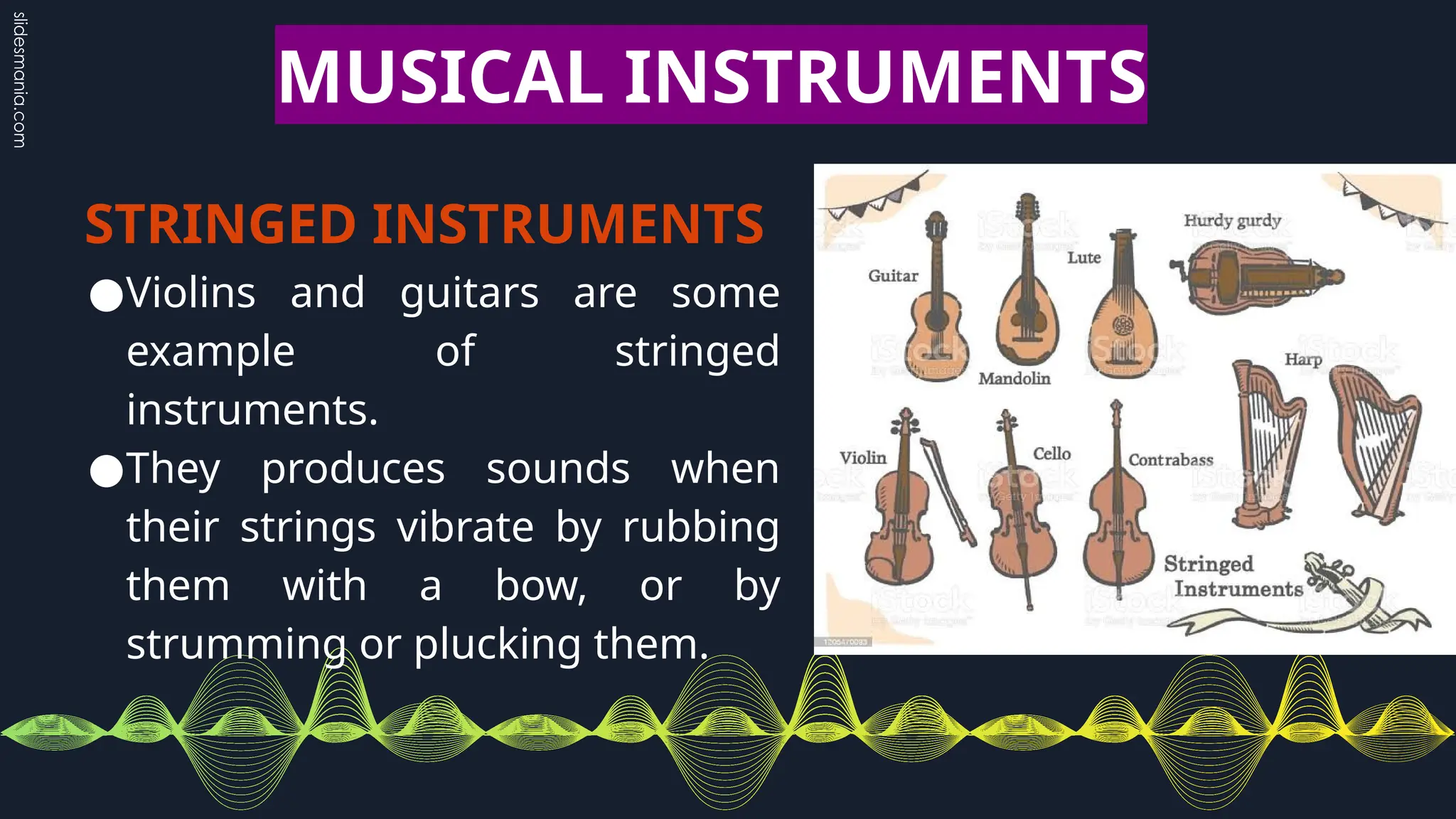
STRINGED INSTRUMENTS
MUSICAL INSTRUMENTS
●Violins and guitars are some
example of stringed
instruments.
●They produces sounds when
their strings vibrate by rubbing
them with a bow, or by
strumming or plucking them.
.
.
WIND
INSTRUMENTS
 Brass instruments like trumpets and
woodwind instruments like flutes.
 In Brass instruments, sounds are
produced when a musician’s lips vibrate
against the mouthpiece causing the air
column to vibrate.
 Woodwind instrument contain a thin
flexible strip of material called reed. It
produces sounds when the reed vibrates
causing the air column in the instrument
to vibrate
PERCUSSION
INSTRUMENTS
It includes drums, cymbals
and xylophone.
These instruments vibrate
when struck. You control the
sound intensity by how hard
you strike
THANK YOU!
&
GOD BLESS!!!

Sound Powerpoint presentation for grade 7..pptx

  • 1.
  • 2.
    Objectives: I. Describe thecharacteristics of sound using the properties of waves II. Demonstrate the changes in the pitch and loudness of sound III. Explain the production of sounds in the human voice box IV. Discuss how pitch, loudness, and quality of sound vary from one sound to another V. Describe how organisms produce, transmit, and receive sounds of various frequencies VI. Create harmonious music using recyclable materials
  • 3.
    Table of Contents: Mediums of Sound transmission  How we hear sounds Lesson 1: Transmission of Sounds Lesson 2: Properties of Sound  Pitch  Doppler Effect  Echolocation  Loudness  Quality Lesson 3: Musical Instruments  Stringed Instruments  Wind Instruments  Percussion Instruments
  • 4.
    What is SoundWave? Vibrations are back and forth motions that create sound. Sound wave is produced when an object vibrates rapidly in a medium like air.
  • 5.
    ●Compressions - Theclose together part of the wave ●Rarefactions – the spread-out parts of a wave
  • 6.
    In which media doessound travel fastest? In Solid? In Liquid? Or In Gas?
  • 7.
     Sounds travelfaster in solids than in liquids and faster in liquid than in gases. Sound travels better through high-density materials. The closer the molecules are together, the faster they can collide and transfer energy.
  • 9.
    Hearing and theHuman Ear The Outer Ear it is a sound collector. It consists of the part that you can see and the ear canal. The visible part is shaped somewhat like a funnel. This shape helps the visible part to collect sound waves and direct them into the ear canal.
  • 10.
    Sound waves thatpass through the ear canal cause the ear drum to vibrate. These vibrations are transmitted to the three small bones, which amplify the vibrations. The Middle Ear  - it is a sound amplifier.  It consists of the ear drum and three tiny bones called hammer, the anvil, and the stirrup.
  • 11.
    The Inner Ear it contains the Cochlea. The cochlea is filled with fluid and is lined with tiny hair-like cells. Vibrations of the stirrup bone are transmitted to the hair cells. The movement of the hair cells produce signals that travel to your brain, where they are interpreted as sound.
  • 13.
  • 14.
    Properties of Sound Pitch o descriptionof how high or low the sound seems to happen a) Frequency - number of sound waves that passes through a point in a certain amount of time, such as one second.
  • 15.
    - The greaterthe frequency, the higher the pitch. - Hertz (Hz) is the unit to measure frequency and pitch.
  • 16.
    Kinds of SoundWaves 1. AUDIBLE SOUND  Human can hear (20 – 20 000 Hz) 2. ULTRASONIC WAVES  Above 20 000 Hz  Cannot be detected by human ear but some animals do.  Dogs can detect as high as 50 000 Hz and bats can hear up to 100 000 Hz.  Uses in Ultrasound
  • 17.
    Loudness o How loudor soft a sound is perceived to be. o Determined mainly by the amplitude of the sound wave. o Decibel (dB) is the unit used to measure sound intensity or loudness.
  • 19.
    SONAR SONAR stands forSound Navigation And Ranging. It uses ultrasonic waves to measure the distance, direction and speed of underwater objects.
  • 20.
    ECHOLOCATION Similar to SONAR Itis used by some animals like bats and dolphins. Bats and Dolphins use this echolocation to navigate, find food and avoid predators.
  • 21.
    3. INFRASOUND  Soundbelow 20 Hz SOURCES OF INFRASOUND:  Vibrating heavy machines  Earthquakes  Thunder  Volcanoes  It cannot be heard by human ear but can cause damage.
  • 22.
    QUALITY / TIMBRE oThe difference among sounds of the same pitch and loudness. o The quality of a sound depends on the waveform of the sound wave. TWO DIFFERENT WAVEFORMS 1. Pure Tone – simplest waveform, it has a soft, pleasant tone quality and sinusoidal 2. Complex Tone – nearly sinusoidal.
  • 23.
    MUSIC VS NOISE MUSIC oCreated using specific frequencies and sound quality and by following a regular pattern. o Pleasant to the ears. NOISE o Has no definite pitch and pattern. o Consider as unpleasant to the ears.
  • 24.
    DOPPLER EFFECT o Achange in the frequency and pitch of sound due to either movement of the source or the listener. Example: Observe the siren of an ambulance car, the pitch is increases as the ambulance car approaches you. As it moves away, the siren’s pitch decreases.
  • 25.
    A. REFRACTION OFSOUND  Change in direction, as the wave moves away from one medium to another.  It bends or refracts as they move through air.
  • 26.
    B. REFLECTION OFSOUND Echo  Reflected sound  It is what you heard shortly after the original.
  • 27.
    C. DIFFRACTION OFSOUND  Sound waves bend or diffract around corners or barriers like doors and walls.
  • 28.
    D. INTERFERENCE  Theresult of two or more sound.  Waves overlapping
  • 29.
    2 Types Constructive Interference oThe sound waves arrive at the same time and phase. Destructive Interference o Waves arrive at interval and are out of phase.
  • 30.
    RESONAN CE The inducing ofvibrations of a natural rate by vibrating source having the same frequency.
  • 31.
    STRINGED INSTRUMENTS MUSICAL INSTRUMENTS ●Violinsand guitars are some example of stringed instruments. ●They produces sounds when their strings vibrate by rubbing them with a bow, or by strumming or plucking them.
  • 32.
    . . WIND INSTRUMENTS  Brass instrumentslike trumpets and woodwind instruments like flutes.  In Brass instruments, sounds are produced when a musician’s lips vibrate against the mouthpiece causing the air column to vibrate.  Woodwind instrument contain a thin flexible strip of material called reed. It produces sounds when the reed vibrates causing the air column in the instrument to vibrate
  • 33.
    PERCUSSION INSTRUMENTS It includes drums,cymbals and xylophone. These instruments vibrate when struck. You control the sound intensity by how hard you strike
  • 34.