By iTutor.com
T- 1-855-694-8886
Email- info@iTutor.com
Angle Sum Property of a Quadrilateral
 The sum of the angles of a quadrilateral is 360º.
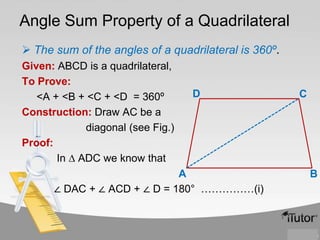
Given: ABCD is a quadrilateral,
To Prove:
<A + <B + <C + <D = 360º
Construction: Draw AC be a
diagonal (see Fig.)
Proof:
In ∆ ADC we know that

D

A
∠ DAC + ∠ ACD + ∠ D = 180° ……………(i)

C

B
Angle Sum Property of a Quadrilateral
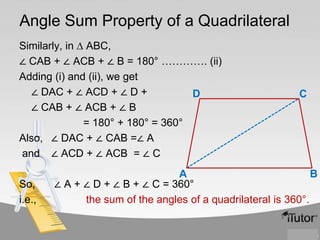
Similarly, in ∆ ABC,
∠ CAB + ∠ ACB + ∠ B = 180° …………. (ii)
Adding (i) and (ii), we get
∠ DAC + ∠ ACD + ∠ D +
D
∠ CAB + ∠ ACB + ∠ B
= 180° + 180° = 360°
Also, ∠ DAC + ∠ CAB =∠ A
and ∠ ACD + ∠ ACB = ∠ C
So,
i.e.,

C

A
B
∠ A + ∠ D + ∠ B + ∠ C = 360°
the sum of the angles of a quadrilateral is 360°.
Properties of a Parallelogram
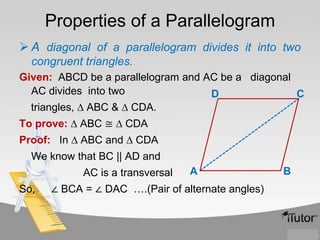
 A diagonal of a parallelogram divides it into two
congruent triangles.
Given: ABCD be a parallelogram and AC be a diagonal
AC divides into two
D
C
triangles, ∆ ABC & ∆ CDA.
To prove: ∆ ABC ≅ ∆ CDA

Proof: In ∆ ABC and ∆ CDA
We know that BC || AD and
AC is a transversal

So,

A

∠ BCA = ∠ DAC ….(Pair of alternate angles)

B
Properties of a Parallelogram
Also,
So,

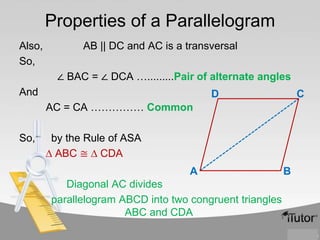
AB || DC and AC is a transversal
∠ BAC = ∠ DCA ….........Pair of alternate angles

And

D

C

AC = CA …………… Common

So,

by the Rule of ASA
∆ ABC ≅ ∆ CDA
A
Diagonal AC divides
parallelogram ABCD into two congruent triangles
ABC and CDA

B
Properties of a Parallelogram
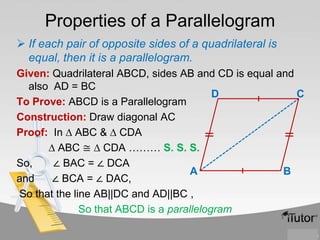
 If each pair of opposite sides of a quadrilateral is
equal, then it is a parallelogram.
Given: Quadrilateral ABCD, sides AB and CD is equal and
also AD = BC
D
C
To Prove: ABCD is a Parallelogram
Construction: Draw diagonal AC
Proof: In ∆ ABC & ∆ CDA
∆ ABC ≅ ∆ CDA ……… S. S. S.
So,
∠ BAC = ∠ DCA
A
B
and
∠ BCA = ∠ DAC,
So that the line AB||DC and AD||BC ,
So that ABCD is a parallelogram
Properties of a Parallelogram
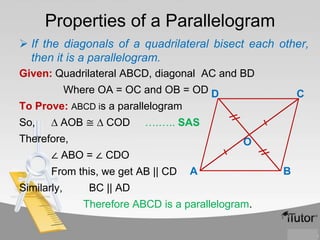
 If the diagonals of a quadrilateral bisect each other,
then it is a parallelogram.
Given: Quadrilateral ABCD, diagonal AC and BD
Where OA = OC and OB = OD D

C

To Prove: ABCD is a parallelogram
So,

∆ AOB ≅ ∆ COD

….….. SAS

Therefore,

O

∠ ABO = ∠ CDO
From this, we get AB || CD

Similarly,

A

BC || AD
Therefore ABCD is a parallelogram.

B
Properties of a Parallelogram
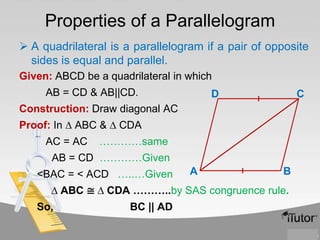
 A quadrilateral is a parallelogram if a pair of opposite
sides is equal and parallel.
Given: ABCD be a quadrilateral in which
AB = CD & AB||CD.

D

C

Construction: Draw diagonal AC
Proof: In ∆ ABC & ∆ CDA

AC = AC

…………same

AB = CD …………Given
<BAC = < ACD …..…Given

A

B

∆ ABC ≅ ∆ CDA ………..by SAS congruence rule.
So,

BC || AD
Properties of a Parallelogram
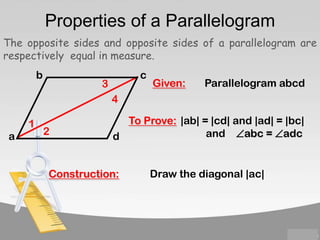
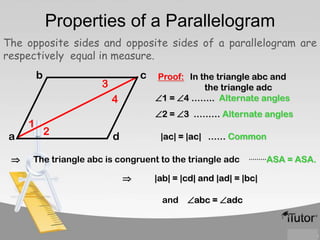
The opposite sides and opposite sides of a parallelogram are
respectively equal in measure.
b

c

3

Given:

Parallelogram abcd

4
1
a

2

To Prove: |ab| = |cd| and |ad| = |bc|
and abc = adc
d

Construction:

Draw the diagonal |ac|
Properties of a Parallelogram
The opposite sides and opposite sides of a parallelogram are
respectively equal in measure.
b

c

3
4

1
a

Proof: In the triangle abc and
the triangle adc
1 = 4 …….. Alternate angles
2 = 3 ……… Alternate angles

2

d

|ac| = |ac| …… Common

The triangle abc is congruent to the triangle adc


………ASA

|ab| = |cd| and |ad| = |bc|
and abc = adc

= ASA.
Mid-point Theorem
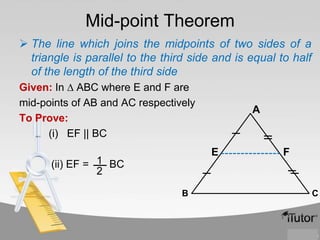
 The line which joins the midpoints of two sides of a
triangle is parallel to the third side and is equal to half
of the length of the third side
Given: In ∆ ABC where E and F are
mid-points of AB and AC respectively
To Prove:
(i) EF || BC

A

E

(ii) EF = 1 BC
2
B

F

C
Mid-point Theorem
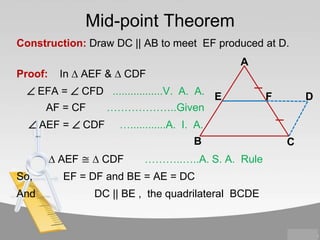
Construction: Draw DC || AB to meet EF produced at D.
A
Proof:

In ∆ AEF & ∆ CDF

EFA =  CFD .................V. A. A.
………………..Given

AF = CF
AEF = CDF

E

∆ AEF ≅ ∆ CDF

And

D

…............A. I. A.
B

So,

F

………..…..A. S. A. Rule

EF = DF and BE = AE = DC

DC || BE , the quadrilateral BCDE

C
Mid-point Theorem
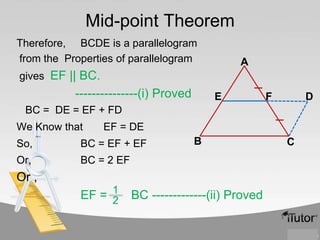
Therefore, BCDE is a parallelogram
from the Properties of parallelogram

A

gives EF || BC.

---------------(i) Proved

E

F

D

BC = DE = EF + FD
We Know that

EF = DE

So,

BC = EF + EF

Or,

B

BC = 2 EF

Or ,

EF = 1
2

BC -------------(ii) Proved

C
Mid-point Theorem
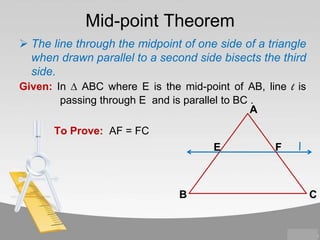
 The line through the midpoint of one side of a triangle
when drawn parallel to a second side bisects the third
side.
Given: In ∆ ABC where E is the mid-point of AB, line l is
passing through E and is parallel to BC .
A
To Prove: AF = FC
E

B

F

l

C
Mid-point Theorem
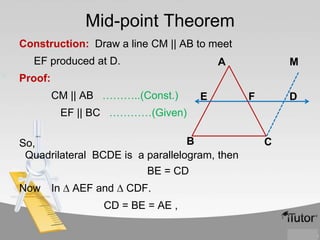
Construction: Draw a line CM || AB to meet
EF produced at D.

A

M

Proof:
CM || AB ………..(Const.)

E

F

D

EF || BC …………(Given)
B
So,
Quadrilateral BCDE is a parallelogram, then
BE = CD
Now

In ∆ AEF and ∆ CDF.
CD = BE = AE ,

C
Mid-point Theorem
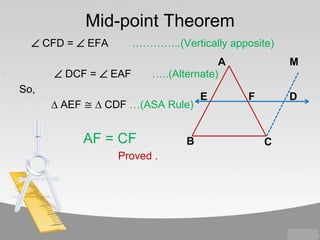
 CFD =  EFA

…………..(Vertically apposite)

 DCF =  EAF

A
…..(Alternate)

So,
∆ AEF ≅ ∆ CDF …(ASA Rule)

AF = CF
Proved .

B

E

M
F

D

C
Areas Of Parallelograms
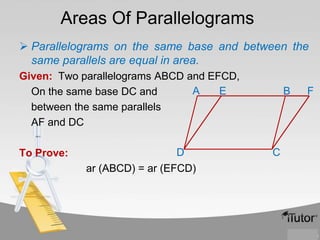
 Parallelograms on the same base and between the
same parallels are equal in area.
Given: Two parallelograms ABCD and EFCD,
A
E
On the same base DC and
between the same parallels
AF and DC
To Prove:

D
ar (ABCD) = ar (EFCD)

B

C

F
Areas Of Parallelograms
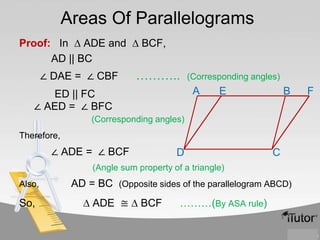
Proof: In ∆ ADE and ∆ BCF,
AD || BC
∠ DAE = ∠ CBF

………..

(Corresponding angles)

A

ED || FC
∠ AED = ∠ BFC

E

B

(Corresponding angles)
Therefore,

∠ ADE = ∠ BCF

D

C

(Angle sum property of a triangle)
Also,

So,

AD = BC (Opposite sides of the parallelogram ABCD)
∆ ADE ≅ ∆ BCF

………(By ASA rule)

F
Areas Of Parallelograms
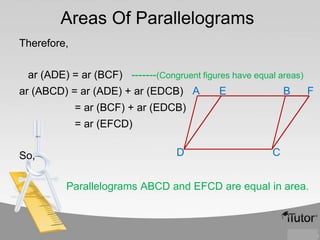
Therefore,
ar (ADE) = ar (BCF) -------(Congruent figures have equal areas)
ar (ABCD) = ar (ADE) + ar (EDCB) A

E

B

F

= ar (BCF) + ar (EDCB)
= ar (EFCD)
So,

D

C

Parallelograms ABCD and EFCD are equal in area.
Areas Of Triangles
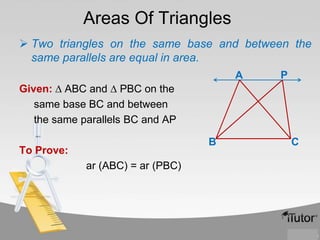
 Two triangles on the same base and between the
same parallels are equal in area.
A

P

Given: ∆ ABC and ∆ PBC on the
same base BC and between
the same parallels BC and AP
B

To Prove:
ar (ABC) = ar (PBC)

C
Areas Of Triangles
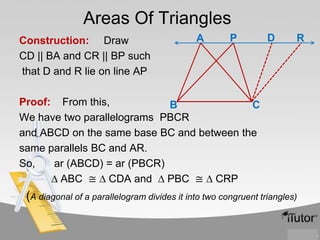
Construction: Draw
CD || BA and CR || BP such
that D and R lie on line AP

A

P

D

R

Proof: From this,
B
C
We have two parallelograms PBCR
and ABCD on the same base BC and between the
same parallels BC and AR.
So,
ar (ABCD) = ar (PBCR)
∆ ABC ≅ ∆ CDA and ∆ PBC ≅ ∆ CRP

(A diagonal of a parallelogram divides it into two congruent triangles)
Areas Of Triangles
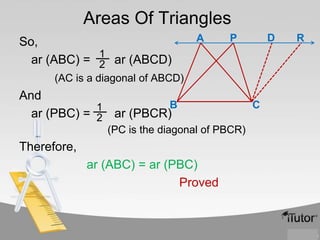
So,
1
ar (ABC) = 2 ar (ABCD)

A

D

P

(AC is a diagonal of ABCD)

And
B
1
ar (PBC) = 2 ar (PBCR)
(PC is the diagonal of PBCR)

Therefore,
ar (ABC) = ar (PBC)
Proved

C

R
Areas Of Triangles
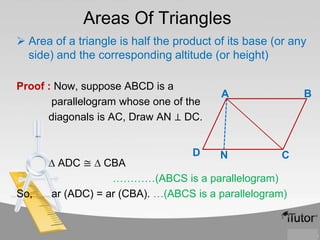
 Area of a triangle is half the product of its base (or any
side) and the corresponding altitude (or height)
Proof : Now, suppose ABCD is a
parallelogram whose one of the
diagonals is AC, Draw AN ⊥ DC.
D

So,

B

A

N

C

∆ ADC ≅ ∆ CBA
…………(ABCS is a parallelogram)
ar (ADC) = ar (CBA). …(ABCS is a parallelogram)
Areas Of Triangles
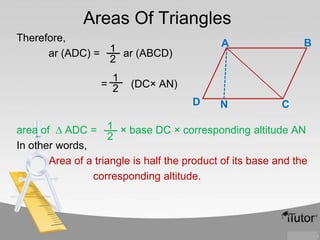
Therefore,
ar (ADC) = 1 ar (ABCD)
2

1
= 2

B

A

(DC× AN)
D

N

C

area of ∆ ADC = 1 × base DC × corresponding altitude AN
2
In other words,
Area of a triangle is half the product of its base and the
corresponding altitude.
Call us for more
Information:
1-855-694-8886
Visit

www.iTutor.com

The End

Quadrilaterals

  • 1.
  • 2.
    Angle Sum Propertyof a Quadrilateral  The sum of the angles of a quadrilateral is 360º. Given: ABCD is a quadrilateral, To Prove: <A + <B + <C + <D = 360º Construction: Draw AC be a diagonal (see Fig.) Proof: In ∆ ADC we know that D A ∠ DAC + ∠ ACD + ∠ D = 180° ……………(i) C B
  • 3.
    Angle Sum Propertyof a Quadrilateral Similarly, in ∆ ABC, ∠ CAB + ∠ ACB + ∠ B = 180° …………. (ii) Adding (i) and (ii), we get ∠ DAC + ∠ ACD + ∠ D + D ∠ CAB + ∠ ACB + ∠ B = 180° + 180° = 360° Also, ∠ DAC + ∠ CAB =∠ A and ∠ ACD + ∠ ACB = ∠ C So, i.e., C A B ∠ A + ∠ D + ∠ B + ∠ C = 360° the sum of the angles of a quadrilateral is 360°.
  • 4.
    Properties of aParallelogram  A diagonal of a parallelogram divides it into two congruent triangles. Given: ABCD be a parallelogram and AC be a diagonal AC divides into two D C triangles, ∆ ABC & ∆ CDA. To prove: ∆ ABC ≅ ∆ CDA Proof: In ∆ ABC and ∆ CDA We know that BC || AD and AC is a transversal So, A ∠ BCA = ∠ DAC ….(Pair of alternate angles) B
  • 5.
    Properties of aParallelogram Also, So, AB || DC and AC is a transversal ∠ BAC = ∠ DCA ….........Pair of alternate angles And D C AC = CA …………… Common So, by the Rule of ASA ∆ ABC ≅ ∆ CDA A Diagonal AC divides parallelogram ABCD into two congruent triangles ABC and CDA B
  • 6.
    Properties of aParallelogram  If each pair of opposite sides of a quadrilateral is equal, then it is a parallelogram. Given: Quadrilateral ABCD, sides AB and CD is equal and also AD = BC D C To Prove: ABCD is a Parallelogram Construction: Draw diagonal AC Proof: In ∆ ABC & ∆ CDA ∆ ABC ≅ ∆ CDA ……… S. S. S. So, ∠ BAC = ∠ DCA A B and ∠ BCA = ∠ DAC, So that the line AB||DC and AD||BC , So that ABCD is a parallelogram
  • 7.
    Properties of aParallelogram  If the diagonals of a quadrilateral bisect each other, then it is a parallelogram. Given: Quadrilateral ABCD, diagonal AC and BD Where OA = OC and OB = OD D C To Prove: ABCD is a parallelogram So, ∆ AOB ≅ ∆ COD ….….. SAS Therefore, O ∠ ABO = ∠ CDO From this, we get AB || CD Similarly, A BC || AD Therefore ABCD is a parallelogram. B
  • 8.
    Properties of aParallelogram  A quadrilateral is a parallelogram if a pair of opposite sides is equal and parallel. Given: ABCD be a quadrilateral in which AB = CD & AB||CD. D C Construction: Draw diagonal AC Proof: In ∆ ABC & ∆ CDA AC = AC …………same AB = CD …………Given <BAC = < ACD …..…Given A B ∆ ABC ≅ ∆ CDA ………..by SAS congruence rule. So, BC || AD
  • 9.
    Properties of aParallelogram The opposite sides and opposite sides of a parallelogram are respectively equal in measure. b c 3 Given: Parallelogram abcd 4 1 a 2 To Prove: |ab| = |cd| and |ad| = |bc| and abc = adc d Construction: Draw the diagonal |ac|
  • 10.
    Properties of aParallelogram The opposite sides and opposite sides of a parallelogram are respectively equal in measure. b c 3 4 1 a Proof: In the triangle abc and the triangle adc 1 = 4 …….. Alternate angles 2 = 3 ……… Alternate angles 2 d |ac| = |ac| …… Common The triangle abc is congruent to the triangle adc  ………ASA |ab| = |cd| and |ad| = |bc| and abc = adc = ASA.
  • 11.
    Mid-point Theorem  Theline which joins the midpoints of two sides of a triangle is parallel to the third side and is equal to half of the length of the third side Given: In ∆ ABC where E and F are mid-points of AB and AC respectively To Prove: (i) EF || BC A E (ii) EF = 1 BC 2 B F C
  • 12.
    Mid-point Theorem Construction: DrawDC || AB to meet EF produced at D. A Proof: In ∆ AEF & ∆ CDF EFA =  CFD .................V. A. A. ………………..Given AF = CF AEF = CDF E ∆ AEF ≅ ∆ CDF And D …............A. I. A. B So, F ………..…..A. S. A. Rule EF = DF and BE = AE = DC DC || BE , the quadrilateral BCDE C
  • 13.
    Mid-point Theorem Therefore, BCDEis a parallelogram from the Properties of parallelogram A gives EF || BC. ---------------(i) Proved E F D BC = DE = EF + FD We Know that EF = DE So, BC = EF + EF Or, B BC = 2 EF Or , EF = 1 2 BC -------------(ii) Proved C
  • 14.
    Mid-point Theorem  Theline through the midpoint of one side of a triangle when drawn parallel to a second side bisects the third side. Given: In ∆ ABC where E is the mid-point of AB, line l is passing through E and is parallel to BC . A To Prove: AF = FC E B F l C
  • 15.
    Mid-point Theorem Construction: Drawa line CM || AB to meet EF produced at D. A M Proof: CM || AB ………..(Const.) E F D EF || BC …………(Given) B So, Quadrilateral BCDE is a parallelogram, then BE = CD Now In ∆ AEF and ∆ CDF. CD = BE = AE , C
  • 16.
    Mid-point Theorem  CFD=  EFA …………..(Vertically apposite)  DCF =  EAF A …..(Alternate) So, ∆ AEF ≅ ∆ CDF …(ASA Rule) AF = CF Proved . B E M F D C
  • 17.
    Areas Of Parallelograms Parallelograms on the same base and between the same parallels are equal in area. Given: Two parallelograms ABCD and EFCD, A E On the same base DC and between the same parallels AF and DC To Prove: D ar (ABCD) = ar (EFCD) B C F
  • 18.
    Areas Of Parallelograms Proof:In ∆ ADE and ∆ BCF, AD || BC ∠ DAE = ∠ CBF ……….. (Corresponding angles) A ED || FC ∠ AED = ∠ BFC E B (Corresponding angles) Therefore, ∠ ADE = ∠ BCF D C (Angle sum property of a triangle) Also, So, AD = BC (Opposite sides of the parallelogram ABCD) ∆ ADE ≅ ∆ BCF ………(By ASA rule) F
  • 19.
    Areas Of Parallelograms Therefore, ar(ADE) = ar (BCF) -------(Congruent figures have equal areas) ar (ABCD) = ar (ADE) + ar (EDCB) A E B F = ar (BCF) + ar (EDCB) = ar (EFCD) So, D C Parallelograms ABCD and EFCD are equal in area.
  • 20.
    Areas Of Triangles Two triangles on the same base and between the same parallels are equal in area. A P Given: ∆ ABC and ∆ PBC on the same base BC and between the same parallels BC and AP B To Prove: ar (ABC) = ar (PBC) C
  • 21.
    Areas Of Triangles Construction:Draw CD || BA and CR || BP such that D and R lie on line AP A P D R Proof: From this, B C We have two parallelograms PBCR and ABCD on the same base BC and between the same parallels BC and AR. So, ar (ABCD) = ar (PBCR) ∆ ABC ≅ ∆ CDA and ∆ PBC ≅ ∆ CRP (A diagonal of a parallelogram divides it into two congruent triangles)
  • 22.
    Areas Of Triangles So, 1 ar(ABC) = 2 ar (ABCD) A D P (AC is a diagonal of ABCD) And B 1 ar (PBC) = 2 ar (PBCR) (PC is the diagonal of PBCR) Therefore, ar (ABC) = ar (PBC) Proved C R
  • 23.
    Areas Of Triangles Area of a triangle is half the product of its base (or any side) and the corresponding altitude (or height) Proof : Now, suppose ABCD is a parallelogram whose one of the diagonals is AC, Draw AN ⊥ DC. D So, B A N C ∆ ADC ≅ ∆ CBA …………(ABCS is a parallelogram) ar (ADC) = ar (CBA). …(ABCS is a parallelogram)
  • 24.
    Areas Of Triangles Therefore, ar(ADC) = 1 ar (ABCD) 2 1 = 2 B A (DC× AN) D N C area of ∆ ADC = 1 × base DC × corresponding altitude AN 2 In other words, Area of a triangle is half the product of its base and the corresponding altitude.
  • 25.
    Call us formore Information: 1-855-694-8886 Visit www.iTutor.com The End