SOUND
Sound Waves
Speed of Sound
Ultrasound
Sound1
Sound waves
Describe the production of sound by vibrating sources.
Sound2
 Sound waves are caused by vibration
 Vibrating guitar strings,
 Vibrating air inside a trumpet
 Vibrating prongs of tuning fork.
 Also, when hard objects are struck, they vibrate and
produce sound waves
Sound3
Sound Waves
Sound waves
Describe the longitudinal nature of sound waves and
describe compression and rarefaction.
Sound4
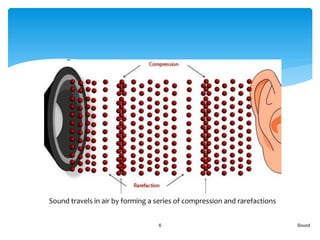
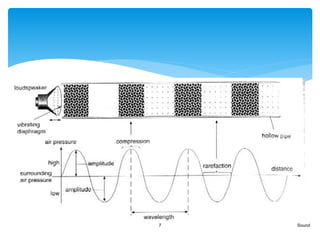
 Sound waves are longitudinal waves as the air
oscillates backwards and forwards as the
compression and rarefactions pass through it.
 When a compression passes, the air pressure rises.
When a rarefaction passes, the pressure falls.
 The distance from on compression to the next is the
wavelength.
Sound5
Sound6
Sound travels in air by forming a series of compression and rarefactions
Sound7
Sound waves
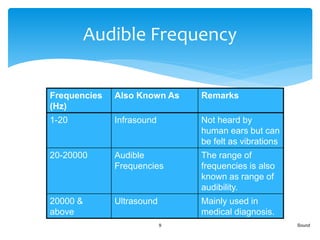
State the approximate range of audible frequencies.
Sound8
Sound9
Audible Frequency
Frequencies
(Hz)
Also Known As Remarks
1-20 Infrasound Not heard by
human ears but can
be felt as vibrations
20-20000 Audible
Frequencies
The range of
frequencies is also
known as range of
audibility.
20000 &
above
Ultrasound Mainly used in
medical diagnosis.
Sound waves
Explain why a medium is required in order to transmit
sound waves and describe an experiment to demonstrate
this.
Sound10
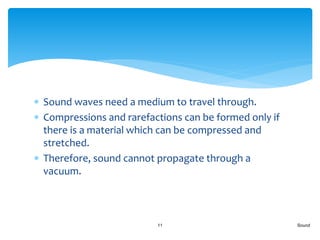
 Sound waves need a medium to travel through.
 Compressions and rarefactions can be formed only if
there is a material which can be compressed and
stretched.
 Therefore, sound cannot propagate through a
vacuum.
Sound11
Sound12
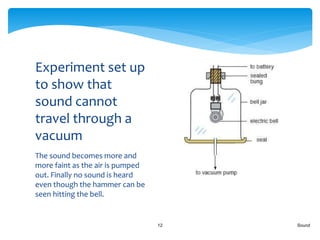
The sound becomes more and
more faint as the air is pumped
out. Finally no sound is heard
even though the hammer can be
seen hitting the bell.
Experiment set up
to show that
sound cannot
travel through a
vacuum
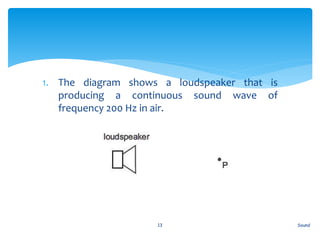
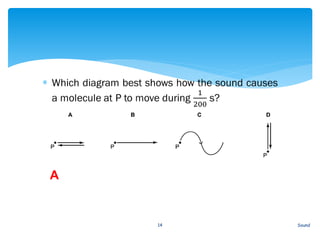
1. The diagram shows a loudspeaker that is
producing a continuous sound wave of
frequency 200 Hz in air.
Sound13

Sound14
A
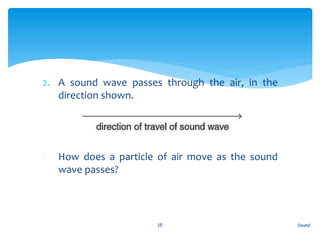
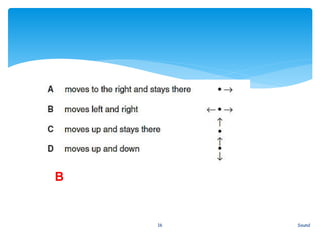
2. A sound wave passes through the air, in the
direction shown.
1. How does a particle of air move as the sound
wave passes?
Sound15
Sound16
B
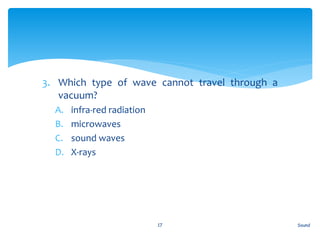
3. Which type of wave cannot travel through a
vacuum?
A. infra-red radiation
B. microwaves
C. sound waves
D. X-rays
Sound17
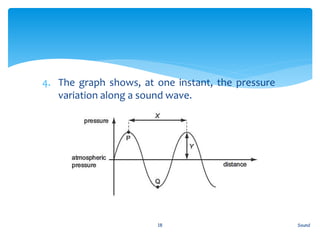
4. The graph shows, at one instant, the pressure
variation along a sound wave.
Sound18
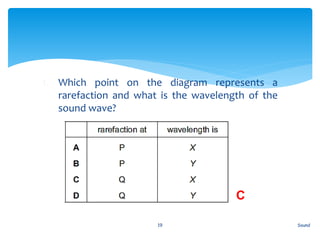
1. Which point on the diagram represents a
rarefaction and what is the wavelength of the
sound wave?
Sound19
C
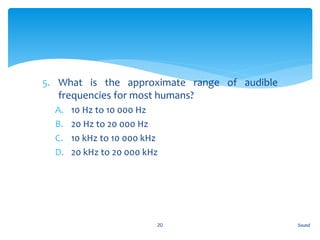
5. What is the approximate range of audible
frequencies for most humans?
A. 10 Hz to 10 000 Hz
B. 20 Hz to 20 000 Hz
C. 10 kHz to 10 000 kHz
D. 20 kHz to 20 000 kHz
Sound20
6. Which of the following can be heard by the
human ear?
A. A whistle emitting a wave of frequency 50 kHz.
B. A bat emitting a wave of frequency of 30 kHz.
C. An insect emitting a wave of 300 Hz.
D. A vibrating spring emitting a wave of frequency of
5 Hz.
Sound21
7. In which of the following frequency ranges is
ultrasound found?
A. 1 Hz – 1 kHz
B. 2 kHz – 10 kHz
C. 11 kHz – 20 kHz
D. 21 kHz – 30 kHz
Sound22
8. What is the approximate value of the highest
frequency that can be heard by a young person?
A. 20 Hz
B. 200 Hz
C. 2000 Hz
D. 20 000 Hz
Sound23
9. Which of the following does not produce a
sound wave?
A. a bell ringing under water
B. a gun fired in a room with no echoes
C. a hammer hitting a block of rubber
D. an explosion in outer space
Sound24
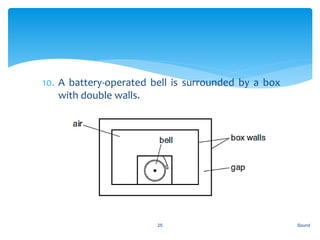
10. A battery-operated bell is surrounded by a box
with double walls.
Sound25
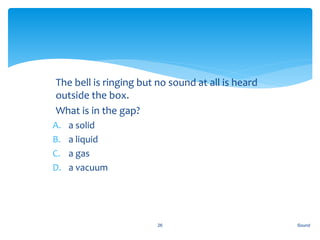
1. The bell is ringing but no sound at all is heard
outside the box.
2. What is in the gap?
A. a solid
B. a liquid
C. a gas
D. a vacuum
Sound26
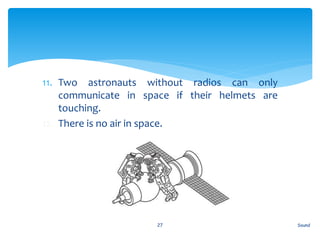
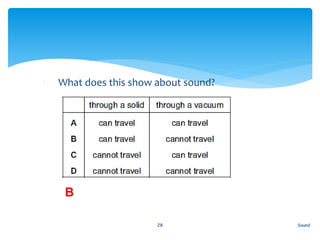
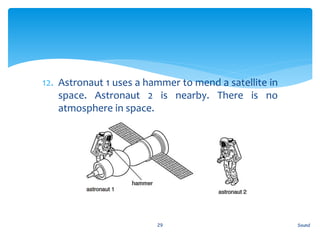
11. Two astronauts without radios can only
communicate in space if their helmets are
touching.
12. There is no air in space.
Sound27
1. What does this show about sound?
Sound28
B
12. Astronaut 1 uses a hammer to mend a satellite in
space. Astronaut 2 is nearby. There is no
atmosphere in space.
Sound29
1. Compared with the sound heard if they were
working on Earth, what does astronaut 2 hear?
A. no sound at all
B. a quieter sound
C. a sound of the same loudness
D. a louder sound
Sound30
Speed of sound
Describe a direct method for the determination of the
speed of sound in air and make the necessary calculation.
Sound31
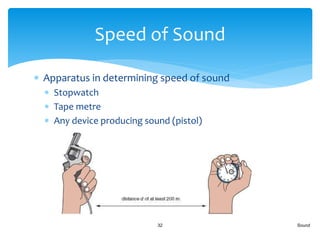
 Apparatus in determining speed of sound
 Stopwatch
 Tape metre
 Any device producing sound (pistol)
Sound32
Speed of Sound
 Procedure
 Two people stand at least 200 m apart, one has a
starting pistol and the other a stopwatch.
 The person with the gun fires it and the one with the
watch starts it when they see the smoke and stops it
when they hear the bang.
 The distance between them is found and the speed of
sound worked out. The experiment should be done a
few times to get an average result.
Sound33
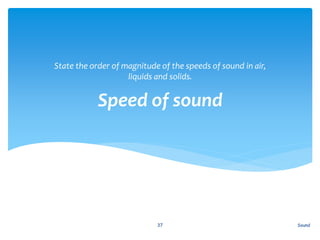
1. Two observers A and B are 500 m apart at A and B.
When a starting pistol is fired at A, the time interval
between the seeing the flash, and hearing the sound
of the pistol at B, is 1.5 s. Assuming no wind is
blowing, what is the speed of sound in air?
2. A and B are two observers 1 km apart. There is a
steady wind blowing. When a gun is fired at A the
time interval between the flash and report observed
at B is 3.04 s. Calculate the velocity of sound in air?
Sound34
Problem Solving
3. Two men stand facing each other, 200 m apart.
When one fire a pistol the other hears a report 0.60
s after the flash. Calculate the velocity of sound in
air.
4. A person is yelling from a woman's dorm window. If
the speed of sound is 348 m/s and the distance from
the dorm to the cafeteria is 87 meters, how long
does it take the sound to reach the cafeteria?
Sound35
5. Sound takes about 3 milliseconds to travel 1 m. How
long will it take to travel from the centre of a cricket
pitch to the spectators, 200 m away?
6. You are watching a thunderstorm. You notice that
you hear the thunder 1.5 s s after you see the
lightning. How far up is the storm taking place?
(Speed of sound in air is 330 m/s)
Sound36
Speed of sound
State the order of magnitude of the speeds of sound in air,
liquids and solids.
Sound37
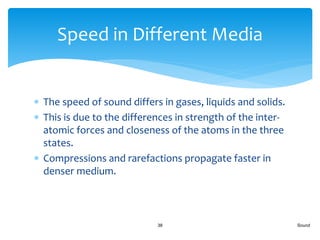
 The speed of sound differs in gases, liquids and solids.
 This is due to the differences in strength of the inter-
atomic forces and closeness of the atoms in the three
states.
 Compressions and rarefactions propagate faster in
denser medium.
Sound38
Speed in Different Media
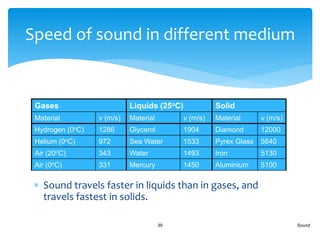
 Sound travels faster in liquids than in gases, and
travels fastest in solids.
Sound39
Speed of sound in different medium
Gases Liquids (25oC) Solid
Material v (m/s) Material v (m/s) Material v (m/s)
Hydrogen (0oC) 1286 Glycerol 1904 Diamond 12000
Helium (0oC) 972 Sea Water 1533 Pyrex Glass 5640
Air (20oC) 343 Water 1493 Iron 5130
Air (0oC) 331 Mercury 1450 Aluminium 5100
Speed of sound
Explain how the loudness and pitch of sound waves relate
to amplitude and frequency.
Sound40
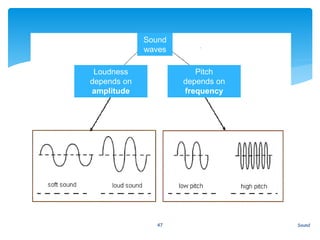
 Any sound that you hear as a tone is made of regular,
evenly spaced waves of air molecules.
 The most noticeable difference between various
tonal sounds is that some sound higher or lower than
others.
 The property which distinguishes the sound in this
way is known as the pitch.
Sound41
Pitch & Frequency
Sound42
Wavelength, Frequency and Pitch
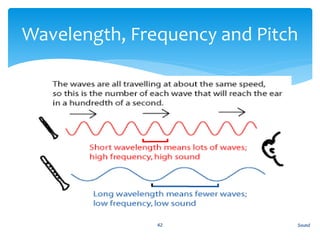
 The pitch of a note depend on its frequency.
 The higher the frequency of a sound, the higher its
pitch.
 The pitch of the notes produced by a string
instruments depend on the length of the strings.
 The longer the string, the lower the pitch (frequency).
Sound43
 Humans and animals sense a wide range of sound
amplitude, volume or loudness--from the very quiet to
the extremely loud.
 Loudness is measured in decibels, which really
measures the energy of the sound.
 The loudness of sound depends on the amplitude of
the wave.
 The bigger the amplitude, the louder the sound.
Sound44
Loudness & Amplitude
 A human can hear from very quiet sounds at 0.1
decibels to sounds at 120 decibels.
 At the high end of the scale, the energy can cause
damage to the sensitive membranes in the ear.
 Younger people can usually have better hearing at the
lower volumes than older people do.
 Animals can hear lower volumes and are more
sensitive to louder noises than humans.
Sound45
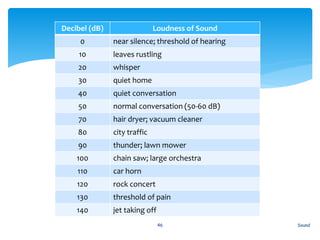
Decibel (dB) Loudness of Sound
0 near silence; threshold of hearing
10 leaves rustling
20 whisper
30 quiet home
40 quiet conversation
50 normal conversation (50-60 dB)
70 hair dryer; vacuum cleaner
80 city traffic
90 thunder; lawn mower
100 chain saw; large orchestra
110 car horn
120 rock concert
130 threshold of pain
140 jet taking off
Sound46
Sound47
Sound
waves
Loudness
depends on
amplitude
Pitch
depends on
frequency
Speed of sound
Describe how the reflection of sound may produce an echo.
Sound48
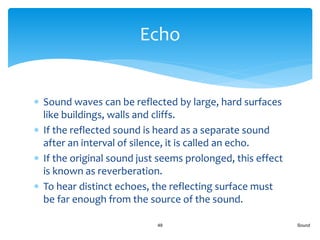
 Sound waves can be reflected by large, hard surfaces
like buildings, walls and cliffs.
 If the reflected sound is heard as a separate sound
after an interval of silence, it is called an echo.
 If the original sound just seems prolonged, this effect
is known as reverberation.
 To hear distinct echoes, the reflecting surface must
be far enough from the source of the sound.
Sound49
Echo
Sound50
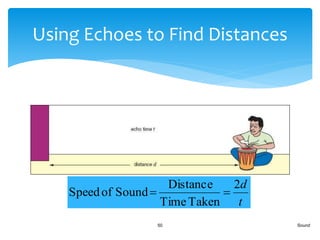
Using Echoes to Find Distances
t
d2
TakenTime
Distance
SoundofSpeed 
 The principles of calculating the distance to the wall is
used in several devices, including:
 Echo-sounder that measures the depth of water under
the boat. It sends pulses of sound waves towards the
sea-bed and measures the echo time.
 Radar that used microwaves instead of sound waves. It
detects the position of aircraft by measuring the ‘echo
times’ of microwave pulses reflected from them.
Sound51
1. A person standing 99 m from the foot of a tall cliff claps
his hand and hears an echo 0.6 s later. Calculate the
velocity of sound in air.
2. A pulse of ultrasound takes 0.1 s to travel to the sea-bed
and return, and the speed of sound in water is 1400 m/s.
How deep is the sea?
3. A man is cutting down a tree with an axe. He hears the
echo of the impact of the axe hitting the tree after 1.6 s.
If the speed of sound is 330 m/s, how far is the tree from
the obstacles?
Sound52
Problem Solving
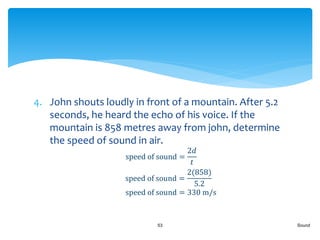
4. John shouts loudly in front of a mountain. After 5.2
seconds, he heard the echo of his voice. If the
mountain is 858 metres away from john, determine
the speed of sound in air.
Sound53
speed of sound =
2𝑑
𝑡
speed of sound =
2(858)
5.2
speed of sound = 330 m/s
5. Ah Sern shouts in front of a high wall. He hears the
echo of his voice 2.5 second later. If the velocity of
sound in air is 340 m/s, calculate the distance
between him and the wall.
Sound54
4. John shouts loudly in front of a mountain. After 5.2
seconds, he heard the echo of his voice. If the mountain
is 858 metres away from john, determine the speed of
sound in air.
5. Ah Sern shouts in front of a high wall. He hears the echo
of his voice 2.5 second later. If the velocity of sound in air
is 340 m/s, calculate the distance between him and the
wall.
6. A man shouts loudly close to a high wall. He hears one
echo. If the man is 40 m from the wall, how long after the
shout will the echo be heard? (Speed of sound in air = 330
m/s)
Sound55
7. A ship is 220 metres from a large cliff when it sounds
its foghorn. Speed of sound in air is 330 m/s
a. When the echo is heard on the ship, how far has the
sound travelled?
b. What time delay is there before the echo is heard?
c. The ship changes its distance from the cliff. When the
echo time is 0.5 seconds, how far is the ship from the
cliff.
Sound56
8. A boat is fitted with an echo-sounder which uses
ultrasound with a frequency of 40 kHz.
a. What is the frequency of the ultrasound in Hz?
b. If ultrasound pulses takes 0.03 seconds to travel from the
boat to the sea-bed and return, how deep is the water
under the boat?
c. What is wavelength of the ultrasound in water?
9. Speed of sound in water = 1400 m/s
Sound57
Speed of sound
Describe the factors which influence the quality (timbre) of
sound waves and how these factors may be demonstrated
using a c.r.o.
Sound58
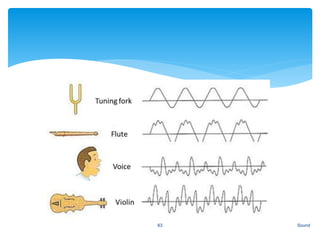
 Sound "quality" or "timbre" describes those
characteristics of sound which allow the ear to
distinguish sounds which have the same pitch and
loudness.
Sound59
Sound Quality
 When two musicians playing same musical note, but one is
on guitar and another one is playing flute, the pitch and
loudness for the note would be the same
 The frequency of the sound wave due to the resonance of
the sound wave, pressure and wave form of the sound
from the instrument would be different.
 Hence we listen two different sound and can differentiate
between the two, this characteristic of the sound is known
as Timbre, as the main characteristics of the sound wave
are same like its pitch, flow and loudness, but we are able
to differentiate between the sound due to change of the
source.
Sound60
Example
 Timbre Depends on:
 Wave form of sound
 Sound pressure
 Timbre Does Not Depends on:
 Pitch
 Loudness
Sound61
Sound62
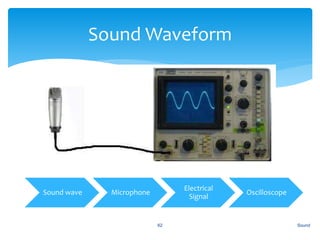
Sound Waveform
Sound wave Microphone
Electrical
Signal
Oscilloscope
Sound63
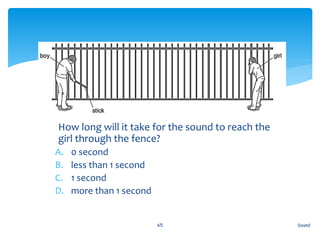
1. A boy strikes a rigid metal fence with a stick to
create a sound along the fence. A girl listens
with her ear against the fence. One second after
the fence is struck, the girl hears a sound
through the air.
Sound64
A. How long will it take for the sound to reach the
girl through the fence?
A. 0 second
B. less than 1 second
C. 1 second
D. more than 1 second
Sound65
2. A flash of lightning and the corresponding thunder
clap are detected 6 s apart. It is calculated that the
lightning struck about 1800 m away.
3. On which assumption is the calculation based?
A. Light reaches us almost instantaneously, but sound
travels at 300 m/s.
B. Light travels 300 m/s faster than sound.
C. Sound reaches us almost instantaneously, but light
travels at 300 m/s.
D. The sound of the thunder was emitted 6 s after the
flash.
Sound66
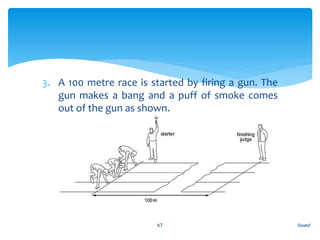
3. A 100 metre race is started by firing a gun. The
gun makes a bang and a puff of smoke comes
out of the gun as shown.
Sound67
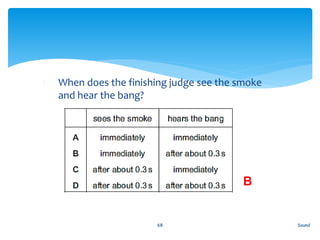
1. When does the finishing judge see the smoke
and hear the bang?
Sound68
B
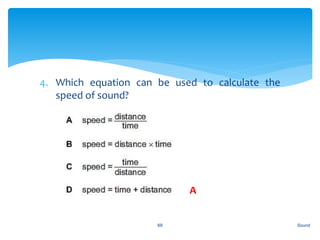
4. Which equation can be used to calculate the
speed of sound?
Sound69
A
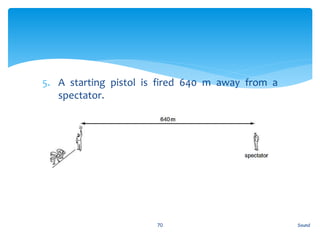
5. A starting pistol is fired 640 m away from a
spectator.
Sound70
1. The spectator hears the sound of the starting
pistol two seconds after seeing the flash from
the gun.
2. What is the speed of sound in air?
A. 160 m/s
B. 320 m/s
C. 640 m/s
D. 1280 m/s
Sound71
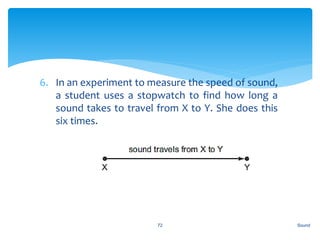
6. In an experiment to measure the speed of sound,
a student uses a stopwatch to find how long a
sound takes to travel from X to Y. She does this
six times.
Sound72
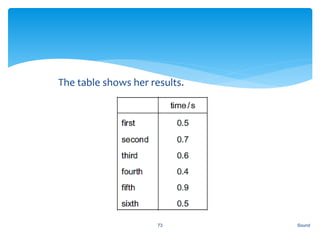
1. The table shows her results.
Sound73
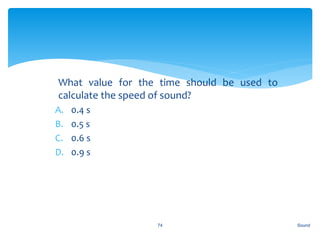
1. What value for the time should be used to
calculate the speed of sound?
A. 0.4 s
B. 0.5 s
C. 0.6 s
D. 0.9 s
Sound74
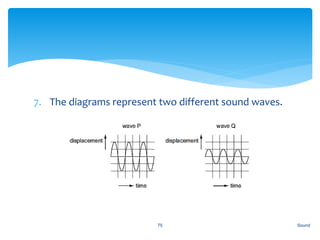
7. The diagrams represent two different sound waves.
Sound75
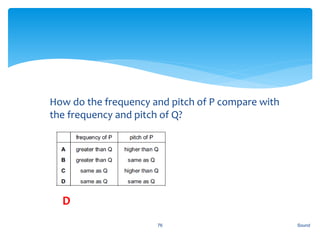
1. How do the frequency and pitch of P compare with
the frequency and pitch of Q?
Sound76
D
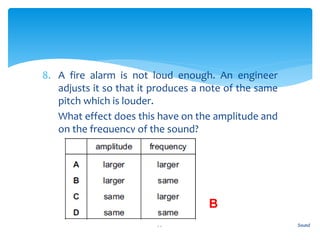
8. A fire alarm is not loud enough. An engineer
adjusts it so that it produces a note of the same
pitch which is louder.
9. What effect does this have on the amplitude and
on the frequency of the sound?
Sound77
B
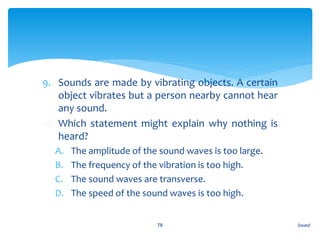
9. Sounds are made by vibrating objects. A certain
object vibrates but a person nearby cannot hear
any sound.
10. Which statement might explain why nothing is
heard?
A. The amplitude of the sound waves is too large.
B. The frequency of the vibration is too high.
C. The sound waves are transverse.
D. The speed of the sound waves is too high.
Sound78
10. Music is produced by the loudspeaker of a radio.
11. Which property of the sound wave increases
when the music is made louder?
A. amplitude
B. frequency
C. speed
D. wavelength
Sound79
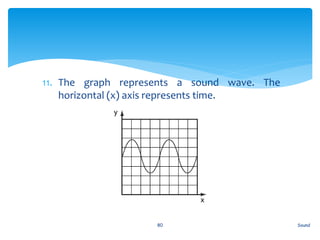
11. The graph represents a sound wave. The
horizontal (x) axis represents time.
Sound80
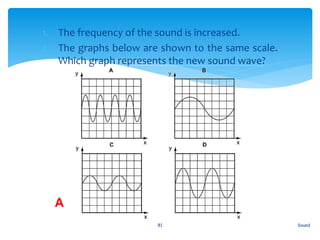
1. The frequency of the sound is increased.
2. The graphs below are shown to the same scale.
Which graph represents the new sound wave?
Sound81
A
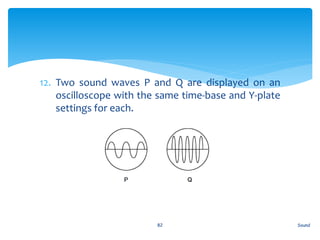
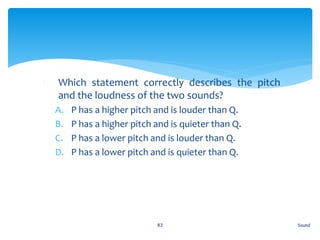
12. Two sound waves P and Q are displayed on an
oscilloscope with the same time-base and Y-plate
settings for each.
Sound82
1. Which statement correctly describes the pitch
and the loudness of the two sounds?
A. P has a higher pitch and is louder than Q.
B. P has a higher pitch and is quieter than Q.
C. P has a lower pitch and is louder than Q.
D. P has a lower pitch and is quieter than Q.
Sound83
13. Which change will lower the pitch of a sound?
A. decreasing its amplitude
B. decreasing its frequency
C. increasing its amplitude
D. increasing its frequency
Sound84
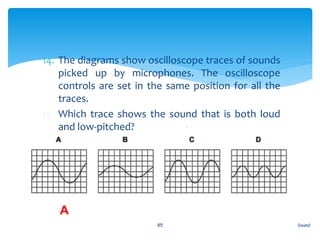
14. The diagrams show oscilloscope traces of sounds
picked up by microphones. The oscilloscope
controls are set in the same position for all the
traces.
15. Which trace shows the sound that is both loud
and low-pitched?
Sound85
A
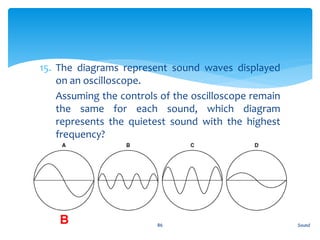
15. The diagrams represent sound waves displayed
on an oscilloscope.
16. Assuming the controls of the oscilloscope remain
the same for each sound, which diagram
represents the quietest sound with the highest
frequency?
Sound86
B
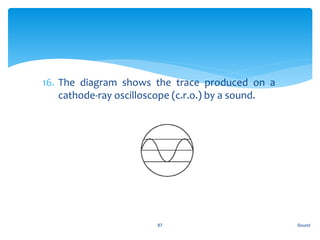
16. The diagram shows the trace produced on a
cathode-ray oscilloscope (c.r.o.) by a sound.
Sound87
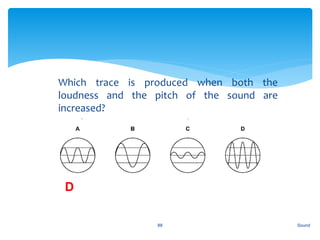
1. Which trace is produced when both the
loudness and the pitch of the sound are
increased?
Sound88
D
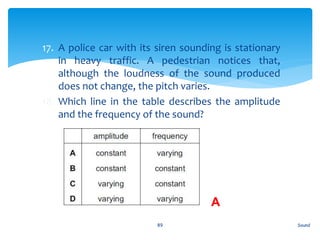
17. A police car with its siren sounding is stationary
in heavy traffic. A pedestrian notices that,
although the loudness of the sound produced
does not change, the pitch varies.
18. Which line in the table describes the amplitude
and the frequency of the sound?
Sound89
A
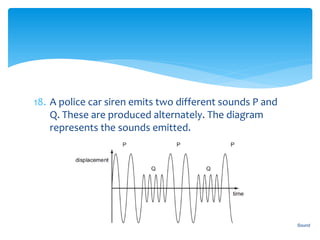
18. A police car siren emits two different sounds P and
Q. These are produced alternately. The diagram
represents the sounds emitted.
Sound90
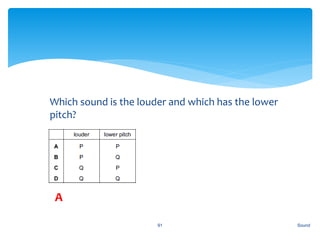
1. Which sound is the louder and which has the lower
pitch?
Sound91
A
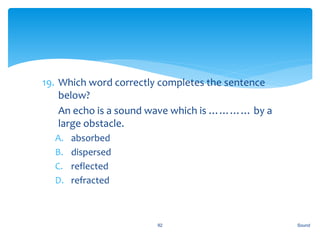
19. Which word correctly completes the sentence
below?
20. An echo is a sound wave which is ………… by a
large obstacle.
A. absorbed
B. dispersed
C. reflected
D. refracted
Sound92
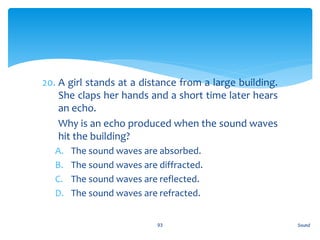
20. A girl stands at a distance from a large building.
She claps her hands and a short time later hears
an echo.
21. Why is an echo produced when the sound waves
hit the building?
A. The sound waves are absorbed.
B. The sound waves are diffracted.
C. The sound waves are reflected.
D. The sound waves are refracted.
Sound93
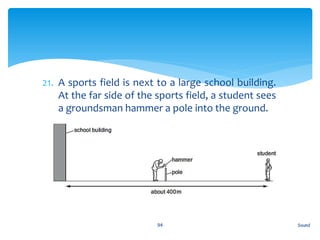
21. A sports field is next to a large school building.
At the far side of the sports field, a student sees
a groundsman hammer a pole into the ground.
Sound94
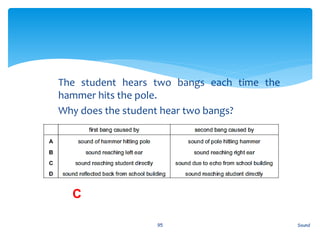
1. The student hears two bangs each time the
hammer hits the pole.
2. Why does the student hear two bangs?
Sound95
C
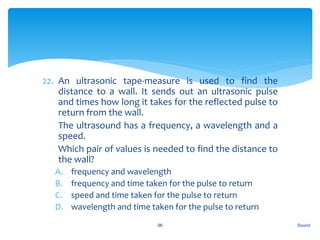
22. An ultrasonic tape-measure is used to find the
distance to a wall. It sends out an ultrasonic pulse
and times how long it takes for the reflected pulse to
return from the wall.
23. The ultrasound has a frequency, a wavelength and a
speed.
24. Which pair of values is needed to find the distance to
the wall?
A. frequency and wavelength
B. frequency and time taken for the pulse to return
C. speed and time taken for the pulse to return
D. wavelength and time taken for the pulse to return
Sound96
23. When the horn on a ship is sounded, the
passengers hear an echo from a cliff after 4.0 s.
24. If the speed of sound is 340 m/s, how far away is
the cliff?
A. 170 m
B. 340 m
C. 680 m
D. 360 m
Sound97
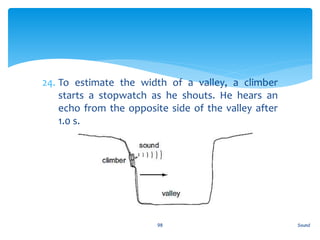
24. To estimate the width of a valley, a climber
starts a stopwatch as he shouts. He hears an
echo from the opposite side of the valley after
1.0 s.
Sound98
1. The sound travels at 340 m/s.
2. What is the width of the valley?
A. 85 m
B. 170 m
C. 340 m
D. 680 m
Sound99
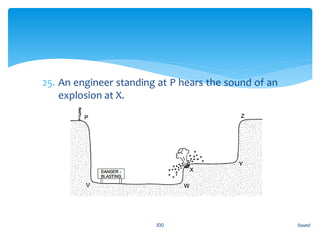
25. An engineer standing at P hears the sound of an
explosion at X.
Sound100
1. After the explosion, she hears two bangs. One
bang is heard a fraction of a second after the
other.
2. The second bang is an echo from
A. XY.
B. PV.
C. ZY.
D. WX.
Sound101
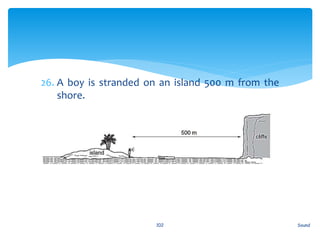
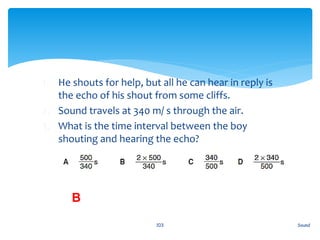
26. A boy is stranded on an island 500 m from the
shore.
Sound102
1. He shouts for help, but all he can hear in reply is
the echo of his shout from some cliffs.
2. Sound travels at 340 m/ s through the air.
3. What is the time interval between the boy
shouting and hearing the echo?
Sound103
B
27. During a thunderstorm, there is an interval of 1.70 s
between an observer seeing the lightning and
hearing the thunder. The speed of sound is 340 m/s.
28. What is the distance between the observer and the
storm?
A. 100 m
B. 200 m
C. 578 m
D. 1160 m
Sound104
28. A ship sends a pulse of sound vertically downwards
to the sea bed. An echo is heard 0.4 seconds later.
29. If the speed of sound in the water is 1200 m/s, how
deep is the water below the ship?
A. 240 m
B. 480 m
C. 1500 m
D. 3000 m
Sound105
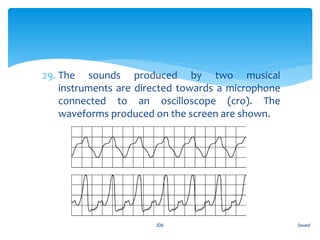
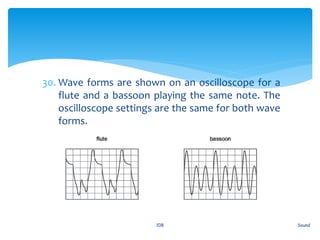
29. The sounds produced by two musical
instruments are directed towards a microphone
connected to an oscilloscope (cro). The
waveforms produced on the screen are shown.
Sound106
1. The waveforms show that the sounds produced
have a different property.
2. What is the property?
A. frequency
B. speed
C. timbre (quality)
D. wavelength
Sound107
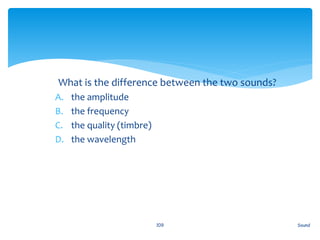
30. Wave forms are shown on an oscilloscope for a
flute and a bassoon playing the same note. The
oscilloscope settings are the same for both wave
forms.
Sound108
1. What is the difference between the two sounds?
A. the amplitude
B. the frequency
C. the quality (timbre)
D. the wavelength
Sound109
Ultrasound
Define ultrasound.
Sound110
 Ultrasound is the type of sound wave with
frequencies greater than 20 kHz.
 Ultrasound cannot be heard by humans, but only
other animals can hear them.
 Ultrasound has many medical and commercial uses.
Sound111
Ultrasound
Ultrasound
Describe the uses of ultrasound in cleaning, quality control
and pre-natal scanning.
Sound112
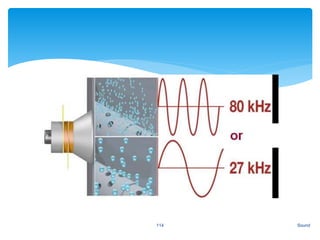
 An ultrasonic cleaning is a process that
uses ultrasound (usually from 20–400 kHz) and an
appropriate cleaning solvent (sometimes ordinary tap
water) to clean items.
 Ultrasonic cleaners are used to clean many different
types of objects, including jewelry,
watches, dental and surgical instruments, industrial
parts and electronic equipment.
Sound113
Ultrasonic Cleaning
Sound114
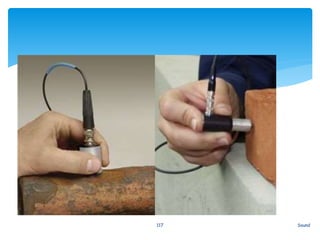
 Nondestructive testing is a method of finding defects
in an object without harming the object.
 In the aircraft industry, NDT is used to look for
internal changes or signs of wear on airplanes.
 The railroad industry also uses nondestructive testing
to examine railway rails for signs of damage.
Sound115
NDT
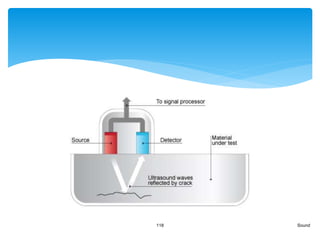
 Ultrasonic waves are emitted from a transducer into
an object and the returning waves are analyzed.
 If an impurity or a crack is present, the sound will
bounce off of them and be seen in the returned signal
Sound116
Sound117
Sound118
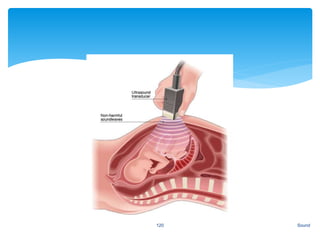
 The ultrasound is sent into the patients body.
 At each boundary between different tissues or
organs some of the ultrasound is reflected.
 The depth of each layer is calculated using the time
taken for each reflected wave to return.
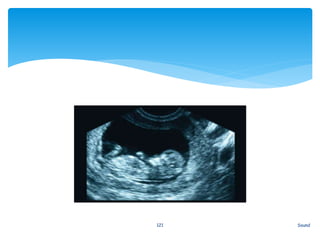
 The reflected waves (echoes) are usually processed
to produce a picture of the inside of the body on a
screen.
Sound119
Ultrasonic scanning
Sound120
Sound121

Sound

  • 1.
    SOUND Sound Waves Speed ofSound Ultrasound Sound1
  • 2.
    Sound waves Describe theproduction of sound by vibrating sources. Sound2
  • 3.
     Sound wavesare caused by vibration  Vibrating guitar strings,  Vibrating air inside a trumpet  Vibrating prongs of tuning fork.  Also, when hard objects are struck, they vibrate and produce sound waves Sound3 Sound Waves
  • 4.
    Sound waves Describe thelongitudinal nature of sound waves and describe compression and rarefaction. Sound4
  • 5.
     Sound wavesare longitudinal waves as the air oscillates backwards and forwards as the compression and rarefactions pass through it.  When a compression passes, the air pressure rises. When a rarefaction passes, the pressure falls.  The distance from on compression to the next is the wavelength. Sound5
  • 6.
    Sound6 Sound travels inair by forming a series of compression and rarefactions
  • 7.
  • 8.
    Sound waves State theapproximate range of audible frequencies. Sound8
  • 9.
    Sound9 Audible Frequency Frequencies (Hz) Also KnownAs Remarks 1-20 Infrasound Not heard by human ears but can be felt as vibrations 20-20000 Audible Frequencies The range of frequencies is also known as range of audibility. 20000 & above Ultrasound Mainly used in medical diagnosis.
  • 10.
    Sound waves Explain whya medium is required in order to transmit sound waves and describe an experiment to demonstrate this. Sound10
  • 11.
     Sound wavesneed a medium to travel through.  Compressions and rarefactions can be formed only if there is a material which can be compressed and stretched.  Therefore, sound cannot propagate through a vacuum. Sound11
  • 12.
    Sound12 The sound becomesmore and more faint as the air is pumped out. Finally no sound is heard even though the hammer can be seen hitting the bell. Experiment set up to show that sound cannot travel through a vacuum
  • 13.
    1. The diagramshows a loudspeaker that is producing a continuous sound wave of frequency 200 Hz in air. Sound13
  • 14.
  • 15.
    2. A soundwave passes through the air, in the direction shown. 1. How does a particle of air move as the sound wave passes? Sound15
  • 16.
  • 17.
    3. Which typeof wave cannot travel through a vacuum? A. infra-red radiation B. microwaves C. sound waves D. X-rays Sound17
  • 18.
    4. The graphshows, at one instant, the pressure variation along a sound wave. Sound18
  • 19.
    1. Which pointon the diagram represents a rarefaction and what is the wavelength of the sound wave? Sound19 C
  • 20.
    5. What isthe approximate range of audible frequencies for most humans? A. 10 Hz to 10 000 Hz B. 20 Hz to 20 000 Hz C. 10 kHz to 10 000 kHz D. 20 kHz to 20 000 kHz Sound20
  • 21.
    6. Which ofthe following can be heard by the human ear? A. A whistle emitting a wave of frequency 50 kHz. B. A bat emitting a wave of frequency of 30 kHz. C. An insect emitting a wave of 300 Hz. D. A vibrating spring emitting a wave of frequency of 5 Hz. Sound21
  • 22.
    7. In whichof the following frequency ranges is ultrasound found? A. 1 Hz – 1 kHz B. 2 kHz – 10 kHz C. 11 kHz – 20 kHz D. 21 kHz – 30 kHz Sound22
  • 23.
    8. What isthe approximate value of the highest frequency that can be heard by a young person? A. 20 Hz B. 200 Hz C. 2000 Hz D. 20 000 Hz Sound23
  • 24.
    9. Which ofthe following does not produce a sound wave? A. a bell ringing under water B. a gun fired in a room with no echoes C. a hammer hitting a block of rubber D. an explosion in outer space Sound24
  • 25.
    10. A battery-operatedbell is surrounded by a box with double walls. Sound25
  • 26.
    1. The bellis ringing but no sound at all is heard outside the box. 2. What is in the gap? A. a solid B. a liquid C. a gas D. a vacuum Sound26
  • 27.
    11. Two astronautswithout radios can only communicate in space if their helmets are touching. 12. There is no air in space. Sound27
  • 28.
    1. What doesthis show about sound? Sound28 B
  • 29.
    12. Astronaut 1uses a hammer to mend a satellite in space. Astronaut 2 is nearby. There is no atmosphere in space. Sound29
  • 30.
    1. Compared withthe sound heard if they were working on Earth, what does astronaut 2 hear? A. no sound at all B. a quieter sound C. a sound of the same loudness D. a louder sound Sound30
  • 31.
    Speed of sound Describea direct method for the determination of the speed of sound in air and make the necessary calculation. Sound31
  • 32.
     Apparatus indetermining speed of sound  Stopwatch  Tape metre  Any device producing sound (pistol) Sound32 Speed of Sound
  • 33.
     Procedure  Twopeople stand at least 200 m apart, one has a starting pistol and the other a stopwatch.  The person with the gun fires it and the one with the watch starts it when they see the smoke and stops it when they hear the bang.  The distance between them is found and the speed of sound worked out. The experiment should be done a few times to get an average result. Sound33
  • 34.
    1. Two observersA and B are 500 m apart at A and B. When a starting pistol is fired at A, the time interval between the seeing the flash, and hearing the sound of the pistol at B, is 1.5 s. Assuming no wind is blowing, what is the speed of sound in air? 2. A and B are two observers 1 km apart. There is a steady wind blowing. When a gun is fired at A the time interval between the flash and report observed at B is 3.04 s. Calculate the velocity of sound in air? Sound34 Problem Solving
  • 35.
    3. Two menstand facing each other, 200 m apart. When one fire a pistol the other hears a report 0.60 s after the flash. Calculate the velocity of sound in air. 4. A person is yelling from a woman's dorm window. If the speed of sound is 348 m/s and the distance from the dorm to the cafeteria is 87 meters, how long does it take the sound to reach the cafeteria? Sound35
  • 36.
    5. Sound takesabout 3 milliseconds to travel 1 m. How long will it take to travel from the centre of a cricket pitch to the spectators, 200 m away? 6. You are watching a thunderstorm. You notice that you hear the thunder 1.5 s s after you see the lightning. How far up is the storm taking place? (Speed of sound in air is 330 m/s) Sound36
  • 37.
    Speed of sound Statethe order of magnitude of the speeds of sound in air, liquids and solids. Sound37
  • 38.
     The speedof sound differs in gases, liquids and solids.  This is due to the differences in strength of the inter- atomic forces and closeness of the atoms in the three states.  Compressions and rarefactions propagate faster in denser medium. Sound38 Speed in Different Media
  • 39.
     Sound travelsfaster in liquids than in gases, and travels fastest in solids. Sound39 Speed of sound in different medium Gases Liquids (25oC) Solid Material v (m/s) Material v (m/s) Material v (m/s) Hydrogen (0oC) 1286 Glycerol 1904 Diamond 12000 Helium (0oC) 972 Sea Water 1533 Pyrex Glass 5640 Air (20oC) 343 Water 1493 Iron 5130 Air (0oC) 331 Mercury 1450 Aluminium 5100
  • 40.
    Speed of sound Explainhow the loudness and pitch of sound waves relate to amplitude and frequency. Sound40
  • 41.
     Any soundthat you hear as a tone is made of regular, evenly spaced waves of air molecules.  The most noticeable difference between various tonal sounds is that some sound higher or lower than others.  The property which distinguishes the sound in this way is known as the pitch. Sound41 Pitch & Frequency
  • 42.
  • 43.
     The pitchof a note depend on its frequency.  The higher the frequency of a sound, the higher its pitch.  The pitch of the notes produced by a string instruments depend on the length of the strings.  The longer the string, the lower the pitch (frequency). Sound43
  • 44.
     Humans andanimals sense a wide range of sound amplitude, volume or loudness--from the very quiet to the extremely loud.  Loudness is measured in decibels, which really measures the energy of the sound.  The loudness of sound depends on the amplitude of the wave.  The bigger the amplitude, the louder the sound. Sound44 Loudness & Amplitude
  • 45.
     A humancan hear from very quiet sounds at 0.1 decibels to sounds at 120 decibels.  At the high end of the scale, the energy can cause damage to the sensitive membranes in the ear.  Younger people can usually have better hearing at the lower volumes than older people do.  Animals can hear lower volumes and are more sensitive to louder noises than humans. Sound45
  • 46.
    Decibel (dB) Loudnessof Sound 0 near silence; threshold of hearing 10 leaves rustling 20 whisper 30 quiet home 40 quiet conversation 50 normal conversation (50-60 dB) 70 hair dryer; vacuum cleaner 80 city traffic 90 thunder; lawn mower 100 chain saw; large orchestra 110 car horn 120 rock concert 130 threshold of pain 140 jet taking off Sound46
  • 47.
  • 48.
    Speed of sound Describehow the reflection of sound may produce an echo. Sound48
  • 49.
     Sound wavescan be reflected by large, hard surfaces like buildings, walls and cliffs.  If the reflected sound is heard as a separate sound after an interval of silence, it is called an echo.  If the original sound just seems prolonged, this effect is known as reverberation.  To hear distinct echoes, the reflecting surface must be far enough from the source of the sound. Sound49 Echo
  • 50.
    Sound50 Using Echoes toFind Distances t d2 TakenTime Distance SoundofSpeed 
  • 51.
     The principlesof calculating the distance to the wall is used in several devices, including:  Echo-sounder that measures the depth of water under the boat. It sends pulses of sound waves towards the sea-bed and measures the echo time.  Radar that used microwaves instead of sound waves. It detects the position of aircraft by measuring the ‘echo times’ of microwave pulses reflected from them. Sound51
  • 52.
    1. A personstanding 99 m from the foot of a tall cliff claps his hand and hears an echo 0.6 s later. Calculate the velocity of sound in air. 2. A pulse of ultrasound takes 0.1 s to travel to the sea-bed and return, and the speed of sound in water is 1400 m/s. How deep is the sea? 3. A man is cutting down a tree with an axe. He hears the echo of the impact of the axe hitting the tree after 1.6 s. If the speed of sound is 330 m/s, how far is the tree from the obstacles? Sound52 Problem Solving
  • 53.
    4. John shoutsloudly in front of a mountain. After 5.2 seconds, he heard the echo of his voice. If the mountain is 858 metres away from john, determine the speed of sound in air. Sound53 speed of sound = 2𝑑 𝑡 speed of sound = 2(858) 5.2 speed of sound = 330 m/s
  • 54.
    5. Ah Sernshouts in front of a high wall. He hears the echo of his voice 2.5 second later. If the velocity of sound in air is 340 m/s, calculate the distance between him and the wall. Sound54
  • 55.
    4. John shoutsloudly in front of a mountain. After 5.2 seconds, he heard the echo of his voice. If the mountain is 858 metres away from john, determine the speed of sound in air. 5. Ah Sern shouts in front of a high wall. He hears the echo of his voice 2.5 second later. If the velocity of sound in air is 340 m/s, calculate the distance between him and the wall. 6. A man shouts loudly close to a high wall. He hears one echo. If the man is 40 m from the wall, how long after the shout will the echo be heard? (Speed of sound in air = 330 m/s) Sound55
  • 56.
    7. A shipis 220 metres from a large cliff when it sounds its foghorn. Speed of sound in air is 330 m/s a. When the echo is heard on the ship, how far has the sound travelled? b. What time delay is there before the echo is heard? c. The ship changes its distance from the cliff. When the echo time is 0.5 seconds, how far is the ship from the cliff. Sound56
  • 57.
    8. A boatis fitted with an echo-sounder which uses ultrasound with a frequency of 40 kHz. a. What is the frequency of the ultrasound in Hz? b. If ultrasound pulses takes 0.03 seconds to travel from the boat to the sea-bed and return, how deep is the water under the boat? c. What is wavelength of the ultrasound in water? 9. Speed of sound in water = 1400 m/s Sound57
  • 58.
    Speed of sound Describethe factors which influence the quality (timbre) of sound waves and how these factors may be demonstrated using a c.r.o. Sound58
  • 59.
     Sound "quality"or "timbre" describes those characteristics of sound which allow the ear to distinguish sounds which have the same pitch and loudness. Sound59 Sound Quality
  • 60.
     When twomusicians playing same musical note, but one is on guitar and another one is playing flute, the pitch and loudness for the note would be the same  The frequency of the sound wave due to the resonance of the sound wave, pressure and wave form of the sound from the instrument would be different.  Hence we listen two different sound and can differentiate between the two, this characteristic of the sound is known as Timbre, as the main characteristics of the sound wave are same like its pitch, flow and loudness, but we are able to differentiate between the sound due to change of the source. Sound60 Example
  • 61.
     Timbre Dependson:  Wave form of sound  Sound pressure  Timbre Does Not Depends on:  Pitch  Loudness Sound61
  • 62.
    Sound62 Sound Waveform Sound waveMicrophone Electrical Signal Oscilloscope
  • 63.
  • 64.
    1. A boystrikes a rigid metal fence with a stick to create a sound along the fence. A girl listens with her ear against the fence. One second after the fence is struck, the girl hears a sound through the air. Sound64
  • 65.
    A. How longwill it take for the sound to reach the girl through the fence? A. 0 second B. less than 1 second C. 1 second D. more than 1 second Sound65
  • 66.
    2. A flashof lightning and the corresponding thunder clap are detected 6 s apart. It is calculated that the lightning struck about 1800 m away. 3. On which assumption is the calculation based? A. Light reaches us almost instantaneously, but sound travels at 300 m/s. B. Light travels 300 m/s faster than sound. C. Sound reaches us almost instantaneously, but light travels at 300 m/s. D. The sound of the thunder was emitted 6 s after the flash. Sound66
  • 67.
    3. A 100metre race is started by firing a gun. The gun makes a bang and a puff of smoke comes out of the gun as shown. Sound67
  • 68.
    1. When doesthe finishing judge see the smoke and hear the bang? Sound68 B
  • 69.
    4. Which equationcan be used to calculate the speed of sound? Sound69 A
  • 70.
    5. A startingpistol is fired 640 m away from a spectator. Sound70
  • 71.
    1. The spectatorhears the sound of the starting pistol two seconds after seeing the flash from the gun. 2. What is the speed of sound in air? A. 160 m/s B. 320 m/s C. 640 m/s D. 1280 m/s Sound71
  • 72.
    6. In anexperiment to measure the speed of sound, a student uses a stopwatch to find how long a sound takes to travel from X to Y. She does this six times. Sound72
  • 73.
    1. The tableshows her results. Sound73
  • 74.
    1. What valuefor the time should be used to calculate the speed of sound? A. 0.4 s B. 0.5 s C. 0.6 s D. 0.9 s Sound74
  • 75.
    7. The diagramsrepresent two different sound waves. Sound75
  • 76.
    1. How dothe frequency and pitch of P compare with the frequency and pitch of Q? Sound76 D
  • 77.
    8. A firealarm is not loud enough. An engineer adjusts it so that it produces a note of the same pitch which is louder. 9. What effect does this have on the amplitude and on the frequency of the sound? Sound77 B
  • 78.
    9. Sounds aremade by vibrating objects. A certain object vibrates but a person nearby cannot hear any sound. 10. Which statement might explain why nothing is heard? A. The amplitude of the sound waves is too large. B. The frequency of the vibration is too high. C. The sound waves are transverse. D. The speed of the sound waves is too high. Sound78
  • 79.
    10. Music isproduced by the loudspeaker of a radio. 11. Which property of the sound wave increases when the music is made louder? A. amplitude B. frequency C. speed D. wavelength Sound79
  • 80.
    11. The graphrepresents a sound wave. The horizontal (x) axis represents time. Sound80
  • 81.
    1. The frequencyof the sound is increased. 2. The graphs below are shown to the same scale. Which graph represents the new sound wave? Sound81 A
  • 82.
    12. Two soundwaves P and Q are displayed on an oscilloscope with the same time-base and Y-plate settings for each. Sound82
  • 83.
    1. Which statementcorrectly describes the pitch and the loudness of the two sounds? A. P has a higher pitch and is louder than Q. B. P has a higher pitch and is quieter than Q. C. P has a lower pitch and is louder than Q. D. P has a lower pitch and is quieter than Q. Sound83
  • 84.
    13. Which changewill lower the pitch of a sound? A. decreasing its amplitude B. decreasing its frequency C. increasing its amplitude D. increasing its frequency Sound84
  • 85.
    14. The diagramsshow oscilloscope traces of sounds picked up by microphones. The oscilloscope controls are set in the same position for all the traces. 15. Which trace shows the sound that is both loud and low-pitched? Sound85 A
  • 86.
    15. The diagramsrepresent sound waves displayed on an oscilloscope. 16. Assuming the controls of the oscilloscope remain the same for each sound, which diagram represents the quietest sound with the highest frequency? Sound86 B
  • 87.
    16. The diagramshows the trace produced on a cathode-ray oscilloscope (c.r.o.) by a sound. Sound87
  • 88.
    1. Which traceis produced when both the loudness and the pitch of the sound are increased? Sound88 D
  • 89.
    17. A policecar with its siren sounding is stationary in heavy traffic. A pedestrian notices that, although the loudness of the sound produced does not change, the pitch varies. 18. Which line in the table describes the amplitude and the frequency of the sound? Sound89 A
  • 90.
    18. A policecar siren emits two different sounds P and Q. These are produced alternately. The diagram represents the sounds emitted. Sound90
  • 91.
    1. Which soundis the louder and which has the lower pitch? Sound91 A
  • 92.
    19. Which wordcorrectly completes the sentence below? 20. An echo is a sound wave which is ………… by a large obstacle. A. absorbed B. dispersed C. reflected D. refracted Sound92
  • 93.
    20. A girlstands at a distance from a large building. She claps her hands and a short time later hears an echo. 21. Why is an echo produced when the sound waves hit the building? A. The sound waves are absorbed. B. The sound waves are diffracted. C. The sound waves are reflected. D. The sound waves are refracted. Sound93
  • 94.
    21. A sportsfield is next to a large school building. At the far side of the sports field, a student sees a groundsman hammer a pole into the ground. Sound94
  • 95.
    1. The studenthears two bangs each time the hammer hits the pole. 2. Why does the student hear two bangs? Sound95 C
  • 96.
    22. An ultrasonictape-measure is used to find the distance to a wall. It sends out an ultrasonic pulse and times how long it takes for the reflected pulse to return from the wall. 23. The ultrasound has a frequency, a wavelength and a speed. 24. Which pair of values is needed to find the distance to the wall? A. frequency and wavelength B. frequency and time taken for the pulse to return C. speed and time taken for the pulse to return D. wavelength and time taken for the pulse to return Sound96
  • 97.
    23. When thehorn on a ship is sounded, the passengers hear an echo from a cliff after 4.0 s. 24. If the speed of sound is 340 m/s, how far away is the cliff? A. 170 m B. 340 m C. 680 m D. 360 m Sound97
  • 98.
    24. To estimatethe width of a valley, a climber starts a stopwatch as he shouts. He hears an echo from the opposite side of the valley after 1.0 s. Sound98
  • 99.
    1. The soundtravels at 340 m/s. 2. What is the width of the valley? A. 85 m B. 170 m C. 340 m D. 680 m Sound99
  • 100.
    25. An engineerstanding at P hears the sound of an explosion at X. Sound100
  • 101.
    1. After theexplosion, she hears two bangs. One bang is heard a fraction of a second after the other. 2. The second bang is an echo from A. XY. B. PV. C. ZY. D. WX. Sound101
  • 102.
    26. A boyis stranded on an island 500 m from the shore. Sound102
  • 103.
    1. He shoutsfor help, but all he can hear in reply is the echo of his shout from some cliffs. 2. Sound travels at 340 m/ s through the air. 3. What is the time interval between the boy shouting and hearing the echo? Sound103 B
  • 104.
    27. During athunderstorm, there is an interval of 1.70 s between an observer seeing the lightning and hearing the thunder. The speed of sound is 340 m/s. 28. What is the distance between the observer and the storm? A. 100 m B. 200 m C. 578 m D. 1160 m Sound104
  • 105.
    28. A shipsends a pulse of sound vertically downwards to the sea bed. An echo is heard 0.4 seconds later. 29. If the speed of sound in the water is 1200 m/s, how deep is the water below the ship? A. 240 m B. 480 m C. 1500 m D. 3000 m Sound105
  • 106.
    29. The soundsproduced by two musical instruments are directed towards a microphone connected to an oscilloscope (cro). The waveforms produced on the screen are shown. Sound106
  • 107.
    1. The waveformsshow that the sounds produced have a different property. 2. What is the property? A. frequency B. speed C. timbre (quality) D. wavelength Sound107
  • 108.
    30. Wave formsare shown on an oscilloscope for a flute and a bassoon playing the same note. The oscilloscope settings are the same for both wave forms. Sound108
  • 109.
    1. What isthe difference between the two sounds? A. the amplitude B. the frequency C. the quality (timbre) D. the wavelength Sound109
  • 110.
  • 111.
     Ultrasound isthe type of sound wave with frequencies greater than 20 kHz.  Ultrasound cannot be heard by humans, but only other animals can hear them.  Ultrasound has many medical and commercial uses. Sound111 Ultrasound
  • 112.
    Ultrasound Describe the usesof ultrasound in cleaning, quality control and pre-natal scanning. Sound112
  • 113.
     An ultrasoniccleaning is a process that uses ultrasound (usually from 20–400 kHz) and an appropriate cleaning solvent (sometimes ordinary tap water) to clean items.  Ultrasonic cleaners are used to clean many different types of objects, including jewelry, watches, dental and surgical instruments, industrial parts and electronic equipment. Sound113 Ultrasonic Cleaning
  • 114.
  • 115.
     Nondestructive testingis a method of finding defects in an object without harming the object.  In the aircraft industry, NDT is used to look for internal changes or signs of wear on airplanes.  The railroad industry also uses nondestructive testing to examine railway rails for signs of damage. Sound115 NDT
  • 116.
     Ultrasonic wavesare emitted from a transducer into an object and the returning waves are analyzed.  If an impurity or a crack is present, the sound will bounce off of them and be seen in the returned signal Sound116
  • 117.
  • 118.
  • 119.
     The ultrasoundis sent into the patients body.  At each boundary between different tissues or organs some of the ultrasound is reflected.  The depth of each layer is calculated using the time taken for each reflected wave to return.  The reflected waves (echoes) are usually processed to produce a picture of the inside of the body on a screen. Sound119 Ultrasonic scanning
  • 120.
  • 121.