PHYSICS OF SOUND
SOUND
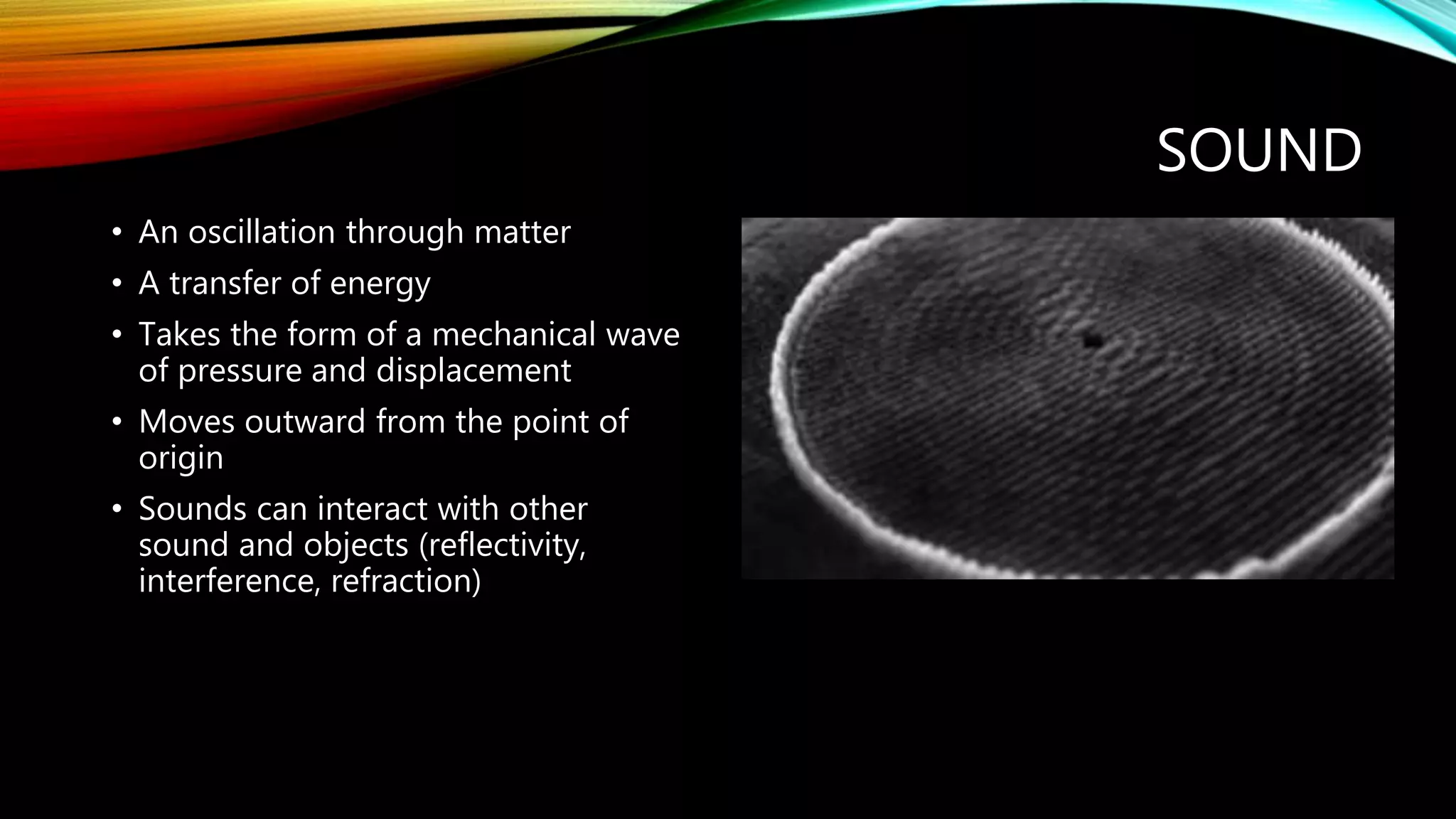
• An oscillation through matter
• A transfer of energy
• Takes the form of a mechanical wave
of pressure and displacement
• Moves outward from the point of
origin
• Sounds can interact with other
sound and objects (reflectivity,
interference, refraction)
WHAT IS A WAVE?
Waves move over long distances – the movement
of the material it passes through is limited.
What we ‘see’ when we see a wave is the energy
moving through matter.
To create a wave, there needs to be some initial
energy input.
TYPES OF WAVES
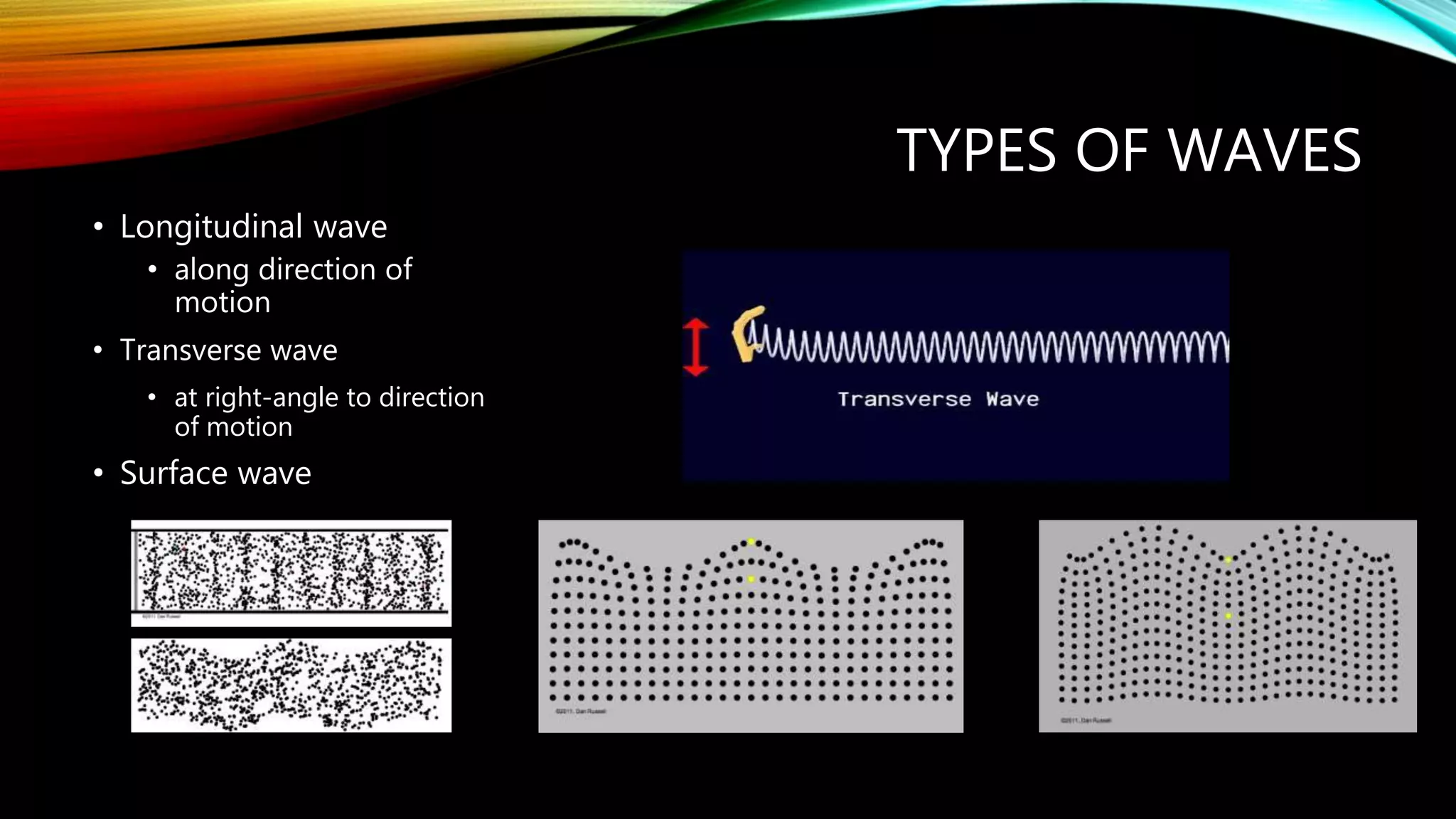
• Longitudinal wave
• along direction of
motion
• Transverse wave
• at right-angle to direction
of motion
• Surface wave
SOUNDWAVES
MECHANICAL WAVES
• Also known as pressure or compression waves
• Energy propagates in the same direction as the wave
𝐴 𝑥, 𝑡 = 𝐴0 cos(𝑘𝑥 − 𝜔𝑡 + 𝜙)
𝐸 ∝ 𝐴2
𝑘 =
2𝜋
𝜆
𝜔 = 2𝜋𝑓
𝑣 = 𝑓𝜆 =
𝜆
𝑇
=
𝑑𝑖𝑠𝑡𝑎𝑛𝑐𝑒
𝑡𝑖𝑚𝑒
CHARACTERISTICS OF WAVES
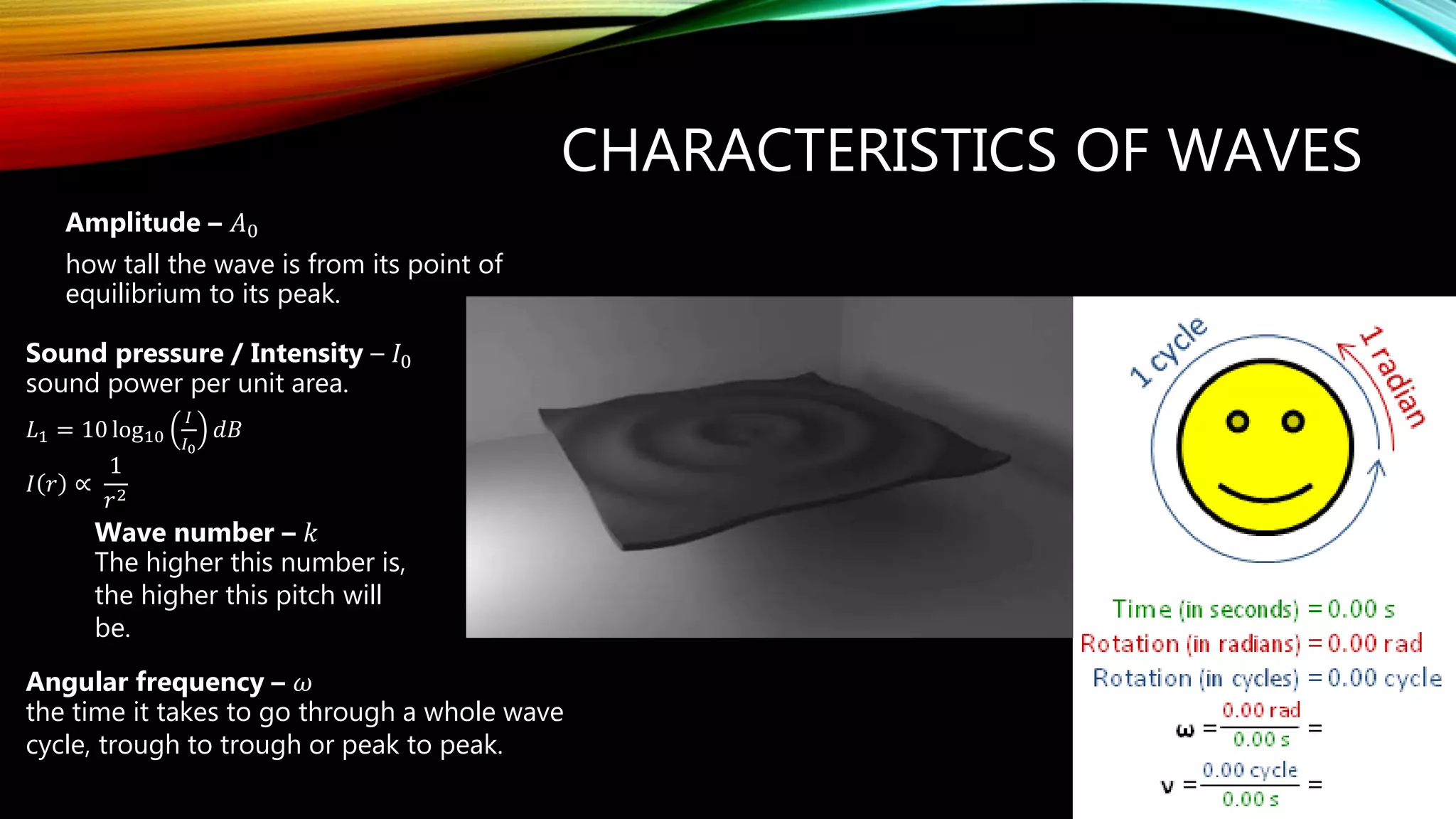
Amplitude – 𝐴0
how tall the wave is from its point of
equilibrium to its peak.
Angular frequency – 𝜔
the time it takes to go through a whole wave
cycle, trough to trough or peak to peak.
Sound pressure / Intensity – 𝐼0
sound power per unit area.
𝐿1 = 10 log10
𝐼
𝐼0
𝑑𝐵
𝐼 𝑟 ∝
1
𝑟2
Wave number – 𝑘
The higher this number is,
the higher this pitch will
be.
CHARACTERISTICS OF SOUND
• Pitch – how “high” or “low”
• Duration – how “long” or “short”
• Loudness – how “loud” or “soft”
• Timbre – the perceived quality of the sound. A guitar as opposed to a piano or thud
of a falling rock or a mechanical drill.
• Sonic Texture – the number of sound sources and the interaction between them. A
quartet as opposed to an orchestra.
• Spatial Location – the distance and location of the sound source.
INTERFERENCE PATTERNS
• When waves overlap, they add and subtract.
STANDING WAVES
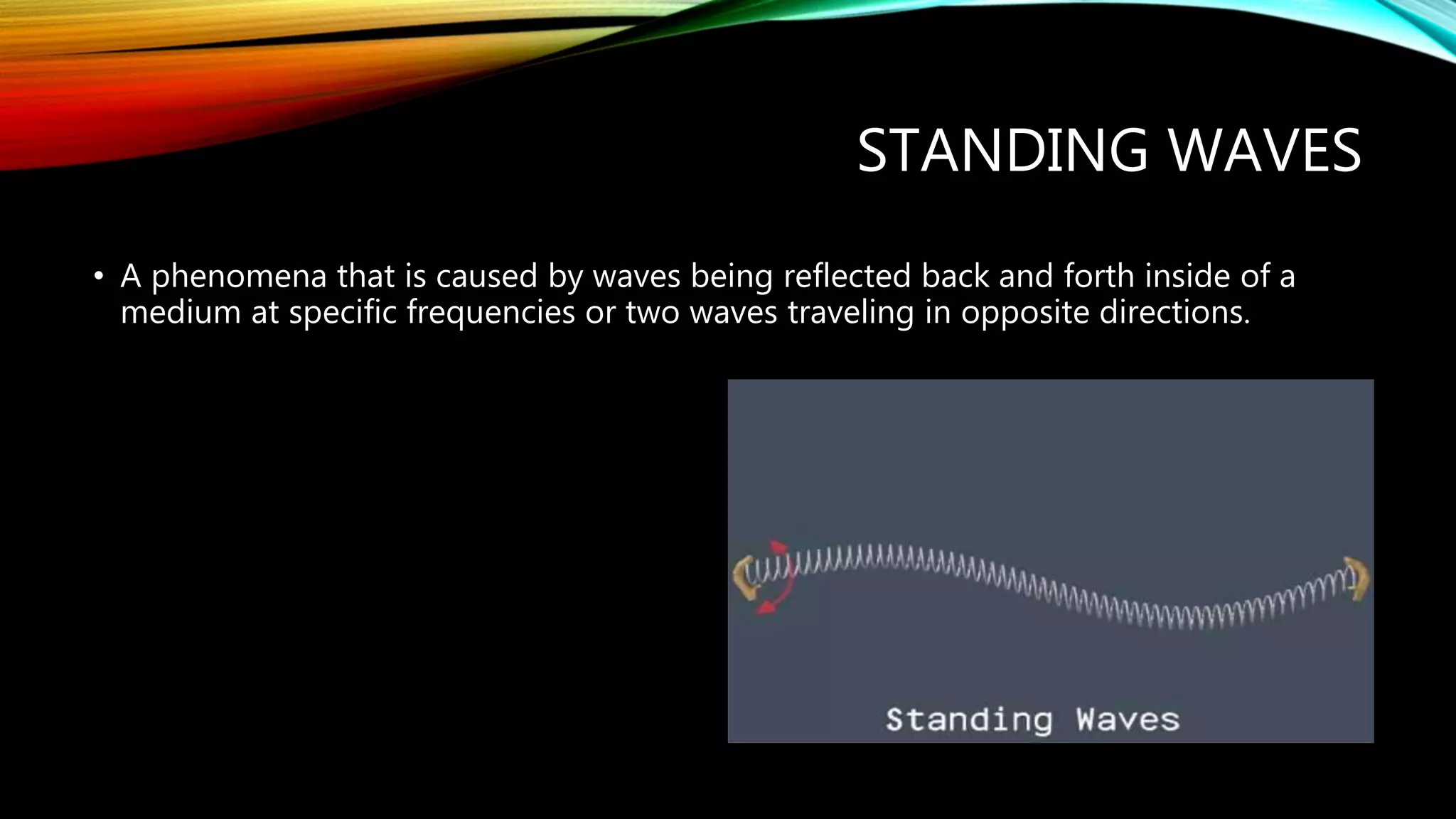
• A phenomena that is caused by waves being reflected back and forth inside of a
medium at specific frequencies or two waves traveling in opposite directions.
STANDING WAVES
SUMMARY
• Waves are cyclical.
• Waves can be described by a few simple values, mostly: 𝐴, 𝑓, 𝜆, and 𝑣.
• Waves move away from the point of origin radially and lose power by 1/𝑟2
• Waves can add together or subtract from each other, based off their amplitude.
• Standing waves form from interference
Contact
Blake Nicholson

Physics of Sound

  • 1.
  • 2.
    SOUND • An oscillationthrough matter • A transfer of energy • Takes the form of a mechanical wave of pressure and displacement • Moves outward from the point of origin • Sounds can interact with other sound and objects (reflectivity, interference, refraction)
  • 3.
    WHAT IS AWAVE? Waves move over long distances – the movement of the material it passes through is limited. What we ‘see’ when we see a wave is the energy moving through matter. To create a wave, there needs to be some initial energy input.
  • 4.
    TYPES OF WAVES •Longitudinal wave • along direction of motion • Transverse wave • at right-angle to direction of motion • Surface wave
  • 5.
  • 6.
    MECHANICAL WAVES • Alsoknown as pressure or compression waves • Energy propagates in the same direction as the wave 𝐴 𝑥, 𝑡 = 𝐴0 cos(𝑘𝑥 − 𝜔𝑡 + 𝜙) 𝐸 ∝ 𝐴2 𝑘 = 2𝜋 𝜆 𝜔 = 2𝜋𝑓 𝑣 = 𝑓𝜆 = 𝜆 𝑇 = 𝑑𝑖𝑠𝑡𝑎𝑛𝑐𝑒 𝑡𝑖𝑚𝑒
  • 7.
    CHARACTERISTICS OF WAVES Amplitude– 𝐴0 how tall the wave is from its point of equilibrium to its peak. Angular frequency – 𝜔 the time it takes to go through a whole wave cycle, trough to trough or peak to peak. Sound pressure / Intensity – 𝐼0 sound power per unit area. 𝐿1 = 10 log10 𝐼 𝐼0 𝑑𝐵 𝐼 𝑟 ∝ 1 𝑟2 Wave number – 𝑘 The higher this number is, the higher this pitch will be.
  • 8.
    CHARACTERISTICS OF SOUND •Pitch – how “high” or “low” • Duration – how “long” or “short” • Loudness – how “loud” or “soft” • Timbre – the perceived quality of the sound. A guitar as opposed to a piano or thud of a falling rock or a mechanical drill. • Sonic Texture – the number of sound sources and the interaction between them. A quartet as opposed to an orchestra. • Spatial Location – the distance and location of the sound source.
  • 9.
    INTERFERENCE PATTERNS • Whenwaves overlap, they add and subtract.
  • 10.
    STANDING WAVES • Aphenomena that is caused by waves being reflected back and forth inside of a medium at specific frequencies or two waves traveling in opposite directions.
  • 11.
  • 12.
    SUMMARY • Waves arecyclical. • Waves can be described by a few simple values, mostly: 𝐴, 𝑓, 𝜆, and 𝑣. • Waves move away from the point of origin radially and lose power by 1/𝑟2 • Waves can add together or subtract from each other, based off their amplitude. • Standing waves form from interference Contact Blake Nicholson