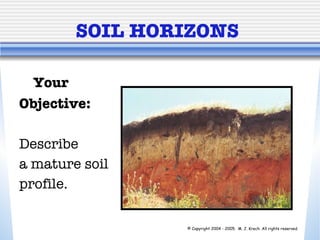
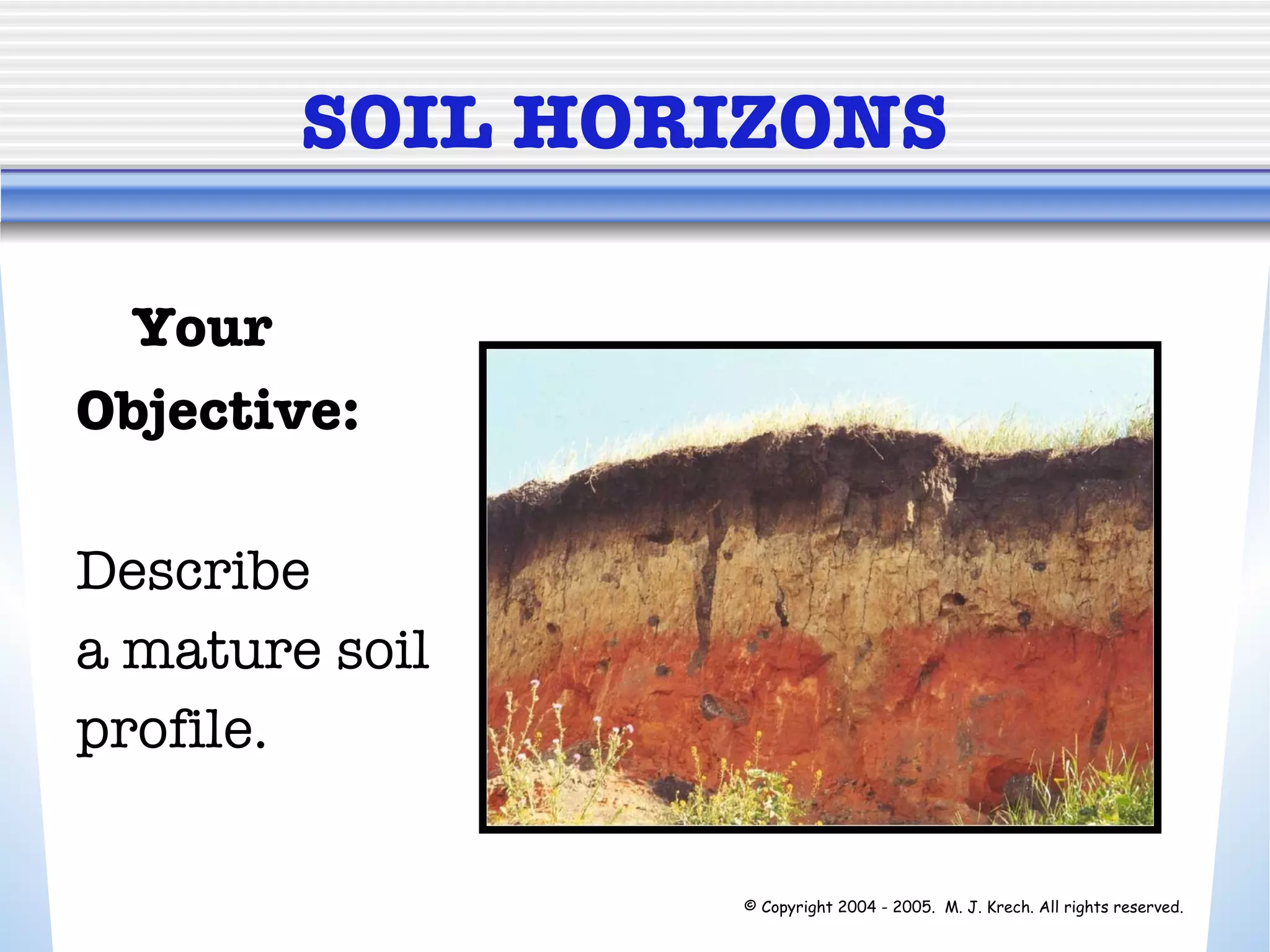
SOIL HORIZONS Your  Objective: Describe  a mature soil  profile. © Copyright 2004 - 2005.  M. J. Krech. All rights reserved.
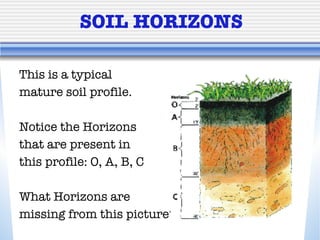
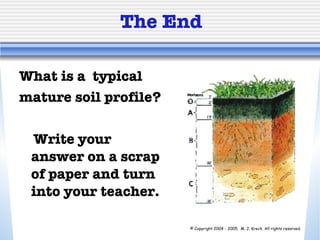
SOIL HORIZONS This is a typical  mature soil profile. Notice the Horizons  that are present in  this profile: O, A, B, C What Horizons are  missing from this picture?
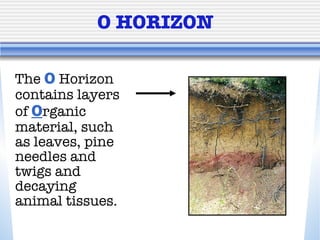
O HORIZON The  O  Horizon contains layers of  O rganic material, such as leaves, pine  needles and twigs and decaying animal tissues.
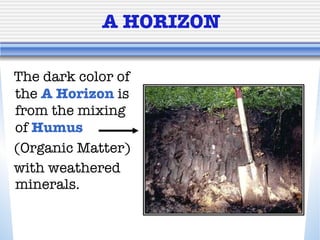
A HORIZON The dark color of the  A Horizon  is from the mixing of  Humus  (Organic Matter)  with weathered minerals.
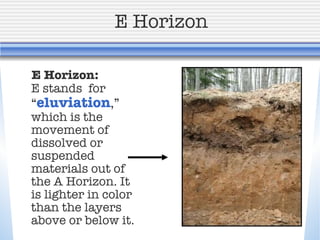
E Horizon E Horizon:   E stands  for “ eluviation ,” which is the movement of dissolved or  suspended materials out of the A Horizon. It is lighter in color than the layers above or below it.
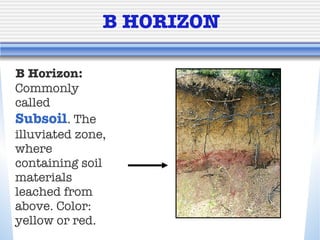
B HORIZON B Horizon:   Commonly called  Subsoil . The illuviated zone, where containing soil materials leached from above. Color: yellow or red.
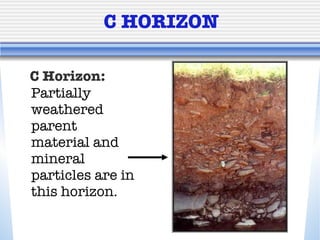
C HORIZON C Horizon:   Partially weathered parent material and mineral particles are in this horizon.
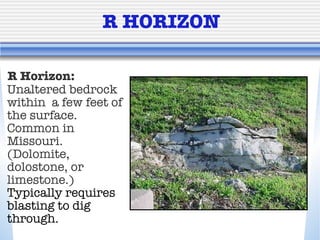
R HORIZON R Horizon:   Unaltered bedrock  within  a few feet of the surface. Common in Missouri.  (Dolomite, dolostone, or limestone.)  Typically requires blasting to dig through.
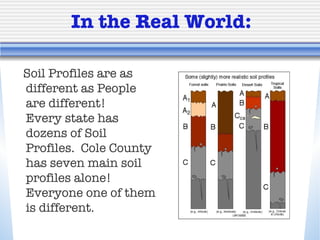
In the Real World: Soil Profiles are as different as People are different!  Every state has dozens of Soil Profiles.  Cole County has seven main soil profiles alone! Everyone one of them is different.
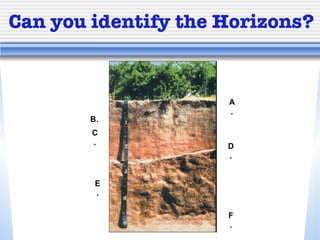
Can you identify the Horizons? A. B. C. D. E. F.
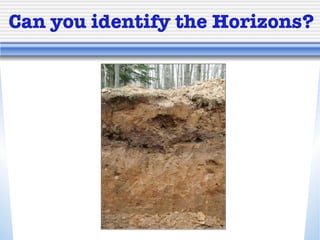
Can you identify the Horizons?
The End What is a  typical  mature soil profile? Write your answer on a scrap of paper and turn into your teacher. © Copyright 2004 - 2005.  M. J. Krech. All rights reserved.

Soil horizons

  • 1.
    SOIL HORIZONS Your Objective: Describe a mature soil profile. © Copyright 2004 - 2005.  M. J. Krech. All rights reserved.
  • 2.
    SOIL HORIZONS Thisis a typical mature soil profile. Notice the Horizons that are present in this profile: O, A, B, C What Horizons are missing from this picture?
  • 3.
    O HORIZON The O Horizon contains layers of O rganic material, such as leaves, pine needles and twigs and decaying animal tissues.
  • 4.
    A HORIZON Thedark color of the A Horizon is from the mixing of Humus (Organic Matter) with weathered minerals.
  • 5.
    E Horizon EHorizon: E stands for “ eluviation ,” which is the movement of dissolved or suspended materials out of the A Horizon. It is lighter in color than the layers above or below it.
  • 6.
    B HORIZON BHorizon: Commonly called Subsoil . The illuviated zone, where containing soil materials leached from above. Color: yellow or red.
  • 7.
    C HORIZON CHorizon: Partially weathered parent material and mineral particles are in this horizon.
  • 8.
    R HORIZON RHorizon: Unaltered bedrock within a few feet of the surface. Common in Missouri. (Dolomite, dolostone, or limestone.) Typically requires blasting to dig through.
  • 9.
    In the RealWorld: Soil Profiles are as different as People are different! Every state has dozens of Soil Profiles. Cole County has seven main soil profiles alone! Everyone one of them is different.
  • 10.
    Can you identifythe Horizons? A. B. C. D. E. F.
  • 11.
    Can you identifythe Horizons?
  • 12.
    The End Whatis a typical mature soil profile? Write your answer on a scrap of paper and turn into your teacher. © Copyright 2004 - 2005.  M. J. Krech. All rights reserved.