WEATHERING
The Riverdeep Academy
Ms. Wenslette Imee C. Balauro
Weathering
The surface of Earth's crust, called lithosphere,
is constantly changing. Rocks break up into smaller
pieces in a process called weathering. This occurs
whenever rocks on or near Earth's surface are
exposed to air, water, and living things.
Weathering can be classified into two general
types: physical and chemical.
Physical Weathering
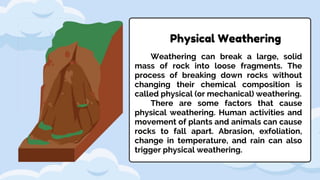
Weathering can break a large, solid
mass of rock into loose fragments. The
process of breaking down rocks without
changing their chemical composition is
called physical (or mechanical) weathering.
There are some factors that cause
physical weathering. Human activities and
movement of plants and animals can cause
rocks to fall apart. Abrasion, exfoliation,
change in temperature, and rain can also
trigger physical weathering.
Causes of Physical Weathering
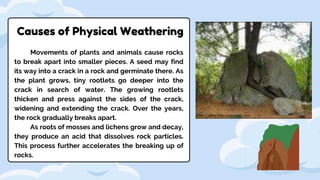
Movements of plants and animals cause rocks
to break apart into smaller pieces. A seed may find
its way into a crack in a rock and germinate there. As
the plant grows, tiny rootlets go deeper into the
crack in search of water. The growing rootlets
thicken and press against the sides of the crack,
widening and extending the crack. Over the years,
the rock gradually breaks apart.
As roots of mosses and lichens grow and decay,
they produce an acid that dissolves rock particles.
This process further accelerates the breaking up of
rocks.
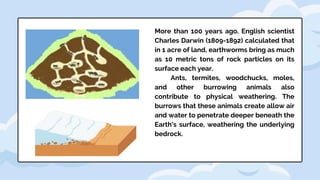
More than 100 years ago, English scientist
Charles Darwin (1809-1892) calculated that
in 1 acre of land, earthworms bring as much
as 10 metric tons of rock particles on its
surface each year.
Ants, termites, woodchucks, moles,
and other burrowing animals also
contribute to physical weathering. The
burrows that these animals create allow air
and water to penetrate deeper beneath the
Earth's surface, weathering the underlying
bedrock.
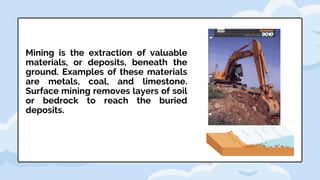
Mining is the extraction of valuable
materials, or deposits, beneath the
ground. Examples of these materials
are metals, coal, and limestone.
Surface mining removes layers of soil
or bedrock to reach the buried
deposits.
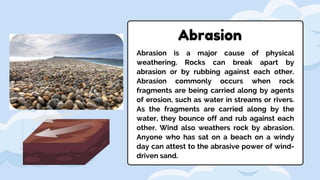
Abrasion
Abrasion is a major cause of physical
weathering. Rocks can break apart by
abrasion or by rubbing against each other.
Abrasion commonly occurs when rock
fragments are being carried along by agents
of erosion, such as water in streams or rivers.
As the fragments are carried along by the
water, they bounce off and rub against each
other. Wind also weathers rock by abrasion.
Anyone who has sat on a beach on a windy
day can attest to the abrasive power of wind-
driven sand.
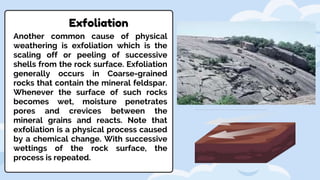
Exfoliation
Another common cause of physical
weathering is exfoliation which is the
scaling off or peeling of successive
shells from the rock surface. Exfoliation
generally occurs in Coarse-grained
rocks that contain the mineral feldspar.
Whenever the surface of such rocks
becomes wet, moisture penetrates
pores and crevices between the
mineral grains and reacts. Note that
exfoliation is a physical process caused
by a chemical change. With successive
wettings of the rock surface, the
process is repeated.
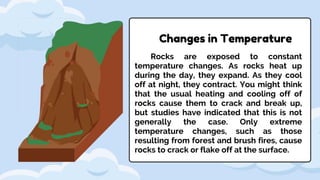
Changes in Temperature
Rocks are exposed to constant
temperature changes. As rocks heat up
during the day, they expand. As they cool
off at night, they contract. You might think
that the usual heating and cooling off of
rocks cause them to crack and break up,
but studies have indicated that this is not
generally the case. Only extreme
temperature changes, such as those
resulting from forest and brush fires, cause
rocks to crack or flake off at the surface.
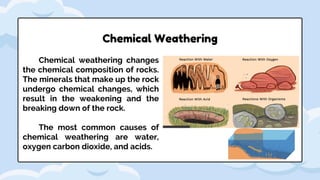
Chemical weathering changes
the chemical composition of rocks.
The minerals that make up the rock
undergo chemical changes, which
result in the weakening and the
breaking down of the rock.
The most common causes of
chemical weathering are water,
oxygen carbon dioxide, and acids.
Chemical Weathering
Water
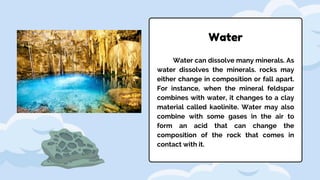
Water can dissolve many minerals. As
water dissolves the minerals. rocks may
either change in composition or fall apart.
For instance, when the mineral feldspar
combines with water, it changes to a clay
material called kaolinite. Water may also
combine with some gases in the air to
form an acid that can change the
composition of the rock that comes in
contact with it.
Oxygen
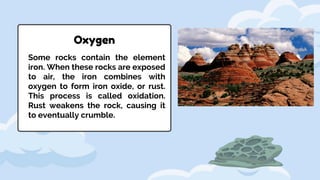
Some rocks contain the element
iron. When these rocks are exposed
to air, the iron combines with
oxygen to form iron oxide, or rust.
This process is called oxidation.
Rust weakens the rock, causing it
to eventually crumble.
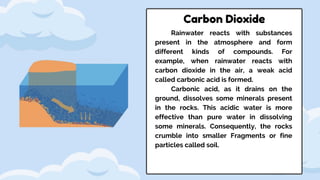
Rainwater reacts with substances
present in the atmosphere and form
different kinds of compounds. For
example, when rainwater reacts with
carbon dioxide in the air, a weak acid
called carbonic acid is formed.
Carbonic acid, as it drains on the
ground, dissolves some minerals present
in the rocks. This acidic water is more
effective than pure water in dissolving
some minerals. Consequently, the rocks
crumble into smaller Fragments or fine
particles called soil.
Carbon Dioxide
Acids
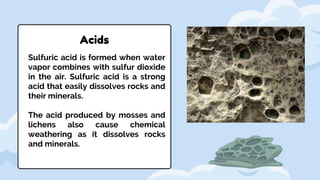
Sulfuric acid is formed when water
vapor combines with sulfur dioxide
in the air. Sulfuric acid is a strong
acid that easily dissolves rocks and
their minerals.
The acid produced by mosses and
lichens also cause chemical
weathering as it dissolves rocks
and minerals.
Factors Affecting the Rate of Weathering
How long does it take for a rock to be broken apart
by weathering process?
The answer is complex since many factors
influence the rate at which a rock will weather. The
main factors affecting weathering are climate,
particle size, mineral composition, exposure to
weathering elements, and time.
Climate
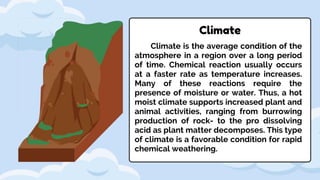
Climate is the average condition of the
atmosphere in a region over a long period
of time. Chemical reaction usually occurs
at a faster rate as temperature increases.
Many of these reactions require the
presence of moisture or water. Thus, a hot
moist climate supports increased plant and
animal activities, ranging from burrowing
production of rock- to the pro dissolving
acid as plant matter decomposes. This type
of climate is a favorable condition for rapid
chemical weathering.
Particle Size
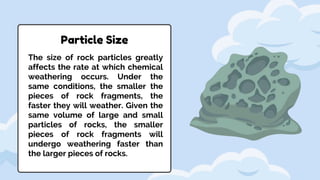
The size of rock particles greatly
affects the rate at which chemical
weathering occurs. Under the
same conditions, the smaller the
pieces of rock fragments, the
faster they will weather. Given the
same volume of large and small
particles of rocks, the smaller
pieces of rock fragments will
undergo weathering faster than
the larger pieces of rocks.
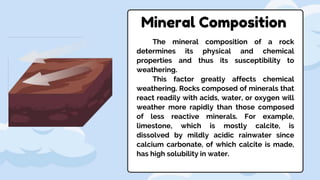
Mineral Composition
The mineral composition of a rock
determines its physical and chemical
properties and thus its susceptibility to
weathering.
This factor greatly affects chemical
weathering. Rocks composed of minerals that
react readily with acids, water, or oxygen will
weather more rapidly than those composed
of less reactive minerals. For example,
limestone, which is mostly calcite, is
dissolved by mildly acidic rainwater since
calcium carbonate, of which calcite is made,
has high solubility in water.
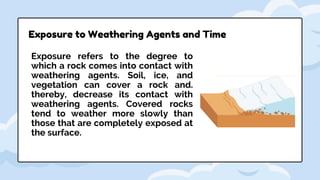
Exposure refers to the degree to
which a rock comes into contact with
weathering agents. Soil, ice, and
vegetation can cover a rock and.
thereby, decrease its contact with
weathering agents. Covered rocks
tend to weather more slowly than
those that are completely exposed at
the surface.
Exposure to Weathering Agents and Time
Products of Weathering
Rocks exposed on the surface of Earth are acted
upon by forces that cause them to disintegrate. Solid
rock is broken into fragments by physical or chemical
forces. These fragments range from the tiniest
particles dissolved in water to the largest boulders.
The fragments produced form sediments and soils.
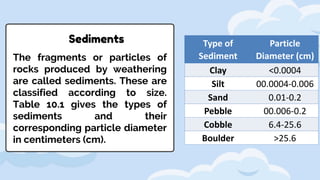
Sediments
The fragments or particles of
rocks produced by weathering
are called sediments. These are
classified according to size.
Table 10.1 gives the types of
sediments and their
corresponding particle diameter
in centimeters (cm).
Type of
Sediment
Particle
Diameter (cm)
Clay <0.0004
Silt 00.0004-0.006
Sand 0.01-0.2
Pebble 00.006-0.2
Cobble 6.4-25.6
Boulder >25.6
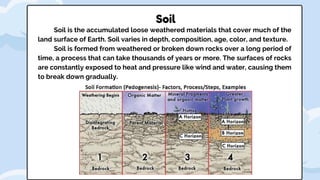
Soil is the accumulated loose weathered materials that cover much of the
land surface of Earth. Soil varies in depth, composition, age, color, and texture.
Soil is formed from weathered or broken down rocks over a long period of
time, a process that can take thousands of years or more. The surfaces of rocks
are constantly exposed to heat and pressure like wind and water, causing them
to break down gradually.
Soil
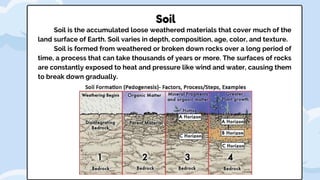
Soil is the accumulated loose weathered materials that cover much of the
land surface of Earth. Soil varies in depth, composition, age, color, and texture.
Soil is formed from weathered or broken down rocks over a long period of
time, a process that can take thousands of years or more. The surfaces of rocks
are constantly exposed to heat and pressure like wind and water, causing them
to break down gradually.
Soil
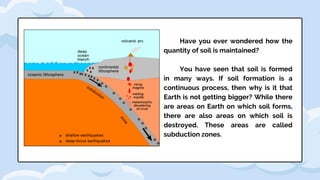
Have you ever wondered how the
quantity of soil is maintained?
You have seen that soil is formed
in many ways. If soil formation is a
continuous process, then why is it that
Earth is not getting bigger? While there
are areas on Earth on which soil forms,
there are also areas on which soil is
destroyed. These areas are called
subduction zones.
GOOD WORK!
RESOURCE PAGE

Weathering and soil erosion presentation.pptx

  • 1.
    WEATHERING The Riverdeep Academy Ms.Wenslette Imee C. Balauro
  • 2.
    Weathering The surface ofEarth's crust, called lithosphere, is constantly changing. Rocks break up into smaller pieces in a process called weathering. This occurs whenever rocks on or near Earth's surface are exposed to air, water, and living things. Weathering can be classified into two general types: physical and chemical.
  • 3.
    Physical Weathering Weathering canbreak a large, solid mass of rock into loose fragments. The process of breaking down rocks without changing their chemical composition is called physical (or mechanical) weathering. There are some factors that cause physical weathering. Human activities and movement of plants and animals can cause rocks to fall apart. Abrasion, exfoliation, change in temperature, and rain can also trigger physical weathering.
  • 4.
    Causes of PhysicalWeathering Movements of plants and animals cause rocks to break apart into smaller pieces. A seed may find its way into a crack in a rock and germinate there. As the plant grows, tiny rootlets go deeper into the crack in search of water. The growing rootlets thicken and press against the sides of the crack, widening and extending the crack. Over the years, the rock gradually breaks apart. As roots of mosses and lichens grow and decay, they produce an acid that dissolves rock particles. This process further accelerates the breaking up of rocks.
  • 5.
    More than 100years ago, English scientist Charles Darwin (1809-1892) calculated that in 1 acre of land, earthworms bring as much as 10 metric tons of rock particles on its surface each year. Ants, termites, woodchucks, moles, and other burrowing animals also contribute to physical weathering. The burrows that these animals create allow air and water to penetrate deeper beneath the Earth's surface, weathering the underlying bedrock.
  • 6.
    Mining is theextraction of valuable materials, or deposits, beneath the ground. Examples of these materials are metals, coal, and limestone. Surface mining removes layers of soil or bedrock to reach the buried deposits.
  • 7.
    Abrasion Abrasion is amajor cause of physical weathering. Rocks can break apart by abrasion or by rubbing against each other. Abrasion commonly occurs when rock fragments are being carried along by agents of erosion, such as water in streams or rivers. As the fragments are carried along by the water, they bounce off and rub against each other. Wind also weathers rock by abrasion. Anyone who has sat on a beach on a windy day can attest to the abrasive power of wind- driven sand.
  • 8.
    Exfoliation Another common causeof physical weathering is exfoliation which is the scaling off or peeling of successive shells from the rock surface. Exfoliation generally occurs in Coarse-grained rocks that contain the mineral feldspar. Whenever the surface of such rocks becomes wet, moisture penetrates pores and crevices between the mineral grains and reacts. Note that exfoliation is a physical process caused by a chemical change. With successive wettings of the rock surface, the process is repeated.
  • 9.
    Changes in Temperature Rocksare exposed to constant temperature changes. As rocks heat up during the day, they expand. As they cool off at night, they contract. You might think that the usual heating and cooling off of rocks cause them to crack and break up, but studies have indicated that this is not generally the case. Only extreme temperature changes, such as those resulting from forest and brush fires, cause rocks to crack or flake off at the surface.
  • 10.
    Chemical weathering changes thechemical composition of rocks. The minerals that make up the rock undergo chemical changes, which result in the weakening and the breaking down of the rock. The most common causes of chemical weathering are water, oxygen carbon dioxide, and acids. Chemical Weathering
  • 11.
    Water Water can dissolvemany minerals. As water dissolves the minerals. rocks may either change in composition or fall apart. For instance, when the mineral feldspar combines with water, it changes to a clay material called kaolinite. Water may also combine with some gases in the air to form an acid that can change the composition of the rock that comes in contact with it.
  • 12.
    Oxygen Some rocks containthe element iron. When these rocks are exposed to air, the iron combines with oxygen to form iron oxide, or rust. This process is called oxidation. Rust weakens the rock, causing it to eventually crumble.
  • 13.
    Rainwater reacts withsubstances present in the atmosphere and form different kinds of compounds. For example, when rainwater reacts with carbon dioxide in the air, a weak acid called carbonic acid is formed. Carbonic acid, as it drains on the ground, dissolves some minerals present in the rocks. This acidic water is more effective than pure water in dissolving some minerals. Consequently, the rocks crumble into smaller Fragments or fine particles called soil. Carbon Dioxide
  • 14.
    Acids Sulfuric acid isformed when water vapor combines with sulfur dioxide in the air. Sulfuric acid is a strong acid that easily dissolves rocks and their minerals. The acid produced by mosses and lichens also cause chemical weathering as it dissolves rocks and minerals.
  • 15.
    Factors Affecting theRate of Weathering How long does it take for a rock to be broken apart by weathering process? The answer is complex since many factors influence the rate at which a rock will weather. The main factors affecting weathering are climate, particle size, mineral composition, exposure to weathering elements, and time.
  • 16.
    Climate Climate is theaverage condition of the atmosphere in a region over a long period of time. Chemical reaction usually occurs at a faster rate as temperature increases. Many of these reactions require the presence of moisture or water. Thus, a hot moist climate supports increased plant and animal activities, ranging from burrowing production of rock- to the pro dissolving acid as plant matter decomposes. This type of climate is a favorable condition for rapid chemical weathering.
  • 17.
    Particle Size The sizeof rock particles greatly affects the rate at which chemical weathering occurs. Under the same conditions, the smaller the pieces of rock fragments, the faster they will weather. Given the same volume of large and small particles of rocks, the smaller pieces of rock fragments will undergo weathering faster than the larger pieces of rocks.
  • 18.
    Mineral Composition The mineralcomposition of a rock determines its physical and chemical properties and thus its susceptibility to weathering. This factor greatly affects chemical weathering. Rocks composed of minerals that react readily with acids, water, or oxygen will weather more rapidly than those composed of less reactive minerals. For example, limestone, which is mostly calcite, is dissolved by mildly acidic rainwater since calcium carbonate, of which calcite is made, has high solubility in water.
  • 19.
    Exposure refers tothe degree to which a rock comes into contact with weathering agents. Soil, ice, and vegetation can cover a rock and. thereby, decrease its contact with weathering agents. Covered rocks tend to weather more slowly than those that are completely exposed at the surface. Exposure to Weathering Agents and Time
  • 20.
    Products of Weathering Rocksexposed on the surface of Earth are acted upon by forces that cause them to disintegrate. Solid rock is broken into fragments by physical or chemical forces. These fragments range from the tiniest particles dissolved in water to the largest boulders. The fragments produced form sediments and soils.
  • 21.
    Sediments The fragments orparticles of rocks produced by weathering are called sediments. These are classified according to size. Table 10.1 gives the types of sediments and their corresponding particle diameter in centimeters (cm). Type of Sediment Particle Diameter (cm) Clay <0.0004 Silt 00.0004-0.006 Sand 0.01-0.2 Pebble 00.006-0.2 Cobble 6.4-25.6 Boulder >25.6
  • 22.
    Soil is theaccumulated loose weathered materials that cover much of the land surface of Earth. Soil varies in depth, composition, age, color, and texture. Soil is formed from weathered or broken down rocks over a long period of time, a process that can take thousands of years or more. The surfaces of rocks are constantly exposed to heat and pressure like wind and water, causing them to break down gradually. Soil
  • 23.
    Soil is theaccumulated loose weathered materials that cover much of the land surface of Earth. Soil varies in depth, composition, age, color, and texture. Soil is formed from weathered or broken down rocks over a long period of time, a process that can take thousands of years or more. The surfaces of rocks are constantly exposed to heat and pressure like wind and water, causing them to break down gradually. Soil
  • 24.
    Have you everwondered how the quantity of soil is maintained? You have seen that soil is formed in many ways. If soil formation is a continuous process, then why is it that Earth is not getting bigger? While there are areas on Earth on which soil forms, there are also areas on which soil is destroyed. These areas are called subduction zones.
  • 25.
  • 26.