Rock & weathering 
As Geo Revision
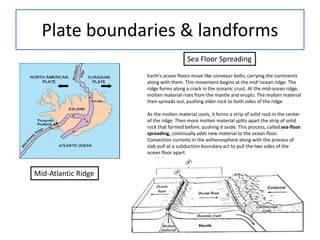
Plate boundaries & landforms 
Mid-Atlantic Ridge 
Sea Floor Spreading 
Earth’s ocean floors move like conveyor belts, carrying the continents 
along with them. This movement begins at the mid~ocean ridge. The 
ridge forms along a crack in the oceanic crust. At the mid-ocean ridge, 
molten material rises from the mantle and erupts. The molten material 
then spreads out, pushing older rock to both sides of the ridge. 
As the molten material cools, it forms a strip of solid rock in the center 
of the ridge. Then more molten material splits apart the strip of solid 
rock that formed before, pushing it aside. This process, called sea-floor 
spreading, continually adds new material to the ocean floor. 
Convection currents in the asthenosphere along with the process of 
slab pull at a subduction boundary act to pull the two sides of the 
ocean floor apart.
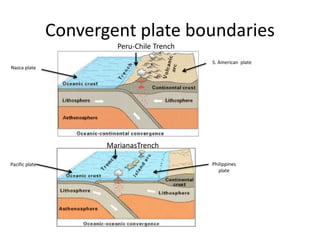
Convergent plate boundaries 
Nazca plate 
S. American plate 
Peru-Chile Trench 
Philippines 
plate 
Pacific plate 
MarianasTrench
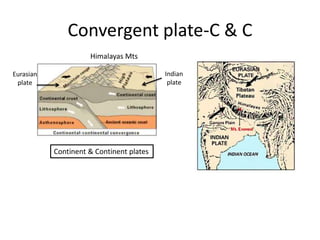
Convergent plate-C & C 
Eurasian 
plate 
Indian 
plate 
Himalayas Mts 
Continent & Continent plates
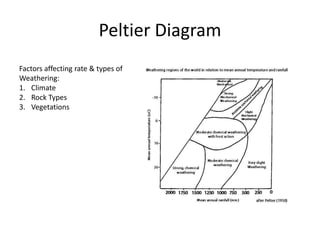
Peltier Diagram 
Factors affecting rate & types of 
Weathering: 
1. Climate 
2. Rock Types 
3. Vegetations
Climate 
From Peltier diagram, it describe the relationship between climate 
(temperature and rainfall) and weathering processes. 
Chemical weathering tends to be most intense in wet and warm climates 
where high temperatures promote chemical reactions, and heavy rainfall 
provides the moisture necessary for the processes to operate. 
Deep weathering profiles are common in area such as tropical climates and 
the characteristic red soils reflect active oxidation. 
Physical weathering active in cold climates where frost shattering dominates. 
In desert environments physical weathering might be expected to dominate 
due to absence of water, chemical weathering is important, particularly 
oxidation.
Rock characteristics 
Rate of chemical weathering is affected by chemical composition of a 
rock. Some minerals are more prone to chemical change than others. 
For example, in granite, both minerals feldspar and mica are chemically 
vulnerable, whereas quartz weathers extremely slowly. 
The presence of iron minerals and salts will affect oxidation and 
hydration respectively, and rocks rich in calcium carbonate (i.e. 
limestone) will be affected by carbonation. 
Joints and bedding planes promote weathering as they enable water 
to penetrate deep into rocks.
Vegetation 
(C ) Vegetation: 
Presence of vegetation also promotes weathering, 
in that organic acids speed up hydrolysis, and plant 
roots may prise, apart jointed rocks. 
Some form of vegetation, such as moss, cling to 
rock surfaces, holding water against them like a wet 
sponge thereby encouraging chemical weathering. 
However this same vegetation might, at the same 
time, protect rock surface from temperature 
extremes, reducing effect of physical weathering.
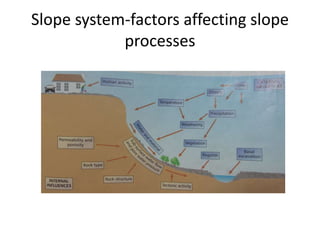
Slope system-factors affecting slope 
processes
Slope as a system 
It is an example of an open system because 
there are inputs from outside such as heat and 
precipitation and outputs e.g. water and 
weathered rock into other systems.
(a) Rock type- the tougher the rock the more able it is to support a steep slope. Igneous and metamorphic rocks are 
extremely strong and are capable of supporting near-vertical slopes, whereas sands and gravel can only support very 
gentle slopes. 
(b) Geological structure-Rock slabs may become detached along bedding planes or joints, promoting rockfalls and 
landslides. 
(c ) Permeability and porosity- An impermeable rock will be liable to surface water flow, and deep gullies may forms. 
(d) Climate-The climate of an area will affect the type of weathering that operates on a slope. It will also depends on 
presence or absent of water and vegetation. Most of mass movement such as mudflows and soil creep are dependent 
on aspects of climate, particularly precipitations. 
(e) Vegetation-If a slope is forested or covered with bushes and grass it is less likely to be active. This is because it will 
protect a slope from direct rainfalls and help bind together particles of rock and soil. 
(f) Weathering-Weathering affects the upper slopes, particularly bare rock outcrops. In general mechanical weathering, 
particularly frost shattering will lead to a more jagged, angular, bare rock surface whereas chemical weathering with its 
tendency to dissolve and produce fine clays, will produce more rounded slopes. 
(g) Basal excavation- It can takes place in the form of river undercutting a slope or the sea cutting a notch in a cliffline. 
Human activities such as road construction can have same effect. Basal excavation can lead to a steepening of a slope, 
so making it unstable. 
(h) Human activity- People are capable of altering slopes directly by mining and quarrying, construction roads and 
housing estates, and terracing land for farming. Slope can also be altered indirectly when, for example, forests are cut 
down for firewood or to make way for agriculture. This deforestation will encourage more surface runoff and soil 
erosion may occur. 
(i) Time- Time a slope exposed to weathering is also important controlling factor. Newly formed landscapes that are 
steep and unvegetated are actively weathered and eroded until they assume a shape that is balance with their 
environmental conditions. But if environment changes (global warming, for example) the balance may be upset and the 
slope profile will be forced to adapt.
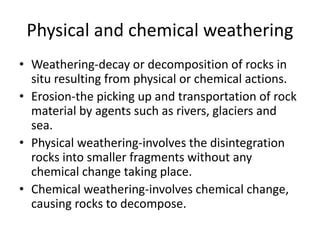
Physical and chemical weathering 
• Weathering-decay or decomposition of rocks in 
situ resulting from physical or chemical actions. 
• Erosion-the picking up and transportation of rock 
material by agents such as rivers, glaciers and 
sea. 
• Physical weathering-involves the disintegration 
rocks into smaller fragments without any 
chemical change taking place. 
• Chemical weathering-involves chemical change, 
causing rocks to decompose.
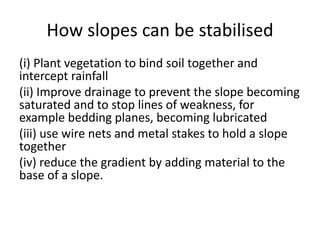
How slopes can be stabilised 
(i) Plant vegetation to bind soil together and 
intercept rainfall 
(ii) Improve drainage to prevent the slope becoming 
saturated and to stop lines of weakness, for 
example bedding planes, becoming lubricated 
(iii) use wire nets and metal stakes to hold a slope 
together 
(iv) reduce the gradient by adding material to the 
base of a slope.
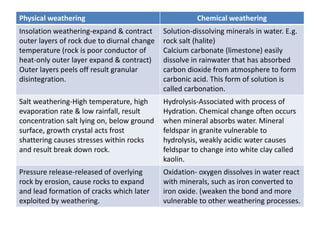
Physical weathering Chemical weathering 
Insolation weathering-expand & contract 
outer layers of rock due to diurnal change 
temperature (rock is poor conductor of 
heat-only outer layer expand & contract) 
Outer layers peels off result granular 
disintegration. 
Solution-dissolving minerals in water. E.g. 
rock salt (halite) 
Calcium carbonate (limestone) easily 
dissolve in rainwater that has absorbed 
carbon dioxide from atmosphere to form 
carbonic acid. This form of solution is 
called carbonation. 
Salt weathering-High temperature, high 
evaporation rate & low rainfall, result 
concentration salt lying on, below ground 
surface, growth crystal acts frost 
shattering causes stresses within rocks 
and result break down rock. 
Hydrolysis-Associated with process of 
Hydration. Chemical change often occurs 
when mineral absorbs water. Mineral 
feldspar in granite vulnerable to 
hydrolysis, weakly acidic water causes 
feldspar to change into white clay called 
kaolin. 
Pressure release-released of overlying 
rock by erosion, cause rocks to expand 
and lead formation of cracks which later 
exploited by weathering. 
Oxidation- oxygen dissolves in water react 
with minerals, such as iron converted to 
iron oxide. (weaken the bond and more 
vulnerable to other weathering processes.
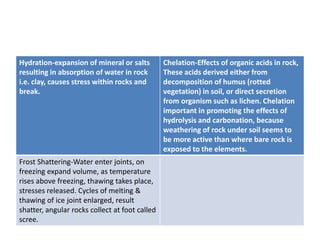
Hydration-expansion of mineral or salts 
resulting in absorption of water in rock 
i.e. clay, causes stress within rocks and 
break. 
Chelation-Effects of organic acids in rock, 
These acids derived either from 
decomposition of humus (rotted 
vegetation) in soil, or direct secretion 
from organism such as lichen. Chelation 
important in promoting the effects of 
hydrolysis and carbonation, because 
weathering of rock under soil seems to 
be more active than where bare rock is 
exposed to the elements. 
Frost Shattering-Water enter joints, on 
freezing expand volume, as temperature 
rises above freezing, thawing takes place, 
stresses released. Cycles of melting & 
thawing of ice joint enlarged, result 
shatter, angular rocks collect at foot called 
scree.
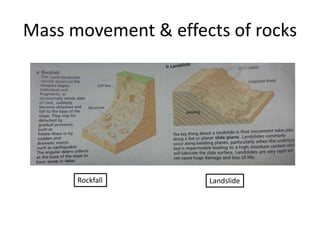
Mass movement & effects of rocks 
Rockfall Landslide
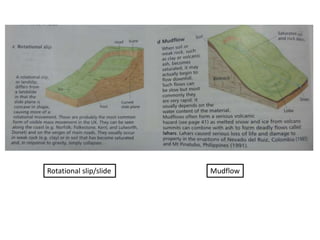
Rotational slip/slide Mudflow
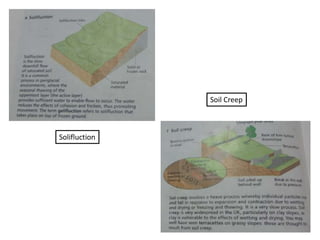
Solifluction 
Soil Creep
Granite 
• Granite forms deep below the ground and is only 
exposed on the surface after many millions of 
years of erosion. 
• A physically tough rock, which is resistant to 
erosion, and commonly forms uplands, for 
example Dartmoor and Bodmin in S.W England. 
• One of the most common features associated 
with granite is a barely rocky outcrop found on 
hilltops called a tor.
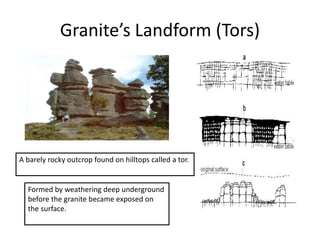
Granite’s Landform (Tors) 
A barely rocky outcrop found on hilltops called a tor. 
Formed by weathering deep underground 
before the granite became exposed on 
the surface.
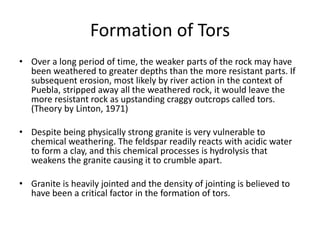
Formation of Tors 
• Over a long period of time, the weaker parts of the rock may have 
been weathered to greater depths than the more resistant parts. If 
subsequent erosion, most likely by river action in the context of 
Puebla, stripped away all the weathered rock, it would leave the 
more resistant rock as upstanding craggy outcrops called tors. 
(Theory by Linton, 1971) 
• Despite being physically strong granite is very vulnerable to 
chemical weathering. The feldspar readily reacts with acidic water 
to form a clay, and this chemical processes is hydrolysis that 
weakens the granite causing it to crumble apart. 
• Granite is heavily jointed and the density of jointing is believed to 
have been a critical factor in the formation of tors.
Limestone 
• Carboniferous limestone is a common form of 
limestone that was formed some 300 million 
years ago during the Carboniferous geological 
period. It outcrops throughout the UK, from the 
Gower in S.Wales to Pennine Hills in Yorkshire. 
• The limestone in these areas has resulted in a 
characteristic landscape known as karst. (both 
overground & underground features)
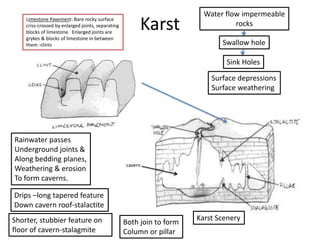
Karst 
Water flow impermeable 
Limestone Pavement: Bare rocky surface 
criss-crossed by enlarged joints, separating 
blocks of limestone. Enlarged joints are 
grykes & blocks of limestone in between 
them -clints Swallow hole 
cavern 
rocks 
Sink Holes 
Surface depressions 
Surface weathering 
Karst Scenery 
Rainwater passes 
Underground joints & 
Along bedding planes, 
Weathering & erosion 
To form caverns. 
Drips –long tapered feature 
Down cavern roof-stalactite 
Shorter, stubbier feature on 
floor of cavern-stalagmite 
Both join to form 
Column or pillar

Rock and weathering booklet

  • 1.
    Rock & weathering As Geo Revision
  • 2.
    Plate boundaries &landforms Mid-Atlantic Ridge Sea Floor Spreading Earth’s ocean floors move like conveyor belts, carrying the continents along with them. This movement begins at the mid~ocean ridge. The ridge forms along a crack in the oceanic crust. At the mid-ocean ridge, molten material rises from the mantle and erupts. The molten material then spreads out, pushing older rock to both sides of the ridge. As the molten material cools, it forms a strip of solid rock in the center of the ridge. Then more molten material splits apart the strip of solid rock that formed before, pushing it aside. This process, called sea-floor spreading, continually adds new material to the ocean floor. Convection currents in the asthenosphere along with the process of slab pull at a subduction boundary act to pull the two sides of the ocean floor apart.
  • 3.
    Convergent plate boundaries Nazca plate S. American plate Peru-Chile Trench Philippines plate Pacific plate MarianasTrench
  • 4.
    Convergent plate-C &C Eurasian plate Indian plate Himalayas Mts Continent & Continent plates
  • 5.
    Peltier Diagram Factorsaffecting rate & types of Weathering: 1. Climate 2. Rock Types 3. Vegetations
  • 6.
    Climate From Peltierdiagram, it describe the relationship between climate (temperature and rainfall) and weathering processes. Chemical weathering tends to be most intense in wet and warm climates where high temperatures promote chemical reactions, and heavy rainfall provides the moisture necessary for the processes to operate. Deep weathering profiles are common in area such as tropical climates and the characteristic red soils reflect active oxidation. Physical weathering active in cold climates where frost shattering dominates. In desert environments physical weathering might be expected to dominate due to absence of water, chemical weathering is important, particularly oxidation.
  • 7.
    Rock characteristics Rateof chemical weathering is affected by chemical composition of a rock. Some minerals are more prone to chemical change than others. For example, in granite, both minerals feldspar and mica are chemically vulnerable, whereas quartz weathers extremely slowly. The presence of iron minerals and salts will affect oxidation and hydration respectively, and rocks rich in calcium carbonate (i.e. limestone) will be affected by carbonation. Joints and bedding planes promote weathering as they enable water to penetrate deep into rocks.
  • 8.
    Vegetation (C )Vegetation: Presence of vegetation also promotes weathering, in that organic acids speed up hydrolysis, and plant roots may prise, apart jointed rocks. Some form of vegetation, such as moss, cling to rock surfaces, holding water against them like a wet sponge thereby encouraging chemical weathering. However this same vegetation might, at the same time, protect rock surface from temperature extremes, reducing effect of physical weathering.
  • 9.
  • 10.
    Slope as asystem It is an example of an open system because there are inputs from outside such as heat and precipitation and outputs e.g. water and weathered rock into other systems.
  • 11.
    (a) Rock type-the tougher the rock the more able it is to support a steep slope. Igneous and metamorphic rocks are extremely strong and are capable of supporting near-vertical slopes, whereas sands and gravel can only support very gentle slopes. (b) Geological structure-Rock slabs may become detached along bedding planes or joints, promoting rockfalls and landslides. (c ) Permeability and porosity- An impermeable rock will be liable to surface water flow, and deep gullies may forms. (d) Climate-The climate of an area will affect the type of weathering that operates on a slope. It will also depends on presence or absent of water and vegetation. Most of mass movement such as mudflows and soil creep are dependent on aspects of climate, particularly precipitations. (e) Vegetation-If a slope is forested or covered with bushes and grass it is less likely to be active. This is because it will protect a slope from direct rainfalls and help bind together particles of rock and soil. (f) Weathering-Weathering affects the upper slopes, particularly bare rock outcrops. In general mechanical weathering, particularly frost shattering will lead to a more jagged, angular, bare rock surface whereas chemical weathering with its tendency to dissolve and produce fine clays, will produce more rounded slopes. (g) Basal excavation- It can takes place in the form of river undercutting a slope or the sea cutting a notch in a cliffline. Human activities such as road construction can have same effect. Basal excavation can lead to a steepening of a slope, so making it unstable. (h) Human activity- People are capable of altering slopes directly by mining and quarrying, construction roads and housing estates, and terracing land for farming. Slope can also be altered indirectly when, for example, forests are cut down for firewood or to make way for agriculture. This deforestation will encourage more surface runoff and soil erosion may occur. (i) Time- Time a slope exposed to weathering is also important controlling factor. Newly formed landscapes that are steep and unvegetated are actively weathered and eroded until they assume a shape that is balance with their environmental conditions. But if environment changes (global warming, for example) the balance may be upset and the slope profile will be forced to adapt.
  • 12.
    Physical and chemicalweathering • Weathering-decay or decomposition of rocks in situ resulting from physical or chemical actions. • Erosion-the picking up and transportation of rock material by agents such as rivers, glaciers and sea. • Physical weathering-involves the disintegration rocks into smaller fragments without any chemical change taking place. • Chemical weathering-involves chemical change, causing rocks to decompose.
  • 13.
    How slopes canbe stabilised (i) Plant vegetation to bind soil together and intercept rainfall (ii) Improve drainage to prevent the slope becoming saturated and to stop lines of weakness, for example bedding planes, becoming lubricated (iii) use wire nets and metal stakes to hold a slope together (iv) reduce the gradient by adding material to the base of a slope.
  • 14.
    Physical weathering Chemicalweathering Insolation weathering-expand & contract outer layers of rock due to diurnal change temperature (rock is poor conductor of heat-only outer layer expand & contract) Outer layers peels off result granular disintegration. Solution-dissolving minerals in water. E.g. rock salt (halite) Calcium carbonate (limestone) easily dissolve in rainwater that has absorbed carbon dioxide from atmosphere to form carbonic acid. This form of solution is called carbonation. Salt weathering-High temperature, high evaporation rate & low rainfall, result concentration salt lying on, below ground surface, growth crystal acts frost shattering causes stresses within rocks and result break down rock. Hydrolysis-Associated with process of Hydration. Chemical change often occurs when mineral absorbs water. Mineral feldspar in granite vulnerable to hydrolysis, weakly acidic water causes feldspar to change into white clay called kaolin. Pressure release-released of overlying rock by erosion, cause rocks to expand and lead formation of cracks which later exploited by weathering. Oxidation- oxygen dissolves in water react with minerals, such as iron converted to iron oxide. (weaken the bond and more vulnerable to other weathering processes.
  • 15.
    Hydration-expansion of mineralor salts resulting in absorption of water in rock i.e. clay, causes stress within rocks and break. Chelation-Effects of organic acids in rock, These acids derived either from decomposition of humus (rotted vegetation) in soil, or direct secretion from organism such as lichen. Chelation important in promoting the effects of hydrolysis and carbonation, because weathering of rock under soil seems to be more active than where bare rock is exposed to the elements. Frost Shattering-Water enter joints, on freezing expand volume, as temperature rises above freezing, thawing takes place, stresses released. Cycles of melting & thawing of ice joint enlarged, result shatter, angular rocks collect at foot called scree.
  • 16.
    Mass movement &effects of rocks Rockfall Landslide
  • 17.
  • 18.
  • 19.
    Granite • Graniteforms deep below the ground and is only exposed on the surface after many millions of years of erosion. • A physically tough rock, which is resistant to erosion, and commonly forms uplands, for example Dartmoor and Bodmin in S.W England. • One of the most common features associated with granite is a barely rocky outcrop found on hilltops called a tor.
  • 20.
    Granite’s Landform (Tors) A barely rocky outcrop found on hilltops called a tor. Formed by weathering deep underground before the granite became exposed on the surface.
  • 21.
    Formation of Tors • Over a long period of time, the weaker parts of the rock may have been weathered to greater depths than the more resistant parts. If subsequent erosion, most likely by river action in the context of Puebla, stripped away all the weathered rock, it would leave the more resistant rock as upstanding craggy outcrops called tors. (Theory by Linton, 1971) • Despite being physically strong granite is very vulnerable to chemical weathering. The feldspar readily reacts with acidic water to form a clay, and this chemical processes is hydrolysis that weakens the granite causing it to crumble apart. • Granite is heavily jointed and the density of jointing is believed to have been a critical factor in the formation of tors.
  • 22.
    Limestone • Carboniferouslimestone is a common form of limestone that was formed some 300 million years ago during the Carboniferous geological period. It outcrops throughout the UK, from the Gower in S.Wales to Pennine Hills in Yorkshire. • The limestone in these areas has resulted in a characteristic landscape known as karst. (both overground & underground features)
  • 23.
    Karst Water flowimpermeable Limestone Pavement: Bare rocky surface criss-crossed by enlarged joints, separating blocks of limestone. Enlarged joints are grykes & blocks of limestone in between them -clints Swallow hole cavern rocks Sink Holes Surface depressions Surface weathering Karst Scenery Rainwater passes Underground joints & Along bedding planes, Weathering & erosion To form caverns. Drips –long tapered feature Down cavern roof-stalactite Shorter, stubbier feature on floor of cavern-stalagmite Both join to form Column or pillar