OBJECTIVESOBJECTIVES
IntrusiveIntrusive
VolcanicVolcanic
FeaturesFeatures
Sills & DykesSills & Dykes
Laccoliths &Laccoliths &
LopolithsLopoliths
BatholithsBatholiths
INTRODUCTIONINTRODUCTION
X
GeographyGeography Module 1Module 1  Unit 4Unit 4  Lesson 26Lesson 26
OBJECTIVESOBJECTIVES
IntrusiveIntrusive
VolcanicVolcanic
FeaturesFeatures
Sills & DykesSills & Dykes
Laccoliths &Laccoliths &
LopolithsLopoliths
BatholithsBatholiths
INTRODUCTIONINTRODUCTION
X
 You would have studied extrusive volcanic features
that are formed on the surface of the earth, and is
easily seen by all.
 This presentation will help you to become familiar
with how intrusive volcanic features are formed
within the earth’s crust .
 Intrusive volcanic features only become exposed
after weathering and erosion. Nevertheless they
contribute to spectacular features on the earth’s
surface.
2
OBJECTIVESOBJECTIVES
IntrusiveIntrusive
VolcanicVolcanic
FeaturesFeatures
Sills & DykesSills & Dykes
Laccoliths &Laccoliths &
LopolithsLopoliths
BatholithsBatholiths
INTRODUCTIONINTRODUCTION
X
At the end of the lesson, you will be able to:
1. identify sills, dykes, laccoliths, lopoliths,
batholiths and plugs.
2. describe each intrusive volcanic feature.
3. explain how each intrusive volcanic feature is
formed.
4. explain the process that takes place for each
intrusive volcanic feature to be exposed at the
surface of the earth, giving an example of each.
5. demonstrate an appreciation for volcanic
landforms.
6. develop an interest in the volcanic activities
occurring within the earth.
3
OBJECTIVESOBJECTIVES
IntrusiveIntrusive
VolcanicVolcanic
FeaturesFeatures
Sills & DykesSills & Dykes
Laccoliths &Laccoliths &
LopolithsLopoliths
BatholithsBatholiths
INTRODUCTIONINTRODUCTION
X
4
EXTRUSIVEEXTRUSIVE
Above theAbove the
earth’s surfaceearth’s surface
INTRUSIVEINTRUSIVE
Below theBelow the
earth’s surfaceearth’s surface
OBJECTIVESOBJECTIVES
IntrusiveIntrusive
VolcanicVolcanic
FeaturesFeatures
Sills & DykesSills & Dykes
Laccoliths &Laccoliths &
LopolithsLopoliths
BatholithsBatholiths
INTRODUCTIONINTRODUCTION
X
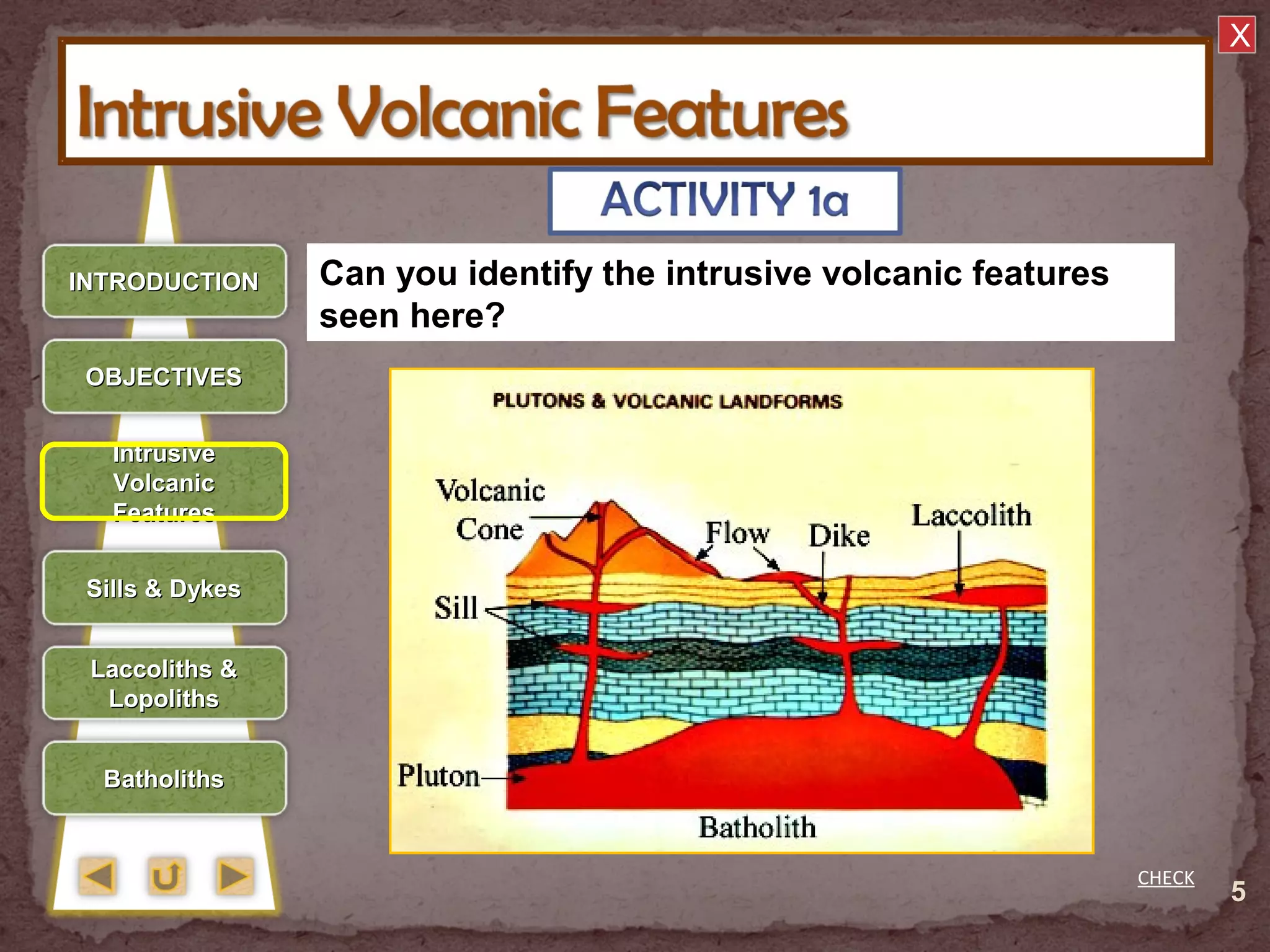
Can you identify the intrusive volcanic features
seen here?
5
CHECK
OBJECTIVESOBJECTIVES
IntrusiveIntrusive
VolcanicVolcanic
FeaturesFeatures
Sills & DykesSills & Dykes
Laccoliths &Laccoliths &
LopolithsLopoliths
BatholithsBatholiths
INTRODUCTIONINTRODUCTION
X
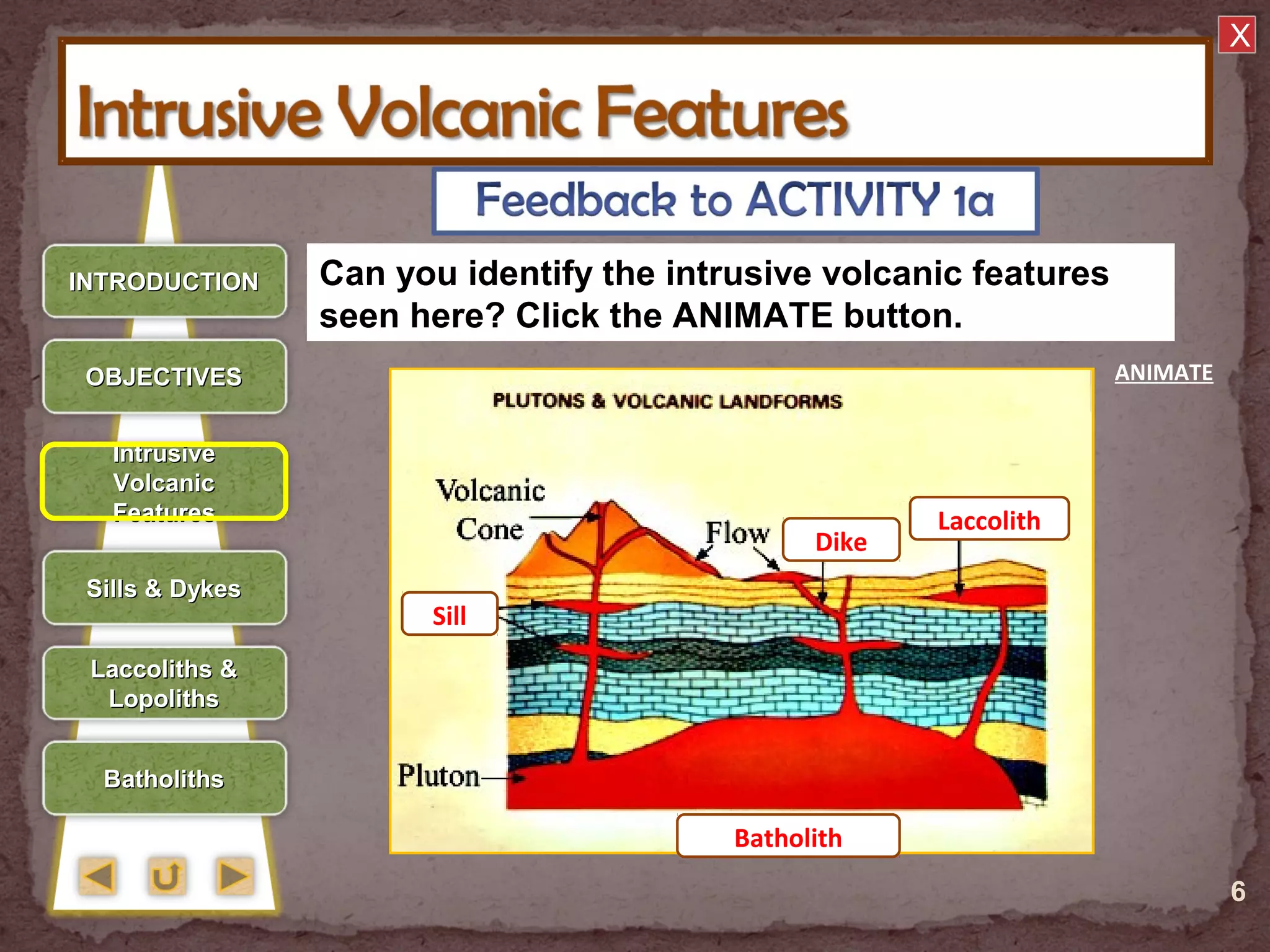
Can you identify the intrusive volcanic features
seen here? Click the ANIMATE button.
6
ANIMATE
Laccolith
Dike
Sill
Batholith
OBJECTIVESOBJECTIVES
IntrusiveIntrusive
VolcanicVolcanic
FeaturesFeatures
Sills & DykesSills & Dykes
Laccoliths &Laccoliths &
LopolithsLopoliths
BatholithsBatholiths
INTRODUCTIONINTRODUCTION
X
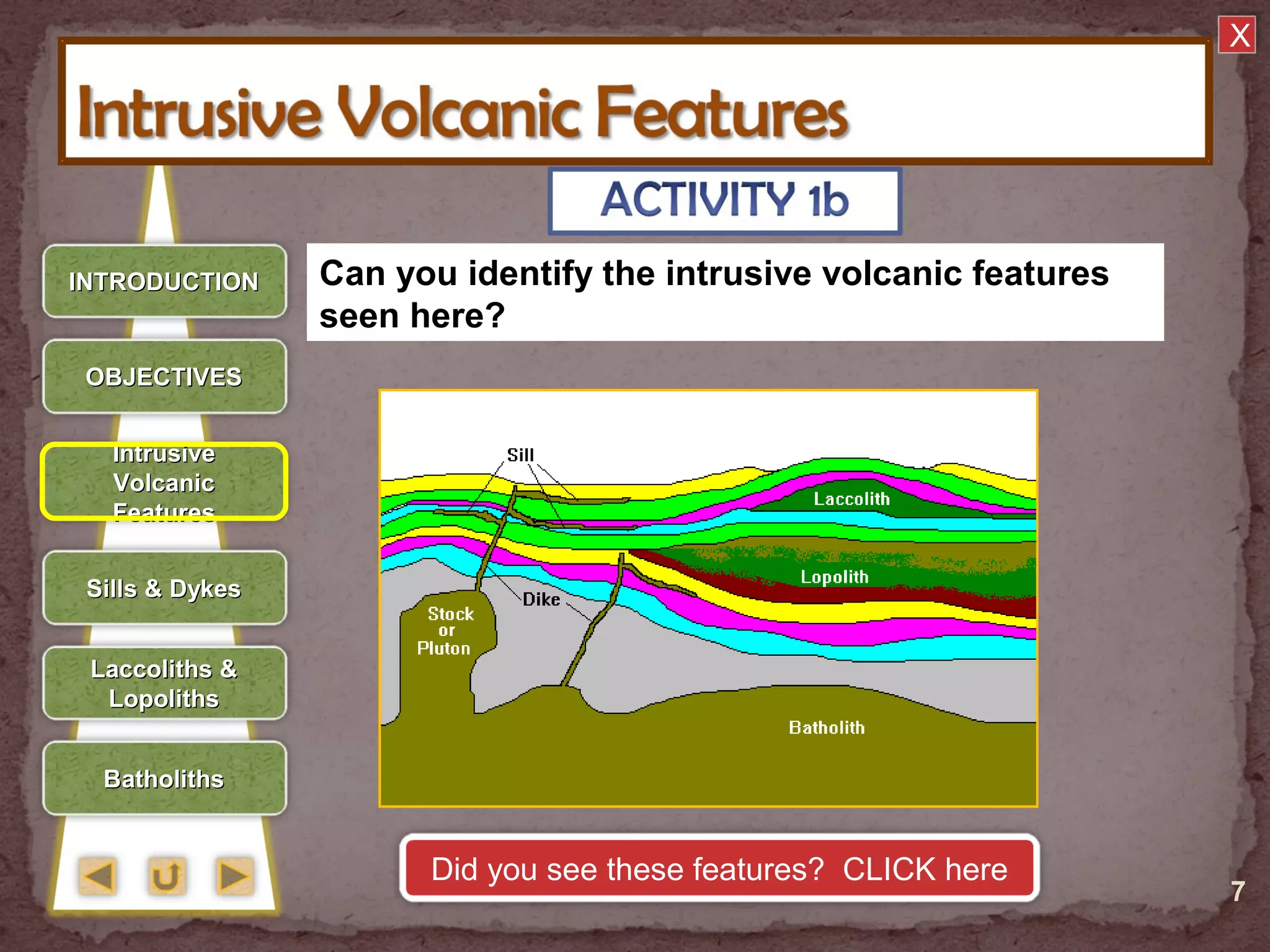
Can you identify the intrusive volcanic features
seen here?
7
Did you see these features? CLICK here
OBJECTIVESOBJECTIVES
IntrusiveIntrusive
VolcanicVolcanic
FeaturesFeatures
Sills & DykesSills & Dykes
Laccoliths &Laccoliths &
LopolithsLopoliths
BatholithsBatholiths
INTRODUCTIONINTRODUCTION
X
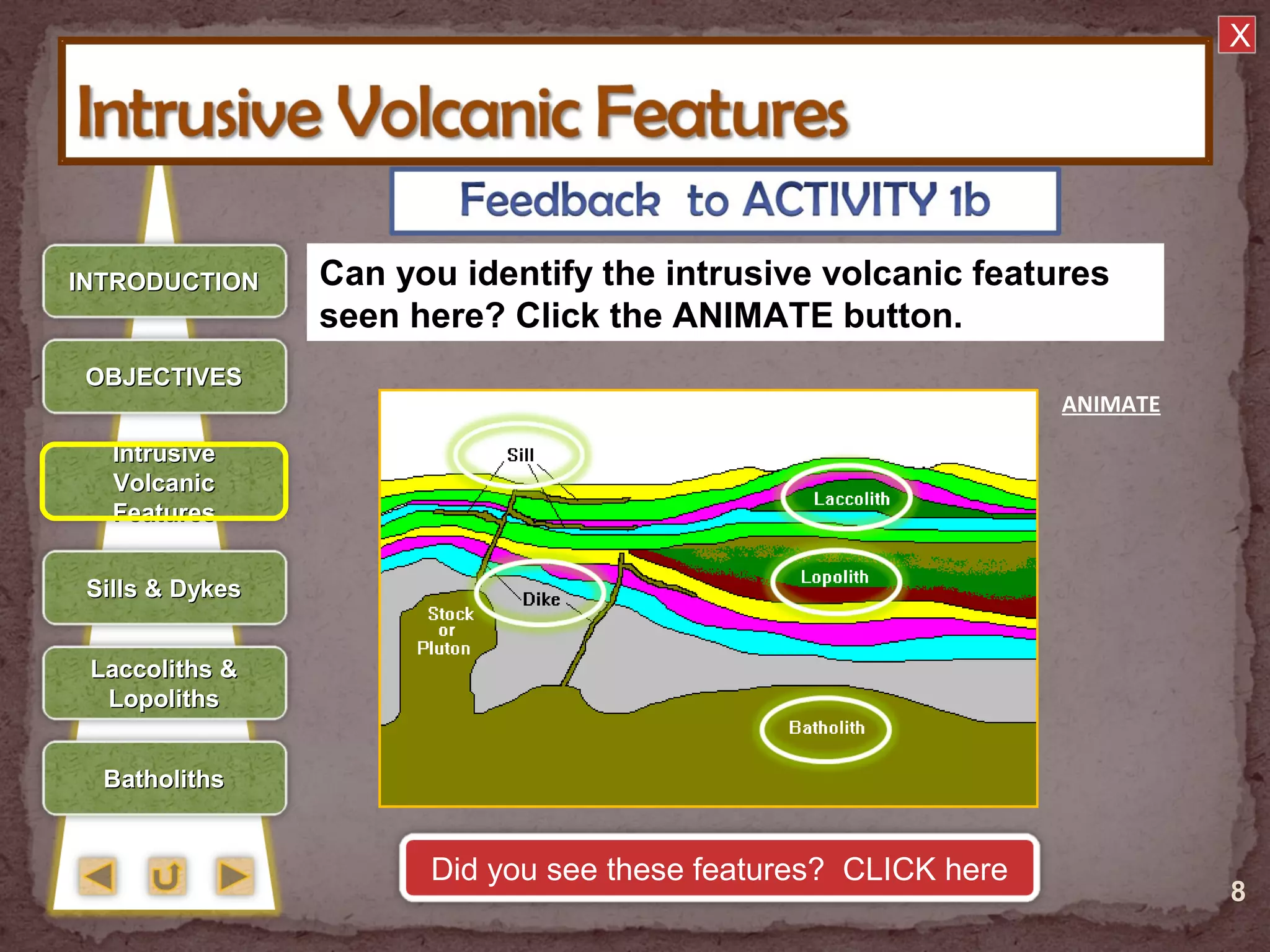
Can you identify the intrusive volcanic features
seen here? Click the ANIMATE button.
8
Did you see these features? CLICK here
ANIMATE
OBJECTIVESOBJECTIVES
IntrusiveIntrusive
VolcanicVolcanic
FeaturesFeatures
Sills & DykesSills & Dykes
Laccoliths &Laccoliths &
LopolithsLopoliths
BatholithsBatholiths
INTRODUCTIONINTRODUCTION
X
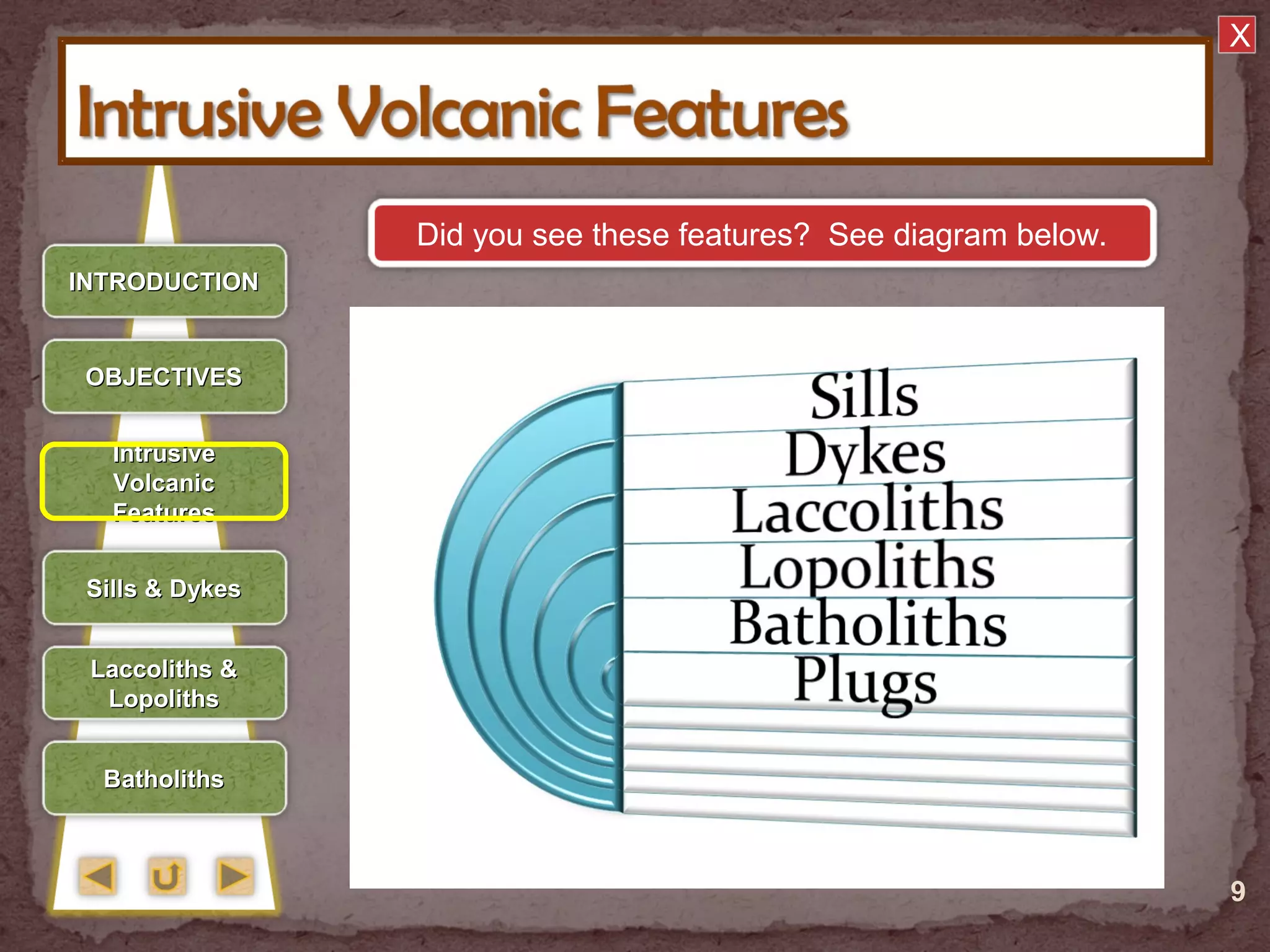
Did you see these features? See diagram below.
9
OBJECTIVESOBJECTIVES
IntrusiveIntrusive
VolcanicVolcanic
FeaturesFeatures
Sills & DykesSills & Dykes
Laccoliths &Laccoliths &
LopolithsLopoliths
BatholithsBatholiths
INTRODUCTIONINTRODUCTION
X
Can you identify the sill in this diagram?
10
It is the feature highlighted inIt is the feature highlighted in blue-greenblue-green..
OBJECTIVESOBJECTIVES
IntrusiveIntrusive
VolcanicVolcanic
FeaturesFeatures
Sills & DykesSills & Dykes
Laccoliths &Laccoliths &
LopolithsLopoliths
BatholithsBatholiths
INTRODUCTIONINTRODUCTION
X
Instructions:
1. Read each question and type your response in the box
below. Click the CHECK button for feedback.
2. You need to be in slide show view to type and edit text.
1. A sill is a sheet like injection of magma between layers of
sedimentary rock. It ranges from a few feet to hundreds of
feet thick.
2. A sill is formed when magma cools and solidifies along the
bedding plane.
11
OBJECTIVESOBJECTIVES
IntrusiveIntrusive
VolcanicVolcanic
FeaturesFeatures
Sills & DykesSills & Dykes
Laccoliths &Laccoliths &
LopolithsLopoliths
BatholithsBatholiths
INTRODUCTIONINTRODUCTION
X
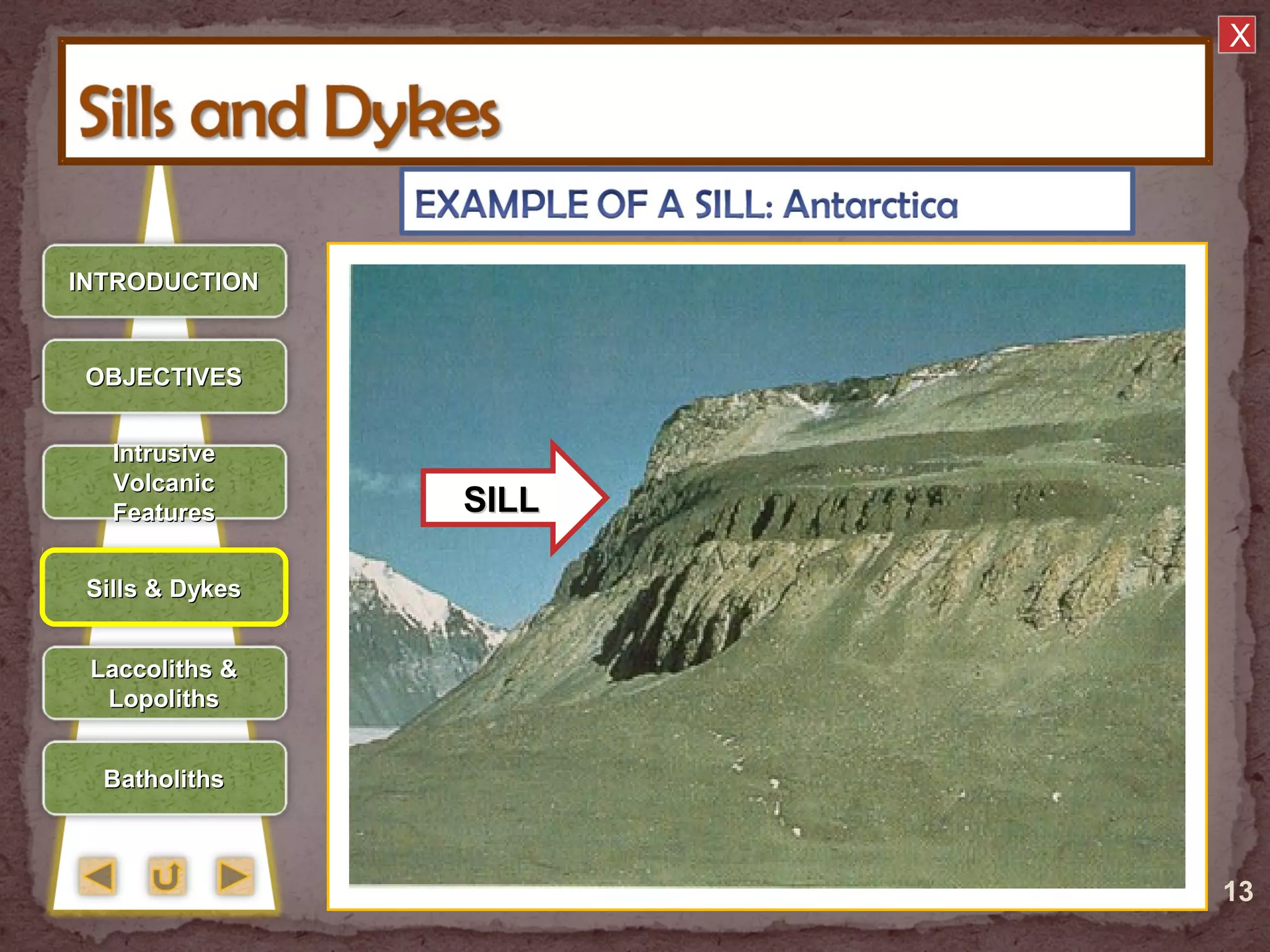
SILLSILL
12
OBJECTIVESOBJECTIVES
IntrusiveIntrusive
VolcanicVolcanic
FeaturesFeatures
Sills & DykesSills & Dykes
Laccoliths &Laccoliths &
LopolithsLopoliths
BatholithsBatholiths
INTRODUCTIONINTRODUCTION
X
SILLSILL
13
OBJECTIVESOBJECTIVES
IntrusiveIntrusive
VolcanicVolcanic
FeaturesFeatures
Sills & DykesSills & Dykes
Laccoliths &Laccoliths &
LopolithsLopoliths
BatholithsBatholiths
INTRODUCTIONINTRODUCTION
X
Instructions:
1. Read each question and type your response in the box below.
Click the CHECK button for feedback.
2. You need to be in slide show view to type and edit text.
The dyke is the feature highlighted in blue-greenblue-green. The
dyke cuts across the bedding plane whereas the sill runs
along the bedding plane.
14
OBJECTIVESOBJECTIVES
IntrusiveIntrusive
VolcanicVolcanic
FeaturesFeatures
Sills & DykesSills & Dykes
Laccoliths &Laccoliths &
LopolithsLopoliths
BatholithsBatholiths
INTRODUCTIONINTRODUCTION
X
15
The dyke tends to be vertical or near vertical
whereas the sill tends to be horizontal or
slightly inclined.
The dyke may reach the surface whereas the
sill is usually exposed at the surface after
erosion takes place.
Continue
Continue
Click for Photo
OBJECTIVESOBJECTIVES
IntrusiveIntrusive
VolcanicVolcanic
FeaturesFeatures
Sills & DykesSills & Dykes
Laccoliths &Laccoliths &
LopolithsLopoliths
BatholithsBatholiths
INTRODUCTIONINTRODUCTION
X
16
DYKEDYKE
PLUGPLUG
DYKEDYKE
PLUGPLUG
OBJECTIVESOBJECTIVES
IntrusiveIntrusive
VolcanicVolcanic
FeaturesFeatures
Sills & DykesSills & Dykes
Laccoliths &Laccoliths &
LopolithsLopoliths
BatholithsBatholiths
INTRODUCTIONINTRODUCTION
X
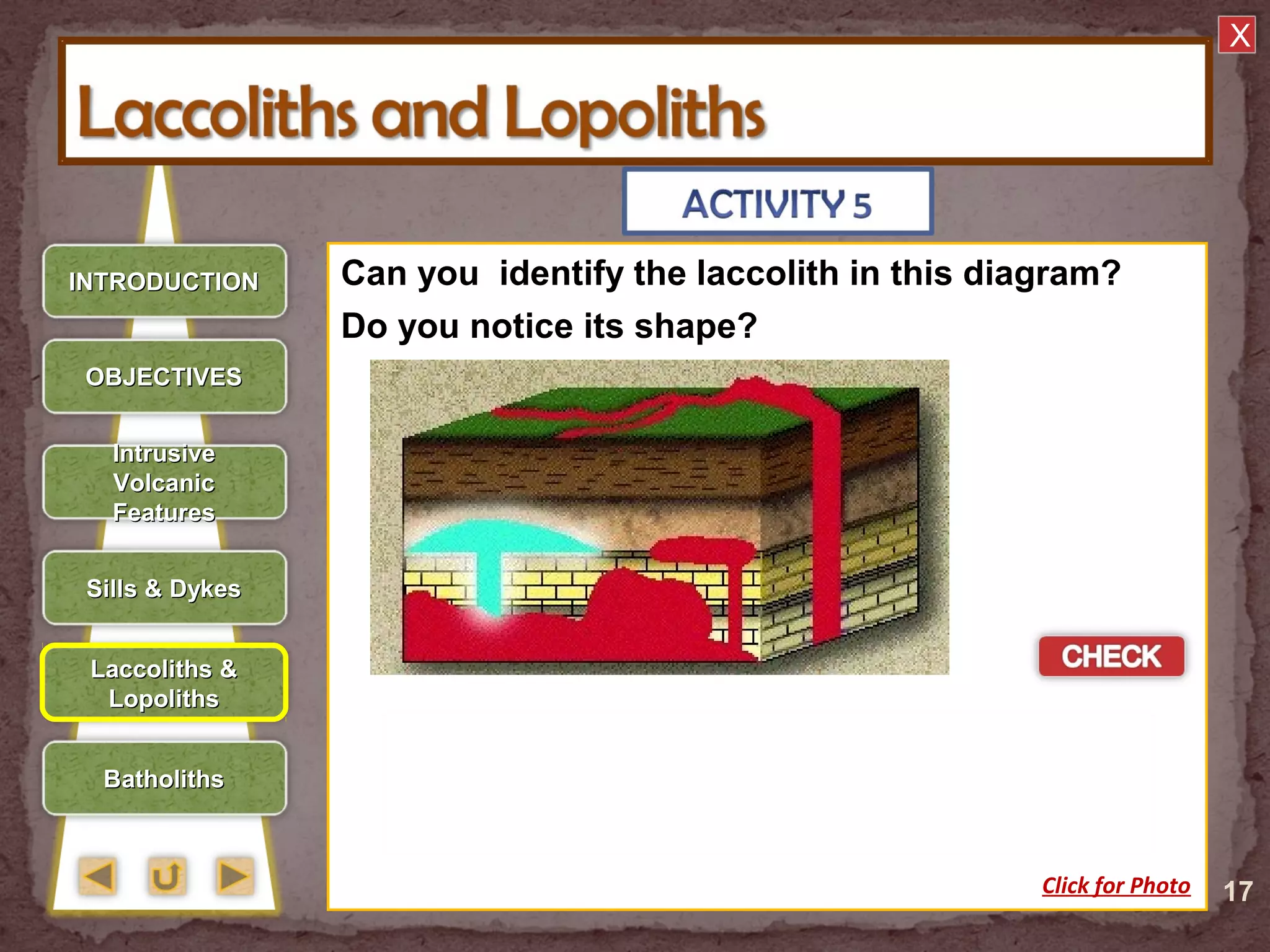
Can you identify the laccolith in this diagram?
Do you notice its shape?
17
The laccolith is highlighted in the blue-greenblue-green
colour. The laccolith has a dome shape.
Click for Photo
OBJECTIVESOBJECTIVES
IntrusiveIntrusive
VolcanicVolcanic
FeaturesFeatures
Sills & DykesSills & Dykes
Laccoliths &Laccoliths &
LopolithsLopoliths
BatholithsBatholiths
INTRODUCTIONINTRODUCTION
X
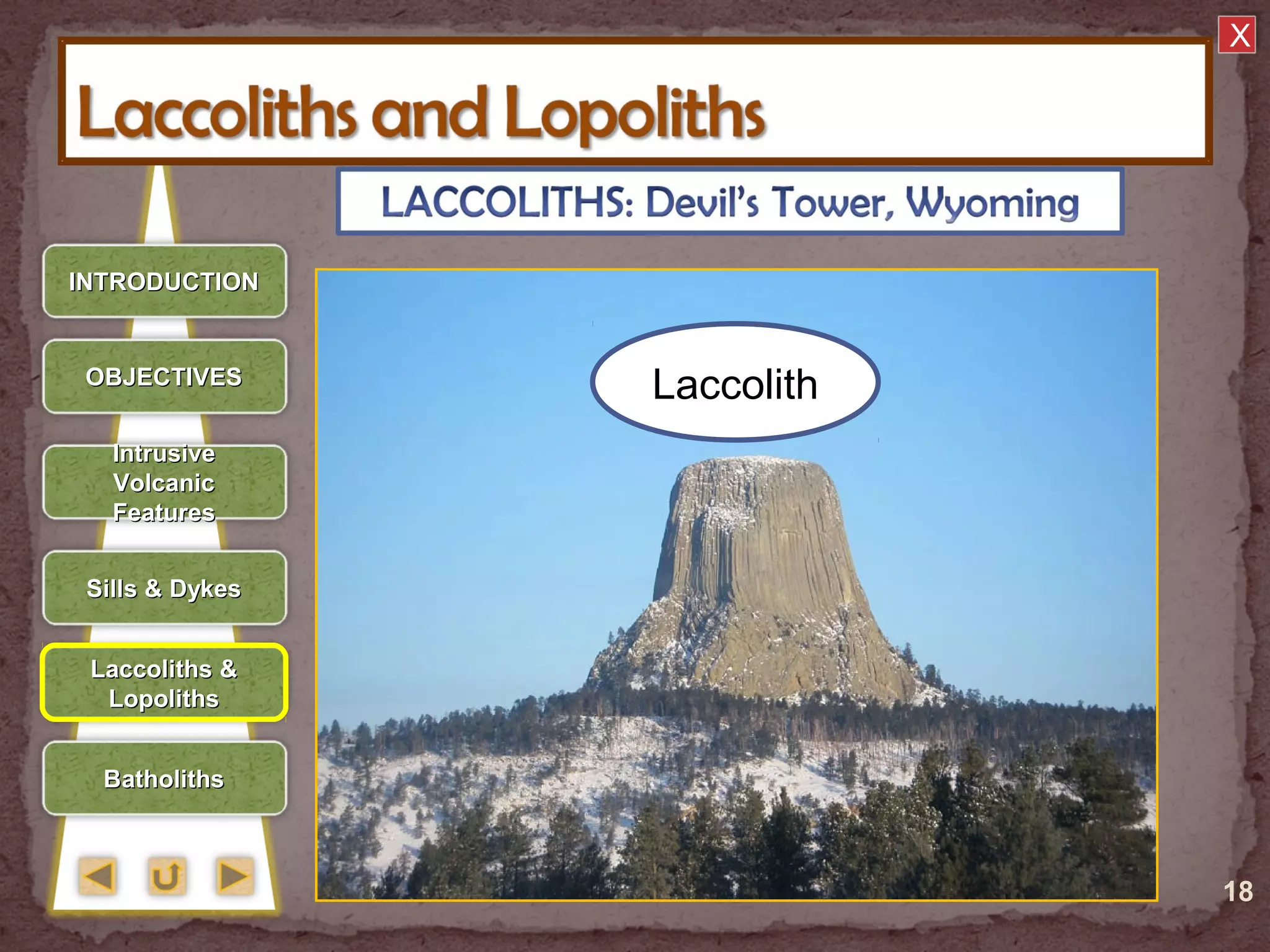
Laccolith
18
OBJECTIVESOBJECTIVES
IntrusiveIntrusive
VolcanicVolcanic
FeaturesFeatures
Sills & DykesSills & Dykes
Laccoliths &Laccoliths &
LopolithsLopoliths
BatholithsBatholiths
INTRODUCTIONINTRODUCTION
X
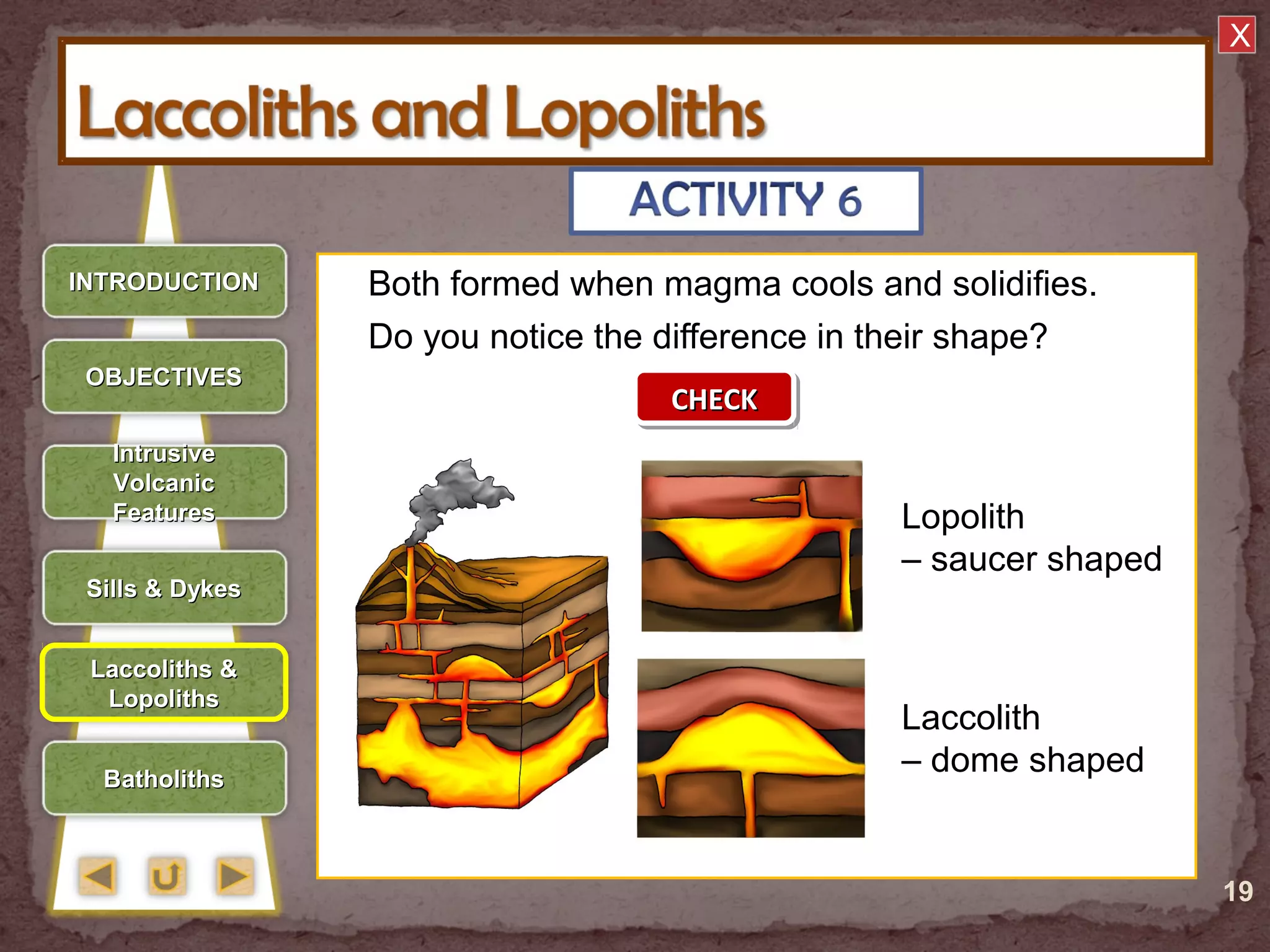
Both formed when magma cools and solidifies.
Do you notice the difference in their shape?
Lopolith
– saucer shaped
CHECKCHECKCHECKCHECK
19
Laccolith
– dome shaped
OBJECTIVESOBJECTIVES
IntrusiveIntrusive
VolcanicVolcanic
FeaturesFeatures
Sills & DykesSills & Dykes
Laccoliths &Laccoliths &
LopolithsLopoliths
BatholithsBatholiths
INTRODUCTIONINTRODUCTION
X
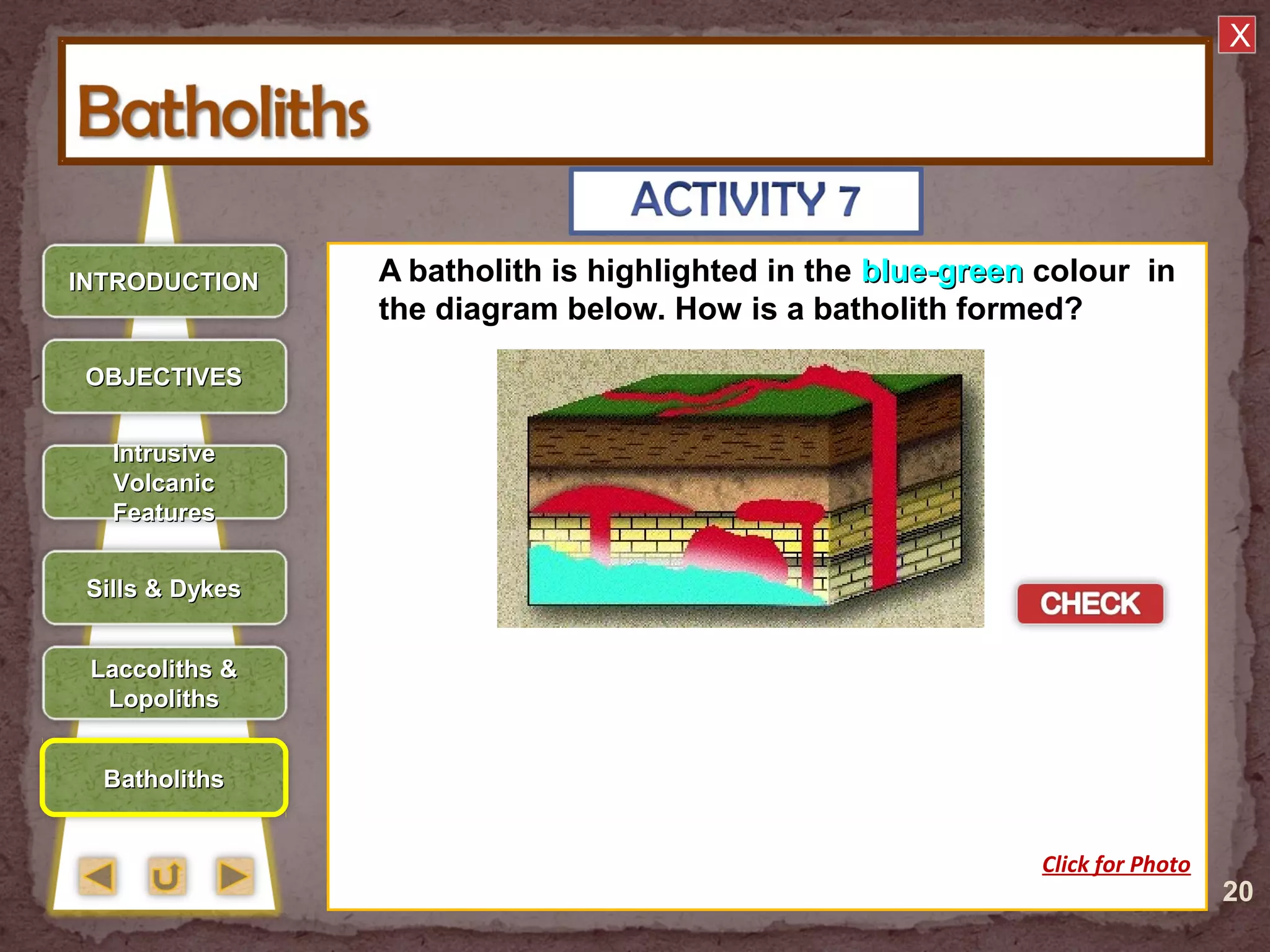
A batholith is highlighted in the blue-greenblue-green colour in
the diagram below. How is a batholith formed?
20
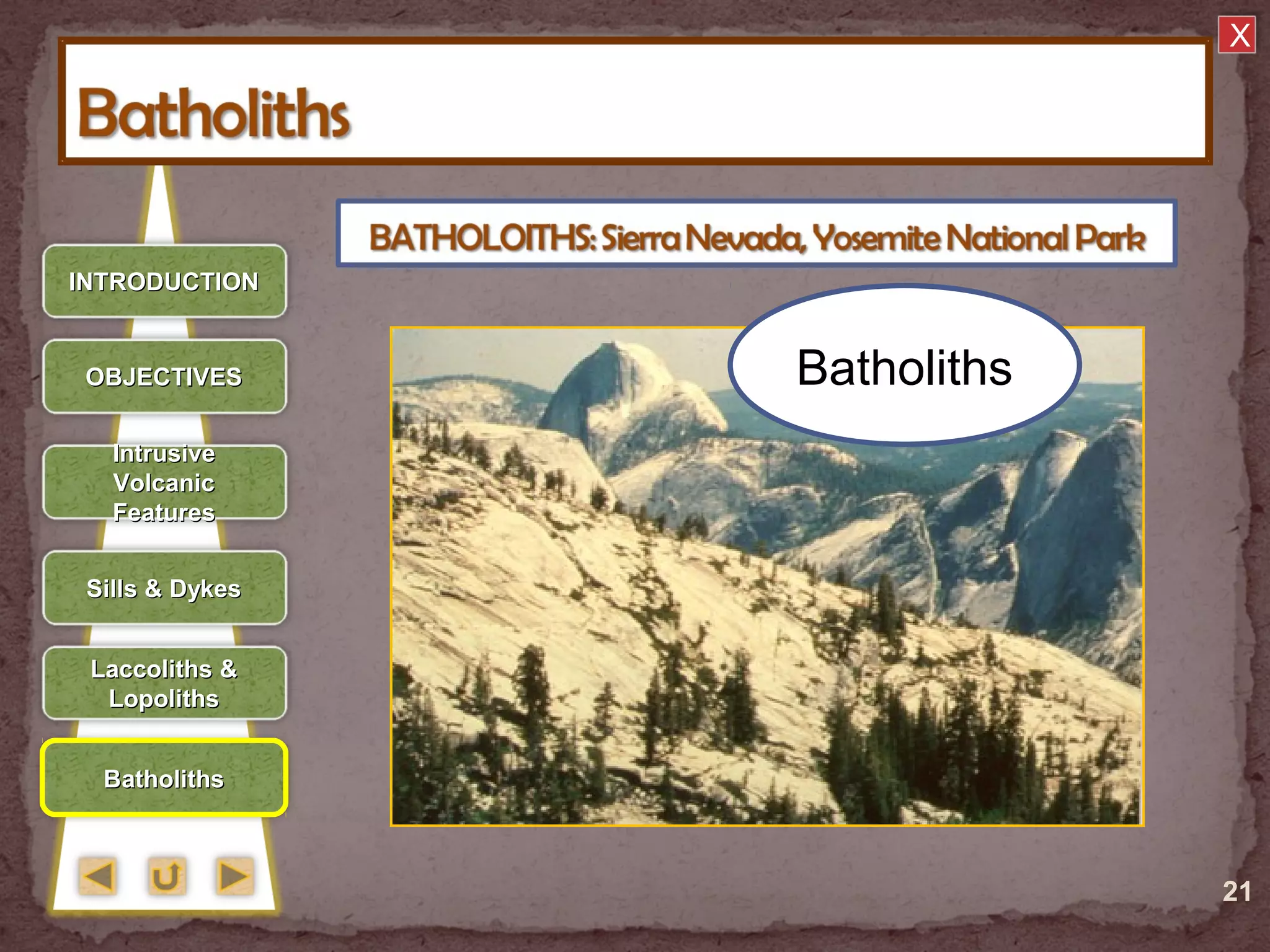
The largest intrusive body.
A large former magma chamber at shallow depth.
Dome-shaped intrusions of magma occurring at the base of mountains
or deep within the earth’s crust.
Click for Photo
OBJECTIVESOBJECTIVES
IntrusiveIntrusive
VolcanicVolcanic
FeaturesFeatures
Sills & DykesSills & Dykes
Laccoliths &Laccoliths &
LopolithsLopoliths
BatholithsBatholiths
INTRODUCTIONINTRODUCTION
X
21
Batholiths
OBJECTIVESOBJECTIVES
IntrusiveIntrusive
VolcanicVolcanic
FeaturesFeatures
Sills & DykesSills & Dykes
Laccoliths &Laccoliths &
LopolithsLopoliths
BatholithsBatholiths
INTRODUCTIONINTRODUCTION
X
 Batholith, Dyke, Lacolith,
http://www.indiana.edu/~geol105/images/gaia_chapter_5/igneou
s_rock_bodies.htm#batholith
 Intrusive Volcanic Features
http://www.uwgb.edu/dutchs/EarthSC202Notes/igneous.htm
 Laccolith
http://www.indiana.edu/~geol105/images/gaia_chapter_5/igneou
s_rock_bodies.htm#batholith
 Laccolith and Lopolith http://vankid.deviantart.com/art/Laccolith-
and-Lopolith-86364109
 Sill http://www.summitpost.org/palisades/607012
 Volcanic Landforms:
http://www.indiana.edu/~geol105/images/gaia_chapter_5/dike&sil
l.jpg
 Intrusive explanatory diagrams
http://www.indiana.edu/~geol116/week4/wk4.html
 Intrusive Features
http://1two3.co.za/geography/geogwiki/grade-
10/geomorphology/introduction/

Geography M1 Intrusive Volcanic

Editor's Notes

  • #2 Read this before viewing as slide show. Note. If you are using PowerPoint 2007, before you begin, look for the Security Warning below the ribbon, above this slide and click the Options button. In the Security Alert box, click “Enable This Content”. If the Security Warning does not appear, then view the presentation as Slide Show. If you are using PowerPoint 2013, look below the ribbon. If you see a Security Warning, click Enable Content before viewing in Slide Show View.
  • #6 Source: http://www.indiana.edu/~geol105/images/gaia_chapter_5/dike&sill.jpg
  • #7 Source: http://www.indiana.edu/~geol105/images/gaia_chapter_5/dike&sill.jpg
  • #8 Source: http://www.uwgb.edu/dutchs/EarthSC202Notes/igneous.htm
  • #9 Source: http://www.uwgb.edu/dutchs/EarthSC202Notes/igneous.htm
  • #11 Batholith, Dyke, Loccolith, http://www.indiana.edu/~geol105/images/gaia_chapter_5/igneous_rock_bodies.htm#batholith
  • #13 Source: http://www.summitpost.org/palisades/607012
  • #14 Source: http://www.indiana.edu/~geol105/images/gaia_chapter_5/igneous_rock_bodies.htm#batholith
  • #15 Source: http://www.indiana.edu/~geol105/images/gaia_chapter_5/igneous_rock_bodies.htm#batholith
  • #16 Source: http://www.indiana.edu/~geol105/images/gaia_chapter_5/igneous_rock_bodies.htm#batholith
  • #17 Source: http://www.indiana.edu/~geol105/images/gaia_chapter_5/igneous_rock_bodies.htm#batholith
  • #18 Source: http://www.indiana.edu/~geol105/images/gaia_chapter_5/igneous_rock_bodies.htm#batholith
  • #19 Source: http://www.indiana.edu/~geol105/images/gaia_chapter_5/igneous_rock_bodies.htm#batholith
  • #20 Source: http://vankid.deviantart.com/art/Laccolith-and-Lopolith-86364109
  • #21 Batholith, Dyke, Loccolith, http://www.indiana.edu/~geol105/images/gaia_chapter_5/igneous_rock_bodies.htm#batholith
  • #22 Source: http://www.indiana.edu/~geol105/images/gaia_chapter_5/igneous_rock_bodies.htm#batholith