Weathering and Soil Formation 4.2 Weathering and organic processes form soil.
VOCABULARY humus - decayed organic matter (dead leaves) in soil soil horizon - a layer of soil with properties that differ from those of the layer above or below it soil profile - horizons in a specific location
Soil is a mixture of weathered rock particles and other materials. SOIL COMPOSITION Weathered rock particles (main ingredient) Water (20-30%) Air (20-30%)  Organic matter (5%) Organic means, “coming from living organisms.” Organic matter in soil comes from the remains and waste products of plants, animals, and other living organisms. *Soils differ depending on what types of rock the rock particles came from.
Humus comes from decayed organic matter. Different soils are made up of different ingredients and different amounts of each ingredient.  The black humus on the left contains much more plant material and water than the red soil on the right.
Types of Soil The kind of soil that forms in an area depends on: The kind of rock in the area The area’s climate (overall weather pattern) The landforms in the area (mountains, valleys) The plant cover in the area The animals and other organisms in the area Time  *The composition of the soil determines what you can grow in it, what you can build on it and what happens to the rainwater that falls on it.
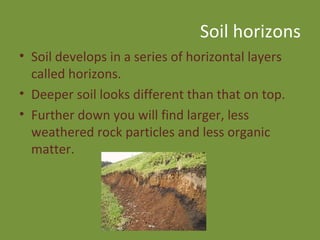
Soil horizons Soil develops in a series of horizontal layers called horizons.  Deeper soil looks different than that on top. Further down you will find larger, less weathered rock particles and less organic matter.
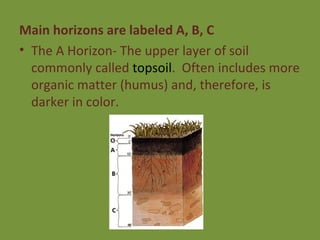
Main horizons are labeled A, B, C The A Horizon- The upper layer of soil commonly called  topsoil .  Often includes more organic matter (humus) and, therefore, is darker in color.
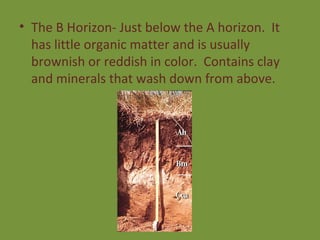
The B Horizon- Just below the A horizon.  It has little organic matter and is usually brownish or reddish in color.  Contains clay and minerals that wash down from above.
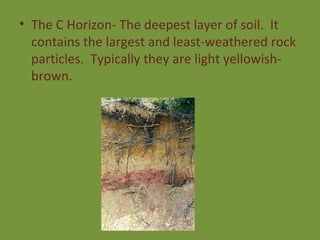
The C Horizon- The deepest layer of soil.  It contains the largest and least-weathered rock particles.  Typically they are light yellowish-brown.
Climate and landforms affect soil Different kinds of soils form in different  climates . Soil that forms in hot, wet climates is different than those that form in cold, dry climates. The  shape of the land  affects soil development. Mountain soils (cold climate) are different than nearby valleys.  Earth’s Surface pg. 124
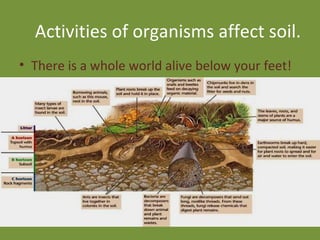
Activities of organisms affect soil. There is a whole world alive below your feet!
ORGANISMS AFFECTING THE SOIL Plants- Trees/ grasses provide much of the organic matter that forms humus. Microorganisms- Include decomposers (fungi, bacteria).  A spoonful of soil may contain 1 million microorganisms.  They change nitrogen in soil and air to compounds that plants can absorb.  Bacteria can produce acids that break down rocks. Cycling of nutrients pg. 126 Animals- Earthworms, ants, termites, mice and groundhogs all live in the soil.  They add to the air content of the soil by loosening and tunneling the soil.  They help to improve drainage also.  Return nutrients to the soil when they die.
Observable, measurable properties of soil. Texture- Determined by the size of the weathered rock particles that it contains. Color- Comes from iron compounds and humus. Pore Space- Spaces between particles. Soils range from 25-60% pore space.  Ideal growing soil is about 50% pore space. Chemistry- Acidity of water in soil determines how well nutrients dissolve.
Review What are the main ingredients of soil? How do climate and landforms affect soils’ characteristics? How do organisms affect the characteristics of soil? Describe the four properties of soil. Which would be more fertile, soil on hilly land or soil on a plain? Why?

4.2 Weathering And Soil Formation

  • 1.
    Weathering and SoilFormation 4.2 Weathering and organic processes form soil.
  • 2.
    VOCABULARY humus -decayed organic matter (dead leaves) in soil soil horizon - a layer of soil with properties that differ from those of the layer above or below it soil profile - horizons in a specific location
  • 3.
    Soil is amixture of weathered rock particles and other materials. SOIL COMPOSITION Weathered rock particles (main ingredient) Water (20-30%) Air (20-30%) Organic matter (5%) Organic means, “coming from living organisms.” Organic matter in soil comes from the remains and waste products of plants, animals, and other living organisms. *Soils differ depending on what types of rock the rock particles came from.
  • 4.
    Humus comes fromdecayed organic matter. Different soils are made up of different ingredients and different amounts of each ingredient. The black humus on the left contains much more plant material and water than the red soil on the right.
  • 5.
    Types of SoilThe kind of soil that forms in an area depends on: The kind of rock in the area The area’s climate (overall weather pattern) The landforms in the area (mountains, valleys) The plant cover in the area The animals and other organisms in the area Time *The composition of the soil determines what you can grow in it, what you can build on it and what happens to the rainwater that falls on it.
  • 6.
    Soil horizons Soildevelops in a series of horizontal layers called horizons. Deeper soil looks different than that on top. Further down you will find larger, less weathered rock particles and less organic matter.
  • 7.
    Main horizons arelabeled A, B, C The A Horizon- The upper layer of soil commonly called topsoil . Often includes more organic matter (humus) and, therefore, is darker in color.
  • 8.
    The B Horizon-Just below the A horizon. It has little organic matter and is usually brownish or reddish in color. Contains clay and minerals that wash down from above.
  • 9.
    The C Horizon-The deepest layer of soil. It contains the largest and least-weathered rock particles. Typically they are light yellowish-brown.
  • 10.
    Climate and landformsaffect soil Different kinds of soils form in different climates . Soil that forms in hot, wet climates is different than those that form in cold, dry climates. The shape of the land affects soil development. Mountain soils (cold climate) are different than nearby valleys. Earth’s Surface pg. 124
  • 11.
    Activities of organismsaffect soil. There is a whole world alive below your feet!
  • 12.
    ORGANISMS AFFECTING THESOIL Plants- Trees/ grasses provide much of the organic matter that forms humus. Microorganisms- Include decomposers (fungi, bacteria). A spoonful of soil may contain 1 million microorganisms. They change nitrogen in soil and air to compounds that plants can absorb. Bacteria can produce acids that break down rocks. Cycling of nutrients pg. 126 Animals- Earthworms, ants, termites, mice and groundhogs all live in the soil. They add to the air content of the soil by loosening and tunneling the soil. They help to improve drainage also. Return nutrients to the soil when they die.
  • 13.
    Observable, measurable propertiesof soil. Texture- Determined by the size of the weathered rock particles that it contains. Color- Comes from iron compounds and humus. Pore Space- Spaces between particles. Soils range from 25-60% pore space. Ideal growing soil is about 50% pore space. Chemistry- Acidity of water in soil determines how well nutrients dissolve.
  • 14.
    Review What arethe main ingredients of soil? How do climate and landforms affect soils’ characteristics? How do organisms affect the characteristics of soil? Describe the four properties of soil. Which would be more fertile, soil on hilly land or soil on a plain? Why?