




Lithosphere
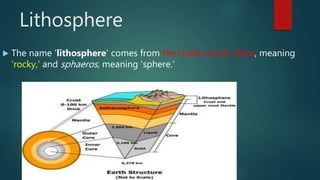
Lithosphere
 The name 'lithosphere' comes from the Greek words lithos, meaning
'rocky,' and sphaeros, meaning 'sphere.‘
Soil
 The word Soil is derived from Latin word “solum”
 Meaning earthy material in which plants growth.
 The science which deals with the study of soil is called Soil Science ,
Pedology (pedos-earth), or edaphology (edaphos-soil)
 The study of soil is helpful in
• Agriculture
• Horticulture
• Forestry
• Irrigation
• Use of fertilizers
 Pedology is also useful in science like
• Geology
• Petrology
• Mineralogy
• Palaeobotany
• Palaeozoology
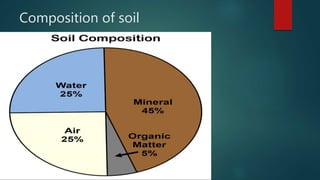
Composition of soil
Formation of soil
 The whole process of soil formation is divided into 2
stage
1. Weathering
2. Soil development or Pedogenesis
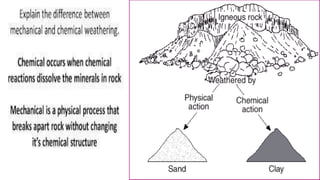
Weathering process
 Weathering of soil forming Rocks : Soil formation is stared by Disintegration or
weathering of rocks parent rocks by some physical, chemical and biological
agents , because of which the soil-forming rocks are broken down in small
particles called Regolith.
 Regolith are the basic material which under the influence of various other
pedogenic process finally develop into mature soil.
Types of Weathering :-
1. Physical Weathering
2. Chemical Weathering
3. Biological Weathering
Physical Weathering
 The physical weathering agents are primarily climatic in character,
 Mechanical effect on substratum with result that fragments are comminuted
into progressively decreasing particle size.
 Such climatic weathering of rock does not cause any chemical transportation
of rocks minerals.
 Commonly occurs in
• Deserts
• High Altitudes
• High latitudes
• Less vegetation cover.
The agents of Physical Weathering
 Temperature
 Water
 Ice
 Gravity
 Wind
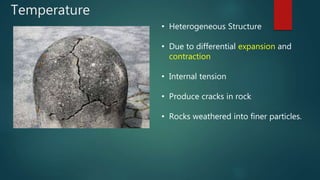
Temperature
• Heterogeneous Structure
• Due to differential expansion and
contraction
• Internal tension
• Produce cracks in rock
• Rocks weathered into finer particles.
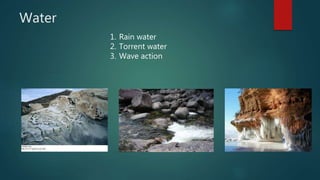
Water
1. Rain water
2. Torrent water
3. Wave action
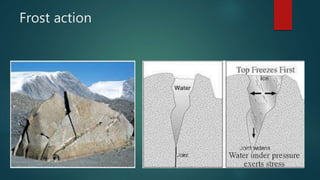
Frost action
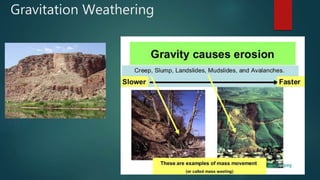
Gravitation Weathering
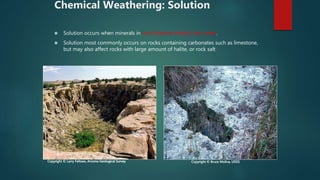
Chemical Weathering: Solution
 Solution occurs when minerals in rock dissolve directly into water.
 Solution most commonly occurs on rocks containing carbonates such as limestone,
but may also affect rocks with large amount of halite, or rock salt
Copyright © Larry Fellows, Arizona Geological Survey Copyright © Bruce Molina, USGS
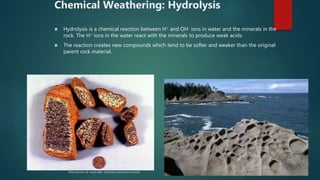
Chemical Weathering: Hydrolysis
 Hydrolysis is a chemical reaction between H+ and OH- ions in water and the minerals in the
rock. The H+ ions in the water react with the minerals to produce weak acids.
 The reaction creates new compounds which tend to be softer and weaker than the original
parent rock material.
Photo Source: Dr. Hugh Mills, Tennessee Technical University
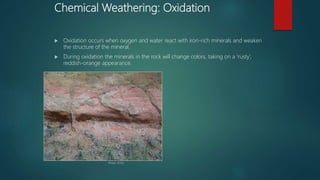
Chemical Weathering: Oxidation
 Oxidation occurs when oxygen and water react with iron-rich minerals and weaken
the structure of the mineral.
 During oxidation the minerals in the rock will change colors, taking on a ‘rusty’,
reddish-orange appearance.
Photo: SCGS
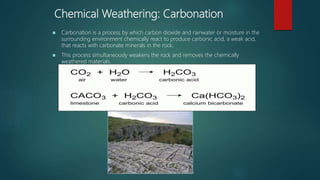
Chemical Weathering: Carbonation
 Carbonation is a process by which carbon dioxide and rainwater or moisture in the
surrounding environment chemically react to produce carbonic acid, a weak acid,
that reacts with carbonate minerals in the rock.
 This process simultaneously weakens the rock and removes the chemically
weathered materials.
Photo source: Wikipedia GNU Free Documentation License
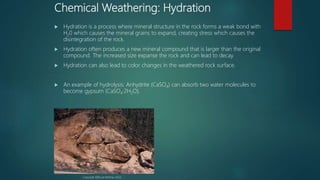
Chemical Weathering: Hydration
 Hydration is a process where mineral structure in the rock forms a weak bond with
H20 which causes the mineral grains to expand, creating stress which causes the
disintegration of the rock.
 Hydration often produces a new mineral compound that is larger than the original
compound. The increased size expanse the rock and can lead to decay.
 Hydration can also lead to color changes in the weathered rock surface.
 An example of hydrolysis: Anhydrite (CaSO4) can absorb two water molecules to
become gypsum (CaSO4·2H2O).
Copyright ©Bruce Molnia, USGS
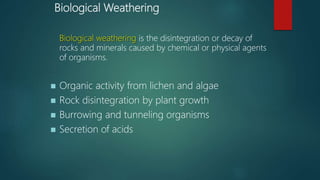
Biological Weathering
Biological weathering is the disintegration or decay of
rocks and minerals caused by chemical or physical agents
of organisms.
 Organic activity from lichen and algae
 Rock disintegration by plant growth
 Burrowing and tunneling organisms
 Secretion of acids
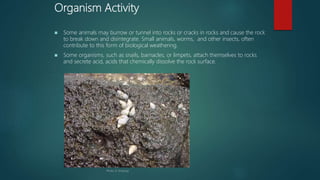
Organism Activity
 Some animals may burrow or tunnel into rocks or cracks in rocks and cause the rock
to break down and disintegrate. Small animals, worms, and other insects, often
contribute to this form of biological weathering.
 Some organisms, such as snails, barnacles, or limpets, attach themselves to rocks
and secrete acid, acids that chemically dissolve the rock surface.
Photo: D. Kroessig
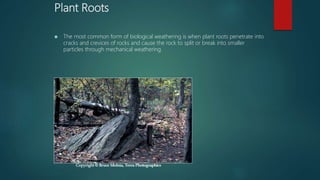
Plant Roots
 The most common form of biological weathering is when plant roots penetrate into
cracks and crevices of rocks and cause the rock to split or break into smaller
particles through mechanical weathering.
Copyright © Bruce Molnia, Terra Photographics
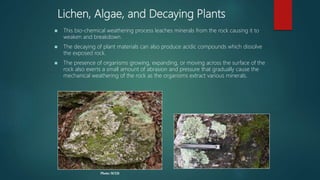
Lichen, Algae, and Decaying Plants
 This bio-chemical weathering process leaches minerals from the rock causing it to
weaken and breakdown.
 The decaying of plant materials can also produce acidic compounds which dissolve
the exposed rock.
 The presence of organisms growing, expanding, or moving across the surface of the
rock also exerts a small amount of abrasion and pressure that gradually cause the
mechanical weathering of the rock as the organisms extract various minerals.
Photo: SCGS
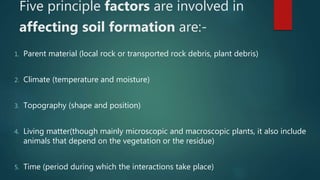
Five principle factors are involved in
affecting soil formation are:-
1. Parent material (local rock or transported rock debris, plant debris)
2. Climate (temperature and moisture)
3. Topography (shape and position)
4. Living matter(though mainly microscopic and macroscopic plants, it also include
animals that depend on the vegetation or the residue)
5. Time (period during which the interactions take place)
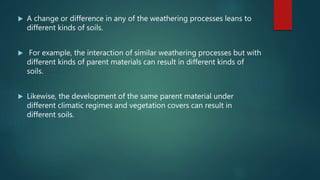
 A change or difference in any of the weathering processes leans to
different kinds of soils.
 For example, the interaction of similar weathering processes but with
different kinds of parent materials can result in different kinds of
soils.
 Likewise, the development of the same parent material under
different climatic regimes and vegetation covers can result in
different soils.
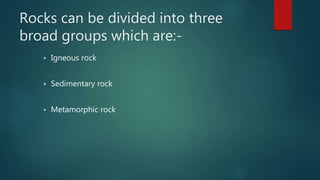
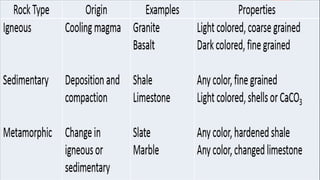
Rocks can be divided into three
broad groups which are:-
 Igneous rock
 Sedimentary rock
 Metamorphic rock
Climate
 The most important climatic factors in soil formation are rainfall, temperature and evaporation. Rain
provides water needed for the chemical processes as well leaching of elements and soil erosion.
Indirectly, rain determines the types of vegetation which in turn determines the amount of organic
matter accumulation, and hence the types of soil formed.
 For example, soils in the humid tropics formed under rain forest are different from soils formed
under grassland vegetation with drier climate. Similarly different temperature will result in different
vegetation and different microorganisms which will give rise to different types of soil.
 Generally, it is the intense climate of high rainfall and temperature that develop acidic soils of the
tropics that are low in nutrients, low in cation exchange capacity, low in organic matter content but
highly acidic and high in exchangeable aluminum. Areas with low rainfall will have alkaline soils with
high base as well as high organic matter content.
Topography
 Topography is an important factor which influence soil development through its effect on soil
erosion and drainage. Topography exerts it influence on soil formation as it determines the ease
of penetration of water or run-off and the drainage of water from a specific area.
 Erosion occurs during heavy rain on steep land. Surface water run-off can remove the surface
layer of soil in the form of sheet erosion. On steep slopes surface erosion very often surpasses
soil formation and hence one would expect to reach the parent material at much shallower
depths in areas of strong relief than in areas of gentler terrain.
 Soil drainage is partly a function of topography. Soils on a river floodplain tend to be wet for
long period of the year while soils on the hill slopes tend to be reasonably dry for most of the
time.
 The amount of soil water has a great influence on the properties of the soils. The soil water takes
up air space in the soil and insufficient air generally prevents root development of plants. In
aerobic conditions, organisms break down leaf litter to produce plant nutrients while under
anaerobic conditions, anaerobic bacteria produce reduced forms of chemical compounds which
are often toxic to plants.
Living Matter (Organisms)
Organisms include microorganisms, macro-organisms and man.
 Microorganisms: are beneficial in that they breakdown litter into simple organic elements or
compounds that can be used as nutrients by high plants.
 Macro organisms: can improve the soil structure by forming burrows and holes.
 Man: can play an important part in modifying the soils to cause erosion by cultivation hill land and
depleting nutrients by removing the crops.
Time (Age)
 Soils change with age.
 The length of time required for any soil to be mature depends on the other soil forming
factors particularly topography and parent material.
 However it is an exceedingly slow process.
 It may be noted that a mature soil is not necessary more fertile than a young alluvial soil
and the length of time a soil has undergone development is not the only factor to
its maturity.

 A sandy soil on a level landscape can reach maturity in decades due mainly to erosion of
the soil material formed.
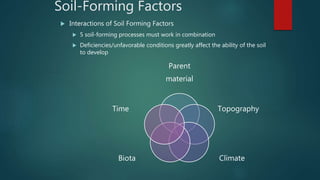
Soil-Forming Factors
 Interactions of Soil Forming Factors
 5 soil-forming processes must work in combination
 Deficiencies/unfavorable conditions greatly affect the ability of the soil
to develop
Parent
material
Topography
ClimateBiota
Time
Thank you 

Lithosphere

  • 1.
  • 2.
    Lithosphere  The name'lithosphere' comes from the Greek words lithos, meaning 'rocky,' and sphaeros, meaning 'sphere.‘
  • 3.
    Soil  The wordSoil is derived from Latin word “solum”  Meaning earthy material in which plants growth.  The science which deals with the study of soil is called Soil Science , Pedology (pedos-earth), or edaphology (edaphos-soil)  The study of soil is helpful in • Agriculture • Horticulture • Forestry • Irrigation • Use of fertilizers
  • 4.
     Pedology isalso useful in science like • Geology • Petrology • Mineralogy • Palaeobotany • Palaeozoology
  • 5.
  • 6.
    Formation of soil The whole process of soil formation is divided into 2 stage 1. Weathering 2. Soil development or Pedogenesis
  • 7.
    Weathering process  Weatheringof soil forming Rocks : Soil formation is stared by Disintegration or weathering of rocks parent rocks by some physical, chemical and biological agents , because of which the soil-forming rocks are broken down in small particles called Regolith.  Regolith are the basic material which under the influence of various other pedogenic process finally develop into mature soil.
  • 8.
    Types of Weathering:- 1. Physical Weathering 2. Chemical Weathering 3. Biological Weathering
  • 9.
    Physical Weathering  Thephysical weathering agents are primarily climatic in character,  Mechanical effect on substratum with result that fragments are comminuted into progressively decreasing particle size.  Such climatic weathering of rock does not cause any chemical transportation of rocks minerals.  Commonly occurs in • Deserts • High Altitudes • High latitudes • Less vegetation cover.
  • 10.
    The agents ofPhysical Weathering  Temperature  Water  Ice  Gravity  Wind
  • 11.
    Temperature • Heterogeneous Structure •Due to differential expansion and contraction • Internal tension • Produce cracks in rock • Rocks weathered into finer particles.
  • 12.
    Water 1. Rain water 2.Torrent water 3. Wave action
  • 13.
  • 14.
  • 15.
    Chemical Weathering: Solution Solution occurs when minerals in rock dissolve directly into water.  Solution most commonly occurs on rocks containing carbonates such as limestone, but may also affect rocks with large amount of halite, or rock salt Copyright © Larry Fellows, Arizona Geological Survey Copyright © Bruce Molina, USGS
  • 16.
    Chemical Weathering: Hydrolysis Hydrolysis is a chemical reaction between H+ and OH- ions in water and the minerals in the rock. The H+ ions in the water react with the minerals to produce weak acids.  The reaction creates new compounds which tend to be softer and weaker than the original parent rock material. Photo Source: Dr. Hugh Mills, Tennessee Technical University
  • 17.
    Chemical Weathering: Oxidation Oxidation occurs when oxygen and water react with iron-rich minerals and weaken the structure of the mineral.  During oxidation the minerals in the rock will change colors, taking on a ‘rusty’, reddish-orange appearance. Photo: SCGS
  • 18.
    Chemical Weathering: Carbonation Carbonation is a process by which carbon dioxide and rainwater or moisture in the surrounding environment chemically react to produce carbonic acid, a weak acid, that reacts with carbonate minerals in the rock.  This process simultaneously weakens the rock and removes the chemically weathered materials. Photo source: Wikipedia GNU Free Documentation License
  • 19.
    Chemical Weathering: Hydration Hydration is a process where mineral structure in the rock forms a weak bond with H20 which causes the mineral grains to expand, creating stress which causes the disintegration of the rock.  Hydration often produces a new mineral compound that is larger than the original compound. The increased size expanse the rock and can lead to decay.  Hydration can also lead to color changes in the weathered rock surface.  An example of hydrolysis: Anhydrite (CaSO4) can absorb two water molecules to become gypsum (CaSO4·2H2O). Copyright ©Bruce Molnia, USGS
  • 21.
    Biological Weathering Biological weatheringis the disintegration or decay of rocks and minerals caused by chemical or physical agents of organisms.  Organic activity from lichen and algae  Rock disintegration by plant growth  Burrowing and tunneling organisms  Secretion of acids
  • 22.
    Organism Activity  Someanimals may burrow or tunnel into rocks or cracks in rocks and cause the rock to break down and disintegrate. Small animals, worms, and other insects, often contribute to this form of biological weathering.  Some organisms, such as snails, barnacles, or limpets, attach themselves to rocks and secrete acid, acids that chemically dissolve the rock surface. Photo: D. Kroessig
  • 23.
    Plant Roots  Themost common form of biological weathering is when plant roots penetrate into cracks and crevices of rocks and cause the rock to split or break into smaller particles through mechanical weathering. Copyright © Bruce Molnia, Terra Photographics
  • 24.
    Lichen, Algae, andDecaying Plants  This bio-chemical weathering process leaches minerals from the rock causing it to weaken and breakdown.  The decaying of plant materials can also produce acidic compounds which dissolve the exposed rock.  The presence of organisms growing, expanding, or moving across the surface of the rock also exerts a small amount of abrasion and pressure that gradually cause the mechanical weathering of the rock as the organisms extract various minerals. Photo: SCGS
  • 25.
    Five principle factorsare involved in affecting soil formation are:- 1. Parent material (local rock or transported rock debris, plant debris) 2. Climate (temperature and moisture) 3. Topography (shape and position) 4. Living matter(though mainly microscopic and macroscopic plants, it also include animals that depend on the vegetation or the residue) 5. Time (period during which the interactions take place)
  • 26.
     A changeor difference in any of the weathering processes leans to different kinds of soils.  For example, the interaction of similar weathering processes but with different kinds of parent materials can result in different kinds of soils.  Likewise, the development of the same parent material under different climatic regimes and vegetation covers can result in different soils.
  • 27.
    Rocks can bedivided into three broad groups which are:-  Igneous rock  Sedimentary rock  Metamorphic rock
  • 29.
    Climate  The mostimportant climatic factors in soil formation are rainfall, temperature and evaporation. Rain provides water needed for the chemical processes as well leaching of elements and soil erosion. Indirectly, rain determines the types of vegetation which in turn determines the amount of organic matter accumulation, and hence the types of soil formed.  For example, soils in the humid tropics formed under rain forest are different from soils formed under grassland vegetation with drier climate. Similarly different temperature will result in different vegetation and different microorganisms which will give rise to different types of soil.  Generally, it is the intense climate of high rainfall and temperature that develop acidic soils of the tropics that are low in nutrients, low in cation exchange capacity, low in organic matter content but highly acidic and high in exchangeable aluminum. Areas with low rainfall will have alkaline soils with high base as well as high organic matter content.
  • 30.
    Topography  Topography isan important factor which influence soil development through its effect on soil erosion and drainage. Topography exerts it influence on soil formation as it determines the ease of penetration of water or run-off and the drainage of water from a specific area.  Erosion occurs during heavy rain on steep land. Surface water run-off can remove the surface layer of soil in the form of sheet erosion. On steep slopes surface erosion very often surpasses soil formation and hence one would expect to reach the parent material at much shallower depths in areas of strong relief than in areas of gentler terrain.  Soil drainage is partly a function of topography. Soils on a river floodplain tend to be wet for long period of the year while soils on the hill slopes tend to be reasonably dry for most of the time.  The amount of soil water has a great influence on the properties of the soils. The soil water takes up air space in the soil and insufficient air generally prevents root development of plants. In aerobic conditions, organisms break down leaf litter to produce plant nutrients while under anaerobic conditions, anaerobic bacteria produce reduced forms of chemical compounds which are often toxic to plants.
  • 31.
    Living Matter (Organisms) Organismsinclude microorganisms, macro-organisms and man.  Microorganisms: are beneficial in that they breakdown litter into simple organic elements or compounds that can be used as nutrients by high plants.  Macro organisms: can improve the soil structure by forming burrows and holes.  Man: can play an important part in modifying the soils to cause erosion by cultivation hill land and depleting nutrients by removing the crops.
  • 32.
    Time (Age)  Soilschange with age.  The length of time required for any soil to be mature depends on the other soil forming factors particularly topography and parent material.  However it is an exceedingly slow process.  It may be noted that a mature soil is not necessary more fertile than a young alluvial soil and the length of time a soil has undergone development is not the only factor to its maturity.   A sandy soil on a level landscape can reach maturity in decades due mainly to erosion of the soil material formed.
  • 33.
    Soil-Forming Factors  Interactionsof Soil Forming Factors  5 soil-forming processes must work in combination  Deficiencies/unfavorable conditions greatly affect the ability of the soil to develop Parent material Topography ClimateBiota Time
  • 34.