The arrangement of soil particles and their aggregate into certain
defined patterns is called soil structure.
The primary soil particles i.e. sand ,silt and clay – usually grouped
together in the form of aggregates.
 Natural aggregates called Ped.
The cohesion with in these aggregates is greater than adhesion.
Structure is studied in the field under natural condition
and it is describes under three categories .
1) Type –shape or form and arrangement pattern of ped.
2) Class – size of ped.
3) Grade – degree of distinctness of ped.
 There are four principle form of structure.
a) Plate-like:
In this structural type aggregates are arranged in
relatively thin horizontal plates. When the units are
thick called platy and when thin, laminar.
a) Prism-like :
The vertical axis is more develop then
horizontal. When the top of such ped is rounded
called columnar and when flat called prismatic
c) Block-like:
All these dimensions are about the same size and
the ped are cube-like with flat or rounded faces. When
faces are flat and the edges sharp angular ,called
angular blocky and when faces and edges are rounded
,called sub angular blocky.
d) Spheroidal: (Sphere-like).
All rounded aggregates are placed in this
group. The aggregates of this group are usually termed
as granular- relatively less porous.
when the granules are very porous called crumby.
Each primary structural type of soils is differentiated into 5- size
classes depending upon the size of the individual peds. The terms
commonly used for the size classes are:
1) Very fine or very thin
2) Fine or thin
3) Medium
4) Coarse or thick
5) Very coarse or very thick.
The term thin and thick used for platy and while the term fine
and coarse for others.
 Grade indicate the degree of distinctness of individual peds.
 It is determined by the stability of aggregates.
 It is influence by moisture content of soil .
 It also depend on O.M, texture etc. four term used to describe
the grade of soil structure are.
1) Structure less. There are no noticeable peds .e.g. loose sand.
2) Weak structure. Indistinct formation of ped, which is not
durable.
Compound structure:
Smaller structural units may be held
together to form larger units called
compound structure.
 Naming of soil structure the sequence
followed is grade, class and type. E.g. strong
coarse angular blocky.
 moderate very coarse granular.
1) Moderate structure: moderately well developed
peds ,which are fairly distinct.
2) Strong structure :very well formed peds which are
quite durable and distinct
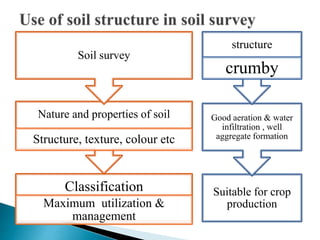
Classification
Maximum utilization &
management
Nature and properties of soil
Structure, texture, colour etc
Soil survey
Suitable for crop
production
Good aeration & water
infiltration , well
aggregate formation
structure
crumby
References.
•Fundamentals of soils by V.N SAHAI 1st ed. 1990
•Soil survey manual by USDA (Indian version) 2009
Soil structure

Soil structure

  • 4.
    The arrangement ofsoil particles and their aggregate into certain defined patterns is called soil structure. The primary soil particles i.e. sand ,silt and clay – usually grouped together in the form of aggregates.  Natural aggregates called Ped. The cohesion with in these aggregates is greater than adhesion.
  • 5.
    Structure is studiedin the field under natural condition and it is describes under three categories . 1) Type –shape or form and arrangement pattern of ped. 2) Class – size of ped. 3) Grade – degree of distinctness of ped.
  • 6.
     There arefour principle form of structure. a) Plate-like: In this structural type aggregates are arranged in relatively thin horizontal plates. When the units are thick called platy and when thin, laminar. a) Prism-like : The vertical axis is more develop then horizontal. When the top of such ped is rounded called columnar and when flat called prismatic
  • 7.
    c) Block-like: All thesedimensions are about the same size and the ped are cube-like with flat or rounded faces. When faces are flat and the edges sharp angular ,called angular blocky and when faces and edges are rounded ,called sub angular blocky. d) Spheroidal: (Sphere-like). All rounded aggregates are placed in this group. The aggregates of this group are usually termed as granular- relatively less porous. when the granules are very porous called crumby.
  • 8.
    Each primary structuraltype of soils is differentiated into 5- size classes depending upon the size of the individual peds. The terms commonly used for the size classes are: 1) Very fine or very thin 2) Fine or thin 3) Medium 4) Coarse or thick 5) Very coarse or very thick. The term thin and thick used for platy and while the term fine and coarse for others.
  • 9.
     Grade indicatethe degree of distinctness of individual peds.  It is determined by the stability of aggregates.  It is influence by moisture content of soil .  It also depend on O.M, texture etc. four term used to describe the grade of soil structure are. 1) Structure less. There are no noticeable peds .e.g. loose sand. 2) Weak structure. Indistinct formation of ped, which is not durable.
  • 10.
    Compound structure: Smaller structuralunits may be held together to form larger units called compound structure.  Naming of soil structure the sequence followed is grade, class and type. E.g. strong coarse angular blocky.  moderate very coarse granular. 1) Moderate structure: moderately well developed peds ,which are fairly distinct. 2) Strong structure :very well formed peds which are quite durable and distinct
  • 11.
    Classification Maximum utilization & management Natureand properties of soil Structure, texture, colour etc Soil survey Suitable for crop production Good aeration & water infiltration , well aggregate formation structure crumby
  • 12.
    References. •Fundamentals of soilsby V.N SAHAI 1st ed. 1990 •Soil survey manual by USDA (Indian version) 2009