Physical properties of soils
A.Murugan
2014004055
Physical properties
Soil texture.
Soil structure.
Surface area.
Soil density.
Soil porosity.
Soil colour.
Soil consistence.
Soil texture
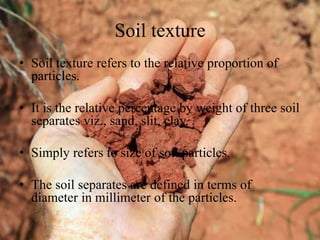
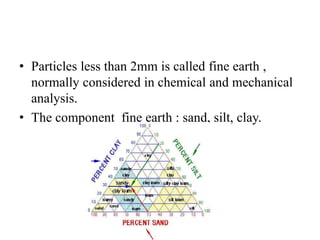
• Soil texture refers to the relative proportion of
particles.
• It is the relative percentage by weight of three soil
separates viz., sand, slit, clay.
• Simply refers to size of soil particles.
• The soil separates are defined in terms of
diameter in millimeter of the particles.
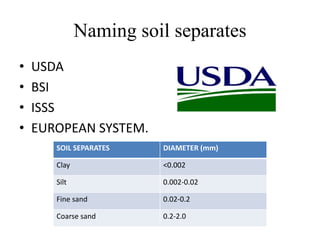
Naming soil separates
• USDA
• BSI
• ISSS
• EUROPEAN SYSTEM.
SOIL SEPARATES DIAMETER (mm)
Clay <0.002
Silt 0.002-0.02
Fine sand 0.02-0.2
Coarse sand 0.2-2.0
• Particles less than 2mm is called fine earth ,
normally considered in chemical and mechanical
analysis.
• The component fine earth : sand, silt, clay.
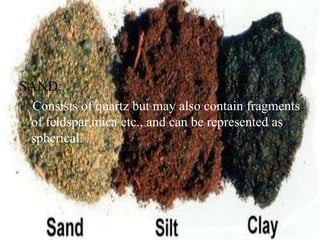
SAND:
Consists of quartz but may also contain fragments
of feldspar,mica etc., and can be represented as
spherical.
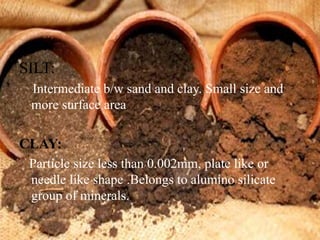
SILT:
Intermediate b/w sand and clay. Small size and
more surface area
CLAY:
Particle size less than 0.002mm, plate like or
needle like shape .Belongs to alumino silicate
group of minerals.
Methods of textural determination
Elutriation method - water and air.
Pipette method.
Decantation method.
Test tube shaking method.
Feel method- feel by fingers , ball formation , stickiness,
ribbon formation.
Importance of soil texture
Texture has good effect on management and
productivity of soil.
Sandy soils are poor store house of plant
nutrients.
Contain low organic matter.
Clay particles play a important roles in soil
fertility.
Loam and silt loam are highly desirable for
cultivation.
Soil structure
The arrangement and organization of primary and
secondary particles in a soil known as soil
structure.
Structure is described under three categories:
Type – shape or form and arrangement pattern
of peds.
Class- size of peds.
Grade – degree of distinctness of peds.
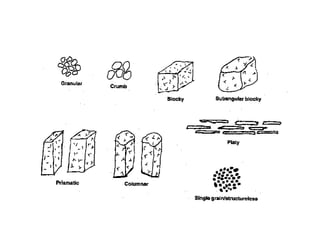
Types of structure
Plate like:
The aggregates are arranged in horizontal plates
or leaflets. When they are thick – platy,
thin – laminar.
Prism like :
The vertical axis is more developed than
horizontal giving a pillar shape. Length 1-10 cm.
Commonly occurred in sub horizons of arid and
semi-arid regions .
• When the tops are rounded – columnar. When flat
/ plane/ level and clear cut - prismatic.
Block like:
All the dimensions are about the same size. The
aggregates are reduced to blocks.
 when the faces are flat and distinct and the edges
are sharp angular- angular blocky.
 when the faces and the edges are mainly rounded
- sub angular blocky. These types confined to sub
soil.
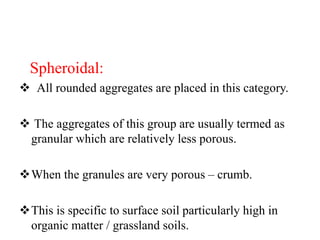
Spheroidal:
 All rounded aggregates are placed in this category.
 The aggregates of this group are usually termed as
granular which are relatively less porous.
When the granules are very porous – crumb.
This is specific to surface soil particularly high in
organic matter / grassland soils.
Classes of structure
Depending upon the size of the individual peds:
Very fine or very thin.
Fine or thin.
Medium.
Coarse or thick.
Very coarse / very thick
The term thick and thin are used for platy types,
while the terms fine and coarse are used for other
structural types.
Grades of structure
Grades indicates the degree of the distinctness of
the individual peds.
Structure less: There is no noticable aggregation.
Weak structure: Poorly developed which are not
durable.
Moderate structure: Moderately well developed
peds which are fairly durable ad distinct.
Strong structure: Very well formed peds which are
quite durable and distinct.
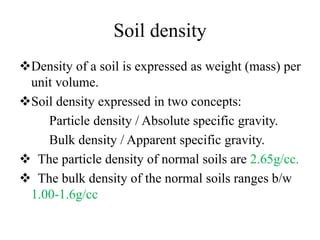
Factors affecting soil structure
Climate.
Organic matter.
Tillage.
Plant roots and residues.
Exchangable cations
Soil density
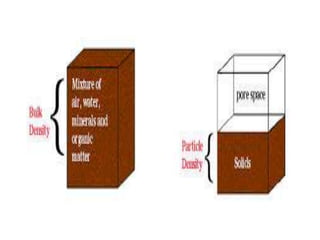
Density of a soil is expressed as weight (mass) per
unit volume.
Soil density expressed in two concepts:
Particle density / Absolute specific gravity.
Bulk density / Apparent specific gravity.
 The particle density of normal soils are 2.65g/cc.
 The bulk density of the normal soils ranges b/w
1.00-1.6g/cc
Bulk and particle density
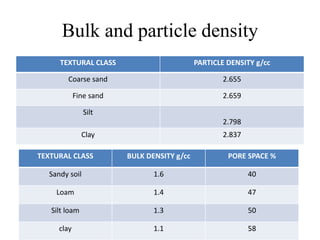
TEXTURAL CLASS PARTICLE DENSITY g/cc
Coarse sand 2.655
Fine sand 2.659
Silt
2.798
Clay 2.837
TEXTURAL CLASS BULK DENSITY g/cc PORE SPACE %
Sandy soil 1.6 40
Loam 1.4 47
Silt loam 1.3 50
clay 1.1 58
Soil porosity
• The pore space of a soil is the space occupied by
air and water.
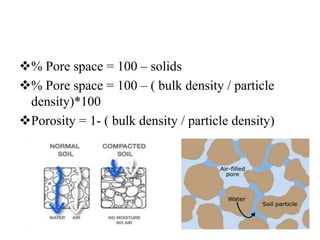
• In sandy soil the pore space is low. In clay soil
pore space is high.
• Presence of organic matter increases the pore
space.
calculating pore space:
% solid = (bulk density/ particle density )*100
% Pore space = 100 – solids
% Pore space = 100 – ( bulk density / particle
density)*100
Porosity = 1- ( bulk density / particle density)
Factors influencing pore space
Soil texture.
Sandy surface soil : 35 to 50%
Medium to fine textured soils: 50 to 60%
Compact sub soil : 25 to 30%
Vegetation.
Biological activity.
Size of pores.
Macro pores (non capillary pores) : >0.05 mm
Micro pores (capillary pores) : < 0.05mm
Soil colour
Soil colour is due to the reflection of EMR by
different soil constituents like minerals organic
matter,water, salts etc.,
The occurrence of two or more patches of colour
is called mottling (due to the presence of
iron,manganese and copper in soil in patches).
Soil colour is inherited from the parent material
and that is referred to as lithocromic . Eg: red
soils developed from red sand stone
Measurement of soil colour
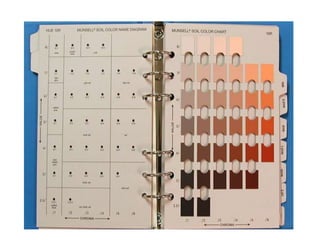
Soil colour is measured using Munsell colour chart and
expressed in terms of Hue, value and chroma.
Hue denotes the dominant spectral colour.
Value denotes the intensity of colour.
Chroma indicates the purity of colour.
10YR 5/4 means , the Hue value is 10YR, 5 is the
value and 4 is the chroma
Factors influencing soil colours
Parent material.
Soil moisture.
Organic matter.
Mixture of organic matter and iron oxides.
Alternate wetting and drying condition
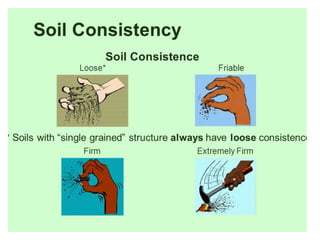
Soil consistence
The resistance of a soil at various moisture contents
to mechanical stresses or manipulations.
It combines with both adhesive and cohesive forces
which determines the soil can be reshaped or
ruptures.
The soil consistency is described at three moisture
levels :
1.wet , 2.moist , 3.dry soil.
Wet soil – consistency is denoted by stickiness and
plasticity.
Atterberg’s constants
He studied plasticity from the point of view of
moisture range over which plasticity range is
maintained.
Shrinkage limit or lower plastic limit.
Plastic limit.
Liquid limit or upper plastic limit.
Plasticity number : The difference b/w the
consistency of upper and lower plastic limits
Factors affecting Atterberg’s constants
Clay content.
Nature of clay minerals.
Nature of exchangable cations.
Organic matter content.
Cohesion.
Sticky point.
Swelling and shrinkage.
Physical properties of soils

Physical properties of soils

  • 1.
    Physical properties ofsoils A.Murugan 2014004055
  • 2.
    Physical properties Soil texture. Soilstructure. Surface area. Soil density. Soil porosity. Soil colour. Soil consistence.
  • 3.
    Soil texture • Soiltexture refers to the relative proportion of particles. • It is the relative percentage by weight of three soil separates viz., sand, slit, clay. • Simply refers to size of soil particles. • The soil separates are defined in terms of diameter in millimeter of the particles.
  • 4.
    Naming soil separates •USDA • BSI • ISSS • EUROPEAN SYSTEM. SOIL SEPARATES DIAMETER (mm) Clay <0.002 Silt 0.002-0.02 Fine sand 0.02-0.2 Coarse sand 0.2-2.0
  • 5.
    • Particles lessthan 2mm is called fine earth , normally considered in chemical and mechanical analysis. • The component fine earth : sand, silt, clay.
  • 6.
    SAND: Consists of quartzbut may also contain fragments of feldspar,mica etc., and can be represented as spherical.
  • 7.
    SILT: Intermediate b/w sandand clay. Small size and more surface area CLAY: Particle size less than 0.002mm, plate like or needle like shape .Belongs to alumino silicate group of minerals.
  • 8.
    Methods of texturaldetermination Elutriation method - water and air. Pipette method. Decantation method. Test tube shaking method. Feel method- feel by fingers , ball formation , stickiness, ribbon formation.
  • 9.
    Importance of soiltexture Texture has good effect on management and productivity of soil. Sandy soils are poor store house of plant nutrients. Contain low organic matter. Clay particles play a important roles in soil fertility. Loam and silt loam are highly desirable for cultivation.
  • 10.
    Soil structure The arrangementand organization of primary and secondary particles in a soil known as soil structure. Structure is described under three categories: Type – shape or form and arrangement pattern of peds. Class- size of peds. Grade – degree of distinctness of peds.
  • 11.
    Types of structure Platelike: The aggregates are arranged in horizontal plates or leaflets. When they are thick – platy, thin – laminar. Prism like : The vertical axis is more developed than horizontal giving a pillar shape. Length 1-10 cm. Commonly occurred in sub horizons of arid and semi-arid regions .
  • 12.
    • When thetops are rounded – columnar. When flat / plane/ level and clear cut - prismatic. Block like: All the dimensions are about the same size. The aggregates are reduced to blocks.  when the faces are flat and distinct and the edges are sharp angular- angular blocky.  when the faces and the edges are mainly rounded - sub angular blocky. These types confined to sub soil.
  • 13.
    Spheroidal:  All roundedaggregates are placed in this category.  The aggregates of this group are usually termed as granular which are relatively less porous. When the granules are very porous – crumb. This is specific to surface soil particularly high in organic matter / grassland soils.
  • 15.
    Classes of structure Dependingupon the size of the individual peds: Very fine or very thin. Fine or thin. Medium. Coarse or thick. Very coarse / very thick The term thick and thin are used for platy types, while the terms fine and coarse are used for other structural types.
  • 16.
    Grades of structure Gradesindicates the degree of the distinctness of the individual peds. Structure less: There is no noticable aggregation. Weak structure: Poorly developed which are not durable. Moderate structure: Moderately well developed peds which are fairly durable ad distinct. Strong structure: Very well formed peds which are quite durable and distinct.
  • 17.
    Factors affecting soilstructure Climate. Organic matter. Tillage. Plant roots and residues. Exchangable cations
  • 18.
    Soil density Density ofa soil is expressed as weight (mass) per unit volume. Soil density expressed in two concepts: Particle density / Absolute specific gravity. Bulk density / Apparent specific gravity.  The particle density of normal soils are 2.65g/cc.  The bulk density of the normal soils ranges b/w 1.00-1.6g/cc
  • 19.
    Bulk and particledensity TEXTURAL CLASS PARTICLE DENSITY g/cc Coarse sand 2.655 Fine sand 2.659 Silt 2.798 Clay 2.837 TEXTURAL CLASS BULK DENSITY g/cc PORE SPACE % Sandy soil 1.6 40 Loam 1.4 47 Silt loam 1.3 50 clay 1.1 58
  • 21.
    Soil porosity • Thepore space of a soil is the space occupied by air and water. • In sandy soil the pore space is low. In clay soil pore space is high. • Presence of organic matter increases the pore space. calculating pore space: % solid = (bulk density/ particle density )*100
  • 22.
    % Pore space= 100 – solids % Pore space = 100 – ( bulk density / particle density)*100 Porosity = 1- ( bulk density / particle density)
  • 23.
    Factors influencing porespace Soil texture. Sandy surface soil : 35 to 50% Medium to fine textured soils: 50 to 60% Compact sub soil : 25 to 30% Vegetation. Biological activity. Size of pores. Macro pores (non capillary pores) : >0.05 mm Micro pores (capillary pores) : < 0.05mm
  • 24.
    Soil colour Soil colouris due to the reflection of EMR by different soil constituents like minerals organic matter,water, salts etc., The occurrence of two or more patches of colour is called mottling (due to the presence of iron,manganese and copper in soil in patches). Soil colour is inherited from the parent material and that is referred to as lithocromic . Eg: red soils developed from red sand stone
  • 25.
    Measurement of soilcolour Soil colour is measured using Munsell colour chart and expressed in terms of Hue, value and chroma. Hue denotes the dominant spectral colour. Value denotes the intensity of colour. Chroma indicates the purity of colour. 10YR 5/4 means , the Hue value is 10YR, 5 is the value and 4 is the chroma
  • 27.
    Factors influencing soilcolours Parent material. Soil moisture. Organic matter. Mixture of organic matter and iron oxides. Alternate wetting and drying condition
  • 28.
    Soil consistence The resistanceof a soil at various moisture contents to mechanical stresses or manipulations. It combines with both adhesive and cohesive forces which determines the soil can be reshaped or ruptures. The soil consistency is described at three moisture levels : 1.wet , 2.moist , 3.dry soil. Wet soil – consistency is denoted by stickiness and plasticity.
  • 30.
    Atterberg’s constants He studiedplasticity from the point of view of moisture range over which plasticity range is maintained. Shrinkage limit or lower plastic limit. Plastic limit. Liquid limit or upper plastic limit. Plasticity number : The difference b/w the consistency of upper and lower plastic limits
  • 31.
    Factors affecting Atterberg’sconstants Clay content. Nature of clay minerals. Nature of exchangable cations. Organic matter content. Cohesion. Sticky point. Swelling and shrinkage.