Codes
Zaharil Anasy
Codes
• The term ‘code’ can be used to refer to any
kind of system that two or more people
employ for communication (It can actually be
used for system used by a single person, as
when someone dvises a private code to
protect certain secrets).
Diglossia
• A diglossic situation exists in a society it has
two distinct code which show clear functional
separation, that is, one code is employed in
one set of circumstances & the other in an
entirely different set.
• Diglossia is a relatively stable language
situation in which in addition to the primary
dialects of the language (which may include a
standard or regional standards).
Diglossic situation in some languages
• Ferguson identified four language situations
which show the major characteristics of the
diglossic phenomenon: Arabic, Swiss, German,
Haitian (French & Creole), and Greek. In each
situation there is a ‘high’ variety (H) of
language & a ‘low’ variety (L) its own
specialized functions and each is viewed
differently by those who are aware of both.
Bilingualism & Multilingualism
• Monolingualism, that is, the ability to use only
one language, while billingualism is having an
effectively equal contro of two native languages.
There are two kinds of bilingualism: stable
bilingual & unstable bilingual.
• People who are bilingual or multilingual do not
necessarily have exactly the same abilities in the
languages (or varieties), in fact, that kind of
parity may be exceptional.
Code-switching & Code mixing
• Code-switching is a conversational strategy
used to establish, cross or destroy group
bounderies to create voke or change
interpersonal relations with their rights &
obligations.
• In a multilingual country like Singapore, the
ability to shift from one language to another is
accepted as quite normal.
Kind of Code-switching
• Wituational cod-switching occurs when the
languages used change according to the
situations in which the converstants find
themselves, they speak one language in one
situation & another in a different one. No
topic change is involved.
• Metaphorical code-switching occurs when a
change of topic requires a change in the
language used.
Code Mixing
• Code-mixing is a switch of codes within a sample
utterance without an associated topic change
(sometimes called intra-sentential code-switching).
E.g. Spanish-English mixing.
1. No van a bring it uo in the meeting.
“They are not going to bring it up in the meeting.”
2. Todos los Mexicanos were riled up.
“All the Mexicans were riled up.”
3. Estaba training para pelear.
“He was training to fight.”
Pidgins, Creoles & Lingua-Francas
• Lingua-franca is a language which is used
habitually by the people whosse mother tongues
are different in order to cacilitate communication
between them.
• Pidgin is a language with no native speaker; it is
no one’s first language but is a contact language.
It is the product of a multilingual situation in
which those who wish to communication must
find a simple language system that will enable
them to do so.
• A creole is often defined as pidgin that has
become the first language of a new
generation of speakers.
• Pidginitation: generally involves some kind of
‘simplifiction’ of a language, e.g. Reduction in
morphology & syntax, tolerance of
consideration phonological variation
(pronunciation) & extensive borrowing
expansion from local mother-tongue.
• Creolization: involves expansion of the
morphology & sytax, regulazation of
phonology & development of a rational and
stable system for increasing vocabulary.
Taboo and Euphimisms
Zaharil Anasy
Sapir-Worf Hypothesis
• The notion currently associated in the English-
speaking country world with the American
scholar B.L. Whorf & programmatic statements
by Aapir that: the semantic structure of the
language which a person speaks either
determines or limits the ways in which they are
able to form conceptions of the world in which
they live.
• Also called the hypothesis of ‘linguistic-relativism’
or ‘linguistic-determinism’.
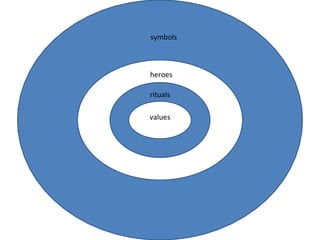
values
rituals
heroes
symbols
Taboo Word
• A word known to speakers but avoided in
some, most, or all forms or contexts of
speech, for reasons of religion, decorum,
politeness, etc.
• Thus in some societies the word for ‘death’ is
a taboo, and is accordingly replaced in most
forms of speech by a metaphor, ‘euphemism.
Euphemism
• Word or term used in place of one avoided as
e.g. Offensive, indecent, or alarming. E.g. A
word for ‘girl’ used of prostitues in place of
the specific word for ‘prostitute’.
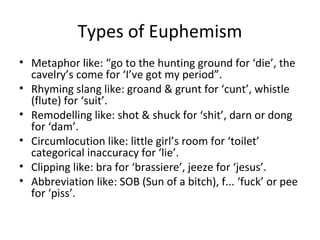
Types of Euphemism
• Metaphor like: “go to the hunting ground for ‘die’, the
cavelry’s come for ‘I’ve got my period”.
• Rhyming slang like: groand & grunt for ‘cunt’, whistle
(flute) for ‘suit’.
• Remodelling like: shot & shuck for ‘shit’, darn or dong
for ‘dam’.
• Circumlocution like: little girl’s room for ‘toilet’
categorical inaccuracy for ‘lie’.
• Clipping like: bra for ‘brassiere’, jeeze for ‘jesus’.
• Abbreviation like: SOB (Sun of a bitch), f... ‘fuck’ or pee
for ‘piss’.
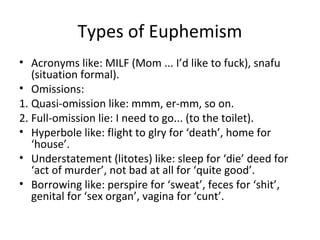
Types of Euphemism
• Acronyms like: MILF (Mom ... I’d like to fuck), snafu
(situation formal).
• Omissions:
1. Quasi-omission like: mmm, er-mm, so on.
2. Full-omission lie: I need to go... (to the toilet).
• Hyperbole like: flight to glry for ‘death’, home for
‘house’.
• Understatement (litotes) like: sleep for ‘die’ deed for
‘act of murder’, not bad at all for ‘quite good’.
• Borrowing like: perspire for ‘sweat’, feces for ‘shit’,
genital for ‘sex organ’, vagina for ‘cunt’.
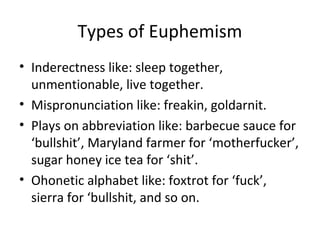
Types of Euphemism
• Inderectness like: sleep together,
unmentionable, live together.
• Mispronunciation like: freakin, goldarnit.
• Plays on abbreviation like: barbecue sauce for
‘bullshit’, Maryland farmer for ‘motherfucker’,
sugar honey ice tea for ‘shit’.
• Ohonetic alphabet like: foxtrot for ‘fuck’,
sierra for ‘bullshit, and so on.
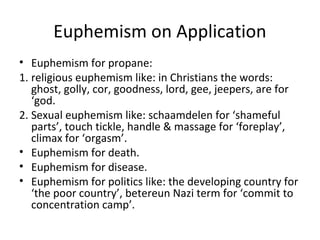
Euphemism on Application
• Euphemism for propane:
1. religious euphemism like: in Christians the words:
ghost, golly, cor, goodness, lord, gee, jeepers, are for
‘god.
2. Sexual euphemism like: schaamdelen for ‘shameful
parts’, touch tickle, handle & massage for ‘foreplay’,
climax for ‘orgasm’.
• Euphemism for death.
• Euphemism for disease.
• Euphemism for politics like: the developing country for
‘the poor country’, betereun Nazi term for ‘commit to
concentration camp’.
Prototype
• Theory of word meaning according to which
meaning are identified, in part at least, by
characteristic instances of whatever class of
objects, atc, a word denotes. E.g. People think
of song birds, such as a robin, as having mopre
of the central character of a bird than others,
such as ducks or falcons.

Sociolinguistics

  • 1.
  • 2.
    Codes • The term‘code’ can be used to refer to any kind of system that two or more people employ for communication (It can actually be used for system used by a single person, as when someone dvises a private code to protect certain secrets).
  • 3.
    Diglossia • A diglossicsituation exists in a society it has two distinct code which show clear functional separation, that is, one code is employed in one set of circumstances & the other in an entirely different set. • Diglossia is a relatively stable language situation in which in addition to the primary dialects of the language (which may include a standard or regional standards).
  • 4.
    Diglossic situation insome languages • Ferguson identified four language situations which show the major characteristics of the diglossic phenomenon: Arabic, Swiss, German, Haitian (French & Creole), and Greek. In each situation there is a ‘high’ variety (H) of language & a ‘low’ variety (L) its own specialized functions and each is viewed differently by those who are aware of both.
  • 5.
    Bilingualism & Multilingualism •Monolingualism, that is, the ability to use only one language, while billingualism is having an effectively equal contro of two native languages. There are two kinds of bilingualism: stable bilingual & unstable bilingual. • People who are bilingual or multilingual do not necessarily have exactly the same abilities in the languages (or varieties), in fact, that kind of parity may be exceptional.
  • 6.
    Code-switching & Codemixing • Code-switching is a conversational strategy used to establish, cross or destroy group bounderies to create voke or change interpersonal relations with their rights & obligations. • In a multilingual country like Singapore, the ability to shift from one language to another is accepted as quite normal.
  • 7.
    Kind of Code-switching •Wituational cod-switching occurs when the languages used change according to the situations in which the converstants find themselves, they speak one language in one situation & another in a different one. No topic change is involved. • Metaphorical code-switching occurs when a change of topic requires a change in the language used.
  • 8.
    Code Mixing • Code-mixingis a switch of codes within a sample utterance without an associated topic change (sometimes called intra-sentential code-switching). E.g. Spanish-English mixing. 1. No van a bring it uo in the meeting. “They are not going to bring it up in the meeting.” 2. Todos los Mexicanos were riled up. “All the Mexicans were riled up.” 3. Estaba training para pelear. “He was training to fight.”
  • 9.
    Pidgins, Creoles &Lingua-Francas • Lingua-franca is a language which is used habitually by the people whosse mother tongues are different in order to cacilitate communication between them. • Pidgin is a language with no native speaker; it is no one’s first language but is a contact language. It is the product of a multilingual situation in which those who wish to communication must find a simple language system that will enable them to do so.
  • 10.
    • A creoleis often defined as pidgin that has become the first language of a new generation of speakers. • Pidginitation: generally involves some kind of ‘simplifiction’ of a language, e.g. Reduction in morphology & syntax, tolerance of consideration phonological variation (pronunciation) & extensive borrowing expansion from local mother-tongue.
  • 11.
    • Creolization: involvesexpansion of the morphology & sytax, regulazation of phonology & development of a rational and stable system for increasing vocabulary.
  • 12.
  • 13.
    Sapir-Worf Hypothesis • Thenotion currently associated in the English- speaking country world with the American scholar B.L. Whorf & programmatic statements by Aapir that: the semantic structure of the language which a person speaks either determines or limits the ways in which they are able to form conceptions of the world in which they live. • Also called the hypothesis of ‘linguistic-relativism’ or ‘linguistic-determinism’.
  • 14.
  • 15.
    Taboo Word • Aword known to speakers but avoided in some, most, or all forms or contexts of speech, for reasons of religion, decorum, politeness, etc. • Thus in some societies the word for ‘death’ is a taboo, and is accordingly replaced in most forms of speech by a metaphor, ‘euphemism.
  • 16.
    Euphemism • Word orterm used in place of one avoided as e.g. Offensive, indecent, or alarming. E.g. A word for ‘girl’ used of prostitues in place of the specific word for ‘prostitute’.
  • 17.
    Types of Euphemism •Metaphor like: “go to the hunting ground for ‘die’, the cavelry’s come for ‘I’ve got my period”. • Rhyming slang like: groand & grunt for ‘cunt’, whistle (flute) for ‘suit’. • Remodelling like: shot & shuck for ‘shit’, darn or dong for ‘dam’. • Circumlocution like: little girl’s room for ‘toilet’ categorical inaccuracy for ‘lie’. • Clipping like: bra for ‘brassiere’, jeeze for ‘jesus’. • Abbreviation like: SOB (Sun of a bitch), f... ‘fuck’ or pee for ‘piss’.
  • 18.
    Types of Euphemism •Acronyms like: MILF (Mom ... I’d like to fuck), snafu (situation formal). • Omissions: 1. Quasi-omission like: mmm, er-mm, so on. 2. Full-omission lie: I need to go... (to the toilet). • Hyperbole like: flight to glry for ‘death’, home for ‘house’. • Understatement (litotes) like: sleep for ‘die’ deed for ‘act of murder’, not bad at all for ‘quite good’. • Borrowing like: perspire for ‘sweat’, feces for ‘shit’, genital for ‘sex organ’, vagina for ‘cunt’.
  • 19.
    Types of Euphemism •Inderectness like: sleep together, unmentionable, live together. • Mispronunciation like: freakin, goldarnit. • Plays on abbreviation like: barbecue sauce for ‘bullshit’, Maryland farmer for ‘motherfucker’, sugar honey ice tea for ‘shit’. • Ohonetic alphabet like: foxtrot for ‘fuck’, sierra for ‘bullshit, and so on.
  • 20.
    Euphemism on Application •Euphemism for propane: 1. religious euphemism like: in Christians the words: ghost, golly, cor, goodness, lord, gee, jeepers, are for ‘god. 2. Sexual euphemism like: schaamdelen for ‘shameful parts’, touch tickle, handle & massage for ‘foreplay’, climax for ‘orgasm’. • Euphemism for death. • Euphemism for disease. • Euphemism for politics like: the developing country for ‘the poor country’, betereun Nazi term for ‘commit to concentration camp’.
  • 21.
    Prototype • Theory ofword meaning according to which meaning are identified, in part at least, by characteristic instances of whatever class of objects, atc, a word denotes. E.g. People think of song birds, such as a robin, as having mopre of the central character of a bird than others, such as ducks or falcons.