Chapter  6
Multilingualism and Language Choice
By: Miriam Meyerhoff
Professor: Dr. Rezaei
Presented by: MojganAzimi
Multilingualism
The use of two or more
languages, either by an
individual speaker or by a
community of speakers.
The ability to use only one
language
for example, Greece
Monolingulaism
Two examples of highly multilingual societies:
Republic of South Africa and Republic of Vanuatu
South Africa: Apartheid regime
The language of business and education: Afrikaans
(Dutch), South African English
Language in South Africa
Following the collapse of apartheid regime in
1990, the republic of south Africa became a
multilingual nation with 11 languages.
Linguistic pluralism
A joint condominium of both British and
French
Upon gaining independence,They make a
distinction between a national language,
official languages and languages of education.
It divides up these functions between French,
English and Bislama.
Language in Vanuatu
Vitality
The likelihood that a language will continue
being used for a range of social functions by a
community of speakers.
Demographic, social and institutional
strength of a language and its speakers.
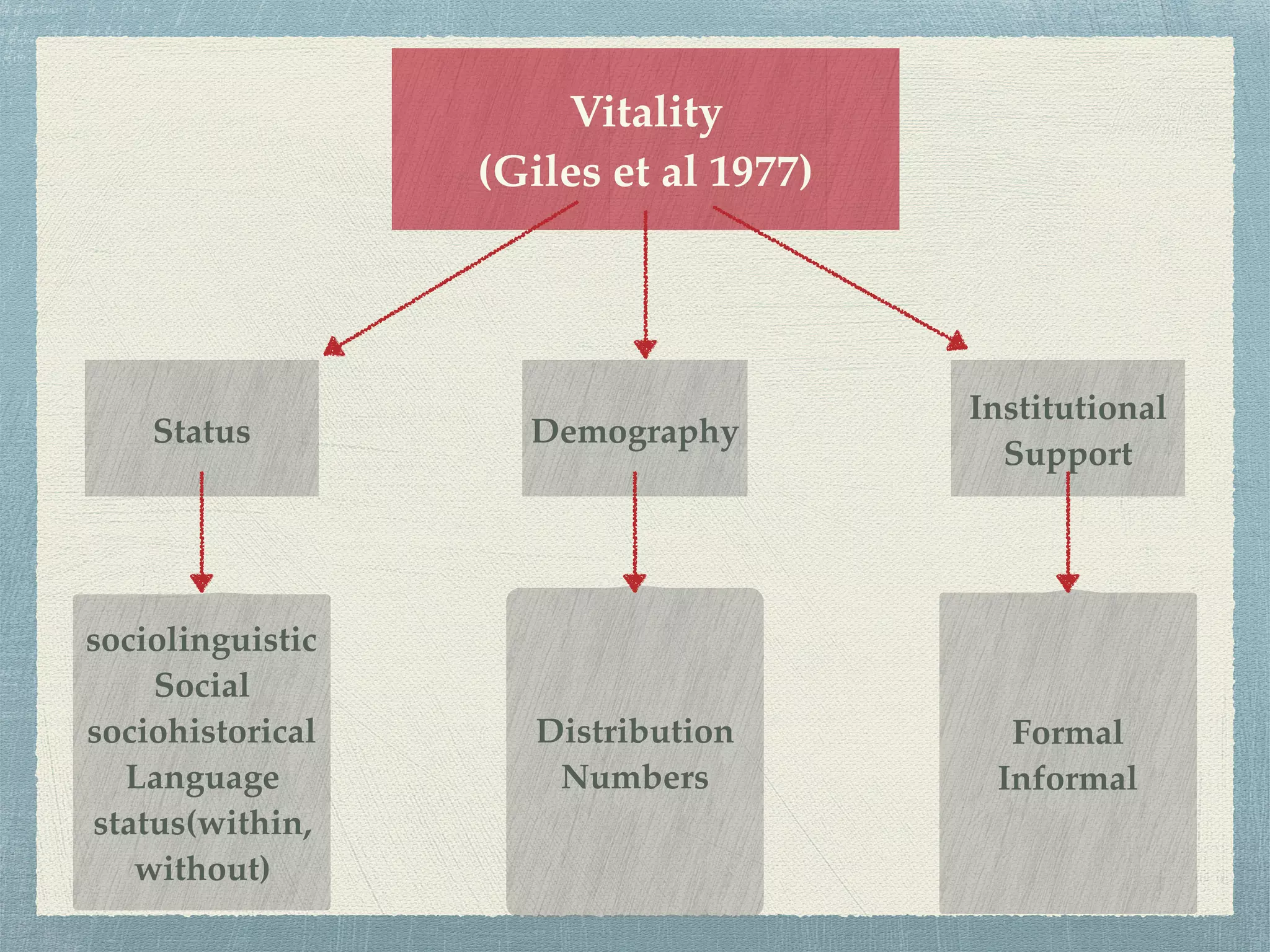
Vitality
(Giles et al 1977)
Status
Institutional
Support
Demography
Distribution
Numbers
Formal
Informal
sociolinguistic
Social
sociohistorical
Language
status(within,
without)
Status Factors
If the speakers of a language have high social status within
the larger community (because of higher social or economic
status) their ethnolinguistic vitality will be higher too.
The status of the language within and outside the
community also matters.(peoples’ attitude towards
language in question, like Latin in Europe)
So too does the historical status that variety has had in the
community in question.(For example, Latin maintained
relatively high vitality in Europe many centuries after it died
out).
Institutional Factors
Formal
Use of a language in the popular mass media, as the medium of
education, and in official government business all increase its
vitality (South Africa and Vanuatu languages).
Informal
Even if the language is not widely used for daily conversation,
local and home-based activities, such as maintenance of a
language for religious purposes and for regular cultural events
can retain a degree of vitality; this will also favor its long-term
maintenance (like Arabic language).
For example :Arabic is the language of the
Koran and Hadith that gives it considerable
informal institutional vitality within the
Muslim community.Furthermore, the
language have high sociohistorical status in
the Muslim community (the books are an
important factor in providing a sense of
cultural continuity for the community).
Demographic Factors
If the group of people speaking the language appreciably
outnumber the speakers of other languages, and
particularly if they are relatively concentrated in a
specific area, then the long-term prognosis for the
maintenance of that language is improved.(like Maori
language in New Zealand).
Immigration/emigration is important because it provides
a ready ‘top-up’ of proficient users of a language variety
and the associated social and cultural traditions.
Ethnolinguistic Vitality
High vitality: If a language is widely spoken
and used and can be spoken for generations.
Low vitality: If a language is shifted and not
used anymore.
Use of a particular language variety is an
extremely significant factor in defining a
cultural or ethnic identity.
Vitality and Prestige
If a language ranks highly in terms of institutional
measures of vitality, it will always have a degree of overt
prestige associated with it. (Ex: a language required for
government jobs is desirable and prestigious for people).
Notion of ethnolinguistic vitality avoids the need to
make a distinction between norms that people are
consciously orienting to (overt prestige) and those that
they seem to be less consciously orienting to (covert
prestige).
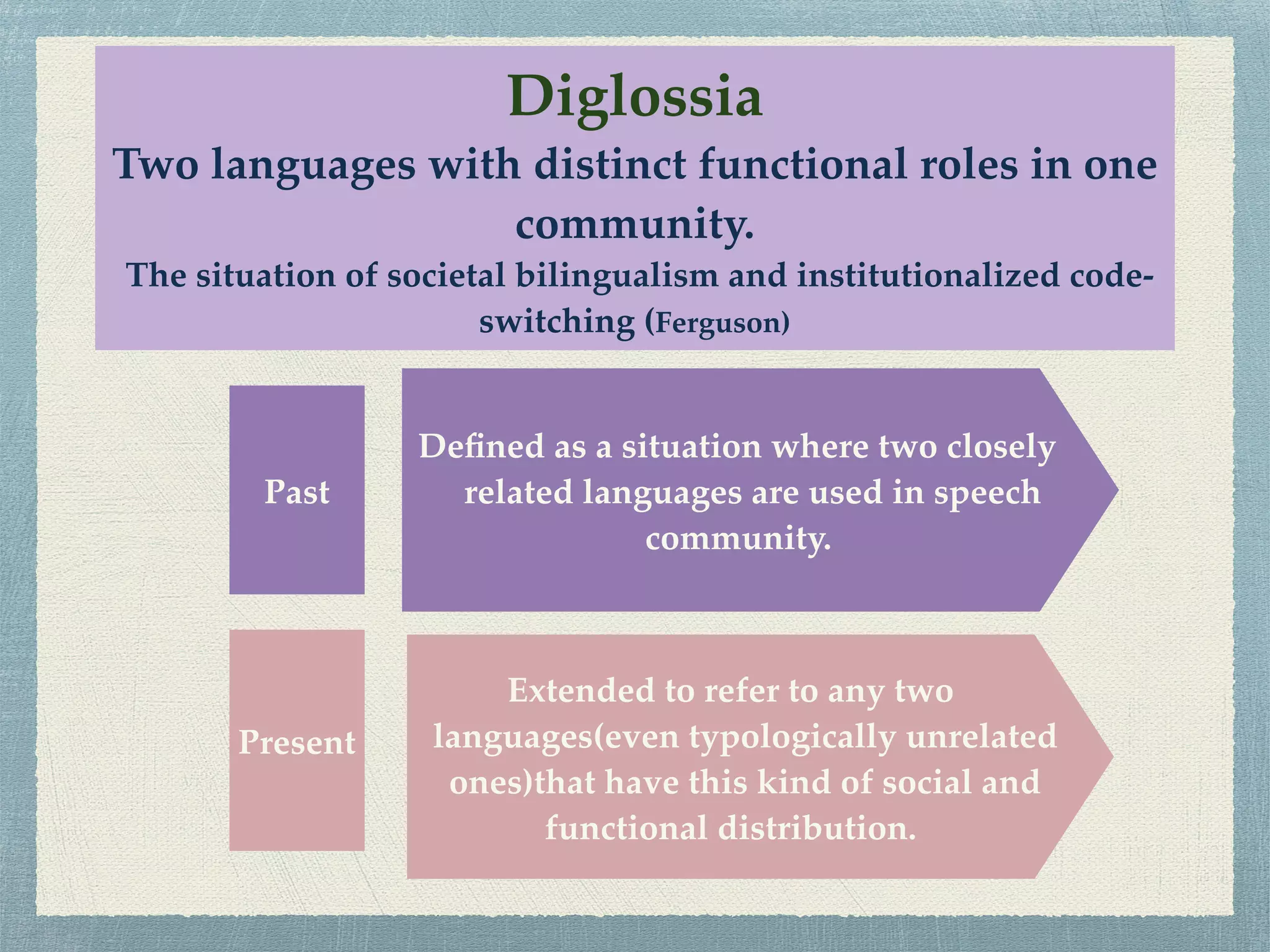
Past
Present
Extended to refer to any two
languages(even typologically unrelated
ones)that have this kind of social and
functional distribution.
Defined as a situation where two closely
related languages are used in speech
community.
Diglossia
Two languages with distinct functional roles in one
community.
The situation of societal bilingualism and institutionalized code-
switching (Ferguson)
Diglossia
High Variety Low Variety
Language with higher overt
prestige used in formal
context(e.g./church,
Newespapers)
Vernacular Variety,
language used in informal
context (e.g./home or market)
In diglossia, two varieties in use in the community may
have historical link to each other, and have its roots in
the other ,but different functions.
EX: Classical and Vernacular Arabic
Vernacular Arabic acquired naturally by children and
were the everyday medium of communication in the
home and with family and friends.
Classical Arabic were used for written media (e.g.,
newspapers and government documents) and when
reading aloud from a script or set texts (e.g., radio
news broadcasts or teachings in a church or a
mosque).
Nested or overlapping diglossia might occur if
you had three or more languages.
Ex:Tanzania , In some domains the local
vernaculars function as the L to Swahili’s H. But
in other domains, Swahili is the L to English’s H.
Fishman argued that “no reason to limit diglossia
only to situations where the varieties were
diachronically related”.
This shifts the emphasis from language structure
to shared norms for acquisition and use in the
community.
Code switching
Moving between different languages or
varieties.
The alternation between varieties, or codes,
across sentences or clause boundarie.
People speaking more than one language, or
who have command over more than one
variety of any language, are equally aware
that in some contexts one variety will serve
their needs better than another.
So depending on where they are, or who
they are talking to ,they change the variety
they use.
Code switching
Domain-
based
Situation(al)
Addressee-
based
Domain
The social and physical setting in
which speakers find themselves.
Situation(al)
A more idiosyncratic and personalised view of
the context or situation of language use . In this
text, used to describe one of the motivations for
code switching.
Diglossic community is one that is characterized by
highly predictable domain-based code switching.
Code switching is not necessarily insitutionalised in
the way diglossia is. There is more individual
creativity and flexibility involved.
Example of code switching(domain and addressee
influence):
Tanzania: vernacular language(rangi) and official
language(swahili)
In the market and in the bank (see book p.121)
Passive knowledge
The ability to understand but not to speak a language.
Active knowledge
The ability to understand and produce a language.
Code mixing
Generally refers to alternations between
varieties, or codes, within a clause or phrase.
The situation where people switch between
different languages within the same sentence.
There can be a lot of mixing of codes during a single
exchange or even within a single speaker’s turn.
There are mixed codes which signal ingroup humour and
affection.
Conversely, they can show hostility to outsiders who may
not understand all the mixed constituents or may not
understand the conventions governing how the codes are
mixed.
Mixed code serves as solidarity marker.
Switching within and between
turns
Attitudes to switching
In some multilingual communities mixing
constituents from one language with another
language can be seriously frowned upon.
The terms used to describe the mixed
utterances are often pejorative or jocular, like
Spanglish or Franglais.
Speech Level
Replacement of vocabulary with
sometimes radically different
forms in the different styles
associated with different social
group or castes.
The person you are talking to, may have a considerable effect
on your speaking style. In some languages these effects are
codified, and there are different speech levels that must be
used when you are talking to someone of higher or lower
status than you.
Ex: Javanese, which is typical of the languages in Indonesia
distinguishes low, mid and high speech levels.
The structure of a sentence does not change radically according
to speech level, but the vocabulary can be entirely replaced.
Thank you

Multilingualism

  • 1.
    Chapter  6 Multilingualism and LanguageChoice By: Miriam Meyerhoff Professor: Dr. Rezaei Presented by: MojganAzimi
  • 2.
    Multilingualism The use oftwo or more languages, either by an individual speaker or by a community of speakers.
  • 3.
    The ability touse only one language for example, Greece Monolingulaism
  • 4.
    Two examples ofhighly multilingual societies: Republic of South Africa and Republic of Vanuatu South Africa: Apartheid regime The language of business and education: Afrikaans (Dutch), South African English Language in South Africa
  • 5.
    Following the collapseof apartheid regime in 1990, the republic of south Africa became a multilingual nation with 11 languages. Linguistic pluralism
  • 6.
    A joint condominiumof both British and French Upon gaining independence,They make a distinction between a national language, official languages and languages of education. It divides up these functions between French, English and Bislama. Language in Vanuatu
  • 7.
    Vitality The likelihood thata language will continue being used for a range of social functions by a community of speakers. Demographic, social and institutional strength of a language and its speakers.
  • 8.
    Vitality (Giles et al1977) Status Institutional Support Demography Distribution Numbers Formal Informal sociolinguistic Social sociohistorical Language status(within, without)
  • 9.
    Status Factors If thespeakers of a language have high social status within the larger community (because of higher social or economic status) their ethnolinguistic vitality will be higher too. The status of the language within and outside the community also matters.(peoples’ attitude towards language in question, like Latin in Europe) So too does the historical status that variety has had in the community in question.(For example, Latin maintained relatively high vitality in Europe many centuries after it died out).
  • 10.
    Institutional Factors Formal Use ofa language in the popular mass media, as the medium of education, and in official government business all increase its vitality (South Africa and Vanuatu languages). Informal Even if the language is not widely used for daily conversation, local and home-based activities, such as maintenance of a language for religious purposes and for regular cultural events can retain a degree of vitality; this will also favor its long-term maintenance (like Arabic language).
  • 11.
    For example :Arabicis the language of the Koran and Hadith that gives it considerable informal institutional vitality within the Muslim community.Furthermore, the language have high sociohistorical status in the Muslim community (the books are an important factor in providing a sense of cultural continuity for the community).
  • 12.
    Demographic Factors If thegroup of people speaking the language appreciably outnumber the speakers of other languages, and particularly if they are relatively concentrated in a specific area, then the long-term prognosis for the maintenance of that language is improved.(like Maori language in New Zealand). Immigration/emigration is important because it provides a ready ‘top-up’ of proficient users of a language variety and the associated social and cultural traditions.
  • 13.
    Ethnolinguistic Vitality High vitality:If a language is widely spoken and used and can be spoken for generations. Low vitality: If a language is shifted and not used anymore. Use of a particular language variety is an extremely significant factor in defining a cultural or ethnic identity.
  • 14.
    Vitality and Prestige Ifa language ranks highly in terms of institutional measures of vitality, it will always have a degree of overt prestige associated with it. (Ex: a language required for government jobs is desirable and prestigious for people). Notion of ethnolinguistic vitality avoids the need to make a distinction between norms that people are consciously orienting to (overt prestige) and those that they seem to be less consciously orienting to (covert prestige).
  • 15.
    Past Present Extended to referto any two languages(even typologically unrelated ones)that have this kind of social and functional distribution. Defined as a situation where two closely related languages are used in speech community. Diglossia Two languages with distinct functional roles in one community. The situation of societal bilingualism and institutionalized code- switching (Ferguson)
  • 16.
    Diglossia High Variety LowVariety Language with higher overt prestige used in formal context(e.g./church, Newespapers) Vernacular Variety, language used in informal context (e.g./home or market)
  • 17.
    In diglossia, twovarieties in use in the community may have historical link to each other, and have its roots in the other ,but different functions. EX: Classical and Vernacular Arabic Vernacular Arabic acquired naturally by children and were the everyday medium of communication in the home and with family and friends. Classical Arabic were used for written media (e.g., newspapers and government documents) and when reading aloud from a script or set texts (e.g., radio news broadcasts or teachings in a church or a mosque).
  • 18.
    Nested or overlappingdiglossia might occur if you had three or more languages. Ex:Tanzania , In some domains the local vernaculars function as the L to Swahili’s H. But in other domains, Swahili is the L to English’s H. Fishman argued that “no reason to limit diglossia only to situations where the varieties were diachronically related”. This shifts the emphasis from language structure to shared norms for acquisition and use in the community.
  • 19.
    Code switching Moving betweendifferent languages or varieties. The alternation between varieties, or codes, across sentences or clause boundarie.
  • 20.
    People speaking morethan one language, or who have command over more than one variety of any language, are equally aware that in some contexts one variety will serve their needs better than another. So depending on where they are, or who they are talking to ,they change the variety they use.
  • 21.
  • 22.
    Domain The social andphysical setting in which speakers find themselves. Situation(al) A more idiosyncratic and personalised view of the context or situation of language use . In this text, used to describe one of the motivations for code switching.
  • 23.
    Diglossic community isone that is characterized by highly predictable domain-based code switching. Code switching is not necessarily insitutionalised in the way diglossia is. There is more individual creativity and flexibility involved. Example of code switching(domain and addressee influence): Tanzania: vernacular language(rangi) and official language(swahili) In the market and in the bank (see book p.121)
  • 24.
    Passive knowledge The abilityto understand but not to speak a language. Active knowledge The ability to understand and produce a language.
  • 25.
    Code mixing Generally refersto alternations between varieties, or codes, within a clause or phrase. The situation where people switch between different languages within the same sentence.
  • 26.
    There can bea lot of mixing of codes during a single exchange or even within a single speaker’s turn. There are mixed codes which signal ingroup humour and affection. Conversely, they can show hostility to outsiders who may not understand all the mixed constituents or may not understand the conventions governing how the codes are mixed. Mixed code serves as solidarity marker. Switching within and between turns
  • 27.
    Attitudes to switching Insome multilingual communities mixing constituents from one language with another language can be seriously frowned upon. The terms used to describe the mixed utterances are often pejorative or jocular, like Spanglish or Franglais.
  • 28.
    Speech Level Replacement ofvocabulary with sometimes radically different forms in the different styles associated with different social group or castes.
  • 29.
    The person youare talking to, may have a considerable effect on your speaking style. In some languages these effects are codified, and there are different speech levels that must be used when you are talking to someone of higher or lower status than you. Ex: Javanese, which is typical of the languages in Indonesia distinguishes low, mid and high speech levels. The structure of a sentence does not change radically according to speech level, but the vocabulary can be entirely replaced.
  • 30.