Language
What is Language
• It is the primary way in which we gain information
about the world around us
• ‘Language’ is not the same as ‘communication’
• Language has 3 key features:
– It has mutually agreed rules (grammar)
– It is intended
– It is creative and open-ended
Try to think up a grammatically correct sentence in the English language that you
think that nobody in history has ever said before
Language and communication
• Can your dog communicate with you?
• Can it use ‘language’?
• Koko the Gorilla was taught American
Sign Language from birth, but do you think
she was truly able to communicate with
her keepers through language?
The Theories of Meaning
• There are 3 theories about what makes
some words meaningful and others not
meaningful:
– Definition Theory
– Denotation Theory
– Image Theory
1. Definition Theory
• This implies that every word can be given
an exact definition
• After all, that’s why we have dictionaries
• However, most definitions are vague, and
of course they have to use other words to
make the definition (this is the problem of
infinite regress)
2. Denotation Theory
• This states that a meaningful word has to
‘stand’ for something
• What does the word ‘Mexico’ stand for?
• Even if this works for material things that
you can physically perceive, what about
things you can’t – like love, freedom
3. Image Theory
• It seems sensible that if the other two theories
can’t be trusted, then we can say that the
meaning of a word is in the ‘image’ it conjures
up in the mind.
• But what is the problem with this?
• You can’t be sure that the image in one person’s
mind is not the same as that in somebody else's.
So how can we be sure we all have the same
understanding of any word in any language?
The Montillation of Traxoline
• It is very important that you learn about
traxoline. Traxoline is a new form of
zionter, It is montillated in Ceristanna. The
Ceristannians gristeriate large amounts of
fevon and then bracter it into quasal
traxoline. Traxoline may be one of our
most lukized snezlaus in the future
because of our zionter lescelidge.
By Julia Lanier
Questions
1. What is traxoline?
2. Do you think a group of people reading this will all have a
similar understanding of the word ‘traxoline’
3. Where is traxoline montillated?
4. How is traxoline quaselled?
5. Why is it so important to know about traxoline?
6. Does this exercise tell you anything about the nature of
language itself?
The Problems of Language
• If we consider language as a means of
gaining knowledge, there are 7 problems:
– Vagueness
– Ambiguity
– Secondary meaning
– Metaphor
– Irony
– Sarcasm
– Idiom
1. Vagueness
• This occurs when your understanding of a word depends on experience or
context
– Hot, early, many, most, a poor student, soon
• Sometimes vague language is used deliberately (especially by politicians) to
avoid committing to anything concrete:
– ‘My officials are monitoring this situation very closely, and I can promise
that we shall take all appropriate measures to ensure that the situation
is resolved in a way that is fair to all the parties involved.’
(Willam Hughes and Jonathan Lavery, Critical Thinking: An Introduction to the Basic Skills, 5th ed. Broadview
Press, 2008)
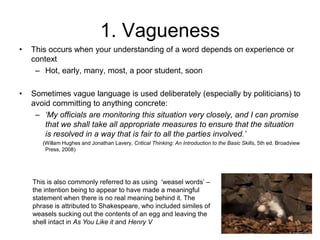
This is also commonly referred to as using ‘weasel words’ –
the intention being to appear to have made a meaningful
statement when there is no real meaning behind it. The
phrase is attributed to Shakespeare, who included similes of
weasels sucking out the contents of an egg and leaving the
shell intact in As You Like it and Henry V
2. Ambiguity
• This occurs where a word or phrase can have more
than one meaning
• Sometimes context allows the meaning to be inferred
(not always correctly)
• Politicians may purposely use ambiguity so that
audience members read their own desired meaning
into a statement:
– “I oppose taxes which hinder economic growth”
You may read into this that the politician is opposed to all taxes, or you
may read into opposition only to selected ones. Could this sentence
be re-written to avoid the ambiguity?
http://edrontheoryofknowledge.blogspot.mx/2014/06/ambiguous-language.html
3. Secondary Meaning
• This occurs when a statement has a hidden connotation behind its
primary meaning (its denotation)
• Sometimes this is in the form of a euphemism (where the
connotation is much less acceptable than the denotation)
– Passed away
– Correctional facility
– Ethnic cleansing
– Collateral damage
– Put to sleep
– Use the bathroom
– Between jobs
Where a secondary meaning is inferred in order to shock rather than be polite, it is
referred to as a dysphemism. e.g. ‘take a dump’ rather than ‘use the bathroom’
4. Metaphor
• A phrase in which you attempt to express the unfamiliar
in terms of the familiar
• They are not literally true statements
• Metaphors require context to be understood (and often a
shared culture)
• We speak, write and think in metaphors all the time
because they are built into language
Dr. House: I'm a night owl, Wilson's an early bird.
We're different species,”
Dr. Cuddy: Then move him into his own cage
Dr. House: Who'll clean the droppings from mine?
5. Irony
• A statement which has the opposite meaning of what is said or expected
• If you don’t recognise irony it can lead to a lot of problems of understanding
• We can catagorise it as:
– Situational irony
– Verbal irony
– Dramatic irony
http://edrontheoryofknowledge.blogspot.mx/2009/02/incorrect-use-of-english-language.html
"Gentlemen, you can't fight in here! This is the War Room."
(Peter Sellers as President Merkin Muffley in Dr. Strangelove, 1964)
It is of course ironic that 'Ironic' is an unironic song about irony. Bonus irony: 'Ironic' is widely
cited as an example of how Americans don't get irony, despite the fact that Alanis Morissette is
Canadian."
(Jon Winokur, The Big Book of Irony. St. Martin's, 2007)
http://edrontheoryofknowledge.blogspot.mx/2014/06/irony.html
Oooo, look at me, Marge, I'm making people happy! I'm the magical man,
from Happy Land, who lives in a gumdrop house on Lollypop Lane!
(Homer Simpson)
from Ancient Greek
εἰρωνεία meaning ”
feigned ignorance"
6. Sarcasm
• Sarcasm is defined as sharp, bitter or cutting remark
• It may or may not include irony
• Like irony, understanding sarcasm requires (second-
order) understanding of context and interpretation of
the speaker’s intention
• This means empathy is required for understanding
https://www.youtube.com/watch?v=UBztjzDr0fM
https://www.youtube.com/watch?v=coBBfe_-uOo
https://www.youtube.com/watch?v=mSy5mEcmgwU
7. Idiom
• A form of expression which has a different meaning compared to its
literal meaning (it is a specific form of ‘secondary meaning’)
• If you have not learned this ‘figurative meaning’ then you will
misunderstand an idiom or it would be nonsensical
• There is a cultural element to idiom
• Examples (in English) include:
– “A taste of your own medicine”
– “Having an axe to grind”
– “Apple of my eye”
– “Beating about the bush”
– “Blood is thicker than water”
– ”Can’t cut the mustard”
– “It’s in the bag”
Lost in Translation
• There are approximately 3000 languages spoken today, but
many are disappearing
• Some words are untranslatable
• Different languages may use very different grammar
• The context of a sentence may give a word a very different
meaning
• A non-native speaker may be unfamiliar with idioms or not catch
metaphor, irony or sarcasm, or encounter problems with accents
http://edrontheoryofknowledge.blogspot.mx/2009/02/lost-in-translation.html
Lost in Translation
The Sapir-Whorf Hypothesis
• This is based on the idea that language determines our experience
of reality (it is also referred to as linguistic determinism)
• We think only what our language allows us to think
• If two languages are very different, then those that speak them will
think very differently
Benjamin WhorfEdward Sapir
Linguistic determinism has become a very popular topic in fiction. Most notably
perhaps in George Orwell’s ‘1984’
The Sapir-Whorf Hypothesis
• In a language experiment bilingual Japanese women were
asked the same questions in English and Japanese when
chatting with researchers. It is postulated that their answers
were different, based on what language they were thinking
and speaking in at the time …
• Real friends should…
– “Help each other” (Japanese)
– “Be very frank” (English)
• When my wishes conflict with my family’s…
– “It is a time of great unhappiness” (Japanese)
– “I do what I want” (English)
The Sapir-Whorf Hypothesis
• Some researchers have reported the
existence of hundreds of words for
different types of snow in the Inuit
language
• Is it therefore reasonable to assume they
perceive their surroundings much
differently to an English speaker?
Criticisms of Sapir-Whorf
• Steven Pinker is a renowned linguist who claims
that there is no truth to the idea that so many
words for snow exist in Inuit, and in any case it
doesn’t affect the way they perceive things.
• Don’t we have an equally huge vocabulary for
snow in the English Language?
• He is one of many anthropologists and linguists
who have tried to discredit the Sapir-Whorf
hypothesis.
Criticisms of Sapir-Whorf
• It is just as possible that ‘reality creates language’ as
‘language creates reality’
• There is evidence from animals and babies that thought
can exist without language. Did early humans ‘think’
before they invented language?
• People think in many different ways. Albert Einstein
claimed he thought in ‘images’ and many autistic people
think in ways that are very alien to others.
• Have you ever had a really good thought but then found
it really difficult to put into words? Does this therefore
suggest that our thoughts exist separately to language to
some degree at least?
Betrand Russell on Language
• In 1905 Bertrand
Russell wrote one of
his most famous and
influential essays
‘On Denoting’
• He began by stating
that there are 2
functions of
language:
– Referring
– Describing
referring describing
Rome
Father
Is sunny
Is going
Bertrand Russell on Language
• He continued by saying that proper names
never actually refer – even though we all
assume they do
• In his most famous example of this he
came up with the phrase:
– “The present king of France is bald”
Is this a referential sentence? Do you see anything strange about it?
It is, in fact, a paradox
Bertrand Russell on Language
• “The present king of France is bald”
• The sentence appears to be false as there is no present
king of France
• However, by declaring it false then logically “The present
king of France must have a full head of hair” – but that can’t
be true either
• Logically it is valid – but it seems to be neither true nor
false (is that possible?)
• Russell was a mathematician and logician – he dedicated
his life to studying problems of logic like this
• His conclusion in this case was that many phrases which
we assume to be referential can’t be
• From this he developed his ‘Theory of Denotation’
Bertrand Russell on Language
• Russell stated that the logically correct version of the
sentence “The present king of France is bald” is:
“There exists one and only one entity which is a king of
France and which is bald”
• Russell and other philosophers after him have been
striving towards developing the perfect form of
language which has no paradoxes

Language

  • 1.
  • 2.
    What is Language •It is the primary way in which we gain information about the world around us • ‘Language’ is not the same as ‘communication’ • Language has 3 key features: – It has mutually agreed rules (grammar) – It is intended – It is creative and open-ended Try to think up a grammatically correct sentence in the English language that you think that nobody in history has ever said before
  • 3.
    Language and communication •Can your dog communicate with you? • Can it use ‘language’? • Koko the Gorilla was taught American Sign Language from birth, but do you think she was truly able to communicate with her keepers through language?
  • 4.
    The Theories ofMeaning • There are 3 theories about what makes some words meaningful and others not meaningful: – Definition Theory – Denotation Theory – Image Theory
  • 5.
    1. Definition Theory •This implies that every word can be given an exact definition • After all, that’s why we have dictionaries • However, most definitions are vague, and of course they have to use other words to make the definition (this is the problem of infinite regress)
  • 6.
    2. Denotation Theory •This states that a meaningful word has to ‘stand’ for something • What does the word ‘Mexico’ stand for? • Even if this works for material things that you can physically perceive, what about things you can’t – like love, freedom
  • 7.
    3. Image Theory •It seems sensible that if the other two theories can’t be trusted, then we can say that the meaning of a word is in the ‘image’ it conjures up in the mind. • But what is the problem with this? • You can’t be sure that the image in one person’s mind is not the same as that in somebody else's. So how can we be sure we all have the same understanding of any word in any language?
  • 8.
    The Montillation ofTraxoline • It is very important that you learn about traxoline. Traxoline is a new form of zionter, It is montillated in Ceristanna. The Ceristannians gristeriate large amounts of fevon and then bracter it into quasal traxoline. Traxoline may be one of our most lukized snezlaus in the future because of our zionter lescelidge. By Julia Lanier
  • 9.
    Questions 1. What istraxoline? 2. Do you think a group of people reading this will all have a similar understanding of the word ‘traxoline’ 3. Where is traxoline montillated? 4. How is traxoline quaselled? 5. Why is it so important to know about traxoline? 6. Does this exercise tell you anything about the nature of language itself?
  • 10.
    The Problems ofLanguage • If we consider language as a means of gaining knowledge, there are 7 problems: – Vagueness – Ambiguity – Secondary meaning – Metaphor – Irony – Sarcasm – Idiom
  • 11.
    1. Vagueness • Thisoccurs when your understanding of a word depends on experience or context – Hot, early, many, most, a poor student, soon • Sometimes vague language is used deliberately (especially by politicians) to avoid committing to anything concrete: – ‘My officials are monitoring this situation very closely, and I can promise that we shall take all appropriate measures to ensure that the situation is resolved in a way that is fair to all the parties involved.’ (Willam Hughes and Jonathan Lavery, Critical Thinking: An Introduction to the Basic Skills, 5th ed. Broadview Press, 2008) This is also commonly referred to as using ‘weasel words’ – the intention being to appear to have made a meaningful statement when there is no real meaning behind it. The phrase is attributed to Shakespeare, who included similes of weasels sucking out the contents of an egg and leaving the shell intact in As You Like it and Henry V
  • 12.
    2. Ambiguity • Thisoccurs where a word or phrase can have more than one meaning • Sometimes context allows the meaning to be inferred (not always correctly) • Politicians may purposely use ambiguity so that audience members read their own desired meaning into a statement: – “I oppose taxes which hinder economic growth” You may read into this that the politician is opposed to all taxes, or you may read into opposition only to selected ones. Could this sentence be re-written to avoid the ambiguity? http://edrontheoryofknowledge.blogspot.mx/2014/06/ambiguous-language.html
  • 13.
    3. Secondary Meaning •This occurs when a statement has a hidden connotation behind its primary meaning (its denotation) • Sometimes this is in the form of a euphemism (where the connotation is much less acceptable than the denotation) – Passed away – Correctional facility – Ethnic cleansing – Collateral damage – Put to sleep – Use the bathroom – Between jobs Where a secondary meaning is inferred in order to shock rather than be polite, it is referred to as a dysphemism. e.g. ‘take a dump’ rather than ‘use the bathroom’
  • 14.
    4. Metaphor • Aphrase in which you attempt to express the unfamiliar in terms of the familiar • They are not literally true statements • Metaphors require context to be understood (and often a shared culture) • We speak, write and think in metaphors all the time because they are built into language Dr. House: I'm a night owl, Wilson's an early bird. We're different species,” Dr. Cuddy: Then move him into his own cage Dr. House: Who'll clean the droppings from mine?
  • 15.
    5. Irony • Astatement which has the opposite meaning of what is said or expected • If you don’t recognise irony it can lead to a lot of problems of understanding • We can catagorise it as: – Situational irony – Verbal irony – Dramatic irony http://edrontheoryofknowledge.blogspot.mx/2009/02/incorrect-use-of-english-language.html "Gentlemen, you can't fight in here! This is the War Room." (Peter Sellers as President Merkin Muffley in Dr. Strangelove, 1964) It is of course ironic that 'Ironic' is an unironic song about irony. Bonus irony: 'Ironic' is widely cited as an example of how Americans don't get irony, despite the fact that Alanis Morissette is Canadian." (Jon Winokur, The Big Book of Irony. St. Martin's, 2007) http://edrontheoryofknowledge.blogspot.mx/2014/06/irony.html Oooo, look at me, Marge, I'm making people happy! I'm the magical man, from Happy Land, who lives in a gumdrop house on Lollypop Lane! (Homer Simpson) from Ancient Greek εἰρωνεία meaning ” feigned ignorance"
  • 16.
    6. Sarcasm • Sarcasmis defined as sharp, bitter or cutting remark • It may or may not include irony • Like irony, understanding sarcasm requires (second- order) understanding of context and interpretation of the speaker’s intention • This means empathy is required for understanding https://www.youtube.com/watch?v=UBztjzDr0fM https://www.youtube.com/watch?v=coBBfe_-uOo https://www.youtube.com/watch?v=mSy5mEcmgwU
  • 17.
    7. Idiom • Aform of expression which has a different meaning compared to its literal meaning (it is a specific form of ‘secondary meaning’) • If you have not learned this ‘figurative meaning’ then you will misunderstand an idiom or it would be nonsensical • There is a cultural element to idiom • Examples (in English) include: – “A taste of your own medicine” – “Having an axe to grind” – “Apple of my eye” – “Beating about the bush” – “Blood is thicker than water” – ”Can’t cut the mustard” – “It’s in the bag”
  • 18.
    Lost in Translation •There are approximately 3000 languages spoken today, but many are disappearing • Some words are untranslatable • Different languages may use very different grammar • The context of a sentence may give a word a very different meaning • A non-native speaker may be unfamiliar with idioms or not catch metaphor, irony or sarcasm, or encounter problems with accents http://edrontheoryofknowledge.blogspot.mx/2009/02/lost-in-translation.html
  • 19.
  • 20.
    The Sapir-Whorf Hypothesis •This is based on the idea that language determines our experience of reality (it is also referred to as linguistic determinism) • We think only what our language allows us to think • If two languages are very different, then those that speak them will think very differently Benjamin WhorfEdward Sapir Linguistic determinism has become a very popular topic in fiction. Most notably perhaps in George Orwell’s ‘1984’
  • 21.
    The Sapir-Whorf Hypothesis •In a language experiment bilingual Japanese women were asked the same questions in English and Japanese when chatting with researchers. It is postulated that their answers were different, based on what language they were thinking and speaking in at the time … • Real friends should… – “Help each other” (Japanese) – “Be very frank” (English) • When my wishes conflict with my family’s… – “It is a time of great unhappiness” (Japanese) – “I do what I want” (English)
  • 22.
    The Sapir-Whorf Hypothesis •Some researchers have reported the existence of hundreds of words for different types of snow in the Inuit language • Is it therefore reasonable to assume they perceive their surroundings much differently to an English speaker?
  • 23.
    Criticisms of Sapir-Whorf •Steven Pinker is a renowned linguist who claims that there is no truth to the idea that so many words for snow exist in Inuit, and in any case it doesn’t affect the way they perceive things. • Don’t we have an equally huge vocabulary for snow in the English Language? • He is one of many anthropologists and linguists who have tried to discredit the Sapir-Whorf hypothesis.
  • 24.
    Criticisms of Sapir-Whorf •It is just as possible that ‘reality creates language’ as ‘language creates reality’ • There is evidence from animals and babies that thought can exist without language. Did early humans ‘think’ before they invented language? • People think in many different ways. Albert Einstein claimed he thought in ‘images’ and many autistic people think in ways that are very alien to others. • Have you ever had a really good thought but then found it really difficult to put into words? Does this therefore suggest that our thoughts exist separately to language to some degree at least?
  • 25.
    Betrand Russell onLanguage • In 1905 Bertrand Russell wrote one of his most famous and influential essays ‘On Denoting’ • He began by stating that there are 2 functions of language: – Referring – Describing referring describing Rome Father Is sunny Is going
  • 26.
    Bertrand Russell onLanguage • He continued by saying that proper names never actually refer – even though we all assume they do • In his most famous example of this he came up with the phrase: – “The present king of France is bald” Is this a referential sentence? Do you see anything strange about it? It is, in fact, a paradox
  • 27.
    Bertrand Russell onLanguage • “The present king of France is bald” • The sentence appears to be false as there is no present king of France • However, by declaring it false then logically “The present king of France must have a full head of hair” – but that can’t be true either • Logically it is valid – but it seems to be neither true nor false (is that possible?) • Russell was a mathematician and logician – he dedicated his life to studying problems of logic like this • His conclusion in this case was that many phrases which we assume to be referential can’t be • From this he developed his ‘Theory of Denotation’
  • 28.
    Bertrand Russell onLanguage • Russell stated that the logically correct version of the sentence “The present king of France is bald” is: “There exists one and only one entity which is a king of France and which is bald” • Russell and other philosophers after him have been striving towards developing the perfect form of language which has no paradoxes