Sociolinguistics
Chapter four : language in
contact
What happens when languages or speakers of
multiple language come into contact?
• language shift
• language maintenance
• ethno linguistic vitality
What happens when languages or speakers
of multiple language come into contact?
 language shift when speakers of a language stop using a minority
language and instead adopt the majority language for group use
Language maintenance is the degree in which an individual or
group of people continue to use their language especially in
bilingual or multilingual
Ethno linguistic vitality is how to maintain language
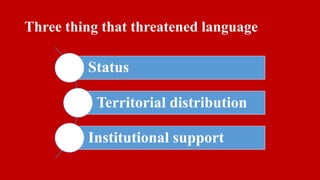
Three thing that threatened language
Status
Territorial distribution
Institutional support
Competency and convergence in
multilingual societies
 contact language , when speakers or groups of people who speak
different languages try to interact with each other
 linguistic consequence convergence of the language
 vocabulary differences maintained
Language ideologies surrounding
multilingualism
 code : a term used instead of language ,speech variety or dialect,
it is sometimes considered to be a more neutral term than the
others
 the term code, seeks to avoid the language versus dialect issue
 code switching: a change by a speaker from one language to
another one. Code switching can take place in a conversation
when one speaker uses one language and other speaker answers in
different language.
 multilingual discourse: the use of linguistic elements from more
than one variety in a conversation or text
Linguistic landscapes
o linguistic landscape, the display of languages in public spaces,
including signs, billboards, advertisements. It is about how
languages appear in public spaces provides evidence about
ideologies concerning particular codes and their speakers.
o in berlin, Germany ,is the dominant language in the linguistic
landscape, both English and Turkish are present which English is
used as a lingua franca for speakers of linguistic backgrounds
Language attitudes in multilingual setting
 matched-guise : the use of recorded voices of people, speaking
first, in one dialect or language and then in another.
 participant are asked to judge speakers of different languages
based on recording on their voices.
 monoglossic ideology : the idea that languages are distinct
entities and should be kept separate.
 pluralist ideology : a way of thinking in which all linguistic
varieties, ways of speaking and ways of being valued.
Diglossia
Diglossia
 when two languages or language varieties exist side by side in a
community and each one is used for different purposes.
 The more standard variety called high variety which is used in
government, media, education
 the other one is non-prestige variety called low-variety, which is
used in the family, with friends or shopping
Domains
 domains refers to language use which determined by topic,
setting and speakers, often used to discuss the choice of a
particular variety of language.
For example :
high varieties are used for delivering formal lectures or political
speeches or broadcasting news on radio and television but in
contrast low-varieties maybe used in giving instruction to workers
in low-prestige occupations or household servant or in conversation
with families
Multilingual discourse
 in multilingual setting, there are no strict or explicit guidelines,
people must select a particular code when they speak, they decide
to switch from that code to another or mix code.
 code switching constraints : rules which govern the structure of
code switching
Metaphorical and situational code switching
 situational code switching : choice of code based on the norms of
the situations
Situational code switching occurs when the languages used, change,
according to the situations in which the speakers find themselves
Metaphorical and situational code switching
 metaphorical code switching : the use of a code as a means to
symbolically redefine the interaction
Metaphorical code switching has an effective dimension to it . The
choice of code carries symbolic meaning , that is the language fits
the message.
Accommodation and audience design
 accommodation : when a person changes their way of speaking to
make it sound more like or less like the speech of the person they
are talking to.
For example :
A teacher may use simple words and sentence structure when he is
talking to a class of young children
Accommodation and audience design
 convergence : the process of two or more languages becoming
more similar to one another.
 divergent : the process of two or more language, becoming less
like each other
For example :
A person may exaggerate their rural accent because they are
annoyed by the attitude of someone from the city.
The markedness model
 markedness : a theory within and across languages, certain linguistic
elements can be seen as unmarked for example : simple, core, prototypical.
While others are seen as marked for example : complex, peripheral or
exceptional.
for example :
Such people I dislike marked
I dislike such people unmarked
thank you for your patience
Mehdi alba

Sociolinguistics chapter 4 introduction to sociolinguistics

  • 1.
  • 2.
    What happens whenlanguages or speakers of multiple language come into contact? • language shift • language maintenance • ethno linguistic vitality
  • 3.
    What happens whenlanguages or speakers of multiple language come into contact?  language shift when speakers of a language stop using a minority language and instead adopt the majority language for group use Language maintenance is the degree in which an individual or group of people continue to use their language especially in bilingual or multilingual Ethno linguistic vitality is how to maintain language
  • 4.
    Three thing thatthreatened language Status Territorial distribution Institutional support
  • 5.
    Competency and convergencein multilingual societies  contact language , when speakers or groups of people who speak different languages try to interact with each other  linguistic consequence convergence of the language  vocabulary differences maintained
  • 6.
    Language ideologies surrounding multilingualism code : a term used instead of language ,speech variety or dialect, it is sometimes considered to be a more neutral term than the others  the term code, seeks to avoid the language versus dialect issue  code switching: a change by a speaker from one language to another one. Code switching can take place in a conversation when one speaker uses one language and other speaker answers in different language.  multilingual discourse: the use of linguistic elements from more than one variety in a conversation or text
  • 7.
    Linguistic landscapes o linguisticlandscape, the display of languages in public spaces, including signs, billboards, advertisements. It is about how languages appear in public spaces provides evidence about ideologies concerning particular codes and their speakers. o in berlin, Germany ,is the dominant language in the linguistic landscape, both English and Turkish are present which English is used as a lingua franca for speakers of linguistic backgrounds
  • 8.
    Language attitudes inmultilingual setting  matched-guise : the use of recorded voices of people, speaking first, in one dialect or language and then in another.  participant are asked to judge speakers of different languages based on recording on their voices.  monoglossic ideology : the idea that languages are distinct entities and should be kept separate.  pluralist ideology : a way of thinking in which all linguistic varieties, ways of speaking and ways of being valued.
  • 9.
    Diglossia Diglossia  when twolanguages or language varieties exist side by side in a community and each one is used for different purposes.  The more standard variety called high variety which is used in government, media, education  the other one is non-prestige variety called low-variety, which is used in the family, with friends or shopping
  • 10.
    Domains  domains refersto language use which determined by topic, setting and speakers, often used to discuss the choice of a particular variety of language. For example : high varieties are used for delivering formal lectures or political speeches or broadcasting news on radio and television but in contrast low-varieties maybe used in giving instruction to workers in low-prestige occupations or household servant or in conversation with families
  • 11.
    Multilingual discourse  inmultilingual setting, there are no strict or explicit guidelines, people must select a particular code when they speak, they decide to switch from that code to another or mix code.  code switching constraints : rules which govern the structure of code switching
  • 12.
    Metaphorical and situationalcode switching  situational code switching : choice of code based on the norms of the situations Situational code switching occurs when the languages used, change, according to the situations in which the speakers find themselves
  • 13.
    Metaphorical and situationalcode switching  metaphorical code switching : the use of a code as a means to symbolically redefine the interaction Metaphorical code switching has an effective dimension to it . The choice of code carries symbolic meaning , that is the language fits the message.
  • 14.
    Accommodation and audiencedesign  accommodation : when a person changes their way of speaking to make it sound more like or less like the speech of the person they are talking to. For example : A teacher may use simple words and sentence structure when he is talking to a class of young children
  • 15.
    Accommodation and audiencedesign  convergence : the process of two or more languages becoming more similar to one another.  divergent : the process of two or more language, becoming less like each other For example : A person may exaggerate their rural accent because they are annoyed by the attitude of someone from the city.
  • 16.
    The markedness model markedness : a theory within and across languages, certain linguistic elements can be seen as unmarked for example : simple, core, prototypical. While others are seen as marked for example : complex, peripheral or exceptional. for example : Such people I dislike marked I dislike such people unmarked
  • 17.
    thank you foryour patience Mehdi alba