LANGUAGES IN SOCIETY
OUTLINE Introduction Diglossia Additive & Subtractive context Language shift & language maintenance Language decline & death Language resurrection Language conflict Language and Nationalism English as a Global Language Conclusion
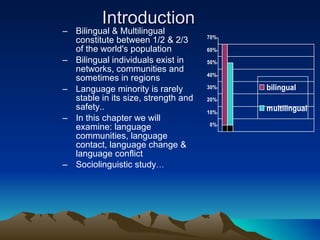
Introduction Bilingual & Multilingual constitute between 1/2 & 2/3 of the world's population Bilingual individuals exist in networks, communities and sometimes in regions  Language minority is rarely stable in its size, strength and safety.. In this chapter we will examine: language communities, language contact, language change & language conflict Sociolinguistic study …
Diglossia Definition: Two languages for one community.. Low language  High language Intergenerational transmission…
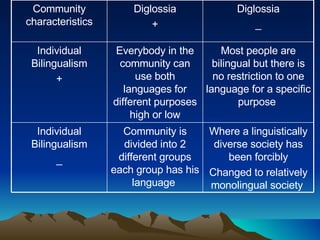
Community characteristics Diglossia + Diglossia _ Individual Bilingualism + Everybody in the community can use both languages for different purposes high or low Most people are bilingual but there is no restriction to one language for a specific purpose  Individual Bilingualism _ Community is divided into 2 different groups each group has his language  Where a linguistically diverse society has been forcibly Changed to relatively monolingual society
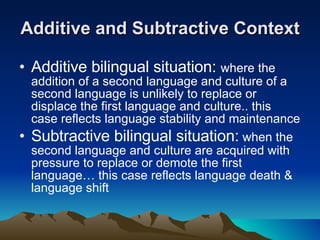
Additive and Subtractive Context Additive bilingual situation:  where the addition of a second language and culture of a second language is unlikely to replace or displace the first language and culture.. this case reflects language stability and maintenance Subtractive bilingual situation:  when the second language and culture are acquired with pressure to replace or demote the first language… this case reflects language death & language shift
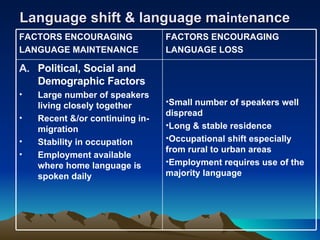
Language shift & language mai nte nance FACTORS ENCOURAGING LANGUAGE MAINTENANCE FACTORS ENCOURAGING LANGUAGE LOSS Political, Social and Demographic Factors Large number of speakers living closely together Recent &/or continuing in-migration Stability in occupation Employment available where home language is spoken daily Small number of speakers well dispread Long & stable residence Occupational shift especially from rural to urban areas Employment requires use of the majority language
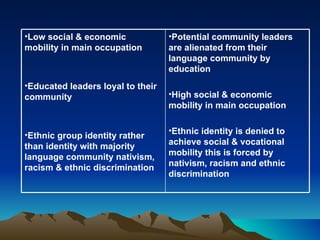
Low social & economic mobility in main occupation Educated leaders loyal to their community Ethnic group identity rather than identity with majority language community nativism, racism & ethnic discrimination Potential community leaders are alienated from their language community by education High social & economic mobility in main occupation Ethnic identity is denied to achieve social & vocational mobility this is forced by nativism, racism and ethnic discrimination
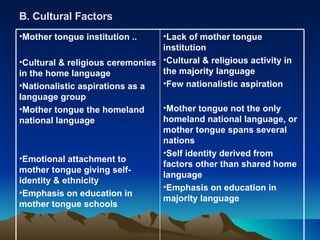
B. Cultural Factors Mother tongue institution .. Cultural & religious ceremonies in the home language Nationalistic aspirations as a language group Mother tongue the homeland national language  Emotional attachment to mother tongue giving self-identity & ethnicity Emphasis on education in mother tongue schools Lack of mother tongue institution Cultural & religious activity in the majority language Few nationalistic aspiration Mother tongue not the only homeland national language, or mother tongue spans several nations  Self identity derived from factors other than shared home language  Emphasis on education in majority language
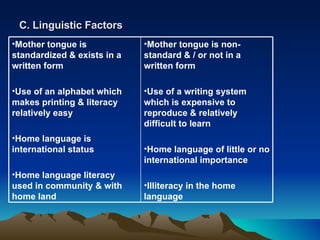
C. Linguistic Factors Mother tongue is standardized & exists in a written form Use of an alphabet which makes printing & literacy relatively easy Home language is international status Home language literacy used in community & with home land Mother tongue is non-standard & / or not in a written form Use of a writing system which is expensive to reproduce & relatively difficult to learn Home language of little or no international importance Illiteracy in the home language
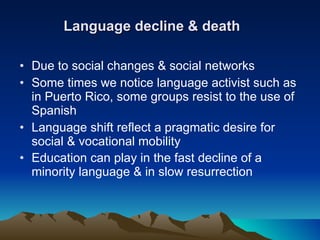
Language decline & death Due to social changes & social networks Some times we notice language activist such as in Puerto Rico, some groups resist to the use of Spanish Language shift reflect a pragmatic desire for social & vocational mobility Education can play in the fast decline of a minority language & in slow resurrection
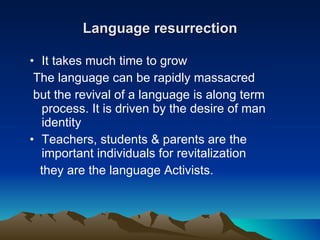
Language resurrection It takes much time to grow The language can be rapidly massacred but the revival of a language is along term process. It is driven by the desire of man identity Teachers, students & parents are the important individuals for revitalization they are the language Activists.
Language conflict In civil war there is an attempt to social control so they attempt to enforce their language Is rooted in: a.  political power straggles  b.  economic tensions c.  issues about rights & privileges
Language and Nationalism Languages are fated according to wider social, economical & political issues: Key symbol of a national identity  Badge of loyalty Negative connotation: it is associated to racism  & language imperialism United States Nationalism favors the replacement of immigrant languages by English  Bilingualism is seen as an obstacle to Nationalism In the world of the Internet , the global economy and ease of transport between countries , the growth of economical & political interdependence give new mean known as Supra-Nationalism which has its effects on language
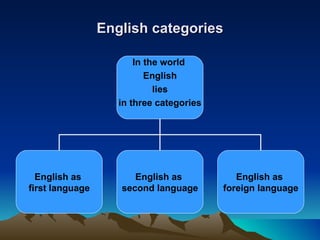
English categories In the world  English lies in three categories English as  first language English as  second language English as  foreign language
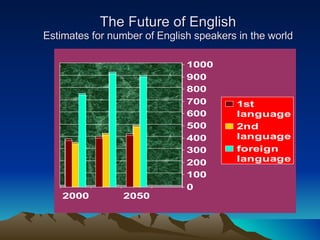
The Future of English Estimates for number of English speakers in the world
The Spread of English English dominates many prestigious domains and functions This wide spread of English ensures that  Anglo culture, Anglo institution  &  Anglo ways of thinking and communicating are spreading
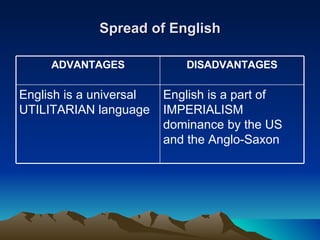
Spread of English ADVANTAGES DISADVANTAGES English is a universal UTILITARIAN language English is a part of IMPERIALISM dominance by the US and the Anglo-Saxon
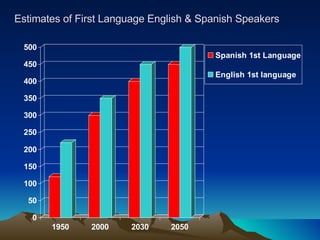
Estimates of First Language English & Spanish Speakers
Conclusion The English language is spreading rapidly mostly as a second and foreign language. It has different effects on the future of minority languages. Bilingualism & Multilingualism in English and another language or languages is globally increasing
Languages in society Presented  By Roula El Danna BBE 6590

Bilingual Power Pt Pres

  • 1.
  • 2.
    OUTLINE Introduction DiglossiaAdditive & Subtractive context Language shift & language maintenance Language decline & death Language resurrection Language conflict Language and Nationalism English as a Global Language Conclusion
  • 3.
    Introduction Bilingual &Multilingual constitute between 1/2 & 2/3 of the world's population Bilingual individuals exist in networks, communities and sometimes in regions Language minority is rarely stable in its size, strength and safety.. In this chapter we will examine: language communities, language contact, language change & language conflict Sociolinguistic study …
  • 4.
    Diglossia Definition: Twolanguages for one community.. Low language High language Intergenerational transmission…
  • 5.
    Community characteristics Diglossia+ Diglossia _ Individual Bilingualism + Everybody in the community can use both languages for different purposes high or low Most people are bilingual but there is no restriction to one language for a specific purpose Individual Bilingualism _ Community is divided into 2 different groups each group has his language Where a linguistically diverse society has been forcibly Changed to relatively monolingual society
  • 6.
    Additive and SubtractiveContext Additive bilingual situation: where the addition of a second language and culture of a second language is unlikely to replace or displace the first language and culture.. this case reflects language stability and maintenance Subtractive bilingual situation: when the second language and culture are acquired with pressure to replace or demote the first language… this case reflects language death & language shift
  • 7.
    Language shift &language mai nte nance FACTORS ENCOURAGING LANGUAGE MAINTENANCE FACTORS ENCOURAGING LANGUAGE LOSS Political, Social and Demographic Factors Large number of speakers living closely together Recent &/or continuing in-migration Stability in occupation Employment available where home language is spoken daily Small number of speakers well dispread Long & stable residence Occupational shift especially from rural to urban areas Employment requires use of the majority language
  • 8.
    Low social &economic mobility in main occupation Educated leaders loyal to their community Ethnic group identity rather than identity with majority language community nativism, racism & ethnic discrimination Potential community leaders are alienated from their language community by education High social & economic mobility in main occupation Ethnic identity is denied to achieve social & vocational mobility this is forced by nativism, racism and ethnic discrimination
  • 9.
    B. Cultural FactorsMother tongue institution .. Cultural & religious ceremonies in the home language Nationalistic aspirations as a language group Mother tongue the homeland national language Emotional attachment to mother tongue giving self-identity & ethnicity Emphasis on education in mother tongue schools Lack of mother tongue institution Cultural & religious activity in the majority language Few nationalistic aspiration Mother tongue not the only homeland national language, or mother tongue spans several nations Self identity derived from factors other than shared home language Emphasis on education in majority language
  • 10.
    C. Linguistic FactorsMother tongue is standardized & exists in a written form Use of an alphabet which makes printing & literacy relatively easy Home language is international status Home language literacy used in community & with home land Mother tongue is non-standard & / or not in a written form Use of a writing system which is expensive to reproduce & relatively difficult to learn Home language of little or no international importance Illiteracy in the home language
  • 11.
    Language decline &death Due to social changes & social networks Some times we notice language activist such as in Puerto Rico, some groups resist to the use of Spanish Language shift reflect a pragmatic desire for social & vocational mobility Education can play in the fast decline of a minority language & in slow resurrection
  • 12.
    Language resurrection Ittakes much time to grow The language can be rapidly massacred but the revival of a language is along term process. It is driven by the desire of man identity Teachers, students & parents are the important individuals for revitalization they are the language Activists.
  • 13.
    Language conflict Incivil war there is an attempt to social control so they attempt to enforce their language Is rooted in: a. political power straggles b. economic tensions c. issues about rights & privileges
  • 14.
    Language and NationalismLanguages are fated according to wider social, economical & political issues: Key symbol of a national identity Badge of loyalty Negative connotation: it is associated to racism & language imperialism United States Nationalism favors the replacement of immigrant languages by English Bilingualism is seen as an obstacle to Nationalism In the world of the Internet , the global economy and ease of transport between countries , the growth of economical & political interdependence give new mean known as Supra-Nationalism which has its effects on language
  • 15.
    English categories Inthe world English lies in three categories English as first language English as second language English as foreign language
  • 16.
    The Future ofEnglish Estimates for number of English speakers in the world
  • 17.
    The Spread ofEnglish English dominates many prestigious domains and functions This wide spread of English ensures that Anglo culture, Anglo institution & Anglo ways of thinking and communicating are spreading
  • 18.
    Spread of EnglishADVANTAGES DISADVANTAGES English is a universal UTILITARIAN language English is a part of IMPERIALISM dominance by the US and the Anglo-Saxon
  • 19.
    Estimates of FirstLanguage English & Spanish Speakers
  • 20.
    Conclusion The Englishlanguage is spreading rapidly mostly as a second and foreign language. It has different effects on the future of minority languages. Bilingualism & Multilingualism in English and another language or languages is globally increasing
  • 21.
    Languages in societyPresented By Roula El Danna BBE 6590