THE ENGLISH LANGUAGE
ACROSSTHEWORLD AND
WITHIN AUSTRALIA
WHO SPEAKS ENGLISH?
 As of 2015, English is the official native language of 67 sovereign states and 27 non-
sovereign entities
 The majority of English speaking nations derive from former territories of the British
empire
 Countries where English is the primary and the ‘de jure’ official language include;
 Bahamas
 Canada
 Kenya
 Singapore
 South Africa
 There are many more countries included on this list, but this gives you an idea about the
varied cultures that have adopted English as their native language
 There are between 360 and 400 million speakers of English, making it the third most
commonly spoken language in the world
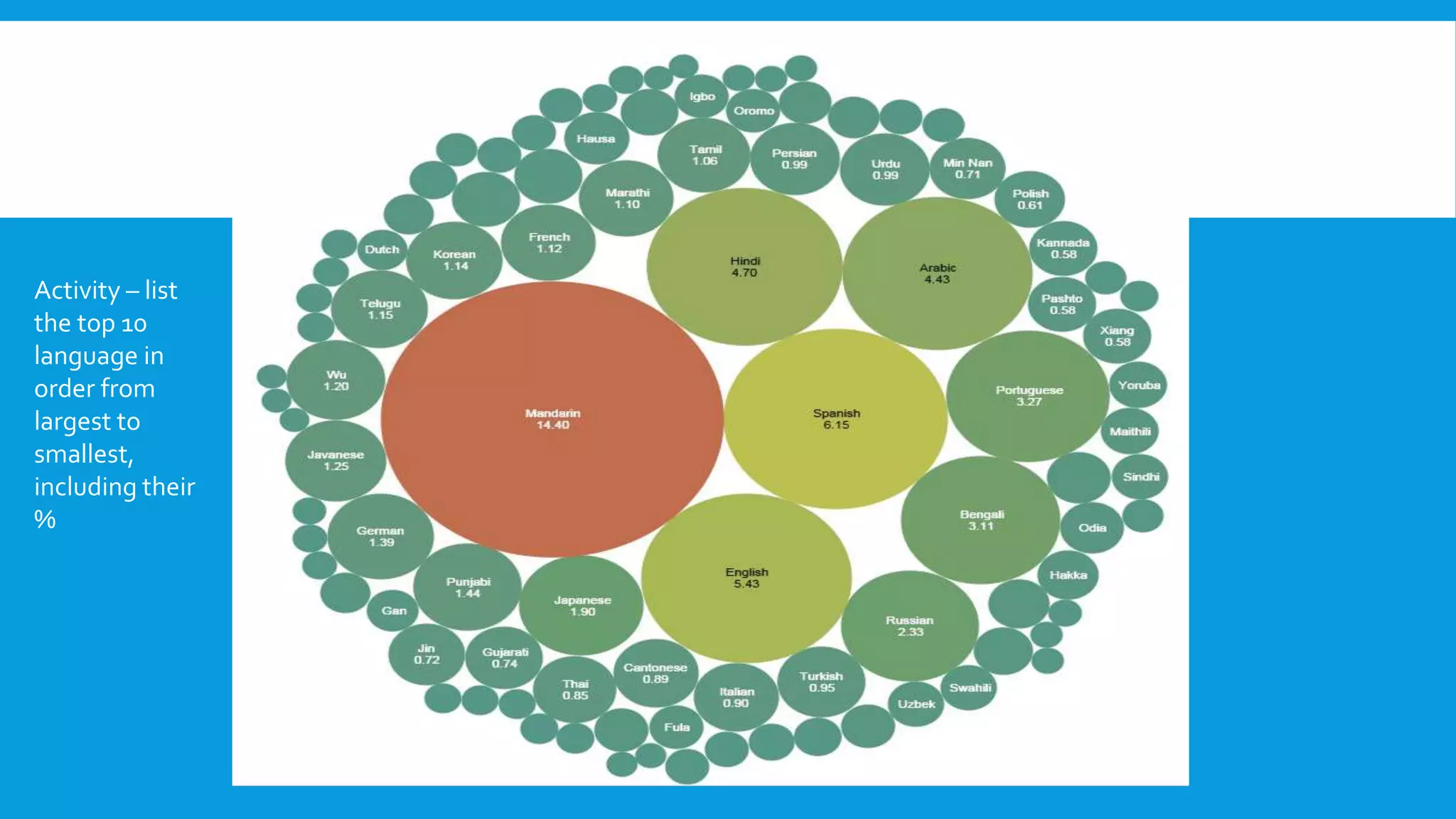
Activity – list
the top 10
language in
order from
largest to
smallest,
including their
%
HOW DID ACCENTS EVOLVE?
 Sociolinguistics refers to accents as a manner of pronunciation peculiar to a particular
individual, location or nation
 Factors impacting accent include;
 Regional or geographical location
 Socio-economic status
 Ethnicity
 Caste/social class
 First language influence
 As human spread out into isolated communities, stresses and peculiarities developed
 Over a long period of time, these differences have developed into identifiable accents
 Activity – List 10 different accents
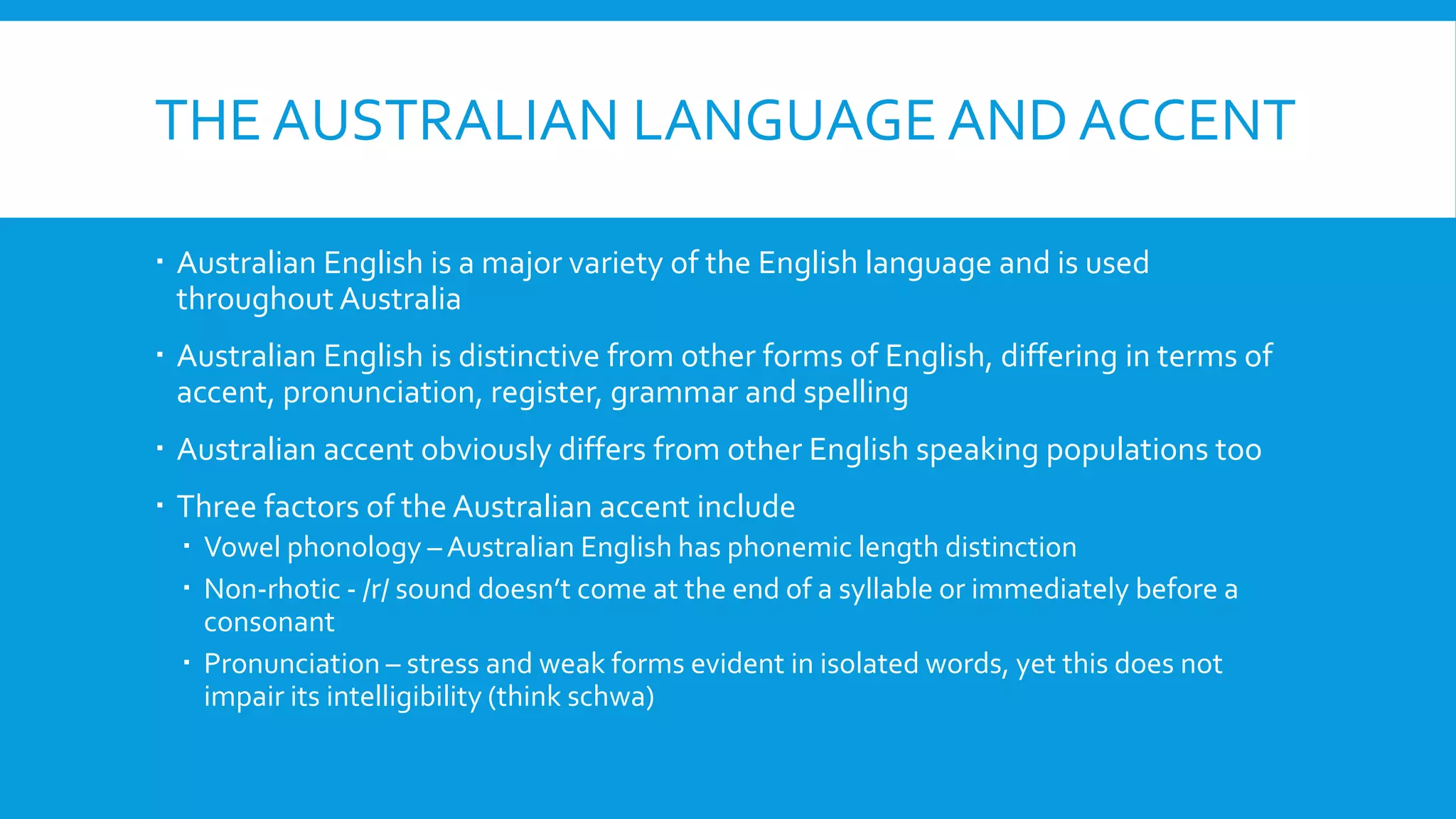
THE AUSTRALIAN LANGUAGE AND ACCENT
 Australian English is a major variety of the English language and is used
throughout Australia
 Australian English is distinctive from other forms of English, differing in terms of
accent, pronunciation, register, grammar and spelling
 Australian accent obviously differs from other English speaking populations too
 Three factors of the Australian accent include
 Vowel phonology – Australian English has phonemic length distinction
 Non-rhotic - /r/ sound doesn’t come at the end of a syllable or immediately before a
consonant
 Pronunciation – stress and weak forms evident in isolated words, yet this does not
impair its intelligibility (think schwa)
THE AUSTRALIAN ACCENT
 Within Australia and the Australian English language, there are three different
types of Australian accent
 https://www.youtube.com/watch?v=ZH4ZQH_3_pE
 How does SimonTaylor explain the three types of Australian accents?
 What does SimonTaylor say we are good at doing with our language? Can you
think of any other examples?
 https://www.youtube.com/watch?v=GPMSpw0CLEg
BROAD AUSTRALIAN ACCENT
 What are some words that are associated with the broad Australian accent?
 Where would you most likely hear the broad Australian accent?
 Can you think of any well-known Australians who had/have a broad Australian
accent?
GENERAL AUSTRALIAN ACCENT
 What are some words that are associated with the general Australian accent?
 Where would you most likely hear the general Australian accent?
 Can you think of any well-known Australians who had/have a general Australian
accent?
CULTIVATED AUSTRALIAN ACCENT
 What are some words that are associated with the cultivated Australian accent?
 Where would you most likely hear the cultivated Australian accent?
 Can you think of any well-known Australians who had/have a cultivated Australian
accent?
CONNOTATION
 An idea or feeling which a word invokes for a person in addition to its
literal or primary meaning
 Negative or positive connotations
 Allows speakers and writers to compare abstract ideas with concrete
concepts in order to give subtle and/or better understanding to the
meaning of words
 Creates more effective use of word meaning
DRAW A SCALE FORTHE FOLLOWING WORDS
ON A NEGATIVETO POSITIVE CONNOTED SCALE
1. Childlike, youthful, young, childish
2. Disabled, retarded, handicapped, crippled
3. Laid-back, lazy, easy-going, relaxed
4. Slim, skinny, slender, thin
5. Cheap, frugal, miserly, economical
6. Proud, confident, egotistical, secure
7. Lovely, knockout, beautiful, stunning
8. Chatty, conversational, talkative, nosy
DENOTATION
 Translation of a sign to its meaning, therefore the literal meaning of a
word
 This means that it refers to the word devoid of emotion, attitude and
colour
 Dictionary definitions
ACTIVITY
 Explain the differences in meaning when the following words are read as a
denotation and a connotation
 Hollywood
 Snake
 Home
 Babe
 Bitch
Come up with two more of your own words to use as an example to
show the difference in meaning when a word is connoted and
denoted. Give their difference meanings
TABOO
 The actual word ‘taboo’ usually refers to a social or religious custom prohibiting,
forbidding and/or restricting people from a particular practice, act, speech or
custom
 Whether an action is taboo or not is very dependant upon the society or religion
which it is, or isn’t, being practiced in. No taboo is officially known as universal
 In our society, taboo is commonly referred to as;
 Killing and hunting
 Sex and sexual relationships (primarily incest, necrophilia, adultery, fornication,
paedophilia, bestiality, masturbation)
 Reproduction (abortion, infanticide)
 Food and dining (cannibalism, dietary laws – halal, kashrut, fasting)
TABOO WORDS
 Taboo words therefore are words and language that are generally considered
inappropriate in certain contexts
 Taboo words within our society can be generalised into three main categories
 “Dirty” words related to sex and excretion. For example “shit”, “”fuck” and “dick”
 Religious words, commonly known as ‘blasphemy’. For example “Jesus”, “Christ” and
“God”
 Animal words used as an insult. For example “bitch”, “cow” and “dog”
 "What counts as taboo language is something defined by culture, and not by
anything inherent in the language."
(Adrian Akmajian, Richard Demers, Ann Farmer, and Robert Harnish, Linguistics:
An Introduction to Language and Communication. MIT Press, 2001)
THE LIGHTER SIDE OFTABOO LANGUAGE
SHIFTING STANDARDS IN SOUTH PARK
Ms. Choksondik: All right children, . . . I'm supposed to clarify the school's position on the word "shit."
Stan:Wow!We can say "shit" in school now?
Kyle:This is ridiculous. Just because they say it onTV, it's all right?
Ms. Choksondik:Yes, but only in the figurative noun form or the adjective form.
Cartman: Huh?
Ms. Choksondik:You can only use it in the nonliteral sense. For instance, "That's a shitty picture of me" is now
fine. However, the literal noun form of [writes on the board] "This is a picture of shit" is still naughty.
Cartman: I don't get it.
Stan: Me neither.
Ms. Choksondik:The adjective form is now also acceptable. For example, "The weather outside is shitty."
However, the literal adjective is not appropriate. For example, "My bad diarrhea made the inside of the toilet
all shitty, and I had to clean it with a rag, which then also became shitty."That's right out!
Timmy: Sssh . . . shit!
Ms. Choksondik:Very good,Timmy.
Butters: Ms. Choksondik, can we say the expletive, like "Oh shit!" or "Shit on a shingle"?
Ms. Choksondik:Yes, that's now fine.
Cartman:Wow!This is gonna be great! A whole new word!
("It Hits the Fan." South Park, 2001)
CLIPPING / SHORTENING
 Clipping, or shortening, refers to the process whereby the commonly know action or
name has become only part of its original word
 These clippings or shortenings tend to evolve from special groups such as school, the
army, police, medical profession, etc
 For example
 Exam(ination), lab(oratory), math(ematics)
 Vet(eran), cap(tain)
 There are four types of ‘clippings’ but we will only focus on the first two
1. Initial clipping
2. Final clipping
3. Medial clipping
4. Complex clipping
CLIPPING / SHORTENING
 Final clipping (apocope)
 This is the most common type of clipping, where the beginning of the prototype
is kept
 For example; ad (advertisement), cable (cablegram), fax (facsimile), gas
(gasoline), gym (gymnasium/gymnastics), pub (public house), pop (popular
music)
 Initial clipping (apheresis)
 Retains the final part of the prototype (original word)
 For example; bot (robot), chute (parachute), roach (cockroach) gator (alligator)
 Final and initial clipping can be combined to retain the middle section of the word
 For example; jammies (pyjamas), fridge (refrigerator) , flu (influenza)
ABBREVIATIONS
 Abbreviations are the shortened form of a word or phrase
 It usually, but not always, consists of a letter, or group of letters, taken from the word or phrase
 A full stop is often used to signify an abbreviation
 Abbreviations have been evident in the English language since it originated, however became
more popular during the growth of phonological linguistic theory in academic Britain
 Abbreviations are popular in general society, however many disciplinary areas have their own
abbreviated language to suit its needs
 Academic studies (arts and science)
 Business and finance
 Computing
 Government
 Medical
 Internet
Activity
Can you come up with an example of
an abbreviation for each area

The english language powerpoint

  • 1.
  • 2.
    WHO SPEAKS ENGLISH? As of 2015, English is the official native language of 67 sovereign states and 27 non- sovereign entities  The majority of English speaking nations derive from former territories of the British empire  Countries where English is the primary and the ‘de jure’ official language include;  Bahamas  Canada  Kenya  Singapore  South Africa  There are many more countries included on this list, but this gives you an idea about the varied cultures that have adopted English as their native language  There are between 360 and 400 million speakers of English, making it the third most commonly spoken language in the world
  • 3.
    Activity – list thetop 10 language in order from largest to smallest, including their %
  • 4.
    HOW DID ACCENTSEVOLVE?  Sociolinguistics refers to accents as a manner of pronunciation peculiar to a particular individual, location or nation  Factors impacting accent include;  Regional or geographical location  Socio-economic status  Ethnicity  Caste/social class  First language influence  As human spread out into isolated communities, stresses and peculiarities developed  Over a long period of time, these differences have developed into identifiable accents  Activity – List 10 different accents
  • 5.
    THE AUSTRALIAN LANGUAGEAND ACCENT  Australian English is a major variety of the English language and is used throughout Australia  Australian English is distinctive from other forms of English, differing in terms of accent, pronunciation, register, grammar and spelling  Australian accent obviously differs from other English speaking populations too  Three factors of the Australian accent include  Vowel phonology – Australian English has phonemic length distinction  Non-rhotic - /r/ sound doesn’t come at the end of a syllable or immediately before a consonant  Pronunciation – stress and weak forms evident in isolated words, yet this does not impair its intelligibility (think schwa)
  • 6.
    THE AUSTRALIAN ACCENT Within Australia and the Australian English language, there are three different types of Australian accent  https://www.youtube.com/watch?v=ZH4ZQH_3_pE  How does SimonTaylor explain the three types of Australian accents?  What does SimonTaylor say we are good at doing with our language? Can you think of any other examples?  https://www.youtube.com/watch?v=GPMSpw0CLEg
  • 7.
    BROAD AUSTRALIAN ACCENT What are some words that are associated with the broad Australian accent?  Where would you most likely hear the broad Australian accent?  Can you think of any well-known Australians who had/have a broad Australian accent?
  • 8.
    GENERAL AUSTRALIAN ACCENT What are some words that are associated with the general Australian accent?  Where would you most likely hear the general Australian accent?  Can you think of any well-known Australians who had/have a general Australian accent?
  • 9.
    CULTIVATED AUSTRALIAN ACCENT What are some words that are associated with the cultivated Australian accent?  Where would you most likely hear the cultivated Australian accent?  Can you think of any well-known Australians who had/have a cultivated Australian accent?
  • 10.
    CONNOTATION  An ideaor feeling which a word invokes for a person in addition to its literal or primary meaning  Negative or positive connotations  Allows speakers and writers to compare abstract ideas with concrete concepts in order to give subtle and/or better understanding to the meaning of words  Creates more effective use of word meaning
  • 11.
    DRAW A SCALEFORTHE FOLLOWING WORDS ON A NEGATIVETO POSITIVE CONNOTED SCALE 1. Childlike, youthful, young, childish 2. Disabled, retarded, handicapped, crippled 3. Laid-back, lazy, easy-going, relaxed 4. Slim, skinny, slender, thin 5. Cheap, frugal, miserly, economical 6. Proud, confident, egotistical, secure 7. Lovely, knockout, beautiful, stunning 8. Chatty, conversational, talkative, nosy
  • 12.
    DENOTATION  Translation ofa sign to its meaning, therefore the literal meaning of a word  This means that it refers to the word devoid of emotion, attitude and colour  Dictionary definitions
  • 13.
    ACTIVITY  Explain thedifferences in meaning when the following words are read as a denotation and a connotation  Hollywood  Snake  Home  Babe  Bitch Come up with two more of your own words to use as an example to show the difference in meaning when a word is connoted and denoted. Give their difference meanings
  • 14.
    TABOO  The actualword ‘taboo’ usually refers to a social or religious custom prohibiting, forbidding and/or restricting people from a particular practice, act, speech or custom  Whether an action is taboo or not is very dependant upon the society or religion which it is, or isn’t, being practiced in. No taboo is officially known as universal  In our society, taboo is commonly referred to as;  Killing and hunting  Sex and sexual relationships (primarily incest, necrophilia, adultery, fornication, paedophilia, bestiality, masturbation)  Reproduction (abortion, infanticide)  Food and dining (cannibalism, dietary laws – halal, kashrut, fasting)
  • 15.
    TABOO WORDS  Taboowords therefore are words and language that are generally considered inappropriate in certain contexts  Taboo words within our society can be generalised into three main categories  “Dirty” words related to sex and excretion. For example “shit”, “”fuck” and “dick”  Religious words, commonly known as ‘blasphemy’. For example “Jesus”, “Christ” and “God”  Animal words used as an insult. For example “bitch”, “cow” and “dog”  "What counts as taboo language is something defined by culture, and not by anything inherent in the language." (Adrian Akmajian, Richard Demers, Ann Farmer, and Robert Harnish, Linguistics: An Introduction to Language and Communication. MIT Press, 2001)
  • 16.
    THE LIGHTER SIDEOFTABOO LANGUAGE SHIFTING STANDARDS IN SOUTH PARK Ms. Choksondik: All right children, . . . I'm supposed to clarify the school's position on the word "shit." Stan:Wow!We can say "shit" in school now? Kyle:This is ridiculous. Just because they say it onTV, it's all right? Ms. Choksondik:Yes, but only in the figurative noun form or the adjective form. Cartman: Huh? Ms. Choksondik:You can only use it in the nonliteral sense. For instance, "That's a shitty picture of me" is now fine. However, the literal noun form of [writes on the board] "This is a picture of shit" is still naughty. Cartman: I don't get it. Stan: Me neither. Ms. Choksondik:The adjective form is now also acceptable. For example, "The weather outside is shitty." However, the literal adjective is not appropriate. For example, "My bad diarrhea made the inside of the toilet all shitty, and I had to clean it with a rag, which then also became shitty."That's right out! Timmy: Sssh . . . shit! Ms. Choksondik:Very good,Timmy. Butters: Ms. Choksondik, can we say the expletive, like "Oh shit!" or "Shit on a shingle"? Ms. Choksondik:Yes, that's now fine. Cartman:Wow!This is gonna be great! A whole new word! ("It Hits the Fan." South Park, 2001)
  • 17.
    CLIPPING / SHORTENING Clipping, or shortening, refers to the process whereby the commonly know action or name has become only part of its original word  These clippings or shortenings tend to evolve from special groups such as school, the army, police, medical profession, etc  For example  Exam(ination), lab(oratory), math(ematics)  Vet(eran), cap(tain)  There are four types of ‘clippings’ but we will only focus on the first two 1. Initial clipping 2. Final clipping 3. Medial clipping 4. Complex clipping
  • 18.
    CLIPPING / SHORTENING Final clipping (apocope)  This is the most common type of clipping, where the beginning of the prototype is kept  For example; ad (advertisement), cable (cablegram), fax (facsimile), gas (gasoline), gym (gymnasium/gymnastics), pub (public house), pop (popular music)  Initial clipping (apheresis)  Retains the final part of the prototype (original word)  For example; bot (robot), chute (parachute), roach (cockroach) gator (alligator)  Final and initial clipping can be combined to retain the middle section of the word  For example; jammies (pyjamas), fridge (refrigerator) , flu (influenza)
  • 19.
    ABBREVIATIONS  Abbreviations arethe shortened form of a word or phrase  It usually, but not always, consists of a letter, or group of letters, taken from the word or phrase  A full stop is often used to signify an abbreviation  Abbreviations have been evident in the English language since it originated, however became more popular during the growth of phonological linguistic theory in academic Britain  Abbreviations are popular in general society, however many disciplinary areas have their own abbreviated language to suit its needs  Academic studies (arts and science)  Business and finance  Computing  Government  Medical  Internet Activity Can you come up with an example of an abbreviation for each area