Changes in
Agriculture and Industry


                    Created by tbonnar.
Job Sectors
• Types of jobs in society can be classified
  into three main sectors:
  Agriculture/Resource
           ex. Farming, mining, forestry, fishing
  Industry
           ex. Factories, workshops, construction
  Service
           ex. Retail, teaching, banking, nursing
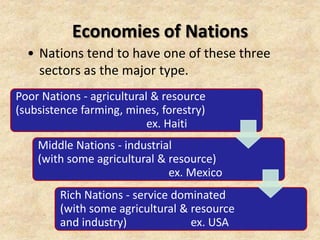
Economies of Nations
  • Nations tend to have one of these three
    sectors as the major type.
Poor Nations - agricultural & resource
(subsistence farming, mines, forestry)
                           ex. Haiti
    Middle Nations - industrial
    (with some agricultural & resource)
                              ex. Mexico
        Rich Nations - service dominated
        (with some agricultural & resource
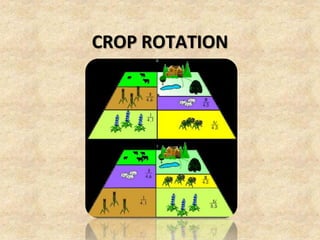
        and industry)             ex. USA
Economies of Nations
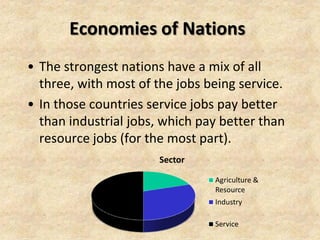
• The strongest nations have a mix of all
  three, with most of the jobs being service.
• In those countries service jobs pay better
  than industrial jobs, which pay better than
  resource jobs (for the most part).
                       Sector

                                Agriculture &
                                Resource
                                Industry

                                Service
Progression of Nations
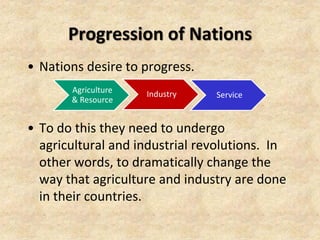
• Nations desire to progress.
       Agriculture   Industry   Service
       & Resource


• To do this they need to undergo
  agricultural and industrial revolutions. In
  other words, to dramatically change the
  way that agriculture and industry are done
  in their countries.
The Agricultural Revolution
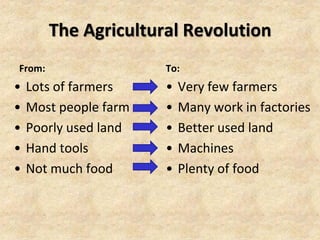
From:                  To:
•   Lots of farmers    •   Very few farmers
•   Most people farm   •   Many work in factories
•   Poorly used land   •   Better used land
•   Hand tools         •   Machines
•   Not much food      •   Plenty of food
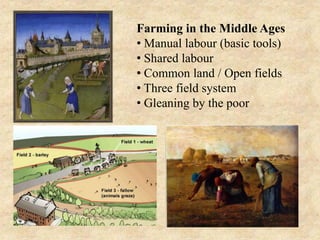
Farming in the Middle Ages
• Manual labour (basic tools)
• Shared labour
• Common land / Open fields
• Three field system
• Gleaning by the poor
1. Bigger Farms
  a. Enclosures
  b. Land Reclamation
2. Better Equipment
  a. Machines
3. Better Techniques
  a. Crop Rotation
  b. Selective Breeding
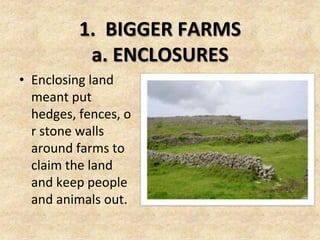
1. BIGGER FARMS
           a. ENCLOSURES
• Enclosing land
  meant put
  hedges, fences, o
  r stone walls
  around farms to
  claim the land
  and keep people
  and animals out.
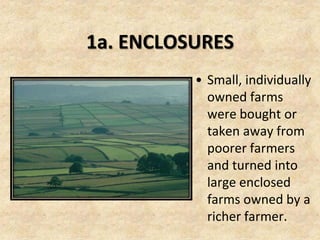
1a. ENCLOSURES
          • Small, individually
            owned farms
            were bought or
            taken away from
            poorer farmers
            and turned into
            large enclosed
            farms owned by a
            richer farmer.
1a. ENCLOSURES
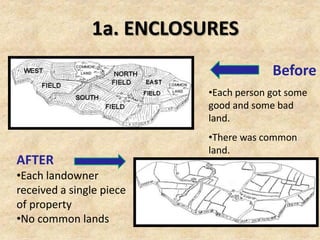
                                       Before
                          •Each person got some
                          good and some bad
                          land.
                          •There was common
                          land.
AFTER
•Each landowner
received a single piece
of property
•No common lands
Small Farmers
   Were Forced off Their Land
• Had to pay for :
  Fences/Walls to surround their farms
  A team of oxen
• Could no longer glean or gather wood
• Often had to sell plots to large
  landowners:
  Forced to Rent or
  Work for someone else
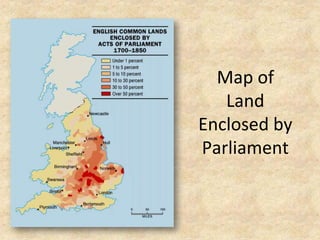
Map of
   Land
Enclosed by
Parliament
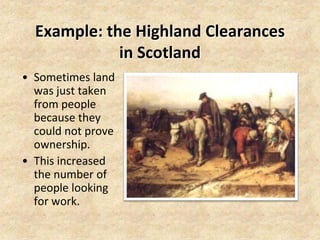
Example: the Highland Clearances
             in Scotland
• Sometimes land
  was just taken
  from people
  because they
  could not prove
  ownership.
• This increased
  the number of
  people looking
  for work.
Enclosures Benefited
         Large Land Owners
• They had the political strength to pass the
  enclosure law
• They owned large unified farms under this
  system which meant:
  Farming was more efficient
  Didn’t need consent of the village to
   experiment with new crop methods
  Could obtain cheap labour
1b. LAND RECLAMATION
• In addition to enclosures, farms also
  increased in size because of land
  reclamation:
  – Marshlands were drained
  – Forests were cleared
  – Poor soil was enriched and used more
2. BETTER EQUIPMENT:
       MACHINES OF THE
  AGRICULTURAL REVOLUTION
• Labour on farms had always been done by
  hand. This was harder to do now with
  bigger farms.
• Farmers with large farms were earning
  more money, and now they were more
  interested in investing in machines
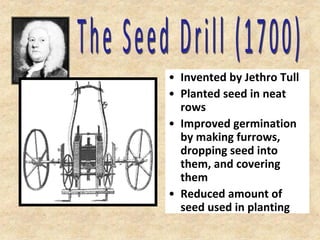
• Invented by Jethro Tull
• Planted seed in neat
  rows
• Improved germination
  by making furrows,
  dropping seed into
  them, and covering
  them
• Reduced amount of
  seed used in planting
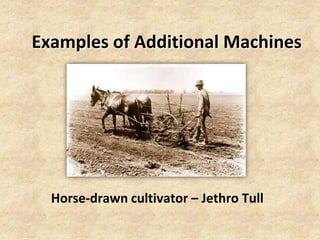
Examples of Additional Machines


  Horse-drawn cultivator – Jethro Tull
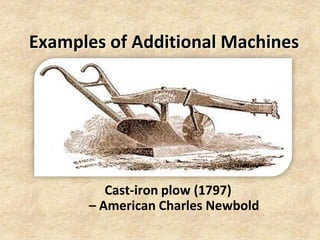
Examples of Additional Machines


         Cast-iron plow (1797)
      – American Charles Newbold
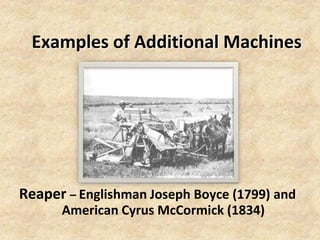
Examples of Additional Machines


Reaper – Englishman Joseph Boyce (1799) and
      American Cyrus McCormick (1834)
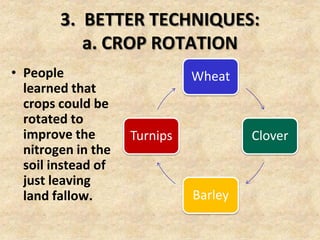
3. BETTER TECHNIQUES:
           a. CROP ROTATION
• People                      Wheat
  learned that
  crops could be
  rotated to
  improve the       Turnips            Clover
  nitrogen in the
  soil instead of
  just leaving
  land fallow.                Barley
CROP ROTATION
CROP ROTATION

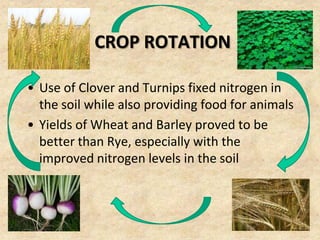
• Use of Clover and Turnips fixed nitrogen in
  the soil while also providing food for animals
• Yields of Wheat and Barley proved to be
  better than Rye, especially with the
  improved nitrogen levels in the soil
3. BETTER TECHNIQUES:
 b. SELECTIVE BREEDING
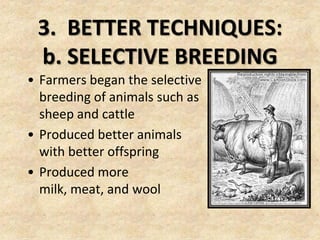
• Farmers began the selective
  breeding of animals such as
  sheep and cattle
• Produced better animals
  with better offspring
• Produced more
  milk, meat, and wool
Summary:
Agricultural Revolutions Need
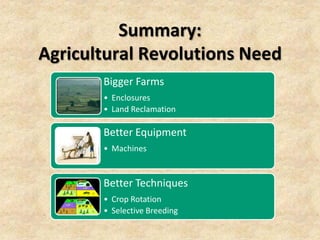
       Bigger Farms
       • Enclosures
       • Land Reclamation

       Better Equipment
       • Machines


       Better Techniques
       • Crop Rotation
       • Selective Breeding
THE SPREAD OF THE
  AGRICULTURAL REVOLUTION
• The Agricultural Revolution began in
  Britain, in the early 1700s.
• It soon spread to other countries. In
  Northern Europe, it took place in the mid-
  1700s.
• In America, the A.R. took place in the
  second half of the 1700s.
Of the Agricultural Revolution
1. Agricultural production increased.
2. Cost of food dropped.
3. Increased production of food helped
   create a rapid growth of population.
4. Large farms, using machines and scientific
   methods, began to dominate agriculture.
   Farming became big business.
Of the Agricultural Revolution
5. The number of small farms began to
   decline.
6. The number of farmers decreased sharply.
7. Many farmers moved to the cities.
8. The population of cities increased rapidly.

Economic Revolutions - Agricultural Revolution

  • 1.
    Changes in Agriculture andIndustry Created by tbonnar.
  • 2.
    Job Sectors • Typesof jobs in society can be classified into three main sectors: Agriculture/Resource ex. Farming, mining, forestry, fishing Industry ex. Factories, workshops, construction Service ex. Retail, teaching, banking, nursing
  • 3.
    Economies of Nations • Nations tend to have one of these three sectors as the major type. Poor Nations - agricultural & resource (subsistence farming, mines, forestry) ex. Haiti Middle Nations - industrial (with some agricultural & resource) ex. Mexico Rich Nations - service dominated (with some agricultural & resource and industry) ex. USA
  • 4.
    Economies of Nations •The strongest nations have a mix of all three, with most of the jobs being service. • In those countries service jobs pay better than industrial jobs, which pay better than resource jobs (for the most part). Sector Agriculture & Resource Industry Service
  • 5.
    Progression of Nations •Nations desire to progress. Agriculture Industry Service & Resource • To do this they need to undergo agricultural and industrial revolutions. In other words, to dramatically change the way that agriculture and industry are done in their countries.
  • 7.
    The Agricultural Revolution From: To: • Lots of farmers • Very few farmers • Most people farm • Many work in factories • Poorly used land • Better used land • Hand tools • Machines • Not much food • Plenty of food
  • 8.
    Farming in theMiddle Ages • Manual labour (basic tools) • Shared labour • Common land / Open fields • Three field system • Gleaning by the poor
  • 9.
    1. Bigger Farms a. Enclosures b. Land Reclamation 2. Better Equipment a. Machines 3. Better Techniques a. Crop Rotation b. Selective Breeding
  • 10.
    1. BIGGER FARMS a. ENCLOSURES • Enclosing land meant put hedges, fences, o r stone walls around farms to claim the land and keep people and animals out.
  • 11.
    1a. ENCLOSURES • Small, individually owned farms were bought or taken away from poorer farmers and turned into large enclosed farms owned by a richer farmer.
  • 12.
    1a. ENCLOSURES Before •Each person got some good and some bad land. •There was common land. AFTER •Each landowner received a single piece of property •No common lands
  • 13.
    Small Farmers Were Forced off Their Land • Had to pay for : Fences/Walls to surround their farms A team of oxen • Could no longer glean or gather wood • Often had to sell plots to large landowners: Forced to Rent or Work for someone else
  • 14.
    Map of Land Enclosed by Parliament
  • 15.
    Example: the HighlandClearances in Scotland • Sometimes land was just taken from people because they could not prove ownership. • This increased the number of people looking for work.
  • 16.
    Enclosures Benefited Large Land Owners • They had the political strength to pass the enclosure law • They owned large unified farms under this system which meant: Farming was more efficient Didn’t need consent of the village to experiment with new crop methods Could obtain cheap labour
  • 17.
    1b. LAND RECLAMATION •In addition to enclosures, farms also increased in size because of land reclamation: – Marshlands were drained – Forests were cleared – Poor soil was enriched and used more
  • 18.
    2. BETTER EQUIPMENT: MACHINES OF THE AGRICULTURAL REVOLUTION • Labour on farms had always been done by hand. This was harder to do now with bigger farms. • Farmers with large farms were earning more money, and now they were more interested in investing in machines
  • 19.
    • Invented byJethro Tull • Planted seed in neat rows • Improved germination by making furrows, dropping seed into them, and covering them • Reduced amount of seed used in planting
  • 20.
    Examples of AdditionalMachines Horse-drawn cultivator – Jethro Tull
  • 21.
    Examples of AdditionalMachines Cast-iron plow (1797) – American Charles Newbold
  • 22.
    Examples of AdditionalMachines Reaper – Englishman Joseph Boyce (1799) and American Cyrus McCormick (1834)
  • 23.
    3. BETTER TECHNIQUES: a. CROP ROTATION • People Wheat learned that crops could be rotated to improve the Turnips Clover nitrogen in the soil instead of just leaving land fallow. Barley
  • 24.
  • 25.
    CROP ROTATION • Useof Clover and Turnips fixed nitrogen in the soil while also providing food for animals • Yields of Wheat and Barley proved to be better than Rye, especially with the improved nitrogen levels in the soil
  • 26.
    3. BETTER TECHNIQUES: b. SELECTIVE BREEDING • Farmers began the selective breeding of animals such as sheep and cattle • Produced better animals with better offspring • Produced more milk, meat, and wool
  • 27.
    Summary: Agricultural Revolutions Need Bigger Farms • Enclosures • Land Reclamation Better Equipment • Machines Better Techniques • Crop Rotation • Selective Breeding
  • 28.
    THE SPREAD OFTHE AGRICULTURAL REVOLUTION • The Agricultural Revolution began in Britain, in the early 1700s. • It soon spread to other countries. In Northern Europe, it took place in the mid- 1700s. • In America, the A.R. took place in the second half of the 1700s.
  • 29.
    Of the AgriculturalRevolution 1. Agricultural production increased. 2. Cost of food dropped. 3. Increased production of food helped create a rapid growth of population. 4. Large farms, using machines and scientific methods, began to dominate agriculture. Farming became big business.
  • 30.
    Of the AgriculturalRevolution 5. The number of small farms began to decline. 6. The number of farmers decreased sharply. 7. Many farmers moved to the cities. 8. The population of cities increased rapidly.