Briefing for Judges
A Word to our Judges…
What Do Judges Do?


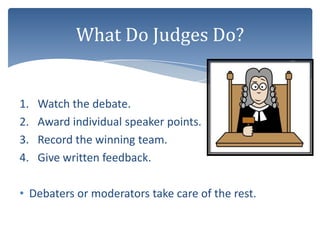
1.   Watch the debate.
2.   Award individual speaker points.
3.   Record the winning team.
4.   Give written feedback.

• Debaters or moderators take care of the rest.
Are You Qualified?


• Yes! Don’t worry!

• There are some things you need to know

• However, a lot of this job is simply listening to
  a debate and recording your honest reaction.
Debaters


• Most of the debaters that you will see today are
  experienced.

• They have entered tournaments throughout this year
  to qualify for our provincial debate tournament.

• Please remember that the Novice teams are grade
  7 & 8 students and may still be new to this process.
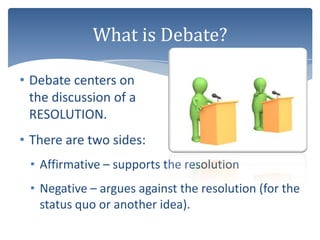
What is Debate?

• Debate centers on
  the discussion of a
  RESOLUTION.
• There are two sides:
 • Affirmative – supports the resolution
 • Negative – argues against the resolution (for the
   status quo or another idea).
Debate Formats
Format of the Tournament


        Novice                  Junior/Senior
• Morning – 2 rounds of     • Morning – 2 rounds of
  prepared Cross-Ex           prepared Cross-Ex

• Afternoon – 2 rounds of   • Afternoon – 2 rounds of
  impromptu Cross-Ex          impromptu CNDF
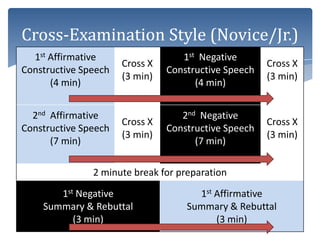
Cross-Examination Style (Novice/Jr.)
  1st Affirmative                  1st Negative
                      Cross X                         Cross X
Constructive Speech             Constructive Speech
                      (3 min)                         (3 min)
      (4 min)                         (4 min)


  2nd Affirmative                  2nd Negative
                      Cross X                         Cross X
Constructive Speech             Constructive Speech
                      (3 min)                         (3 min)
      (7 min)                         (7 min)

               2 minute break for preparation
       1st Negative                   1st Affirmative
    Summary & Rebuttal              Summary & Rebuttal
          (3 min)                         (3 min)
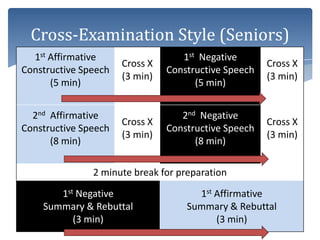
Cross-Examination Style (Seniors)
  1st Affirmative                  1st Negative
                      Cross X                         Cross X
Constructive Speech             Constructive Speech
                      (3 min)                         (3 min)
      (5 min)                         (5 min)


  2nd Affirmative                  2nd Negative
                      Cross X                         Cross X
Constructive Speech             Constructive Speech
                      (3 min)                         (3 min)
      (8 min)                         (8 min)

               2 minute break for preparation
       1st Negative                   1st Affirmative
    Summary & Rebuttal              Summary & Rebuttal
          (3 min)                         (3 min)
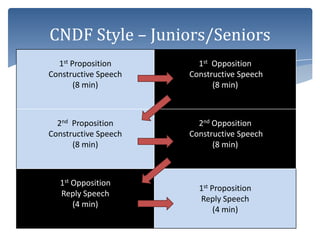
CNDF Style – Juniors/Seniors
  1st Proposition       1st Opposition
Constructive Speech   Constructive Speech
       (8 min)              (8 min)


  2nd Proposition       2nd Opposition
Constructive Speech   Constructive Speech
      (8 min)               (8 min)


  1st Opposition
                        1st Proposition
  Reply Speech
                        Reply Speech
      (4 min)
                             (4 min)
Prepared Debate


• Definition of the resolution should be fair and
  reasonable. It shouldn’t be obviously unfair to
  one team.
• Usually the definition is agreed upon by both
  teams and not argued about. However, it can
  be argued about sometimes.
Prepared Debate


• Evidence should be very specific. They
  have had time to research this topic.
• Keep in mind that younger students will
  probably have a weaker grasp of ideas.
Prepared Debate


• The debate is prepared, the speeches
  are not.
• Speeches should still be improvised
  from their notes (not read out).
• Students who perform prepared
  speeches should receive lower marks.
Impromptu Debate


• Students define the resolution. The
  definition should be fair and debatable.
• Definitions should not turn the debate onto a
  topic that seems to have nothing to do with
  the resolution.
• Expect less detailed content knowledge.
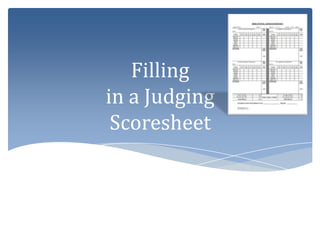
Filling
in a Judging
 Scoresheet
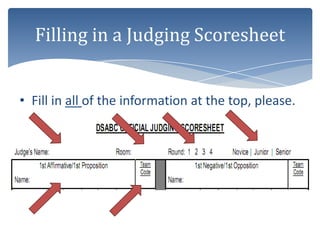
Filling in a Judging Scoresheet


• Fill in all of the information at the top, please.
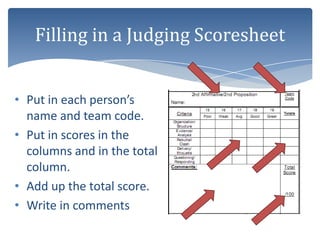
Filling in a Judging Scoresheet


• Put in each person’s
  name and team code.
• Put in scores in the
  columns and in the total
  column.
• Add up the total score.
• Write in comments
Speaker Points


• It can be difficult to assign speaker points.
  Therefore, we use a very tight range and some
  detailed score descriptions to help.

• Marks for each category must be between 15
  and 19.

• Total marks must be between 75 and 95.
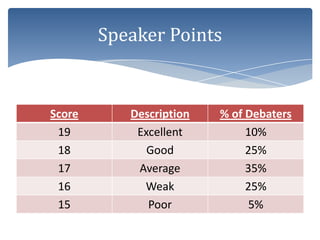
Speaker Points


Score      Description   % of Debaters
 19         Excellent         10%
 18           Good            25%
 17         Average           35%
 16          Weak             25%
 15           Poor             5%
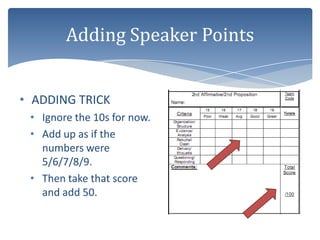
Adding Speaker Points


• ADDING TRICK
 • Ignore the 10s for now.
 • Add up as if the
   numbers were
   5/6/7/8/9.
 • Then take that score
   and add 50.
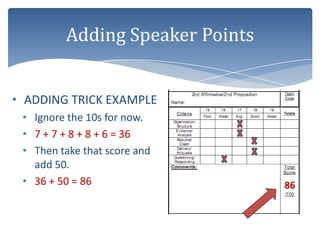
Adding Speaker Points


• ADDING TRICK EXAMPLE
 • Ignore the 10s for now.
 • 7 + 7 + 8 + 8 + 6 = 36
 • Then take that score and
   add 50.
 • 36 + 50 = 86                  86
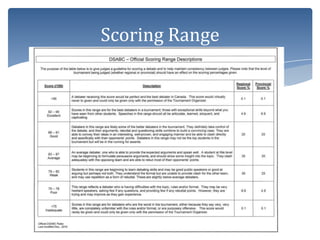
Scoring Range
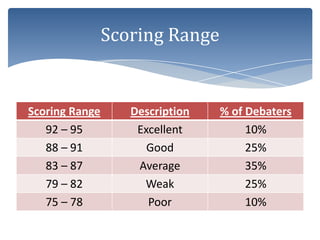
Scoring Range


Scoring Range      Description   % of Debaters
   92 – 95          Excellent         10%
   88 – 91            Good            25%
   83 – 87          Average           35%
   79 – 82           Weak             25%
   75 – 78            Poor            10%
Record the Winning Team


• Ties are not allowed in a debate.

• If you can’t decide, the negative wins because the
  affirmative has not proved their case. Adjust the
  scores accordingly.

• Mark the winning team on your ballot.
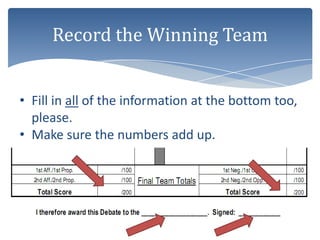
Record the Winning Team


• Fill in all of the information at the bottom too,
  please.
• Make sure the numbers add up.
Scoresheet
Categories
Scoresheet Categories


• Complete your ballot by considering the five areas
   of focus:
1. Organization/Structure
2. Evidence/Analysis
3. Rebuttal/Clash
4. Delivery/Etiquette
5. Questioning/Responding
1. ORGANIZATION/STRUCTURE


• The speech should be well-
  structured, logical, and coherent. I.E. easy to
  follow.
• Introductions and conclusions should explain
  what is going to be said and what has been
  said.
• Transition words should mark stages in the
  speech.
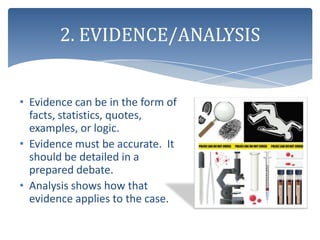
2. EVIDENCE/ANALYSIS


• Evidence can be in the form of
  facts, statistics, quotes,
  examples, or logic.
• Evidence must be accurate. It
  should be detailed in a
  prepared debate.
• Analysis shows how that
  evidence applies to the case.
3. DELIVERY/ETIQUETTE


•   Evaluate presentation style.
•   Is the speaker confident?
•   Does he/she keep your interest?
•   Is his/her voice dynamic?
•   What is his/her body language saying?
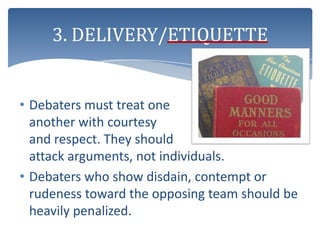
3. DELIVERY/ETIQUETTE


• Debaters must treat one
  another with courtesy
  and respect. They should
  attack arguments, not individuals.
• Debaters who show disdain, contempt or
  rudeness toward the opposing team should be
  heavily penalized.
4. REBUTTAL/CLASH


• Clash is a central principle
  of debate. Without clash,
  there is no debate. Therefore, clash will
  usually be a major factor in deciding who won.
• Debaters must clash directly and specifically
  with their opponents. They should say why the
  opponents’ main points are wrong.
REBUTTAL/REPLY SPEECHES


• Both teams summarize THEIR cases and explain why
  they’re right.
• They also summarize main CLASHES and why you
  should ignore the opposition’s arguments
• During Rebuttals there should be no new
  arguments, although there can be new evidence.
5. Questioning/Responding
         (Cross-Examination)

• This form of questioning is meant to
  gain valuable admissions and identify
  weaknesses of the opponents’ case.
• Questioners control the cross-ex time.
  They ask questions. The witnesses must
  answer all relevant questions.
5. Questioning/Responding
        (Cross-Examination)

• Questioners should be polite and provide enough
  time for the question to be answered. They can
  however interrupt verbose or evasive answers.
• Consider both the questions and the answers when
  you mark.
5. Questioning/Responding
            (CNDF Style)

• Debaters use Points of Information to interrupt a
  speech to challenge each other’s arguments.
• Each debater should offer 2 questions or more during
  each opponent’s speech.
• The speaker should take 2 questions.
Final Points
Final Points


• Please make some brief comments on the
  scoresheets. Debaters will get the chance to
  read these.

• Please do not make oral comments to
  debaters during the tournament.
Final Points


• Show no bias on the issue - act as though you
  know nothing but what the debaters present.

• If you feel you have a conflict of interest in
  judging a debate, please switch rooms with
  another judge.
Final Points


• Especially in your first debate, keep in mind if
  you have any doubts, err towards the middle
  ground.

• Remain CONSISTENT for the rest of the
  tournament.
Final Points


• Judges should not sit together or discuss their
  ballots. Decide on your own and submit your
  ballot to the moderator.

• The judge’s decision is always right!
Enjoy the Experience.


   Thanks again!

DSABC Briefing for Judges

  • 1.
  • 2.
    A Word toour Judges…
  • 3.
    What Do JudgesDo? 1. Watch the debate. 2. Award individual speaker points. 3. Record the winning team. 4. Give written feedback. • Debaters or moderators take care of the rest.
  • 4.
    Are You Qualified? •Yes! Don’t worry! • There are some things you need to know • However, a lot of this job is simply listening to a debate and recording your honest reaction.
  • 5.
    Debaters • Most ofthe debaters that you will see today are experienced. • They have entered tournaments throughout this year to qualify for our provincial debate tournament. • Please remember that the Novice teams are grade 7 & 8 students and may still be new to this process.
  • 6.
    What is Debate? •Debate centers on the discussion of a RESOLUTION. • There are two sides: • Affirmative – supports the resolution • Negative – argues against the resolution (for the status quo or another idea).
  • 7.
  • 8.
    Format of theTournament Novice Junior/Senior • Morning – 2 rounds of • Morning – 2 rounds of prepared Cross-Ex prepared Cross-Ex • Afternoon – 2 rounds of • Afternoon – 2 rounds of impromptu Cross-Ex impromptu CNDF
  • 9.
    Cross-Examination Style (Novice/Jr.) 1st Affirmative 1st Negative Cross X Cross X Constructive Speech Constructive Speech (3 min) (3 min) (4 min) (4 min) 2nd Affirmative 2nd Negative Cross X Cross X Constructive Speech Constructive Speech (3 min) (3 min) (7 min) (7 min) 2 minute break for preparation 1st Negative 1st Affirmative Summary & Rebuttal Summary & Rebuttal (3 min) (3 min)
  • 10.
    Cross-Examination Style (Seniors) 1st Affirmative 1st Negative Cross X Cross X Constructive Speech Constructive Speech (3 min) (3 min) (5 min) (5 min) 2nd Affirmative 2nd Negative Cross X Cross X Constructive Speech Constructive Speech (3 min) (3 min) (8 min) (8 min) 2 minute break for preparation 1st Negative 1st Affirmative Summary & Rebuttal Summary & Rebuttal (3 min) (3 min)
  • 11.
    CNDF Style –Juniors/Seniors 1st Proposition 1st Opposition Constructive Speech Constructive Speech (8 min) (8 min) 2nd Proposition 2nd Opposition Constructive Speech Constructive Speech (8 min) (8 min) 1st Opposition 1st Proposition Reply Speech Reply Speech (4 min) (4 min)
  • 12.
    Prepared Debate • Definitionof the resolution should be fair and reasonable. It shouldn’t be obviously unfair to one team. • Usually the definition is agreed upon by both teams and not argued about. However, it can be argued about sometimes.
  • 13.
    Prepared Debate • Evidenceshould be very specific. They have had time to research this topic. • Keep in mind that younger students will probably have a weaker grasp of ideas.
  • 14.
    Prepared Debate • Thedebate is prepared, the speeches are not. • Speeches should still be improvised from their notes (not read out). • Students who perform prepared speeches should receive lower marks.
  • 15.
    Impromptu Debate • Studentsdefine the resolution. The definition should be fair and debatable. • Definitions should not turn the debate onto a topic that seems to have nothing to do with the resolution. • Expect less detailed content knowledge.
  • 16.
  • 17.
    Filling in aJudging Scoresheet • Fill in all of the information at the top, please.
  • 18.
    Filling in aJudging Scoresheet • Put in each person’s name and team code. • Put in scores in the columns and in the total column. • Add up the total score. • Write in comments
  • 19.
    Speaker Points • Itcan be difficult to assign speaker points. Therefore, we use a very tight range and some detailed score descriptions to help. • Marks for each category must be between 15 and 19. • Total marks must be between 75 and 95.
  • 20.
    Speaker Points Score Description % of Debaters 19 Excellent 10% 18 Good 25% 17 Average 35% 16 Weak 25% 15 Poor 5%
  • 21.
    Adding Speaker Points •ADDING TRICK • Ignore the 10s for now. • Add up as if the numbers were 5/6/7/8/9. • Then take that score and add 50.
  • 22.
    Adding Speaker Points •ADDING TRICK EXAMPLE • Ignore the 10s for now. • 7 + 7 + 8 + 8 + 6 = 36 • Then take that score and add 50. • 36 + 50 = 86 86
  • 23.
  • 24.
    Scoring Range Scoring Range Description % of Debaters 92 – 95 Excellent 10% 88 – 91 Good 25% 83 – 87 Average 35% 79 – 82 Weak 25% 75 – 78 Poor 10%
  • 25.
    Record the WinningTeam • Ties are not allowed in a debate. • If you can’t decide, the negative wins because the affirmative has not proved their case. Adjust the scores accordingly. • Mark the winning team on your ballot.
  • 26.
    Record the WinningTeam • Fill in all of the information at the bottom too, please. • Make sure the numbers add up.
  • 27.
  • 28.
    Scoresheet Categories • Completeyour ballot by considering the five areas of focus: 1. Organization/Structure 2. Evidence/Analysis 3. Rebuttal/Clash 4. Delivery/Etiquette 5. Questioning/Responding
  • 29.
    1. ORGANIZATION/STRUCTURE • Thespeech should be well- structured, logical, and coherent. I.E. easy to follow. • Introductions and conclusions should explain what is going to be said and what has been said. • Transition words should mark stages in the speech.
  • 30.
    2. EVIDENCE/ANALYSIS • Evidencecan be in the form of facts, statistics, quotes, examples, or logic. • Evidence must be accurate. It should be detailed in a prepared debate. • Analysis shows how that evidence applies to the case.
  • 31.
    3. DELIVERY/ETIQUETTE • Evaluate presentation style. • Is the speaker confident? • Does he/she keep your interest? • Is his/her voice dynamic? • What is his/her body language saying?
  • 32.
    3. DELIVERY/ETIQUETTE • Debatersmust treat one another with courtesy and respect. They should attack arguments, not individuals. • Debaters who show disdain, contempt or rudeness toward the opposing team should be heavily penalized.
  • 33.
    4. REBUTTAL/CLASH • Clashis a central principle of debate. Without clash, there is no debate. Therefore, clash will usually be a major factor in deciding who won. • Debaters must clash directly and specifically with their opponents. They should say why the opponents’ main points are wrong.
  • 34.
    REBUTTAL/REPLY SPEECHES • Bothteams summarize THEIR cases and explain why they’re right. • They also summarize main CLASHES and why you should ignore the opposition’s arguments • During Rebuttals there should be no new arguments, although there can be new evidence.
  • 35.
    5. Questioning/Responding (Cross-Examination) • This form of questioning is meant to gain valuable admissions and identify weaknesses of the opponents’ case. • Questioners control the cross-ex time. They ask questions. The witnesses must answer all relevant questions.
  • 36.
    5. Questioning/Responding (Cross-Examination) • Questioners should be polite and provide enough time for the question to be answered. They can however interrupt verbose or evasive answers. • Consider both the questions and the answers when you mark.
  • 37.
    5. Questioning/Responding (CNDF Style) • Debaters use Points of Information to interrupt a speech to challenge each other’s arguments. • Each debater should offer 2 questions or more during each opponent’s speech. • The speaker should take 2 questions.
  • 38.
  • 39.
    Final Points • Pleasemake some brief comments on the scoresheets. Debaters will get the chance to read these. • Please do not make oral comments to debaters during the tournament.
  • 40.
    Final Points • Showno bias on the issue - act as though you know nothing but what the debaters present. • If you feel you have a conflict of interest in judging a debate, please switch rooms with another judge.
  • 41.
    Final Points • Especiallyin your first debate, keep in mind if you have any doubts, err towards the middle ground. • Remain CONSISTENT for the rest of the tournament.
  • 42.
    Final Points • Judgesshould not sit together or discuss their ballots. Decide on your own and submit your ballot to the moderator. • The judge’s decision is always right!
  • 43.