To learn about the Earth, two tools you can
use are globes and maps.
A globe is a model of the planet Earth as if
seeing it from outer space. A globe is round
and shows continents and oceans. There are
seven continents on Earth and four oceans.
A map is a model of the Earth shown on a flat
surface. Maps are useful because you can
carry them with you.
Let’s look at a map more closely…
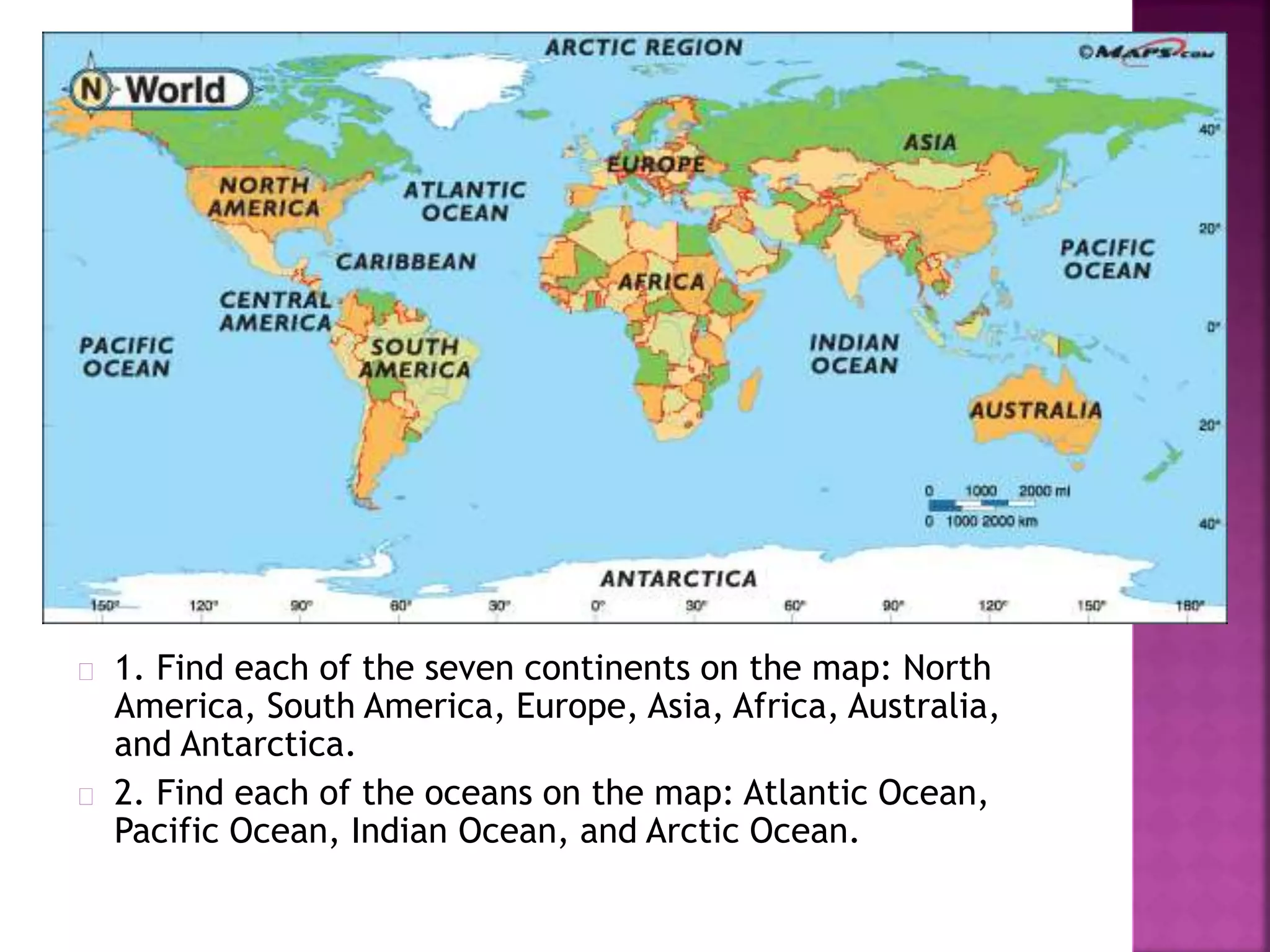
1. Find each of the seven continents on the map: North
America, South America, Europe, Asia, Africa, Australia,
and Antarctica.
2. Find each of the oceans on the map: Atlantic Ocean,
Pacific Ocean, Indian Ocean, and Arctic Ocean.
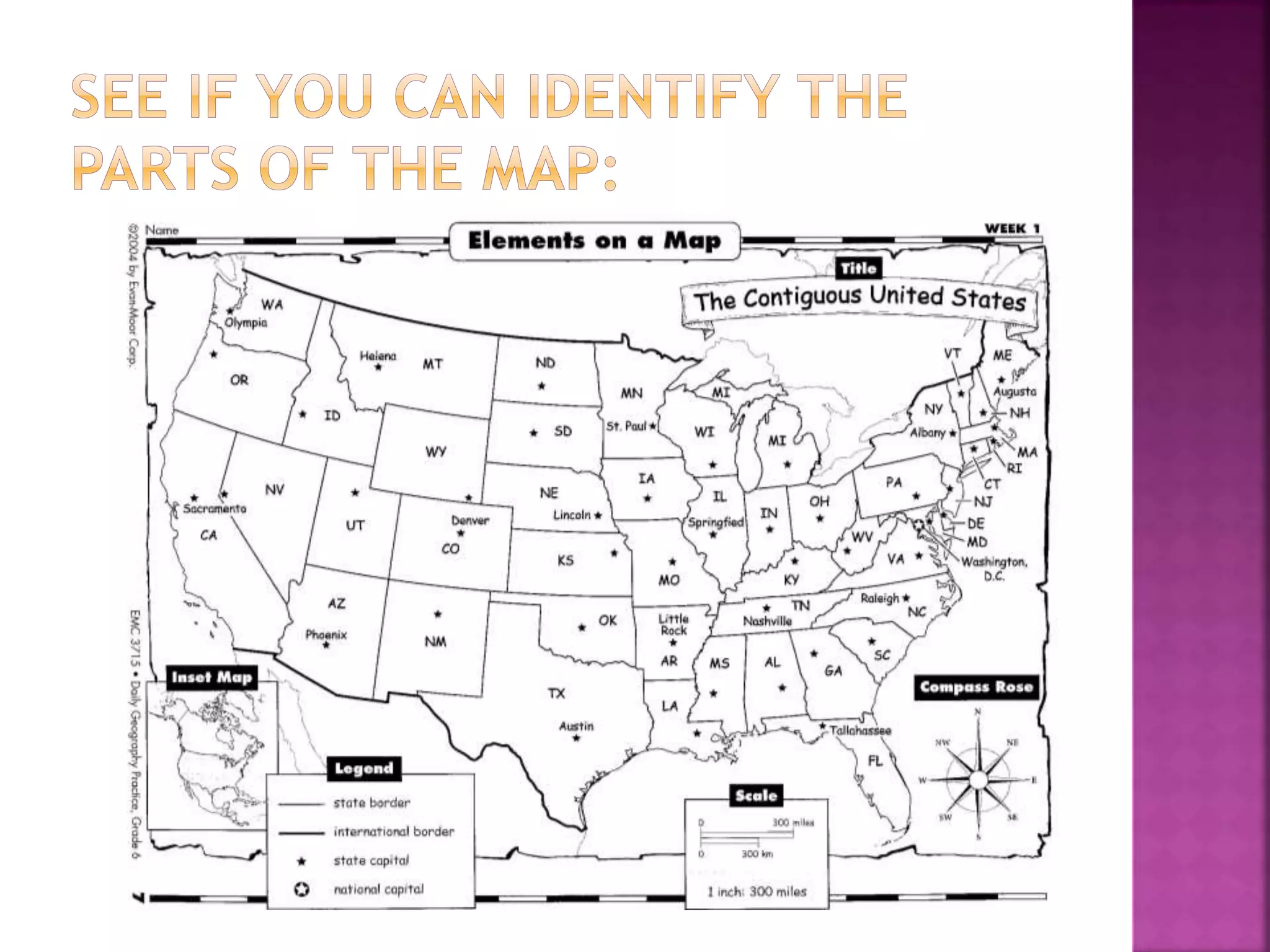
Every map has five important elements:
Title
Legend/Key
Compass Rose
Scale
Inset Map
Each element has a purpose:
The title tells you the purpose of the map.
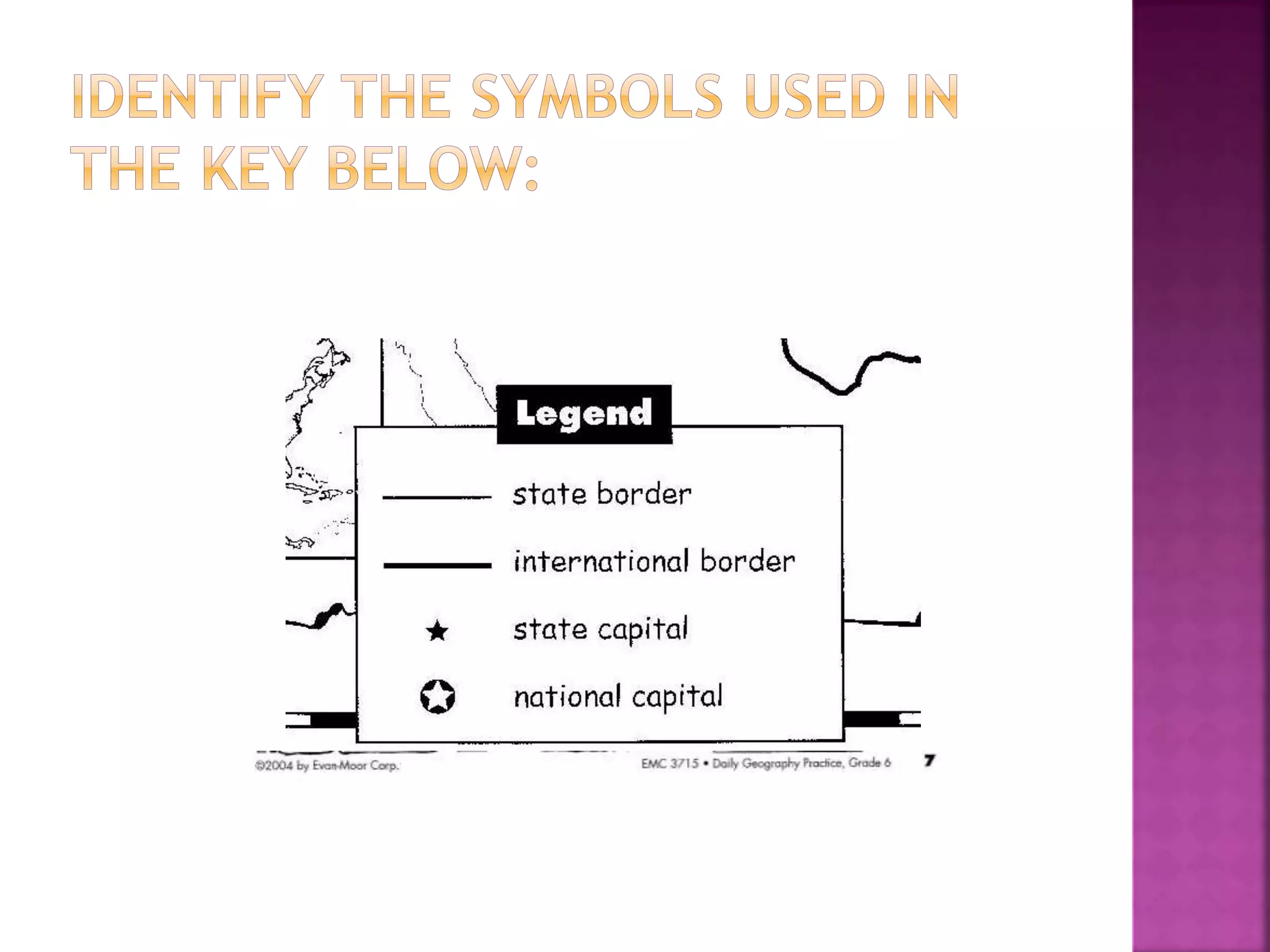
The legend shows you what symbols on the map mean.
The compass rose is a directional arrow that shows cardinal
and sometimes intermediate directions on a map.
The scale is shown in both standard and metric measurements
and show distance between objects on the map.
The inset map is a smaller map that shows a “larger” area of
land around the map.
Have you ever seen a star or a dot on a map?
The legend or map key will tell you what
those symbols mean.
For example, the map key might tell you that
a dot stands for a city.
The key might also indicate that a black line
represents a state border.
It might show you how to identify a river
with a blue line.
Different cartographers (map-makers) use
different map projections.
Another reason for this difference is that
maps can be created to represent different
features of the same places.
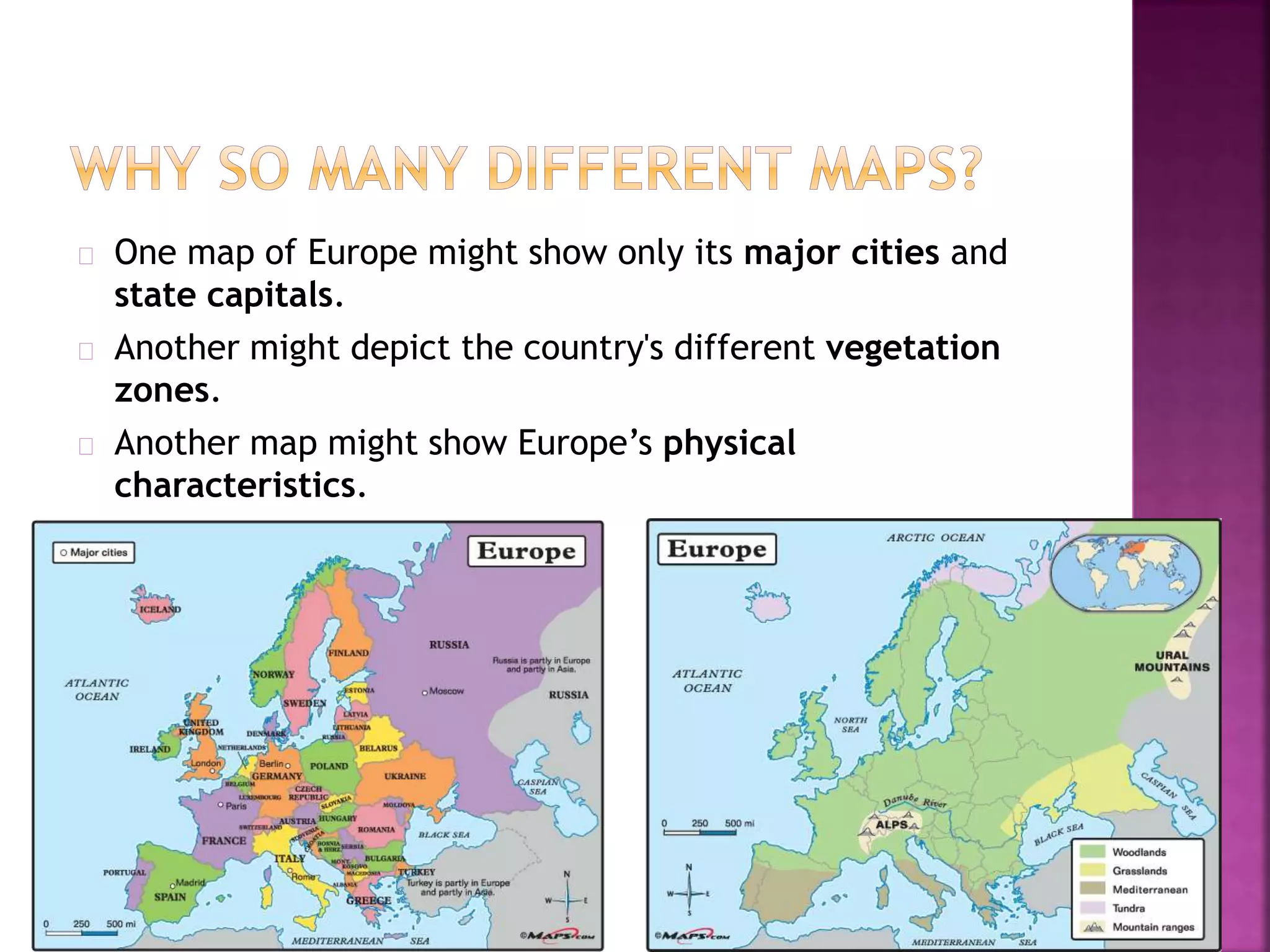
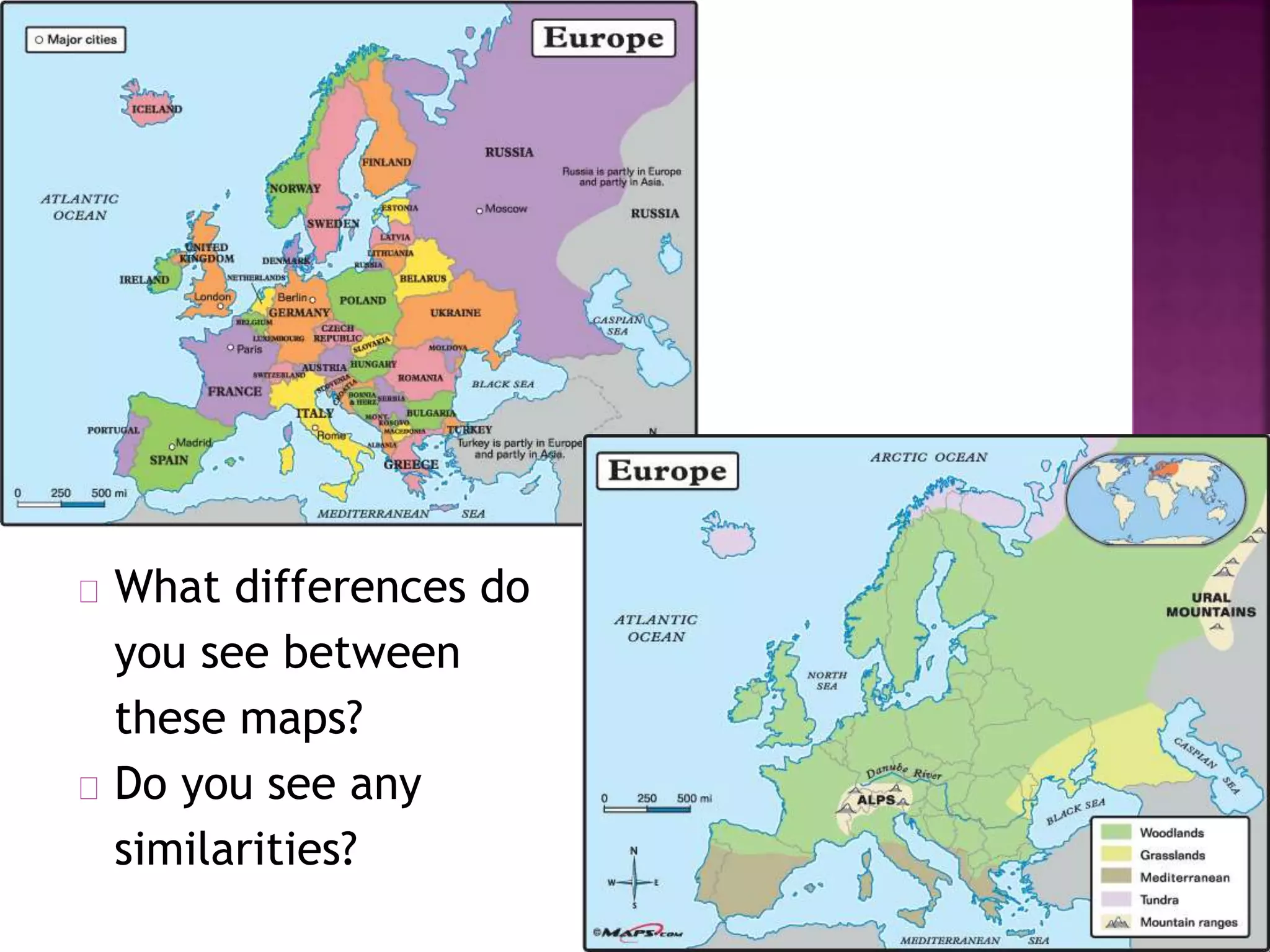
One map of Europe might show only its major cities and
state capitals.
Another might depict the country's different vegetation
zones.
Another map might show Europe’s physical
characteristics.
What differences do
you see between
these maps?
Do you see any
similarities?
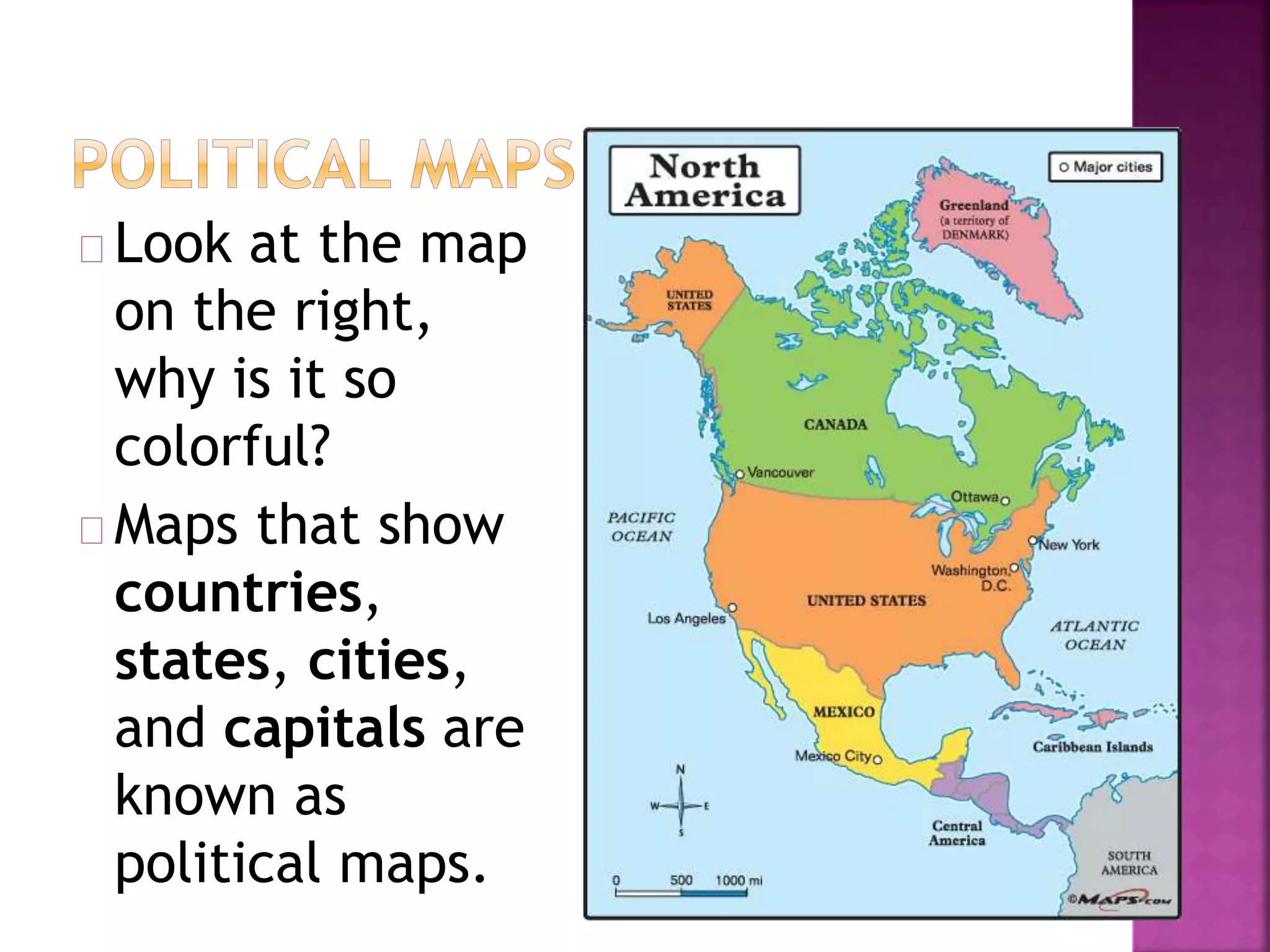
Look at the map
on the right,
why is it so
colorful?
Maps that show
countries,
states, cities,
and capitals are
known as
political maps.
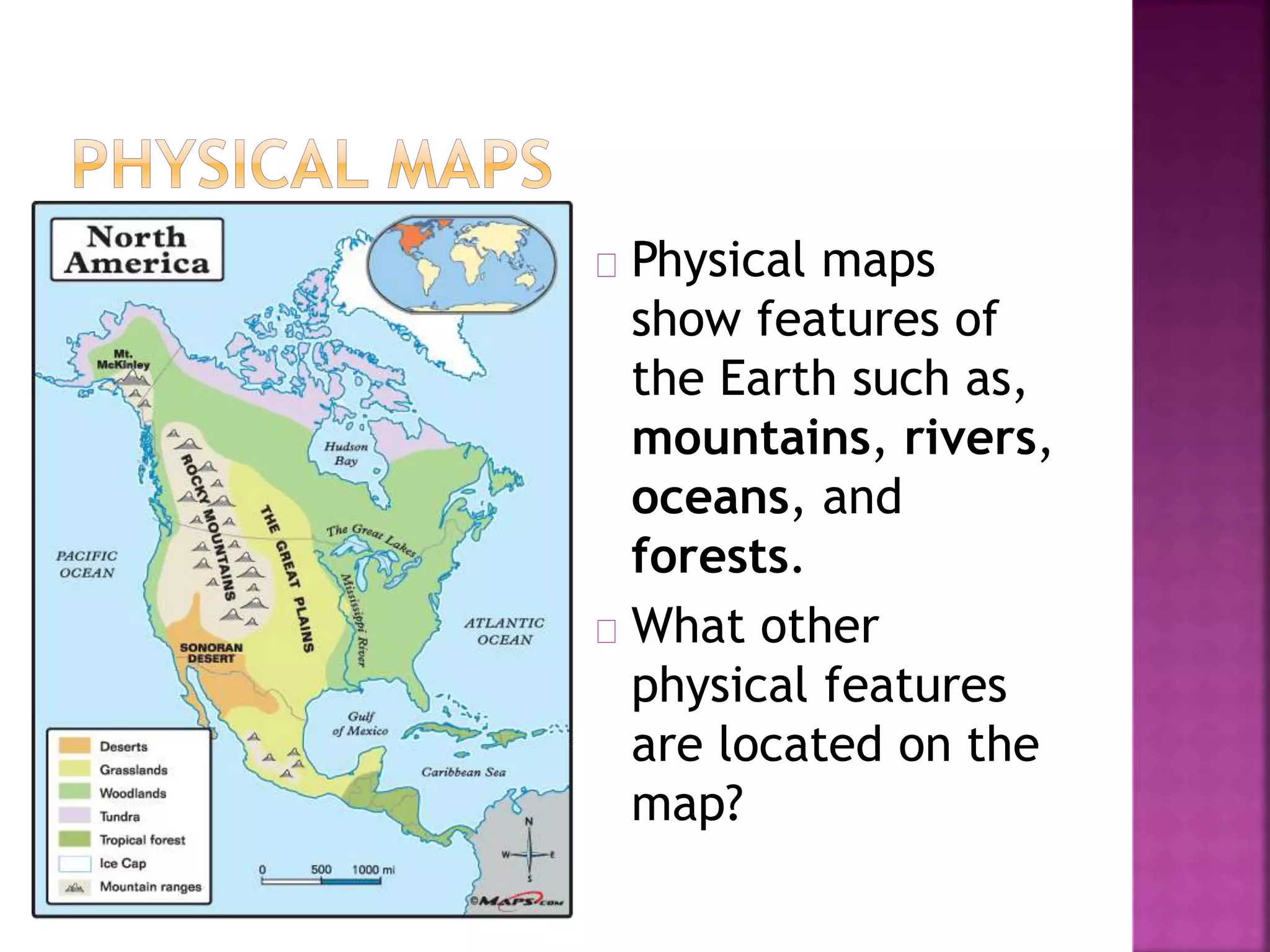
Physical maps
show features of
the Earth such as,
mountains, rivers,
oceans, and
forests.
What other
physical features
are located on the
map?
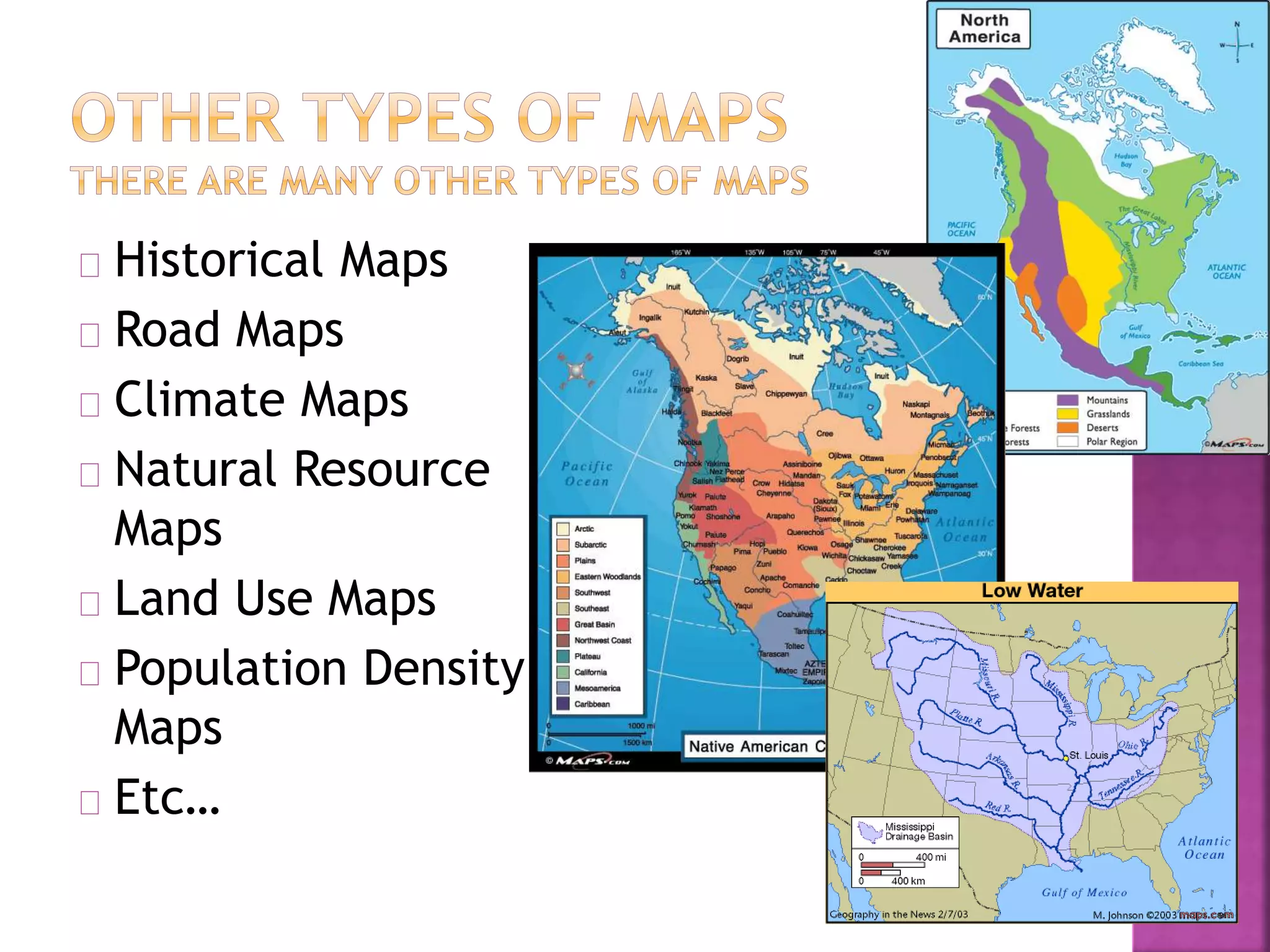
Historical Maps
Road Maps
Climate Maps
Natural Resource
Maps
Land Use Maps
Population Density
Maps
Etc…
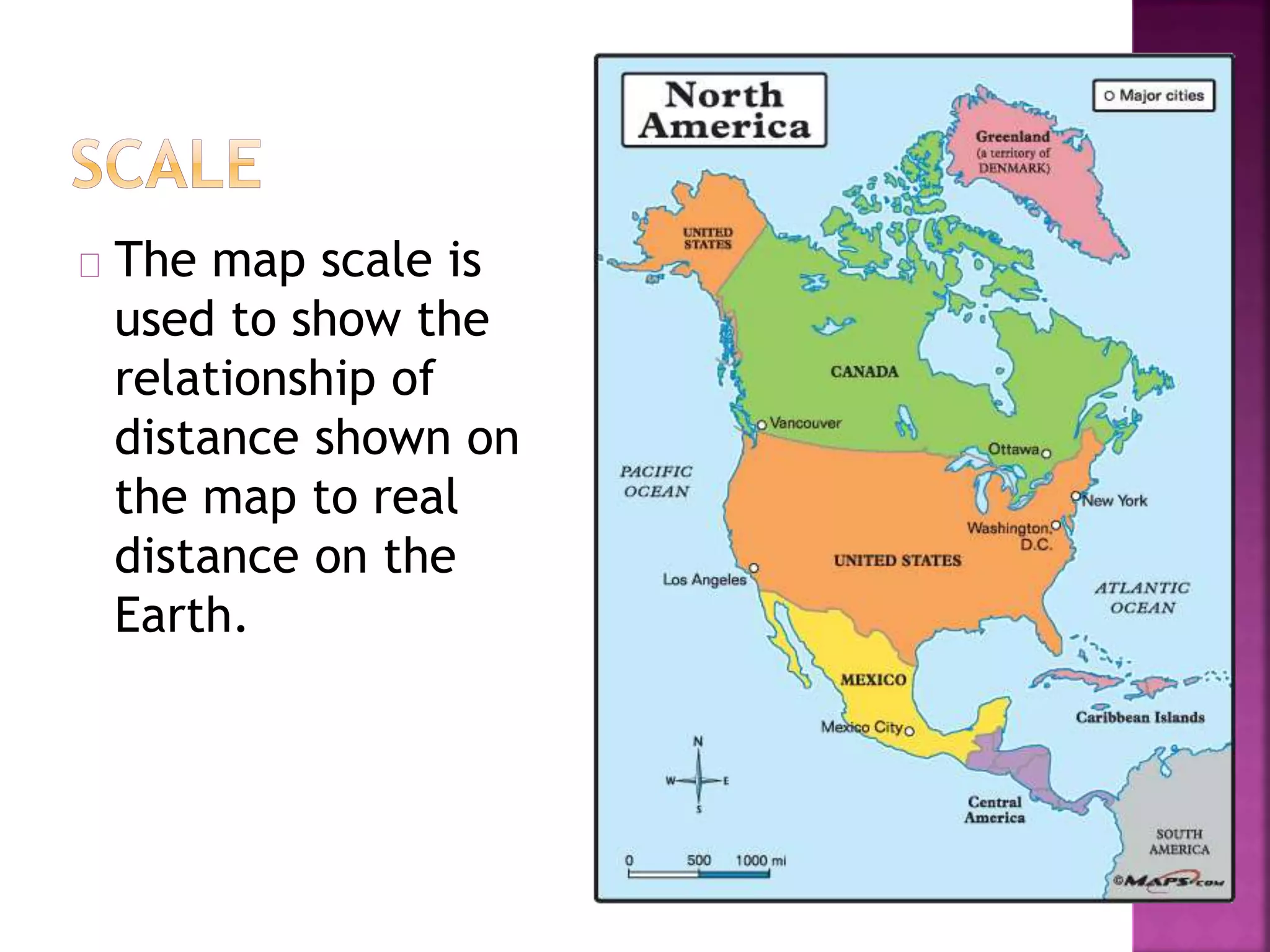
The map scale is
used to show the
relationship of
distance shown on
the map to real
distance on the
Earth.
On many maps you see crisscrossing lines
with numbers by them. These lines and
numbers form a grid system that allows
us to describe the absolute, or exact,
location of any place on Earth.
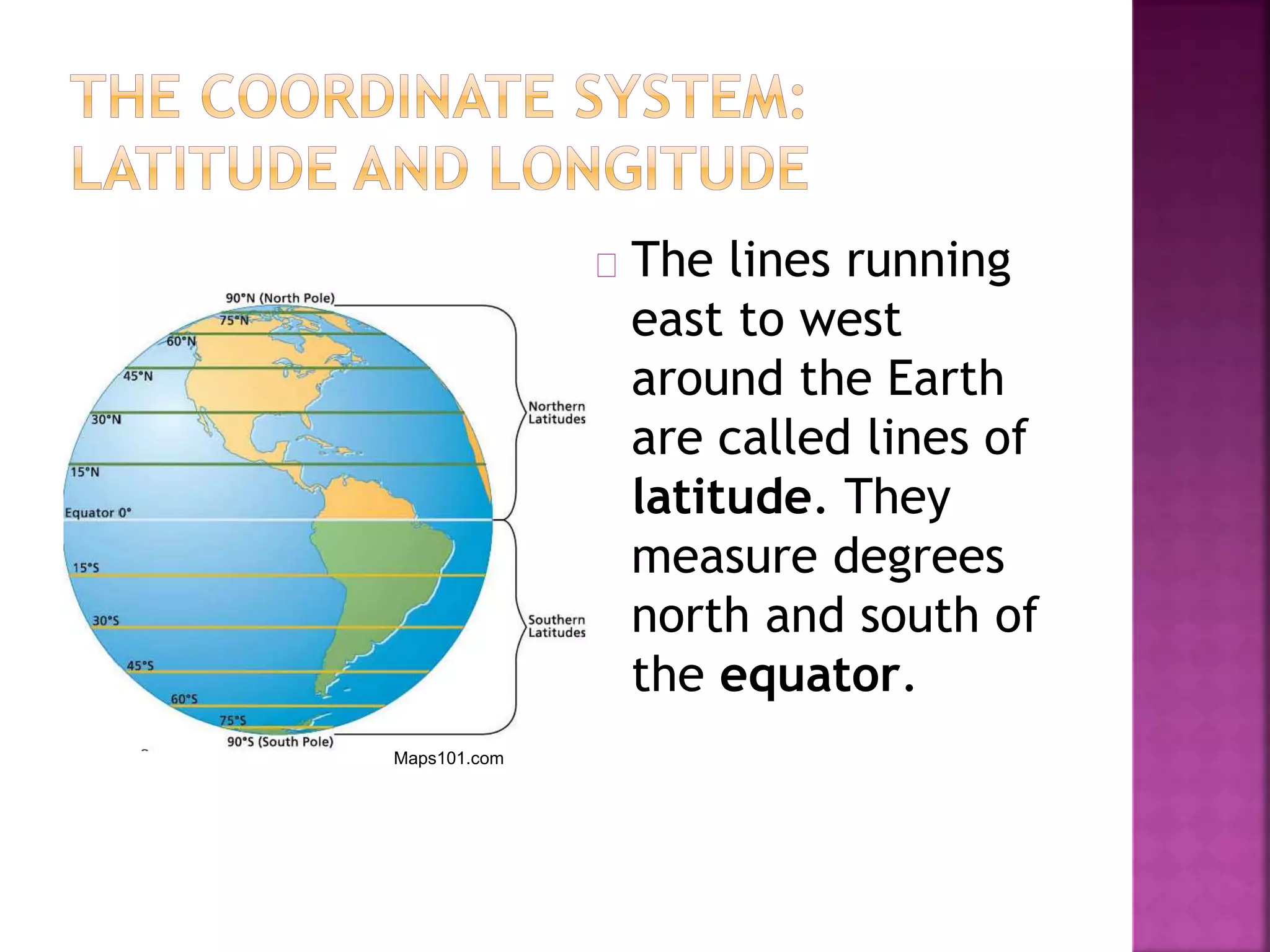
The lines running
east to west
around the Earth
are called lines of
latitude. They
measure degrees
north and south of
the equator.
Maps101.com
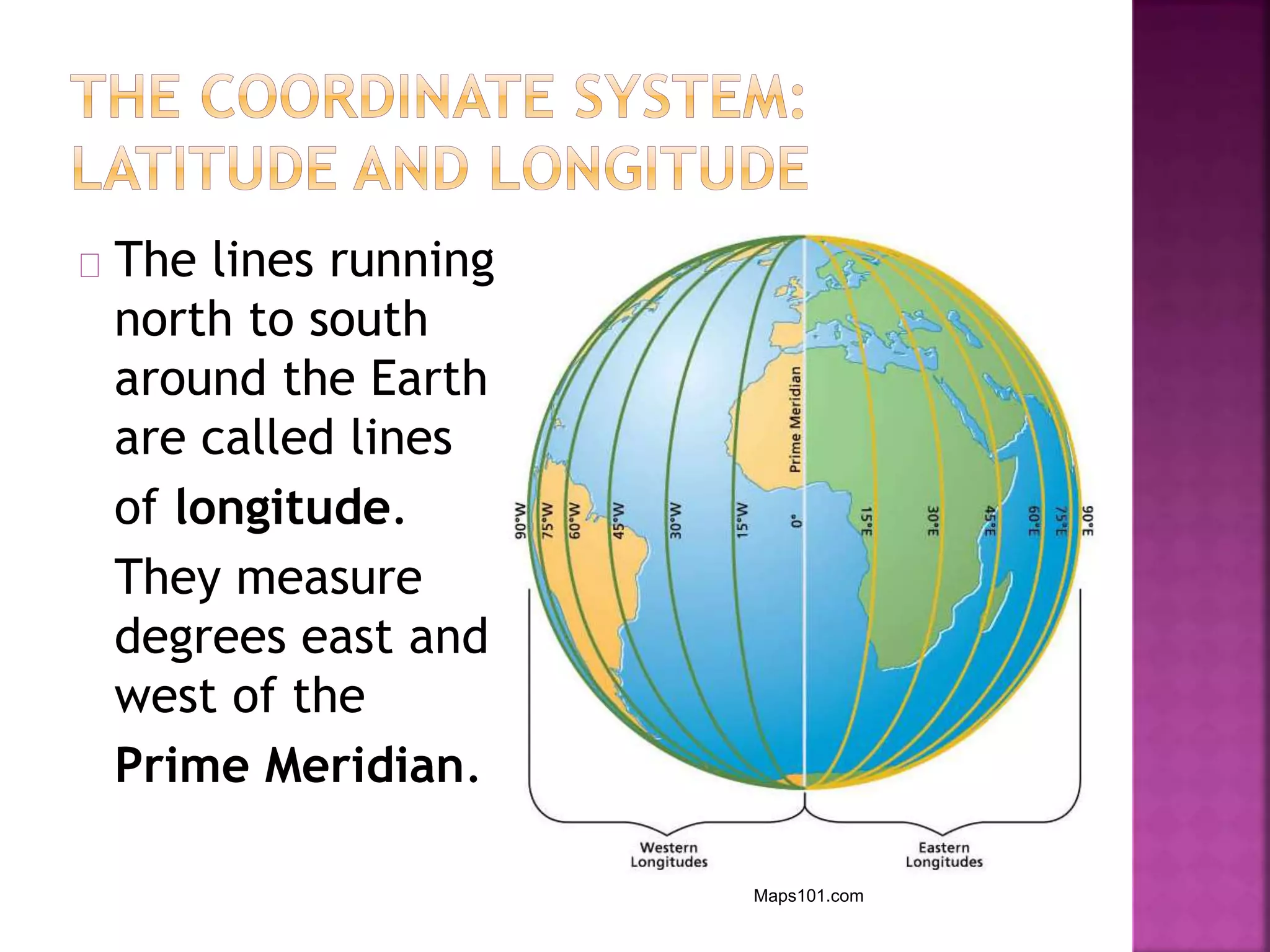
The lines running
north to south
around the Earth
are called lines
of longitude.
They measure
degrees east and
west of the
Prime Meridian.
Maps101.com
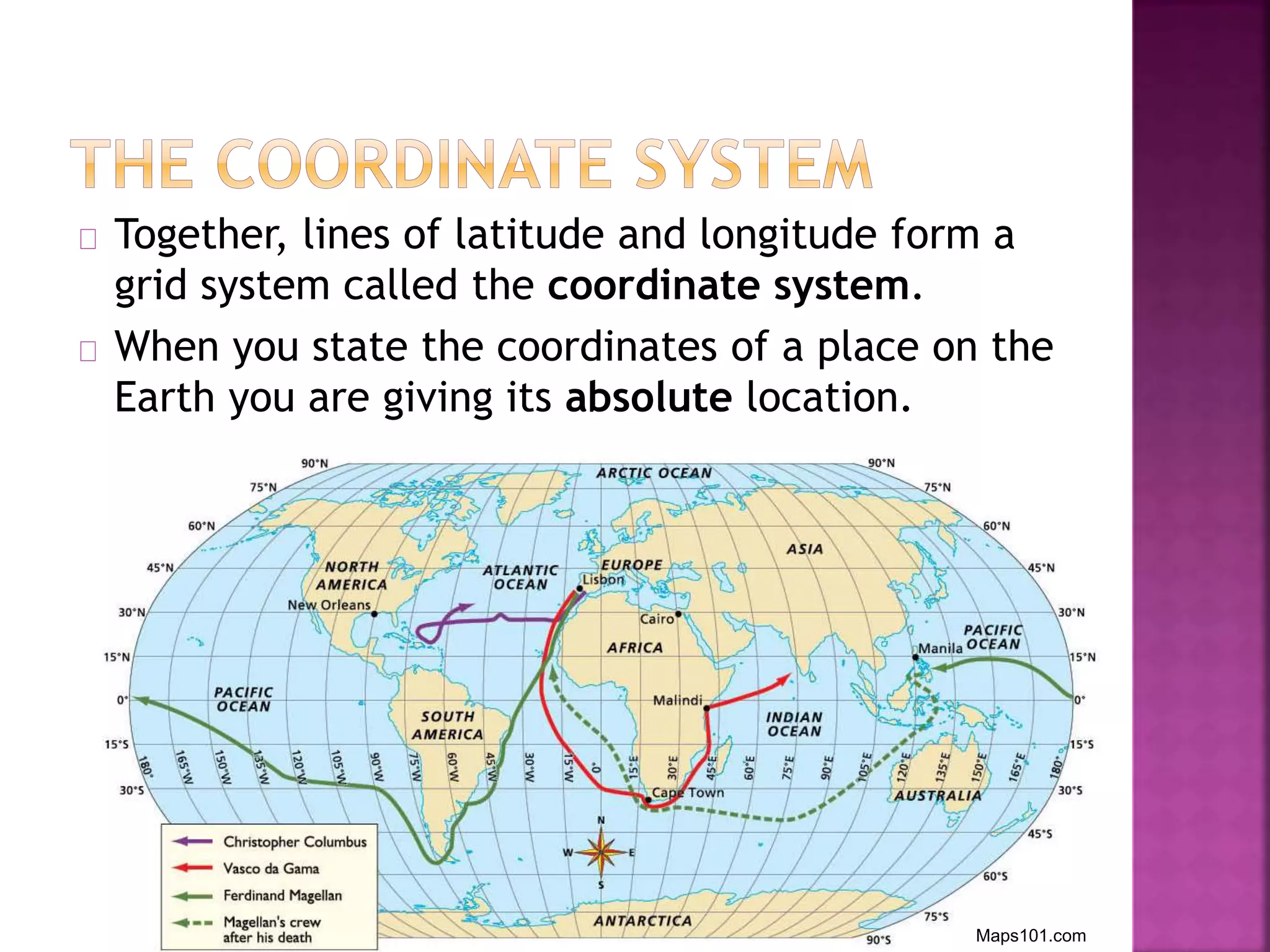
Together, lines of latitude and longitude form a
grid system called the coordinate system.
When you state the coordinates of a place on the
Earth you are giving its absolute location.
Maps101.com
Maps101.com

What is a Map?

  • 2.
    To learn aboutthe Earth, two tools you can use are globes and maps. A globe is a model of the planet Earth as if seeing it from outer space. A globe is round and shows continents and oceans. There are seven continents on Earth and four oceans. A map is a model of the Earth shown on a flat surface. Maps are useful because you can carry them with you. Let’s look at a map more closely…
  • 3.
    1. Find eachof the seven continents on the map: North America, South America, Europe, Asia, Africa, Australia, and Antarctica. 2. Find each of the oceans on the map: Atlantic Ocean, Pacific Ocean, Indian Ocean, and Arctic Ocean.
  • 4.
    Every map hasfive important elements: Title Legend/Key Compass Rose Scale Inset Map Each element has a purpose: The title tells you the purpose of the map. The legend shows you what symbols on the map mean. The compass rose is a directional arrow that shows cardinal and sometimes intermediate directions on a map. The scale is shown in both standard and metric measurements and show distance between objects on the map. The inset map is a smaller map that shows a “larger” area of land around the map.
  • 6.
    Have you everseen a star or a dot on a map? The legend or map key will tell you what those symbols mean. For example, the map key might tell you that a dot stands for a city. The key might also indicate that a black line represents a state border. It might show you how to identify a river with a blue line.
  • 8.
    Different cartographers (map-makers)use different map projections. Another reason for this difference is that maps can be created to represent different features of the same places.
  • 9.
    One map ofEurope might show only its major cities and state capitals. Another might depict the country's different vegetation zones. Another map might show Europe’s physical characteristics.
  • 10.
    What differences do yousee between these maps? Do you see any similarities?
  • 11.
    Look at themap on the right, why is it so colorful? Maps that show countries, states, cities, and capitals are known as political maps.
  • 12.
    Physical maps show featuresof the Earth such as, mountains, rivers, oceans, and forests. What other physical features are located on the map?
  • 13.
    Historical Maps Road Maps ClimateMaps Natural Resource Maps Land Use Maps Population Density Maps Etc…
  • 14.
    The map scaleis used to show the relationship of distance shown on the map to real distance on the Earth.
  • 15.
    On many mapsyou see crisscrossing lines with numbers by them. These lines and numbers form a grid system that allows us to describe the absolute, or exact, location of any place on Earth.
  • 16.
    The lines running eastto west around the Earth are called lines of latitude. They measure degrees north and south of the equator. Maps101.com
  • 17.
    The lines running northto south around the Earth are called lines of longitude. They measure degrees east and west of the Prime Meridian. Maps101.com
  • 18.
    Together, lines oflatitude and longitude form a grid system called the coordinate system. When you state the coordinates of a place on the Earth you are giving its absolute location. Maps101.com
  • 19.