Divisibility
What exactly does it mean?


                    Created by tbonnar
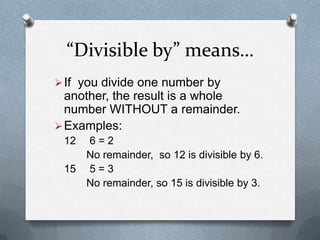
“Divisible by” means…
 If you divide one number by
  another, the result is a whole
  number WITHOUT a remainder.
 Examples:
 12 6=2
    No remainder, so 12 is divisible by 6.
 15 5 = 3
    No remainder, so 15 is divisible by 3.
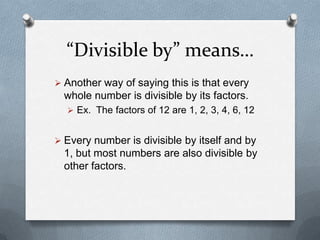
“Divisible by” means…
 Another way of saying this is that every
  whole number is divisible by its factors.
   Ex. The factors of 12 are 1, 2, 3, 4, 6, 12


 Every number is divisible by itself and by
  1, but most numbers are also divisible by
  other factors.
Ch. 1.1
Divisibility by 2, 5, and 10.
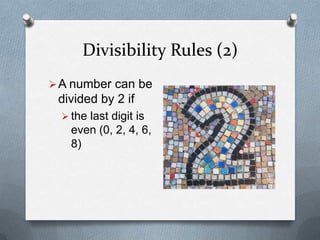
Divisibility Rules (2)
 A number can be
 divided by 2 if
   the last digit is
    even (0, 2, 4, 6,
    8)
Divisibility Rules (5)

            A number is
             divisible by 5 if
               the last digit is a
                5 or a 0
Divisibility Rules (10)

 A number can be
 divided by 10 if
   the last digit is
    a0
Ch. 1.2
Divisibility by 3 and 9.
Divisibility Rules (3)
            a number is
            divisible by 3 if

            the sum of the
            digits is 3 or a
            multiple of 3
Check Divisibility (3)
           a) 627


           b) 3278


           c) 4002


           d) 37782
Divisibility Rules (9)
            A number is
             divisible by 9 if

            the sum of all the
             digits will add to 9
             or a multiple of 9
Check Divisibility (9)
           a) 627


           b) 3278


           c) 4002


           d) 37782
Regrouping to show
            Divisibility
 One way to help            Ex. 1240 =
  show divisibility is to      124 tens + 0 ones
  regroup the number
  using place value          Ex. 52 255 =
  charts.
                               52 thousands + 2
 This sometimes                hundreds + 5 tens
  makes it clear                + 5 ones
  whether the number
  is divisible.
Ch. 1.3
Divisibility by 6.
Divisibility Rules (6)

 A number can be
  divided by 6 if

 the last digit is
  even and the sum
  of all the digits is 3
  or a multiple of 3.
Divisibility Rules (6)

 In other words, it
 must be divisible
 by both:
2 and 3
Check Divisibility (6)
a) 348


b) 2987


c) 5630


d) 46 524
Ch. 1.4
Divisibility by 4 and 8.
Divisibility Rules (4)
          a number is
          divisible by 4 if
            the number
            made by the
            last two digits
            can be divided
            by 4
Check Divisibility (4)
         a) 3466


         b) 1288


         c) 39804


         d) 64 684
Divisibility Rules (8)
 A number is
 divisible by 8 if

 the number
 made by the last
 three digits will
 be divisible by 8
Check Divisibility (8)
a) 3466


b) 1288


c) 39804


d) 64 684
Ch. 1.1 – 1.4
Divisibility Rules Review
 2, the last digit will be an even number


 3, all the digits will add to a multiple of 3


 4, the number made by the last two digits
  can be divided by 4

 5, the last digit will be a 5 or 0
Divisibility Rules Review
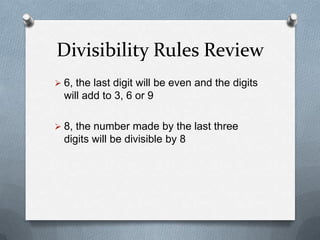
 6, the last digit will be even (rule for 2) and
  the digits will add to a multiple of 3

 8, the number made by the last three
  digits will be divisible by 8
Divisibility Rules Review
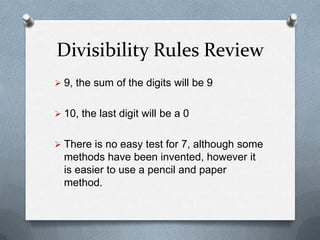
 9, the sum of the digits will be 9 or a
  multiple of 9

 10, the last digit will be a 0


 There is no easy test for 7. Although
  some methods have been invented,
  however it is easier to simply do the
  regular division.
Divisibility Rules
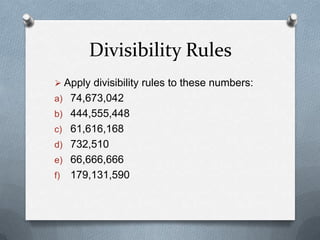
 Apply divisibility rules to these numbers:
a) 74,673,042
b) 444,555,448
c) 61,616,168
d) 732,510
e) 66,666,666
f)   179,131,590
Ch. 1.5
Divisibility by 0
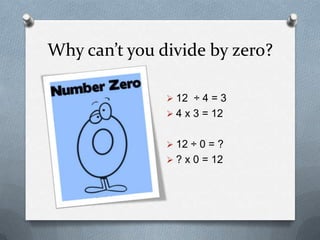
Why can’t you divide by zero?

               12 ÷ 4 = 3
               4 x 3 = 12

               12 ÷ 0 = ?
               ? x 0 = 12

               What x 0 = 12? Is there
                any answer?
               What does your calculator
                say?
Why can’t you divide by zero?
              Or, another way to think
               of it:
              12 ÷ 4 = 3 means 12
               divided into groups of 4
               gives 3 groups of 4.
              12 ÷ 0 = ? Means 12
               divided into ? groups of
               0.
              How many groups of 0
               do you need to equal
               12?
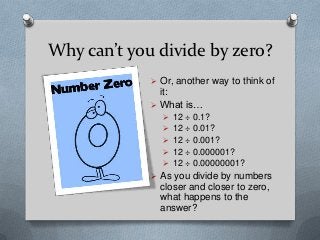
Why can’t you divide by zero?
              Or, another way to think of
               it:
              What is…
                12 ÷ 0.1?
                12 ÷ 0.01?
                12 ÷ 0.001?
                12 ÷ 0.000001?
                12 ÷ 0.00000001?
              As you divide by numbers
               closer and closer to zero,
               what happens to the
               answer?

Divisibility Rules

  • 1.
    Divisibility What exactly doesit mean? Created by tbonnar
  • 2.
    “Divisible by” means… If you divide one number by another, the result is a whole number WITHOUT a remainder.  Examples: 12 6=2 No remainder, so 12 is divisible by 6. 15 5 = 3 No remainder, so 15 is divisible by 3.
  • 3.
    “Divisible by” means… Another way of saying this is that every whole number is divisible by its factors.  Ex. The factors of 12 are 1, 2, 3, 4, 6, 12  Every number is divisible by itself and by 1, but most numbers are also divisible by other factors.
  • 4.
  • 5.
    Divisibility Rules (2) A number can be divided by 2 if  the last digit is even (0, 2, 4, 6, 8)
  • 6.
    Divisibility Rules (5)  A number is divisible by 5 if  the last digit is a 5 or a 0
  • 7.
    Divisibility Rules (10) A number can be divided by 10 if  the last digit is a0
  • 8.
  • 9.
    Divisibility Rules (3)  a number is divisible by 3 if  the sum of the digits is 3 or a multiple of 3
  • 10.
    Check Divisibility (3) a) 627 b) 3278 c) 4002 d) 37782
  • 11.
    Divisibility Rules (9)  A number is divisible by 9 if  the sum of all the digits will add to 9 or a multiple of 9
  • 12.
    Check Divisibility (9) a) 627 b) 3278 c) 4002 d) 37782
  • 13.
    Regrouping to show Divisibility  One way to help  Ex. 1240 = show divisibility is to  124 tens + 0 ones regroup the number using place value  Ex. 52 255 = charts.  52 thousands + 2  This sometimes hundreds + 5 tens makes it clear + 5 ones whether the number is divisible.
  • 14.
  • 15.
    Divisibility Rules (6) A number can be divided by 6 if  the last digit is even and the sum of all the digits is 3 or a multiple of 3.
  • 16.
    Divisibility Rules (6) In other words, it must be divisible by both: 2 and 3
  • 17.
    Check Divisibility (6) a)348 b) 2987 c) 5630 d) 46 524
  • 18.
  • 19.
    Divisibility Rules (4)  a number is divisible by 4 if  the number made by the last two digits can be divided by 4
  • 20.
    Check Divisibility (4) a) 3466 b) 1288 c) 39804 d) 64 684
  • 21.
    Divisibility Rules (8) A number is divisible by 8 if  the number made by the last three digits will be divisible by 8
  • 22.
    Check Divisibility (8) a)3466 b) 1288 c) 39804 d) 64 684
  • 23.
    Ch. 1.1 –1.4 Divisibility Rules Review
  • 24.
    Divisibility Rules Review 2, the last digit will be an even number  3, all the digits will add to a multiple of 3  4, the number made by the last two digits can be divided by 4  5, the last digit will be a 5 or 0
  • 25.
    Divisibility Rules Review 6, the last digit will be even (rule for 2) and the digits will add to a multiple of 3  8, the number made by the last three digits will be divisible by 8
  • 26.
    Divisibility Rules Review 9, the sum of the digits will be 9 or a multiple of 9  10, the last digit will be a 0  There is no easy test for 7. Although some methods have been invented, however it is easier to simply do the regular division.
  • 27.
    Divisibility Rules  Applydivisibility rules to these numbers: a) 74,673,042 b) 444,555,448 c) 61,616,168 d) 732,510 e) 66,666,666 f) 179,131,590
  • 28.
  • 29.
    Why can’t youdivide by zero?  12 ÷ 4 = 3  4 x 3 = 12  12 ÷ 0 = ?  ? x 0 = 12  What x 0 = 12? Is there any answer?  What does your calculator say?
  • 30.
    Why can’t youdivide by zero?  Or, another way to think of it:  12 ÷ 4 = 3 means 12 divided into groups of 4 gives 3 groups of 4.  12 ÷ 0 = ? Means 12 divided into ? groups of 0.  How many groups of 0 do you need to equal 12?
  • 31.
    Why can’t youdivide by zero?  Or, another way to think of it:  What is…  12 ÷ 0.1?  12 ÷ 0.01?  12 ÷ 0.001?  12 ÷ 0.000001?  12 ÷ 0.00000001?  As you divide by numbers closer and closer to zero, what happens to the answer?