GEOGRAPHY
SKILLS:
SCALE
Map Scale
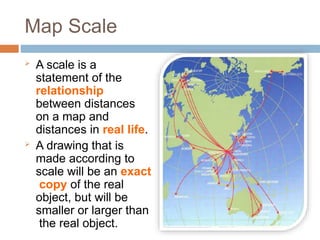
 A scale is a
statement of the
relationship
between distances
on a map and
distances in real life.
 A drawing that is
made according to
scale will be an exact
copy of the real
object, but will be
smaller or larger than
the real object.
Map Scale
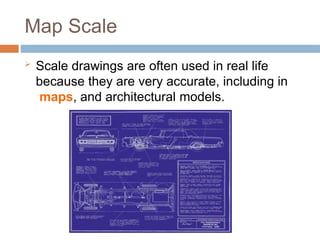
 Scale drawings are often used in real life
because they are very accurate, including in
maps, and architectural models.
Three Types of Scale
Section A:
Three Types of Scale
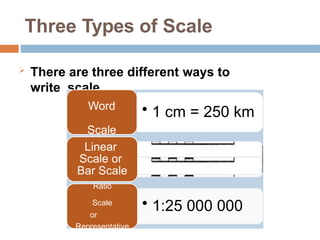
 There are three different ways to
write scale.
• 1 cm = 250 km
Word
Scale
• 1:25 000 000
Linear
Scale or
Bar Scale
Ratio
Scale
or
Representative
Fraction Scale
Map Scales
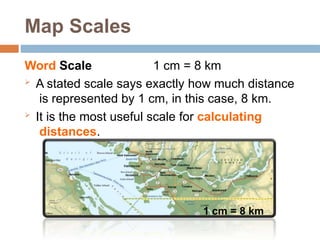
Word Scale 1 cm = 8 km
 A stated scale says exactly how much distance
is represented by 1 cm, in this case, 8 km.
 It is the most useful scale for calculating
distances.
1 cm = 8 km
Map Scales
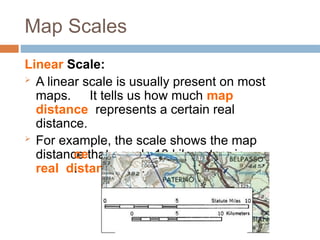
Linear Scale:
 A linear scale is usually present on most
maps. It tells us how much map
distance represents a certain real
distance.
 For example, the scale shows the map
distance that equals 10 kilometers in
real distan
ce
.
Map Scales
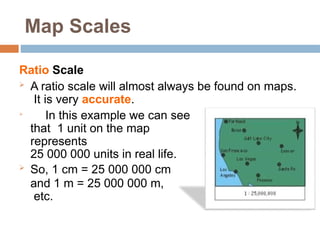
Ratio Scale
 A ratio scale will almost always be found on maps.
It is very accurate.

In this example we can see
that 1 unit on the map
represents
25 000 000 units in real life.
 So, 1 cm = 25 000 000 cm
and 1 m = 25 000 000 m,
etc.
Map Scales:
Changing Scales
 Distances such as 25 000 000 cm are very
difficult to imagine. So, we usually
change a ratio scale into a stated scale.
 In this example, we would use the metric
system to help us change the ratio scale of
1:25 000 000 into a stated scale of 1 cm =
250 km.
Large Scale vs. Small Scale
Map Scales:
Large
Scale
vs.
Small
Scale
Map Scales:
Large Scale vs. Small Scale
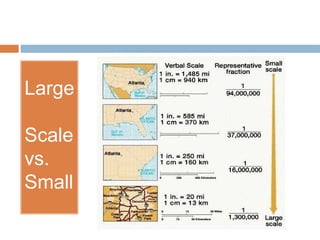
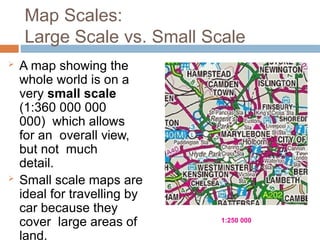
 A map showing the
whole world is on a
very small scale
(1:360 000 000
000) which allows
for an overall view,
but not much
detail.
 Small scale maps are
ideal for travelling by
car because they
cover large areas of
land.
1:250 000
Map Scales:
Large Scale vs. Small Scale
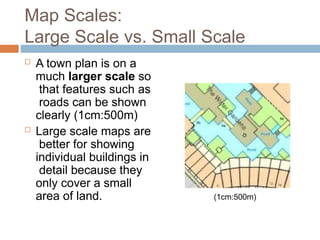
 A town plan is on a
much larger scale so
that features such as
roads can be shown
clearly (1cm:500m)
 Large scale maps are
better for showing
individual buildings in
detail because they
only cover a small
area of land. (1cm:500m)

Map Scales.pptxNBKVHHHHHHHHHHHHHHHHHHHHHHVYUGI

  • 1.
  • 2.
    Map Scale  Ascale is a statement of the relationship between distances on a map and distances in real life.  A drawing that is made according to scale will be an exact copy of the real object, but will be smaller or larger than the real object.
  • 3.
    Map Scale  Scaledrawings are often used in real life because they are very accurate, including in maps, and architectural models.
  • 4.
    Three Types ofScale Section A:
  • 5.
    Three Types ofScale  There are three different ways to write scale. • 1 cm = 250 km Word Scale • 1:25 000 000 Linear Scale or Bar Scale Ratio Scale or Representative Fraction Scale
  • 6.
    Map Scales Word Scale1 cm = 8 km  A stated scale says exactly how much distance is represented by 1 cm, in this case, 8 km.  It is the most useful scale for calculating distances. 1 cm = 8 km
  • 7.
    Map Scales Linear Scale: A linear scale is usually present on most maps. It tells us how much map distance represents a certain real distance.  For example, the scale shows the map distance that equals 10 kilometers in real distan ce .
  • 8.
    Map Scales Ratio Scale A ratio scale will almost always be found on maps. It is very accurate.  In this example we can see that 1 unit on the map represents 25 000 000 units in real life.  So, 1 cm = 25 000 000 cm and 1 m = 25 000 000 m, etc.
  • 9.
    Map Scales: Changing Scales Distances such as 25 000 000 cm are very difficult to imagine. So, we usually change a ratio scale into a stated scale.  In this example, we would use the metric system to help us change the ratio scale of 1:25 000 000 into a stated scale of 1 cm = 250 km.
  • 10.
    Large Scale vs.Small Scale Map Scales:
  • 11.
  • 12.
    Map Scales: Large Scalevs. Small Scale  A map showing the whole world is on a very small scale (1:360 000 000 000) which allows for an overall view, but not much detail.  Small scale maps are ideal for travelling by car because they cover large areas of land. 1:250 000
  • 13.
    Map Scales: Large Scalevs. Small Scale  A town plan is on a much larger scale so that features such as roads can be shown clearly (1cm:500m)  Large scale maps are better for showing individual buildings in detail because they only cover a small area of land. (1cm:500m)