REFLEXIVE VERBS
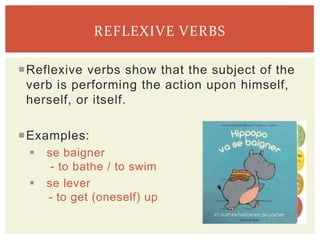
Reflexive verbs show that the subject of the
verb is performing the action upon
himself, herself, or itself.
Examples:
 se baigner
- to bathe / to swim
 se lever
- to get (oneself) up
REFLEXIVE VERBS
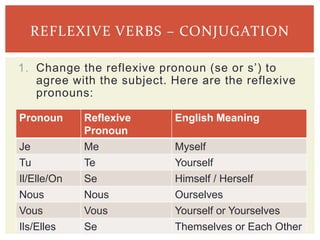
1. Change the reflexive pronoun (se or s’) to
agree with the subject. Here are the reflexive
pronouns:
REFLEXIVE VERBS – CONJUGATION
Pronoun Reflexive
Pronoun
English Meaning
Je Me Myself
Tu Te Yourself
Il/Elle/On Se Himself / Herself
Nous Nous Ourselves
Vous Vous Yourself or Yourselves
Ils/Elles Se Themselves or Each Other
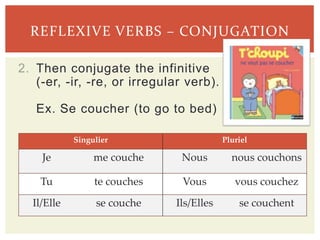
2. Then conjugate the infinitive
(-er, -ir, -re, or irregular verb).
Ex. Se coucher (to go to bed)
REFLEXIVE VERBS – CONJUGATION
Singulier Pluriel
Je me couche Nous nous couchons
Tu te couches Vous vous couchez
Il/Elle se couche Ils/Elles se couchent
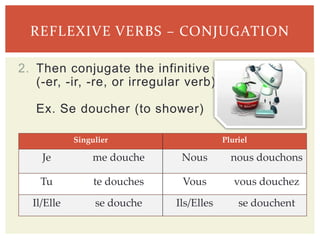
2. Then conjugate the infinitive
(-er, -ir, -re, or irregular verb).
Ex. Se doucher (to shower)
REFLEXIVE VERBS – CONJUGATION
Singulier Pluriel
Je me douche Nous nous douchons
Tu te douches Vous vous douchez
Il/Elle se douche Ils/Elles se douchent
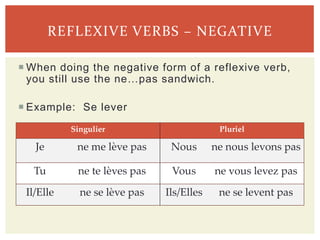
 When doing the negative form of a reflexive verb,
you still use the ne…pas sandwich.
 Example: Se lever
REFLEXIVE VERBS – NEGATIVE
Singulier Pluriel
Je ne me lève pas Nous ne nous levons pas
Tu ne te lèves pas Vous ne vous levez pas
Il/Elle ne se lève pas Ils/Elles ne se levent pas
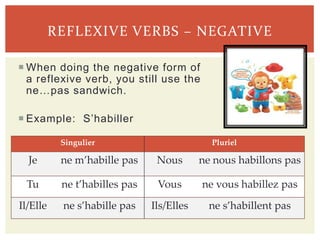
 When doing the negative form of
a reflexive verb, you still use the
ne…pas sandwich.
 Example: S’habiller
REFLEXIVE VERBS – NEGATIVE
Singulier Pluriel
Je ne m’habille pas Nous ne nous habillons pas
Tu ne t’habilles pas Vous ne vous habillez pas
Il/Elle ne s’habille pas Ils/Elles ne s’habillent pas
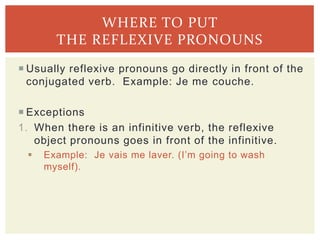
 Usually reflexive pronouns go directly in front of the
conjugated verb. Example: Je me couche.
 Exceptions
1. When there is an infinitive verb, the reflexive
object pronouns goes in front of the infinitive.
 Example: Je vais me laver. (I’m going to wash
myself).
WHERE TO PUT
THE REFLEXIVE PRONOUNS
 Exceptions
2. When there is a
command…
 the reflexive pronouns go
after the conjugated verb.
 The reflexive pronouns
also change for some!
 Examples:
 Lave-toi
 Levez-vous
Normal
Reflexive
Pronoun
Reflexive
Pronouns for
commands
Je Moi
Tu Toi
Il/Elle Il/Elle
Nous Nous
Vous Vous
Ils/Elles Ills/Elles
WHERE TO PUT
THE REFLEXIVE PRONOUNS
COMMON
REFLEXIVE VERBS
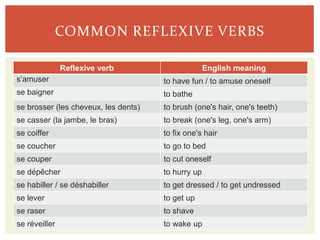
COMMON REFLEXIVE VERBS
Reflexive verb English meaning
s’amuser to have fun / to amuse oneself
se baigner to bathe
se brosser (les cheveux, les dents) to brush (one's hair, one's teeth)
se casser (la jambe, le bras) to break (one's leg, one's arm)
se coiffer to fix one's hair
se coucher to go to bed
se couper to cut oneself
se dépêcher to hurry up
se habiller / se déshabiller to get dressed / to get undressed
se lever to get up
se raser to shave
se réveiller to wake up
REFLEXIVE
AND
NON-REFLEXIVE
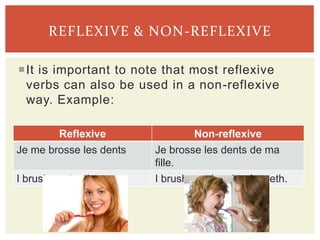
REFLEXIVE & NON-REFLEXIVE
It is important to note that most reflexive
verbs can also be used in a non-reflexive
way. Example:
Reflexive Non-reflexive
Je me brosse les dents Je brosse les dents de ma
fille.
I brush my teeth. I brush my daughter’s teeth.
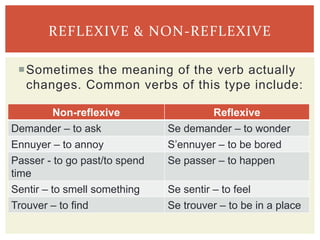
Sometimes the meaning of the verb actually
changes. Common verbs of this type include:
REFLEXIVE & NON-REFLEXIVE
Non-reflexive Reflexive
Demander – to ask Se demander – to wonder
Ennuyer – to annoy S’ennuyer – to be bored
Passer - to go past/to spend
time
Se passer – to happen
Sentir – to smell something Se sentir – to feel
Trouver – to find Se trouver – to be in a place

Reflexive verbs - in French

  • 1.
  • 2.
    Reflexive verbs showthat the subject of the verb is performing the action upon himself, herself, or itself. Examples:  se baigner - to bathe / to swim  se lever - to get (oneself) up REFLEXIVE VERBS
  • 3.
    1. Change thereflexive pronoun (se or s’) to agree with the subject. Here are the reflexive pronouns: REFLEXIVE VERBS – CONJUGATION Pronoun Reflexive Pronoun English Meaning Je Me Myself Tu Te Yourself Il/Elle/On Se Himself / Herself Nous Nous Ourselves Vous Vous Yourself or Yourselves Ils/Elles Se Themselves or Each Other
  • 4.
    2. Then conjugatethe infinitive (-er, -ir, -re, or irregular verb). Ex. Se coucher (to go to bed) REFLEXIVE VERBS – CONJUGATION Singulier Pluriel Je me couche Nous nous couchons Tu te couches Vous vous couchez Il/Elle se couche Ils/Elles se couchent
  • 5.
    2. Then conjugatethe infinitive (-er, -ir, -re, or irregular verb). Ex. Se doucher (to shower) REFLEXIVE VERBS – CONJUGATION Singulier Pluriel Je me douche Nous nous douchons Tu te douches Vous vous douchez Il/Elle se douche Ils/Elles se douchent
  • 6.
     When doingthe negative form of a reflexive verb, you still use the ne…pas sandwich.  Example: Se lever REFLEXIVE VERBS – NEGATIVE Singulier Pluriel Je ne me lève pas Nous ne nous levons pas Tu ne te lèves pas Vous ne vous levez pas Il/Elle ne se lève pas Ils/Elles ne se levent pas
  • 7.
     When doingthe negative form of a reflexive verb, you still use the ne…pas sandwich.  Example: S’habiller REFLEXIVE VERBS – NEGATIVE Singulier Pluriel Je ne m’habille pas Nous ne nous habillons pas Tu ne t’habilles pas Vous ne vous habillez pas Il/Elle ne s’habille pas Ils/Elles ne s’habillent pas
  • 8.
     Usually reflexivepronouns go directly in front of the conjugated verb. Example: Je me couche.  Exceptions 1. When there is an infinitive verb, the reflexive object pronouns goes in front of the infinitive.  Example: Je vais me laver. (I’m going to wash myself). WHERE TO PUT THE REFLEXIVE PRONOUNS
  • 9.
     Exceptions 2. Whenthere is a command…  the reflexive pronouns go after the conjugated verb.  The reflexive pronouns also change for some!  Examples:  Lave-toi  Levez-vous Normal Reflexive Pronoun Reflexive Pronouns for commands Je Moi Tu Toi Il/Elle Il/Elle Nous Nous Vous Vous Ils/Elles Ills/Elles WHERE TO PUT THE REFLEXIVE PRONOUNS
  • 10.
  • 11.
    COMMON REFLEXIVE VERBS Reflexiveverb English meaning s’amuser to have fun / to amuse oneself se baigner to bathe se brosser (les cheveux, les dents) to brush (one's hair, one's teeth) se casser (la jambe, le bras) to break (one's leg, one's arm) se coiffer to fix one's hair se coucher to go to bed se couper to cut oneself se dépêcher to hurry up se habiller / se déshabiller to get dressed / to get undressed se lever to get up se raser to shave se réveiller to wake up
  • 12.
  • 13.
    REFLEXIVE & NON-REFLEXIVE Itis important to note that most reflexive verbs can also be used in a non-reflexive way. Example: Reflexive Non-reflexive Je me brosse les dents Je brosse les dents de ma fille. I brush my teeth. I brush my daughter’s teeth.
  • 14.
    Sometimes the meaningof the verb actually changes. Common verbs of this type include: REFLEXIVE & NON-REFLEXIVE Non-reflexive Reflexive Demander – to ask Se demander – to wonder Ennuyer – to annoy S’ennuyer – to be bored Passer - to go past/to spend time Se passer – to happen Sentir – to smell something Se sentir – to feel Trouver – to find Se trouver – to be in a place