Dr Vishal Kulkarni
MBBS MD (Microbiology)

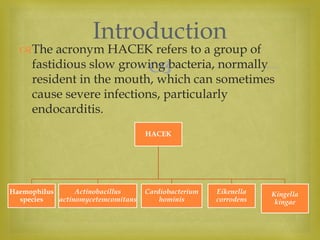
The acronym HACEK refers to a group of
fastidious slow growing bacteria, normally
resident in the mouth, which can sometimes
cause severe infections, particularly
endocarditis.
Introduction
HACEK
Haemophilus
species
Actinobacillus
actinomycetemcomitans
Cardiobacterium
hominis
Eikenella
corrodens
Kingella
kingae

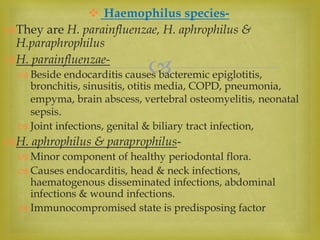
 Haemophilus species-
They are H. parainfluenzae, H. aphrophilus &
H.paraphrophilus
H. parainfluenzae-
 Beside endocarditis causes bacteremic epiglotitis,
bronchitis, sinusitis, otitis media, COPD, pneumonia,
empyma, brain abscess, vertebral osteomyelitis, neonatal
sepsis.
 Joint infections, genital & biliary tract infection,
H. aphrophilus & paraprophilus-
 Minor component of healthy periodontal flora.
 Causes endocarditis, head & neck infections,
haematogenous disseminated infections, abdominal
infections & wound infections.
 Immunocompromised state is predisposing factor

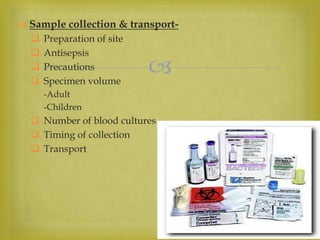
 Sample collection & transport-
 Preparation of site
 Antisepsis
 Precautions
 Specimen volume
-Adult
-Children
 Number of blood cultures
 Timing of collection
 Transport

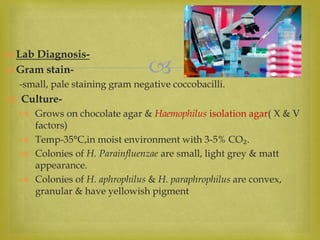
 Lab Diagnosis-
 Gram stain-
-small, pale staining gram negative coccobacilli.
 Culture-
 Grows on chocolate agar & Haemophilus isolation agar( X & V
factors)
 Temp-35°C,in moist environment with 3-5% CO₂.
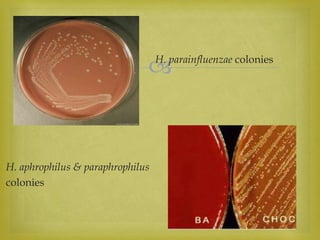
 Colonies of H. Parainfluenzae are small, light grey & matt
appearance.
 Colonies of H. aphrophilus & H. paraphrophilus are convex,
granular & have yellowish pigment
H. parainfluenzae colonies
H. aphrophilus & paraphrophilus
colonies

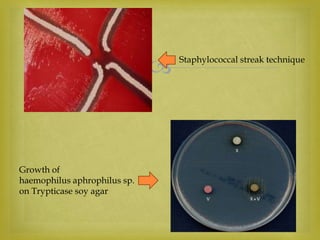
 H. parainfluenzae & H. paraphrophilus require only V factor
for growth.
 H. aphrophilus requires the X factor.
 This principle can be used in identification of these species.
 Staphylococcal Streak Technique- Satellitism.
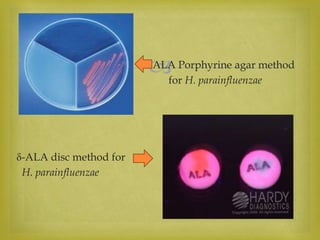
 ALA Porphyrin agar method
 δ-ALA- porphyrin disc method
 Biochemical reactions-
Oxidase +ve
Catalase –ve
Produces acid from sugars
ALA test +ve.
 Staphylococcal streak technique
Growth of
haemophilus aphrophilus sp.
on Trypticase soy agar
ALA Porphyrine agar method
for H. parainfluenzae
δ-ALA disc method for
H. parainfluenzae

Antimicrobial susceptibility test-
These 3 species are generally susceptible to-
 3rd generation cephalosporins
 Quinolones
 Tetracyclines
 Aminoglycosides.

 Actinobacillus actinomycetemcomitans-
Is a part of normal flora of oral cavity, particularly
in gingival, supragingival crevices.
Is a/w actinomycotic infections, endocarditis,
bacteremia, wound infection, dental infections.
Native valve endocarditis occurs in individuals
with prior valve damage.
Complications- pericarditis, paraventricular
abscess, CCF, septic emboli, hematogenous
dissemination.
Predisposing factors- poor dentition, recent dental
manipulation

 Clinical features-
 Fever, weight loss, chills, cough, night sweats are common
along with heart murmur.
 Hepatosplenomegaly, splinter haemorrhages.
 Localized OR Generalized juvenile periodontitis.
 May cause severe head & neck infections
 Gram stain-
 Pale staining Gram negative coccobacilli
 Cultural characteristics-
 Grows slowly on chocolate agar
 Colonies are small, smooth, transluscent, nonhemolytic
& have slightly irregular edges.
 Lack of growth on Mac Conkey & other enteric agar.
 Biochemical Reactions-
 Oxidase -ve
 Catalse +ve
 Acid from sugars

 Molecular methods-
 Polyacrylamde Gel Electrophoresis
 Antimicrobial susceptibility test-
 Sensitive to 3rd generation cephalosporines
 Fluoroquinolones
 Tetracycline, doxycycline, azithromycine, septran,
rifampin, aminoglycosides
 T/t for periodontal disease-
 Subgingival debridement, scaling, root canal with
antimicrobial therapy.

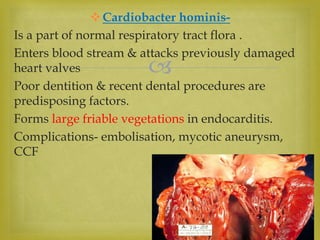
Cardiobacter hominis-
Is a part of normal respiratory tract flora .
Enters blood stream & attacks previously damaged
heart valves
Poor dentition & recent dental procedures are
predisposing factors.
Forms large friable vegetations in endocarditis.
Complications- embolisation, mycotic aneurysm,
CCF
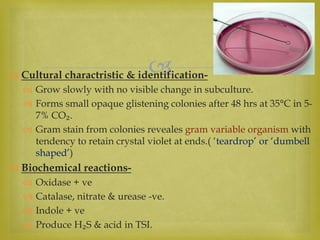
 Cultural charactristic & identification-
 Grow slowly with no visible change in subculture.
 Forms small opaque glistening colonies after 48 hrs at 35°C in 5-
7% CO₂.
 Gram stain from colonies reveales gram variable organism with
tendency to retain crystal violet at ends.( ‘teardrop’ or ‘dumbell
shaped’)
 Biochemical reactions-
 Oxidase + ve
 Catalase, nitrate & urease -ve.
 Indole + ve
 Produce H₂S & acid in TSI.

 Antimicrobial susceptibility test-
 Susceptible to most antibiotics like penicilline, ampicilline,
3rd Generation cephalosporines, imipenem, meropenem,
fluoroquinolones, aminoglycosides.
 For endocarditis, recommended T/t is third generation
cephalosporines.

Eikenella Corrodenes
It is a part of mouth & upper respiratory tract.
Plays role in periodontal diseases, oral infections
(gingivitis, periapical abscess, root canal
infections).
Other infections includes ocular infections, head
neck infections, pleuropulmonary infections,
intraabdominal infections & skeletal infections.
E. corrdenes bacteremia & endocarditis are seen
in immunocompromised pts, IV drug abusers,
individuals with previously valvular damage &
recent dental work.

 Cultural characteristics & identifiation-
 Grows on both blood & chocolate agar but not on Mac
Conkey agar.
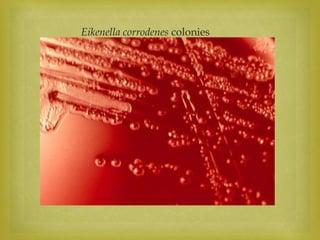
 Colonies are small grey moist & may ‘pit’ the agar.
 On Gram stain from colonies, they are regular GNB & not
seen like coccobacilli.
 Biochemical reactions-
 Oxidase +ve
 Catalase –ve
 Reduces nitrates to nitrites
 They are asaccharolytic
 Lysine & ornitine decarboxylase positive.

Eikenella corrodenes colonies

 Molecular methods-
 For detection, identification & typing of E. corrodens .
 Done with specific DNA probes for gingivitis,
periodontitis.
 Epidemological methods include SDS-PAGE, Pulse field
gel electrophoresis, PCR, restriction endonuclease
analysis.

 Antimicrobial susceptibility-
 Susceptible to ampicilline, amoxicilline, tetracyclines,
imipenem, meropenem.
 Are resistant to penicillinase resistant penicillins,
clindamycin, vancomycin, erythromycin, metronidazole &
aminoglycosides.
 Most isolates are susceptible to 1st generation
cephalosporines with cephazoline being most active & also
to 3rd generation cephalosporines.

Kingella kingae
 Although they are part of normal upper respiratory &
genitourinary tract flora of humans, they are
increasingly recognised as human pathogens.
 Besides endocarditis, causes bacteremia & osteoarticular
infections in pediatric patients.
 Age group- 6months to 4 years.
 K. Kingae has essentially replaced H. influenzae as the
most common GNBs causing osteoarticular infections in
kids less than 3 yrs of age.

 They also cause
 Bone & joint infections
 Osteomyelitis of long bones
 Bacteremia
 CVS complications d/t endocarditis (pericarditis,
pericardial abscess, mycotic aneurysm, infarction, CCF)
 Predisposing factors-
 Poor oral hygiene, pharyngitis, dental manipulation,
immunocompromised states.

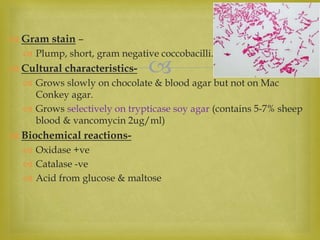
 Gram stain –
 Plump, short, gram negative coccobacilli.
 Cultural characteristics-
 Grows slowly on chocolate & blood agar but not on Mac
Conkey agar.
 Grows selectively on trypticase soy agar (contains 5-7% sheep
blood & vancomycin 2ug/ml)
 Biochemical reactions-
 Oxidase +ve
 Catalase -ve
 Acid from glucose & maltose

PCR can be used for direct detection of kingella
kingae in joint fluid.
Antimicrobial susceptibility-
 Are susceptible to penicillin, ampicillin, oxacillin, all
generation cephalosporins, chloramphenicol,
aminoglycoside & septran.
 Resistant to erythromycin, clindamycin & vancomycin.

Thank You..!

Hacek

  • 1.
    Dr Vishal Kulkarni MBBSMD (Microbiology)
  • 2.
     The acronym HACEKrefers to a group of fastidious slow growing bacteria, normally resident in the mouth, which can sometimes cause severe infections, particularly endocarditis. Introduction HACEK Haemophilus species Actinobacillus actinomycetemcomitans Cardiobacterium hominis Eikenella corrodens Kingella kingae
  • 3.
      Haemophilus species- Theyare H. parainfluenzae, H. aphrophilus & H.paraphrophilus H. parainfluenzae-  Beside endocarditis causes bacteremic epiglotitis, bronchitis, sinusitis, otitis media, COPD, pneumonia, empyma, brain abscess, vertebral osteomyelitis, neonatal sepsis.  Joint infections, genital & biliary tract infection, H. aphrophilus & paraprophilus-  Minor component of healthy periodontal flora.  Causes endocarditis, head & neck infections, haematogenous disseminated infections, abdominal infections & wound infections.  Immunocompromised state is predisposing factor
  • 4.
      Sample collection& transport-  Preparation of site  Antisepsis  Precautions  Specimen volume -Adult -Children  Number of blood cultures  Timing of collection  Transport
  • 5.
      Lab Diagnosis- Gram stain- -small, pale staining gram negative coccobacilli.  Culture-  Grows on chocolate agar & Haemophilus isolation agar( X & V factors)  Temp-35°C,in moist environment with 3-5% CO₂.  Colonies of H. Parainfluenzae are small, light grey & matt appearance.  Colonies of H. aphrophilus & H. paraphrophilus are convex, granular & have yellowish pigment
  • 6.
    H. parainfluenzae colonies H.aphrophilus & paraphrophilus colonies
  • 7.
      H. parainfluenzae& H. paraphrophilus require only V factor for growth.  H. aphrophilus requires the X factor.  This principle can be used in identification of these species.  Staphylococcal Streak Technique- Satellitism.  ALA Porphyrin agar method  δ-ALA- porphyrin disc method  Biochemical reactions- Oxidase +ve Catalase –ve Produces acid from sugars ALA test +ve.
  • 8.
     Staphylococcal streaktechnique Growth of haemophilus aphrophilus sp. on Trypticase soy agar
  • 9.
    ALA Porphyrine agarmethod for H. parainfluenzae δ-ALA disc method for H. parainfluenzae
  • 10.
     Antimicrobial susceptibility test- These3 species are generally susceptible to-  3rd generation cephalosporins  Quinolones  Tetracyclines  Aminoglycosides.
  • 11.
      Actinobacillus actinomycetemcomitans- Isa part of normal flora of oral cavity, particularly in gingival, supragingival crevices. Is a/w actinomycotic infections, endocarditis, bacteremia, wound infection, dental infections. Native valve endocarditis occurs in individuals with prior valve damage. Complications- pericarditis, paraventricular abscess, CCF, septic emboli, hematogenous dissemination. Predisposing factors- poor dentition, recent dental manipulation
  • 12.
      Clinical features- Fever, weight loss, chills, cough, night sweats are common along with heart murmur.  Hepatosplenomegaly, splinter haemorrhages.  Localized OR Generalized juvenile periodontitis.  May cause severe head & neck infections
  • 13.
     Gram stain- Pale staining Gram negative coccobacilli  Cultural characteristics-  Grows slowly on chocolate agar  Colonies are small, smooth, transluscent, nonhemolytic & have slightly irregular edges.  Lack of growth on Mac Conkey & other enteric agar.  Biochemical Reactions-  Oxidase -ve  Catalse +ve  Acid from sugars
  • 14.
      Molecular methods- Polyacrylamde Gel Electrophoresis  Antimicrobial susceptibility test-  Sensitive to 3rd generation cephalosporines  Fluoroquinolones  Tetracycline, doxycycline, azithromycine, septran, rifampin, aminoglycosides  T/t for periodontal disease-  Subgingival debridement, scaling, root canal with antimicrobial therapy.
  • 15.
     Cardiobacter hominis- Is apart of normal respiratory tract flora . Enters blood stream & attacks previously damaged heart valves Poor dentition & recent dental procedures are predisposing factors. Forms large friable vegetations in endocarditis. Complications- embolisation, mycotic aneurysm, CCF
  • 16.
     Cultural charactristic& identification-  Grow slowly with no visible change in subculture.  Forms small opaque glistening colonies after 48 hrs at 35°C in 5- 7% CO₂.  Gram stain from colonies reveales gram variable organism with tendency to retain crystal violet at ends.( ‘teardrop’ or ‘dumbell shaped’)  Biochemical reactions-  Oxidase + ve  Catalase, nitrate & urease -ve.  Indole + ve  Produce H₂S & acid in TSI.
  • 17.
      Antimicrobial susceptibilitytest-  Susceptible to most antibiotics like penicilline, ampicilline, 3rd Generation cephalosporines, imipenem, meropenem, fluoroquinolones, aminoglycosides.  For endocarditis, recommended T/t is third generation cephalosporines.
  • 18.
     Eikenella Corrodenes It isa part of mouth & upper respiratory tract. Plays role in periodontal diseases, oral infections (gingivitis, periapical abscess, root canal infections). Other infections includes ocular infections, head neck infections, pleuropulmonary infections, intraabdominal infections & skeletal infections. E. corrdenes bacteremia & endocarditis are seen in immunocompromised pts, IV drug abusers, individuals with previously valvular damage & recent dental work.
  • 19.
      Cultural characteristics& identifiation-  Grows on both blood & chocolate agar but not on Mac Conkey agar.  Colonies are small grey moist & may ‘pit’ the agar.  On Gram stain from colonies, they are regular GNB & not seen like coccobacilli.  Biochemical reactions-  Oxidase +ve  Catalase –ve  Reduces nitrates to nitrites  They are asaccharolytic  Lysine & ornitine decarboxylase positive.
  • 20.
  • 21.
      Molecular methods- For detection, identification & typing of E. corrodens .  Done with specific DNA probes for gingivitis, periodontitis.  Epidemological methods include SDS-PAGE, Pulse field gel electrophoresis, PCR, restriction endonuclease analysis.
  • 22.
      Antimicrobial susceptibility- Susceptible to ampicilline, amoxicilline, tetracyclines, imipenem, meropenem.  Are resistant to penicillinase resistant penicillins, clindamycin, vancomycin, erythromycin, metronidazole & aminoglycosides.  Most isolates are susceptible to 1st generation cephalosporines with cephazoline being most active & also to 3rd generation cephalosporines.
  • 23.
     Kingella kingae  Althoughthey are part of normal upper respiratory & genitourinary tract flora of humans, they are increasingly recognised as human pathogens.  Besides endocarditis, causes bacteremia & osteoarticular infections in pediatric patients.  Age group- 6months to 4 years.  K. Kingae has essentially replaced H. influenzae as the most common GNBs causing osteoarticular infections in kids less than 3 yrs of age.
  • 24.
      They alsocause  Bone & joint infections  Osteomyelitis of long bones  Bacteremia  CVS complications d/t endocarditis (pericarditis, pericardial abscess, mycotic aneurysm, infarction, CCF)  Predisposing factors-  Poor oral hygiene, pharyngitis, dental manipulation, immunocompromised states.
  • 25.
      Gram stain–  Plump, short, gram negative coccobacilli.  Cultural characteristics-  Grows slowly on chocolate & blood agar but not on Mac Conkey agar.  Grows selectively on trypticase soy agar (contains 5-7% sheep blood & vancomycin 2ug/ml)  Biochemical reactions-  Oxidase +ve  Catalase -ve  Acid from glucose & maltose
  • 26.
     PCR can beused for direct detection of kingella kingae in joint fluid. Antimicrobial susceptibility-  Are susceptible to penicillin, ampicillin, oxacillin, all generation cephalosporins, chloramphenicol, aminoglycoside & septran.  Resistant to erythromycin, clindamycin & vancomycin.
  • 27.