
Dr. Rajesh Karyakarte        MD

Professor & Head,
Department of Microbiology,
Government Medical college, Akola
 Molecular Biology is the application of science
  and technology to living organisms, as well as
  parts, products and models thereof, to alter
  living or non-living materials for the production
  of knowledge, goods, and services (1).
 Pathogenicity is the capacity of a microbe to
  cause damage, in a host.
 Pathogenesis is the process of producing this
  damage.
(1)http://www.oecd.org/document/42/0,3343,en_2649_34537_1933994_1_1_1_1,00.html
   Falkow (1988) proposed “Molecular Koch’s
    Postulates,” a set of conceptual tools for
    dissection of bacterial pathogenesis based on
    the identification of the genes responsible for
    causing disease (2).
   Many genes required for virulence in bacteria are
    in discrete DNA segments, e.g., pathogenicity
    islands. Acquisition of these genes is sufficient
    for a bacterium to become virulent.
(2) Falkow S. Molecular Koch's postulates applied to microbial pathogenicity. Rev Infect Dis
     1988; 10(suppl 2): S274-6.
   Molecular studies show that the chemistry of
    the microbial surface is the major distinction
    between pathogenic and nonpathogenic
    microorganisms.
   Tropism of microorganisms is subdivided
    into:
     Tissue and host tropism
     Species-specific tropism
   Uropathogenic E. coli adhere to human
    urinary tissue cells by PapG adhesin, which is
    a component of Pap (pyelonephritis-
    associated pili).
   There are three PapG alleles (Class I, II, and
    III). Class II PapG is associated with
    pyelonephritis and Class III with cystitis.
   PapG binds Gal-α-1-4-Gal containing glycolipid
    present on the surface of renal epithelial cells.
   The glycolipid has a digalactoside core linked
    via a -glucose residue to a ceramide group that
    anchors the receptor to cell membrane. This
    receptor is named globotriasylceramide (GbO3).
   GbO3 with one additional sugar moiety (GalNAc)
    becomes GbO4 (Globoside) and
   GbO3 with two additional sugar moieties
    (GalNAc 2) becomes GbO5 (Forssman
    antigen).(3)
(3) Dodson KW, Pinkner JS, etal. Structural basis of the interaction of the pylonephritic E. coli adhesin
     to its human kidney receptor. Cell 2001; 105: 733-43.
   Neisseria gonorrhoeae, N. meningitidis, E. coli
    (expressing CFA-I and CFA-II) and group A
    Streptococci are limited to human infection
    due to species-specific tropism.
   A single strain of E. coli may be able to
    express several distinct adhesins encoded by
    respective distinct regions of chromosomes
    or of plasmids, which helps in adapting to
    changing environment.
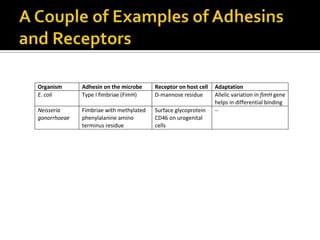
Organism      Adhesin on the microbe     Receptor on host cell   Adaptation
E. coli       Type I fimbriae (FimH)     D-mannose residue       Allelic variation in fimH gene
                                                                 helps in differential binding
Neisseria     Fimbriae with methylated   Surface glycoprotein    --
gonorrhoeae   phenylalanine amino        CD46 on urogenital
              terminus residue           cells
   Molecular biology has helped in elucidation of
    the molecular basis of biofilm formation.
   Staphylococcus epidermidis forms biofilms
    and is a major cause of medical-device
    related infections.
   The intercellular adhesion in these biofilms is
    provided by polysaccharide intercellular
    adhesin (PIA).
   PIA is a linear glucosaminoglycan composed
    of N-acetylglucosamine in -1,6-glycosidic
    linkages containing deacetylated amino
    groups and succinate and phosphate
    substitution.
   Synthesis of PIA requires expression of icaADBC
    operon.
   These genes are controlled with the help of
    alternative sigma factor B, icaR, two more
    regulatory loci, plus phase variation due to IS
    element insertion.
   PIA production can be stopped by inactivational
    IS element insertion that allows individual S.
    epidermidis cells to leave the biofilm to colonize
    new surfaces.(4)
(4) Dobinsky S, Kiel K, Rohde H, Bartscht K, Knobloch JK, Horstkotte MA, Mack D. Glucose-
    related dissociation between icaADBC transcription and biofilm expression by Staphylococcus
    epidermidis: Evidence for an additional factor required for polysaccharide intercellular
    adhesin synthesis. J Bacteriol 2003; 185: 2879-86.
   In Enterobacteriaceae, the waa locus enzymes
    required for the sequential assembly of the
    core oligosaccharide on to the lipid A
    acceptor. This locus consists of three operons:
   The gmhD operon that directs inner core
    biosynthesis
   The central waaQ operon that is responsible
    for outer core; and
   The waaA operon that contains the structural
    genes for a bifunctional KDO
    transferase, which is required for the addition
    of KDO to the inner core
   With a few exceptions, the enzymes involved
    in O-polysaccharide assembly are encodes by
    genes at the rfb locus and are expressed
    constitutively.
   Translocation of protein synthesized in the cell occurs
    across the inner and outer membranes in Gram-
    negative bacteria by one of the five main pathways:
     Type I Mechanism: Utilized for secretion of the hemolytic
        toxin HlyA from E. coli.
       Type II Mechanism: Is the general secretory pathway.
       Type III Mechanism: Responsible for injection of proteins
        into eukaryotic cells
       Type IV Mechanism: Also responsible for injection of
        proteins into eukaryotic cells, known as TFSS (Type four
        secretion system)
       Type V Mechanism: Also called autotransportation
   Pathogenic Yersinia spp. utilize the YopH
    proteins to cause dephosphorylation of
    several macrophage proteins to prevent
    phagocytosis.
   Transient tyrosine phosphorylation of
    macrophage proteins is required for normal
    phagocytosis.
   Salmonellae on the other hand possess two
    type III secretion systems. These systems are
    encoded by two distinct gene clusters termed
    Salmonella pathogenicity island (SPI-1 and
    SPI-2).
   These secretion systems have different roles
    with SPI-1 involved in mucosal penetration
    and SPI-2 with systemic spread.
   Pathogenic bacteria encounter countless
    different environments and therefore need to
    constantly monitor diverse physical and
    chemical signals to tailor their responses with
    the help of regulatory proteins.
   The 6.3-MB genome of P. aeruginosa, for
    example, contains around 5500 genes, some
    10% of which encode such regulatory
    proteins. These regulatory proteins help
    expression or repression of specific genes
    depending on environmental cues.
   For example, if iron is plentiful in the
    environment, synthesis of siderophores and
    their associated export and import pathways
    can be switched off.
   V. cholerae have an inverse correlation
    between motility and virulence gene
    expression as it switches between aquatic
    and human host environment.
   In E. coli, the 17-kDa Fur repressor protein
    controls transcription from iron-responsive
    promoters in an iron-dependant manner, i.e.
    to be active, Fur requires ferrous ion as a
    corepressor.
   When iron is plentiful, the Fur-Fe2+ complex
    interacts with an operator sequence called
    Fur box and prevents gene expression.
   During iron scarcity, ferrous ion is removed
    from the Fur-Fe2+ complex by the cell. Fur
    alone cannot act as repressor for expression
    of iron-repressed structural genes. The entire
    iron absorption system becomes active.
   An enormous number of genes, including
    many virulence determinants, regulate this
    system.
   This system consists of two regulator
    proteins, a cytoplasmic-membrane
    associated sensor and a response regulator in
    the bacterial cell.
   TCSTC sense a variety of different factors
    including oxygen, hydrogen, quorum-sensing
    signal molecules, Mg2+ and phosphate
    limitation.
   It is crucial in many bacterial infections that
    the bacterial population attains a particular
    cell density to overcome host defense and
    establish an infection.
   Pathogens have an ability to communicate
    between themselves to orchestrate collective
    attack against the host immune system.
   The term ‘quorum sensing’ is commonly used
    in describing the phenomenon whereby
    accumulation of a diffusible, low-molecular-
    weight signal molecule (sometimes called
    ‘autoinducer’) enables individual bacterial
    cell to sense when the minimal number, or
    ‘quorum’ of bacterial cell has been achieved
    for a concerted response to be initiated.
   Bacteria employ a number of different quorum
    sensing ‘languages’, and several families of
    signal molecules have been characterized.
   At molecular level, quorum sensing requires a
    synthase plus a signal transduction system for
    producing and responding to the signal
    molecule.
   Many bacterial species have quorum sensing
    system consisting of the luxS and a furanone-
    related molecule AI-2 (for autoinducer-2).
   P. aeruginosa has a multisystem quorum
    sensing. It possesses two AHL (N-
    acylhomoserine lactone) dependant quorum-
    sensing systems.
   Apart from AHLs, P. aeruginosa has a third
    quorum-sensing molecule, the pseudomonas
    quinolone signal (PQS).
   Staphylococci produce quorum-sensing
    molecules termed autoinducing peptides
    (AIP).
Molecular biology   redefining pathogenesis 20100926

Molecular biology redefining pathogenesis 20100926

  • 1.
    Dr. Rajesh Karyakarte MD Professor & Head, Department of Microbiology, Government Medical college, Akola
  • 2.
     Molecular Biologyis the application of science and technology to living organisms, as well as parts, products and models thereof, to alter living or non-living materials for the production of knowledge, goods, and services (1).  Pathogenicity is the capacity of a microbe to cause damage, in a host.  Pathogenesis is the process of producing this damage. (1)http://www.oecd.org/document/42/0,3343,en_2649_34537_1933994_1_1_1_1,00.html
  • 3.
    Falkow (1988) proposed “Molecular Koch’s Postulates,” a set of conceptual tools for dissection of bacterial pathogenesis based on the identification of the genes responsible for causing disease (2).  Many genes required for virulence in bacteria are in discrete DNA segments, e.g., pathogenicity islands. Acquisition of these genes is sufficient for a bacterium to become virulent. (2) Falkow S. Molecular Koch's postulates applied to microbial pathogenicity. Rev Infect Dis 1988; 10(suppl 2): S274-6.
  • 4.
    Molecular studies show that the chemistry of the microbial surface is the major distinction between pathogenic and nonpathogenic microorganisms.  Tropism of microorganisms is subdivided into:  Tissue and host tropism  Species-specific tropism
  • 5.
    Uropathogenic E. coli adhere to human urinary tissue cells by PapG adhesin, which is a component of Pap (pyelonephritis- associated pili).  There are three PapG alleles (Class I, II, and III). Class II PapG is associated with pyelonephritis and Class III with cystitis.
  • 6.
    PapG binds Gal-α-1-4-Gal containing glycolipid present on the surface of renal epithelial cells.  The glycolipid has a digalactoside core linked via a -glucose residue to a ceramide group that anchors the receptor to cell membrane. This receptor is named globotriasylceramide (GbO3).  GbO3 with one additional sugar moiety (GalNAc) becomes GbO4 (Globoside) and  GbO3 with two additional sugar moieties (GalNAc 2) becomes GbO5 (Forssman antigen).(3) (3) Dodson KW, Pinkner JS, etal. Structural basis of the interaction of the pylonephritic E. coli adhesin to its human kidney receptor. Cell 2001; 105: 733-43.
  • 7.
    Neisseria gonorrhoeae, N. meningitidis, E. coli (expressing CFA-I and CFA-II) and group A Streptococci are limited to human infection due to species-specific tropism.  A single strain of E. coli may be able to express several distinct adhesins encoded by respective distinct regions of chromosomes or of plasmids, which helps in adapting to changing environment.
  • 8.
    Organism Adhesin on the microbe Receptor on host cell Adaptation E. coli Type I fimbriae (FimH) D-mannose residue Allelic variation in fimH gene helps in differential binding Neisseria Fimbriae with methylated Surface glycoprotein -- gonorrhoeae phenylalanine amino CD46 on urogenital terminus residue cells
  • 9.
    Molecular biology has helped in elucidation of the molecular basis of biofilm formation.  Staphylococcus epidermidis forms biofilms and is a major cause of medical-device related infections.  The intercellular adhesion in these biofilms is provided by polysaccharide intercellular adhesin (PIA).
  • 10.
    PIA is a linear glucosaminoglycan composed of N-acetylglucosamine in -1,6-glycosidic linkages containing deacetylated amino groups and succinate and phosphate substitution.
  • 11.
    Synthesis of PIA requires expression of icaADBC operon.  These genes are controlled with the help of alternative sigma factor B, icaR, two more regulatory loci, plus phase variation due to IS element insertion.  PIA production can be stopped by inactivational IS element insertion that allows individual S. epidermidis cells to leave the biofilm to colonize new surfaces.(4) (4) Dobinsky S, Kiel K, Rohde H, Bartscht K, Knobloch JK, Horstkotte MA, Mack D. Glucose- related dissociation between icaADBC transcription and biofilm expression by Staphylococcus epidermidis: Evidence for an additional factor required for polysaccharide intercellular adhesin synthesis. J Bacteriol 2003; 185: 2879-86.
  • 12.
    In Enterobacteriaceae, the waa locus enzymes required for the sequential assembly of the core oligosaccharide on to the lipid A acceptor. This locus consists of three operons:  The gmhD operon that directs inner core biosynthesis  The central waaQ operon that is responsible for outer core; and
  • 13.
    The waaA operon that contains the structural genes for a bifunctional KDO transferase, which is required for the addition of KDO to the inner core  With a few exceptions, the enzymes involved in O-polysaccharide assembly are encodes by genes at the rfb locus and are expressed constitutively.
  • 14.
    Translocation of protein synthesized in the cell occurs across the inner and outer membranes in Gram- negative bacteria by one of the five main pathways:  Type I Mechanism: Utilized for secretion of the hemolytic toxin HlyA from E. coli.  Type II Mechanism: Is the general secretory pathway.  Type III Mechanism: Responsible for injection of proteins into eukaryotic cells  Type IV Mechanism: Also responsible for injection of proteins into eukaryotic cells, known as TFSS (Type four secretion system)  Type V Mechanism: Also called autotransportation
  • 15.
    Pathogenic Yersinia spp. utilize the YopH proteins to cause dephosphorylation of several macrophage proteins to prevent phagocytosis.  Transient tyrosine phosphorylation of macrophage proteins is required for normal phagocytosis.
  • 16.
    Salmonellae on the other hand possess two type III secretion systems. These systems are encoded by two distinct gene clusters termed Salmonella pathogenicity island (SPI-1 and SPI-2).  These secretion systems have different roles with SPI-1 involved in mucosal penetration and SPI-2 with systemic spread.
  • 17.
    Pathogenic bacteria encounter countless different environments and therefore need to constantly monitor diverse physical and chemical signals to tailor their responses with the help of regulatory proteins.
  • 18.
    The 6.3-MB genome of P. aeruginosa, for example, contains around 5500 genes, some 10% of which encode such regulatory proteins. These regulatory proteins help expression or repression of specific genes depending on environmental cues.
  • 19.
    For example, if iron is plentiful in the environment, synthesis of siderophores and their associated export and import pathways can be switched off.  V. cholerae have an inverse correlation between motility and virulence gene expression as it switches between aquatic and human host environment.
  • 20.
    In E. coli, the 17-kDa Fur repressor protein controls transcription from iron-responsive promoters in an iron-dependant manner, i.e. to be active, Fur requires ferrous ion as a corepressor.
  • 21.
    When iron is plentiful, the Fur-Fe2+ complex interacts with an operator sequence called Fur box and prevents gene expression.  During iron scarcity, ferrous ion is removed from the Fur-Fe2+ complex by the cell. Fur alone cannot act as repressor for expression of iron-repressed structural genes. The entire iron absorption system becomes active.
  • 22.
    An enormous number of genes, including many virulence determinants, regulate this system.  This system consists of two regulator proteins, a cytoplasmic-membrane associated sensor and a response regulator in the bacterial cell.
  • 23.
    TCSTC sense a variety of different factors including oxygen, hydrogen, quorum-sensing signal molecules, Mg2+ and phosphate limitation.
  • 24.
    It is crucial in many bacterial infections that the bacterial population attains a particular cell density to overcome host defense and establish an infection.  Pathogens have an ability to communicate between themselves to orchestrate collective attack against the host immune system.
  • 25.
    The term ‘quorum sensing’ is commonly used in describing the phenomenon whereby accumulation of a diffusible, low-molecular- weight signal molecule (sometimes called ‘autoinducer’) enables individual bacterial cell to sense when the minimal number, or ‘quorum’ of bacterial cell has been achieved for a concerted response to be initiated.
  • 26.
    Bacteria employ a number of different quorum sensing ‘languages’, and several families of signal molecules have been characterized.  At molecular level, quorum sensing requires a synthase plus a signal transduction system for producing and responding to the signal molecule.  Many bacterial species have quorum sensing system consisting of the luxS and a furanone- related molecule AI-2 (for autoinducer-2).
  • 27.
    P. aeruginosa has a multisystem quorum sensing. It possesses two AHL (N- acylhomoserine lactone) dependant quorum- sensing systems.  Apart from AHLs, P. aeruginosa has a third quorum-sensing molecule, the pseudomonas quinolone signal (PQS).  Staphylococci produce quorum-sensing molecules termed autoinducing peptides (AIP).