   According to family members this 65 y/o male
    patient developed difficulty in walking for the
    past 6 months.

   Patient was apparently normal 6 months back
    when he started developing gradual difficulty in
    walking, in form of in coordination so that he
    used to walk holding on to walls or other support
    available .
   They were also complaining forgetfulness,
    hallucinations for past 4 months.


   Gradually family Members noticed that patient
    was becoming forgetful over time, and he used to
    forget familiar faces, names, topic he discussed
    half an hour back
   They gave h/o altered sensorium with
    mycoclonic jerks for 2 months.

   He also used to develop sudden , brief loss of
    contact with the environment.
   His sensorium became gradually impaired .

   He was admitted at a hospital in nepal 2 months
    back, diagnosed as a case of Neurosyphilis, was
    given benzathine penicillin but did not improved.
   He became irritable in the hospital, for which he
    was given serenace (Haloperidol)and thereafter
    he became unconscious, rigid.

   Despite withdrawing Serenace , his sensorium
    did not improved and since then he gradually
    slipped to unconscious state. He was referred to
    BLK with these complaints.
   He was diagnosed with hypertension 3 years
    back.
   No h/o DM
 He is semiconscious
 Vitals at the time of admission

  BP:138/100 mm hg
  PR: 98/minute
  RR: 30/minute
  Temp: 101* f
CVS :S1 S2 + No abnormal sounds
Chest: Bilateral air entry positive , No crepitations
Abdomen: Soft , No Swellings.
   Patient was opening his eyes spontaneously
   Not following commands
   Moving his limbs(flexion) in response to painful
    stimuli.

   Pupils: Normal in size , reacting to light

   No apparent cranial nerve abnormality
   Motor exam: Rigidity felt in all 4 limbs which is
    more in upperlimbs
   Flexion of both his upperlimbs in response to
    deep painful stimuli
   DTR-
   Plantar response: flexor response in both feet
   Myloclonic jerks – present in all 4 limbs.
   CSF FLUID EXAMINATION FOR CELL COUNT
    Clear ,colourless
    Microscopic examination:
    Total leucocyte count 5 cells/cu mm
    (Adults- 0-5 cells/cu mm Neonate-0-30 cells/cu
    mm)
    Differential leucocyte count
    neutrophils 6/10 cells counted
    lymphocytes 4/10 cells counted
   TORCH PANEL- negative
   TB PCR
    M.Tuberculosis complex : not detected
    nontuberculosis mycobacteria: not detected
   CMV PCR- Negative.
   TPHA CSF- Negative
   Cryptococcal antigen CSF-Negative.
   CSF Indian ink staining -Encapsulated yeast cells
    resembling Cryptococcus species not seen.
CSF Cerebrospinal fluid
Gram stain :
 No cells seen.
 No organisms seen.
Culture &sensitivity:
    The culture is sterile after 5 days of aerobic incubation at
    35 degree centigrade.
CT SCAN OF THE HEAD – PLAIN
   The cerebral parenchyma shows normal attenuation
    values.
   The ventricles, cisterns and sulci are generally prominent.
   Bilateral basal ganglia calcification is seen.
   There is no midline shift.
   The cerebellar hemispheres and brain stem are normal.
   The 4th ventricle is normal in size and midline in
    position.
    CONCLUSION:
    The findings are consistent with diffuse cerebral
    atrophy consistent with the age of the patient.
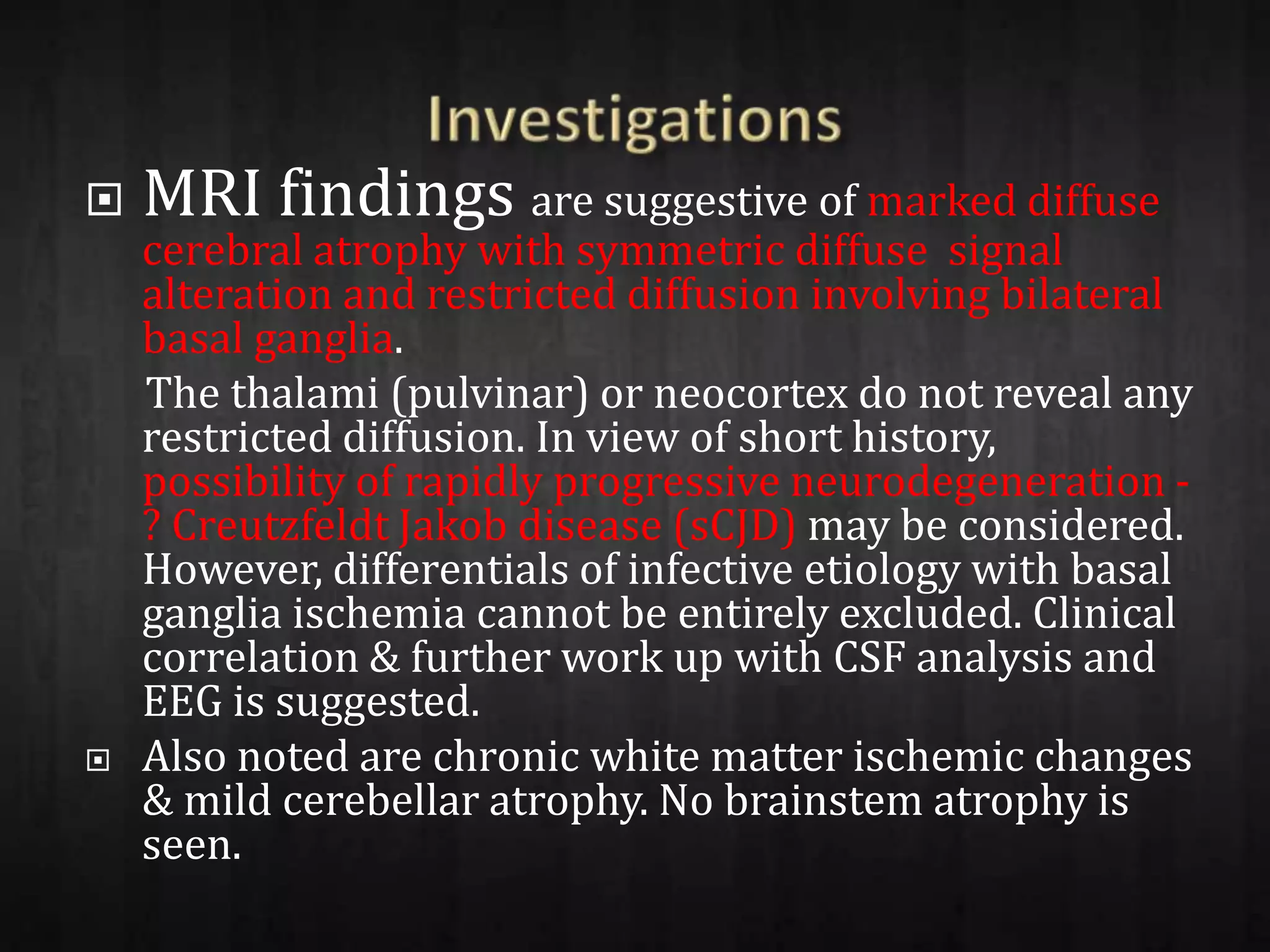
   MRI findings are suggestive of marked diffuse
    cerebral atrophy with symmetric diffuse signal
    alteration and restricted diffusion involving bilateral
    basal ganglia.
    The thalami (pulvinar) or neocortex do not reveal any
    restricted diffusion. In view of short history,
    possibility of rapidly progressive neurodegeneration -
    ? Creutzfeldt Jakob disease (sCJD) may be considered.
    However, differentials of infective etiology with basal
    ganglia ischemia cannot be entirely excluded. Clinical
    correlation & further work up with CSF analysis and
    EEG is suggested.
   Also noted are chronic white matter ischemic changes
    & mild cerebellar atrophy. No brainstem atrophy is
    seen.
   Slow virus infections are also known as prion
    diseases, after the presumed infectious agent, as
    well as transmissible spongiform
    encephalopathies (TSEs), after the
    histopathologic changes associated with these
    infections.
   Prions are proteinaceous infectious particles
    (PrPs).

   The brain pathology of prion diseases consists of
    a vacuolar (spongiform) degeneration of the
    neuropil, cortical neurons, and subcortical gray
    matter with neuronal loss and gliosis.
   Early diagnosis is difficult, in part because prions
    do not have nucleic acids, making conventional
    nucleic acid–based viral detection systems
    ineffective.

   PrPs also elude detection by not producing a
    humoral immune response.
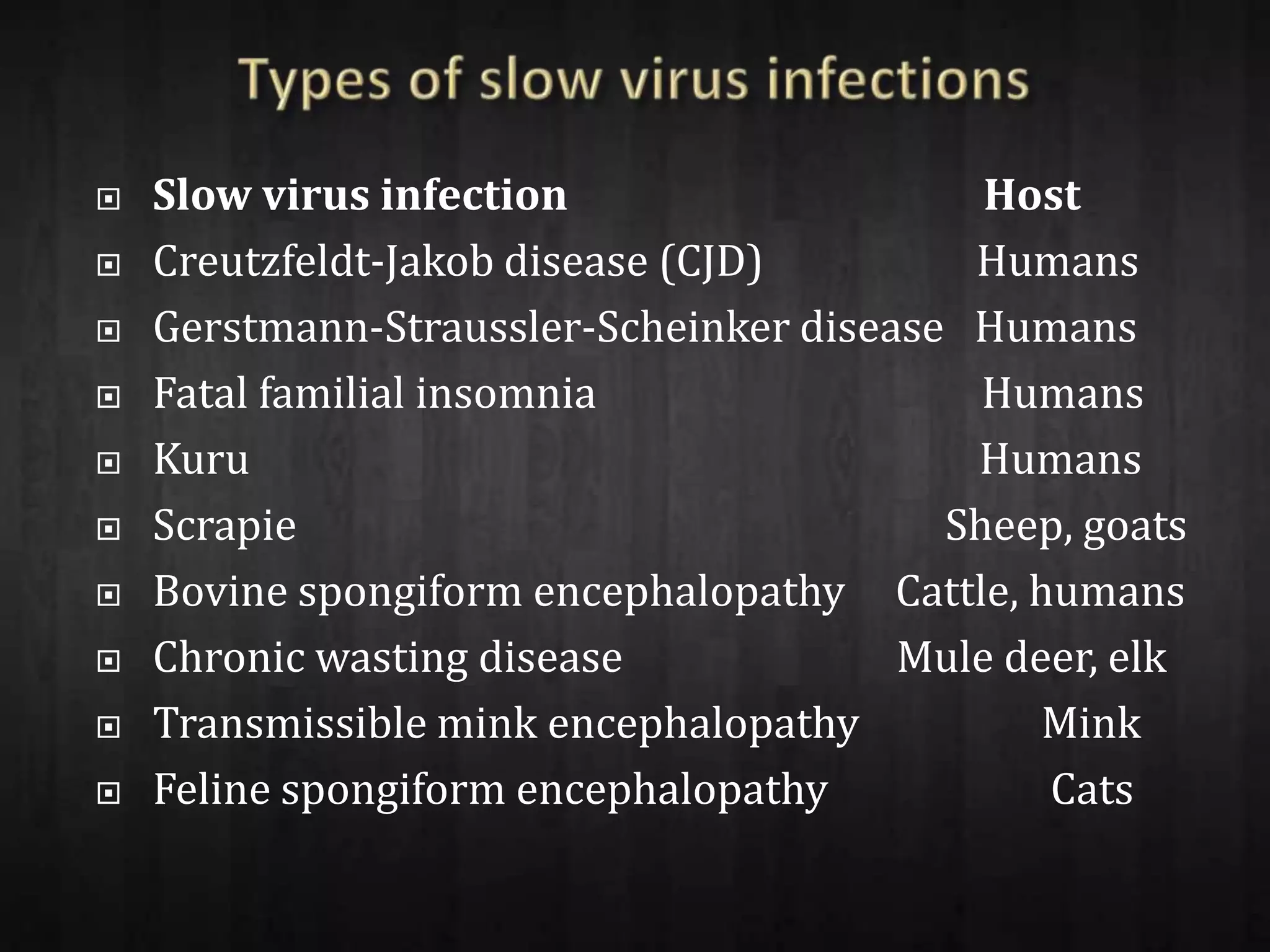
   Slow virus infection                    Host
   Creutzfeldt-Jakob disease (CJD)        Humans
   Gerstmann-Straussler-Scheinker disease Humans
   Fatal familial insomnia                 Humans
   Kuru                                   Humans
   Scrapie                               Sheep, goats
   Bovine spongiform encephalopathy Cattle, humans
   Chronic wasting disease             Mule deer, elk
   Transmissible mink encephalopathy          Mink
   Feline spongiform encephalopathy           Cats
   Prion diseases are categorized into three groups:
    sporadic, (85%), hereditary &acquired(15%)

   15% consist of hereditary forms (hereditary
    Creutzfeldt-Jakob disease [CJD], Gerstmann-
    Straussler-Scheinker disease, fatal familial insomnia)
    and acquired forms.
    Acquired forms may be transmitted iatrogenically
    (through human growth hormone therapy, dura
    mater grafts, or other neurosurgical procedures) or
    through cannibalism (kuru) , variant CJD (vCJD) in
    humans, scrapie in sheep, and bovine spongiform
    encephalopathy (BSE) in cattle.
   1. Creutzfeldt-Jakob Disease (CJD) clinical diagnosis:
    Criteria for probable sporadic CJD:
   The clinical diagnosis of CJD is currently based on the
    combination of progressive dementia, myoclonus, and
    multifocal neurological dysfunction, associated with a
    characteristic periodic electroencephalogram (EEG).

   However, new variant CJD, most growth hormone-related
    iatrogenic cases, and up to 40% of sporadic cases are not
    noted to have the characteristic EEG appearance. This
    hampers clinical diagnosis, and hence surveillance, and
    illustrates the need for additional diagnostic tests.
    Proposed criteria for probable sporadic CJD:
       a. Progressive dementia.
          and
       b. At least two out of the following four clinical features:
         i. Myoclonus.
         ii. Visual or cerebellar disturbance.
         iii. Pyramidal/extrapyramidal dysfunction.
         iv. Akinetic mutism.
       and
    2. A typical EEG during an illness of any duration.
     and/or
    3. A positive 14-3-3 cerebral spinal fluid assay and a
      clinical duration to death less than 2 years.
    4. Routine investigations should not suggest an alternative
      diagnosis.
   New-variant Creutzfeldt-Jakob disease (nvCJD)
    cannot be diagnosed with certainty on clinical
    criteria alone at present.

   However, based on the 23 neuropathologically
    confirmed cases, the diagnosis of nvCJD should
    be considered as a possibility in a patient with a
    progressive neuropsychiatric disorder, with at
    least five out of the following six List 1 clinical
    features. The suspicion of nvCJD is strengthened
    by the following criteria in List 2.
    A patient with a progressive neuropsychiatric disorder and five out of the six clinical features in
     List 1 and all of the criteria in List 2 should be considered as a suspect case of nvCJD for
     surveillance purposes.

     List 1
1. Early psychiatric symptoms.
2. Early persistent parasthesias/dysesthesias.
3. Ataxia.
4. Chorea/dystonia or myoclonus.
5. Dementia.
6. Akinetic mutism.

     List 2
1. The absence of a history of potential iatrogenic exposure.
2. Clinical duration more than 6 months.
3. Age at onset less than 50 years.
4. The absence of a PrP gene mutation.
5. The EEG does not show the typical periodic appearance.
6. Routine investigations that do not suggest an alternative diagnosis.
7. A magnetic resonance image showing abnormal bilateral high signal from the pulvinar on axial
T2-and/or proton-density-weighted images.
   Sporadic CJD
     1. Definite Diagnosed by standard neuropathological techniques and/or immunocytochemically
     and/or Western blot-confirmed protease-resistant PrP and/or presence of scrapie associated
    fibrils.
     2. Probable
     a. Progressive dementia and at least two out of the following four clinical features:
     • Myoclonus.
     • Visual or cerebellar disturbance.
     • Pyramidal/extrapyramidal dysfunction.
     • Akinetic mutism.
       and
      b. A typical EEG during an illness of any duration
     and/or
     c. A positive 14-3-3 CSF assay and a clinical duration to death less than 2 years.
     d. Routine investigations should not suggest an alternative diagnosis.
     3. Possible Same clinical criteria as definite but no, or atypical, EEG and duration less than 2 years

   Iatrogenic CJD Progressive cerebellar syndrome in a recipient of human cadaveric-derived
    pituitary hormone;
    Or sporadic CJD with a recognized exposure risk, e.g., antecedent neurosurgery with dura
     mater graft

   Familial CJD Definite or probable CJD plus definite or probable CJD in a first-degree relative
     and/or
     Neuropsychiatric disorder plus disease-specific PrP gene mutation
   1. Creutzfeldt-Jakob disease (CJD)—sporadic, iatrogenic (recognized risk) or familial
    (same disease in first degree relative or disease-associated PrP gene mutation):
    Spongiform encephalopathy in cerebral and/or cerebellar cortex and/or subcortical
    gray matter; and/or encephalopathy with prion protein (PrP) immunoreactivity
    (plaque and/or diffuse synaptic and/or patchy/perivacuolar types).

   2. New-variant CJD—Spongiform encephalopathy with abundant PrP deposition; in
    particular, multiple fibrillary PrP plaques surrounded by a halo of spongiform
    vacuoles (“florid” plaques, “daisy-like” plaques) and other PrP plaques, and
    amorphous pericellular and perivascular PrP deposits; especially prominent in the
    cerebellar molecular layer.


   3. Gerstmann-Sträussler-Scheinker disease (in family with dominantly inherited
    progressive ataxia and/or dementia and one of a variety of PrP gene mutations):
    Encephalo(myelo)pathy with multicentric PrP plaques.

   4. Familial fatal insomnia (in member of a family with a PrP gene mutation at codon
    178 in frame with methionine at codon 129): Thalamic degeneration, variable
    spongiform change in cerebrum.

   5. Kuru: Spongiform encephalopathy in the Fore population of Papua New Guinea.
   Alzheimer’s disease
   Hyperammonemia
   Lewy body disease
   Binswanger’s disease
   AIDS dementia
   Hyperparathyroidism
   Hypo- and hypernatremia
   Hypoglycemia
   Multiple cerebral abscesses
   MELAS syndrome
   Hepatic encephalopathy
   Baclofen, mianserin, metrizamide, and lithium toxicity
   Postanoxic encephalopathy
   MELAS ( mitochondrial encephalopathy, lactic acidosis, and
    stroke-like episodes)
   Herpes simplex and other encephalitides
   Stroke (especially recent)
   Subarachnoid haemorrhage
   Hypoxic/Ischemic encephalopathy
   Barbiturate intoxication
   Glioblastoma
   Carcinomatous meningitis (especially small-cell lung
    carcinoma)
   Paraneoplastic encephalopathy
   Corticobasal degeneration
Creutzfeldt–Jakob disease

Creutzfeldt–Jakob disease

  • 2.
    According to family members this 65 y/o male patient developed difficulty in walking for the past 6 months.  Patient was apparently normal 6 months back when he started developing gradual difficulty in walking, in form of in coordination so that he used to walk holding on to walls or other support available .
  • 3.
    They were also complaining forgetfulness, hallucinations for past 4 months.  Gradually family Members noticed that patient was becoming forgetful over time, and he used to forget familiar faces, names, topic he discussed half an hour back
  • 4.
    They gave h/o altered sensorium with mycoclonic jerks for 2 months.  He also used to develop sudden , brief loss of contact with the environment.
  • 5.
    His sensorium became gradually impaired .  He was admitted at a hospital in nepal 2 months back, diagnosed as a case of Neurosyphilis, was given benzathine penicillin but did not improved.
  • 6.
    He became irritable in the hospital, for which he was given serenace (Haloperidol)and thereafter he became unconscious, rigid.  Despite withdrawing Serenace , his sensorium did not improved and since then he gradually slipped to unconscious state. He was referred to BLK with these complaints.
  • 7.
    He was diagnosed with hypertension 3 years back.  No h/o DM
  • 8.
     He issemiconscious  Vitals at the time of admission BP:138/100 mm hg PR: 98/minute RR: 30/minute Temp: 101* f CVS :S1 S2 + No abnormal sounds Chest: Bilateral air entry positive , No crepitations Abdomen: Soft , No Swellings.
  • 9.
    Patient was opening his eyes spontaneously  Not following commands  Moving his limbs(flexion) in response to painful stimuli.  Pupils: Normal in size , reacting to light  No apparent cranial nerve abnormality
  • 10.
    Motor exam: Rigidity felt in all 4 limbs which is more in upperlimbs  Flexion of both his upperlimbs in response to deep painful stimuli  DTR-  Plantar response: flexor response in both feet  Myloclonic jerks – present in all 4 limbs.
  • 11.
    CSF FLUID EXAMINATION FOR CELL COUNT Clear ,colourless Microscopic examination: Total leucocyte count 5 cells/cu mm (Adults- 0-5 cells/cu mm Neonate-0-30 cells/cu mm) Differential leucocyte count neutrophils 6/10 cells counted lymphocytes 4/10 cells counted
  • 12.
    TORCH PANEL- negative  TB PCR M.Tuberculosis complex : not detected nontuberculosis mycobacteria: not detected  CMV PCR- Negative.  TPHA CSF- Negative  Cryptococcal antigen CSF-Negative.  CSF Indian ink staining -Encapsulated yeast cells resembling Cryptococcus species not seen.
  • 13.
    CSF Cerebrospinal fluid Gramstain : No cells seen. No organisms seen. Culture &sensitivity: The culture is sterile after 5 days of aerobic incubation at 35 degree centigrade.
  • 14.
    CT SCAN OFTHE HEAD – PLAIN  The cerebral parenchyma shows normal attenuation values.  The ventricles, cisterns and sulci are generally prominent.  Bilateral basal ganglia calcification is seen.  There is no midline shift.  The cerebellar hemispheres and brain stem are normal.  The 4th ventricle is normal in size and midline in position. CONCLUSION: The findings are consistent with diffuse cerebral atrophy consistent with the age of the patient.
  • 15.
    MRI findings are suggestive of marked diffuse cerebral atrophy with symmetric diffuse signal alteration and restricted diffusion involving bilateral basal ganglia. The thalami (pulvinar) or neocortex do not reveal any restricted diffusion. In view of short history, possibility of rapidly progressive neurodegeneration - ? Creutzfeldt Jakob disease (sCJD) may be considered. However, differentials of infective etiology with basal ganglia ischemia cannot be entirely excluded. Clinical correlation & further work up with CSF analysis and EEG is suggested.  Also noted are chronic white matter ischemic changes & mild cerebellar atrophy. No brainstem atrophy is seen.
  • 26.
    Slow virus infections are also known as prion diseases, after the presumed infectious agent, as well as transmissible spongiform encephalopathies (TSEs), after the histopathologic changes associated with these infections.
  • 27.
    Prions are proteinaceous infectious particles (PrPs).  The brain pathology of prion diseases consists of a vacuolar (spongiform) degeneration of the neuropil, cortical neurons, and subcortical gray matter with neuronal loss and gliosis.
  • 28.
    Early diagnosis is difficult, in part because prions do not have nucleic acids, making conventional nucleic acid–based viral detection systems ineffective.  PrPs also elude detection by not producing a humoral immune response.
  • 29.
    Slow virus infection Host  Creutzfeldt-Jakob disease (CJD) Humans  Gerstmann-Straussler-Scheinker disease Humans  Fatal familial insomnia Humans  Kuru Humans  Scrapie Sheep, goats  Bovine spongiform encephalopathy Cattle, humans  Chronic wasting disease Mule deer, elk  Transmissible mink encephalopathy Mink  Feline spongiform encephalopathy Cats
  • 30.
    Prion diseases are categorized into three groups: sporadic, (85%), hereditary &acquired(15%)  15% consist of hereditary forms (hereditary Creutzfeldt-Jakob disease [CJD], Gerstmann- Straussler-Scheinker disease, fatal familial insomnia) and acquired forms.  Acquired forms may be transmitted iatrogenically (through human growth hormone therapy, dura mater grafts, or other neurosurgical procedures) or through cannibalism (kuru) , variant CJD (vCJD) in humans, scrapie in sheep, and bovine spongiform encephalopathy (BSE) in cattle.
  • 31.
    1. Creutzfeldt-Jakob Disease (CJD) clinical diagnosis: Criteria for probable sporadic CJD:  The clinical diagnosis of CJD is currently based on the combination of progressive dementia, myoclonus, and multifocal neurological dysfunction, associated with a characteristic periodic electroencephalogram (EEG).  However, new variant CJD, most growth hormone-related iatrogenic cases, and up to 40% of sporadic cases are not noted to have the characteristic EEG appearance. This hampers clinical diagnosis, and hence surveillance, and illustrates the need for additional diagnostic tests.
  • 32.
    Proposed criteria for probable sporadic CJD: a. Progressive dementia. and b. At least two out of the following four clinical features: i. Myoclonus. ii. Visual or cerebellar disturbance. iii. Pyramidal/extrapyramidal dysfunction. iv. Akinetic mutism. and 2. A typical EEG during an illness of any duration. and/or 3. A positive 14-3-3 cerebral spinal fluid assay and a clinical duration to death less than 2 years. 4. Routine investigations should not suggest an alternative diagnosis.
  • 33.
    New-variant Creutzfeldt-Jakob disease (nvCJD) cannot be diagnosed with certainty on clinical criteria alone at present.  However, based on the 23 neuropathologically confirmed cases, the diagnosis of nvCJD should be considered as a possibility in a patient with a progressive neuropsychiatric disorder, with at least five out of the following six List 1 clinical features. The suspicion of nvCJD is strengthened by the following criteria in List 2.
  • 34.
    A patient with a progressive neuropsychiatric disorder and five out of the six clinical features in List 1 and all of the criteria in List 2 should be considered as a suspect case of nvCJD for surveillance purposes.  List 1 1. Early psychiatric symptoms. 2. Early persistent parasthesias/dysesthesias. 3. Ataxia. 4. Chorea/dystonia or myoclonus. 5. Dementia. 6. Akinetic mutism.  List 2 1. The absence of a history of potential iatrogenic exposure. 2. Clinical duration more than 6 months. 3. Age at onset less than 50 years. 4. The absence of a PrP gene mutation. 5. The EEG does not show the typical periodic appearance. 6. Routine investigations that do not suggest an alternative diagnosis. 7. A magnetic resonance image showing abnormal bilateral high signal from the pulvinar on axial T2-and/or proton-density-weighted images.
  • 35.
    Sporadic CJD 1. Definite Diagnosed by standard neuropathological techniques and/or immunocytochemically and/or Western blot-confirmed protease-resistant PrP and/or presence of scrapie associated fibrils. 2. Probable a. Progressive dementia and at least two out of the following four clinical features: • Myoclonus. • Visual or cerebellar disturbance. • Pyramidal/extrapyramidal dysfunction. • Akinetic mutism. and b. A typical EEG during an illness of any duration and/or c. A positive 14-3-3 CSF assay and a clinical duration to death less than 2 years. d. Routine investigations should not suggest an alternative diagnosis. 3. Possible Same clinical criteria as definite but no, or atypical, EEG and duration less than 2 years  Iatrogenic CJD Progressive cerebellar syndrome in a recipient of human cadaveric-derived pituitary hormone; Or sporadic CJD with a recognized exposure risk, e.g., antecedent neurosurgery with dura mater graft  Familial CJD Definite or probable CJD plus definite or probable CJD in a first-degree relative and/or Neuropsychiatric disorder plus disease-specific PrP gene mutation
  • 36.
    1. Creutzfeldt-Jakob disease (CJD)—sporadic, iatrogenic (recognized risk) or familial (same disease in first degree relative or disease-associated PrP gene mutation): Spongiform encephalopathy in cerebral and/or cerebellar cortex and/or subcortical gray matter; and/or encephalopathy with prion protein (PrP) immunoreactivity (plaque and/or diffuse synaptic and/or patchy/perivacuolar types).  2. New-variant CJD—Spongiform encephalopathy with abundant PrP deposition; in particular, multiple fibrillary PrP plaques surrounded by a halo of spongiform vacuoles (“florid” plaques, “daisy-like” plaques) and other PrP plaques, and amorphous pericellular and perivascular PrP deposits; especially prominent in the cerebellar molecular layer.  3. Gerstmann-Sträussler-Scheinker disease (in family with dominantly inherited progressive ataxia and/or dementia and one of a variety of PrP gene mutations): Encephalo(myelo)pathy with multicentric PrP plaques.  4. Familial fatal insomnia (in member of a family with a PrP gene mutation at codon 178 in frame with methionine at codon 129): Thalamic degeneration, variable spongiform change in cerebrum.  5. Kuru: Spongiform encephalopathy in the Fore population of Papua New Guinea.
  • 37.
    Alzheimer’s disease  Hyperammonemia  Lewy body disease  Binswanger’s disease  AIDS dementia  Hyperparathyroidism  Hypo- and hypernatremia  Hypoglycemia  Multiple cerebral abscesses  MELAS syndrome  Hepatic encephalopathy  Baclofen, mianserin, metrizamide, and lithium toxicity  Postanoxic encephalopathy  MELAS ( mitochondrial encephalopathy, lactic acidosis, and stroke-like episodes)
  • 38.
    Herpes simplex and other encephalitides  Stroke (especially recent)  Subarachnoid haemorrhage  Hypoxic/Ischemic encephalopathy  Barbiturate intoxication  Glioblastoma  Carcinomatous meningitis (especially small-cell lung carcinoma)  Paraneoplastic encephalopathy  Corticobasal degeneration