PRION
MOHAMMAD BILAL KAKAR
MICROBIAL TAXONOMY
DEPARTMENT OF MICROBIOLOGY
UNIVERSITY OF BALOCHISTAN QUETTA
TABLE OF CONTENTS
 PRION
 HISTORY
 EPIDEMIOLOGY
 TRANSMISSION
 DISEASE IN HUMANS
 DISEASE IN ANIMALS
 PREVENTION AND CONTROL
PRION
 Smaller than smallest known virus
 Not yet completely characterized
 Most widely accepted theory
 Prion = Proteinaceous infectious particle
 Normal Protein
 PrPC (C for cellular)
 Glycoprotein normally found at cell surface inserted in plasma
membrane
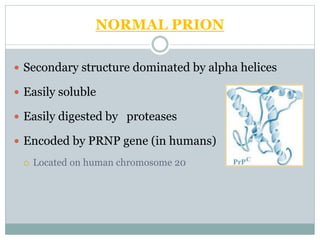
NORMAL PRION
 Secondary structure dominated by alpha helices
 Easily soluble
 Easily digested by proteases
 Encoded by PRNP gene (in humans)
 Located on human chromosome 20
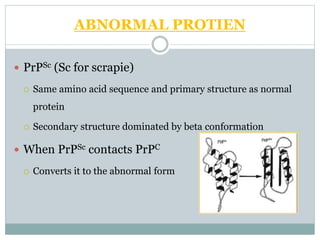
ABNORMAL PROTIEN
 PrPSc (Sc for scrapie)
 Same amino acid sequence and primary structure as normal
protein
 Secondary structure dominated by beta conformation
 When PrPSc contacts PrPC
 Converts it to the abnormal form
 Insoluble in all but strongest solvents
 Highly resistant to digestion by proteases
 Survives in tissues post-mortem
 Extremely resistant
 Heat, normal sterilization processes, sunlight
 No detectable immune response
HISTORY KURU
 New Guinea in early 1900’s
 People practicing cannibalism
 1957-1968
 Over 1,100 people died
 Majority of deaths
 Women, children and elderly
 Incubation period >30 days
HISTORY CJD
 Sporadic human encephalopathy
 Worldwide 1-2 cases/million people
 Different forms
 Spontaneous (85%)
 Genetic (10-15%)
 Iatrogenic (<1%)
 Average age of onset 65 years
 Duration of illness, 4.5 months
HISTORY BSE
 1986, First confirmed case in United Kingdom (UK)
 1988, UK bans meat and bone meal from ruminants
in cattle feed
 1989, USDA bans importation of ruminants from
countries with BSE
 1993, Peak of BSE in UK
 1,000 new cases reported weekly
HISTORY: BSE
 1997, US & Canada ban ruminant products fed
back to ruminants
 US importation ban extended to all of Europe
 2001, European Union ordered mandatory tests on
cattle
 Older than 30 months destined for slaughter
 May 2003, BSE diagnosed in 6 yr. old Angus beef
cow in Alberta, Canada
 Herd mates all tested negative
 Single case in 1993 was cow imported from UK
HISTORY: BSE
 December 2003, BSE diagnosed in 6½ yr old Holstein
cow in Washington State
 Possibly imported from Canada
 DNA testing being conducted
 Complications following calving
 Sent to slaughter
 Brain tissue sent to NVSL–per FSIS protocol
 Presumptive positive by NVSL
 Definitively positive by UK lab
HISTORY: VCJD
 Human encephalopathy due to consuming BSE
contaminated foods
 1995, UK: First confirmed case
 Incubation period not known
 Mean age at death
 28 years old
 Mean duration of infection
 14 months
HISTORY: SCRAPIE
 Sheep and goat disease
 Recognized 250 years ago
 Great Britain and W. Europe
 1947 diagnosed in the U.S.
 More than 1,000 flocks; mostly Suffolk
 Scrapie: Ovine Slaughter Surveillance Study (SOSS)
 Overall national prevalence 0.2%
 Higher in black-faced sheep
HISTORY: CWD
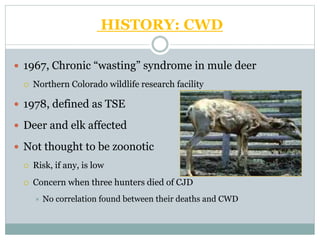
 1967, Chronic “wasting” syndrome in mule deer
 Northern Colorado wildlife research facility
 1978, defined as TSE
 Deer and elk affected
 Not thought to be zoonotic
 Risk, if any, is low
 Concern when three hunters died of CJD
 No correlation found between their deaths and CWD
HUMAN TRANSMISSION
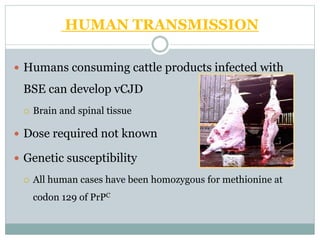
 Humans consuming cattle products infected with
BSE can develop vCJD
 Brain and spinal tissue
 Dose required not known
 Genetic susceptibility
 All human cases have been homozygous for methionine at
codon 129 of PrPC
HUMAN TRANSMISSION
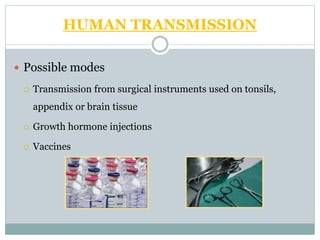
 Possible modes
 Transmission from surgical instruments used on tonsils,
appendix or brain tissue
 Growth hormone injections
 Vaccines
HUMAN TRANSMISSION
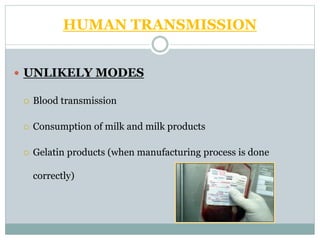
 UNLIKELY MODES
 Blood transmission
 Consumption of milk and milk products
 Gelatin products (when manufacturing process is done
correctly)
ANIMAL TRANSMISSION
 BSE
 Cattle feed
 Sheep carcasses infected with scrapie
 Cattle carcasses infected with unknown TSE
 Maternal transmission occurs at very low levels
 SCRAPIE
 Spread from ewe to offspring through placenta and placental
fluids
 Genetic susceptibilities
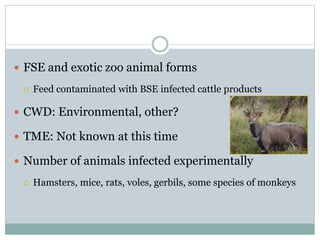
 FSE and exotic zoo animal forms
 Feed contaminated with BSE infected cattle products
 CWD: Environmental, other?
 TME: Not known at this time
 Number of animals infected experimentally
 Hamsters, mice, rats, voles, gerbils, some species of monkeys
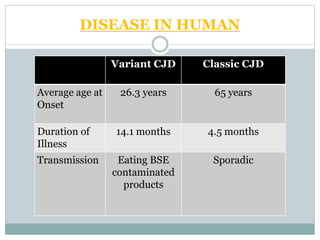
DISEASE IN HUMAN
Variant CJD Classic CJD
Average age at
Onset
26.3 years 65 years
Duration of
Illness
14.1 months 4.5 months
Transmission Eating BSE
contaminated
products
Sporadic
CLINICAL SYMPTOMS: VCJD
 Initial symptoms
 Depression and schizophrenia like psychosis
 Neurological signs
 Unsteadiness, difficulty walking, and involuntary muscle
movements
 Progression
 Become completely immobile and mute
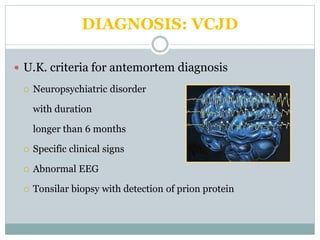
DIAGNOSIS: VCJD
 U.K. criteria for antemortem diagnosis
 Neuropsychiatric disorder
with duration
longer than 6 months
 Specific clinical signs
 Abnormal EEG
 Tonsilar biopsy with detection of prion protein
DIAGNOSIS: VCJD
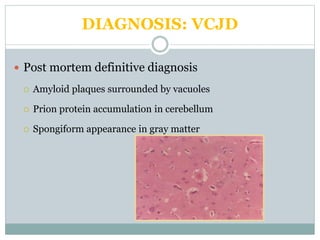
 Post mortem definitive diagnosis
 Amyloid plaques surrounded by vacuoles
 Prion protein accumulation in cerebellum
 Spongiform appearance in gray matter
TREATMENT: VCJD
 No effective treatment available
 Experimental drugs under investigation
 Quinicrine
 Symptomatic treatment
 Supportive care
TSE IN ANIMALS
 INCUBATION PERIOD
 Scrapie: Sheep 2-5 years
 BSE: Cattle 2-8 years
 CWD: Deer and elk 18 months
 TME: Mink 7+ months
 FSE: Feline unknown, most 4-9 years of age
CLINICAL SIGNS: BSE, SCRAPIE, CWD
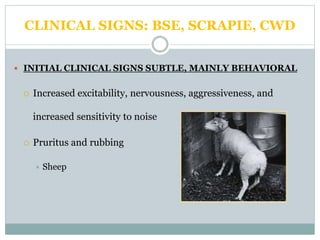
 INITIAL CLINICAL SIGNS SUBTLE, MAINLY BEHAVIORAL
 Increased excitability, nervousness, aggressiveness, and
increased sensitivity to noise
 Pruritus and rubbing
 Sheep
CLINICAL SIGNS: BSE, SCRAPIE, CWD
 Terminal state
 Hypokinesis, hypermetria, falling and general paresis
 Tremors and muscle fasciculations
 Neck and face
 Wasting despite good appetite
 PU/PD in deer and elk
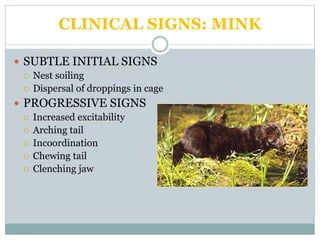
CLINICAL SIGNS: MINK
 SUBTLE INITIAL SIGNS
 Nest soiling
 Dispersal of droppings in cage
 PROGRESSIVE SIGNS
 Increased excitability
 Arching tail
 Incoordination
 Chewing tail
 Clenching jaw
CLINICAL SIGNS: FSE
 Behavioral changes, tremors, ataxia
 Increased aggression
 Later stages
 Somnolence
 Convulsions
 Excessive salivation
 Hyper-responsiveness to loud noise
 Dilated pupils
 Death in 6-8 weeks
DIAGNOSIS
 Post mortem: detection of prion
 Microscopic examination of brain tissue at necropsy
 Live animal tests: USDA/APHIS
 Tonsillar biopsy in deer
 Time consuming and expensive
 3rd eyelid test in sheep
 Blood tests
PREVENTION AND CONTROL
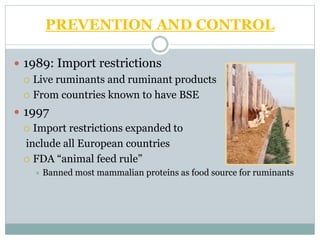
 1989: Import restrictions
 Live ruminants and ruminant products
 From countries known to have BSE
 1997
 Import restrictions expanded to
include all European countries
 FDA “animal feed rule”
 Banned most mammalian proteins as food source for ruminants
GOVERNMENT PRECAUTIONS
 Targeted surveillance
 High risk animals
 Adult animals with neurological signs
 Non-ambulatory “downer” cows
 Rabies- negative cattle
 Cattle dying on farms
 2003: 20,000 animals tested for BSE
 47 times the number required by the OIE
 2004: Enhanced surveillance
 Test maximum number of animals possible
SPECIFIC GUIDELINES FOR
HUNTERS REGARDING CWD
 Dress the deer/elk properly
 Minimize handling of brain and spinal tissues
 Wear rubber gloves when field dressing
 Use strong household bleach for cleaning knifes and saws
 Any suspicious elk and deer should be reported to
health officials
 Testing of elk and deer available in many states
PREVENTION AND CONTROL
 Surveillance for CJD in US
 CDC
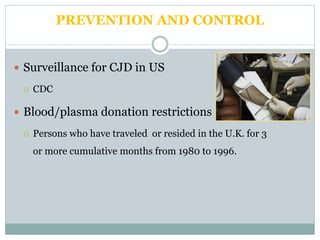
 Blood/plasma donation restrictions
 Persons who have traveled or resided in the U.K. for 3
or more cumulative months from 1980 to 1996.
ANY
QUESTION?

Prion

  • 1.
    PRION MOHAMMAD BILAL KAKAR MICROBIALTAXONOMY DEPARTMENT OF MICROBIOLOGY UNIVERSITY OF BALOCHISTAN QUETTA
  • 2.
    TABLE OF CONTENTS PRION  HISTORY  EPIDEMIOLOGY  TRANSMISSION  DISEASE IN HUMANS  DISEASE IN ANIMALS  PREVENTION AND CONTROL
  • 3.
    PRION  Smaller thansmallest known virus  Not yet completely characterized  Most widely accepted theory  Prion = Proteinaceous infectious particle  Normal Protein  PrPC (C for cellular)  Glycoprotein normally found at cell surface inserted in plasma membrane
  • 4.
    NORMAL PRION  Secondarystructure dominated by alpha helices  Easily soluble  Easily digested by proteases  Encoded by PRNP gene (in humans)  Located on human chromosome 20
  • 5.
    ABNORMAL PROTIEN  PrPSc(Sc for scrapie)  Same amino acid sequence and primary structure as normal protein  Secondary structure dominated by beta conformation  When PrPSc contacts PrPC  Converts it to the abnormal form
  • 6.
     Insoluble inall but strongest solvents  Highly resistant to digestion by proteases  Survives in tissues post-mortem  Extremely resistant  Heat, normal sterilization processes, sunlight  No detectable immune response
  • 7.
    HISTORY KURU  NewGuinea in early 1900’s  People practicing cannibalism  1957-1968  Over 1,100 people died  Majority of deaths  Women, children and elderly  Incubation period >30 days
  • 8.
    HISTORY CJD  Sporadichuman encephalopathy  Worldwide 1-2 cases/million people  Different forms  Spontaneous (85%)  Genetic (10-15%)  Iatrogenic (<1%)  Average age of onset 65 years  Duration of illness, 4.5 months
  • 9.
    HISTORY BSE  1986,First confirmed case in United Kingdom (UK)  1988, UK bans meat and bone meal from ruminants in cattle feed  1989, USDA bans importation of ruminants from countries with BSE  1993, Peak of BSE in UK  1,000 new cases reported weekly
  • 10.
    HISTORY: BSE  1997,US & Canada ban ruminant products fed back to ruminants  US importation ban extended to all of Europe  2001, European Union ordered mandatory tests on cattle  Older than 30 months destined for slaughter  May 2003, BSE diagnosed in 6 yr. old Angus beef cow in Alberta, Canada  Herd mates all tested negative  Single case in 1993 was cow imported from UK
  • 11.
    HISTORY: BSE  December2003, BSE diagnosed in 6½ yr old Holstein cow in Washington State  Possibly imported from Canada  DNA testing being conducted  Complications following calving  Sent to slaughter  Brain tissue sent to NVSL–per FSIS protocol  Presumptive positive by NVSL  Definitively positive by UK lab
  • 12.
    HISTORY: VCJD  Humanencephalopathy due to consuming BSE contaminated foods  1995, UK: First confirmed case  Incubation period not known  Mean age at death  28 years old  Mean duration of infection  14 months
  • 13.
    HISTORY: SCRAPIE  Sheepand goat disease  Recognized 250 years ago  Great Britain and W. Europe  1947 diagnosed in the U.S.  More than 1,000 flocks; mostly Suffolk  Scrapie: Ovine Slaughter Surveillance Study (SOSS)  Overall national prevalence 0.2%  Higher in black-faced sheep
  • 14.
    HISTORY: CWD  1967,Chronic “wasting” syndrome in mule deer  Northern Colorado wildlife research facility  1978, defined as TSE  Deer and elk affected  Not thought to be zoonotic  Risk, if any, is low  Concern when three hunters died of CJD  No correlation found between their deaths and CWD
  • 15.
    HUMAN TRANSMISSION  Humansconsuming cattle products infected with BSE can develop vCJD  Brain and spinal tissue  Dose required not known  Genetic susceptibility  All human cases have been homozygous for methionine at codon 129 of PrPC
  • 16.
    HUMAN TRANSMISSION  Possiblemodes  Transmission from surgical instruments used on tonsils, appendix or brain tissue  Growth hormone injections  Vaccines
  • 17.
    HUMAN TRANSMISSION  UNLIKELYMODES  Blood transmission  Consumption of milk and milk products  Gelatin products (when manufacturing process is done correctly)
  • 18.
    ANIMAL TRANSMISSION  BSE Cattle feed  Sheep carcasses infected with scrapie  Cattle carcasses infected with unknown TSE  Maternal transmission occurs at very low levels  SCRAPIE  Spread from ewe to offspring through placenta and placental fluids  Genetic susceptibilities
  • 19.
     FSE andexotic zoo animal forms  Feed contaminated with BSE infected cattle products  CWD: Environmental, other?  TME: Not known at this time  Number of animals infected experimentally  Hamsters, mice, rats, voles, gerbils, some species of monkeys
  • 20.
    DISEASE IN HUMAN VariantCJD Classic CJD Average age at Onset 26.3 years 65 years Duration of Illness 14.1 months 4.5 months Transmission Eating BSE contaminated products Sporadic
  • 21.
    CLINICAL SYMPTOMS: VCJD Initial symptoms  Depression and schizophrenia like psychosis  Neurological signs  Unsteadiness, difficulty walking, and involuntary muscle movements  Progression  Become completely immobile and mute
  • 22.
    DIAGNOSIS: VCJD  U.K.criteria for antemortem diagnosis  Neuropsychiatric disorder with duration longer than 6 months  Specific clinical signs  Abnormal EEG  Tonsilar biopsy with detection of prion protein
  • 23.
    DIAGNOSIS: VCJD  Postmortem definitive diagnosis  Amyloid plaques surrounded by vacuoles  Prion protein accumulation in cerebellum  Spongiform appearance in gray matter
  • 24.
    TREATMENT: VCJD  Noeffective treatment available  Experimental drugs under investigation  Quinicrine  Symptomatic treatment  Supportive care
  • 25.
    TSE IN ANIMALS INCUBATION PERIOD  Scrapie: Sheep 2-5 years  BSE: Cattle 2-8 years  CWD: Deer and elk 18 months  TME: Mink 7+ months  FSE: Feline unknown, most 4-9 years of age
  • 26.
    CLINICAL SIGNS: BSE,SCRAPIE, CWD  INITIAL CLINICAL SIGNS SUBTLE, MAINLY BEHAVIORAL  Increased excitability, nervousness, aggressiveness, and increased sensitivity to noise  Pruritus and rubbing  Sheep
  • 27.
    CLINICAL SIGNS: BSE,SCRAPIE, CWD  Terminal state  Hypokinesis, hypermetria, falling and general paresis  Tremors and muscle fasciculations  Neck and face  Wasting despite good appetite  PU/PD in deer and elk
  • 28.
    CLINICAL SIGNS: MINK SUBTLE INITIAL SIGNS  Nest soiling  Dispersal of droppings in cage  PROGRESSIVE SIGNS  Increased excitability  Arching tail  Incoordination  Chewing tail  Clenching jaw
  • 29.
    CLINICAL SIGNS: FSE Behavioral changes, tremors, ataxia  Increased aggression  Later stages  Somnolence  Convulsions  Excessive salivation  Hyper-responsiveness to loud noise  Dilated pupils  Death in 6-8 weeks
  • 30.
    DIAGNOSIS  Post mortem:detection of prion  Microscopic examination of brain tissue at necropsy  Live animal tests: USDA/APHIS  Tonsillar biopsy in deer  Time consuming and expensive  3rd eyelid test in sheep  Blood tests
  • 31.
    PREVENTION AND CONTROL 1989: Import restrictions  Live ruminants and ruminant products  From countries known to have BSE  1997  Import restrictions expanded to include all European countries  FDA “animal feed rule”  Banned most mammalian proteins as food source for ruminants
  • 32.
    GOVERNMENT PRECAUTIONS  Targetedsurveillance  High risk animals  Adult animals with neurological signs  Non-ambulatory “downer” cows  Rabies- negative cattle  Cattle dying on farms  2003: 20,000 animals tested for BSE  47 times the number required by the OIE  2004: Enhanced surveillance  Test maximum number of animals possible
  • 33.
    SPECIFIC GUIDELINES FOR HUNTERSREGARDING CWD  Dress the deer/elk properly  Minimize handling of brain and spinal tissues  Wear rubber gloves when field dressing  Use strong household bleach for cleaning knifes and saws  Any suspicious elk and deer should be reported to health officials  Testing of elk and deer available in many states
  • 34.
    PREVENTION AND CONTROL Surveillance for CJD in US  CDC  Blood/plasma donation restrictions  Persons who have traveled or resided in the U.K. for 3 or more cumulative months from 1980 to 1996.
  • 35.