
Situated Learning and Communities of Practice  Dr. Terry Carter, tjcarter@vcu.edu Virginia Commonwealth University
The Language of Situated Learning  Communities of practice Legitimate peripheral participation Situated learning, situated cognition, learning in situ Cognitive apprenticeships Thinking in context, thinking embedded in context Heuristic Tools and learning Enculturating environment
Language, con’t Novices, experts, and Just Plain Folks (JPFs) Canonical practice Dialectics Narration, collaboration, and social construction of knowledge Bricolage Inert knowledge vs. robust knowledge Organizations as communities of communities Inter-organizational communities of practice
Four Major premises Learning is grounded in actions of everyday situations Knowledge is acquired situationally and transfers only to similar situations Learning is a social process Learning is not separated from action
Unique Factors in Situated Learning Students learn content through activities rather than by acquiring information as organized by instructors Content is inherent in doing the task Learning is dilemma-driven Subject matter emerges from cues in the environment and from dialogue among the community
Content is embedded in … Context Community Participation
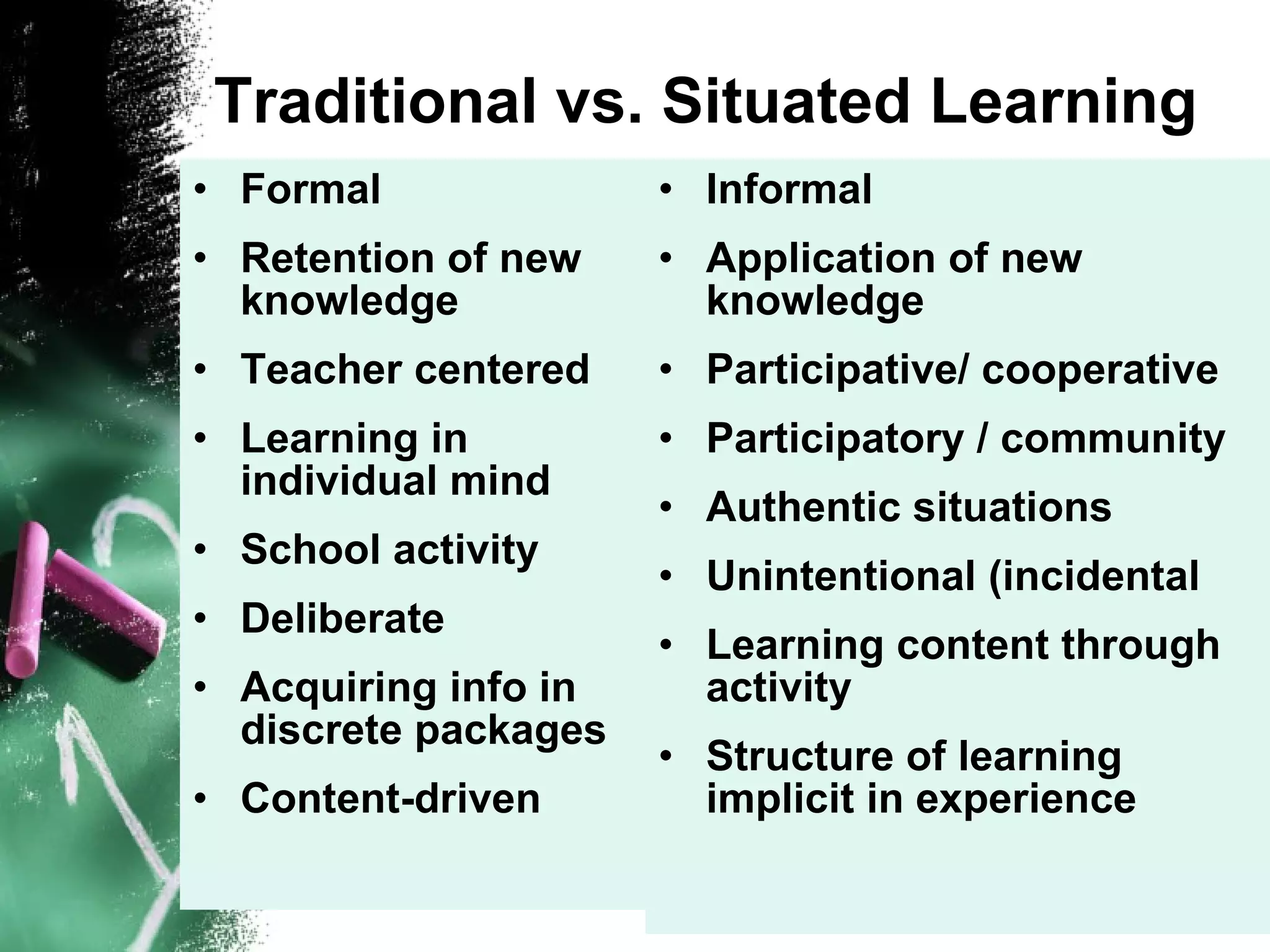
Traditional vs. Situated Learning Formal Retention of new knowledge Teacher centered Learning in  individual mind School activity Deliberate Acquiring info in discrete packages Content-driven Informal Application of new knowledge Participative/ cooperative Participatory / community Authentic situations Unintentional (incidental Learning content through activity Structure of learning implicit in experience

Situated learning and communities of practice

  • 1.
    Situated Learning andCommunities of Practice Dr. Terry Carter, tjcarter@vcu.edu Virginia Commonwealth University
  • 2.
    The Language ofSituated Learning Communities of practice Legitimate peripheral participation Situated learning, situated cognition, learning in situ Cognitive apprenticeships Thinking in context, thinking embedded in context Heuristic Tools and learning Enculturating environment
  • 3.
    Language, con’t Novices,experts, and Just Plain Folks (JPFs) Canonical practice Dialectics Narration, collaboration, and social construction of knowledge Bricolage Inert knowledge vs. robust knowledge Organizations as communities of communities Inter-organizational communities of practice
  • 4.
    Four Major premisesLearning is grounded in actions of everyday situations Knowledge is acquired situationally and transfers only to similar situations Learning is a social process Learning is not separated from action
  • 5.
    Unique Factors inSituated Learning Students learn content through activities rather than by acquiring information as organized by instructors Content is inherent in doing the task Learning is dilemma-driven Subject matter emerges from cues in the environment and from dialogue among the community
  • 6.
    Content is embeddedin … Context Community Participation
  • 7.
    Traditional vs. SituatedLearning Formal Retention of new knowledge Teacher centered Learning in individual mind School activity Deliberate Acquiring info in discrete packages Content-driven Informal Application of new knowledge Participative/ cooperative Participatory / community Authentic situations Unintentional (incidental Learning content through activity Structure of learning implicit in experience
  • 8.
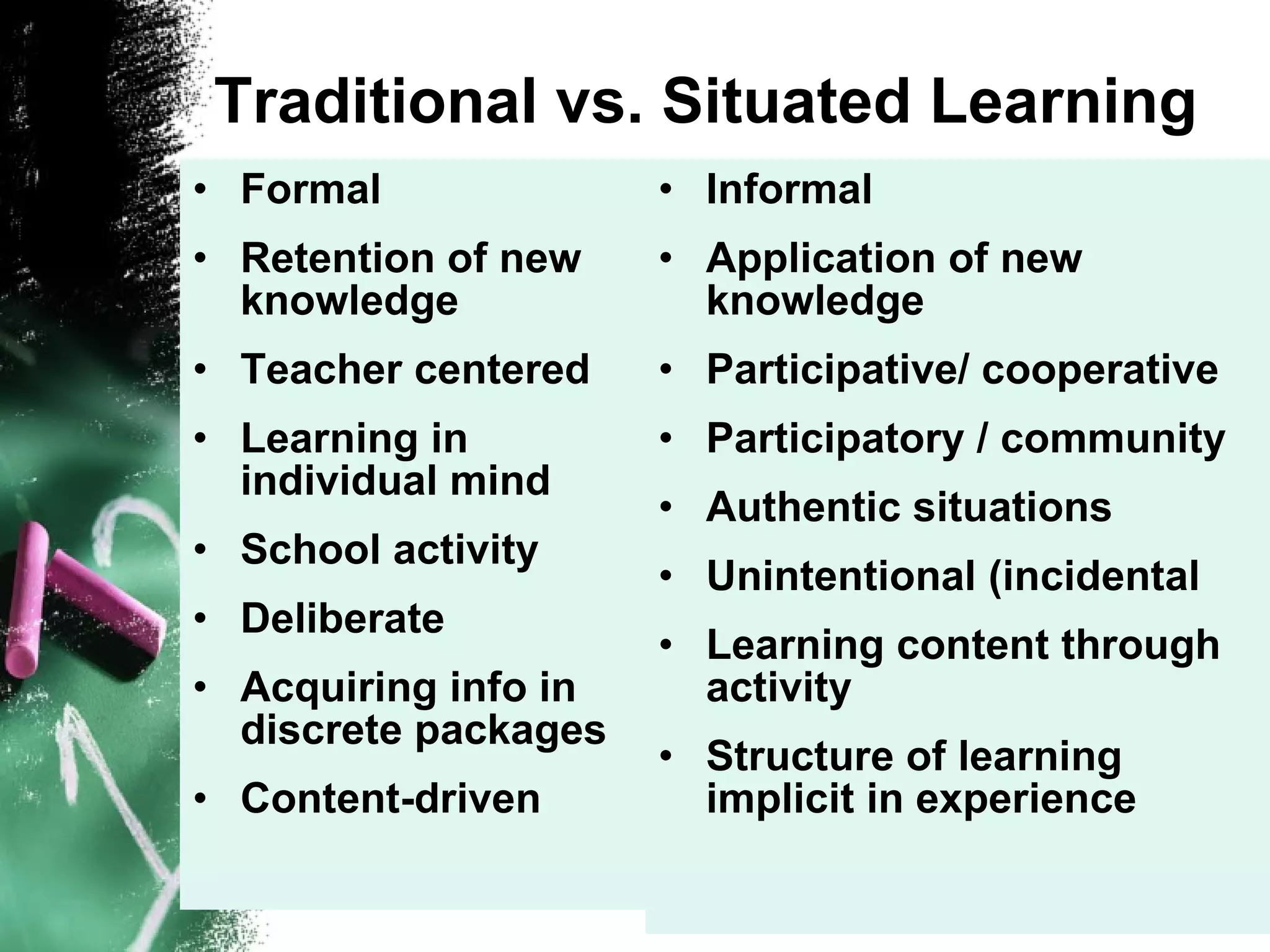
    Traditional vs. SituatedLearning Formal Retention of new knowledge Teacher centered Learning in individual mind School activity Deliberate Acquiring info in discrete packages Content-driven Informal Application of new knowledge Participative/ cooperative Participatory / community Authentic situations Unintentional (incidental Learning content through activity Structure of learning implicit in experience