HOW ARE WE
LEARNING?
Bijoy K Thomas
9th November 2022
Bijoy K Thomas - For internal Circulation 1
LEARNING
https://padlet.com/Ebijoy/7mfdvd4w9tkncipm
Bijoy K Thomas - For internal Circulation 2
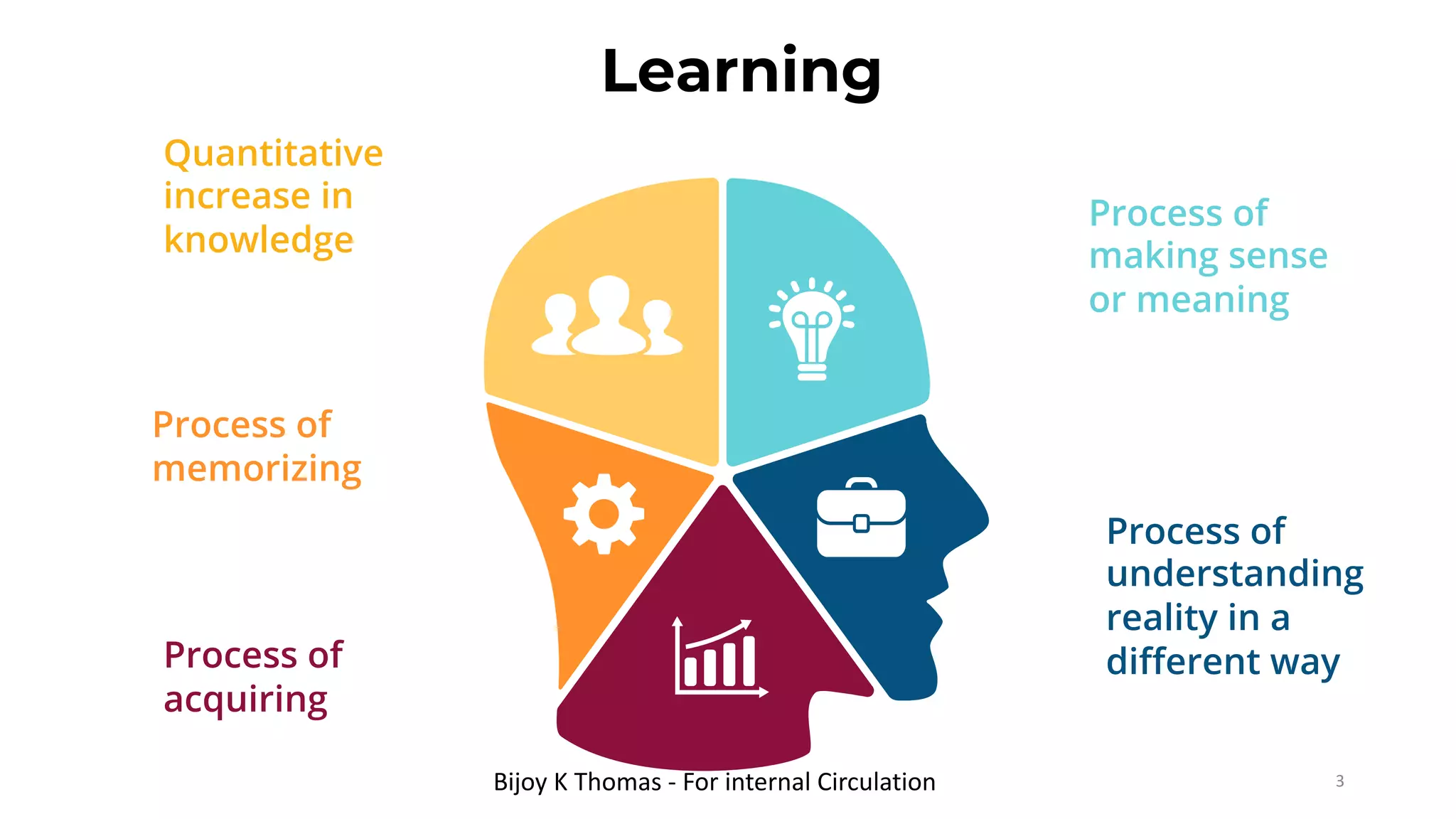
Process of
understanding
reality in a
different way
Process of
making sense
or meaning
Process of
acquiring
Process of
memorizing
Quantitative
increase in
knowledge
Learning
Bijoy K Thomas - For internal Circulation 3
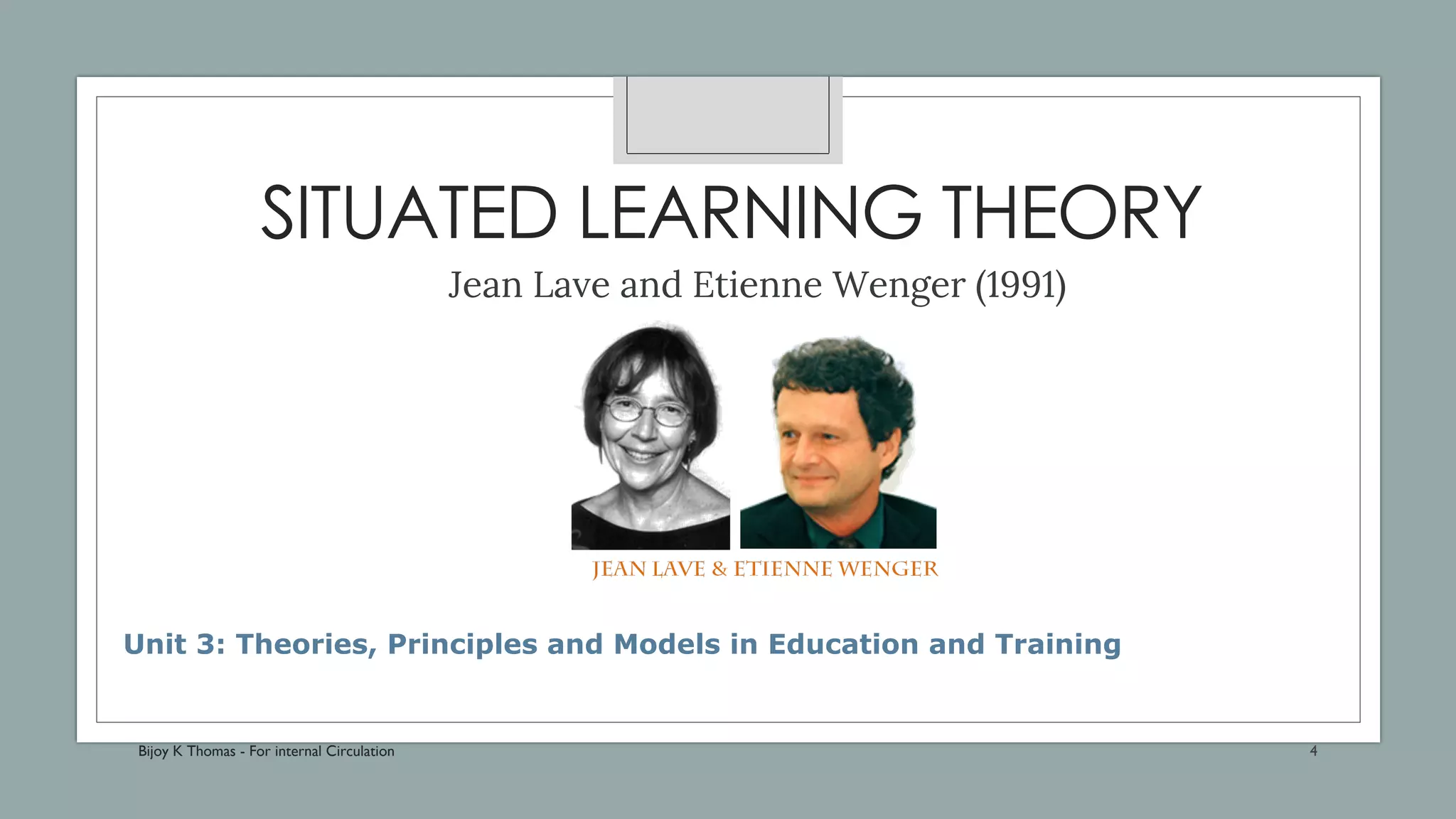
SITUATED LEARNING THEORY
Jean Lave and Etienne Wenger (1991)
Unit 3: Theories, Principles and Models in Education and Training
Bijoy K Thomas - For internal Circulation 4
Learning Outcomes
1. Explain Situated Learning Theory
2. Describe the elements of Situated Learning Theory
3. Analyses the application of Situated Learning Theory in the classroom
Bijoy K Thomas - For internal Circulation 5
ELEMENTS OF SITUATED
LEARNING /
COGNITION
Bijoy K Thomas - For internal Circulation 6
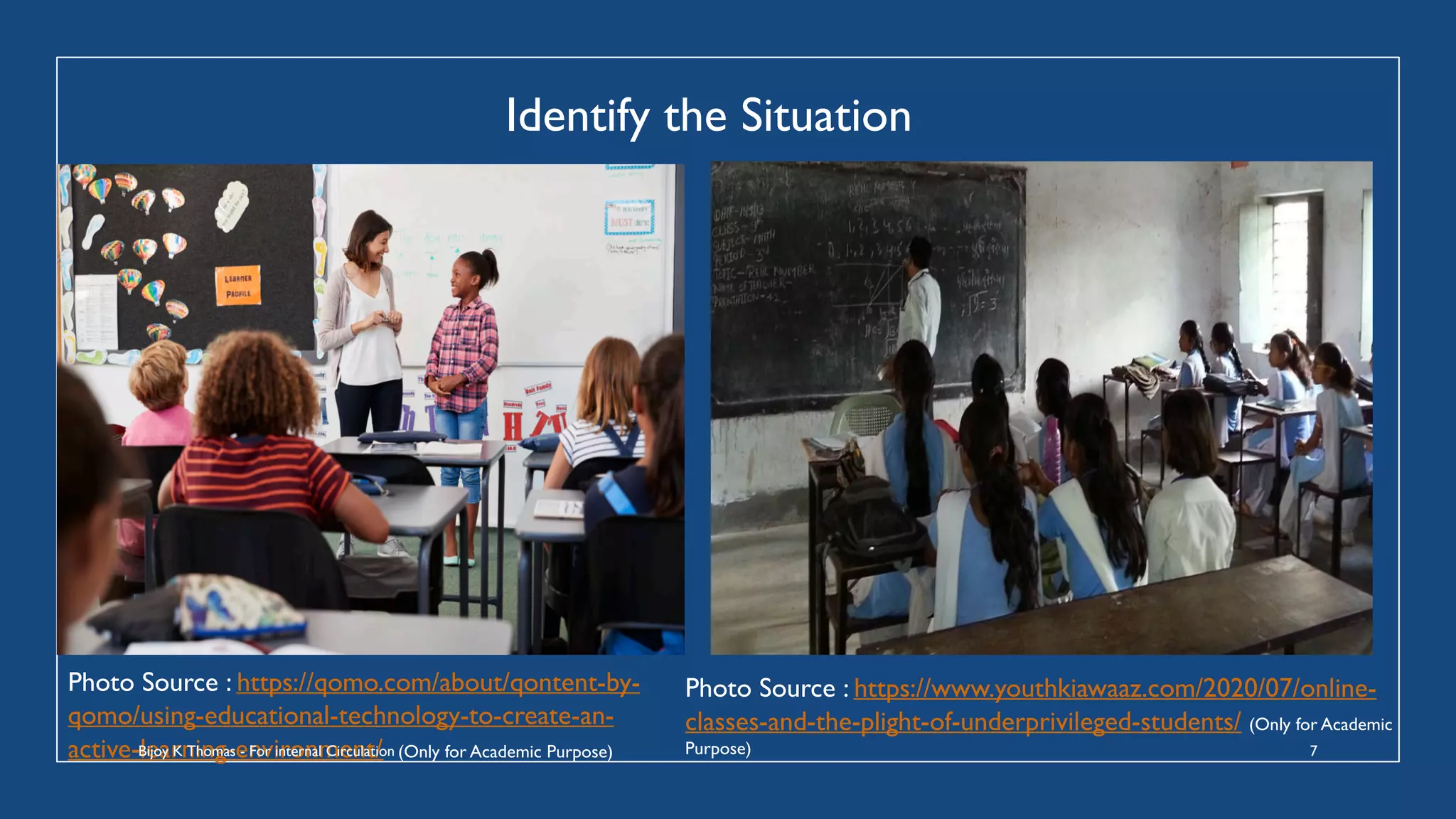
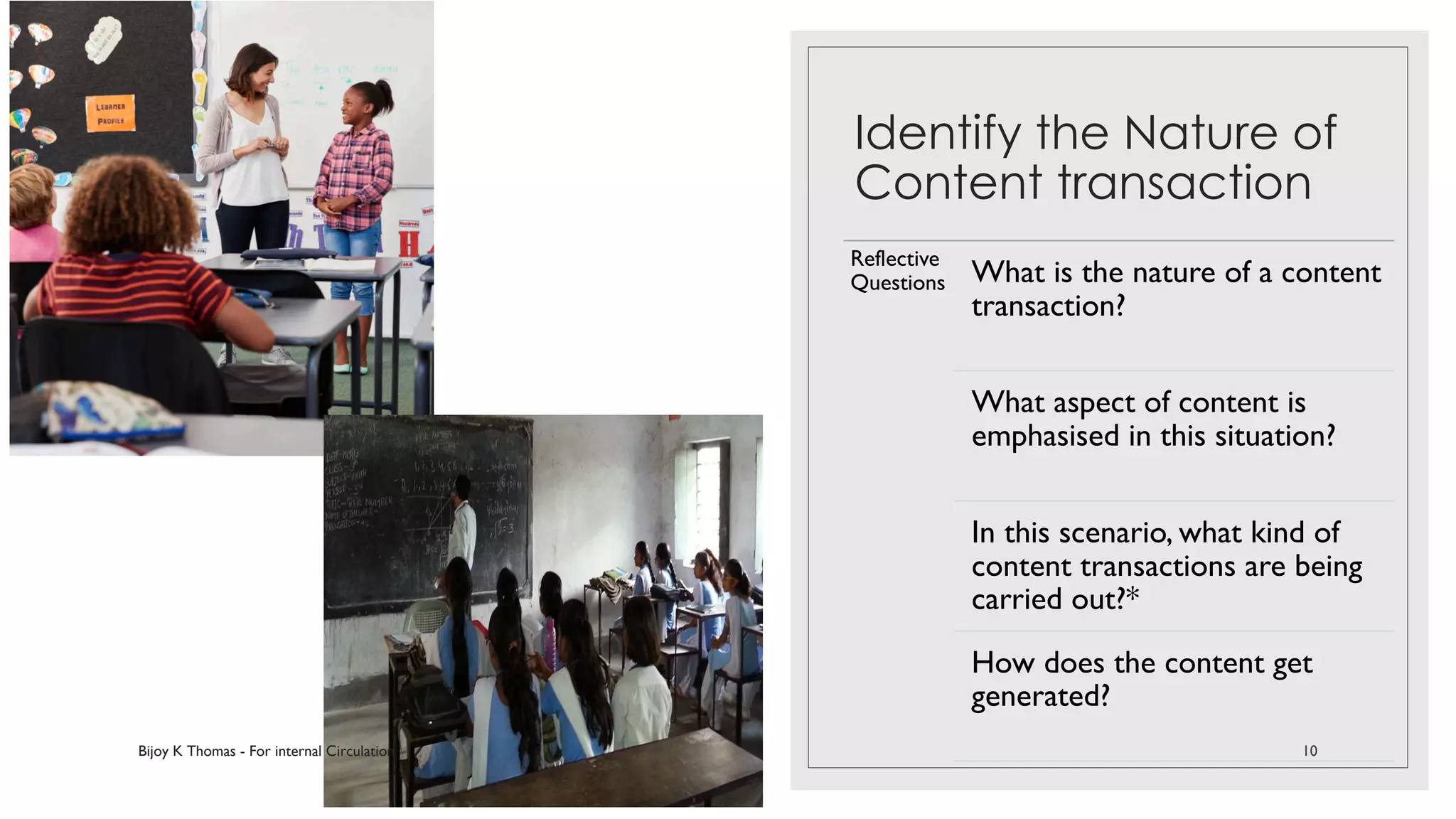
Identify the Situation
Photo Source : https://qomo.com/about/qontent-by-
qomo/using-educational-technology-to-create-an-
active-learning-environment/ (Only for Academic Purpose)
Photo Source : https://www.youthkiawaaz.com/2020/07/online-
classes-and-the-plight-of-underprivileged-students/ (Only for Academic
Purpose)
Bijoy K Thomas - For internal Circulation 7
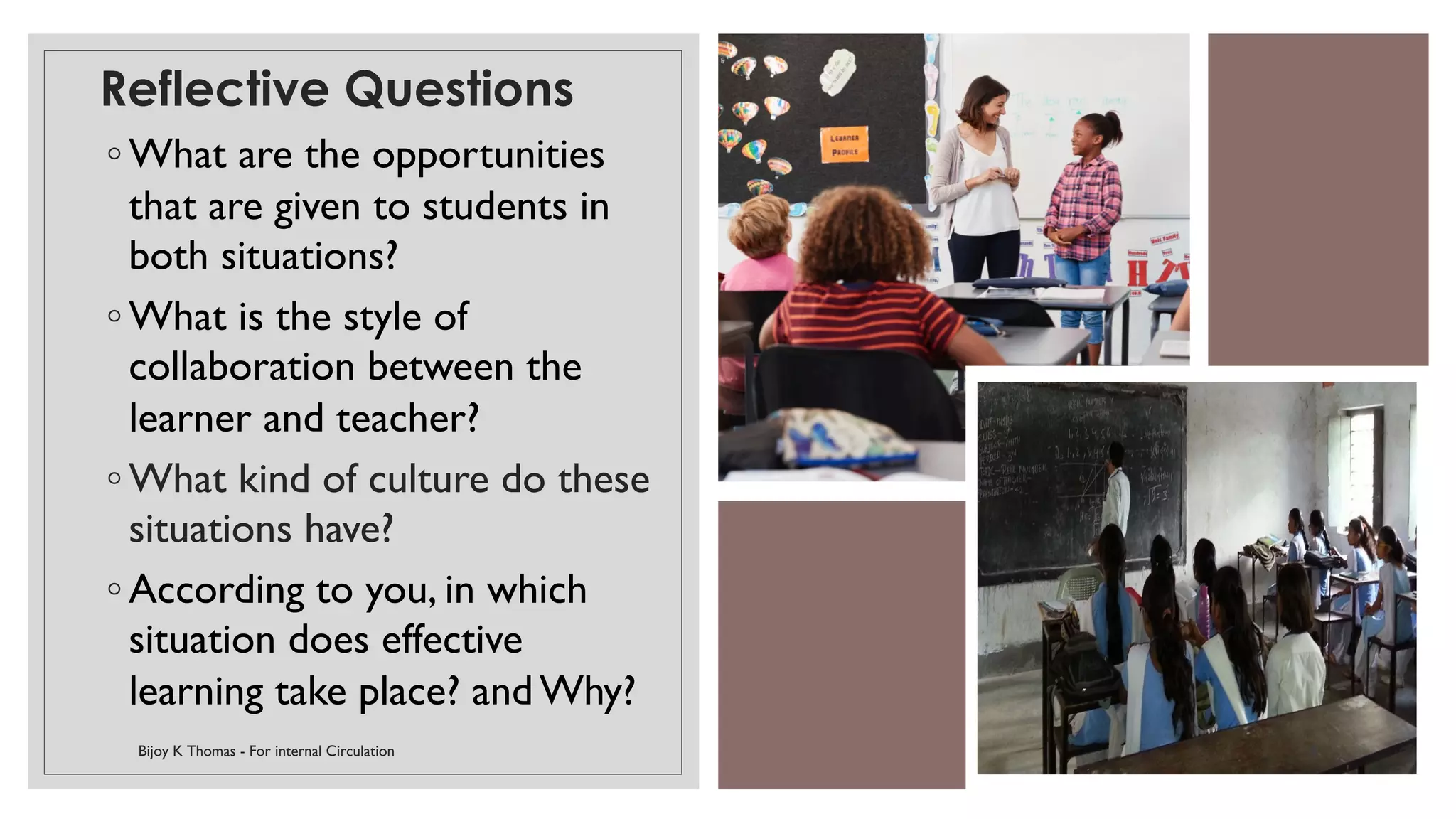
Reflective Questions
◦ What are the opportunities
that are given to students in
both situations?
◦ What is the style of
collaboration between the
learner and teacher?
◦ What kind of culture do these
situations have?
◦ According to you, in which
situation does effective
learning take place? and Why?
Bijoy K Thomas - For internal Circulation 8
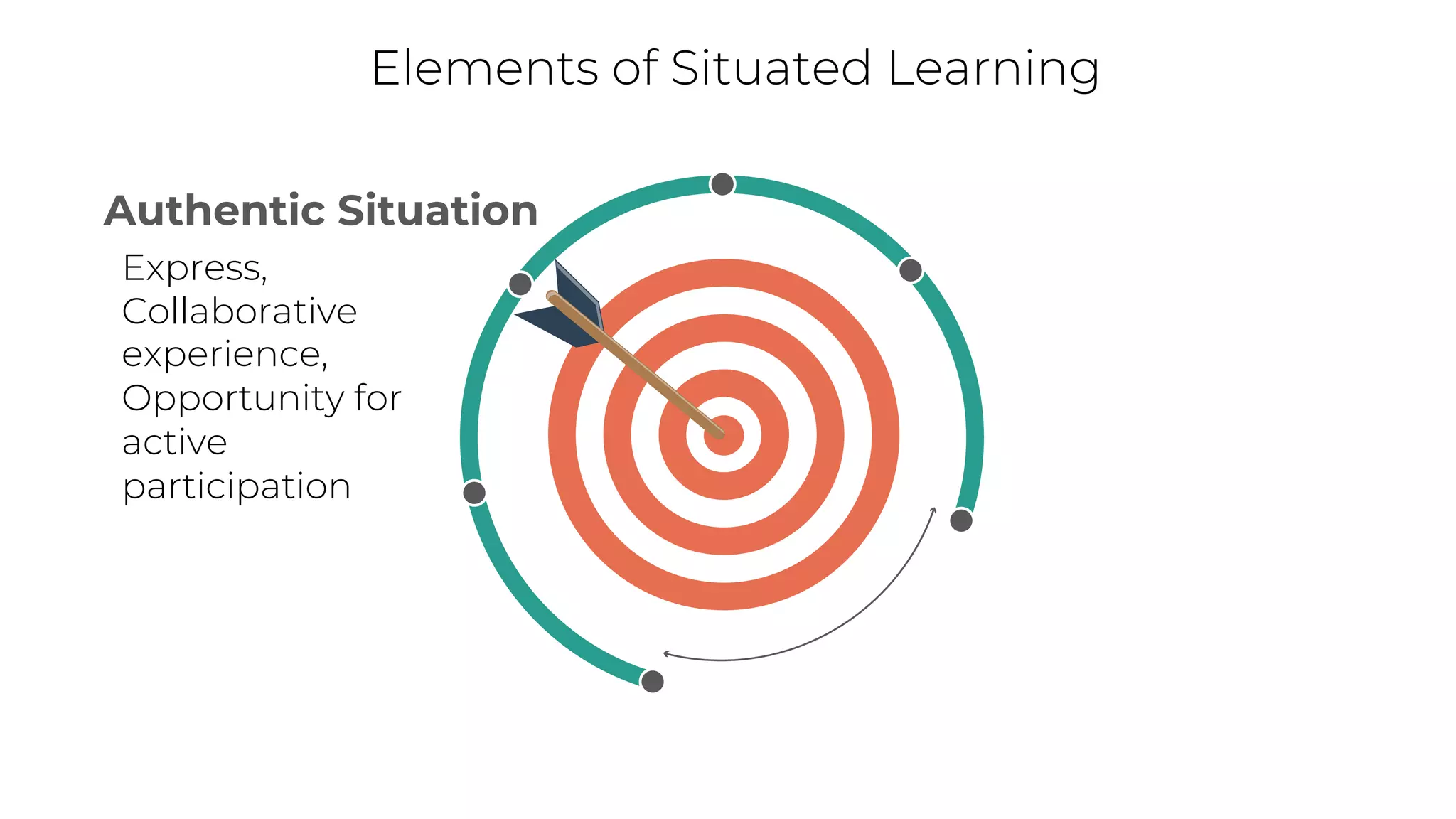
Authentic Situation
Elements of Situated Learning
Express,
Collaborative
experience,
Opportunity for
active
participation
Identify the Nature of
Content transaction
Reflective
Questions What is the nature of a content
transaction?
What aspect of content is
emphasised in this situation?
In this scenario, what kind of
content transactions are being
carried out?*
How does the content get
generated?
Bijoy K Thomas - For internal Circulation 10
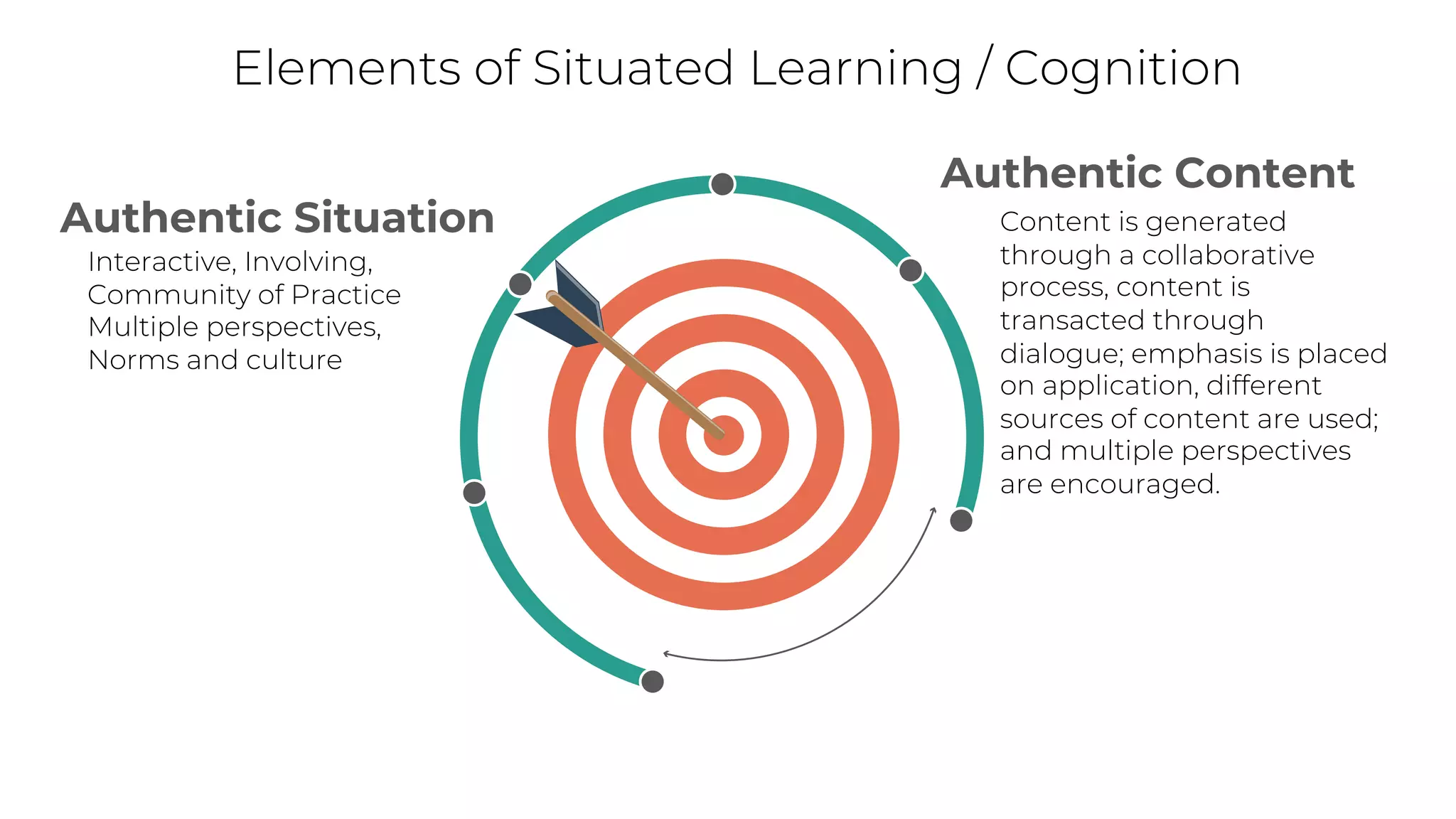
Authentic Situation
Elements of Situated Learning / Cognition
Authentic Content
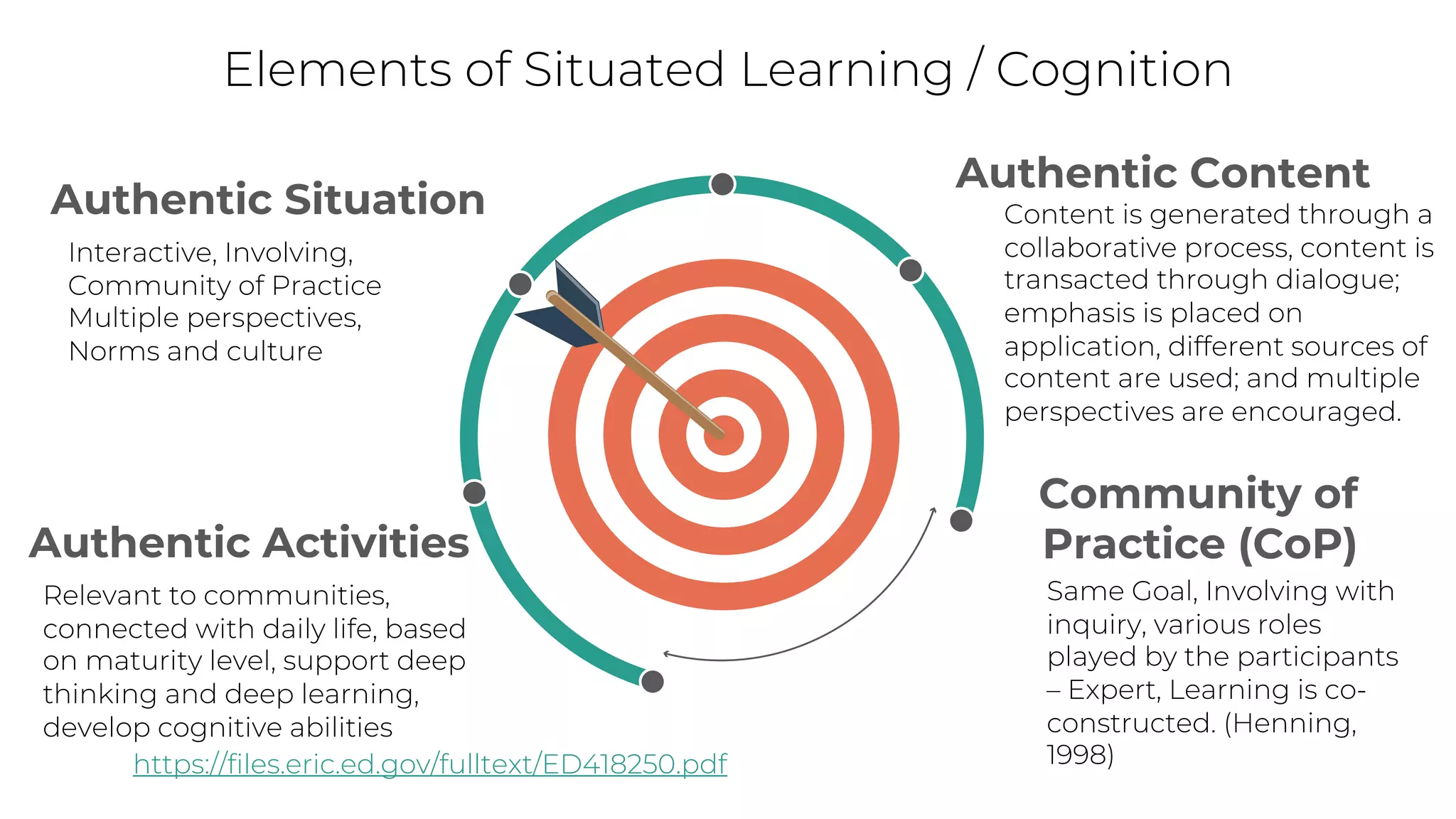
Content is generated
through a collaborative
process, content is
transacted through
dialogue; emphasis is placed
on application, different
sources of content are used;
and multiple perspectives
are encouraged.
Interactive, Involving,
Community of Practice
Multiple perspectives,
Norms and culture
Identify the Nature
of Activities
Reflective
Questions What is the nature of the
activities involved in this
situation?
How does these activities
relevant to their learning
process?
Bijoy K Thomas - For internal Circulation 12
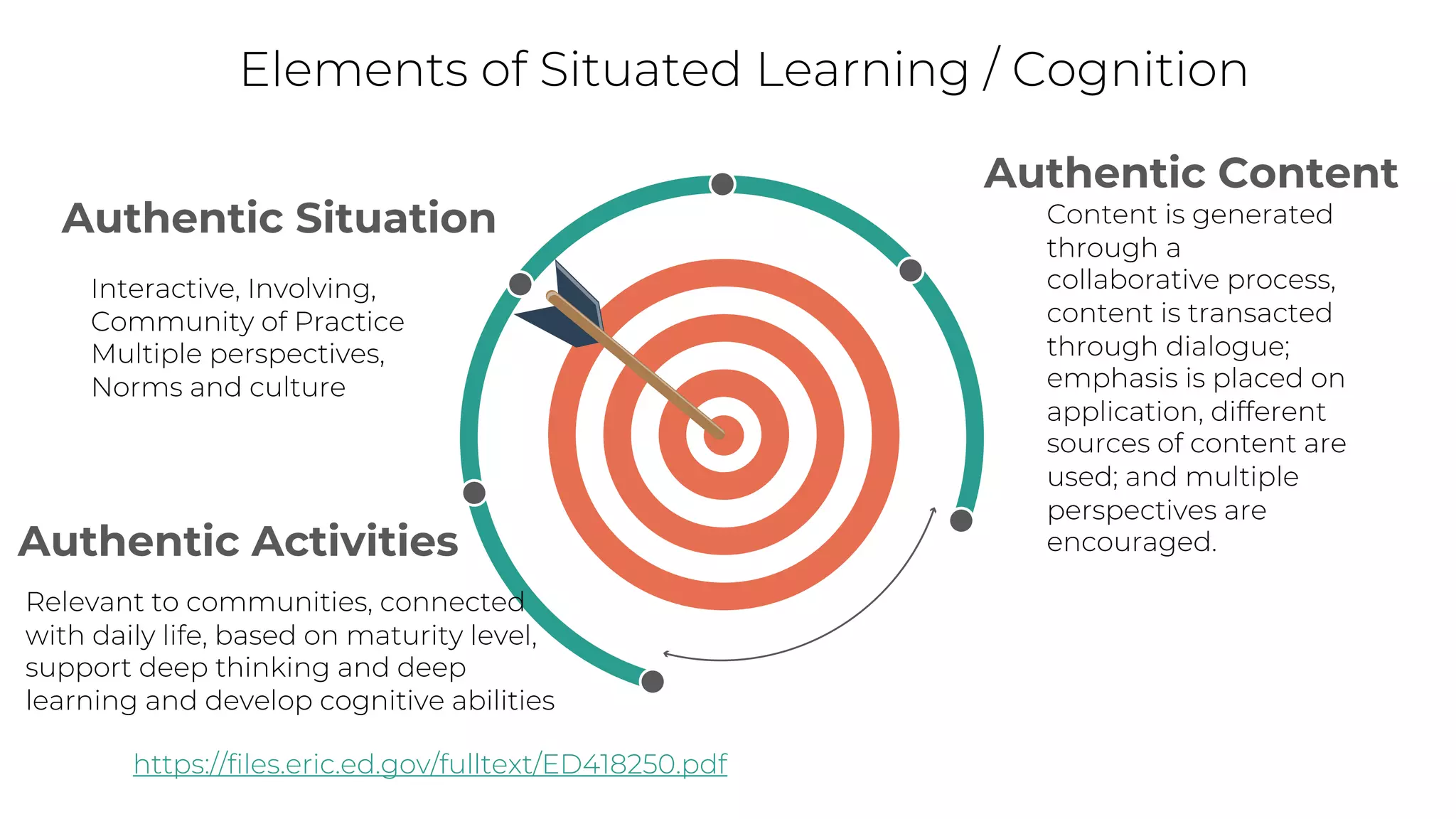
Authentic Situation
Elements of Situated Learning / Cognition
Authentic Content
Content is generated
through a
collaborative process,
content is transacted
through dialogue;
emphasis is placed on
application, different
sources of content are
used; and multiple
perspectives are
encouraged.
Interactive, Involving,
Community of Practice
Multiple perspectives,
Norms and culture
https://files.eric.ed.gov/fulltext/ED418250.pdf
Authentic Activities
Relevant to communities, connected
with daily life, based on maturity level,
support deep thinking and deep
learning and develop cognitive abilities
Identify the Nature
of Community
Reflective
Questions
What is the nature of the community
involved in this situation?
Do they have a common goal?
Do you believe that everyone has
knowledge in every field?
How does the community get
involved in acquiring knowledge?
What are the different roles played by
the community member?
Bijoy K Thomas - For internal Circulation 14
Authentic Situation
Elements of Situated Learning / Cognition
Authentic Content
Content is generated through a
collaborative process, content is
transacted through dialogue;
emphasis is placed on
application, different sources of
content are used; and multiple
perspectives are encouraged.
Interactive, Involving,
Community of Practice
Multiple perspectives,
Norms and culture
Community of
Practice (CoP)
Same Goal, Involving with
inquiry, various roles
played by the participants
– Expert, Learning is co-
constructed. (Henning,
1998)
https://files.eric.ed.gov/fulltext/ED418250.pdf
Authentic Activities
Relevant to communities,
connected with daily life, based
on maturity level, support deep
thinking and deep learning,
develop cognitive abilities
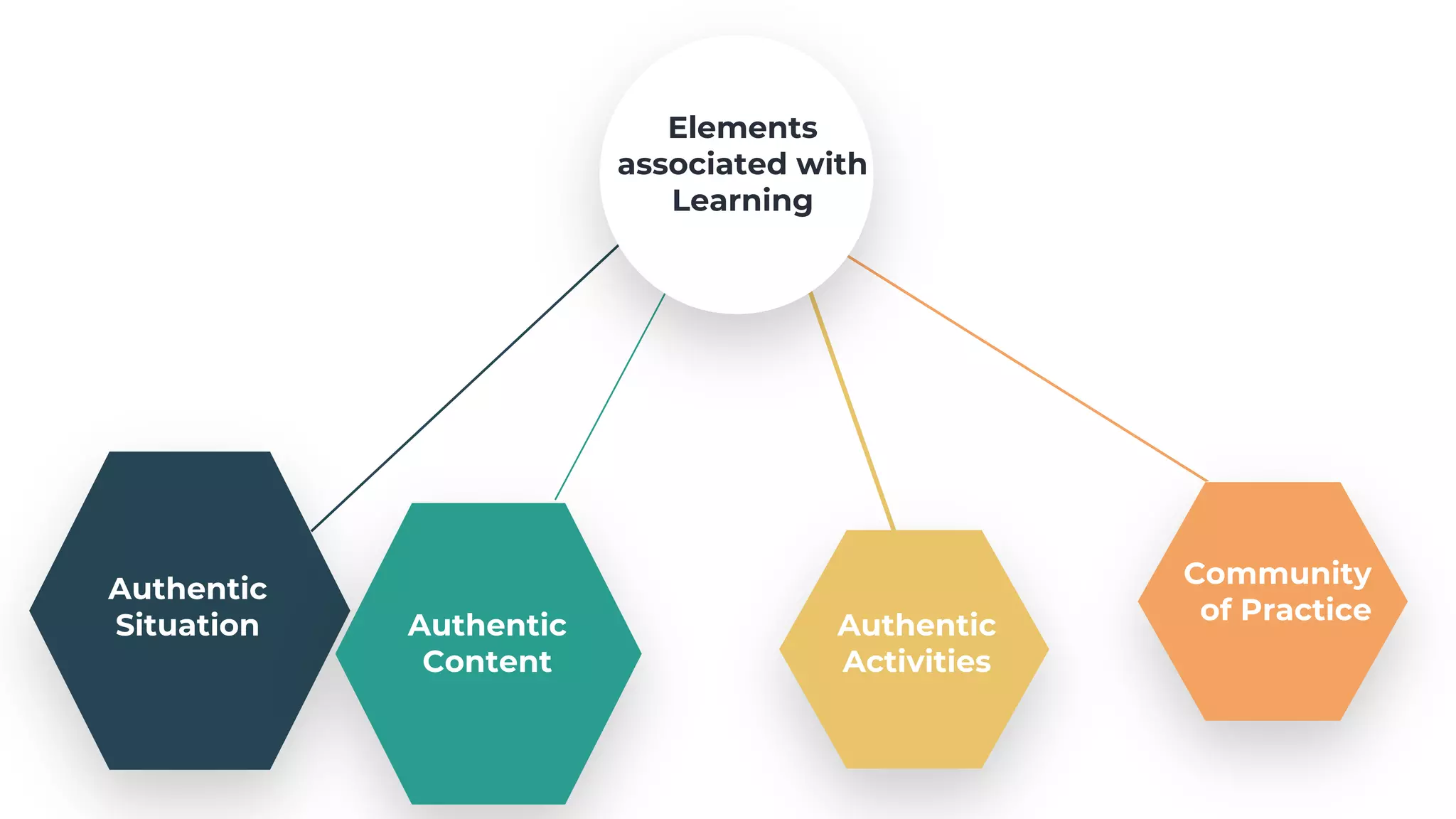
Authentic
Situation
Elements
associated with
Learning
Authentic
Content
Authentic
Activities
Community
of Practice
Learning is through Legitimate Peripheral Participation
Learning is a social process
Central principle of Learning according to Situated
Learning Theory
Through legitimate practice, learners develop their knowledge, skill, and
discourse moving from novices to experts
Ref. Anderson et al., 1996 & Wilson, 1993 17
HOW CAN
WE APPLY
THIS THEORY
INTO
PRACTICE?
Bijoy K Thomas - For internal Circulation 18
Discussion
◦ Group 1 : Planning of the lesson
◦ Group 2 : Engaging the Learners and Activities
◦ Group 3:Teacher approach
◦ Group 4: Evaluation
https://padlet.com/Ebijoy/pmve2rwgcvh0xwhz
Bijoy K Thomas - For internal Circulation 19
Assignment
Read and Reflect
◦ Mousley,A. (n.d.). Mathematical and Pedagogical Understanding as Situated Cognition.
Deakin University. Retrieved November 8, 2022, from
https://files.eric.ed.gov/fulltext/ED501036.pdf
◦ Ladley. (2010). Games Based Situated Learning. In games-ED.The Pixel Fountain Ltd).
https://www.pixelfountain.co.uk/download/Games-Based-Situated-Learning-v1.pdf
Task
Develop a Lesson plan based on the principles of Situated Learning Theory
Bijoy K Thomas - For internal Circulation 20
References
◦ Pg Hj Besar, Dk Siti Norainna. (2018). Situated LearningTheory:The Key to Effective Classroom
Teaching?.
https://www.researchgate.net/publication/327530821_Situated_Learning_Theory_The_Key_to_Effective
_Classroom_Teaching
◦ Clancey,William. (1995).A tutorial on situated learning. Proceedings of the International Conference on
Computers and Education (Taiwan).
https://www.researchgate.net/publication/28762415_A_tutorial_on_situated_learning
◦ LAVE, & WENGER. (2008) Situated Learning Legitimate Peripheral Participation. In Cambridge University
Press. http://s3.amazonaws.com/arena-
attachments/1301652/cb419d882cd5bb5286069675b449da38.pdf?1506793465
◦ Lenski, S. J., & Caskey, M. M. (2009). Using the Lesson Study Approach to Plan for Student Learning.
Middle School Journal, 40(3), 50-57. Retrieved from https://core.ac.uk/download/pdf/37765731.pdf
◦ Ladley. (2010). Games Based Situated Learning. In games-ED.The Pixel Fountain Ltd).
https://www.pixelfountain.co.uk/download/Games-Based-Situated-Learning-v1.pdf
◦ Images are used only for Academic purpose
Bijoy K Thomas - For internal Circulation 21

Situated Learning.pdf

  • 1.
    HOW ARE WE LEARNING? BijoyK Thomas 9th November 2022 Bijoy K Thomas - For internal Circulation 1
  • 2.
  • 3.
    Process of understanding reality ina different way Process of making sense or meaning Process of acquiring Process of memorizing Quantitative increase in knowledge Learning Bijoy K Thomas - For internal Circulation 3
  • 4.
    SITUATED LEARNING THEORY JeanLave and Etienne Wenger (1991) Unit 3: Theories, Principles and Models in Education and Training Bijoy K Thomas - For internal Circulation 4
  • 5.
    Learning Outcomes 1. ExplainSituated Learning Theory 2. Describe the elements of Situated Learning Theory 3. Analyses the application of Situated Learning Theory in the classroom Bijoy K Thomas - For internal Circulation 5
  • 6.
    ELEMENTS OF SITUATED LEARNING/ COGNITION Bijoy K Thomas - For internal Circulation 6
  • 7.
    Identify the Situation PhotoSource : https://qomo.com/about/qontent-by- qomo/using-educational-technology-to-create-an- active-learning-environment/ (Only for Academic Purpose) Photo Source : https://www.youthkiawaaz.com/2020/07/online- classes-and-the-plight-of-underprivileged-students/ (Only for Academic Purpose) Bijoy K Thomas - For internal Circulation 7
  • 8.
    Reflective Questions ◦ Whatare the opportunities that are given to students in both situations? ◦ What is the style of collaboration between the learner and teacher? ◦ What kind of culture do these situations have? ◦ According to you, in which situation does effective learning take place? and Why? Bijoy K Thomas - For internal Circulation 8
  • 9.
    Authentic Situation Elements ofSituated Learning Express, Collaborative experience, Opportunity for active participation
  • 10.
    Identify the Natureof Content transaction Reflective Questions What is the nature of a content transaction? What aspect of content is emphasised in this situation? In this scenario, what kind of content transactions are being carried out?* How does the content get generated? Bijoy K Thomas - For internal Circulation 10
  • 11.
    Authentic Situation Elements ofSituated Learning / Cognition Authentic Content Content is generated through a collaborative process, content is transacted through dialogue; emphasis is placed on application, different sources of content are used; and multiple perspectives are encouraged. Interactive, Involving, Community of Practice Multiple perspectives, Norms and culture
  • 12.
    Identify the Nature ofActivities Reflective Questions What is the nature of the activities involved in this situation? How does these activities relevant to their learning process? Bijoy K Thomas - For internal Circulation 12
  • 13.
    Authentic Situation Elements ofSituated Learning / Cognition Authentic Content Content is generated through a collaborative process, content is transacted through dialogue; emphasis is placed on application, different sources of content are used; and multiple perspectives are encouraged. Interactive, Involving, Community of Practice Multiple perspectives, Norms and culture https://files.eric.ed.gov/fulltext/ED418250.pdf Authentic Activities Relevant to communities, connected with daily life, based on maturity level, support deep thinking and deep learning and develop cognitive abilities
  • 14.
    Identify the Nature ofCommunity Reflective Questions What is the nature of the community involved in this situation? Do they have a common goal? Do you believe that everyone has knowledge in every field? How does the community get involved in acquiring knowledge? What are the different roles played by the community member? Bijoy K Thomas - For internal Circulation 14
  • 15.
    Authentic Situation Elements ofSituated Learning / Cognition Authentic Content Content is generated through a collaborative process, content is transacted through dialogue; emphasis is placed on application, different sources of content are used; and multiple perspectives are encouraged. Interactive, Involving, Community of Practice Multiple perspectives, Norms and culture Community of Practice (CoP) Same Goal, Involving with inquiry, various roles played by the participants – Expert, Learning is co- constructed. (Henning, 1998) https://files.eric.ed.gov/fulltext/ED418250.pdf Authentic Activities Relevant to communities, connected with daily life, based on maturity level, support deep thinking and deep learning, develop cognitive abilities
  • 16.
  • 17.
    Learning is throughLegitimate Peripheral Participation Learning is a social process Central principle of Learning according to Situated Learning Theory Through legitimate practice, learners develop their knowledge, skill, and discourse moving from novices to experts Ref. Anderson et al., 1996 & Wilson, 1993 17
  • 18.
    HOW CAN WE APPLY THISTHEORY INTO PRACTICE? Bijoy K Thomas - For internal Circulation 18
  • 19.
    Discussion ◦ Group 1: Planning of the lesson ◦ Group 2 : Engaging the Learners and Activities ◦ Group 3:Teacher approach ◦ Group 4: Evaluation https://padlet.com/Ebijoy/pmve2rwgcvh0xwhz Bijoy K Thomas - For internal Circulation 19
  • 20.
    Assignment Read and Reflect ◦Mousley,A. (n.d.). Mathematical and Pedagogical Understanding as Situated Cognition. Deakin University. Retrieved November 8, 2022, from https://files.eric.ed.gov/fulltext/ED501036.pdf ◦ Ladley. (2010). Games Based Situated Learning. In games-ED.The Pixel Fountain Ltd). https://www.pixelfountain.co.uk/download/Games-Based-Situated-Learning-v1.pdf Task Develop a Lesson plan based on the principles of Situated Learning Theory Bijoy K Thomas - For internal Circulation 20
  • 21.
    References ◦ Pg HjBesar, Dk Siti Norainna. (2018). Situated LearningTheory:The Key to Effective Classroom Teaching?. https://www.researchgate.net/publication/327530821_Situated_Learning_Theory_The_Key_to_Effective _Classroom_Teaching ◦ Clancey,William. (1995).A tutorial on situated learning. Proceedings of the International Conference on Computers and Education (Taiwan). https://www.researchgate.net/publication/28762415_A_tutorial_on_situated_learning ◦ LAVE, & WENGER. (2008) Situated Learning Legitimate Peripheral Participation. In Cambridge University Press. http://s3.amazonaws.com/arena- attachments/1301652/cb419d882cd5bb5286069675b449da38.pdf?1506793465 ◦ Lenski, S. J., & Caskey, M. M. (2009). Using the Lesson Study Approach to Plan for Student Learning. Middle School Journal, 40(3), 50-57. Retrieved from https://core.ac.uk/download/pdf/37765731.pdf ◦ Ladley. (2010). Games Based Situated Learning. In games-ED.The Pixel Fountain Ltd). https://www.pixelfountain.co.uk/download/Games-Based-Situated-Learning-v1.pdf ◦ Images are used only for Academic purpose Bijoy K Thomas - For internal Circulation 21