OPERANT CONDITIONING
      By: K. Garcia
WHAT IS IT?


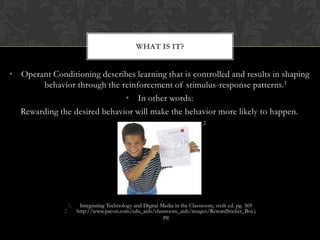
• Operant Conditioning describes learning that is controlled and results in shaping
       behavior through the reinforcement of stimulus-response patterns.1
                              • In other words:
  Rewarding the desired behavior will make the behavior more likely to happen.
                                                                         2


                 1. Integrating Technology and Digital Media in the Classroom, sixth ed. pg. 369
               2. http://www.pacon.com/edu_aids/classroom_aids/images/RewardSticker_Boy.j
                                                        pg
WHO THOUGHT OF THIS?


 • The pioneer in this learning theory was B.F. Skinner (1904 – 1990). He
   conducted experiments in which he rewarded the desired behavior of the
        subjects and therefore saw them behaving in the desired manner.
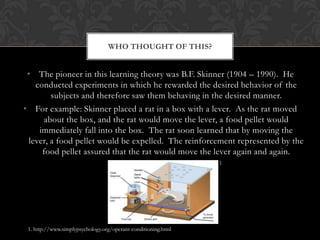
• For example: Skinner placed a rat in a box with a lever. As the rat moved
     about the box, and the rat would move the lever, a food pellet would
    immediately fall into the box. The rat soon learned that by moving the
 lever, a food pellet would be expelled. The reinforcement represented by the
     food pellet assured that the rat would move the lever again and again.
                                                                1


 1. http://www.simplypsychology.org/operant-conditioning.html
HOW IS THIS HELPFUL FOR
                                   TEACHERS?

 • Teachers can use the principal ideas behind operant conditioning to motivate a
     student to do well by reinforcing positive and good behavior in the classroom
          with learning and testing and at home with homework and studying.
• For example: A student may earn classroom dollars for each A they get on a test.
     These classroom dollars can then be used to purchase goodies from a treasure
    chest that’s filled with items priced according to their value in classroom dollars.
       Students will be motivated to earn an A on a test in hopes of being able to
                     purchase their desired item from the treasure chest.
  • By reinforcing (classroom dollars) good behavior (earning an A on a test), the
                         student is more likely to want to earn an A.
• In a technology classroom, a student could be reinforced with internet game time
      minutes instead of classroom dollars. Students that earn an A could use the
     awarded minutes to play computer games while in the classroom. They could
         even accumulate these and build up to an hour of internet game time!
HOW DOES THIS AFFECT
                                       STUDENTS?

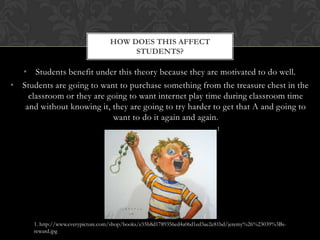
  • Students benefit under this theory because they are motivated to do well.
• Students are going to want to purchase something from the treasure chest in the
    classroom or they are going to want internet play time during classroom time
   and without knowing it, they are going to try harder to get that A and going to
                           want to do it again and again.
                                                                          1


      1. http://www.everypicture.com/shop/books/e55b8d1789356ed4a06d1ed3ae2e81bd/jeremy%26%23039%3Bs-
      reward.jpg
FOR MY OWN TEACHING?


• This theory is incredibly helpful for my own teaching. It will allow me to
        think of different ways in which I could motivate my students by
  reinforcing their excellent behavior in hopes of motivating them to do well
                                 in their schooling.
 • This theory could be manipulated in so many different ways to apply to
   many different subjects and grade levels that virtually EVERY teacher be
      influenced by operant conditioning in order to better the chances of
                               student achievement.

Operant Conditioning for the Classroom

  • 1.
    OPERANT CONDITIONING By: K. Garcia
  • 2.
    WHAT IS IT? •Operant Conditioning describes learning that is controlled and results in shaping behavior through the reinforcement of stimulus-response patterns.1 • In other words: Rewarding the desired behavior will make the behavior more likely to happen. 2 1. Integrating Technology and Digital Media in the Classroom, sixth ed. pg. 369 2. http://www.pacon.com/edu_aids/classroom_aids/images/RewardSticker_Boy.j pg
  • 3.
    WHO THOUGHT OFTHIS? • The pioneer in this learning theory was B.F. Skinner (1904 – 1990). He conducted experiments in which he rewarded the desired behavior of the subjects and therefore saw them behaving in the desired manner. • For example: Skinner placed a rat in a box with a lever. As the rat moved about the box, and the rat would move the lever, a food pellet would immediately fall into the box. The rat soon learned that by moving the lever, a food pellet would be expelled. The reinforcement represented by the food pellet assured that the rat would move the lever again and again. 1 1. http://www.simplypsychology.org/operant-conditioning.html
  • 4.
    HOW IS THISHELPFUL FOR TEACHERS? • Teachers can use the principal ideas behind operant conditioning to motivate a student to do well by reinforcing positive and good behavior in the classroom with learning and testing and at home with homework and studying. • For example: A student may earn classroom dollars for each A they get on a test. These classroom dollars can then be used to purchase goodies from a treasure chest that’s filled with items priced according to their value in classroom dollars. Students will be motivated to earn an A on a test in hopes of being able to purchase their desired item from the treasure chest. • By reinforcing (classroom dollars) good behavior (earning an A on a test), the student is more likely to want to earn an A. • In a technology classroom, a student could be reinforced with internet game time minutes instead of classroom dollars. Students that earn an A could use the awarded minutes to play computer games while in the classroom. They could even accumulate these and build up to an hour of internet game time!
  • 5.
    HOW DOES THISAFFECT STUDENTS? • Students benefit under this theory because they are motivated to do well. • Students are going to want to purchase something from the treasure chest in the classroom or they are going to want internet play time during classroom time and without knowing it, they are going to try harder to get that A and going to want to do it again and again. 1 1. http://www.everypicture.com/shop/books/e55b8d1789356ed4a06d1ed3ae2e81bd/jeremy%26%23039%3Bs- reward.jpg
  • 6.
    FOR MY OWNTEACHING? • This theory is incredibly helpful for my own teaching. It will allow me to think of different ways in which I could motivate my students by reinforcing their excellent behavior in hopes of motivating them to do well in their schooling. • This theory could be manipulated in so many different ways to apply to many different subjects and grade levels that virtually EVERY teacher be influenced by operant conditioning in order to better the chances of student achievement.