Behaviorism Learning TheoryBy:Michelle Pascale
Behaviorism LearningThe Behaviorism Learning Theory is the prediction and control of human behavior in which introspection and/or independent thinking play no essential part in its teaching methods.That is, human learning is based purely on the notion that there is no internal cognitive processing of information.
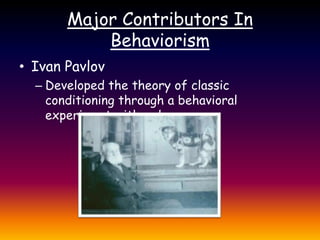
Major Contributors In BehaviorismIvan PavlovDeveloped the theory of classic conditioning through a behavioral experiment with a dog
Classic ConditioningClassic Conditioning is to the process of introducing a stimulus in hopes of achieving a desired reflexIt is a learning process that occurs through associations between an environmental stimulus and a naturally occurring stimulus
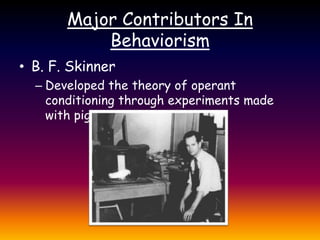
Major Contributors In BehaviorismB. F. SkinnerDeveloped the theory of operant conditioning through experiments made with pigeons
Operant ConditioningOperant Conditioning is the process of introducing a stimulus with the hopes of achieving a desired responseIt is a learning process that is the result of shaping behavior through the reinforcement of stimulus-response patterns
Behaviorism In The ClassroomBehaviorism can be applied to a classroom quite easilyReward those behaviors that are positive through incentives and encouragementEliminate those behaviors that are negative through punishment and consequences such as taking something away
Behaviorism And TechnologyBehaviorism’s positive reinforcement can be found throughout many educational software applicationsOnline learning uses visual and sometimes audio cues to positively reinforce a student when he or she gives a correct answerNegative reinforcement can also be used in the same manner in order for the student when he or she chooses an incorrect answer
Behaviorism In My ClassroomIn my classroom, I would try to use positive reinforcement to provide my students with an enjoyable learning experience. I would only use negative reinforcements when it is the last option I have to turn to, in order to help my students learn to their fullest ability. Positive reinforcement helps the student to retain their knowledge in a long-term sense, and that is my goal.
Creditshttp://psychology.about.com/od/behavioralpsychology/a/classcond.htmflowstate.homestead.com/skinner.htmlhttp://www.flavinscorner.com/skinnerbird.JPGhttp://wik.ed.uiuc.edu/index.php/Behaviorismhttp://radvar.files.wordpress.com/2009/04/thinking-bart.jpg

Behaviorism learning theory