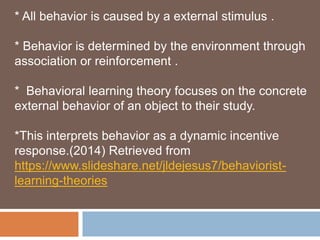
B.F. Skinner was an influential American psychologist who developed the theory of behaviorism. Behaviorism views human behavior as responses to environmental stimuli and is learned through reinforcement or punishment. Skinner argued that behavior is shaped by consequences and that understanding behavior means examining relationships between actions and their effects. Key aspects of Skinner's theory included operant conditioning, the use of reinforcement to increase behaviors, and the view that language is learned through parental positive reinforcement of children's vocalizations. While behaviorism was influential, Skinner's theories were also criticized for overgeneralizing from limited experiments and not explaining more complex behaviors.








![MEDICAL_BEHAVIORAL_SCIENCE[1] [Autosaved].pptx](https://cdn.slidesharecdn.com/ss_thumbnails/medicalbehavioralscience1autosaved-241126100112-21c18b33-thumbnail.jpg?width=640&height=640&fit=bounds)


