Learner Centered Paradigm in Online Education (in 2 parts) Barbara Lauridsen, MBA Core Adjunct Faculty, National University Learner, PhD Information Technology Education, Capella University [email_address] www.barbaralauridsen.com
Session Abstract (Part 1) “ What is known about how adults learn and are motivated to participate in online learning to advance their career?” Exploring the lenses through which educators view their own practice to support learners in becoming self directed.  The themes are:  theories about ways of knowing, adult development, Andragogy Sharing a perspective elements of critical thinking
Agenda – Part 1 Tip # 1  Become Story Centered Tip # 2  Open evaluation of learning experience increases awareness/trust Tip # 3  Teach “Around the Circle” Tip # 4  Build upon a problem-oriented approach Tip # 5  Encourage goal orientation Tip # 6  Build upon prior knowledge
Agenda – Part 2 Room 122 1:30 Tip # 7  Follow a path from teacher to moderator to facilitator to mentor Tip # 8  Evaluate our own teaching Tip # 9  Evaluate the shared learning experience Tip #10 Cultivate a holistic approach Tip #11 Coach, Motivate, Delegate, Moderate, Facilitate Tip #12 Participate in shifting the paradigm
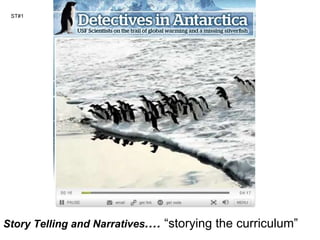
ST#1 Story Telling and Narratives .…  “storying the curriculum”
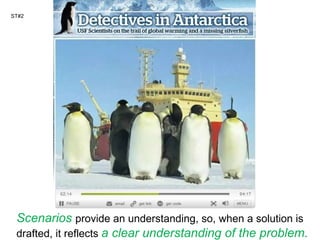
ST#2 Scenarios   provide an understanding, so, when a solution is drafted, it reflects  a clear understanding of the problem.
ST#3 “ Bell weather” of climate change.
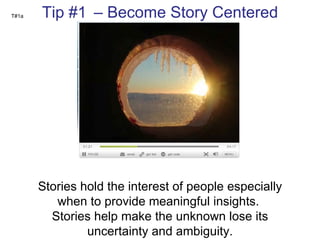
T#1a Tip #1 a  – Become Story Centered Stories hold the interest of people especially when to provide meaningful insights.  Stories help make the unknown lose its uncertainty and ambiguity.
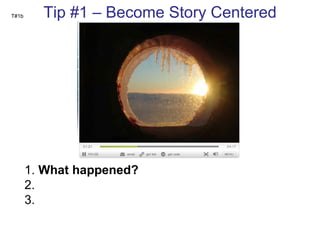
T#1b Tip #1 b   – Become Story Centered 1.  What happened? 2.  3.
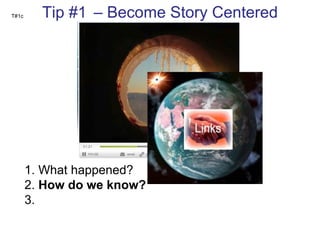
T#1c Tip #1 c  – Become Story Centered 1. What happened? 2.  How do we know? 3.
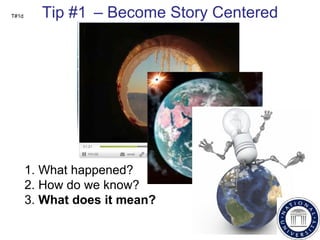
T#1d Tip #1 d  – Become Story Centered 1. What happened? 2. How do we know? 3.  What does it mean?
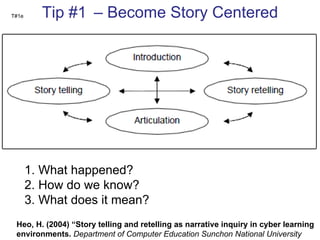
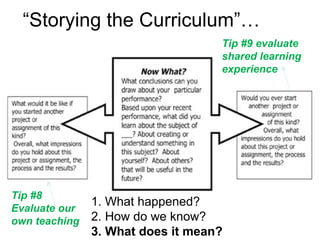
T#1e Tip #1 e  – Become Story Centered 1. What happened? 2. How do we know? 3. What does it mean? Heo, H. (2004) “Story telling and retelling as narrative inquiry in cyber learning environments.  Department of Computer Education Sunchon National University
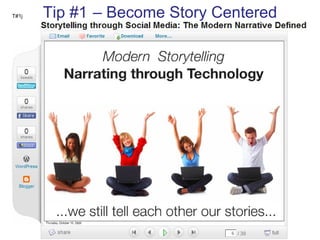
T#1j Tip #1 j  – Become Story Centered
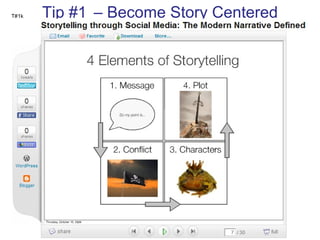
T#1k Tip #1 k  – Become Story Centered
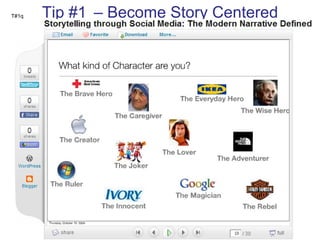
T#1q Tip #1 q  – Become Story Centered
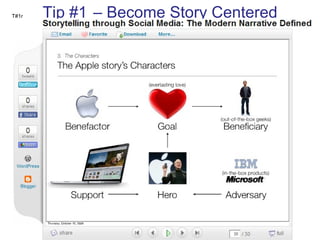
T#1r Tip #1 r  – Become Story Centered
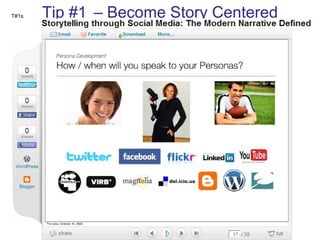
T#1s Tip #1 s  – Become Story Centered
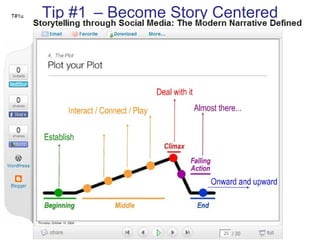
T#1u Tip #1 u  – Become Story Centered
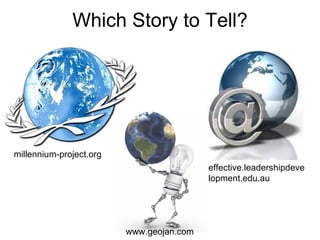
Which Story to Tell? millennium-project.org effective.leadershipdevelopment.edu.au www.geojan.com
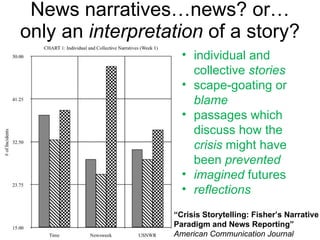
News narratives…news? or… only an  interpretation  of a story? individual and collective  stories scape-goating or  blame passages which discuss how the  crisis  might have been  prevented   imagined  futures reflections “ Crisis Storytelling: Fisher’s Narrative Paradigm and News Reporting”  American Communication Journal
The Great Learning a The non-western way of thinking contributes to effective online communications for diverse teams in peer-to-peer collaboration.  A well-known philosopher expressed the insight that the cultivation of the person depends on the “ rectifying of the mind ” (Confucius, 500 B.C.E) …which can be understood  as  expressing meaning in reasoning …
The Great Learning b The non-western way of thinking contributes to effective online communications for diverse teams in peer-to-peer collaboration.  A well-known philosopher expressed the insight that the cultivation of the person depends on the “ rectifying of the mind ” (Confucius, 500 B.C.E) …which can be understood  as  expressing meaning in  reasoning … that is integrated with observations.
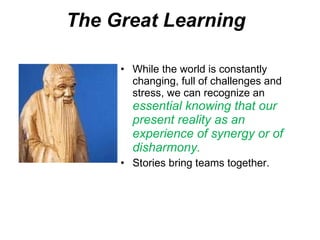
The Great Learning c While the world is constantly changing, full of challenges and stress, we can recognize an  essential knowing that our present reality as an experience of synergy or of disharmony.  Stories bring teams together.
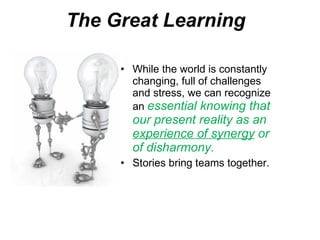
The Great Learning d While the world is constantly changing, full of challenges and stress, we can recognize an  essential knowing that our present reality as an  experience of synergy  or of disharmony.  Stories bring teams together.
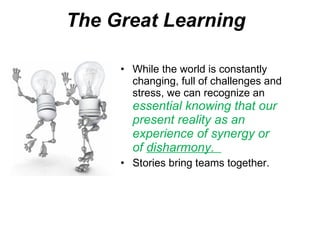
The Great Learning e While the world is constantly changing, full of challenges and stress, we can recognize an  essential knowing that our present reality as an experience of synergy or of  disharmony.  Stories bring teams together.
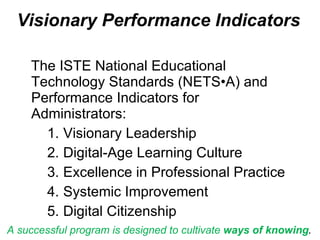
Visionary Performance Indicators a The ISTE National Educational Technology Standards (NETS•A) and Performance Indicators for Administrators: Visionary Leadership Digital-Age Learning Culture Excellence in Professional Practice Systemic Improvement Digital Citizenship
Visionary Performance Indicators b The ISTE National Educational Technology Standards (NETS•A) and Performance Indicators for Administrators: Visionary Leadership Digital-Age Learning Culture Excellence in Professional Practice Systemic Improvement Digital Citizenship A successful program is designed to cultivate  ways of knowing .
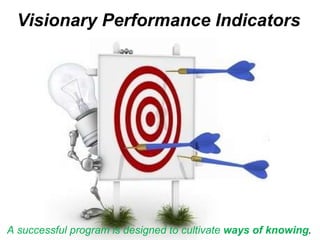
Visionary Performance Indicators c A successful program is designed to cultivate  ways of knowing .
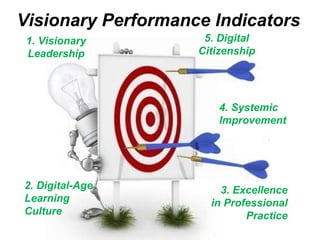
Visionary Performance Indicators d 1. Visionary Leadership 2. Digital-Age Learning Culture 3. Excellence in Professional Practice 4. Systemic Improvement 5. Digital Citizenship
Tip #2 Open evaluation of learning experience increases awareness and trust A successful program is designed to cultivate  ways of knowing .  …  inspires and facilitates stakeholders toward a “ shared vision of purposeful change that maximizes use of digital-age resources to meet and exceed learning goals,  support effective instructional practice, and maximize performance of district and school leaders” (ISTE, 2009).
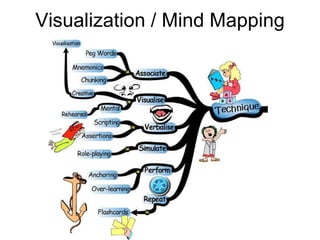
Visualization / Mind Mapping
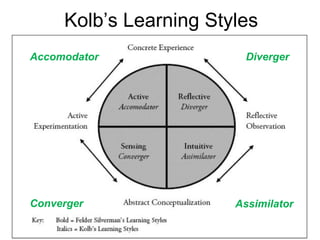
Kolb’s Learning Styles e Accomodator Diverger Converger  Assimilator
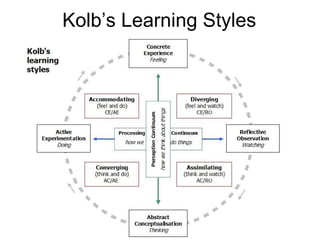
Kolb’s Learning Styles f
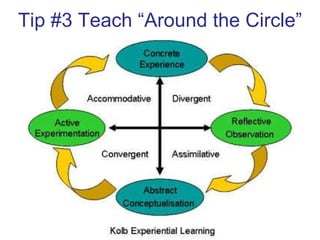
Tip #3 Teach “Around the Circle”
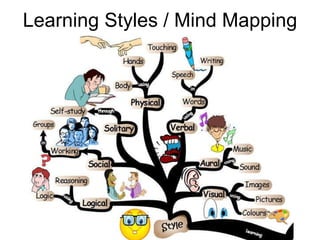
Learning Styles / Mind Mapping
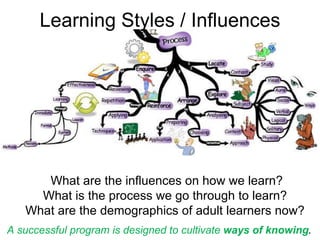
Learning Styles / Influences What are the influences on how we learn? What is the process we go through to learn?  What are the demographics of adult learners now?  A successful program is designed to cultivate  ways of knowing .
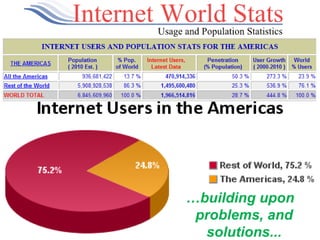
… building upon  problems, and solutions...
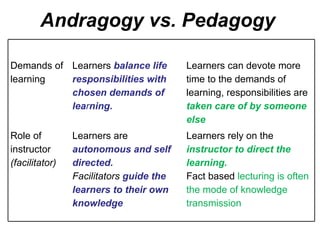
Andragogy vs. Pedagogy b   Demands of learning Learners   balance life responsibilities with chosen demands of lea r ning. Learners can devote more time to the demands of learning, responsibilities are  taken care of by someone else Role of instructor  (facilitator) Learners are  autonomous and self directed.  Facilitators  guide the learners to their own knowledge Learners rely on the  instructor to direct the learning.  Fact based  lecturing is often the mode of knowledge transmission
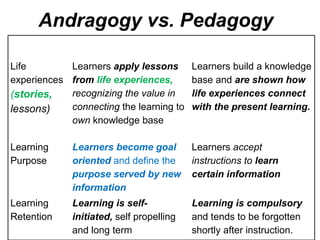
Andragogy vs. Pedagogy c   Life experiences  ( stories,  lessons) Learners  apply lessons from  life experiences,  recognizing the value in connecting  the learning to  own  knowledge base Learners build a knowledge base and  are shown how life experiences connect with the present learning. Learning Purpose Learners become goal oriented  and define the  purpose served by new information Learners  accept instructions to  learn certain information Learning Retention Learning is self-initiated,  self propelling and long term Learning is compulsory  and tends to be forgotten shortly after instruction.
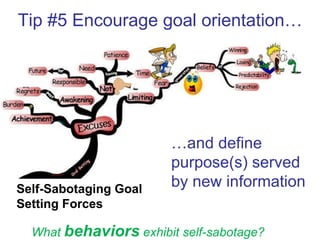
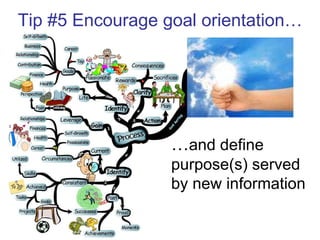
Tip #5 Encourage goal orientation… … and define purpose(s) served by new information
Tip #5 Encourage goal orientation… … and define purpose(s) served by new information Self-Sabotaging Goal Setting Forces What  behaviors   exhibit self-sabotage?
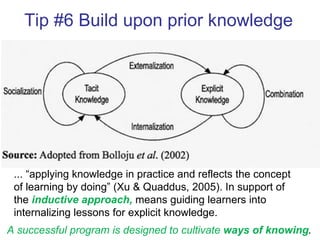
Tip #6 Build upon prior knowledge a ... “applying knowledge in practice and reflects the concept of learning by doing” (Xu & Quaddus, 2005). In support of the  inductive approach,  means guiding learners into internalizing lessons for explicit knowledge.  A successful program is designed to cultivate  ways of knowing .
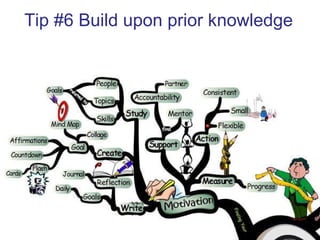
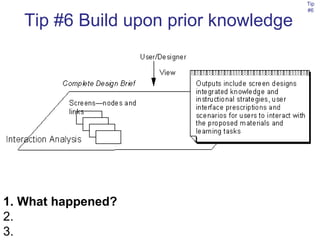
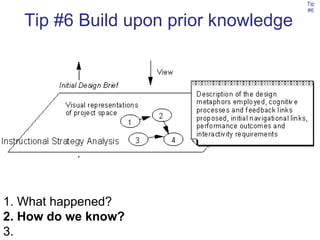
Tip #6 Build upon prior knowledge b
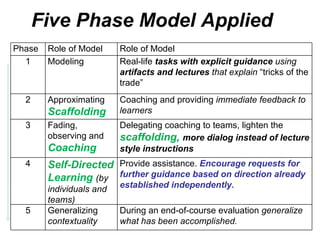
Five Phase Model Applied .   Phase Role of Model Role of Model 1 Modeling Real-life  tasks with explicit guidance  using  artifacts and lectures  that explain  “tricks of the trade” 2 Approximating  Scaffolding Coaching and providing  immediate feedback to learners 3 Fading, observing and  Coaching Delegating coaching to teams, lighten the  scaffolding,  more dialog instead of lecture style instructions   4 Self-Directed Learning  (by individuals and teams) Provide assistance.  Encourage requests for further guidance based on direction already established independently.   5 Generalizing  contextuality During an end-of-course evaluation  generalize what has been accomplished.
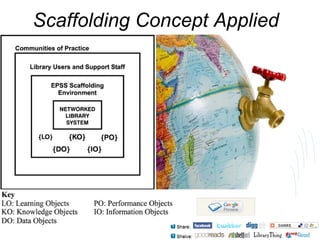
Scaffolding Concept Applied .
Scaffolding as a metaphor… Math Mediator
Scaffolding Concept Applied b
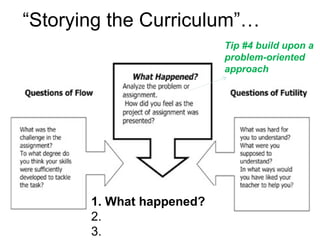
“ Storying the Curriculum”… a 1. What happened? 2.  3.  Tip #4 build upon a  problem-oriented approach
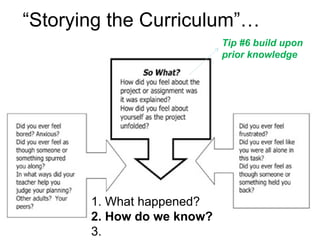
1. What happened? 2. How do we know? 3.  “ Storying the Curriculum”… b Tip #6 build upon prior knowledge
1. What happened? 2. How do we know? 3. What does it mean? “ Storying the Curriculum”… c Tip #9 evaluate shared learning experience Tip #8 Evaluate our own teaching
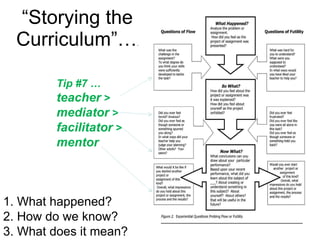
“ Storying the Curriculum”… . 1. What happened? 2. How do we know? 3. What does it mean? Tip #7 … teacher  >  mediator  >  facilitator  >  mentor
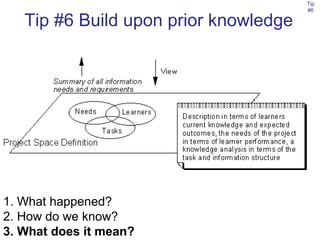
Tip #6 Build upon prior knowledge a 1. What happened? 2.  3.  Tip #6
Tip #6 Build upon prior knowledge b 1. What happened? 2. How do we know? 3.  Tip #6
Tip #6 Build upon prior knowledge c 1. What happened? 2. How do we know? 3. What does it mean? Tip #6
SUMMARY (Part 1) Tip # 1  Become Story Centered Tip # 2  Open evaluation of learning experience increases awareness/trust Tip # 3  Teach “Around the Circle” Tip # 4  Build upon a problem-oriented approach Tip # 5  Encourage goal orientation Tip # 6  Build upon prior knowledge
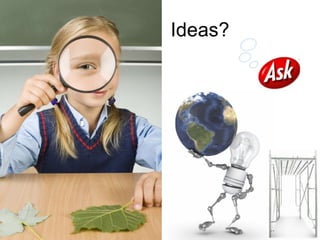
Ideas?
Agenda – Part 2 Room 122 1:30 Tip # 7  Follow a path from teacher to moderator to facilitator to mentor Tip # 8  Evaluate our own teaching Tip # 9  Evaluate the shared learning experience Tip #10 Cultivate a holistic approach Tip #11 Coach, Motivate, Delegate, Moderate, Facilitate Tip #12 Participate in shifting the paradigm
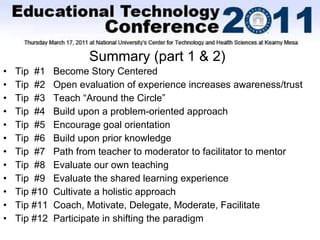
Summary (part 1 & 2) Tip  #1  Become Story Centered Tip  #2  Open evaluation of experience increases awareness/trust Tip  #3  Teach “Around the Circle” Tip  #4  Build upon a problem-oriented approach Tip  #5  Encourage goal orientation Tip  #6  Build upon prior knowledge Tip  #7  Path from teacher to moderator to facilitator to mentor Tip  #8  Evaluate our own teaching Tip  #9  Evaluate the shared learning experience Tip #10  Cultivate a holistic approach Tip #11  Coach, Motivate, Delegate, Moderate, Facilitate Tip #12  Participate in shifting the paradigm

NU EdTech LearnerCenteredParadigm Tips 1-6

  • 1.
    Learner Centered Paradigmin Online Education (in 2 parts) Barbara Lauridsen, MBA Core Adjunct Faculty, National University Learner, PhD Information Technology Education, Capella University [email_address] www.barbaralauridsen.com
  • 2.
    Session Abstract (Part1) “ What is known about how adults learn and are motivated to participate in online learning to advance their career?” Exploring the lenses through which educators view their own practice to support learners in becoming self directed. The themes are: theories about ways of knowing, adult development, Andragogy Sharing a perspective elements of critical thinking
  • 3.
    Agenda – Part1 Tip # 1 Become Story Centered Tip # 2 Open evaluation of learning experience increases awareness/trust Tip # 3 Teach “Around the Circle” Tip # 4 Build upon a problem-oriented approach Tip # 5 Encourage goal orientation Tip # 6 Build upon prior knowledge
  • 4.
    Agenda – Part2 Room 122 1:30 Tip # 7 Follow a path from teacher to moderator to facilitator to mentor Tip # 8 Evaluate our own teaching Tip # 9 Evaluate the shared learning experience Tip #10 Cultivate a holistic approach Tip #11 Coach, Motivate, Delegate, Moderate, Facilitate Tip #12 Participate in shifting the paradigm
  • 5.
    ST#1 Story Tellingand Narratives .… “storying the curriculum”
  • 6.
    ST#2 Scenarios provide an understanding, so, when a solution is drafted, it reflects a clear understanding of the problem.
  • 7.
    ST#3 “ Bellweather” of climate change.
  • 8.
    T#1a Tip #1a – Become Story Centered Stories hold the interest of people especially when to provide meaningful insights. Stories help make the unknown lose its uncertainty and ambiguity.
  • 9.
    T#1b Tip #1b – Become Story Centered 1. What happened? 2. 3.
  • 10.
    T#1c Tip #1c – Become Story Centered 1. What happened? 2. How do we know? 3.
  • 11.
    T#1d Tip #1d – Become Story Centered 1. What happened? 2. How do we know? 3. What does it mean?
  • 12.
    T#1e Tip #1e – Become Story Centered 1. What happened? 2. How do we know? 3. What does it mean? Heo, H. (2004) “Story telling and retelling as narrative inquiry in cyber learning environments. Department of Computer Education Sunchon National University
  • 13.
    T#1j Tip #1j – Become Story Centered
  • 14.
    T#1k Tip #1k – Become Story Centered
  • 15.
    T#1q Tip #1q – Become Story Centered
  • 16.
    T#1r Tip #1r – Become Story Centered
  • 17.
    T#1s Tip #1s – Become Story Centered
  • 18.
    T#1u Tip #1u – Become Story Centered
  • 19.
    Which Story toTell? millennium-project.org effective.leadershipdevelopment.edu.au www.geojan.com
  • 20.
    News narratives…news? or…only an interpretation of a story? individual and collective stories scape-goating or blame passages which discuss how the crisis might have been prevented imagined futures reflections “ Crisis Storytelling: Fisher’s Narrative Paradigm and News Reporting” American Communication Journal
  • 21.
    The Great Learninga The non-western way of thinking contributes to effective online communications for diverse teams in peer-to-peer collaboration. A well-known philosopher expressed the insight that the cultivation of the person depends on the “ rectifying of the mind ” (Confucius, 500 B.C.E) …which can be understood as expressing meaning in reasoning …
  • 22.
    The Great Learningb The non-western way of thinking contributes to effective online communications for diverse teams in peer-to-peer collaboration. A well-known philosopher expressed the insight that the cultivation of the person depends on the “ rectifying of the mind ” (Confucius, 500 B.C.E) …which can be understood as expressing meaning in reasoning … that is integrated with observations.
  • 23.
    The Great Learningc While the world is constantly changing, full of challenges and stress, we can recognize an essential knowing that our present reality as an experience of synergy or of disharmony. Stories bring teams together.
  • 24.
    The Great Learningd While the world is constantly changing, full of challenges and stress, we can recognize an essential knowing that our present reality as an experience of synergy or of disharmony. Stories bring teams together.
  • 25.
    The Great Learninge While the world is constantly changing, full of challenges and stress, we can recognize an essential knowing that our present reality as an experience of synergy or of disharmony. Stories bring teams together.
  • 26.
    Visionary Performance Indicatorsa The ISTE National Educational Technology Standards (NETS•A) and Performance Indicators for Administrators: Visionary Leadership Digital-Age Learning Culture Excellence in Professional Practice Systemic Improvement Digital Citizenship
  • 27.
    Visionary Performance Indicatorsb The ISTE National Educational Technology Standards (NETS•A) and Performance Indicators for Administrators: Visionary Leadership Digital-Age Learning Culture Excellence in Professional Practice Systemic Improvement Digital Citizenship A successful program is designed to cultivate ways of knowing .
  • 28.
    Visionary Performance Indicatorsc A successful program is designed to cultivate ways of knowing .
  • 29.
    Visionary Performance Indicatorsd 1. Visionary Leadership 2. Digital-Age Learning Culture 3. Excellence in Professional Practice 4. Systemic Improvement 5. Digital Citizenship
  • 30.
    Tip #2 Openevaluation of learning experience increases awareness and trust A successful program is designed to cultivate ways of knowing . … inspires and facilitates stakeholders toward a “ shared vision of purposeful change that maximizes use of digital-age resources to meet and exceed learning goals, support effective instructional practice, and maximize performance of district and school leaders” (ISTE, 2009).
  • 31.
  • 32.
    Kolb’s Learning Stylese Accomodator Diverger Converger Assimilator
  • 33.
  • 34.
    Tip #3 Teach“Around the Circle”
  • 35.
    Learning Styles /Mind Mapping
  • 36.
    Learning Styles /Influences What are the influences on how we learn? What is the process we go through to learn? What are the demographics of adult learners now? A successful program is designed to cultivate ways of knowing .
  • 37.
    … building upon problems, and solutions...
  • 38.
    Andragogy vs. Pedagogyb Demands of learning Learners balance life responsibilities with chosen demands of lea r ning. Learners can devote more time to the demands of learning, responsibilities are taken care of by someone else Role of instructor (facilitator) Learners are autonomous and self directed. Facilitators guide the learners to their own knowledge Learners rely on the instructor to direct the learning. Fact based lecturing is often the mode of knowledge transmission
  • 39.
    Andragogy vs. Pedagogyc Life experiences ( stories, lessons) Learners apply lessons from life experiences, recognizing the value in connecting the learning to own knowledge base Learners build a knowledge base and are shown how life experiences connect with the present learning. Learning Purpose Learners become goal oriented and define the purpose served by new information Learners accept instructions to learn certain information Learning Retention Learning is self-initiated, self propelling and long term Learning is compulsory and tends to be forgotten shortly after instruction.
  • 40.
    Tip #5 Encouragegoal orientation… … and define purpose(s) served by new information
  • 41.
    Tip #5 Encouragegoal orientation… … and define purpose(s) served by new information Self-Sabotaging Goal Setting Forces What behaviors exhibit self-sabotage?
  • 42.
    Tip #6 Buildupon prior knowledge a ... “applying knowledge in practice and reflects the concept of learning by doing” (Xu & Quaddus, 2005). In support of the inductive approach, means guiding learners into internalizing lessons for explicit knowledge. A successful program is designed to cultivate ways of knowing .
  • 43.
    Tip #6 Buildupon prior knowledge b
  • 44.
    Five Phase ModelApplied . Phase Role of Model Role of Model 1 Modeling Real-life tasks with explicit guidance using artifacts and lectures that explain “tricks of the trade” 2 Approximating Scaffolding Coaching and providing immediate feedback to learners 3 Fading, observing and Coaching Delegating coaching to teams, lighten the scaffolding, more dialog instead of lecture style instructions 4 Self-Directed Learning (by individuals and teams) Provide assistance. Encourage requests for further guidance based on direction already established independently. 5 Generalizing contextuality During an end-of-course evaluation generalize what has been accomplished.
  • 45.
  • 46.
    Scaffolding as ametaphor… Math Mediator
  • 47.
  • 48.
    “ Storying theCurriculum”… a 1. What happened? 2. 3. Tip #4 build upon a problem-oriented approach
  • 49.
    1. What happened?2. How do we know? 3. “ Storying the Curriculum”… b Tip #6 build upon prior knowledge
  • 50.
    1. What happened?2. How do we know? 3. What does it mean? “ Storying the Curriculum”… c Tip #9 evaluate shared learning experience Tip #8 Evaluate our own teaching
  • 51.
    “ Storying theCurriculum”… . 1. What happened? 2. How do we know? 3. What does it mean? Tip #7 … teacher > mediator > facilitator > mentor
  • 52.
    Tip #6 Buildupon prior knowledge a 1. What happened? 2. 3. Tip #6
  • 53.
    Tip #6 Buildupon prior knowledge b 1. What happened? 2. How do we know? 3. Tip #6
  • 54.
    Tip #6 Buildupon prior knowledge c 1. What happened? 2. How do we know? 3. What does it mean? Tip #6
  • 55.
    SUMMARY (Part 1)Tip # 1 Become Story Centered Tip # 2 Open evaluation of learning experience increases awareness/trust Tip # 3 Teach “Around the Circle” Tip # 4 Build upon a problem-oriented approach Tip # 5 Encourage goal orientation Tip # 6 Build upon prior knowledge
  • 56.
  • 57.
    Agenda – Part2 Room 122 1:30 Tip # 7 Follow a path from teacher to moderator to facilitator to mentor Tip # 8 Evaluate our own teaching Tip # 9 Evaluate the shared learning experience Tip #10 Cultivate a holistic approach Tip #11 Coach, Motivate, Delegate, Moderate, Facilitate Tip #12 Participate in shifting the paradigm
  • 58.
    Summary (part 1& 2) Tip #1 Become Story Centered Tip #2 Open evaluation of experience increases awareness/trust Tip #3 Teach “Around the Circle” Tip #4 Build upon a problem-oriented approach Tip #5 Encourage goal orientation Tip #6 Build upon prior knowledge Tip #7 Path from teacher to moderator to facilitator to mentor Tip #8 Evaluate our own teaching Tip #9 Evaluate the shared learning experience Tip #10 Cultivate a holistic approach Tip #11 Coach, Motivate, Delegate, Moderate, Facilitate Tip #12 Participate in shifting the paradigm