Nama : Hendra Ardianto Rizka Pratama
NIM : 1410501024 Dosen Pembimbing : R., Suryoto Edi Raharjo, ST., M.Eng
Fakultas : Teknik elektro
Universitas Tidar
Lyapunov stability is named after Aleksandr Lyapunov, a Russian
mathematician who published his book The General Problem of
Stability of Motion in 1892. Lyapunov was the first to consider the
modifications necessary in nonlinear systems to the linear theory of
stability based on linearizing near a point of equilibrium.
equilibrium point ´ xeq 2 Rn for which f(xeq) = 0
thus x(t) = xeq 8 t ¸ 0 is a solution to the ODE
E.g., pendulum equation
q m
l
two equilibrium points:
x1 = 0, x2 = 0 (down)
and x1 = p, x2 = 0 (up)
equilibrium point ´ xeq 2 Rn for which f(xeq) = 0
thus x(t) = xeq 8 t ¸ 0 is a solution to the ODE
Definition (e–d definition):
The equilibrium point xeq 2 Rn is (Lyapunov) stable if
8 e > 0 9 d >0 : ||x(t0) – xeq|| · d ) ||x(t) – xeq|| · e 8 t¸ t0¸ 0
xeq
d
e
x(t)
1. if the solution starts close to xeq
it will remain close to it forever
2. e can be made arbitrarily small
by choosing d sufficiently small
xeq=(0,0)
stable
xeq=(p,0)
unstable
q m
l
x1 is an angle so you must
“glue” left to right
extremes of this plot
Definition (continuity definition):
The equilibrium point xeq 2 Rn is (Lyapunov) stable if T is continuous at xeq:
8 e > 0 9 d >0 : ||x0 – xeq|| · d ) ||T(x0) – T(xeq)||sig · e
Xsig ´ set of all piecewise continuous signals taking values in Rn
Given a signal x2Xsig, ||x||sig supt¸0 ||x(t)||
ODE can be seen as an operator
T : Rn ! Xsig
that maps x0 2 Rn into the solution that starts at x(0) = x0
supt¸0 ||x(t) – xeq|| · e
xeq
d
e
x(t)
can be extended to
nonequilibrium solutions
Definition (continuity definition):
A solution x*:[0,T)!Rn is (Lyapunov) stable if T is continuous at x*
0 x*(0), i.e.,
8 e > 0 9 d >0 : ||x0 – x*
0|| · d ) ||T(x0) – T(x*
0)||sig · e
Xsig ´ set of all piecewise continuous signals taking values in Rn
Given a signal x2Xsig, ||x||sig supt¸0 ||x(t)||
ODE can be seen as an operator T : Rn ! Xsig
that maps x0 2 Rn into the solution that starts at x(0) = x0
signal norm
supt¸0 ||x(t) – x*(t)|| · e d
e
x(t) x*(t)
pend.m
x* Lyapunov stable
vdp.m
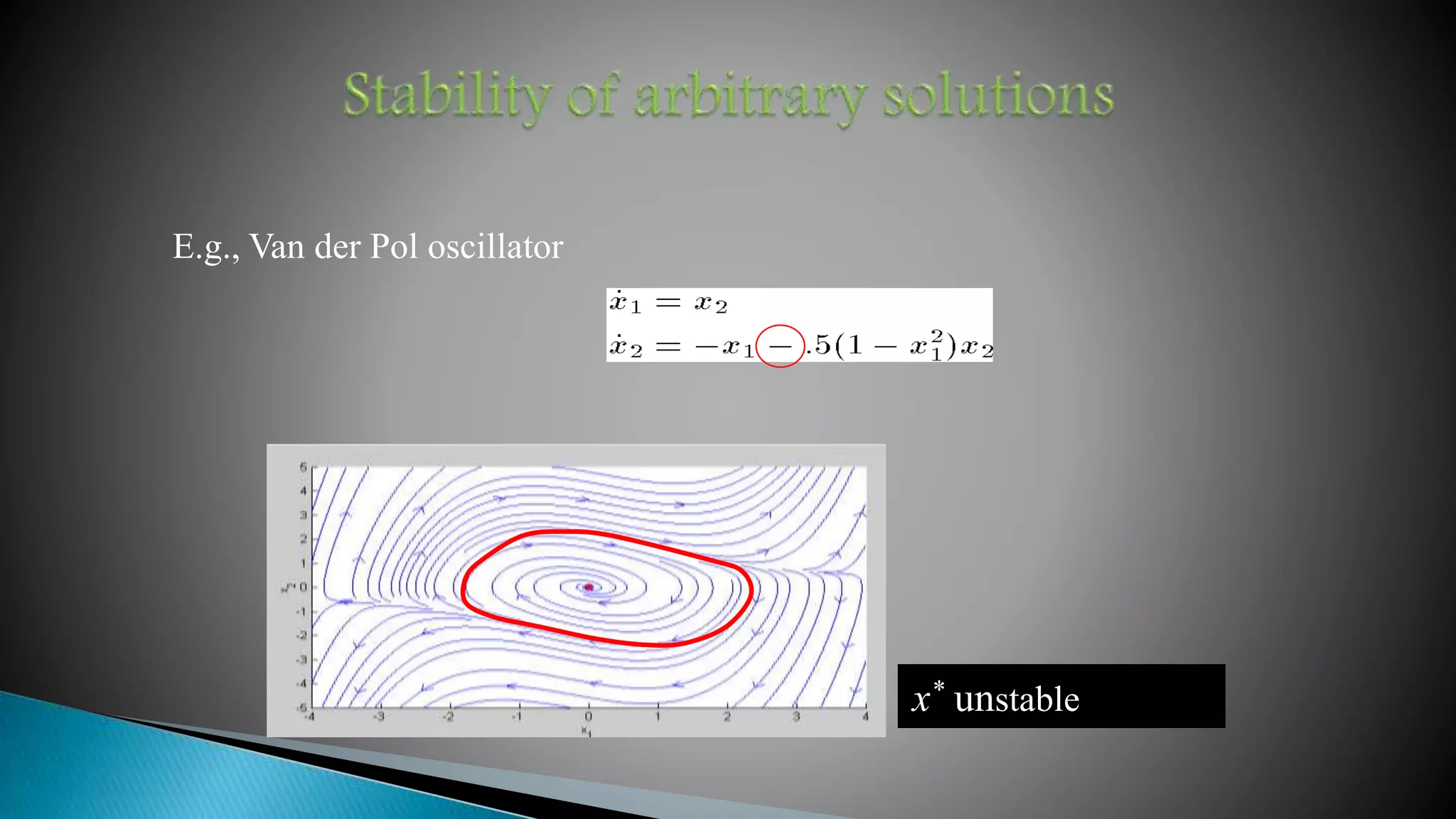
E.g., Van der Pol oscillator
x* unstable
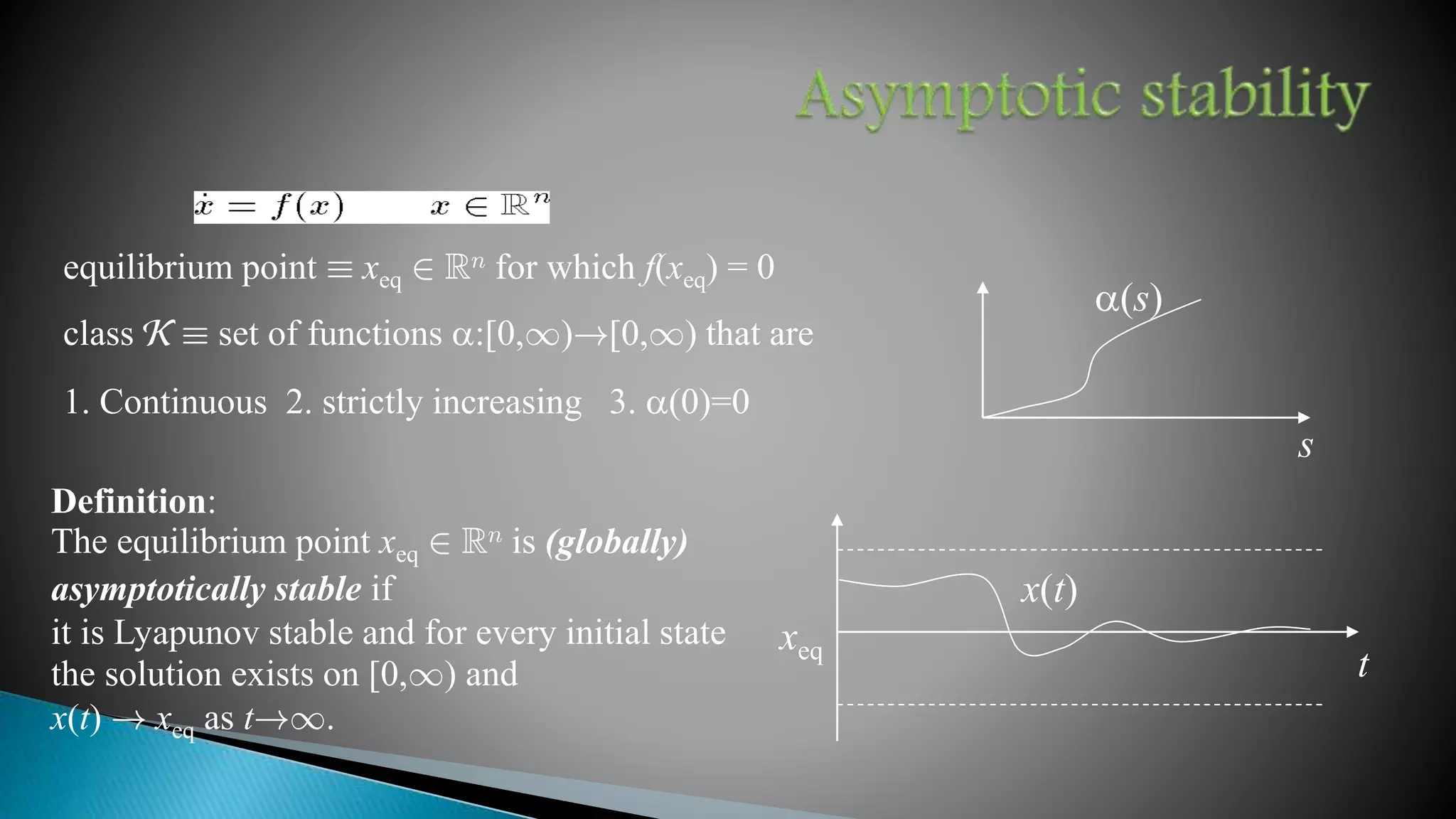
Definition:
The equilibrium point xeq 2 Rn is (globally)
asymptotically stable if
it is Lyapunov stable and for every initial state
the solution exists on [0,1) and
x(t) ! xeq as t!1.
xeq
x(t)
s
a(s)
equilibrium point ´ xeq 2 Rn for which f(xeq) = 0
class K ´ set of functions a:[0,1)![0,1) that are
1. Continuous 2. strictly increasing 3. a(0)=0
t
Convergence by itself does not imply stability, e.g.,
all solutions converge to zero but
xeq= (0,0) system is not stable
equilibrium point ´ (0,0)
Why was Mr. Lyapunov so
picky? Why shouldn’t
boundedness and convergence
to zero suffice?
x1 is an angle so you must “glue”
left to right extremes of this plot
TERIMA KASIH

sistem non linier Lyapunov Stability

  • 1.
    Nama : HendraArdianto Rizka Pratama NIM : 1410501024 Dosen Pembimbing : R., Suryoto Edi Raharjo, ST., M.Eng Fakultas : Teknik elektro Universitas Tidar
  • 2.
    Lyapunov stability isnamed after Aleksandr Lyapunov, a Russian mathematician who published his book The General Problem of Stability of Motion in 1892. Lyapunov was the first to consider the modifications necessary in nonlinear systems to the linear theory of stability based on linearizing near a point of equilibrium.
  • 3.
    equilibrium point ´xeq 2 Rn for which f(xeq) = 0 thus x(t) = xeq 8 t ¸ 0 is a solution to the ODE E.g., pendulum equation q m l two equilibrium points: x1 = 0, x2 = 0 (down) and x1 = p, x2 = 0 (up)
  • 4.
    equilibrium point ´xeq 2 Rn for which f(xeq) = 0 thus x(t) = xeq 8 t ¸ 0 is a solution to the ODE Definition (e–d definition): The equilibrium point xeq 2 Rn is (Lyapunov) stable if 8 e > 0 9 d >0 : ||x(t0) – xeq|| · d ) ||x(t) – xeq|| · e 8 t¸ t0¸ 0 xeq d e x(t) 1. if the solution starts close to xeq it will remain close to it forever 2. e can be made arbitrarily small by choosing d sufficiently small
  • 5.
    xeq=(0,0) stable xeq=(p,0) unstable q m l x1 isan angle so you must “glue” left to right extremes of this plot
  • 6.
    Definition (continuity definition): Theequilibrium point xeq 2 Rn is (Lyapunov) stable if T is continuous at xeq: 8 e > 0 9 d >0 : ||x0 – xeq|| · d ) ||T(x0) – T(xeq)||sig · e Xsig ´ set of all piecewise continuous signals taking values in Rn Given a signal x2Xsig, ||x||sig supt¸0 ||x(t)|| ODE can be seen as an operator T : Rn ! Xsig that maps x0 2 Rn into the solution that starts at x(0) = x0 supt¸0 ||x(t) – xeq|| · e xeq d e x(t) can be extended to nonequilibrium solutions
  • 7.
    Definition (continuity definition): Asolution x*:[0,T)!Rn is (Lyapunov) stable if T is continuous at x* 0 x*(0), i.e., 8 e > 0 9 d >0 : ||x0 – x* 0|| · d ) ||T(x0) – T(x* 0)||sig · e Xsig ´ set of all piecewise continuous signals taking values in Rn Given a signal x2Xsig, ||x||sig supt¸0 ||x(t)|| ODE can be seen as an operator T : Rn ! Xsig that maps x0 2 Rn into the solution that starts at x(0) = x0 signal norm supt¸0 ||x(t) – x*(t)|| · e d e x(t) x*(t) pend.m
  • 8.
  • 9.
    E.g., Van derPol oscillator x* unstable
  • 10.
    Definition: The equilibrium pointxeq 2 Rn is (globally) asymptotically stable if it is Lyapunov stable and for every initial state the solution exists on [0,1) and x(t) ! xeq as t!1. xeq x(t) s a(s) equilibrium point ´ xeq 2 Rn for which f(xeq) = 0 class K ´ set of functions a:[0,1)![0,1) that are 1. Continuous 2. strictly increasing 3. a(0)=0 t
  • 11.
    Convergence by itselfdoes not imply stability, e.g., all solutions converge to zero but xeq= (0,0) system is not stable equilibrium point ´ (0,0) Why was Mr. Lyapunov so picky? Why shouldn’t boundedness and convergence to zero suffice? x1 is an angle so you must “glue” left to right extremes of this plot
  • 12.