Stability analysis of impulsive
fractional differential systems
with delay
By Qi Wang, Dicheng Lu, Yuyun Fang
Presentation by Mostafa Shokrian Zeini

Important Questions:
- What is an impulsive differential equation? And what are its applications?
- Why is the Gronwall inequality developed for? What is the application of
the generalized Gronwall inequality?
- What is the main approach for the stability analysis of delayed impulsive
fractional differential systems?

Impulsive Differential Equations
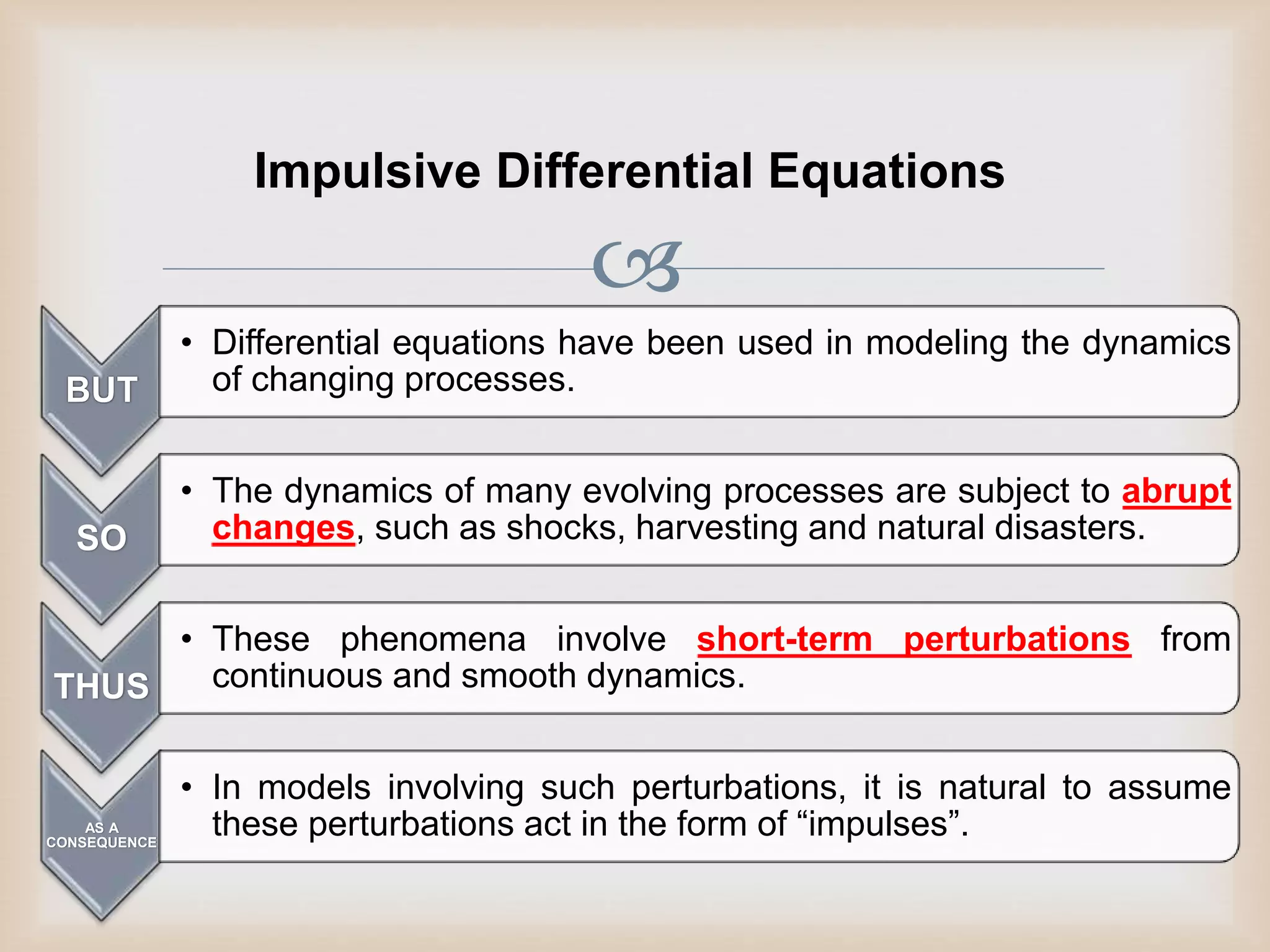
BUT
• Differential equations have been used in modeling the dynamics
of changing processes.
SO
• The dynamics of many evolving processes are subject to abrupt
changes, such as shocks, harvesting and natural disasters.
THUS
• These phenomena involve short-term perturbations from
continuous and smooth dynamics.
AS A
CONSEQUENCE
• In models involving such perturbations, it is natural to assume
these perturbations act in the form of “impulses”.

Impulsive Differential Equations
IN
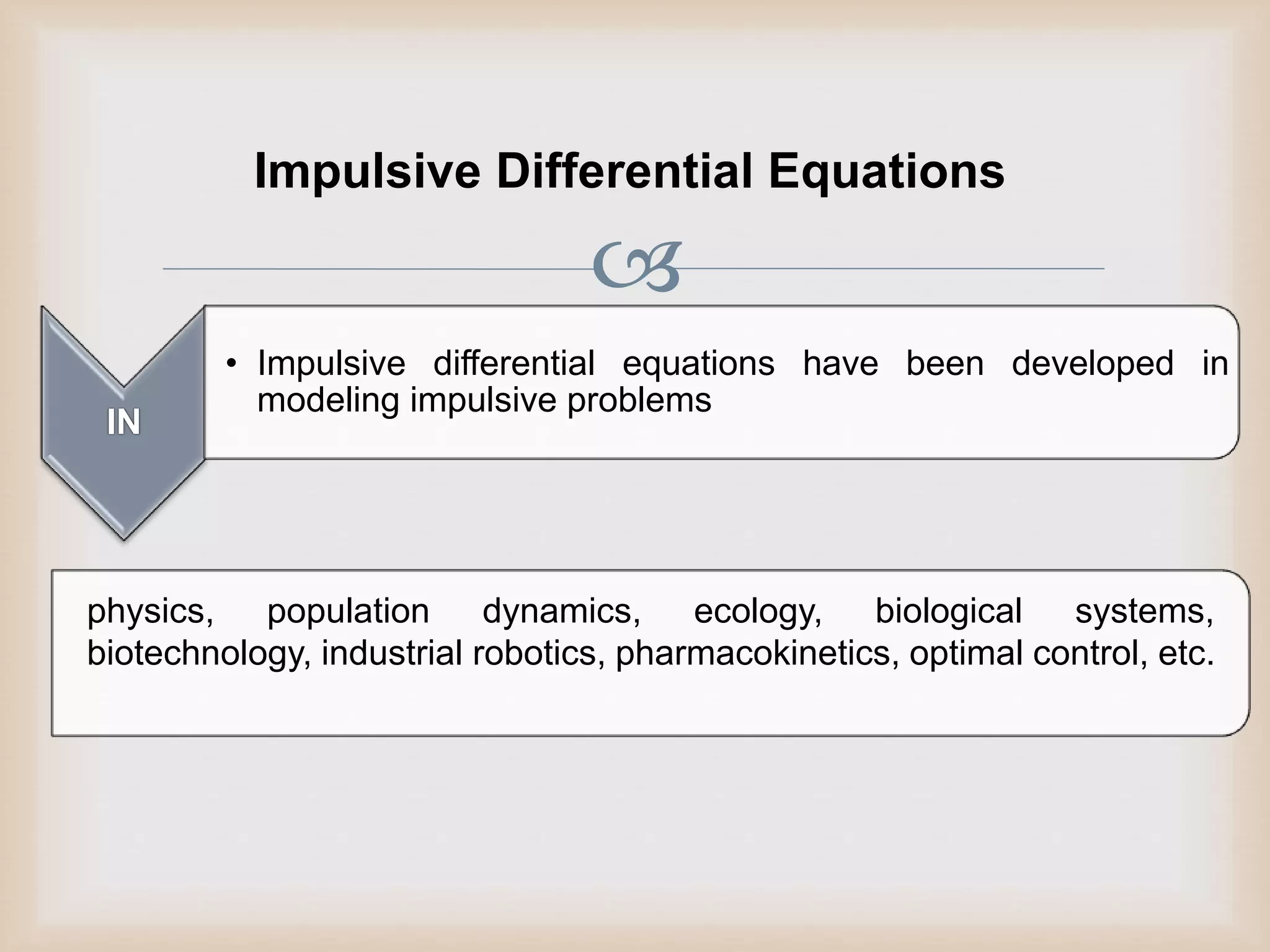
• Impulsive differential equations have been developed in
modeling impulsive problems
physics, population dynamics, ecology, biological systems,
biotechnology, industrial robotics, pharmacokinetics, optimal control, etc.

Gronwall Inequality and its Generalized Form
Integral inequalities play an important role in the
qualitative analysis of the solutions to differential and
integral equations.
The Gronwall (Gronwall–Bellman–Raid) inequality
provides explicit bounds on solutions of a class of
linear integral inequalities.

Gronwall Inequality and its Generalized Form
If
𝑥 𝑡 ≤ ℎ 𝑡 +
𝑡0
𝑡
𝑘 𝑠 𝑥 𝑠 𝑑𝑠 , 𝑡 ∈ 𝑡0, 𝑇 ,
where all the functions involved are continuous on 𝑡0, 𝑇 , 𝑇
≤ +∞, and 𝑘(𝑡) ≥ 0, then 𝑥 𝑡 satisfies
𝑥 𝑡 ≤ ℎ 𝑡 +
𝑡0
𝑡
ℎ(𝑠)𝑘 𝑠 exp[
𝑠
𝑡
𝑘 𝑢 𝑑𝑢]𝑑𝑠 , 𝑡 ∈ 𝑡0, 𝑇 .
The
Standard
Gronwall
Inequality

Gronwall Inequality and its Generalized Form
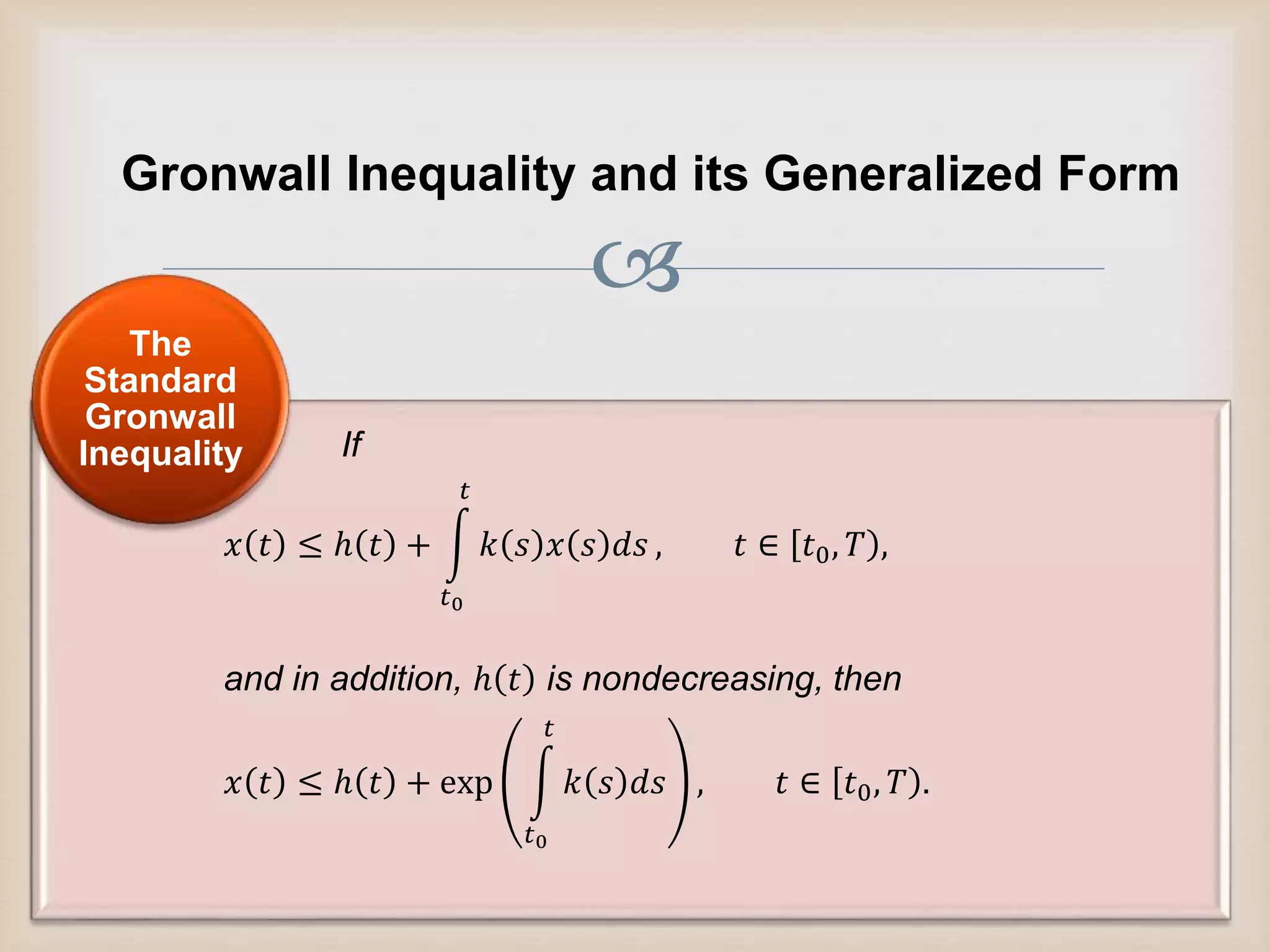
If
𝑥 𝑡 ≤ ℎ 𝑡 +
𝑡0
𝑡
𝑘 𝑠 𝑥 𝑠 𝑑𝑠 , 𝑡 ∈ 𝑡0, 𝑇 ,
and in addition, ℎ 𝑡 is nondecreasing, then
𝑥 𝑡 ≤ ℎ 𝑡 + exp
𝑡0
𝑡
𝑘 𝑠 𝑑𝑠 , 𝑡 ∈ 𝑡0, 𝑇 .
The
Standard
Gronwall
Inequality

Gronwall Inequality and its Generalized Form
sometimes we need a different form, to discuss the weakly
singular Volterra integral equations encountered in
fractional differential equations.
we present a slight generalization of the Gronwall
inequality which can be used in a fractional differential
equation.
However
S
o

Gronwall Inequality and its Generalized Form
Suppose 𝑥 𝑡 and 𝑎 𝑡 are nonnegative and locally
integrable on 0 ≤ 𝑡 < 𝑇 (some 𝑇 ≤ +∞), and 𝑔(𝑡) is a
nonnegative, nondecreasing continuous function defined
on 0 ≤ 𝑡 < 𝑇, 𝑔 𝑡 ≤ 𝑀 = 𝑐𝑜𝑛𝑠𝑡𝑎𝑛𝑡, and 𝛼 > 0 with
𝑥 𝑡 ≤ 𝑎 𝑡 + 𝑔(𝑡)
0
𝑡
(𝑡 − 𝑠) 𝛼−1
𝑥 𝑠 𝑑𝑠
on this interval. Then
𝑥 𝑡 ≤ 𝑎 𝑡 + 𝑔(𝑡)
0
𝑡
[
𝑛=1
∞
(𝑔(𝑡)𝛤(𝛼)) 𝑛
𝛤(𝑛𝛼)
(𝑡 − 𝑠) 𝑛𝛼−1 𝑎(𝑠)]𝑑𝑠
The
Generalized
Gronwall
Inequality

Impulsive Fractional Differential Systems
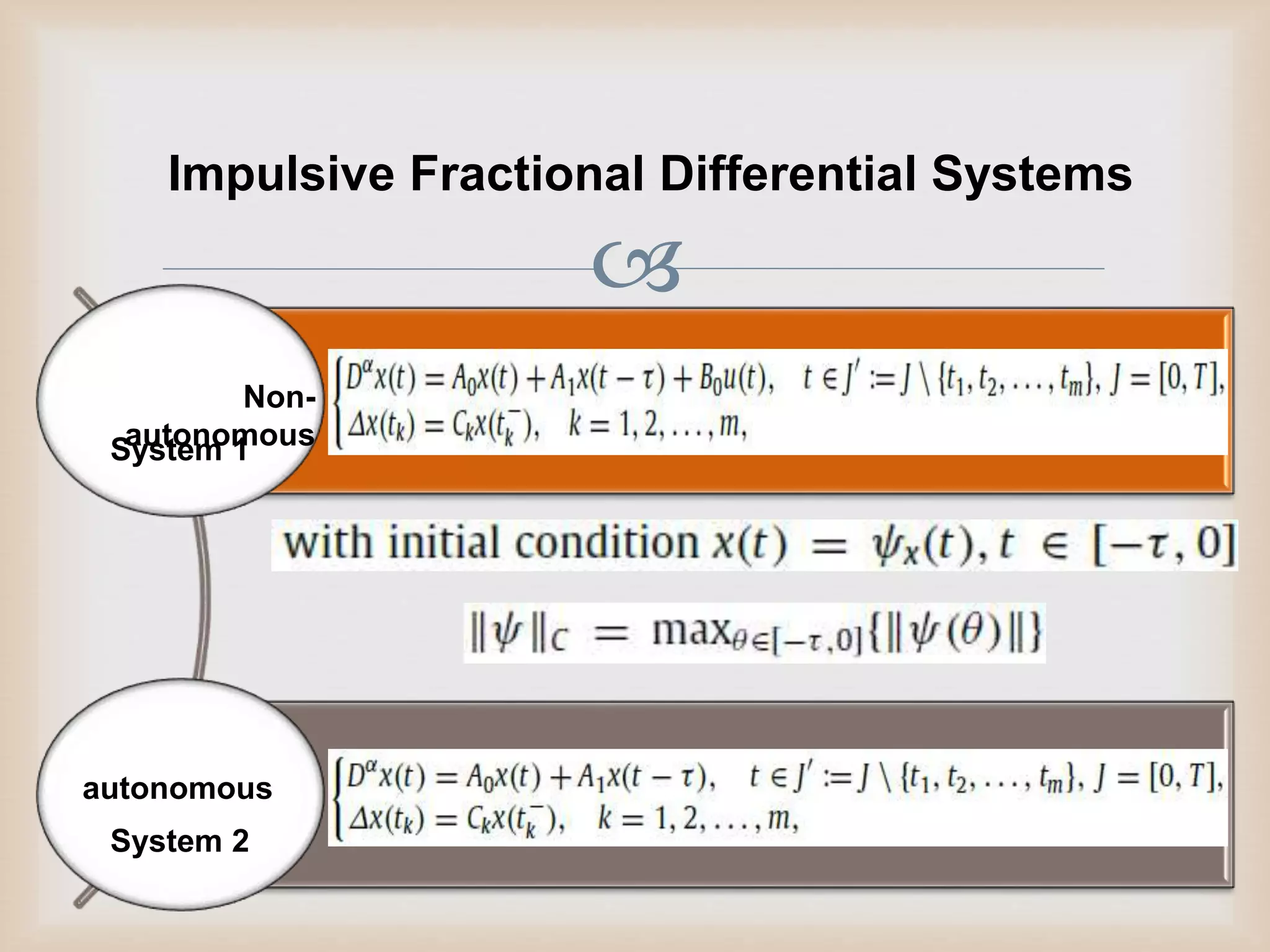
Non-
autonomous
autonomous
System 1
System 2

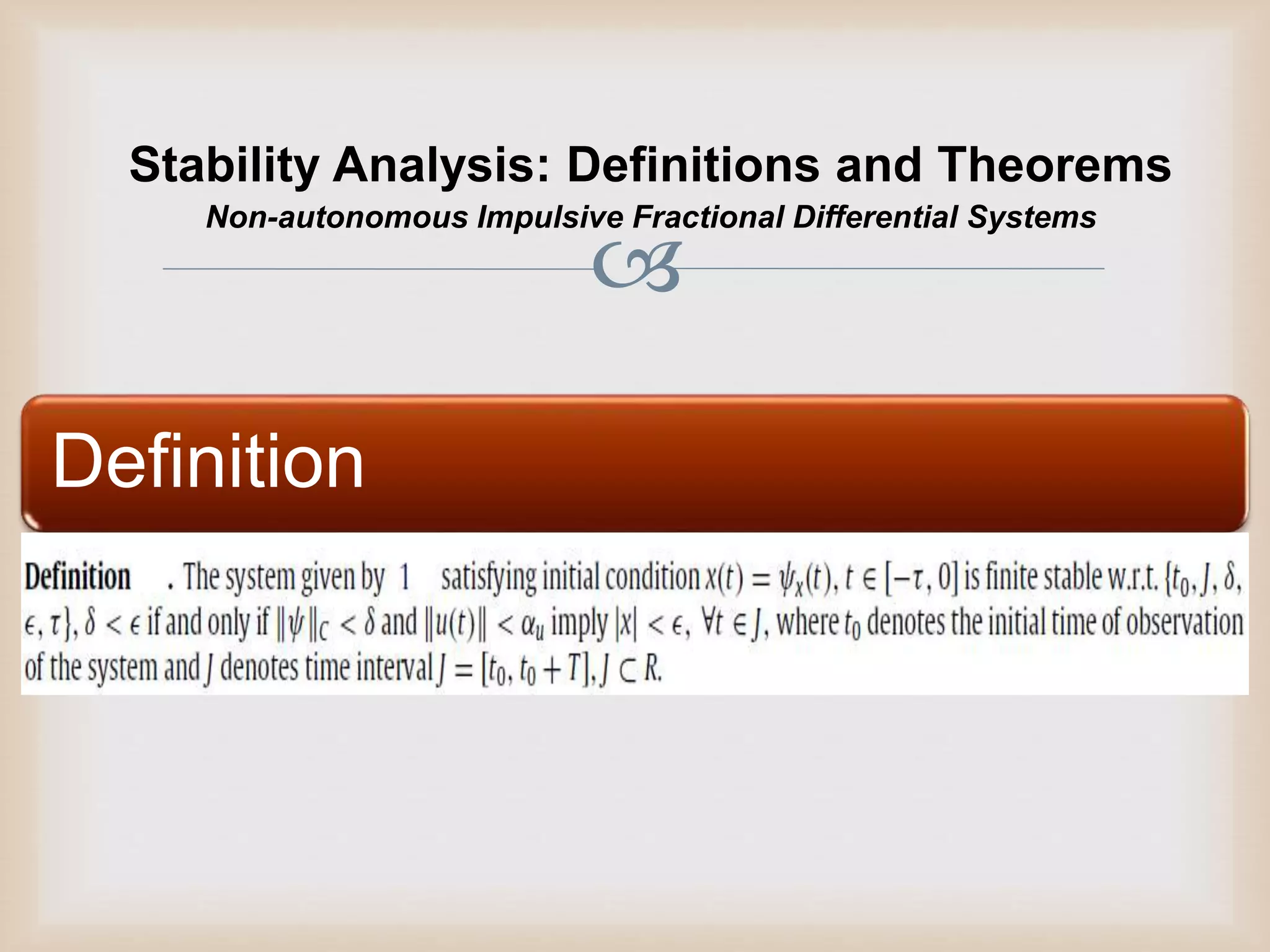
Stability Analysis: Definitions and Theorems
Definition
Non-autonomous Impulsive Fractional Differential Systems

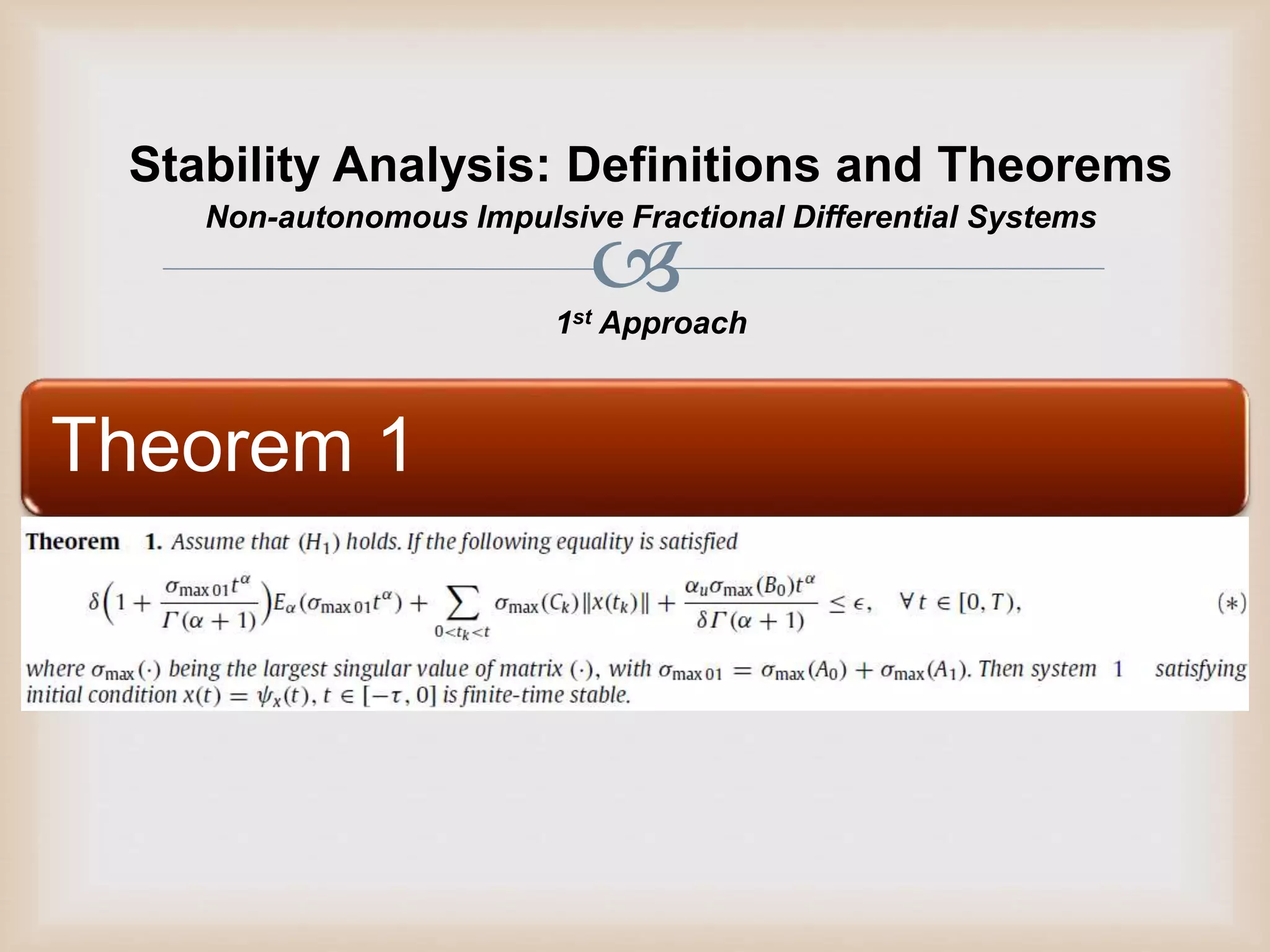
Stability Analysis: Definitions and Theorems
Theorem 1
Non-autonomous Impulsive Fractional Differential Systems
1st Approach

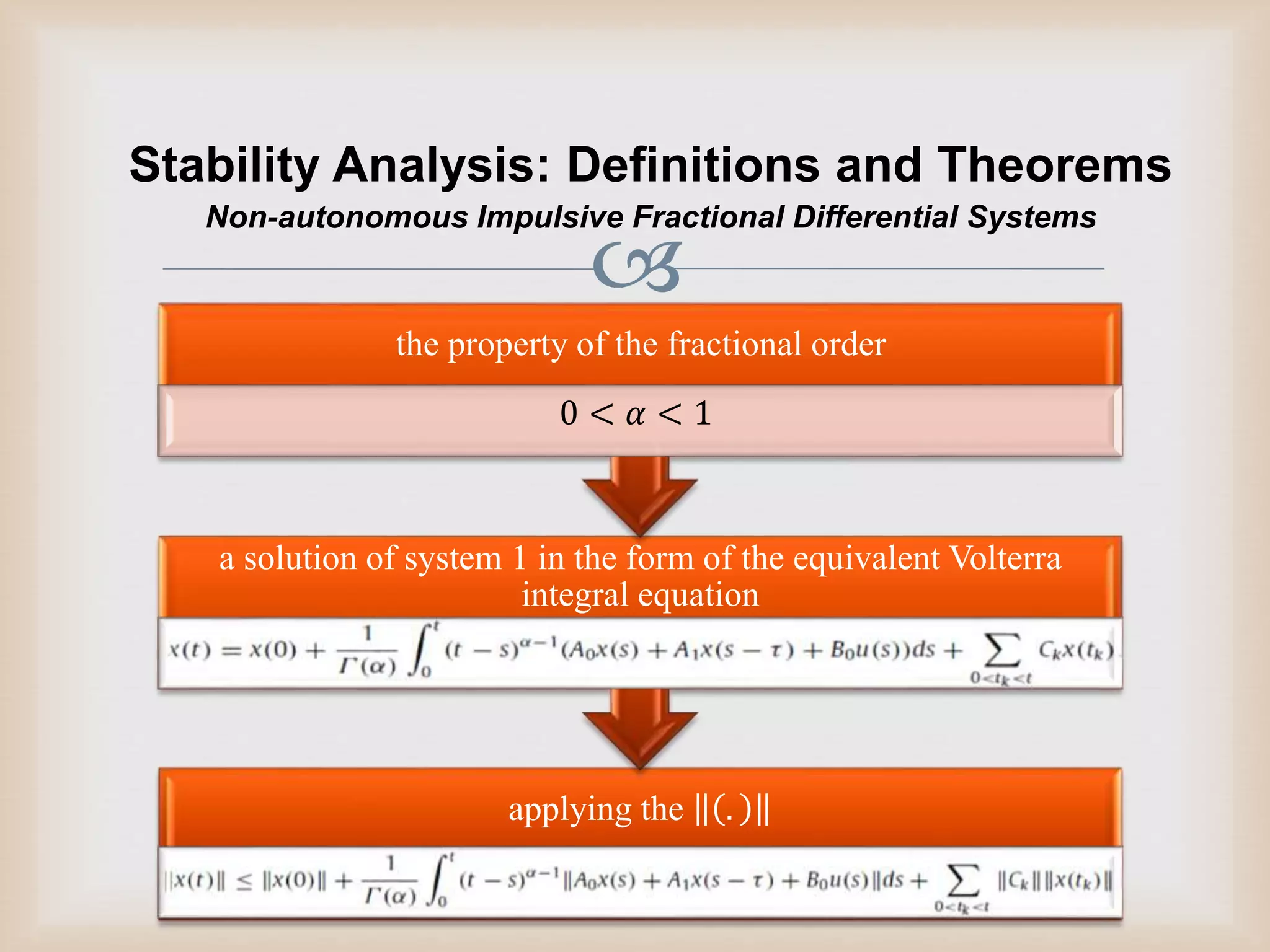
Stability Analysis: Definitions and Theorems
applying the .
a solution of system 1 in the form of the equivalent Volterra
integral equation
the property of the fractional order
0 < 𝛼 < 1
Non-autonomous Impulsive Fractional Differential Systems

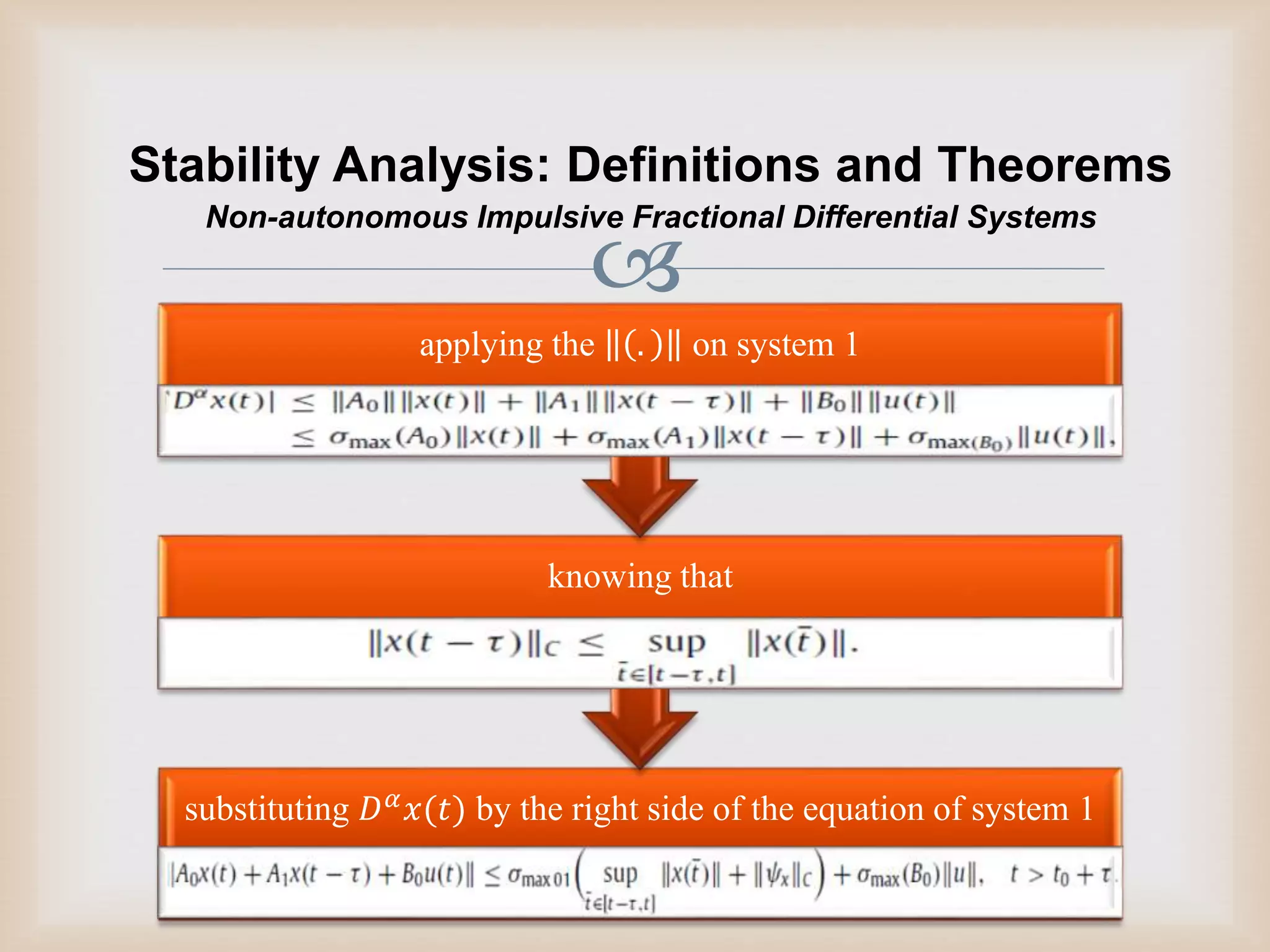
Stability Analysis: Definitions and Theorems
substituting 𝐷 𝛼 𝑥(𝑡) by the right side of the equation of system 1
knowing that
applying the . on system 1
Non-autonomous Impulsive Fractional Differential Systems

Stability Analysis: Definitions and Theorems
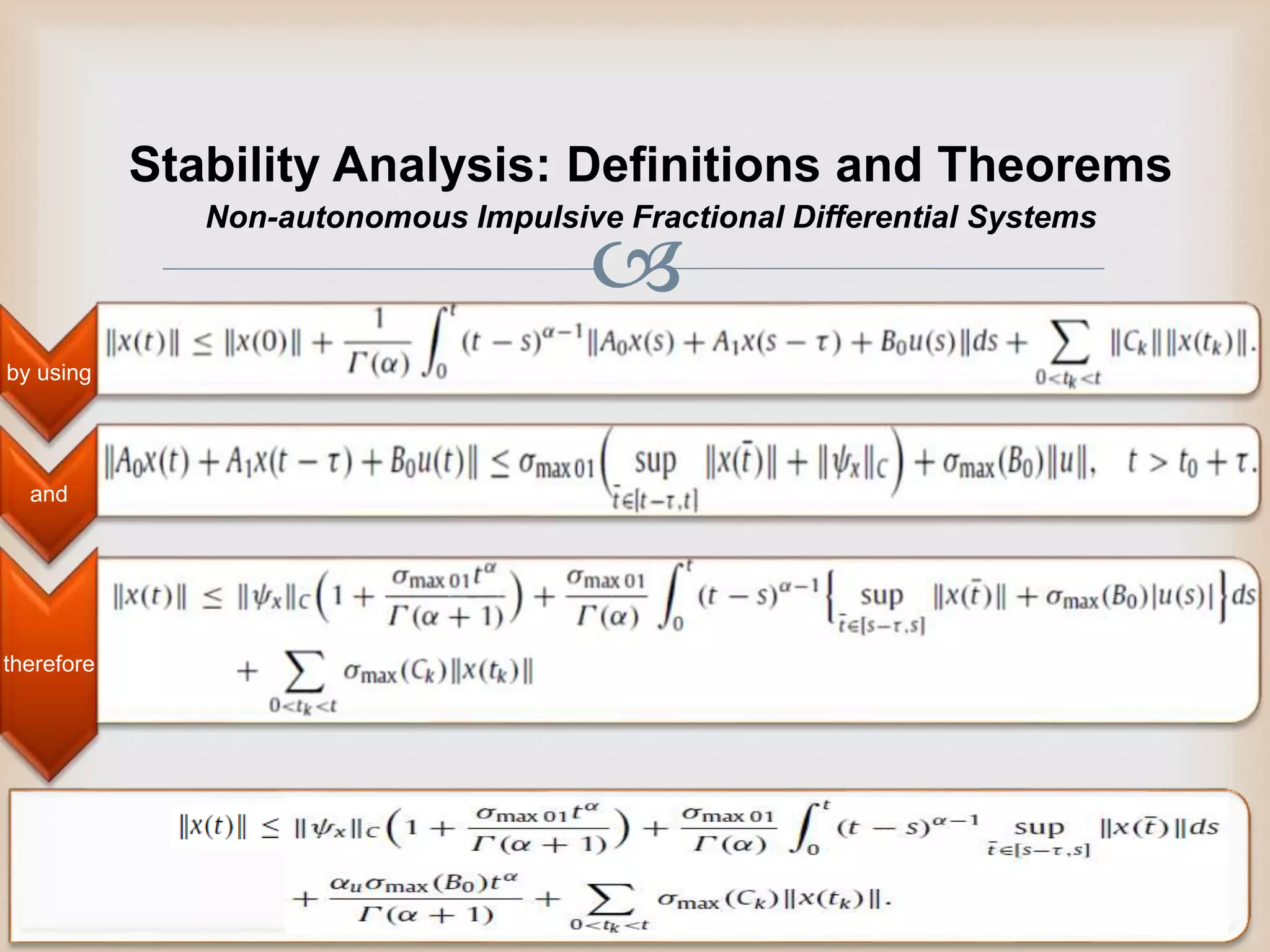
by using
and
therefore
Non-autonomous Impulsive Fractional Differential Systems

Some Preliminaries by using the Generalized
Gronwall Inequality
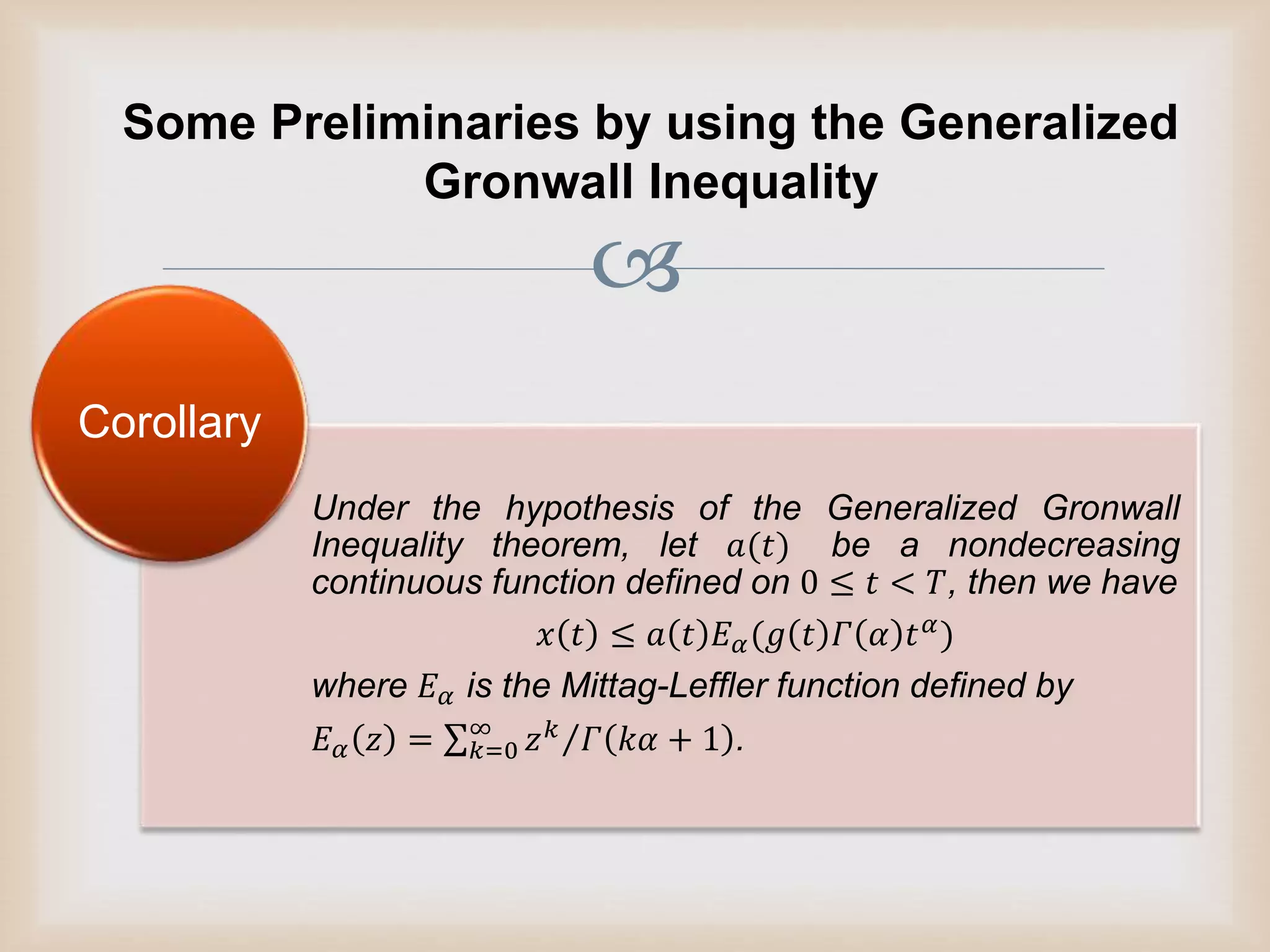
Under the hypothesis of the Generalized Gronwall
Inequality theorem, let 𝑎(𝑡) be a nondecreasing
continuous function defined on 0 ≤ 𝑡 < 𝑇, then we have
𝑥 𝑡 ≤ 𝑎 𝑡 𝐸 𝛼(𝑔 𝑡 𝛤 𝛼 𝑡 𝛼)
where 𝐸 𝛼 is the Mittag-Leffler function defined by
𝐸 𝛼 𝑧 = 𝑘=0
∞
𝑧 𝑘 𝛤 𝑘𝛼 + 1 .
Corollary

Stability Analysis: Definitions and Theorems
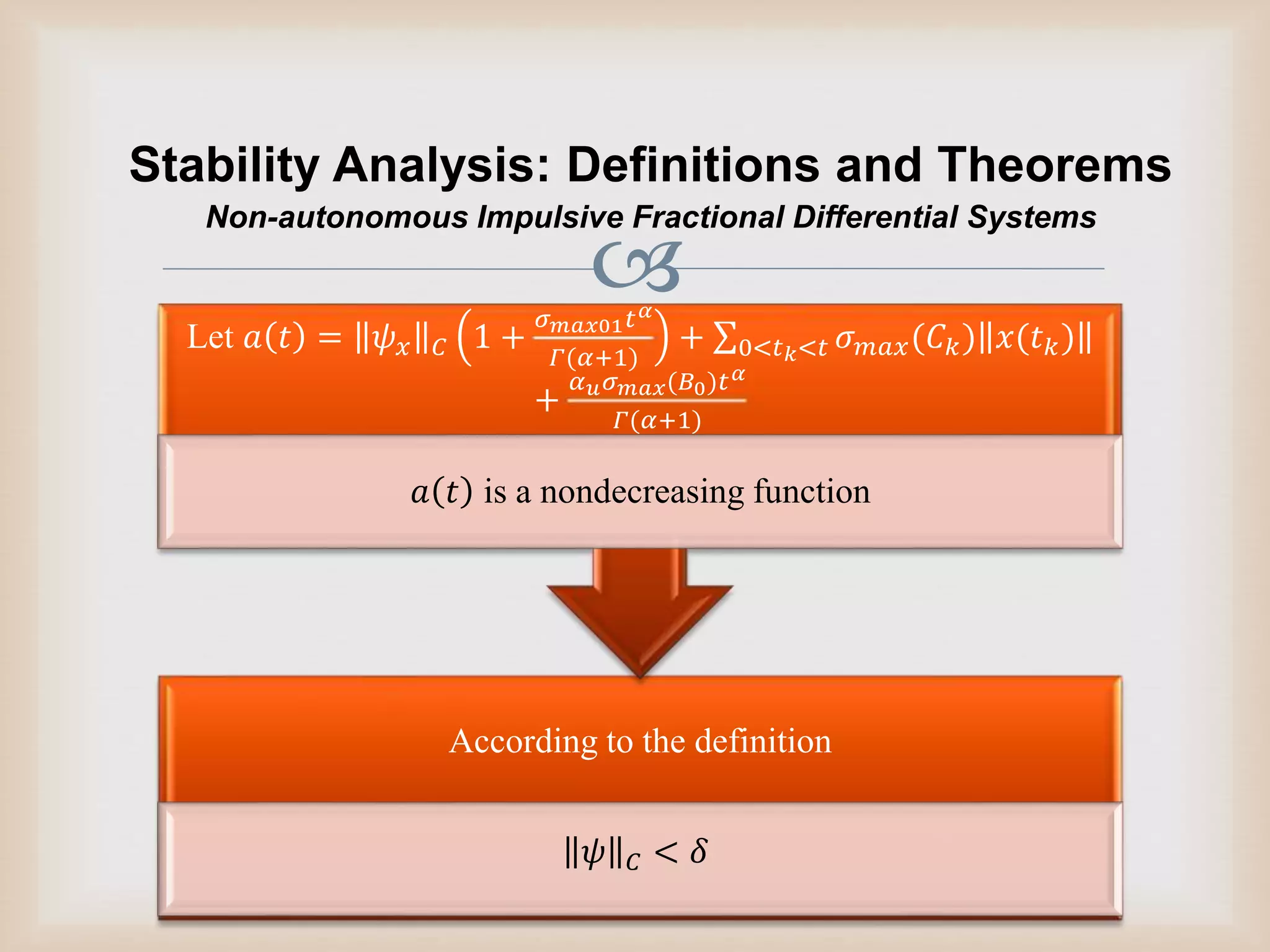
According to the definition
𝜓 𝐶 < 𝛿
Let 𝑎 𝑡 = 𝜓 𝑥 𝐶 1 +
𝜎 𝑚𝑎𝑥01 𝑡 𝛼
𝛤(𝛼+1)
+ 0<𝑡 𝑘<𝑡 𝜎 𝑚𝑎𝑥(𝐶 𝑘) 𝑥(𝑡 𝑘)
+
𝛼 𝑢 𝜎 𝑚𝑎𝑥(𝐵0)𝑡 𝛼
𝛤(𝛼+1)
𝑎 𝑡 is a nondecreasing function
Non-autonomous Impulsive Fractional Differential Systems

Stability Analysis: Definitions and Theorems
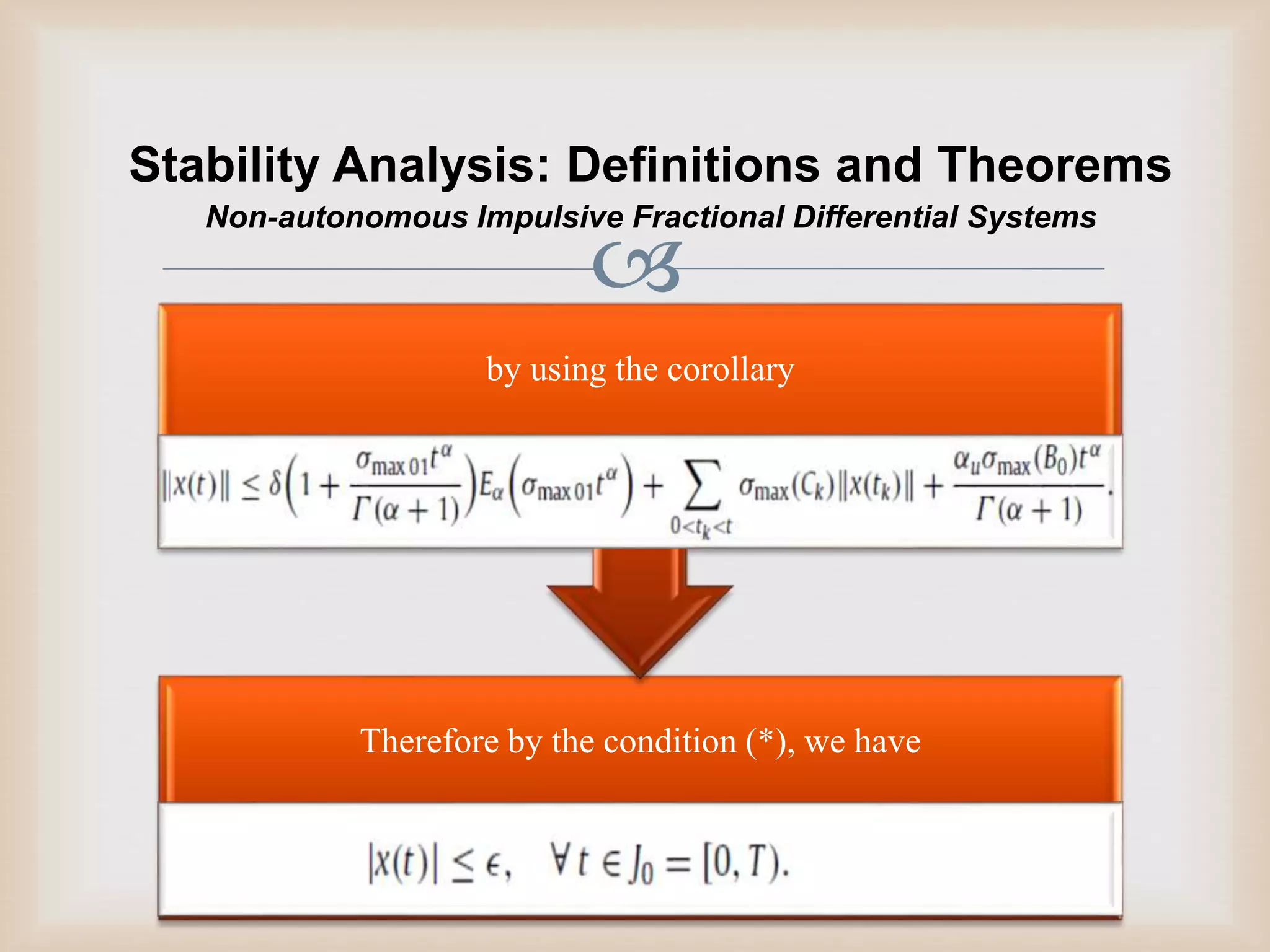
Therefore by the condition (*), we have
by using the corollary
Non-autonomous Impulsive Fractional Differential Systems

Stability Analysis: Definitions and Theorems
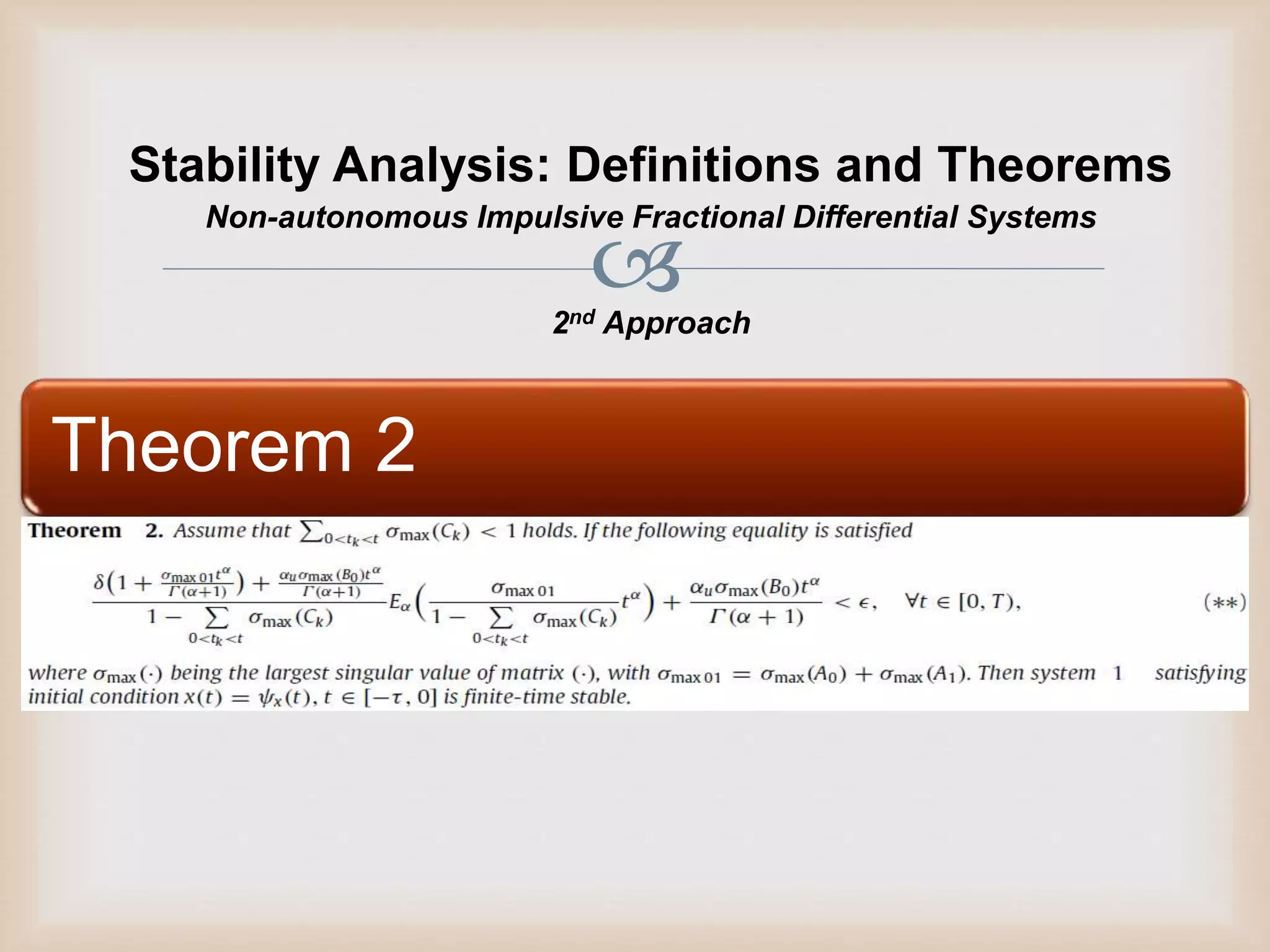
Theorem 2
Non-autonomous Impulsive Fractional Differential Systems
2nd Approach

Stability Analysis: Definitions and Theorems
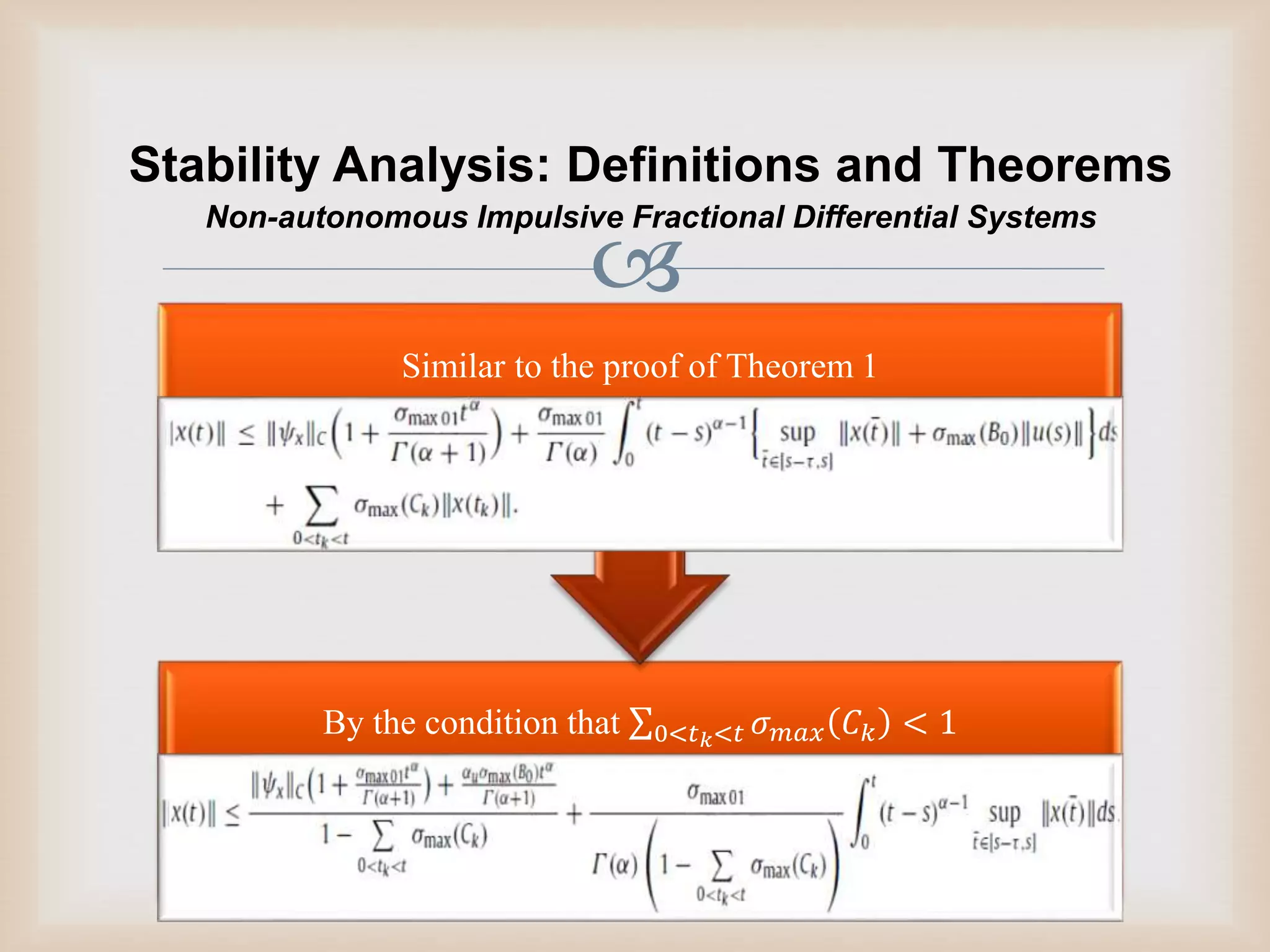
By the condition that 0<𝑡 𝑘<𝑡 𝜎 𝑚𝑎𝑥 𝐶 𝑘 < 1
Similar to the proof of Theorem 1
Non-autonomous Impulsive Fractional Differential Systems

Stability Analysis: Definitions and Theorems
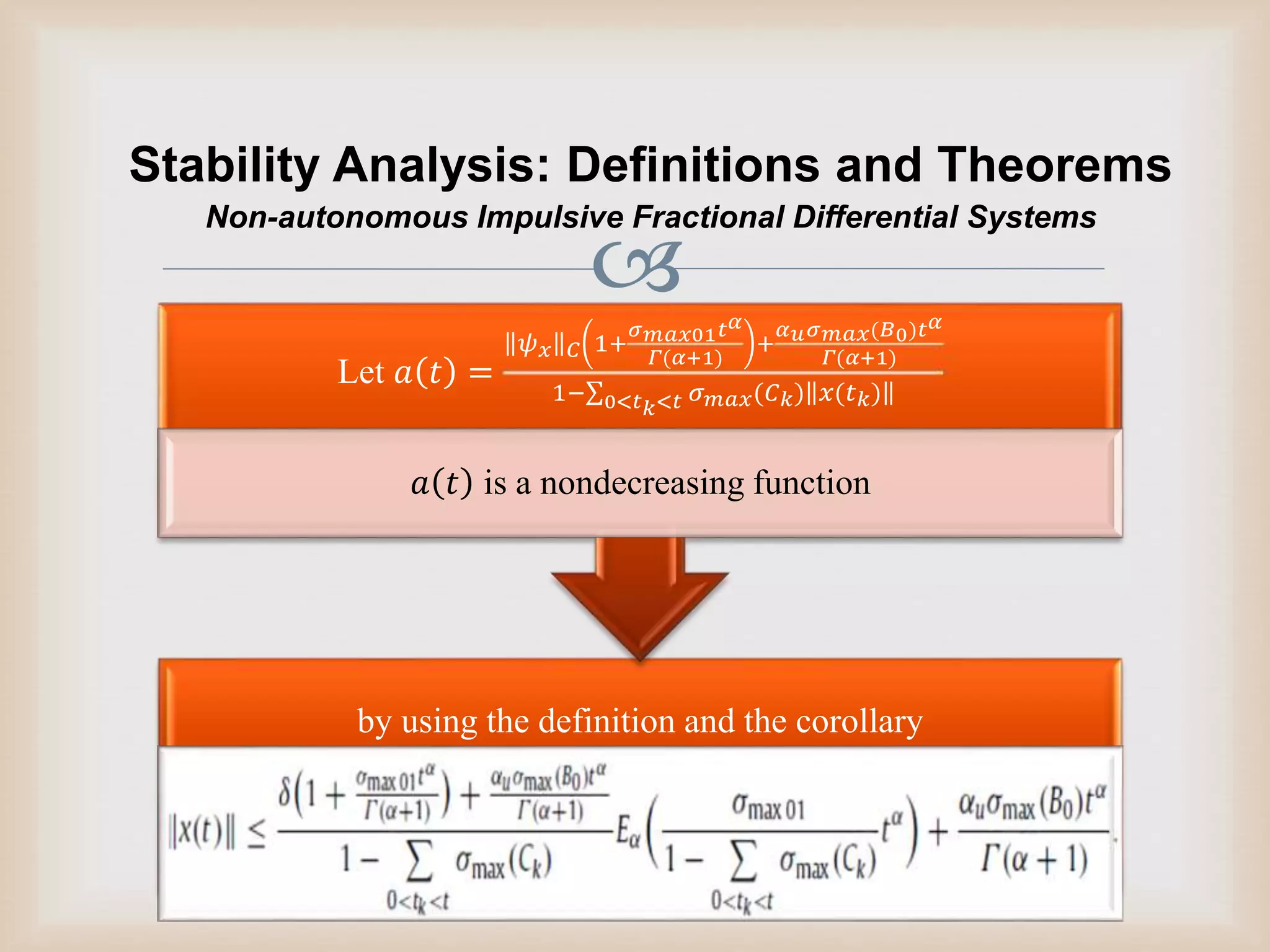
by using the definition and the corollary
Let 𝑎 𝑡 =
𝜓 𝑥 𝐶 1+
𝜎 𝑚𝑎𝑥01 𝑡 𝛼
𝛤(𝛼+1)
+
𝛼 𝑢 𝜎 𝑚𝑎𝑥(𝐵0)𝑡 𝛼
𝛤(𝛼+1)
1− 0<𝑡 𝑘<𝑡 𝜎 𝑚𝑎𝑥(𝐶 𝑘) 𝑥(𝑡 𝑘)
𝑎 𝑡 is a nondecreasing function
Non-autonomous Impulsive Fractional Differential Systems

Stability Analysis: Definitions and Theorems
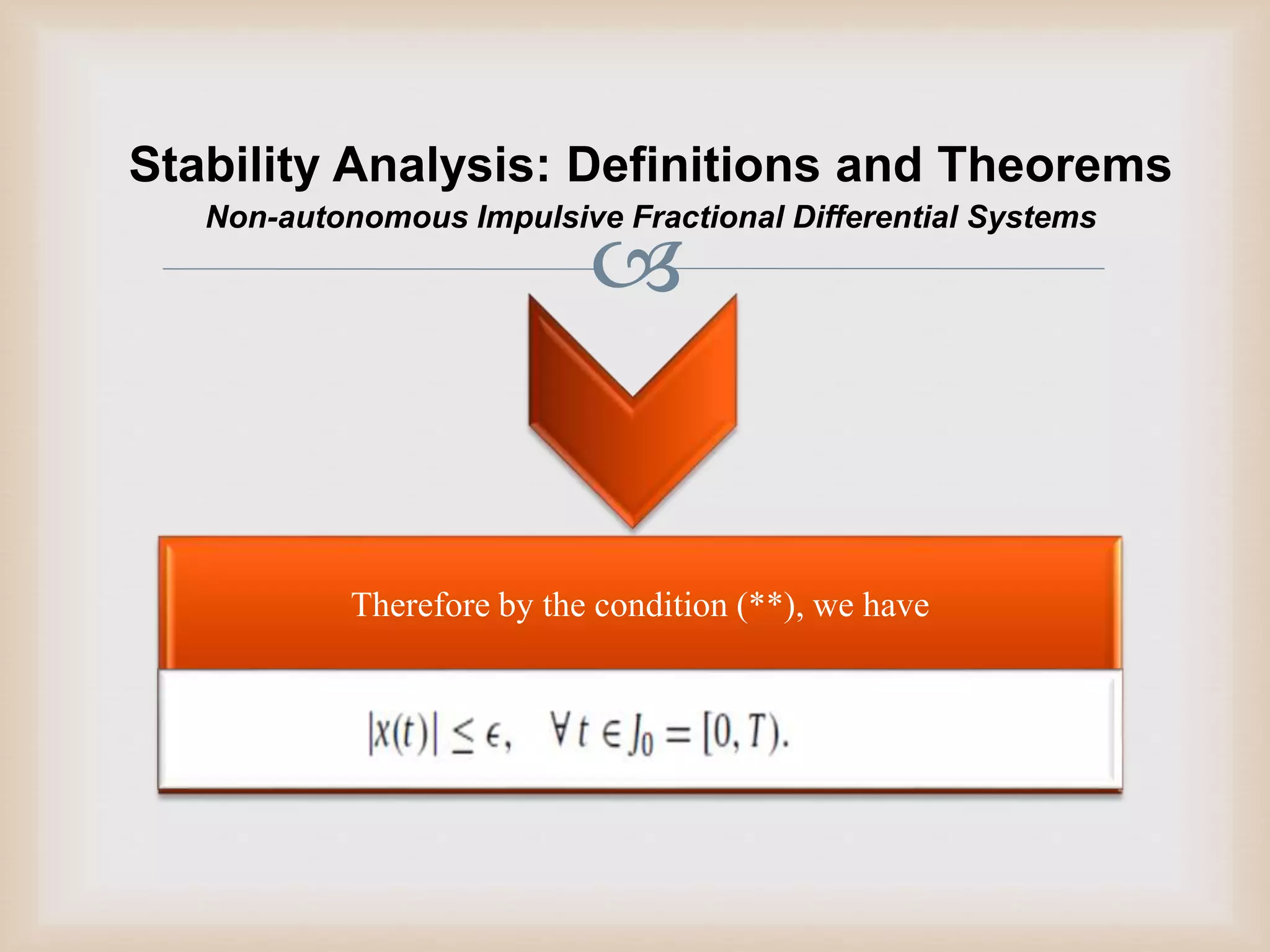
Therefore by the condition (**), we have
Non-autonomous Impulsive Fractional Differential Systems

Stability Analysis: Definitions and Theorems
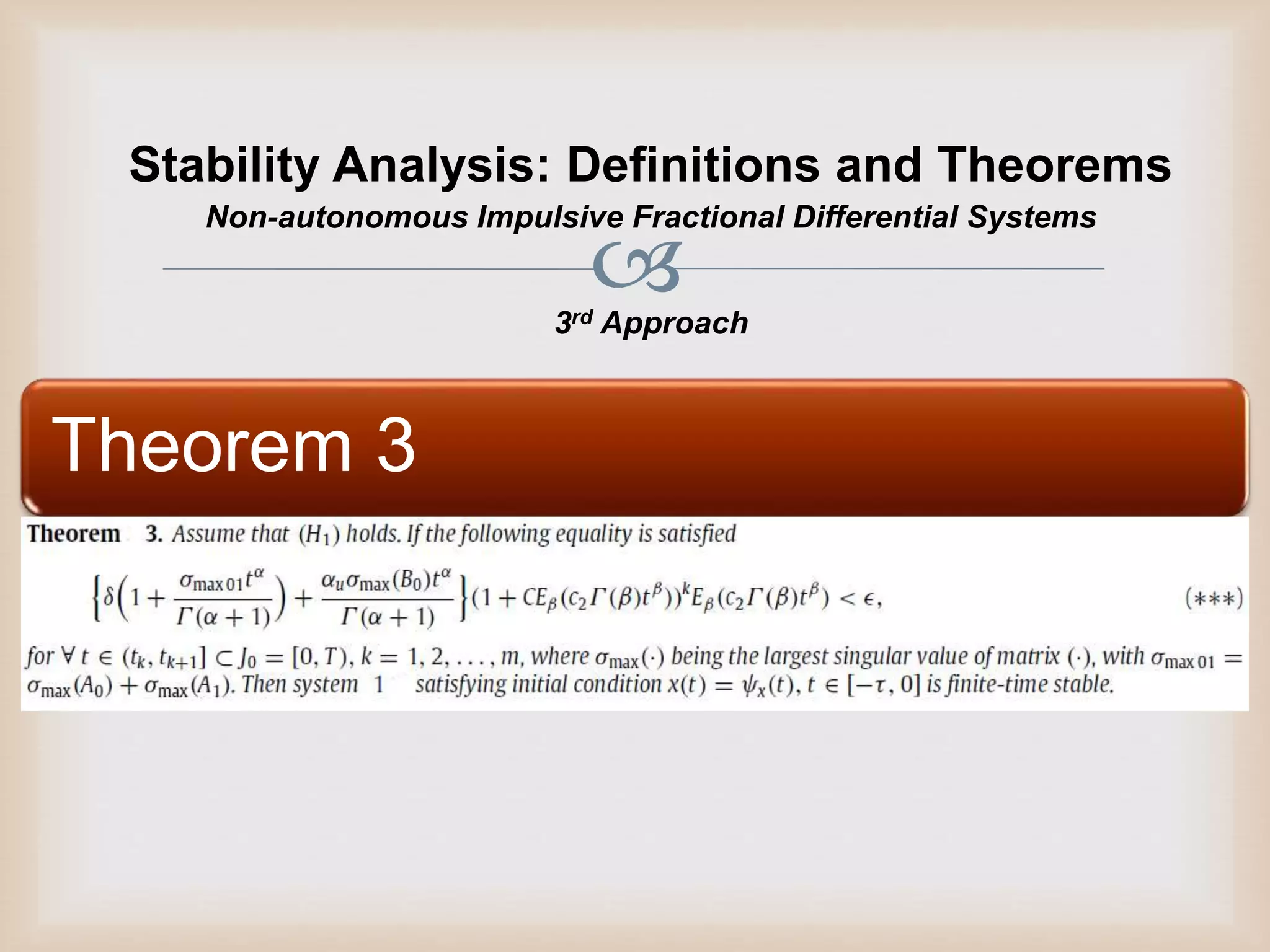
Theorem 3
Non-autonomous Impulsive Fractional Differential Systems
3rd Approach

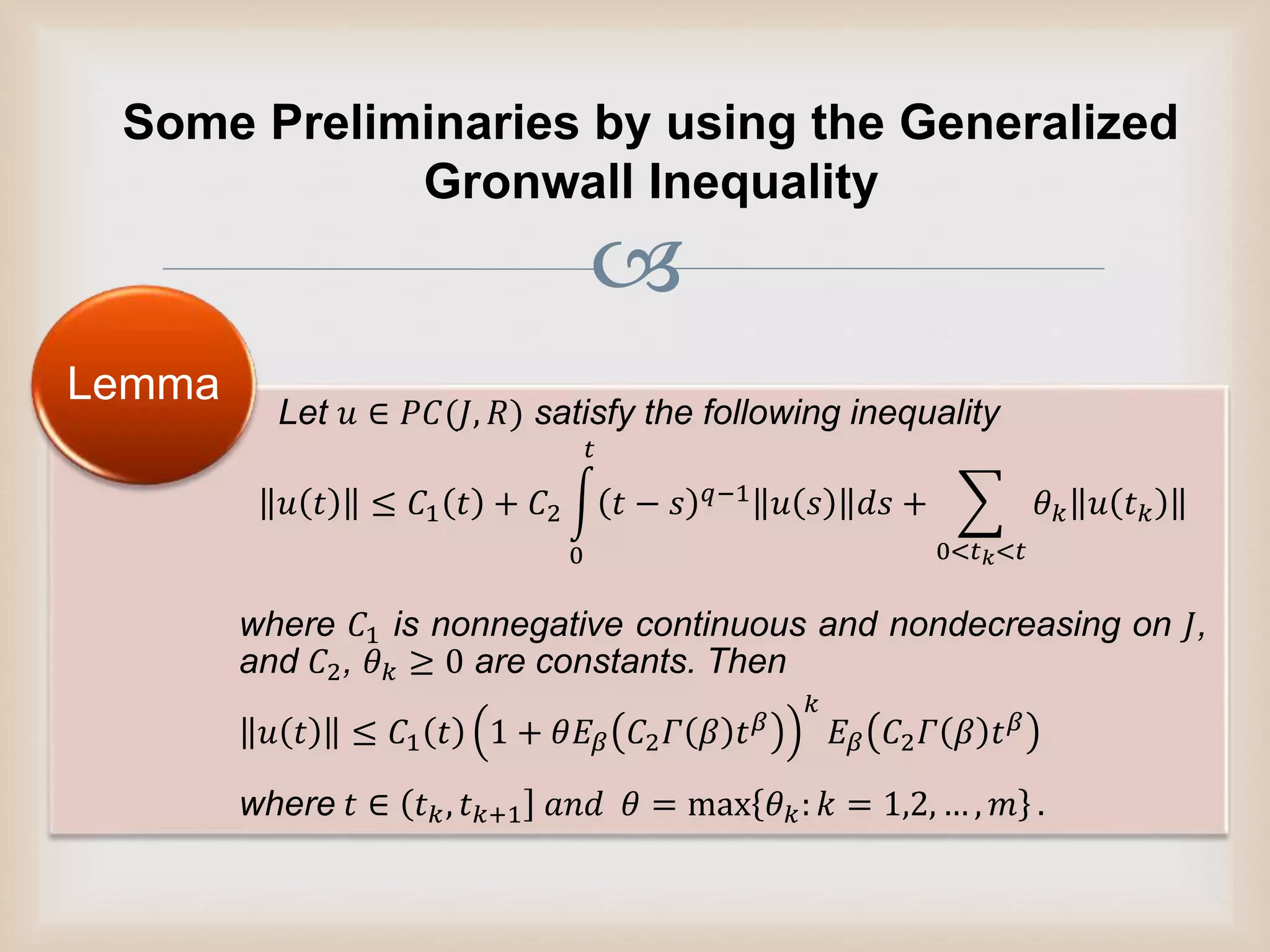
Some Preliminaries by using the Generalized
Gronwall Inequality
Let 𝑢 ∈ 𝑃𝐶(𝐽, 𝑅) satisfy the following inequality
𝑢 𝑡 ≤ 𝐶1 𝑡 + 𝐶2
0
𝑡
𝑡 − 𝑠 𝑞−1 𝑢 𝑠 𝑑𝑠 +
0<𝑡 𝑘<𝑡
𝜃 𝑘 𝑢 𝑡 𝑘
where 𝐶1 is nonnegative continuous and nondecreasing on 𝐽,
and 𝐶2, 𝜃 𝑘 ≥ 0 are constants. Then
𝑢 𝑡 ≤ 𝐶1 𝑡 1 + 𝜃𝐸𝛽 𝐶2 𝛤 𝛽 𝑡 𝛽
𝑘
𝐸𝛽 𝐶2 𝛤 𝛽 𝑡 𝛽
where 𝑡 ∈ 𝑡 𝑘, 𝑡 𝑘+1 𝑎𝑛𝑑 𝜃 = max 𝜃 𝑘: 𝑘 = 1,2, … , 𝑚 .
Lemma

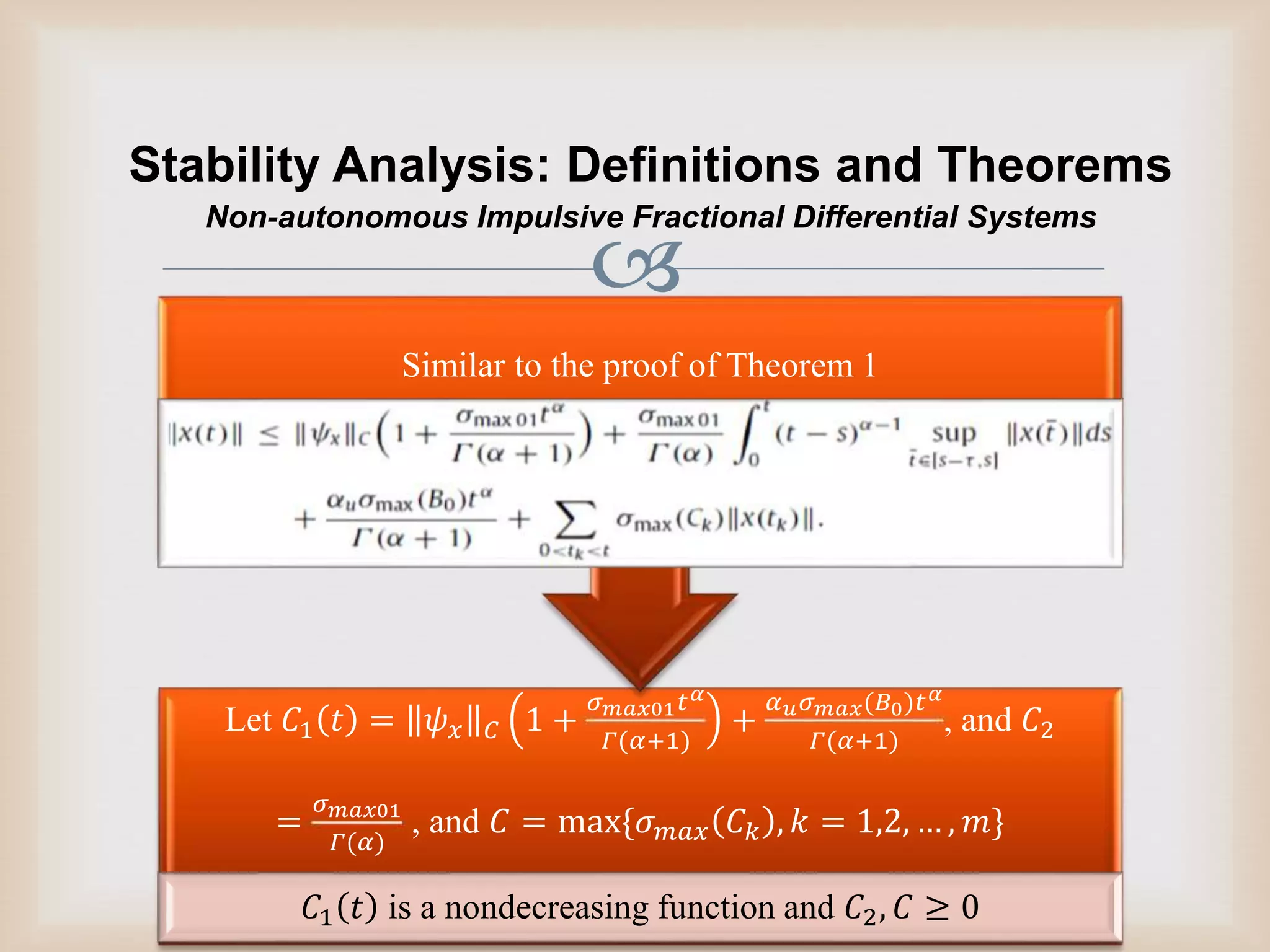
Stability Analysis: Definitions and Theorems
Let 𝐶1 𝑡 = 𝜓 𝑥 𝐶 1 +
𝜎 𝑚𝑎𝑥01 𝑡 𝛼
𝛤(𝛼+1)
+
𝛼 𝑢 𝜎 𝑚𝑎𝑥(𝐵0)𝑡 𝛼
𝛤(𝛼+1)
, and 𝐶2
=
𝜎 𝑚𝑎𝑥01
𝛤(𝛼)
, and 𝐶 = max{𝜎 𝑚𝑎𝑥 𝐶 𝑘 , 𝑘 = 1,2, … , 𝑚}
𝐶1 𝑡 is a nondecreasing function and 𝐶2, 𝐶 ≥ 0
Similar to the proof of Theorem 1
Non-autonomous Impulsive Fractional Differential Systems

Stability Analysis: Definitions and Theorems
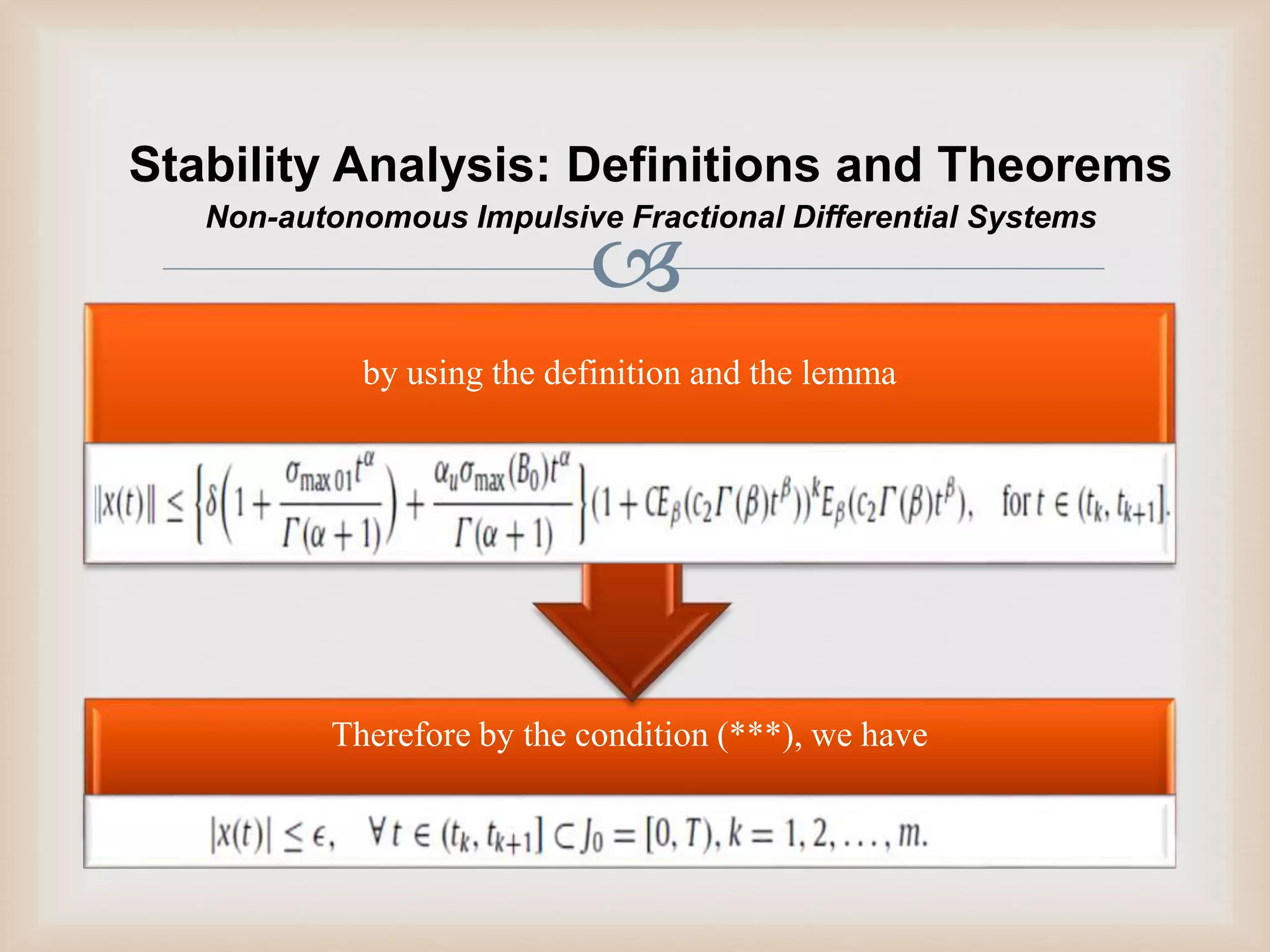
Therefore by the condition (***), we have
by using the definition and the lemma
Non-autonomous Impulsive Fractional Differential Systems

Stability Analysis: Definitions and Theorems
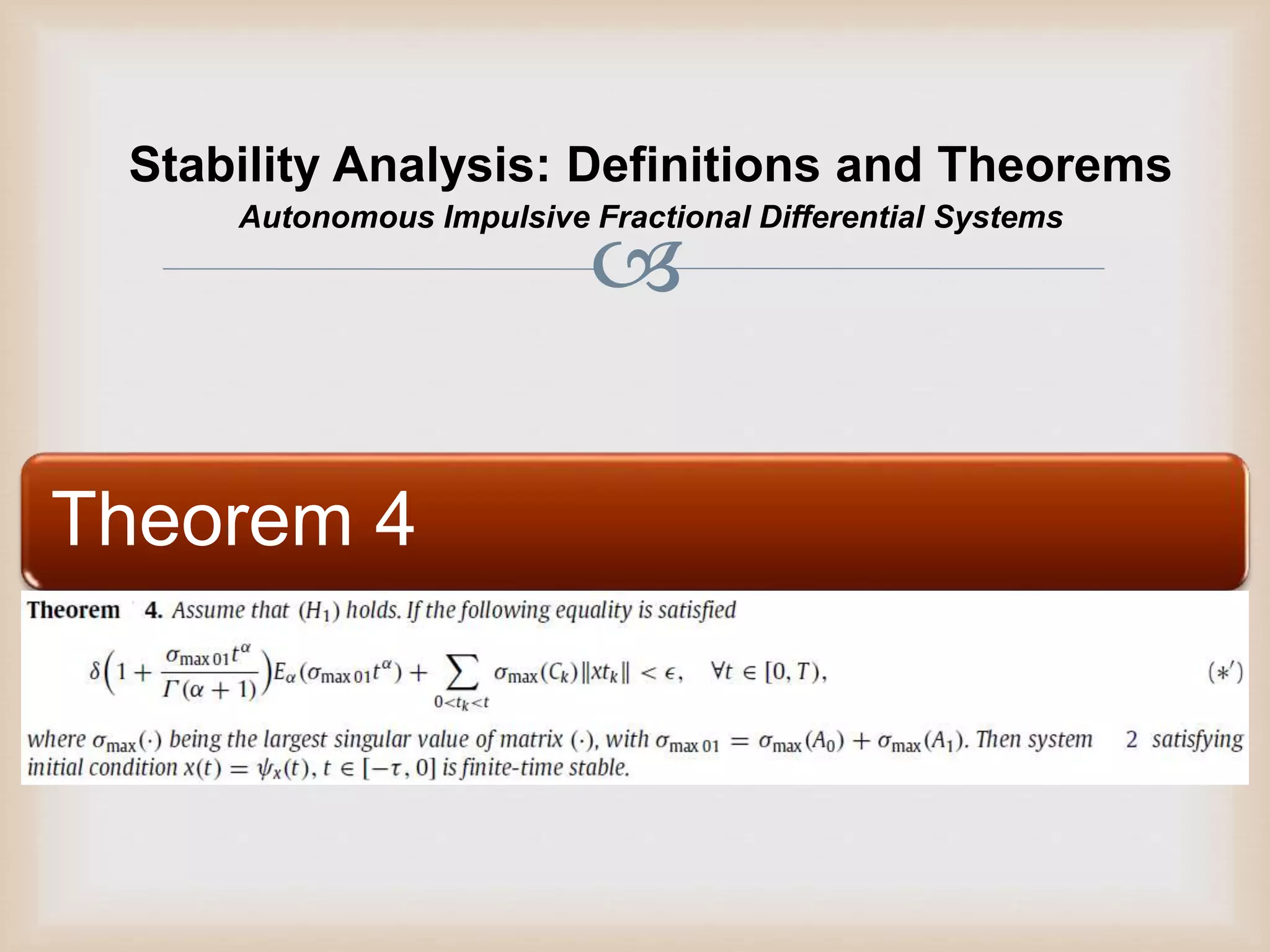
Theorem 4
Autonomous Impulsive Fractional Differential Systems

Stability Analysis: Definitions and Theorems
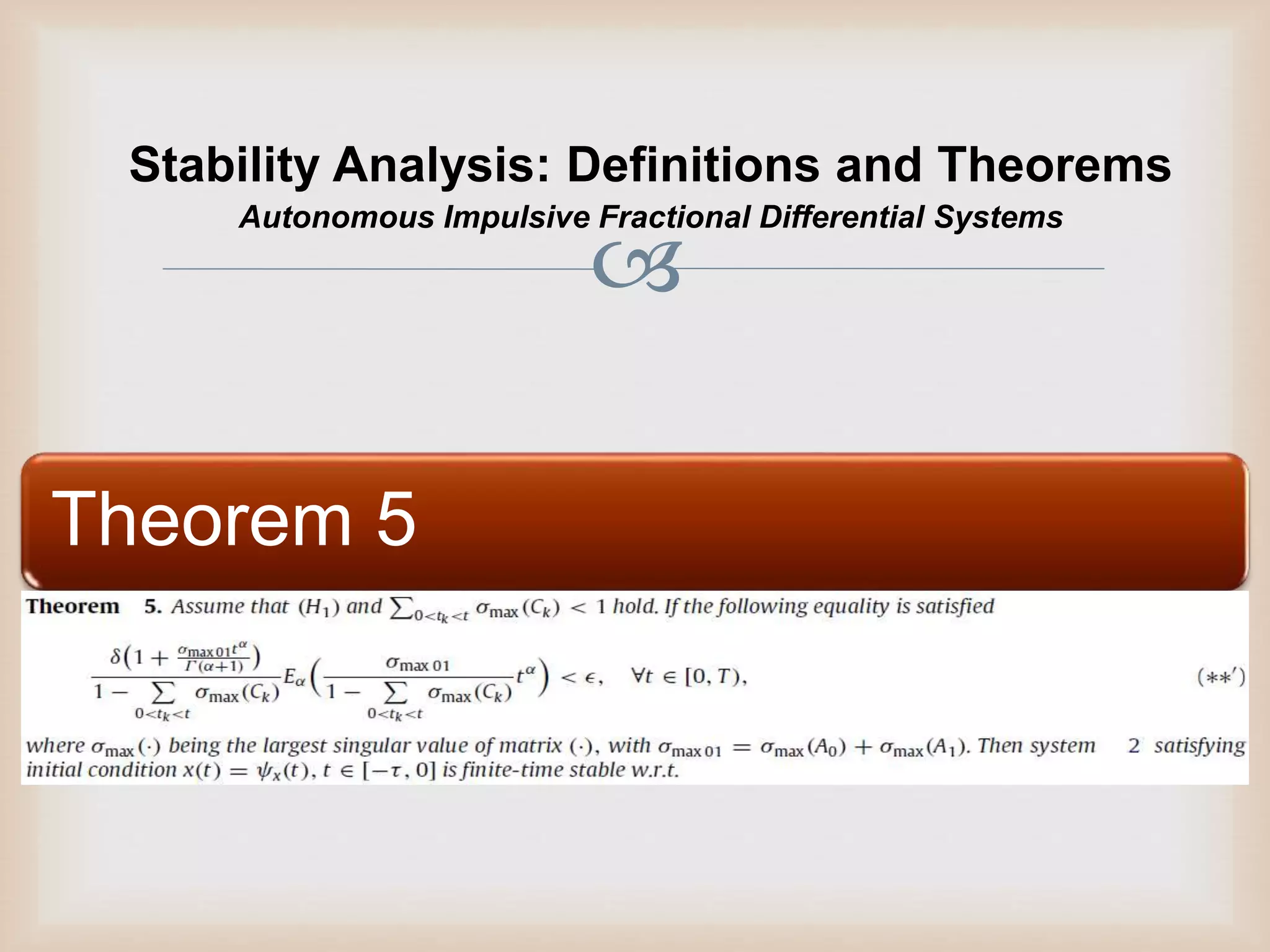
Theorem 5
Autonomous Impulsive Fractional Differential Systems

Stability Analysis: Definitions and Theorems
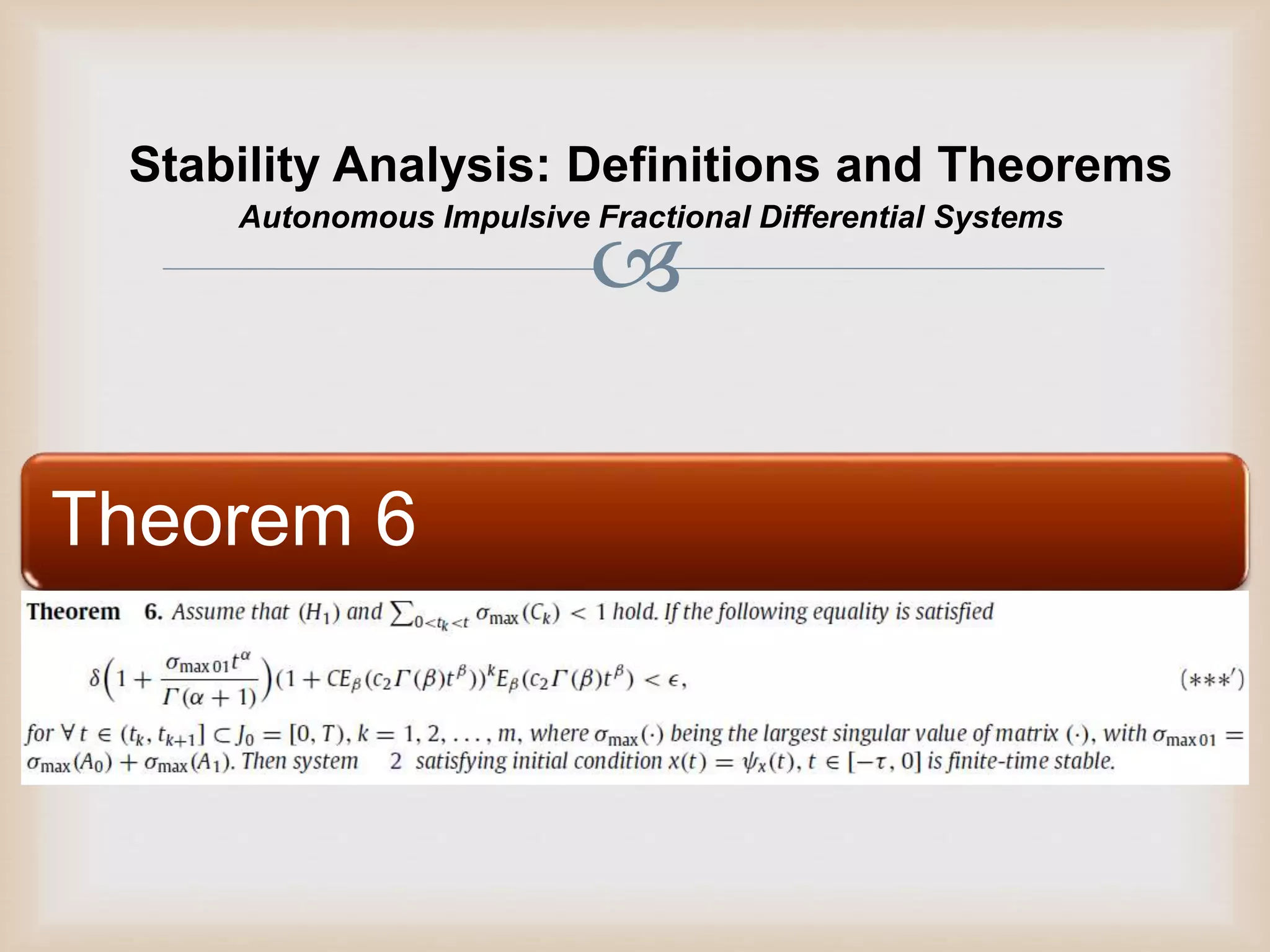
Theorem 6
Autonomous Impulsive Fractional Differential Systems

References
1. Q. Wang, D. Lu, Y. Fang, “Stability analysis of impulsive fractional
differential systems with delayˮ, 2015, Applied Mathematics Letters,
40, pp. 1-6.
2. H. Ye, J. Gao, Y. Ding, “A generalized Gronwall inequality and its
application to a fractional differential equationˮ, 2007, J. Math. Anal.
Appl., 328, pp. 963-968.
3. M. Benchohra, J. Henderson, S. Ntouyas, “Impulsive Differential
Equations and Inclusionsˮ, 2006, Contemporary Mathematics and Its
Applications, volume 2, Hindawi Publishing Corporation, NY.
4. M.P. Lazarević, Aleksandar M. Spasić, “Finite-time stability analysis
of fractional order time-delay systems: Gronwall’s approachˮ, 2009,
Math. Comput. Modelling, 49, pp. 475-481.

Stability analysis of impulsive fractional differential systems with delay

  • 1.
    Stability analysis ofimpulsive fractional differential systems with delay By Qi Wang, Dicheng Lu, Yuyun Fang Presentation by Mostafa Shokrian Zeini
  • 2.
     Important Questions: - Whatis an impulsive differential equation? And what are its applications? - Why is the Gronwall inequality developed for? What is the application of the generalized Gronwall inequality? - What is the main approach for the stability analysis of delayed impulsive fractional differential systems?
  • 3.
     Impulsive Differential Equations BUT •Differential equations have been used in modeling the dynamics of changing processes. SO • The dynamics of many evolving processes are subject to abrupt changes, such as shocks, harvesting and natural disasters. THUS • These phenomena involve short-term perturbations from continuous and smooth dynamics. AS A CONSEQUENCE • In models involving such perturbations, it is natural to assume these perturbations act in the form of “impulses”.
  • 4.
     Impulsive Differential Equations IN •Impulsive differential equations have been developed in modeling impulsive problems physics, population dynamics, ecology, biological systems, biotechnology, industrial robotics, pharmacokinetics, optimal control, etc.
  • 5.
     Gronwall Inequality andits Generalized Form Integral inequalities play an important role in the qualitative analysis of the solutions to differential and integral equations. The Gronwall (Gronwall–Bellman–Raid) inequality provides explicit bounds on solutions of a class of linear integral inequalities.
  • 6.
     Gronwall Inequality andits Generalized Form If 𝑥 𝑡 ≤ ℎ 𝑡 + 𝑡0 𝑡 𝑘 𝑠 𝑥 𝑠 𝑑𝑠 , 𝑡 ∈ 𝑡0, 𝑇 , where all the functions involved are continuous on 𝑡0, 𝑇 , 𝑇 ≤ +∞, and 𝑘(𝑡) ≥ 0, then 𝑥 𝑡 satisfies 𝑥 𝑡 ≤ ℎ 𝑡 + 𝑡0 𝑡 ℎ(𝑠)𝑘 𝑠 exp[ 𝑠 𝑡 𝑘 𝑢 𝑑𝑢]𝑑𝑠 , 𝑡 ∈ 𝑡0, 𝑇 . The Standard Gronwall Inequality
  • 7.
     Gronwall Inequality andits Generalized Form If 𝑥 𝑡 ≤ ℎ 𝑡 + 𝑡0 𝑡 𝑘 𝑠 𝑥 𝑠 𝑑𝑠 , 𝑡 ∈ 𝑡0, 𝑇 , and in addition, ℎ 𝑡 is nondecreasing, then 𝑥 𝑡 ≤ ℎ 𝑡 + exp 𝑡0 𝑡 𝑘 𝑠 𝑑𝑠 , 𝑡 ∈ 𝑡0, 𝑇 . The Standard Gronwall Inequality
  • 8.
     Gronwall Inequality andits Generalized Form sometimes we need a different form, to discuss the weakly singular Volterra integral equations encountered in fractional differential equations. we present a slight generalization of the Gronwall inequality which can be used in a fractional differential equation. However S o
  • 9.
     Gronwall Inequality andits Generalized Form Suppose 𝑥 𝑡 and 𝑎 𝑡 are nonnegative and locally integrable on 0 ≤ 𝑡 < 𝑇 (some 𝑇 ≤ +∞), and 𝑔(𝑡) is a nonnegative, nondecreasing continuous function defined on 0 ≤ 𝑡 < 𝑇, 𝑔 𝑡 ≤ 𝑀 = 𝑐𝑜𝑛𝑠𝑡𝑎𝑛𝑡, and 𝛼 > 0 with 𝑥 𝑡 ≤ 𝑎 𝑡 + 𝑔(𝑡) 0 𝑡 (𝑡 − 𝑠) 𝛼−1 𝑥 𝑠 𝑑𝑠 on this interval. Then 𝑥 𝑡 ≤ 𝑎 𝑡 + 𝑔(𝑡) 0 𝑡 [ 𝑛=1 ∞ (𝑔(𝑡)𝛤(𝛼)) 𝑛 𝛤(𝑛𝛼) (𝑡 − 𝑠) 𝑛𝛼−1 𝑎(𝑠)]𝑑𝑠 The Generalized Gronwall Inequality
  • 10.
     Impulsive Fractional DifferentialSystems Non- autonomous autonomous System 1 System 2
  • 11.
     Stability Analysis: Definitionsand Theorems Definition Non-autonomous Impulsive Fractional Differential Systems
  • 12.
     Stability Analysis: Definitionsand Theorems Theorem 1 Non-autonomous Impulsive Fractional Differential Systems 1st Approach
  • 13.
     Stability Analysis: Definitionsand Theorems applying the . a solution of system 1 in the form of the equivalent Volterra integral equation the property of the fractional order 0 < 𝛼 < 1 Non-autonomous Impulsive Fractional Differential Systems
  • 14.
     Stability Analysis: Definitionsand Theorems substituting 𝐷 𝛼 𝑥(𝑡) by the right side of the equation of system 1 knowing that applying the . on system 1 Non-autonomous Impulsive Fractional Differential Systems
  • 15.
     Stability Analysis: Definitionsand Theorems by using and therefore Non-autonomous Impulsive Fractional Differential Systems
  • 16.
     Some Preliminaries byusing the Generalized Gronwall Inequality Under the hypothesis of the Generalized Gronwall Inequality theorem, let 𝑎(𝑡) be a nondecreasing continuous function defined on 0 ≤ 𝑡 < 𝑇, then we have 𝑥 𝑡 ≤ 𝑎 𝑡 𝐸 𝛼(𝑔 𝑡 𝛤 𝛼 𝑡 𝛼) where 𝐸 𝛼 is the Mittag-Leffler function defined by 𝐸 𝛼 𝑧 = 𝑘=0 ∞ 𝑧 𝑘 𝛤 𝑘𝛼 + 1 . Corollary
  • 17.
     Stability Analysis: Definitionsand Theorems According to the definition 𝜓 𝐶 < 𝛿 Let 𝑎 𝑡 = 𝜓 𝑥 𝐶 1 + 𝜎 𝑚𝑎𝑥01 𝑡 𝛼 𝛤(𝛼+1) + 0<𝑡 𝑘<𝑡 𝜎 𝑚𝑎𝑥(𝐶 𝑘) 𝑥(𝑡 𝑘) + 𝛼 𝑢 𝜎 𝑚𝑎𝑥(𝐵0)𝑡 𝛼 𝛤(𝛼+1) 𝑎 𝑡 is a nondecreasing function Non-autonomous Impulsive Fractional Differential Systems
  • 18.
     Stability Analysis: Definitionsand Theorems Therefore by the condition (*), we have by using the corollary Non-autonomous Impulsive Fractional Differential Systems
  • 19.
     Stability Analysis: Definitionsand Theorems Theorem 2 Non-autonomous Impulsive Fractional Differential Systems 2nd Approach
  • 20.
     Stability Analysis: Definitionsand Theorems By the condition that 0<𝑡 𝑘<𝑡 𝜎 𝑚𝑎𝑥 𝐶 𝑘 < 1 Similar to the proof of Theorem 1 Non-autonomous Impulsive Fractional Differential Systems
  • 21.
     Stability Analysis: Definitionsand Theorems by using the definition and the corollary Let 𝑎 𝑡 = 𝜓 𝑥 𝐶 1+ 𝜎 𝑚𝑎𝑥01 𝑡 𝛼 𝛤(𝛼+1) + 𝛼 𝑢 𝜎 𝑚𝑎𝑥(𝐵0)𝑡 𝛼 𝛤(𝛼+1) 1− 0<𝑡 𝑘<𝑡 𝜎 𝑚𝑎𝑥(𝐶 𝑘) 𝑥(𝑡 𝑘) 𝑎 𝑡 is a nondecreasing function Non-autonomous Impulsive Fractional Differential Systems
  • 22.
     Stability Analysis: Definitionsand Theorems Therefore by the condition (**), we have Non-autonomous Impulsive Fractional Differential Systems
  • 23.
     Stability Analysis: Definitionsand Theorems Theorem 3 Non-autonomous Impulsive Fractional Differential Systems 3rd Approach
  • 24.
     Some Preliminaries byusing the Generalized Gronwall Inequality Let 𝑢 ∈ 𝑃𝐶(𝐽, 𝑅) satisfy the following inequality 𝑢 𝑡 ≤ 𝐶1 𝑡 + 𝐶2 0 𝑡 𝑡 − 𝑠 𝑞−1 𝑢 𝑠 𝑑𝑠 + 0<𝑡 𝑘<𝑡 𝜃 𝑘 𝑢 𝑡 𝑘 where 𝐶1 is nonnegative continuous and nondecreasing on 𝐽, and 𝐶2, 𝜃 𝑘 ≥ 0 are constants. Then 𝑢 𝑡 ≤ 𝐶1 𝑡 1 + 𝜃𝐸𝛽 𝐶2 𝛤 𝛽 𝑡 𝛽 𝑘 𝐸𝛽 𝐶2 𝛤 𝛽 𝑡 𝛽 where 𝑡 ∈ 𝑡 𝑘, 𝑡 𝑘+1 𝑎𝑛𝑑 𝜃 = max 𝜃 𝑘: 𝑘 = 1,2, … , 𝑚 . Lemma
  • 25.
     Stability Analysis: Definitionsand Theorems Let 𝐶1 𝑡 = 𝜓 𝑥 𝐶 1 + 𝜎 𝑚𝑎𝑥01 𝑡 𝛼 𝛤(𝛼+1) + 𝛼 𝑢 𝜎 𝑚𝑎𝑥(𝐵0)𝑡 𝛼 𝛤(𝛼+1) , and 𝐶2 = 𝜎 𝑚𝑎𝑥01 𝛤(𝛼) , and 𝐶 = max{𝜎 𝑚𝑎𝑥 𝐶 𝑘 , 𝑘 = 1,2, … , 𝑚} 𝐶1 𝑡 is a nondecreasing function and 𝐶2, 𝐶 ≥ 0 Similar to the proof of Theorem 1 Non-autonomous Impulsive Fractional Differential Systems
  • 26.
     Stability Analysis: Definitionsand Theorems Therefore by the condition (***), we have by using the definition and the lemma Non-autonomous Impulsive Fractional Differential Systems
  • 27.
     Stability Analysis: Definitionsand Theorems Theorem 4 Autonomous Impulsive Fractional Differential Systems
  • 28.
     Stability Analysis: Definitionsand Theorems Theorem 5 Autonomous Impulsive Fractional Differential Systems
  • 29.
     Stability Analysis: Definitionsand Theorems Theorem 6 Autonomous Impulsive Fractional Differential Systems
  • 30.
     References 1. Q. Wang,D. Lu, Y. Fang, “Stability analysis of impulsive fractional differential systems with delayˮ, 2015, Applied Mathematics Letters, 40, pp. 1-6. 2. H. Ye, J. Gao, Y. Ding, “A generalized Gronwall inequality and its application to a fractional differential equationˮ, 2007, J. Math. Anal. Appl., 328, pp. 963-968. 3. M. Benchohra, J. Henderson, S. Ntouyas, “Impulsive Differential Equations and Inclusionsˮ, 2006, Contemporary Mathematics and Its Applications, volume 2, Hindawi Publishing Corporation, NY. 4. M.P. Lazarević, Aleksandar M. Spasić, “Finite-time stability analysis of fractional order time-delay systems: Gronwall’s approachˮ, 2009, Math. Comput. Modelling, 49, pp. 475-481.