SIS “Final Element” Diagnostics
Including The SOV, Using A
Digital Valve Controller
C B Chakradhaar– Instrument & Control Specialist
Riyaz Ali – Director Instruments
Presenters
 C B Chakradhaar - I & C Specialist
 Riyaz Ali – CFSP
Introduction
SIS “Final Control Element” Diagnostics by Digital
Valve Controller
 Basic Concepts and Need
 Traditional Test Methods
 Present Field Issues & Pains
 Digital Valve Controller to the Rescue
 SOV Health Monitoring
 Critical Evaluation of Solution
 Ras Gas (End User) Field Experience
 Evaluation of Solution
 Lesson Learned
Dike Passive protection layer
Emergency response layer
Plant and
Emergency
Response
Process
Value
Normal behaviour
Basic
Process
Control
System
Process control layer
Basic Concepts and Need
Operator
Intervention
Process control layer
Process alarm
Process
Shutdown
Trip level alarm
Safety
Instrumented
System
Safety layer
Emergency
Shut Down
Prevent
Mitigate
x x
Relief valve,
Rupture disk Active protection layer
Safety Through Layers of Protection
Basic Concepts and Need
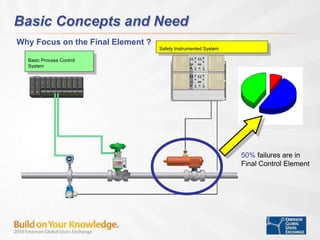
50% failures are in
Final Control Element
Safety Instrumented System
Basic Process Control
System
Why Focus on the Final Element ?
 Typically operate in one position - only move
upon an emergency
 Without mechanical movement, unreliability
inherently increases
 Frequent testing ensures valve availability upon
Demand
 Historically, inexpensive mechanical jammer or
expensive labor intensive pneumatic testing
methods are used
Basic Concepts and Need
Why does the SIS Final Element account for 50% of failures?
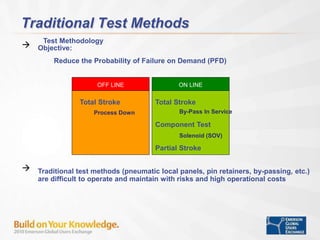
Traditional Test Methods
 Objective:
Reduce the Probability of Failure on Demand (PFD)
OFF LINE
Total Stroke
Process Down
ON LINE
Total Stroke
By-Pass In Service
Component Test
Partial Stroke
Solenoid (SOV)
 Traditional test methods (pneumatic local panels, pin retainers, by-passing, etc.)
are difficult to operate and maintain with risks and high operational costs
Test Methodology
Present Field Issues & Pains
By-pass Valve
Pneumatic panels Mechanical retainers
Existing Test Methods Have High Costs
Logic Solver with Limit Switch
Digital Valve Controller to the Rescue
Simple Operation
Safety Audit
Ensures Valve Returns to Normal Position
Stroke Test Speed
Final Element Variation
Avoiding Accidental Closure Testing
Maintaining the Process
The Test objectives
Digital Valve Controller to the Rescue
Simple Operation
Safety Audit
Ensures Valve Returns to Normal Position
Stroke Test Speed
Final Element Variation
Avoiding Accidental Closure Testing
Maintaining the Process
The Test objectives
IMPROVE PFD
Reduce labor costs
Improve flexibility
Valve exercised to an
extent
Digital Valve Controller to the Rescue
Simple Operation
Safety Audit
Ensures Valve Returns to Normal Position
Stroke Test Speed
Final Element Variation
Avoiding Accidental Closure Testing
Maintaining the Process
The Test objectives
FIELDVUE Partial
Stroke is done on-line.
FIELDVUE Partial
Stroke capable of
being trimmed to suit
the process.
Digital Valve Controller to the Rescue
Simple Operation
Safety Audit
Ensures Valve Returns to Normal Position
Stroke Test Speed
Final Element Variation
Avoiding Accidental Closure Testing
Maintaining the Process
The Test objectives
FIELDVUE Partial
Stroke Test avoid to
casually close the
valve
Digital Valve Controller to the Rescue
Simple Operation
Safety Audit
Ensures Valve Returns to Normal Position
Stroke Test Speed
Final Element Variation
Avoiding Accidental Closure Testing
Maintaining the Process
The Test objectives
FIELDVUE Partial
Stroke Test checks
valve movement and
collects travel and
pressure data.
Digital Valve Controller to the Rescue
Simple Operation
Safety Audit
Ensures Valve Returns to Normal Position
Stroke Test Speed
Final Element Variation
Avoiding Accidental Closure Testing
Maintaining the Process
The Test objectives
FIELDVUE Partial
Stroke could be start
using a simple push
button
Digital Valve Controller to the Rescue
Simple Operation
Safety Audit
Ensures Valve Returns to Normal Position
Stroke Test Speed
Final Element Variation
Avoiding Accidental Closure Testing
Maintaining the Process
The Test objectives
FIELDVUE Partial
Stroke test Speed can
be varied to Suit
Process.
Digital Valve Controller to the Rescue
Simple Operation
Safety Audit
Ensures Valve Returns to Normal Position
Stroke Test Speed
Final Element Variation
Avoiding Accidental Closure Testing
Maintaining the Process
The Test objectives
FIELDVUE Partial
Stroke Test takes
valve to its original
position. If stuck, will
provide an alert.
Travel, pressure and
device condtion
monitored regularly.
Digital Valve Controller to the Rescue
Simple Operation
Safety Audit
Ensures Valve Returns to Normal Position
Stroke Test Speed
Final Element Variation
Avoiding Accidental Closure Testing
Maintaining the Process
The Test objectives
FIELDVUE Partial
Stroke Test result
stored in the
instrument.
ValveLink Audit Trail &
Documentation
Digital Valve Controller to the
Rescue
 Increase SIL Level
– Implementation of Partial Stroking on Final Control Element
improves PFD to achieve better SIL level
 Validation of SIS
– Partial Stroking Validates the proper operation of the FCE
– Final Control Elements are commonly untested and are inherently
unreliable
 Maintains SIL Level
– Safely extend turnaround times
1/PFD(t)
Time
Test Interval
Without testing the PFD increases
PFDavg
The Influence of Partial Stroke testing
Digital Valve Controller to the Rescue
 Partial Stroke “Valve Stuck” ALERT
– If the valve does not move or sticks the Digital
Valve Controller STOPS the test
– Valve returns to normal operation position and
alert is generated
– The valve will not slam shut, causing a plant
“Spurious Trip”
 Trigger ALERT
– Captures valve movement or pressure changes
– Automatically stores travel, pressure and
deviation data in the digital valve controller
Supply Pressure ALERT
– Low supply pressure causes an alert
Unique Alert Features
Digital Valve Controller to the Rescue
 Any safety DEMAND overrides Partial Stroke Test
Mode
 Remote push button test returns to normal
operation if:
– partial stroke fails
– push button is held outside 3-5 seconds
timeframe
– Safety DEMAND occurs
 Write Protection or ‘tamper-proof’ lock
– Deters local unauthorized access to
calibration or configuration parameters
Specific Safeguards
Digital Valve Controller to the Rescue
 Diagnose VALVE failures before
they happen
– Moves the SIS valve into
predictive maintenance
regimes
– Additional diagnostics
• Friction buildup
• Valve shaft shear
• Air supply pressure
deviations
– Option to collect data during
a demand
Diagnostics
Digital Valve Controller to the
Rescue
Diagnostics Enhancements
Digital Valve Controller to the Rescue
Companion Software Alert Log
Companion Software Audit Log
Companion Software Test DataBase
Intrument Alert Log
Last Partial Stroke Test Stored in the
Intrument
Audit Documentation
Port B
Port A
Supply Pressure
0-20 mA Point To Point
Or 0-24 Volts Multidrop
From Logic Solver
0 mA or 0 Volt ESDV Closed
20 mA or 24 Volts ESDV Open
24 Volts DC From Logic Solver
Solenoid Valve Health Monitoring
Port B
Port A
Supply Pressure
0-20 mA Point To Point
Or 0-24 Volts Multidrop
From Logic Solver
0 mA or 0 Volt ESDV Closed
20 mA or 24 Volts ESDV Open
24 Volts DC from Logic Solver
Pressure Measurement Downstream
SOV
Solenoid Valve Health Monitoring
Port B
Port A
Supply Pressure
0-20 mA Point To Point
Or 0-24 Volts Multidrop
From Logic Solver
0 mA or 0 Volt ESDV Closed
20 mA or 24 Volts ESDV Open
24 Volts DC From Logic Solver
PULSE
Solenoid Valve Health Monitoring
 The solenoid valve can be pulsed for a split second
– Long enough so that the solenoid vents
(verification that the solenoid valve is functional)
– Short enough so that the actuator doesn’t bleed
enough pressure to make the SIS valve move.
Critical Evaluation for Solution
 PST Scripted avoiding Human Error
 Chances of Spurious Trip Reduced during PST
 Demand Overrides PST
 “Valve Stuck” Conditions Alerted
 Health Detection of “Final Element”
 SOV Health Monitoring
 Trigger Capability to Capture Safety Demand
Event
 Compare and Overlay Previous Results to Predict
Valve state
 Audit Documentation by Date and Time Stamp
Real Life Examples from Ras Gas - Qatar
IAMS Hardware Architecture in each SIH
IAMS W/S
Field Devices
Hart Mux
Field Devices
I/A DCS
Real Life Examples from Ras Gas - Qatar
AMS Valve Link Suite opened Via Pactware
Real Life Examples from Ras Gas - Qatar
Digital Valve Controller access via AMS
ValveLinkTM Software
Real Life Examples from Ras Gas - Qatar
Full Stroke Test Initiated
Real Life Examples from Ras Gas - Qatar
FST signature taken and saved
Real Life Examples from Ras Gas - Qatar
Initiating a PST
Real Life Examples from Ras Gas - Qatar
PST signature taken and saved
Real Life Examples from Ras Gas - Qatar
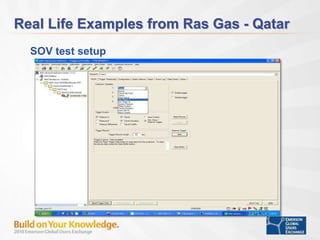
SOV test setup
Real Life Examples from Ras Gas - Qatar
SOV test initiated from DCS
Real Life Examples from Ras Gas - Qatar
Response graph taken and saved
Real Life Examples from Ras Gas - Qatar
Valve Step Response Test
Real Life Examples from Ras Gas - Qatar
Benefits realized
 FST and PST signatures taken during loop check
 FST signature compared with Factory signature
to study valve wear and tear
 PST performed with 10% valve movement
 PST – SOV test signature saved
 Diagnostic errors assist in identifying issues and
enable taking necessary corrective actions
Lesson Learned
 PST Recommendations / Learning
– Use the valve signature to refine the partial stroke test
parameters, such as minimum pressure and upper operating
pressure.
– When a valve fails to move, adjust the speed, minimum
pressure or pause time.
– Map the HART bit of FIELDVUE Instruments to HOST for
getting SOV Health
– Check travel deviation or pressure deviation alert point to
ensure correct configuration, this can be the cause of failure.
– Enable pressure mode to reduce stroke time of valve.
– Test more often than required to exercise valves if necessary.
– Baseline data from initial valve signature is PRICELESS!!!
Business Results Achieved
 Testing valve On Line Improves Reliability and
Plant Availability
 Trigger Data Available in case of “Safety
Demand”
 Continuous Health Monitoring of Final Element
 SOV Integrity Check
 Predictive Maintenance
 Improved PST Flexibility
 Reduced Labor Cost
 Compliance to Regulatory Requirements
 Integration to Logic Solver Possible
Summary
 Possible Issues on Final Element Testing
 Customer Needs and Requirements
 Field Issue and Concerns
 Possible Remedy – Digital solution
 Critical Evaluation of Solution
 Field Experience from Ras Gas
Where To Get More Information
 IEC61508 – Functional Safety of Electrical / Electronic /
Programmable Electronic Safety Related Systems
 IEC61511 – Functional Safety – Safety Instrumented
Systems for Process Industry Sector
 ISA-TR84.00.02-2002 – Part 1 to 5
 Control System Safety Evaluation & Reliability – W M Goble
 Safety Integrity Level Selection – Ed Marszal and Eric
Scharpf

SIS “Final Element” Diagnostics Including The SOV, Using A Digital Valve Controller

  • 1.
    SIS “Final Element”Diagnostics Including The SOV, Using A Digital Valve Controller C B Chakradhaar– Instrument & Control Specialist Riyaz Ali – Director Instruments
  • 2.
    Presenters  C BChakradhaar - I & C Specialist  Riyaz Ali – CFSP
  • 3.
    Introduction SIS “Final ControlElement” Diagnostics by Digital Valve Controller  Basic Concepts and Need  Traditional Test Methods  Present Field Issues & Pains  Digital Valve Controller to the Rescue  SOV Health Monitoring  Critical Evaluation of Solution  Ras Gas (End User) Field Experience  Evaluation of Solution  Lesson Learned
  • 4.
    Dike Passive protectionlayer Emergency response layer Plant and Emergency Response Process Value Normal behaviour Basic Process Control System Process control layer Basic Concepts and Need Operator Intervention Process control layer Process alarm Process Shutdown Trip level alarm Safety Instrumented System Safety layer Emergency Shut Down Prevent Mitigate x x Relief valve, Rupture disk Active protection layer Safety Through Layers of Protection
  • 5.
    Basic Concepts andNeed 50% failures are in Final Control Element Safety Instrumented System Basic Process Control System Why Focus on the Final Element ?
  • 6.
     Typically operatein one position - only move upon an emergency  Without mechanical movement, unreliability inherently increases  Frequent testing ensures valve availability upon Demand  Historically, inexpensive mechanical jammer or expensive labor intensive pneumatic testing methods are used Basic Concepts and Need Why does the SIS Final Element account for 50% of failures?
  • 7.
    Traditional Test Methods Objective: Reduce the Probability of Failure on Demand (PFD) OFF LINE Total Stroke Process Down ON LINE Total Stroke By-Pass In Service Component Test Partial Stroke Solenoid (SOV)  Traditional test methods (pneumatic local panels, pin retainers, by-passing, etc.) are difficult to operate and maintain with risks and high operational costs Test Methodology
  • 8.
    Present Field Issues& Pains By-pass Valve Pneumatic panels Mechanical retainers Existing Test Methods Have High Costs Logic Solver with Limit Switch
  • 9.
    Digital Valve Controllerto the Rescue Simple Operation Safety Audit Ensures Valve Returns to Normal Position Stroke Test Speed Final Element Variation Avoiding Accidental Closure Testing Maintaining the Process The Test objectives
  • 10.
    Digital Valve Controllerto the Rescue Simple Operation Safety Audit Ensures Valve Returns to Normal Position Stroke Test Speed Final Element Variation Avoiding Accidental Closure Testing Maintaining the Process The Test objectives IMPROVE PFD Reduce labor costs Improve flexibility Valve exercised to an extent
  • 11.
    Digital Valve Controllerto the Rescue Simple Operation Safety Audit Ensures Valve Returns to Normal Position Stroke Test Speed Final Element Variation Avoiding Accidental Closure Testing Maintaining the Process The Test objectives FIELDVUE Partial Stroke is done on-line. FIELDVUE Partial Stroke capable of being trimmed to suit the process.
  • 12.
    Digital Valve Controllerto the Rescue Simple Operation Safety Audit Ensures Valve Returns to Normal Position Stroke Test Speed Final Element Variation Avoiding Accidental Closure Testing Maintaining the Process The Test objectives FIELDVUE Partial Stroke Test avoid to casually close the valve
  • 13.
    Digital Valve Controllerto the Rescue Simple Operation Safety Audit Ensures Valve Returns to Normal Position Stroke Test Speed Final Element Variation Avoiding Accidental Closure Testing Maintaining the Process The Test objectives FIELDVUE Partial Stroke Test checks valve movement and collects travel and pressure data.
  • 14.
    Digital Valve Controllerto the Rescue Simple Operation Safety Audit Ensures Valve Returns to Normal Position Stroke Test Speed Final Element Variation Avoiding Accidental Closure Testing Maintaining the Process The Test objectives FIELDVUE Partial Stroke could be start using a simple push button
  • 15.
    Digital Valve Controllerto the Rescue Simple Operation Safety Audit Ensures Valve Returns to Normal Position Stroke Test Speed Final Element Variation Avoiding Accidental Closure Testing Maintaining the Process The Test objectives FIELDVUE Partial Stroke test Speed can be varied to Suit Process.
  • 16.
    Digital Valve Controllerto the Rescue Simple Operation Safety Audit Ensures Valve Returns to Normal Position Stroke Test Speed Final Element Variation Avoiding Accidental Closure Testing Maintaining the Process The Test objectives FIELDVUE Partial Stroke Test takes valve to its original position. If stuck, will provide an alert. Travel, pressure and device condtion monitored regularly.
  • 17.
    Digital Valve Controllerto the Rescue Simple Operation Safety Audit Ensures Valve Returns to Normal Position Stroke Test Speed Final Element Variation Avoiding Accidental Closure Testing Maintaining the Process The Test objectives FIELDVUE Partial Stroke Test result stored in the instrument. ValveLink Audit Trail & Documentation
  • 18.
    Digital Valve Controllerto the Rescue  Increase SIL Level – Implementation of Partial Stroking on Final Control Element improves PFD to achieve better SIL level  Validation of SIS – Partial Stroking Validates the proper operation of the FCE – Final Control Elements are commonly untested and are inherently unreliable  Maintains SIL Level – Safely extend turnaround times 1/PFD(t) Time Test Interval Without testing the PFD increases PFDavg The Influence of Partial Stroke testing
  • 19.
    Digital Valve Controllerto the Rescue  Partial Stroke “Valve Stuck” ALERT – If the valve does not move or sticks the Digital Valve Controller STOPS the test – Valve returns to normal operation position and alert is generated – The valve will not slam shut, causing a plant “Spurious Trip”  Trigger ALERT – Captures valve movement or pressure changes – Automatically stores travel, pressure and deviation data in the digital valve controller Supply Pressure ALERT – Low supply pressure causes an alert Unique Alert Features
  • 20.
    Digital Valve Controllerto the Rescue  Any safety DEMAND overrides Partial Stroke Test Mode  Remote push button test returns to normal operation if: – partial stroke fails – push button is held outside 3-5 seconds timeframe – Safety DEMAND occurs  Write Protection or ‘tamper-proof’ lock – Deters local unauthorized access to calibration or configuration parameters Specific Safeguards
  • 21.
    Digital Valve Controllerto the Rescue  Diagnose VALVE failures before they happen – Moves the SIS valve into predictive maintenance regimes – Additional diagnostics • Friction buildup • Valve shaft shear • Air supply pressure deviations – Option to collect data during a demand Diagnostics
  • 22.
    Digital Valve Controllerto the Rescue Diagnostics Enhancements
  • 23.
    Digital Valve Controllerto the Rescue Companion Software Alert Log Companion Software Audit Log Companion Software Test DataBase Intrument Alert Log Last Partial Stroke Test Stored in the Intrument Audit Documentation
  • 24.
    Port B Port A SupplyPressure 0-20 mA Point To Point Or 0-24 Volts Multidrop From Logic Solver 0 mA or 0 Volt ESDV Closed 20 mA or 24 Volts ESDV Open 24 Volts DC From Logic Solver Solenoid Valve Health Monitoring
  • 25.
    Port B Port A SupplyPressure 0-20 mA Point To Point Or 0-24 Volts Multidrop From Logic Solver 0 mA or 0 Volt ESDV Closed 20 mA or 24 Volts ESDV Open 24 Volts DC from Logic Solver Pressure Measurement Downstream SOV Solenoid Valve Health Monitoring
  • 26.
    Port B Port A SupplyPressure 0-20 mA Point To Point Or 0-24 Volts Multidrop From Logic Solver 0 mA or 0 Volt ESDV Closed 20 mA or 24 Volts ESDV Open 24 Volts DC From Logic Solver PULSE Solenoid Valve Health Monitoring
  • 27.
    Solenoid Valve HealthMonitoring  The solenoid valve can be pulsed for a split second – Long enough so that the solenoid vents (verification that the solenoid valve is functional) – Short enough so that the actuator doesn’t bleed enough pressure to make the SIS valve move.
  • 28.
    Critical Evaluation forSolution  PST Scripted avoiding Human Error  Chances of Spurious Trip Reduced during PST  Demand Overrides PST  “Valve Stuck” Conditions Alerted  Health Detection of “Final Element”  SOV Health Monitoring  Trigger Capability to Capture Safety Demand Event  Compare and Overlay Previous Results to Predict Valve state  Audit Documentation by Date and Time Stamp
  • 29.
    Real Life Examplesfrom Ras Gas - Qatar
  • 30.
    Real Life Examplesfrom Ras Gas - Qatar IAMS Hardware Architecture in each SIH IAMS W/S Field Devices Hart Mux Field Devices I/A DCS
  • 31.
    Real Life Examplesfrom Ras Gas - Qatar AMS Valve Link Suite opened Via Pactware
  • 32.
    Real Life Examplesfrom Ras Gas - Qatar Digital Valve Controller access via AMS ValveLinkTM Software
  • 33.
    Real Life Examplesfrom Ras Gas - Qatar Full Stroke Test Initiated
  • 34.
    Real Life Examplesfrom Ras Gas - Qatar FST signature taken and saved
  • 35.
    Real Life Examplesfrom Ras Gas - Qatar Initiating a PST
  • 36.
    Real Life Examplesfrom Ras Gas - Qatar PST signature taken and saved
  • 37.
    Real Life Examplesfrom Ras Gas - Qatar SOV test setup
  • 38.
    Real Life Examplesfrom Ras Gas - Qatar SOV test initiated from DCS
  • 39.
    Real Life Examplesfrom Ras Gas - Qatar Response graph taken and saved
  • 40.
    Real Life Examplesfrom Ras Gas - Qatar Valve Step Response Test
  • 41.
    Real Life Examplesfrom Ras Gas - Qatar Benefits realized  FST and PST signatures taken during loop check  FST signature compared with Factory signature to study valve wear and tear  PST performed with 10% valve movement  PST – SOV test signature saved  Diagnostic errors assist in identifying issues and enable taking necessary corrective actions
  • 42.
    Lesson Learned  PSTRecommendations / Learning – Use the valve signature to refine the partial stroke test parameters, such as minimum pressure and upper operating pressure. – When a valve fails to move, adjust the speed, minimum pressure or pause time. – Map the HART bit of FIELDVUE Instruments to HOST for getting SOV Health – Check travel deviation or pressure deviation alert point to ensure correct configuration, this can be the cause of failure. – Enable pressure mode to reduce stroke time of valve. – Test more often than required to exercise valves if necessary. – Baseline data from initial valve signature is PRICELESS!!!
  • 43.
    Business Results Achieved Testing valve On Line Improves Reliability and Plant Availability  Trigger Data Available in case of “Safety Demand”  Continuous Health Monitoring of Final Element  SOV Integrity Check  Predictive Maintenance  Improved PST Flexibility  Reduced Labor Cost  Compliance to Regulatory Requirements  Integration to Logic Solver Possible
  • 44.
    Summary  Possible Issueson Final Element Testing  Customer Needs and Requirements  Field Issue and Concerns  Possible Remedy – Digital solution  Critical Evaluation of Solution  Field Experience from Ras Gas
  • 45.
    Where To GetMore Information  IEC61508 – Functional Safety of Electrical / Electronic / Programmable Electronic Safety Related Systems  IEC61511 – Functional Safety – Safety Instrumented Systems for Process Industry Sector  ISA-TR84.00.02-2002 – Part 1 to 5  Control System Safety Evaluation & Reliability – W M Goble  Safety Integrity Level Selection – Ed Marszal and Eric Scharpf