Safety Integrity Level
(SIL)
By
A.K. Gupta
ADIS: P-4, Ch.2
ALLOCATING SAFETY INTEGRITY LEVELS
IN PRACTICE
1. Introduction
2. Safety Integrity
3. Safety Integrity Levels
4. Risk Acceptability
5. Allocating SILs
6. Problems
7. Conclusions
2
1. Introduction
• Industrial safety in pre-digital era focused
mainly around:
– safe work practices,
– hazardous materials control, and
– the protective “armouring” of personnel and
equipment (PPE and machine guarding)
3
Introduction
• Today, safety penetrates far deeper into more
complex manufacturing infrastructures,
extending its protective influence all the way
to a company’s bottom line.
• Contemporary safety systems reduce risk with
operational advancements that improve
reliability, productivity and profitability as
well.
4
Introduction
• What is a Risky System?
5
Can you
answer?
Introduction
• What is a Risky System?
• It is a system with an unacceptable
combination of:
• probability of occurrence of harm
and
• the severity of that harm.
6
Introduction
• Document the safety requirements
specification
• Justify selection of control devices
7
Assess risk and mitigate it
• The risk assessment should be followed by the
assignment of Safety Integrity Levels (SILs)
8
2. Safety Integrity
• It is the ability of a safety function to continue
to be effective in spite of deterioration of its
implementation
9
Safety Integrity
• Things can go wrong, so we need additional functionality
– Safety functions to reduce the risks (redundancy)
• Safety functions can have varied implementation measures
• active functionality
• design properties
• administrative measures
• any combination of the above
 Safety functions help in reducing the risks.
 Failure of part of the implementation does not mean total loss
of the safety function. (Example: Failure of one solenoid out
of 3 in series does not affect the system.)
10
3. Safety Integrity Levels
• The degree or level of Safety Integrity is determined by:
• the number of safety measures implemented
• how effective they are
• how vulnerable they are
• how independent they are
• … and so on.
• Many different degrees of safety integrity, grouped into 5
levels (0–4):
• SIL 0 = no safety integrity at all
• ...
• SIL 4 = highest possible safety integrity level
• For "important" safety functions, a high SIL will be needed.
• Safety Integrity Levels depend on Risk Acceptability.
11
Safety Integrity Level (SIL)
12
SIL Inference Risk
Reduction
Availability
(%) *
4 (Highest Safety
Integrity Level) 10-4 to 10-5 10,000 to 100,000 99.99 to 99.999
3 10-3 to 10-4 1,000 to 10,000 99.9 to 99.99
2 10-2 to 10-3 100 to 1,000 99 to 99.9
1 10-1 to 10-2 10 to 100 90 to 99
0 (No safety
integrity level at all) < 10-1 < 10 < 90
* Likelihood (%) that failure would not occur.
4. Risk Acceptability
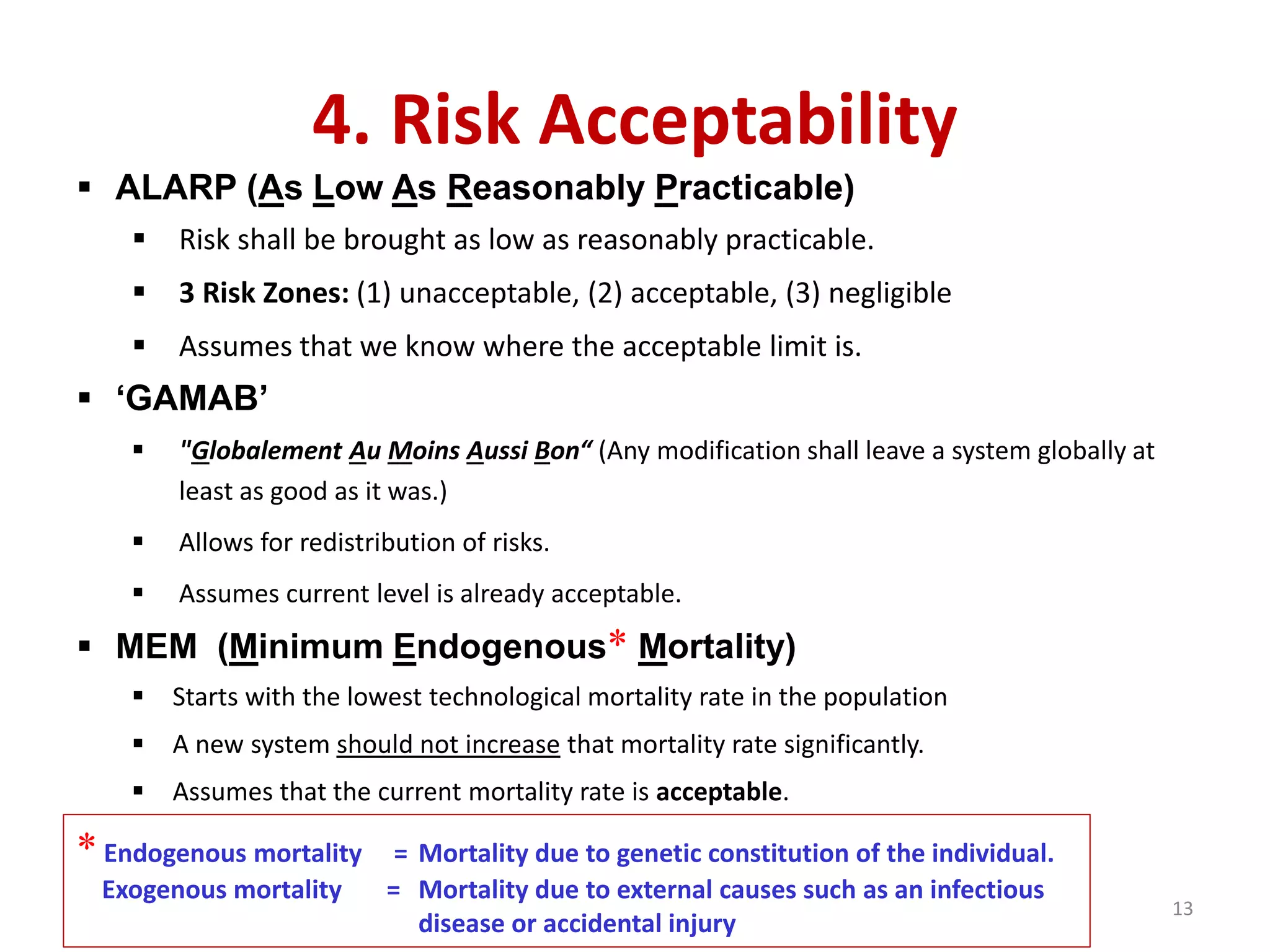
 ALARP (As Low As Reasonably Practicable)
 Risk shall be brought as low as reasonably practicable.
 3 Risk Zones: (1) unacceptable, (2) acceptable, (3) negligible
 Assumes that we know where the acceptable limit is.
 ‘GAMAB’
 "Globalement Au Moins Aussi Bon“ (Any modification shall leave a system globally at
least as good as it was.)
 Allows for redistribution of risks.
 Assumes current level is already acceptable.
 MEM (Minimum Endogenous* Mortality)
 Starts with the lowest technological mortality rate in the population
 A new system should not increase that mortality rate significantly.
 Assumes that the current mortality rate is acceptable.
*Endogenous mortality = Mortality due to genetic constitution of the individual.
Exogenous mortality = Mortality due to external causes such as an infectious
disease or accidental injury
13
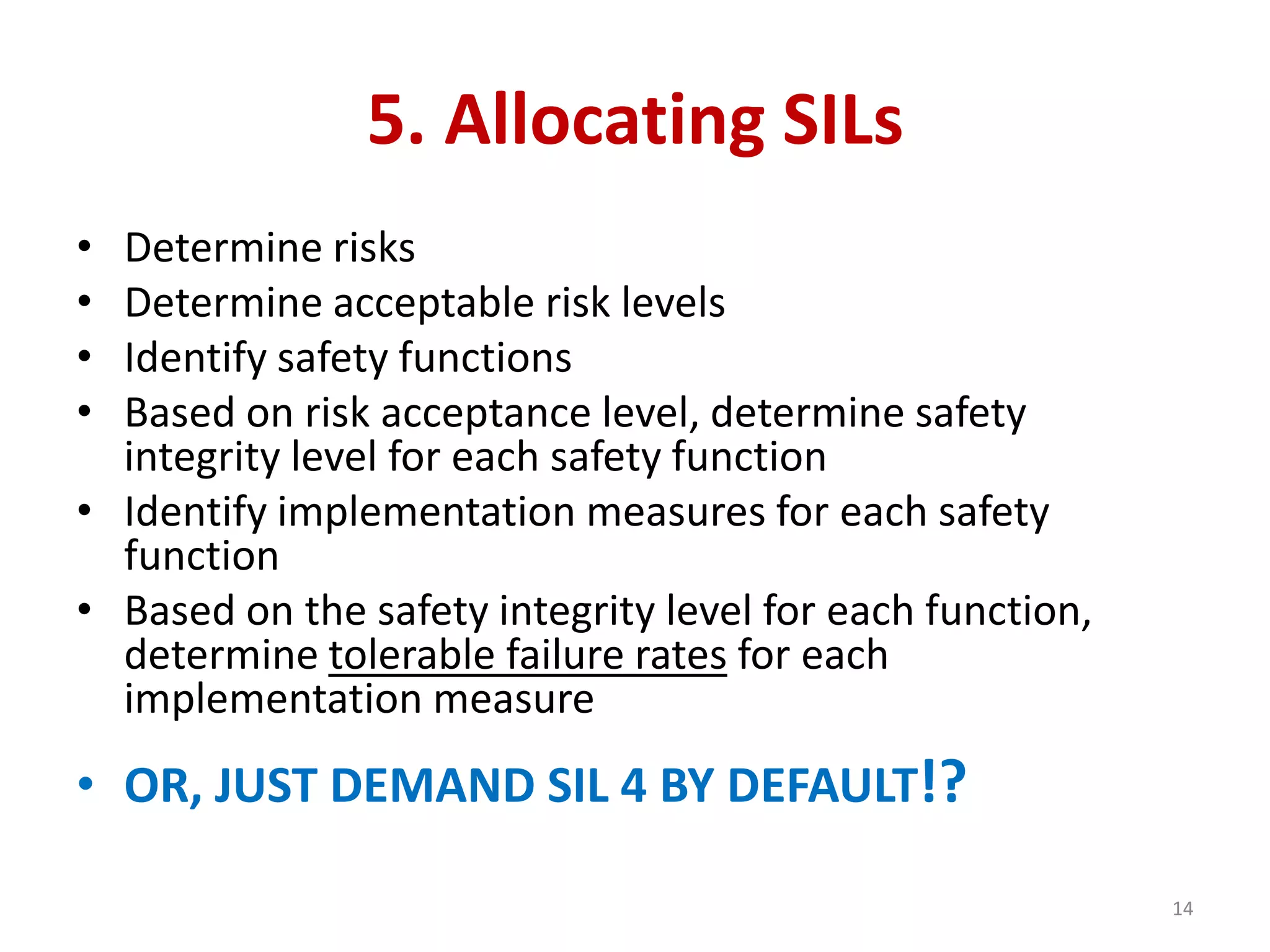
5. Allocating SILs
• Determine risks
• Determine acceptable risk levels
• Identify safety functions
• Based on risk acceptance level, determine safety
integrity level for each safety function
• Identify implementation measures for each safety
function
• Based on the safety integrity level for each function,
determine tolerable failure rates for each
implementation measure
• OR, JUST DEMAND SIL 4 BY DEFAULT!?
14
6. Problems
– SIL 4 is VERY EXPENSIVE.
– Systems that have been working satisfactorily
don't necessarily fulfill SIL 4 requirements.
• So, think: Do we always need SIL 4?
– The relationship between failure rates and SILs is
often misunderstood:
• SILs depend on failure rates of safety functions and
not on failure rates of equipment.
– Risk acceptability is controversial.
15
7. Conclusions
 Agreed methods for determining acceptable risk levels
must be determined
 Demanding the highest safety integrity level by default
can be uneconomic decision.
• A proper analysis could show that a lower safety integrity
level is sufficient.
 Non-technical measures for implementing safety
functions must be included in the analyses
 Apply the standards correctly:
• Perform risk acceptability analyses first
• Next, identify the safety functions
• Then allocate SILs.
* * * * * 16
Thank you for
your attention
17

SIL.ppt

  • 1.
  • 2.
    ALLOCATING SAFETY INTEGRITYLEVELS IN PRACTICE 1. Introduction 2. Safety Integrity 3. Safety Integrity Levels 4. Risk Acceptability 5. Allocating SILs 6. Problems 7. Conclusions 2
  • 3.
    1. Introduction • Industrialsafety in pre-digital era focused mainly around: – safe work practices, – hazardous materials control, and – the protective “armouring” of personnel and equipment (PPE and machine guarding) 3
  • 4.
    Introduction • Today, safetypenetrates far deeper into more complex manufacturing infrastructures, extending its protective influence all the way to a company’s bottom line. • Contemporary safety systems reduce risk with operational advancements that improve reliability, productivity and profitability as well. 4
  • 5.
    Introduction • What isa Risky System? 5 Can you answer?
  • 6.
    Introduction • What isa Risky System? • It is a system with an unacceptable combination of: • probability of occurrence of harm and • the severity of that harm. 6
  • 7.
    Introduction • Document thesafety requirements specification • Justify selection of control devices 7
  • 8.
    Assess risk andmitigate it • The risk assessment should be followed by the assignment of Safety Integrity Levels (SILs) 8
  • 9.
    2. Safety Integrity •It is the ability of a safety function to continue to be effective in spite of deterioration of its implementation 9
  • 10.
    Safety Integrity • Thingscan go wrong, so we need additional functionality – Safety functions to reduce the risks (redundancy) • Safety functions can have varied implementation measures • active functionality • design properties • administrative measures • any combination of the above  Safety functions help in reducing the risks.  Failure of part of the implementation does not mean total loss of the safety function. (Example: Failure of one solenoid out of 3 in series does not affect the system.) 10
  • 11.
    3. Safety IntegrityLevels • The degree or level of Safety Integrity is determined by: • the number of safety measures implemented • how effective they are • how vulnerable they are • how independent they are • … and so on. • Many different degrees of safety integrity, grouped into 5 levels (0–4): • SIL 0 = no safety integrity at all • ... • SIL 4 = highest possible safety integrity level • For "important" safety functions, a high SIL will be needed. • Safety Integrity Levels depend on Risk Acceptability. 11
  • 12.
    Safety Integrity Level(SIL) 12 SIL Inference Risk Reduction Availability (%) * 4 (Highest Safety Integrity Level) 10-4 to 10-5 10,000 to 100,000 99.99 to 99.999 3 10-3 to 10-4 1,000 to 10,000 99.9 to 99.99 2 10-2 to 10-3 100 to 1,000 99 to 99.9 1 10-1 to 10-2 10 to 100 90 to 99 0 (No safety integrity level at all) < 10-1 < 10 < 90 * Likelihood (%) that failure would not occur.
  • 13.
    4. Risk Acceptability ALARP (As Low As Reasonably Practicable)  Risk shall be brought as low as reasonably practicable.  3 Risk Zones: (1) unacceptable, (2) acceptable, (3) negligible  Assumes that we know where the acceptable limit is.  ‘GAMAB’  "Globalement Au Moins Aussi Bon“ (Any modification shall leave a system globally at least as good as it was.)  Allows for redistribution of risks.  Assumes current level is already acceptable.  MEM (Minimum Endogenous* Mortality)  Starts with the lowest technological mortality rate in the population  A new system should not increase that mortality rate significantly.  Assumes that the current mortality rate is acceptable. *Endogenous mortality = Mortality due to genetic constitution of the individual. Exogenous mortality = Mortality due to external causes such as an infectious disease or accidental injury 13
  • 14.
    5. Allocating SILs •Determine risks • Determine acceptable risk levels • Identify safety functions • Based on risk acceptance level, determine safety integrity level for each safety function • Identify implementation measures for each safety function • Based on the safety integrity level for each function, determine tolerable failure rates for each implementation measure • OR, JUST DEMAND SIL 4 BY DEFAULT!? 14
  • 15.
    6. Problems – SIL4 is VERY EXPENSIVE. – Systems that have been working satisfactorily don't necessarily fulfill SIL 4 requirements. • So, think: Do we always need SIL 4? – The relationship between failure rates and SILs is often misunderstood: • SILs depend on failure rates of safety functions and not on failure rates of equipment. – Risk acceptability is controversial. 15
  • 16.
    7. Conclusions  Agreedmethods for determining acceptable risk levels must be determined  Demanding the highest safety integrity level by default can be uneconomic decision. • A proper analysis could show that a lower safety integrity level is sufficient.  Non-technical measures for implementing safety functions must be included in the analyses  Apply the standards correctly: • Perform risk acceptability analyses first • Next, identify the safety functions • Then allocate SILs. * * * * * 16
  • 17.
    Thank you for yourattention 17