Arif Rahman – The Production Systems 1
Slide 5
Single Station
Arif Rahman, ST MT
Arif Rahman – The Production Systems
Most common manufacturing system in
industry
Operation is independent of other stations
Perform either processing or assembly
operations
Can be designed for:
¤ Single model production
¤ Batch production
¤ Mixed model production
Single-Station Manufacturing Cells
2
Arif Rahman – The Production Systems
M
(Manual)
A
(Automated)
TypeI
Single Station Manufacturing Cells
3
Arif Rahman – The Production Systems
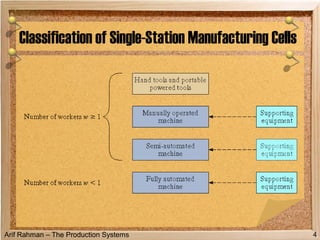
Classification of Single-Station Manufacturing Cells
4
Arif Rahman – The Production Systems
“One worker tending one production machine
(most common model)”
Most widely used production method, especially
in job shop and batch production
Reasons for popularity:
¤ Shortest time to implement
¤ Requires least capital investment
¤ Easiest to install and operate
¤ Typically, the lowest unit cost for low production
¤ Most flexible for product or part changeovers
Single-Station Manned Cell
5
Arif Rahman – The Production Systems
Worker operating a standard machine tool
¤ Worker loads & unloads parts, operates machine
¤ Machine is manually operated
¤ Worker attention required continuously or for
most of the cycle
Worker operating semi-automatic machine
¤ Worker loads & unloads parts, change cutting
tools, starts semi-automatic work cycle
¤ Worker attention not required continuously during
entire work cycle
Worker using hand tools or portable power
tools at one location
Single-Station Manned Cell Examples
6
Arif Rahman – The Production Systems
Two (or more) workers required to operate
machine (n = 1, w > 1)
¤ Two workers required to manipulate heavy forging at
forge press
¤ Welder and fitter in arc welding work cell
¤ Multiple workers combining their efforts to assemble
one large piece of machinery at a single assembly
station
One principal production machine plus support
equipment
¤ Drying equipment for a manually operated injection
moulding machine
¤ Trimming shears at impression-die forge hammer to
trim flash from forged part
Variations of Single-Station Manned Cell
7
Arif Rahman – The Production Systems
“Fully automated production machine capable of
operating unattended for longer than one work
cycle”
Worker not required except for periodic tending
Reasons why it is important:
¤ labour cost is reduced
¤ Easiest and least expensive automated system to
implement
¤ Production rates usually higher than manned cell
¤ First step in implementing an integrated multi-station
automated system
Single-Station Automated Cell
8
Arif Rahman – The Production Systems
Drying equipment used to dry the
incoming plastic moulding compound
plays a supporting role to the moulding
machine
A robot loading and unloading an
automated production machine
Bowl feeders and other parts-feeding
devices used to deliver components in a
single robot assembly cell
Single-Station Automated Cell: supporting equipment
9
Arif Rahman – The Production Systems
For single model and batch model production:
¤ Programmed operation for all steps in work cycle
¤ Parts storage subsystem
¤ Automatic loading, unloading, and transfer between
parts storage subsystem and machine
¤ Periodic attention of worker for removal of finished
work units, resupply of starting work units, changes
tools, and other machine tending
¤ Built-in safeguards to avoid self-destructive operation
or damage to work units or unsafe to workers
Enablers for Unattended Cell Operation
10
Arif Rahman – The Production Systems
For mixed model production:
¤ All of the preceding enablers, plus:
¤ Work unit identification:
• Automatic identification (e.g., bar codes) or
sensors that recognize alternative features of
starting units
• If starting units are the same, work unit
identification is unnecessary
¤ Capability to download programs for each work unit
style (programs prepared in advance)
¤ Capability for quick changeover of physical setup
Enablers for Unattended Cell Operation
11
Arif Rahman – The Production Systems
Are necessary conditions for unattended operation
Given a capacity = np parts in the storage subsystem, the cell can
theoretically operate for a time
where:
UT = unattended time of operation (min)
np = parts storage capacity of the storage
subsystem (pc)
Tc = cycle time of the automated workstation
(min/pc)
¤ In reality, unattended time will be less than UT because the
worker needs time to unload finished parts and load raw work
parts into the storage subsystem
Parts Storage Subsystem and Automatic Parts Transfer
12
cpTnUT =
Arif Rahman – The Production Systems
Typical objectives in defining the desired parts
storage capacity np:
¤ Make npTc = a fixed time interval that allows one
worker to tend multiple machines
¤ Make npTc = time between scheduled tool changes
¤ Make npTc = one complete shift
¤ Make npTc = one overnight (“lights-out operation”)
The time of unattended operation increases
directly with storage capacity, so there is an
advantage to designing the storage subsystem
with sufficient capacity to satisfy the plant’s
operational objectives.
Parts Storage Capacity
13
Arif Rahman – The Production Systems
Example: two-position automatic pallet changer
(APC)
With no pallet changer, work cycle elements of
loading/unloading and processing would have to
be performed sequentially
where:
Tm = machine time
Ts = worker service time
Storage Capacity of One Part
14
smc TTT +=
Arif Rahman – The Production Systems
Example: two-position automatic pallet
changer (APC)
With pallet changer, work cycle elements
can be performed simultaneously
where:
Tr = repositioning time of pallet changer
Storage Capacity of One Part
15
{ } rsmc TTTT += ,max
Arif Rahman – The Production Systems
CNC Machining centre with Automatic Pallet Changer - Stores One Part
16
Arif Rahman – The Production Systems
Machining centres:
¤ Various designs of parts storage unit interfaced to
automatic pallet changer (or other automated transfer
mechanism)
Turning centres:
¤ Industrial robot interface with parts carousel
Plastic moulding or extrusion:
¤ Hopper contains sufficient moulding compound for
unattended operation
Sheet metal stamping:
¤ Starting material is sheet metal coil
Storage Capacities Greater Than One
17
Arif Rahman – The Production Systems
Storage Capacities Greater Than One
18
Machining centre and automatic pallet
changer with pallet holders arranged
radially; parts storage capacity = 5
Arif Rahman – The Production Systems
Storage Capacities Greater Than One
19
Machining centre and in-line shuttle cart
system with pallet holders along its length;
parts storage capacity = 16
Arif Rahman – The Production Systems
Storage Capacities Greater Than One
20
Machining centre with pallets held on
indexing table; parts storage capacity = 6
Arif Rahman – The Production Systems
Storage Capacities Greater Than One
21
Machining centre and parts storage
carousel with parts loaded onto pallets;
parts storage capacity = 12
Arif Rahman – The Production Systems
CNC machining centre (MC) with worker to load/unload
CNC turning centre (TC) with worker to load/unload
Cluster of two CNC turning centres with time sharing of
one worker to load/unload
Plastic injection moulding on semi-automatic cycle with
worker to unload moulding, sprue, and runner
One worker at electronics subassembly workstation
inserting components into PCB
Stamping press with worker loading blanks and
unloading stampings each cycle
Applications of Single Station Manned Cells
22
Arif Rahman – The Production Systems
CNC MC with APC and parts storage subsystem
CNC TC with robot and parts storage carousel
Cluster of ten CNC TCs, each with robot and parts
storage carousel, and time sharing of one worker to
load/unload the carousels
Plastic injection moulding on automatic cycle with robot
arm to unload moulding, sprue, and runner
Electronics assembly station with automated insertion
machine inserting components into PCBs
Stamping press stamps parts from long coil
Applications of Single Station Automated Cells
23
Arif Rahman – The Production Systems
“Machine tool capable of performing multiple
operations that use rotating tools on a work part
in one setup under NC control”
Typical operations: milling, drilling, and related
operations
Typical features to reduce non-productive time:
¤ Automatic tool changer
¤ Automatic work part positioning
¤ Automatic pallet changer
CNC Machining centre
24
Arif Rahman – The Production Systems
CNC Horizontal Machining centre
25
Arif Rahman – The Production Systems
“Machine tool capable of performing
multiple operations on a rotating work part
in one setup under NC control”
Typical operations:
¤ Turning and related operations, e.g., contour
turning
¤ Drilling and related operations along work part
axis of rotation
CNC Turning centre
26
Arif Rahman – The Production Systems
CNC Turning centre
27
Arif Rahman – The Production Systems
Automated Stamping Press
28
Stamping press on automatic cycle
producing stampings from sheet metal coil
Arif Rahman – The Production Systems
“Machine tool capable of performing
multiple operations either with single point
turning tools or rotating cutters in one
setup under NC control”
Typical operations:
¤ Turning, milling, drilling and related operations
Enabling feature:
¤ Capability to control position of c-axis in addition to x-
and z-axis control (turning centre is limited to x- and
z-axis control)
CNC Mill-Turn centre
29
Arif Rahman – The Production Systems
Part with Mill-Turn Features
30
Example part with turned, milled, and
drilled features
Arif Rahman – The Production Systems
Sequence of Operations of a Mill-Turn centre for Example Part
31
1. Turn smaller diameter,
2. Mill flat with part in programmed angular positions, four
positions for square cross section,
3. Drill hole with part in programmed angular position, and
4. Cut-off of the machined piece
Arif Rahman – The Production Systems
How many workstations are required to
satisfy production requirements
How many machines can be assigned to
one worker in a machine cluster (a
collection of two or more identical or
similar machines that are serviced by one
worker)
Analysis of Single-Station Cells
32
Arif Rahman – The Production Systems
Determine the total workload that must be
accomplished in a certain period (hour,
week, month, year), where workload is
defined as the total hours required to
complete a given amount of work or to
produce a given number of work units
scheduled during the period
Divide the workload by the hours available
on one workstation in the same period
Analysis of Single-Station Cells: number of workstations required
33
Arif Rahman – The Production Systems
where:
WL = workload scheduled for a given period
(hr of work/hr or hr of work/wk)
Q = quantity to be produced during the period
(pc/hr or pc/wk)
Tc = cycle time required per piece (hr/pc)
Analysis of Single-Station Cells: number of workstations required
34
cQTWL =
Arif Rahman – The Production Systems
If the workload includes multiple parts or
product styles that all be produced on the
same type of workstation:
Analysis of Single-Station Cells: number of workstations required
35
cj
P
j
jTQWL ∑=
=
1
Arif Rahman – The Production Systems
Number of workstations:
where:
n = number of workstations
AT = available time on one station in the period
(hr/period)
Analysis of Single-Station Cells: number of workstations required
36
AT
WL
n =
Arif Rahman – The Production Systems
A total of 800 shafts must be produced in the lathe
section of the machine shop during a particular
week. Each shaft is identical and requires a
machine cycle time Tc = 11.5 minutes. All of the
lathes in the department are equivalent in terms of
their capability to produce shaft in the specified
cycle time.
How many lathes must be devoted to shaft
production during the given week, if there are 40 hr
of available time on each lathe?
Example 1:
37
Arif Rahman – The Production Systems
Several factors that complicate the
computation of the number of workstations
¤ Setup time in batch production
¤ Availability/reliability
¤ Utilization
¤ Worker efficiency
¤ Defect rate
Analysis of Single-Station Cells: number of workstations required
38
Arif Rahman – The Production Systems
Previous Example, suppose that a setup will
be required for each lathe that used to
satisfy the production requirements. The
lathe setup for this type of parts take 3.5 hr.
How many lathes are required during the
week?
Low utilization or overtime?
Example 2:
39
Arif Rahman – The Production Systems
A total of 800 shafts must be produced in the lathe
section of the machine shop during a particular
week. The shafts are of 20 different types, each
type being produced in its own batch. Average
batch size is 40 parts. Each batch requires a setup
and the average setup time in 3.5 hr. The average
machine cycle time to produce a shaft Tc = 11.5
min.
How many lathes are required during the week?
Example 3:
40
Arif Rahman – The Production Systems
where:
AT = available time (hr)
T = actual clock time during the period (hr)
A = availability
U = utilization
Analysis of Single-Station Cells: number of workstations required
41
UATAT ⋅⋅=
Arif Rahman – The Production Systems
Worker efficiency: the number of work
units actually completed by the worker in a
given period divided by the number of
units that would be produced at standard
performance
An efficiency greater than 1.00 reduces
the workload, while an efficiency less than
1.00 increases the workload
Analysis of Single-Station Cells: number of workstations required
42
Arif Rahman – The Production Systems
Defect rate: the fraction of parts produced
that are defective
A defect rate greater than zero increases
the quantity of work units that must be
processed in order to yield the desired
quantity
Analysis of Single-Station Cells: number of workstations required
43
Arif Rahman – The Production Systems
The relationship between the starting
quantity and the quantity produced:
where:
Q = quantity of good units made in the
process
Qo = original or starting quantity
q = fraction defect rate
Analysis of Single-Station Cells: number of workstations required
44
( )qQQ o −= 1
Arif Rahman – The Production Systems
The combined effect of worker efficiency
and fraction defect rate
where:
Ew = worker efficiency
q = fraction defect rate
Analysis of Single-Station Cells: number of workstations required
45
( ) w
c
E
T
q
Q
WL
−
=
1
Arif Rahman – The Production Systems
Suppose last example that the anticipated
availability of the lathes is 95%, and the expected
utilization for calculation purposes is 100%. The
expected worker efficiency during production =
110% and during setup = 100%. The fraction
defect rate for the lathe work of this type is 3%.
Other data from previous example are applicable.
How many lathes are required during the week,
given this additional information?
Example 4:
46
Arif Rahman – The Production Systems
The manning level is reduced from M = 1 to M =
1/n where n = # machines assigned to the worker
Conditions must be satisfied to organize a
collection of machines into a machine cluster:
¤ The semi-automatic machine cycle is long relative to
the service portion of the cycle that requires the
worker’s attention
¤ The semi-automatic machine cycle time is the same
for all machines
¤ The machines that the worker would service are
located in close enough proximity to allow time to
walk between them
¤ The work rules of the plant permit a worker to service
more than one machine
Analysis of Single-Station Cells: machine clusters
47
Arif Rahman – The Production Systems
For the system to be perfectly balanced in
terms of worker time and machine cycle time
where:
n = number of machines
Tm = machine semi-automatic cycle time (min)
Ts = worker service time per machine (min)
Tr = worker positioning time between machines
(min)
Analysis of Single-Station Cells: machine clusters
48
( ) smrs TTTTn +=+
Arif Rahman – The Production Systems
The number of machines that should be
assigned to one worker:
Analysis of Single-Station Cells: machine clusters
49
rs
sm
TT
TT
n
+
+
=
Arif Rahman – The Production Systems
n will not be an integer
¤ n1 = the integer that is less than n
¤ n2 = the integer that is greater than n
Determine which of alternatives is
preferable by introducing cost factors into
analysis
¤ CL = the labour cost rate
¤ Cm = machine cost rate
Analysis of Single-Station Cells: machine clusters
50
Arif Rahman – The Production Systems
Case 1: n1 = maximum integer ≤ n
¤ The worker will have idle time, and the cycle
time of the machine cluster will be the cycle
time of the machines
¤ Assuming one work unit is produced by each
machine during a cycle, we have the following
cost:
Analysis of Single-Station Cells: machine clusters
51
smc TTT +=
Arif Rahman – The Production Systems
Case 1: n1 = maximum integer ≤ n
where:
Cpc(n1) = cost per work unit ($/pc)
CL = labour cost rate ($/min)
Cm = cost rate per machine ($/min)
(Tm + Ts) is expressed in minutes
Analysis of Single-Station Cells: machine clusters
52
( ) ( )smm
L
pc TTC
n
C
nC +





+=
1
1
Arif Rahman – The Production Systems
Case 2: n2 = minimum integer > n
¤ The machines will have idle time, and the
cycle time of the machine cluster will be the
time it takes for the worker to service the n2
machines
Analysis of Single-Station Cells: machine clusters
53
( )rsc TTnT += 2
Arif Rahman – The Production Systems
Case 2: n2 = minimum integer > n
¤ The corresponding cost per piece is given by:
Analysis of Single-Station Cells: machine clusters
54
( ) ( )( )rsmLpc TTnCCnC ++= 22
Arif Rahman – The Production Systems
Case 3: in the absence of cost data
needed to make these calculations, the
corresponding number of machines to
assign the worker is therefore given by:
Analysis of Single-Station Cells: machine clusters
55
rs
sm
TT
TT
n
+
+
≤= intmax1
Arif Rahman – The Production Systems
A machine shop contains many CNC lathes that
operate on a semi-automatic machining cycle
under part program control. A significant number of
these machines produce the same part, whose
machining cycle time = 2.75 min. One worker is
required to perform unloading and loading of parts
at the end of each machining cycle. This takes 25
sec.
Determine how many machines one worker can service if
it takes an average of 20 sec to walk between the
machines and no machine idle time is allowed.
Example 5:
56
Arif Rahman – The Production Systems 57
It’s end of slides…It’s end of slides…
…… Any question ?Any question ?

05 single station

  • 1.
    Arif Rahman –The Production Systems 1 Slide 5 Single Station Arif Rahman, ST MT
  • 2.
    Arif Rahman –The Production Systems Most common manufacturing system in industry Operation is independent of other stations Perform either processing or assembly operations Can be designed for: ¤ Single model production ¤ Batch production ¤ Mixed model production Single-Station Manufacturing Cells 2
  • 3.
    Arif Rahman –The Production Systems M (Manual) A (Automated) TypeI Single Station Manufacturing Cells 3
  • 4.
    Arif Rahman –The Production Systems Classification of Single-Station Manufacturing Cells 4
  • 5.
    Arif Rahman –The Production Systems “One worker tending one production machine (most common model)” Most widely used production method, especially in job shop and batch production Reasons for popularity: ¤ Shortest time to implement ¤ Requires least capital investment ¤ Easiest to install and operate ¤ Typically, the lowest unit cost for low production ¤ Most flexible for product or part changeovers Single-Station Manned Cell 5
  • 6.
    Arif Rahman –The Production Systems Worker operating a standard machine tool ¤ Worker loads & unloads parts, operates machine ¤ Machine is manually operated ¤ Worker attention required continuously or for most of the cycle Worker operating semi-automatic machine ¤ Worker loads & unloads parts, change cutting tools, starts semi-automatic work cycle ¤ Worker attention not required continuously during entire work cycle Worker using hand tools or portable power tools at one location Single-Station Manned Cell Examples 6
  • 7.
    Arif Rahman –The Production Systems Two (or more) workers required to operate machine (n = 1, w > 1) ¤ Two workers required to manipulate heavy forging at forge press ¤ Welder and fitter in arc welding work cell ¤ Multiple workers combining their efforts to assemble one large piece of machinery at a single assembly station One principal production machine plus support equipment ¤ Drying equipment for a manually operated injection moulding machine ¤ Trimming shears at impression-die forge hammer to trim flash from forged part Variations of Single-Station Manned Cell 7
  • 8.
    Arif Rahman –The Production Systems “Fully automated production machine capable of operating unattended for longer than one work cycle” Worker not required except for periodic tending Reasons why it is important: ¤ labour cost is reduced ¤ Easiest and least expensive automated system to implement ¤ Production rates usually higher than manned cell ¤ First step in implementing an integrated multi-station automated system Single-Station Automated Cell 8
  • 9.
    Arif Rahman –The Production Systems Drying equipment used to dry the incoming plastic moulding compound plays a supporting role to the moulding machine A robot loading and unloading an automated production machine Bowl feeders and other parts-feeding devices used to deliver components in a single robot assembly cell Single-Station Automated Cell: supporting equipment 9
  • 10.
    Arif Rahman –The Production Systems For single model and batch model production: ¤ Programmed operation for all steps in work cycle ¤ Parts storage subsystem ¤ Automatic loading, unloading, and transfer between parts storage subsystem and machine ¤ Periodic attention of worker for removal of finished work units, resupply of starting work units, changes tools, and other machine tending ¤ Built-in safeguards to avoid self-destructive operation or damage to work units or unsafe to workers Enablers for Unattended Cell Operation 10
  • 11.
    Arif Rahman –The Production Systems For mixed model production: ¤ All of the preceding enablers, plus: ¤ Work unit identification: • Automatic identification (e.g., bar codes) or sensors that recognize alternative features of starting units • If starting units are the same, work unit identification is unnecessary ¤ Capability to download programs for each work unit style (programs prepared in advance) ¤ Capability for quick changeover of physical setup Enablers for Unattended Cell Operation 11
  • 12.
    Arif Rahman –The Production Systems Are necessary conditions for unattended operation Given a capacity = np parts in the storage subsystem, the cell can theoretically operate for a time where: UT = unattended time of operation (min) np = parts storage capacity of the storage subsystem (pc) Tc = cycle time of the automated workstation (min/pc) ¤ In reality, unattended time will be less than UT because the worker needs time to unload finished parts and load raw work parts into the storage subsystem Parts Storage Subsystem and Automatic Parts Transfer 12 cpTnUT =
  • 13.
    Arif Rahman –The Production Systems Typical objectives in defining the desired parts storage capacity np: ¤ Make npTc = a fixed time interval that allows one worker to tend multiple machines ¤ Make npTc = time between scheduled tool changes ¤ Make npTc = one complete shift ¤ Make npTc = one overnight (“lights-out operation”) The time of unattended operation increases directly with storage capacity, so there is an advantage to designing the storage subsystem with sufficient capacity to satisfy the plant’s operational objectives. Parts Storage Capacity 13
  • 14.
    Arif Rahman –The Production Systems Example: two-position automatic pallet changer (APC) With no pallet changer, work cycle elements of loading/unloading and processing would have to be performed sequentially where: Tm = machine time Ts = worker service time Storage Capacity of One Part 14 smc TTT +=
  • 15.
    Arif Rahman –The Production Systems Example: two-position automatic pallet changer (APC) With pallet changer, work cycle elements can be performed simultaneously where: Tr = repositioning time of pallet changer Storage Capacity of One Part 15 { } rsmc TTTT += ,max
  • 16.
    Arif Rahman –The Production Systems CNC Machining centre with Automatic Pallet Changer - Stores One Part 16
  • 17.
    Arif Rahman –The Production Systems Machining centres: ¤ Various designs of parts storage unit interfaced to automatic pallet changer (or other automated transfer mechanism) Turning centres: ¤ Industrial robot interface with parts carousel Plastic moulding or extrusion: ¤ Hopper contains sufficient moulding compound for unattended operation Sheet metal stamping: ¤ Starting material is sheet metal coil Storage Capacities Greater Than One 17
  • 18.
    Arif Rahman –The Production Systems Storage Capacities Greater Than One 18 Machining centre and automatic pallet changer with pallet holders arranged radially; parts storage capacity = 5
  • 19.
    Arif Rahman –The Production Systems Storage Capacities Greater Than One 19 Machining centre and in-line shuttle cart system with pallet holders along its length; parts storage capacity = 16
  • 20.
    Arif Rahman –The Production Systems Storage Capacities Greater Than One 20 Machining centre with pallets held on indexing table; parts storage capacity = 6
  • 21.
    Arif Rahman –The Production Systems Storage Capacities Greater Than One 21 Machining centre and parts storage carousel with parts loaded onto pallets; parts storage capacity = 12
  • 22.
    Arif Rahman –The Production Systems CNC machining centre (MC) with worker to load/unload CNC turning centre (TC) with worker to load/unload Cluster of two CNC turning centres with time sharing of one worker to load/unload Plastic injection moulding on semi-automatic cycle with worker to unload moulding, sprue, and runner One worker at electronics subassembly workstation inserting components into PCB Stamping press with worker loading blanks and unloading stampings each cycle Applications of Single Station Manned Cells 22
  • 23.
    Arif Rahman –The Production Systems CNC MC with APC and parts storage subsystem CNC TC with robot and parts storage carousel Cluster of ten CNC TCs, each with robot and parts storage carousel, and time sharing of one worker to load/unload the carousels Plastic injection moulding on automatic cycle with robot arm to unload moulding, sprue, and runner Electronics assembly station with automated insertion machine inserting components into PCBs Stamping press stamps parts from long coil Applications of Single Station Automated Cells 23
  • 24.
    Arif Rahman –The Production Systems “Machine tool capable of performing multiple operations that use rotating tools on a work part in one setup under NC control” Typical operations: milling, drilling, and related operations Typical features to reduce non-productive time: ¤ Automatic tool changer ¤ Automatic work part positioning ¤ Automatic pallet changer CNC Machining centre 24
  • 25.
    Arif Rahman –The Production Systems CNC Horizontal Machining centre 25
  • 26.
    Arif Rahman –The Production Systems “Machine tool capable of performing multiple operations on a rotating work part in one setup under NC control” Typical operations: ¤ Turning and related operations, e.g., contour turning ¤ Drilling and related operations along work part axis of rotation CNC Turning centre 26
  • 27.
    Arif Rahman –The Production Systems CNC Turning centre 27
  • 28.
    Arif Rahman –The Production Systems Automated Stamping Press 28 Stamping press on automatic cycle producing stampings from sheet metal coil
  • 29.
    Arif Rahman –The Production Systems “Machine tool capable of performing multiple operations either with single point turning tools or rotating cutters in one setup under NC control” Typical operations: ¤ Turning, milling, drilling and related operations Enabling feature: ¤ Capability to control position of c-axis in addition to x- and z-axis control (turning centre is limited to x- and z-axis control) CNC Mill-Turn centre 29
  • 30.
    Arif Rahman –The Production Systems Part with Mill-Turn Features 30 Example part with turned, milled, and drilled features
  • 31.
    Arif Rahman –The Production Systems Sequence of Operations of a Mill-Turn centre for Example Part 31 1. Turn smaller diameter, 2. Mill flat with part in programmed angular positions, four positions for square cross section, 3. Drill hole with part in programmed angular position, and 4. Cut-off of the machined piece
  • 32.
    Arif Rahman –The Production Systems How many workstations are required to satisfy production requirements How many machines can be assigned to one worker in a machine cluster (a collection of two or more identical or similar machines that are serviced by one worker) Analysis of Single-Station Cells 32
  • 33.
    Arif Rahman –The Production Systems Determine the total workload that must be accomplished in a certain period (hour, week, month, year), where workload is defined as the total hours required to complete a given amount of work or to produce a given number of work units scheduled during the period Divide the workload by the hours available on one workstation in the same period Analysis of Single-Station Cells: number of workstations required 33
  • 34.
    Arif Rahman –The Production Systems where: WL = workload scheduled for a given period (hr of work/hr or hr of work/wk) Q = quantity to be produced during the period (pc/hr or pc/wk) Tc = cycle time required per piece (hr/pc) Analysis of Single-Station Cells: number of workstations required 34 cQTWL =
  • 35.
    Arif Rahman –The Production Systems If the workload includes multiple parts or product styles that all be produced on the same type of workstation: Analysis of Single-Station Cells: number of workstations required 35 cj P j jTQWL ∑= = 1
  • 36.
    Arif Rahman –The Production Systems Number of workstations: where: n = number of workstations AT = available time on one station in the period (hr/period) Analysis of Single-Station Cells: number of workstations required 36 AT WL n =
  • 37.
    Arif Rahman –The Production Systems A total of 800 shafts must be produced in the lathe section of the machine shop during a particular week. Each shaft is identical and requires a machine cycle time Tc = 11.5 minutes. All of the lathes in the department are equivalent in terms of their capability to produce shaft in the specified cycle time. How many lathes must be devoted to shaft production during the given week, if there are 40 hr of available time on each lathe? Example 1: 37
  • 38.
    Arif Rahman –The Production Systems Several factors that complicate the computation of the number of workstations ¤ Setup time in batch production ¤ Availability/reliability ¤ Utilization ¤ Worker efficiency ¤ Defect rate Analysis of Single-Station Cells: number of workstations required 38
  • 39.
    Arif Rahman –The Production Systems Previous Example, suppose that a setup will be required for each lathe that used to satisfy the production requirements. The lathe setup for this type of parts take 3.5 hr. How many lathes are required during the week? Low utilization or overtime? Example 2: 39
  • 40.
    Arif Rahman –The Production Systems A total of 800 shafts must be produced in the lathe section of the machine shop during a particular week. The shafts are of 20 different types, each type being produced in its own batch. Average batch size is 40 parts. Each batch requires a setup and the average setup time in 3.5 hr. The average machine cycle time to produce a shaft Tc = 11.5 min. How many lathes are required during the week? Example 3: 40
  • 41.
    Arif Rahman –The Production Systems where: AT = available time (hr) T = actual clock time during the period (hr) A = availability U = utilization Analysis of Single-Station Cells: number of workstations required 41 UATAT ⋅⋅=
  • 42.
    Arif Rahman –The Production Systems Worker efficiency: the number of work units actually completed by the worker in a given period divided by the number of units that would be produced at standard performance An efficiency greater than 1.00 reduces the workload, while an efficiency less than 1.00 increases the workload Analysis of Single-Station Cells: number of workstations required 42
  • 43.
    Arif Rahman –The Production Systems Defect rate: the fraction of parts produced that are defective A defect rate greater than zero increases the quantity of work units that must be processed in order to yield the desired quantity Analysis of Single-Station Cells: number of workstations required 43
  • 44.
    Arif Rahman –The Production Systems The relationship between the starting quantity and the quantity produced: where: Q = quantity of good units made in the process Qo = original or starting quantity q = fraction defect rate Analysis of Single-Station Cells: number of workstations required 44 ( )qQQ o −= 1
  • 45.
    Arif Rahman –The Production Systems The combined effect of worker efficiency and fraction defect rate where: Ew = worker efficiency q = fraction defect rate Analysis of Single-Station Cells: number of workstations required 45 ( ) w c E T q Q WL − = 1
  • 46.
    Arif Rahman –The Production Systems Suppose last example that the anticipated availability of the lathes is 95%, and the expected utilization for calculation purposes is 100%. The expected worker efficiency during production = 110% and during setup = 100%. The fraction defect rate for the lathe work of this type is 3%. Other data from previous example are applicable. How many lathes are required during the week, given this additional information? Example 4: 46
  • 47.
    Arif Rahman –The Production Systems The manning level is reduced from M = 1 to M = 1/n where n = # machines assigned to the worker Conditions must be satisfied to organize a collection of machines into a machine cluster: ¤ The semi-automatic machine cycle is long relative to the service portion of the cycle that requires the worker’s attention ¤ The semi-automatic machine cycle time is the same for all machines ¤ The machines that the worker would service are located in close enough proximity to allow time to walk between them ¤ The work rules of the plant permit a worker to service more than one machine Analysis of Single-Station Cells: machine clusters 47
  • 48.
    Arif Rahman –The Production Systems For the system to be perfectly balanced in terms of worker time and machine cycle time where: n = number of machines Tm = machine semi-automatic cycle time (min) Ts = worker service time per machine (min) Tr = worker positioning time between machines (min) Analysis of Single-Station Cells: machine clusters 48 ( ) smrs TTTTn +=+
  • 49.
    Arif Rahman –The Production Systems The number of machines that should be assigned to one worker: Analysis of Single-Station Cells: machine clusters 49 rs sm TT TT n + + =
  • 50.
    Arif Rahman –The Production Systems n will not be an integer ¤ n1 = the integer that is less than n ¤ n2 = the integer that is greater than n Determine which of alternatives is preferable by introducing cost factors into analysis ¤ CL = the labour cost rate ¤ Cm = machine cost rate Analysis of Single-Station Cells: machine clusters 50
  • 51.
    Arif Rahman –The Production Systems Case 1: n1 = maximum integer ≤ n ¤ The worker will have idle time, and the cycle time of the machine cluster will be the cycle time of the machines ¤ Assuming one work unit is produced by each machine during a cycle, we have the following cost: Analysis of Single-Station Cells: machine clusters 51 smc TTT +=
  • 52.
    Arif Rahman –The Production Systems Case 1: n1 = maximum integer ≤ n where: Cpc(n1) = cost per work unit ($/pc) CL = labour cost rate ($/min) Cm = cost rate per machine ($/min) (Tm + Ts) is expressed in minutes Analysis of Single-Station Cells: machine clusters 52 ( ) ( )smm L pc TTC n C nC +      += 1 1
  • 53.
    Arif Rahman –The Production Systems Case 2: n2 = minimum integer > n ¤ The machines will have idle time, and the cycle time of the machine cluster will be the time it takes for the worker to service the n2 machines Analysis of Single-Station Cells: machine clusters 53 ( )rsc TTnT += 2
  • 54.
    Arif Rahman –The Production Systems Case 2: n2 = minimum integer > n ¤ The corresponding cost per piece is given by: Analysis of Single-Station Cells: machine clusters 54 ( ) ( )( )rsmLpc TTnCCnC ++= 22
  • 55.
    Arif Rahman –The Production Systems Case 3: in the absence of cost data needed to make these calculations, the corresponding number of machines to assign the worker is therefore given by: Analysis of Single-Station Cells: machine clusters 55 rs sm TT TT n + + ≤= intmax1
  • 56.
    Arif Rahman –The Production Systems A machine shop contains many CNC lathes that operate on a semi-automatic machining cycle under part program control. A significant number of these machines produce the same part, whose machining cycle time = 2.75 min. One worker is required to perform unloading and loading of parts at the end of each machining cycle. This takes 25 sec. Determine how many machines one worker can service if it takes an average of 20 sec to walk between the machines and no machine idle time is allowed. Example 5: 56
  • 57.
    Arif Rahman –The Production Systems 57 It’s end of slides…It’s end of slides… …… Any question ?Any question ?

Editor's Notes

  • #38 Q = 800; Tc = 11.5; AT = 40; WL= 9200 min = 153.33 hr; n = 3.83 N = 3, OT = 11,1/MACHINES N = 4, U = 95.75%
  • #40 AT=40-3.5=36.5; n=4.2 U = 4.2/5 = 84% OT = (3.5 + 153.33/4) – 40 = 1.83; tot = 1.83*4 = 7.33
  • #41 Setup: 3.5*20/40 = 1.75; Prod: 800*11.5/60/40=3.83; Tot = 5,583
  • #47 Setup WL = 20*3.5/1 = 70 AT = 40*1*1 = 40 N = 70/40 = 1.75 Prod WL = 20*40*11.5/60 : 1.10*(1-003) = 143.7 AT = 40 * 0.95 * 1 = 38 N = 143.7/38 = 3.78 N tot = 5.53
  • #57 Tm = 2.75 Ts = 25/60 Tr = 20/60 N1 = 4.22 Tc = 3.167 Service time = 4 * 0.4167 = 1.667 Walking = 4*0.333=1.333 Idle = 0.167 = 10 s