©2008 Pearson Education, Inc.,
Upper Saddle River, NJ. All
rights reserved. This material
is protected under all copyright
laws as they currently exist.
No portion of this material may
be reproduced, in any form or
by any means, without
Manufacturing System Defined
A collection of integrated equipment and human
resources, whose function is to perform one or
more processing and/or assembly operations on a
starting raw material, part, or set of parts
• Equipment includes
– Production machines and tools
– Material handling and work positioning devices
– Computer systems
• Human resources are required either full-time or
periodically to keep the system running
©2008 Pearson Education, Inc.,
Upper Saddle River, NJ. All
rights reserved. This material
is protected under all copyright
laws as they currently exist.
No portion of this material may
be reproduced, in any form or
by any means, without
permission in writing from the
Examples of Manufacturing Systems
• Single-station cells
• Machine clusters
• Manual assembly lines
• Automated transfer lines
• Automated assembly systems
• Machine cells (cellular manufacturing)
• Flexible manufacturing systems
©2008 Pearson Education, Inc.,
Upper Saddle River, NJ. All
rights reserved. This material
is protected under all copyright
laws as they currently exist.
No portion of this material may
be reproduced, in any form or
by any means, without
permission in writing from the
Components of a
Manufacturing System
1. Production machines
2. Material handling system
3. Computer system to coordinate and/or control
the preceding components
4. Human workers to operate and manage the
system
©2008 Pearson Education, Inc.,
Upper Saddle River, NJ. All
rights reserved. This material
is protected under all copyright
laws as they currently exist.
No portion of this material may
be reproduced, in any form or
by any means, without
permission in writing from the
Production Machines
• In virtually all modern manufacturing systems,
most of the actual processing or assembly work
is accomplished by machines or with the aid of
tools
• Classification of production machines:
1. Manually operated machines are controlled or
supervised by a human worker
2. Semi-automated machines perform a portion of the
work cycle under some form of program control, and
a worker tends the machine the rest of the cycle
3. Fully automated machines operate for extended
periods of time with no human attention
Classification of
Manufacturing Systems
• Factors that define and distinguish
manufacturing systems:
1. Types of operations
2. Number of workstations
3. System layout
4. Automation and manning level
5. Part or product variety
Types of Operations Performed
• Processing versus assembly operations
• Type(s) of materials processed
• Size and weight of work units
• Part or product complexity
– For assembled products, number of components per
product
– For individual parts, number of distinct operations to
complete processing
• Part geometry
– For machined parts, rotational vs. non-rotational
Number of Workstations
• Convenient measure of the size of the system
– Let n = number of workstations
– Individual workstations can be identified by subscript i,
where i = 1, 2, ..., n
• Affects performance factors such as workload
capacity, production rate, and reliability
– As n increases, this usually means greater workload
capacity and higher production rate
– There must be a synergistic effect that derives from n
multiple stations working together vs. n single stations
System Layout
• Applies mainly to multi-station systems
• Fixed routing vs. variable routing
– In systems with fixed routing, workstations are
usually arranged linearly
– In systems with variable routing, a variety of layouts
are possible
• System layout is an important factor in
determining the most appropriate type of
material handling system
Automation and Manning Levels
• Level of workstation automation
– Manually operated
– Semi-automated
– Fully automated
• Manning level Mi = proportion of time worker is in
attendance at station i
– Mi = 1 means that one worker must be at the station
continuously
– Mi  1 indicates manual operations
– Mi < 1 usually denotes some form of automation
Part or Product Variety:
Flexibility
The degree to which the system is capable of
dealing with variations in the parts or products it
produces
• Three cases:
1. Single-model case - all parts or products are identical
2. Batch-model case - different parts or products are
produced by the system, but they are produced in
batches because changeovers are required
3. Mixed-model case - different parts or products are
produced by the system, but the system can handle
the differences without the need for time-consuming
changes in setup
Single-Station Manufacturing Cells
• Most common manufacturing system in industry
• Operation is independent of other stations
• Perform either processing or assembly operations
• Can be designed for:
– Single model production
– Batch production
– Mixed model production
Single-Station Manned Cell
One worker tending one production machine
(most common model)
• Most widely used production method,
especially in job shop and batch production
• Reasons for popularity:
– Shortest time to implement
– Requires least capital investment
– Easiest to install and operate
– Typically, the lowest unit cost for low production
– Most flexible for product or part changeovers
Single-Station Manned Cell
Examples
• Worker operating a standard machine tool
– Worker loads & unloads parts, operates machine
– Machine is manually operated
• Worker operating semi-automatic machine
– Worker loads & unloads parts, starts semi-automatic
work cycle
– Worker attention not required continuously during
entire work cycle
• Worker using hand tools or portable power tools
at one location
Single-Station Automated Cell
Fully automated production machine capable of
operating unattended for longer than one work
cycle
• Worker not required except for periodic tending
• Reasons why it is important:
– Labor cost is reduced
– Easiest and least expensive automated system to
implement
– Production rates usually higher than manned cell
– First step in implementing an integrated multi-station
automated system
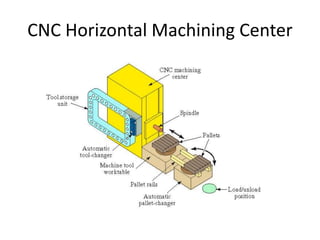
CNC Horizontal Machining Center
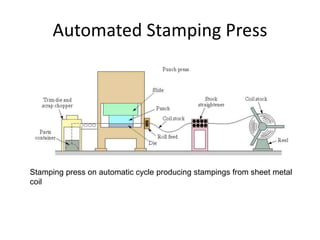
Automated Stamping Press
Stamping press on automatic cycle producing stampings from sheet metal
coil
Manual Assembly Lines
• Factors favoring the use of assembly lines:
– High or medium demand for product
– Identical or similar products
– Total work content can be divided into work
elements
– It is technologically impossible or economically
infeasible to automate the assembly operations
• Most consumer products are assembled on
manual assembly lines
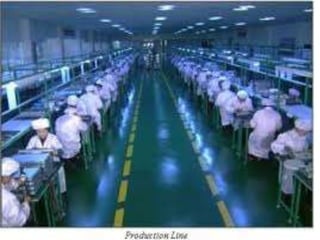
Manual Assembly Line Defined
A production line consisting of a sequence of
workstations where assembly tasks are
performed by human workers as the product
moves along the line
• Organized to produce a single product or a
limited range of products
– Each product consists of multiple components joined
together by various assembly work elements
• Total work content - the sum of all work elements required
to assemble one product unit on the line
©2008 Pearson Education, Inc.,
Upper Saddle River, NJ. All
rights reserved. This material
is protected under all copyright
laws as they currently exist.
No portion of this material may
be reproduced, in any form or
by any means, without
permission in writing from the
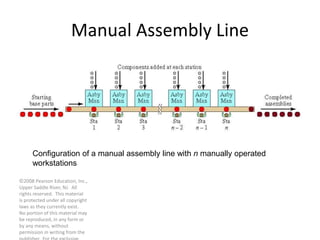
Manual Assembly Line
Configuration of a manual assembly line with n manually operated
workstations
©2008 Pearson Education, Inc.,
Upper Saddle River, NJ. All
rights reserved. This material
is protected under all copyright
laws as they currently exist.
No portion of this material may
be reproduced, in any form or
by any means, without
permission in writing from the
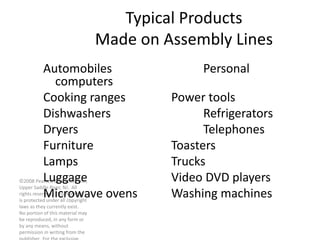
Typical Products
Made on Assembly Lines
Automobiles Personal
computers
Cooking ranges Power tools
Dishwashers Refrigerators
Dryers Telephones
Furniture Toasters
Lamps Trucks
Luggage Video DVD players
Microwave ovens Washing machines
©2008 Pearson Education, Inc.,
Upper Saddle River, NJ. All
rights reserved. This material
is protected under all copyright
laws as they currently exist.
No portion of this material may
be reproduced, in any form or
by any means, without
permission in writing from the
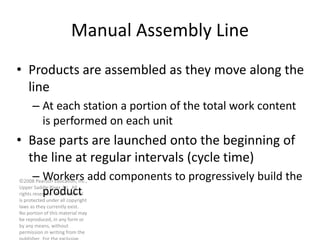
Manual Assembly Line
• Products are assembled as they move along the
line
– At each station a portion of the total work content
is performed on each unit
• Base parts are launched onto the beginning of
the line at regular intervals (cycle time)
– Workers add components to progressively build the
product
©2008 Pearson Education, Inc.,
Upper Saddle River, NJ. All
rights reserved. This material
is protected under all copyright
laws as they currently exist.
No portion of this material may
be reproduced, in any form or
by any means, without
permission in writing from the
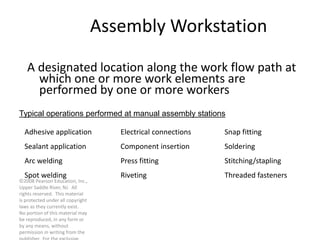
Assembly Workstation
A designated location along the work flow path at
which one or more work elements are
performed by one or more workers
Typical operations performed at manual assembly stations
Adhesive application
Sealant application
Arc welding
Spot welding
Electrical connections
Component insertion
Press fitting
Riveting
Snap fitting
Soldering
Stitching/stapling
Threaded fasteners
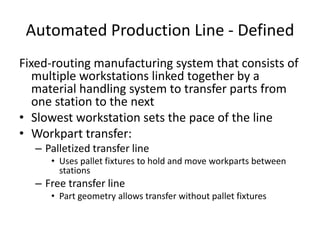
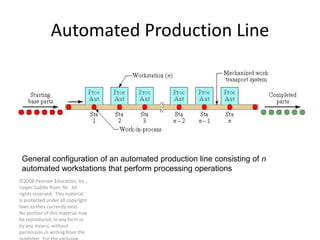
Automated Production Line - Defined
Fixed-routing manufacturing system that consists of
multiple workstations linked together by a
material handling system to transfer parts from
one station to the next
• Slowest workstation sets the pace of the line
• Workpart transfer:
– Palletized transfer line
• Uses pallet fixtures to hold and move workparts between
stations
– Free transfer line
• Part geometry allows transfer without pallet fixtures
©2008 Pearson Education, Inc.,
Upper Saddle River, NJ. All
rights reserved. This material
is protected under all copyright
laws as they currently exist.
No portion of this material may
be reproduced, in any form or
by any means, without
permission in writing from the
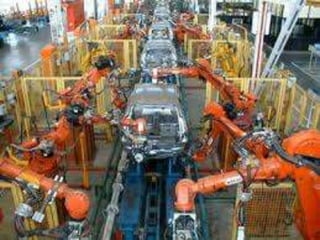
Automated Production Line
General configuration of an automated production line consisting of n
automated workstations that perform processing operations
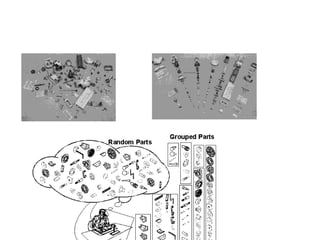
Group Technology (GT) Defined
A manufacturing philosophy in which similar parts
are identified and grouped together to take
advantage of their similarities in design and
production
• Similarities among parts permit them to be
classified into part families
– In each part family, processing steps are similar
• The improvement is typically achieved by
organizing the production facilities into
manufacturing cells that specialize in production
of certain part families
Overview of Group Technology
• Parts in the medium production quantity
range are usually made in batches
• Disadvantages of batch production:
– Downtime for changeovers
– High inventory carrying costs
• GT minimizes these disadvantages by
recognizing that although the parts are
different, there are groups of parts that
possess similarities
Part Families and
Cellular Manufacturing
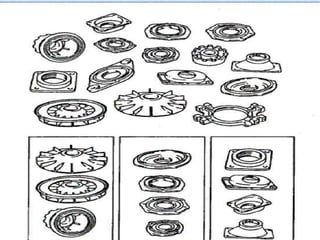
• GT exploits the part similarities by utilizing
similar processes and tooling to produce them
• Machines are grouped into cells, each cell
specializing in the production of a part family
– Called cellular manufacturing
• Cellular manufacturing can be implemented by
manual or automated methods
– When automated, the term flexible manufacturing
system is often applied
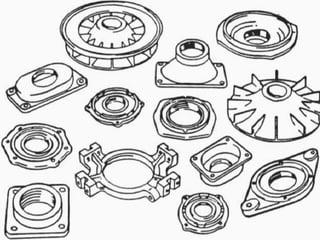
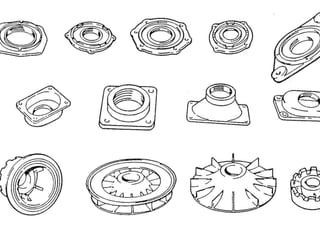
Part Family
A collection of parts that possess similarities in
geometric shape and size, or in the processing
steps used in their manufacture
• Part families are a central feature of group
technology
– There are always differences among parts in a
family
– But the similarities are close enough that the parts
can be grouped into the same family
Part Families
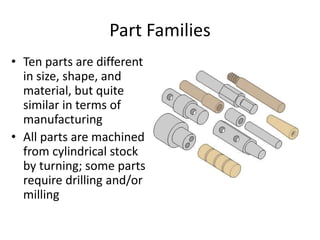
• Ten parts are different
in size, shape, and
material, but quite
similar in terms of
manufacturing
• All parts are machined
from cylindrical stock
by turning; some parts
require drilling and/or
milling
Cellular Manufacturing
Application of group technology in which dissimilar
machines or processes are aggregated into cells,
each of which is dedicated to the production of a
part family or limited group of families
• Typical objectives of cellular manufacturing:
– To shorten manufacturing lead times
– To reduce WIP
– To improve quality
– To simplify production scheduling
– To reduce setup times
©2008 Pearson Education, Inc.,
Upper Saddle River, NJ. All
rights reserved. This material
is protected under all copyright
laws as they currently exist.
No portion of this material may
be reproduced, in any form or
by any means, without
permission in writing from the
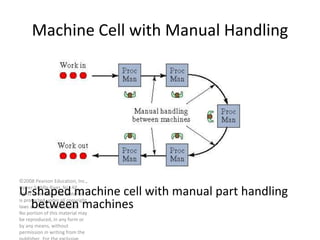
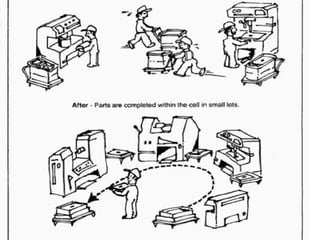
Machine Cell with Manual Handling
U-shaped machine cell with manual part handling
between machines
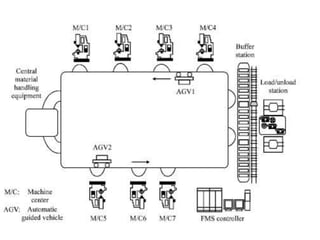
Flexible Manufacturing System -
Defined
A highly automated GT machine cell, consisting of a
group of processing stations (usually CNC machine
tools), interconnected by an automated material
handling and storage system, and controlled by an
integrated computer system
• The FMS relies on the principles of GT
– No manufacturing system can produce an unlimited
range of products
– An FMS is capable of producing a single part family or a
limited range of part families
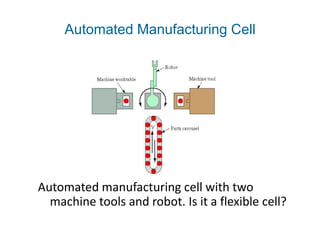
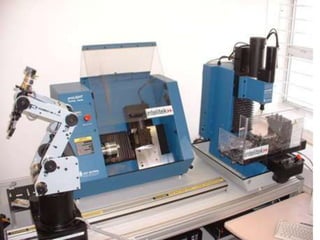
Automated manufacturing cell with two
machine tools and robot. Is it a flexible cell?
Automated Manufacturing Cell
• http://www.stacicorp.com/video-tours
https://books.google.com.pk/books?id=aSCxYL
WA0pwC&pg=PA106&lpg=PA106&dq=differen
ce+between+machine+cell+and+cluster&sourc
e=bl&ots=tIfO5AXslB&sig=MewKFy1-
wVspgQPjFvnLanqrKUw&hl=en&sa=X&ei=oWD
IVPqPFdHUoASlgIHoCg&ved=0CFAQ6AEwCQ#v
=onepage&q=difference%20between%20mach
ine%20cell%20and%20cluster&f=false

Manufacturing System Defined mechanical.pptx

  • 1.
    ©2008 Pearson Education,Inc., Upper Saddle River, NJ. All rights reserved. This material is protected under all copyright laws as they currently exist. No portion of this material may be reproduced, in any form or by any means, without Manufacturing System Defined A collection of integrated equipment and human resources, whose function is to perform one or more processing and/or assembly operations on a starting raw material, part, or set of parts • Equipment includes – Production machines and tools – Material handling and work positioning devices – Computer systems • Human resources are required either full-time or periodically to keep the system running
  • 2.
    ©2008 Pearson Education,Inc., Upper Saddle River, NJ. All rights reserved. This material is protected under all copyright laws as they currently exist. No portion of this material may be reproduced, in any form or by any means, without permission in writing from the Examples of Manufacturing Systems • Single-station cells • Machine clusters • Manual assembly lines • Automated transfer lines • Automated assembly systems • Machine cells (cellular manufacturing) • Flexible manufacturing systems
  • 3.
    ©2008 Pearson Education,Inc., Upper Saddle River, NJ. All rights reserved. This material is protected under all copyright laws as they currently exist. No portion of this material may be reproduced, in any form or by any means, without permission in writing from the Components of a Manufacturing System 1. Production machines 2. Material handling system 3. Computer system to coordinate and/or control the preceding components 4. Human workers to operate and manage the system
  • 4.
    ©2008 Pearson Education,Inc., Upper Saddle River, NJ. All rights reserved. This material is protected under all copyright laws as they currently exist. No portion of this material may be reproduced, in any form or by any means, without permission in writing from the Production Machines • In virtually all modern manufacturing systems, most of the actual processing or assembly work is accomplished by machines or with the aid of tools • Classification of production machines: 1. Manually operated machines are controlled or supervised by a human worker 2. Semi-automated machines perform a portion of the work cycle under some form of program control, and a worker tends the machine the rest of the cycle 3. Fully automated machines operate for extended periods of time with no human attention
  • 5.
    Classification of Manufacturing Systems •Factors that define and distinguish manufacturing systems: 1. Types of operations 2. Number of workstations 3. System layout 4. Automation and manning level 5. Part or product variety
  • 6.
    Types of OperationsPerformed • Processing versus assembly operations • Type(s) of materials processed • Size and weight of work units • Part or product complexity – For assembled products, number of components per product – For individual parts, number of distinct operations to complete processing • Part geometry – For machined parts, rotational vs. non-rotational
  • 7.
    Number of Workstations •Convenient measure of the size of the system – Let n = number of workstations – Individual workstations can be identified by subscript i, where i = 1, 2, ..., n • Affects performance factors such as workload capacity, production rate, and reliability – As n increases, this usually means greater workload capacity and higher production rate – There must be a synergistic effect that derives from n multiple stations working together vs. n single stations
  • 8.
    System Layout • Appliesmainly to multi-station systems • Fixed routing vs. variable routing – In systems with fixed routing, workstations are usually arranged linearly – In systems with variable routing, a variety of layouts are possible • System layout is an important factor in determining the most appropriate type of material handling system
  • 9.
    Automation and ManningLevels • Level of workstation automation – Manually operated – Semi-automated – Fully automated • Manning level Mi = proportion of time worker is in attendance at station i – Mi = 1 means that one worker must be at the station continuously – Mi  1 indicates manual operations – Mi < 1 usually denotes some form of automation
  • 10.
    Part or ProductVariety: Flexibility The degree to which the system is capable of dealing with variations in the parts or products it produces • Three cases: 1. Single-model case - all parts or products are identical 2. Batch-model case - different parts or products are produced by the system, but they are produced in batches because changeovers are required 3. Mixed-model case - different parts or products are produced by the system, but the system can handle the differences without the need for time-consuming changes in setup
  • 11.
    Single-Station Manufacturing Cells •Most common manufacturing system in industry • Operation is independent of other stations • Perform either processing or assembly operations • Can be designed for: – Single model production – Batch production – Mixed model production
  • 12.
    Single-Station Manned Cell Oneworker tending one production machine (most common model) • Most widely used production method, especially in job shop and batch production • Reasons for popularity: – Shortest time to implement – Requires least capital investment – Easiest to install and operate – Typically, the lowest unit cost for low production – Most flexible for product or part changeovers
  • 13.
    Single-Station Manned Cell Examples •Worker operating a standard machine tool – Worker loads & unloads parts, operates machine – Machine is manually operated • Worker operating semi-automatic machine – Worker loads & unloads parts, starts semi-automatic work cycle – Worker attention not required continuously during entire work cycle • Worker using hand tools or portable power tools at one location
  • 14.
    Single-Station Automated Cell Fullyautomated production machine capable of operating unattended for longer than one work cycle • Worker not required except for periodic tending • Reasons why it is important: – Labor cost is reduced – Easiest and least expensive automated system to implement – Production rates usually higher than manned cell – First step in implementing an integrated multi-station automated system
  • 15.
  • 16.
    Automated Stamping Press Stampingpress on automatic cycle producing stampings from sheet metal coil
  • 17.
    Manual Assembly Lines •Factors favoring the use of assembly lines: – High or medium demand for product – Identical or similar products – Total work content can be divided into work elements – It is technologically impossible or economically infeasible to automate the assembly operations • Most consumer products are assembled on manual assembly lines
  • 18.
    Manual Assembly LineDefined A production line consisting of a sequence of workstations where assembly tasks are performed by human workers as the product moves along the line • Organized to produce a single product or a limited range of products – Each product consists of multiple components joined together by various assembly work elements • Total work content - the sum of all work elements required to assemble one product unit on the line
  • 20.
    ©2008 Pearson Education,Inc., Upper Saddle River, NJ. All rights reserved. This material is protected under all copyright laws as they currently exist. No portion of this material may be reproduced, in any form or by any means, without permission in writing from the Manual Assembly Line Configuration of a manual assembly line with n manually operated workstations
  • 21.
    ©2008 Pearson Education,Inc., Upper Saddle River, NJ. All rights reserved. This material is protected under all copyright laws as they currently exist. No portion of this material may be reproduced, in any form or by any means, without permission in writing from the Typical Products Made on Assembly Lines Automobiles Personal computers Cooking ranges Power tools Dishwashers Refrigerators Dryers Telephones Furniture Toasters Lamps Trucks Luggage Video DVD players Microwave ovens Washing machines
  • 22.
    ©2008 Pearson Education,Inc., Upper Saddle River, NJ. All rights reserved. This material is protected under all copyright laws as they currently exist. No portion of this material may be reproduced, in any form or by any means, without permission in writing from the Manual Assembly Line • Products are assembled as they move along the line – At each station a portion of the total work content is performed on each unit • Base parts are launched onto the beginning of the line at regular intervals (cycle time) – Workers add components to progressively build the product
  • 23.
    ©2008 Pearson Education,Inc., Upper Saddle River, NJ. All rights reserved. This material is protected under all copyright laws as they currently exist. No portion of this material may be reproduced, in any form or by any means, without permission in writing from the Assembly Workstation A designated location along the work flow path at which one or more work elements are performed by one or more workers Typical operations performed at manual assembly stations Adhesive application Sealant application Arc welding Spot welding Electrical connections Component insertion Press fitting Riveting Snap fitting Soldering Stitching/stapling Threaded fasteners
  • 24.
    Automated Production Line- Defined Fixed-routing manufacturing system that consists of multiple workstations linked together by a material handling system to transfer parts from one station to the next • Slowest workstation sets the pace of the line • Workpart transfer: – Palletized transfer line • Uses pallet fixtures to hold and move workparts between stations – Free transfer line • Part geometry allows transfer without pallet fixtures
  • 25.
    ©2008 Pearson Education,Inc., Upper Saddle River, NJ. All rights reserved. This material is protected under all copyright laws as they currently exist. No portion of this material may be reproduced, in any form or by any means, without permission in writing from the Automated Production Line General configuration of an automated production line consisting of n automated workstations that perform processing operations
  • 27.
    Group Technology (GT)Defined A manufacturing philosophy in which similar parts are identified and grouped together to take advantage of their similarities in design and production • Similarities among parts permit them to be classified into part families – In each part family, processing steps are similar • The improvement is typically achieved by organizing the production facilities into manufacturing cells that specialize in production of certain part families
  • 29.
    Overview of GroupTechnology • Parts in the medium production quantity range are usually made in batches • Disadvantages of batch production: – Downtime for changeovers – High inventory carrying costs • GT minimizes these disadvantages by recognizing that although the parts are different, there are groups of parts that possess similarities
  • 30.
    Part Families and CellularManufacturing • GT exploits the part similarities by utilizing similar processes and tooling to produce them • Machines are grouped into cells, each cell specializing in the production of a part family – Called cellular manufacturing • Cellular manufacturing can be implemented by manual or automated methods – When automated, the term flexible manufacturing system is often applied
  • 31.
    Part Family A collectionof parts that possess similarities in geometric shape and size, or in the processing steps used in their manufacture • Part families are a central feature of group technology – There are always differences among parts in a family – But the similarities are close enough that the parts can be grouped into the same family
  • 32.
    Part Families • Tenparts are different in size, shape, and material, but quite similar in terms of manufacturing • All parts are machined from cylindrical stock by turning; some parts require drilling and/or milling
  • 36.
    Cellular Manufacturing Application ofgroup technology in which dissimilar machines or processes are aggregated into cells, each of which is dedicated to the production of a part family or limited group of families • Typical objectives of cellular manufacturing: – To shorten manufacturing lead times – To reduce WIP – To improve quality – To simplify production scheduling – To reduce setup times
  • 37.
    ©2008 Pearson Education,Inc., Upper Saddle River, NJ. All rights reserved. This material is protected under all copyright laws as they currently exist. No portion of this material may be reproduced, in any form or by any means, without permission in writing from the Machine Cell with Manual Handling U-shaped machine cell with manual part handling between machines
  • 39.
    Flexible Manufacturing System- Defined A highly automated GT machine cell, consisting of a group of processing stations (usually CNC machine tools), interconnected by an automated material handling and storage system, and controlled by an integrated computer system • The FMS relies on the principles of GT – No manufacturing system can produce an unlimited range of products – An FMS is capable of producing a single part family or a limited range of part families
  • 40.
    Automated manufacturing cellwith two machine tools and robot. Is it a flexible cell? Automated Manufacturing Cell
  • 43.