Ishwar V. Bhoge.
Parag J. Tarwadi.
Presented by :-
What is Low Cost Automation ?
It is a technology that creates some degree of automation
around the existing equipment, tool, methods, and people, using
mostly standard components available in the market.
Useful in activity releated to discrete manufacturing.Wide
range of activity such as
Loading
Feeding
Clamping
Machining
Welding
Forming
Gauging
Assembly and Packing can be subjected to LCA system
adoption.
Useful in processing industries for manufacturing chemicals,
oils, or pharmaceuticals.
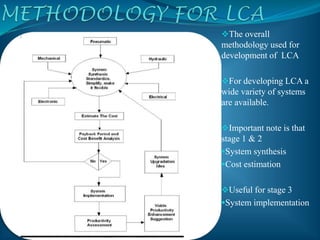
The overall
methodology used for
development of LCA
For developing LCA a
wide variety of systems
are available.
Important note is that
stage 1 & 2
System synthesis
Cost estimation
Useful for stage 3
System implementation
Well synthesised through emphasis on the guiding principles
of standardization, simplicity, reusability, flexibility and
maintainability.
Long term benefits must be considerable.
System stability condition.
Playback period and system up gradation.
LCA systems are basically
Mechanical System :-
Rugged, Simple and Cheap.
Made up of elements like Cams, Gears, Mechanisms with
linkages, Indexing devices, Feeding devices etc.
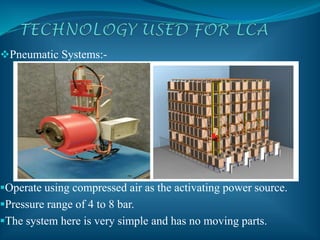
Pneumatic Systems:-
Operate using compressed air as the activating power source.
Pressure range of 4 to 8 bar.
The system here is very simple and has no moving parts.
Hydraulic Systems :-
Costlier than pneumatic systems.
Very wild field application.
They are used virtually in every industry, such as:-
•Die casting machines in casting process.
•Presses for heavy duty metal forming processes
Electric System:-
Consist of electric motors or electro-magnets for
actuation (AD, DC, servo, stepper etc.)
The electric circuit consists of two parts:
(A) The actuator part which consists of the electromagnets,
motors, brakes etc. along with safety devices like
overload protection,
(B) The control part consisting of activating devices like
start, stop push buttons, limit switches, relays, timers
etc.
Hybrid System :-
More than one type of system is used and interfaced
appropriately with another so that the advantages of both
are used, while ensuring that the disadvantages are not
detrimental to the functional requirements.
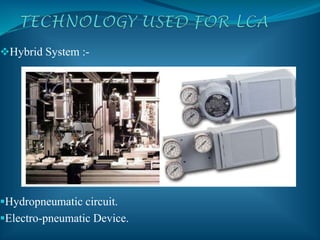
Hybrid System :-
Hydropneumatic circuit.
Electro-pneumatic Device.
Use of PLC (Programmable Logic Control) can be
replace h hardwired ladder logic.
Use of PC can improved capabilities of PLC by storing
data & using as per our requirement.
No hardware assembly is required, assembly time is
low.
System becomes very compact, no hardware elements
connected through wires.
Micro-controller Based Low Cost Automation :-
Micro-computer based design brings flexibility, re-
configurability, compactness and economy to an automation
system.
Processing power is available through micro-controllers at
very reasonable prices hence Low Cost.
Low cost electro-mechanical automation system.
High technology, low cost automation implemented with
Mechanical systems controlled by microcontroller is indeed for
big growth and wide applications in the Indian Industry.
The need to have Good Manufacturing Practices (GMP)
in place in the drug and pharmaceutical sector.
Batch process plants are not fully geared to adapt to
GMP norms that are being laid down.
There are many difficulties in implementation of GMP
in the batch process industries. Because of their ledge of
the process characteristics.
Batch Process Monitoring :
Low cost data acquisition systems can be used to monitor
some of the key process variables like temperature,
pressure, pH, conductivity etc.
Multivariate statistical analysis tools like Principal
Component Analysis (PCA), and Multi-way PCA etc., can
be used for such inferential measurements to provide the
soft sensors for tracking the product quality.
Batch process Control :
The non linear and dynamic nature of batch process operation
makes the batch process control problem rather complex.
Batch distillation is another operation used widely in the
process industry.
Batch process data can be used to develop tendency models
Through modeling one can develop optimal operational
policies permitting higher recovery of costly products, as well
as recycle policies which minimize reprocessing cost.
Batch Process Management :
Higher productivity, better capacity utilization, energy
conservation and flexible manufacturing, batch process
planning through formal optimization tools help in
evolving production plans to meet set operational goal.
Troubleshooting and for making modification is
avoided.
Use manual participation and hence take more time
to learn, because changing form one design to another,
the skill is inbuilt into the program.
One has to understand the need to overcome “the
learning curve” problem.
Productivity may even decrease when a person is in the
learning phase.
LCA is a technology that promises to be very useful for
any kind of manufacturing organization.
ANY QURIES ???

Low cost automation

  • 1.
    Ishwar V. Bhoge. ParagJ. Tarwadi. Presented by :-
  • 2.
    What is LowCost Automation ? It is a technology that creates some degree of automation around the existing equipment, tool, methods, and people, using mostly standard components available in the market.
  • 3.
    Useful in activityreleated to discrete manufacturing.Wide range of activity such as Loading Feeding Clamping Machining Welding Forming Gauging Assembly and Packing can be subjected to LCA system adoption. Useful in processing industries for manufacturing chemicals, oils, or pharmaceuticals.
  • 4.
    The overall methodology usedfor development of LCA For developing LCA a wide variety of systems are available. Important note is that stage 1 & 2 System synthesis Cost estimation Useful for stage 3 System implementation
  • 5.
    Well synthesised throughemphasis on the guiding principles of standardization, simplicity, reusability, flexibility and maintainability. Long term benefits must be considerable. System stability condition. Playback period and system up gradation.
  • 6.
    LCA systems arebasically Mechanical System :- Rugged, Simple and Cheap. Made up of elements like Cams, Gears, Mechanisms with linkages, Indexing devices, Feeding devices etc.
  • 7.
    Pneumatic Systems:- Operate usingcompressed air as the activating power source. Pressure range of 4 to 8 bar. The system here is very simple and has no moving parts.
  • 8.
    Hydraulic Systems :- Costlierthan pneumatic systems. Very wild field application. They are used virtually in every industry, such as:- •Die casting machines in casting process. •Presses for heavy duty metal forming processes
  • 9.
    Electric System:- Consist ofelectric motors or electro-magnets for actuation (AD, DC, servo, stepper etc.) The electric circuit consists of two parts: (A) The actuator part which consists of the electromagnets, motors, brakes etc. along with safety devices like overload protection, (B) The control part consisting of activating devices like start, stop push buttons, limit switches, relays, timers etc.
  • 10.
    Hybrid System :- Morethan one type of system is used and interfaced appropriately with another so that the advantages of both are used, while ensuring that the disadvantages are not detrimental to the functional requirements.
  • 11.
    Hybrid System :- Hydropneumaticcircuit. Electro-pneumatic Device.
  • 12.
    Use of PLC(Programmable Logic Control) can be replace h hardwired ladder logic. Use of PC can improved capabilities of PLC by storing data & using as per our requirement. No hardware assembly is required, assembly time is low. System becomes very compact, no hardware elements connected through wires.
  • 13.
    Micro-controller Based LowCost Automation :- Micro-computer based design brings flexibility, re- configurability, compactness and economy to an automation system. Processing power is available through micro-controllers at very reasonable prices hence Low Cost. Low cost electro-mechanical automation system. High technology, low cost automation implemented with Mechanical systems controlled by microcontroller is indeed for big growth and wide applications in the Indian Industry.
  • 14.
    The need tohave Good Manufacturing Practices (GMP) in place in the drug and pharmaceutical sector. Batch process plants are not fully geared to adapt to GMP norms that are being laid down. There are many difficulties in implementation of GMP in the batch process industries. Because of their ledge of the process characteristics.
  • 15.
    Batch Process Monitoring: Low cost data acquisition systems can be used to monitor some of the key process variables like temperature, pressure, pH, conductivity etc. Multivariate statistical analysis tools like Principal Component Analysis (PCA), and Multi-way PCA etc., can be used for such inferential measurements to provide the soft sensors for tracking the product quality.
  • 16.
    Batch process Control: The non linear and dynamic nature of batch process operation makes the batch process control problem rather complex. Batch distillation is another operation used widely in the process industry. Batch process data can be used to develop tendency models Through modeling one can develop optimal operational policies permitting higher recovery of costly products, as well as recycle policies which minimize reprocessing cost.
  • 17.
    Batch Process Management: Higher productivity, better capacity utilization, energy conservation and flexible manufacturing, batch process planning through formal optimization tools help in evolving production plans to meet set operational goal.
  • 18.
    Troubleshooting and formaking modification is avoided. Use manual participation and hence take more time to learn, because changing form one design to another, the skill is inbuilt into the program.
  • 19.
    One has tounderstand the need to overcome “the learning curve” problem. Productivity may even decrease when a person is in the learning phase. LCA is a technology that promises to be very useful for any kind of manufacturing organization.
  • 21.