Introduction
Manufacturing System
• Manufacturing systems consist of human workers, automation,
and various material handling technologies, configured in
ways that create specific manufacturing system typologies.
• Our focus in this unit is upon manufacturing systems that are
said to be automated, and so concentration will be put upon the
types of integrated equipment that is used and arranged in a
manufacturing cell.
Cont…
• This can range from production machines and tools, material
handling and work positioning devices, to the use of various
computer systems that facilitate automation in the production
environment.
• A manufacturing system is a collection of integrated
equipment and human resources, whose function is to perform
one or more processing and/or assembly operations on a
starting raw material, part, or set of parts.
Cont…
• The manufacturing system is where value-added work is
performed to parts and/or products.
• in system of production it is supported by:
• quality control,
• material handling,
• automation control.
Cont..
• Single station cell—one worker tends one production machine
that operates on semi-automatic cycle
• Machine cluster—one worker tends a group of semi-
automated machines
• Automated transfer line—production line consisting of a series
of automated workstations that perform processing operations
• Automated assembly system—performs a sequence of
automated or mechanized assembly operations
• Flexible manufacturing system (FMS)—a highly automated
machine cell that produces part or product families; often
consists of workstations comprising CNC machine tools
Components of Manufacturing
• A manufacturing system consists of the following components:
• production machines (plus tools, fixtures, and other related
hardware);
• A material handling system;
• a computer system to co-ordinate and/or control the preceding
components;
• human workers to operate and manage the system.
Production Machine
• Machines can be classified according to worker participation
in the task, as:
• manually-operated
• semi-automated
• fully automated.
Manual Operated Machine
• Controlled or supervised by a worker or operator,
there is a clear division of labour, whereby the
machine provides the power for the operation and the
worker provides the control.
• Conventional machine tools (such as lathes, milling
machines, drill presses etc.) fit this category.
• The worker must attend the machine continuously
during the work cycle.
Manually Operated Machine
Semi-automated machines
• This performs a portion of the work cycle under
programme control, and then a worker assumes
control for the remainder of the cycle.
• An example of a machine in this capacity is a CNC
lathe, where the CNC machine performs its
processing operation as per the programme, and then
the worker unloads and reloads the machine for the
next work cycle.
• The worker must attend the machine every cycle, but
need not be continuously present.
Semi-automated machines
Fully automated machines
• This has the capability to operate with no
human attention for periods of time that are
longer than one work cycle.
Fully automated machines
Material Handling
• For most processing and assembly operations the following
material handling actions can be distinguished:
• Loading work units at each station
• Positioning work units at the station
• Unloading work units from the station after processing
• Transporting work units between stations;
• Performing temporary storage, if necessary
Cont…..
• There are, in general, two types of work transport:
• fixed routing, and variable routing
• Fixed routing uses the same sequence of workstations to
process identical work units as they passed through the
system;
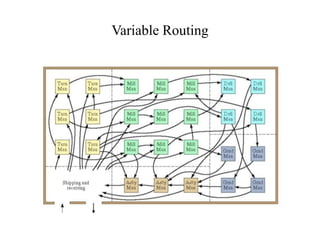
• whereas, with variable routing, work units are transported
through a variety of different station sequences to allow for
variable processing to be performed on transported work units
Computer Control System
• Computer systems are an integral part of automated
manufacturing, as they are required to control fully-automated
and semi-automated equipment and participate in overall co-
ordination and management of the manufacturing system.
Cont..
• Computer functions utilised in automated manufacturing
include:
• The communication of instructions to workers
• The downloading of workpart programmes
• The control of the material handling system
• The scheduling of production
• The diagnosis of failures
• The monitoring of safety
• The maintenance of quality control
• The management of operations.
Human Resources
• Humans also have a role to play, even if it is only in a
supervisory capacity.
• In cases where humans perform some value-added work on
work units, the work done is called direct labour—that is,
physical labour that results in an increase in value of the
processed work unit.
• This generally includes direct work done on work units or
work done to control the machines that are processing the
workpart.
Cont….
• Human workers are also required to:
• manage and support the system as computer programmers;
• operate and direct computer activities;
• maintain and repair the automated manufacturing system,
Classification of manufacturing System
• Types of operations performed
• Number of workstations
• System layout
• Automation and manning level
• Product or part variety.
Types of operations performed
• Type of material processed
• Size or weight of the part or product
• Part or product complexity
• Part geometry
Number of Workstations
• The number of workstations in a manufacturing system exerts
a strong influence on the performance of the manufacturing
system, in terms of its workload capacity, production rate, and
reliability.
• As the number of workstations increases, the more work can
be performed by the system, which may translate into a higher
production rate
Cont…
• The use of multiple workstations can also produce a
synergistic benefit, when compared against single workstation
systems.
• The total amount of work performed on the part or product is
too complex to accomplish at a single workstation; instead the
task is divided among a multiple of stations, thus simplifying
the complexity of the task into simpler work elements.
Cont…
• However, the more workstations developed in a system
generally means that the system itself becomes more complex,
and harder to manage and maintain.
• The system consists of more workers, machines, and parts to
be handed.
• Reliability and maintenance problems also begin to surface on
a more frequent basis.
System Layout
• System configuration, or the layout of the manufacturing
system’s workstations, is also an important factor. This applies
mainly, of course, to systems with multiple workstations.
• Workstation layouts for fixed routing are usually arranged
linearly, as in a production line.
• variable routing layouts can have multiple configurations.
System layout is an important factor for the design of the
material handling system.
Automation and Manning Levels
• The level of automation deployed is an important
characteristic of the manufacturing system.
• Workstation machines may be manually-operated,
semiautomated, or fully-automated.
• This factor allows us to define the amount of time
that a human operator is required to be in attendance
at a workstation as the manning level (Mi) of the
workstation
Part or Product Variety
• This factor examines the manufacturing system’s flexibility for
dealing with variations in the parts or products it produces.
• Part or product variations that could occur in manufacturing
systems include:
• variations in type, or colour of plastic or moulded parts;
• variations in electronic components placed on circuit boards;
• variations in the size of printed circuit boards handled;
• variations in part geometry;
• variations in parts
Part Variety
Cont..
Overview of the Classification Scheme
• single-station cells.
• multi-station systems with fixed routing.
• multi-station systems with variable routing.
Single Station cell
Multi-station Systems with Fixed Routing
• Single workstations are widespread, but typically come in one
of two forms:
• manned workstations—where a worker is in attendance
continuously or for a portion of each work cycle
• automated stations—where worker attention is required less
frequently than the set work cycle.
• Both systems are used for assembly. Single-station cell
systems are popular because they are relatively inexpensive to
implement.
• They are highly flexible, and they are easy to convert to
automation when required
Fixed Routing
Multi-station Systems with Fixed Routing
• A multi-station system with fixed routing is
essentially a production line, which consists of a
series of workstations laid-out so that the part/product
moves from one station to the next, while a value-
adding work element is performed at each
workstation along the way.
Variable Routing
A multiple-station system with variable routing
• is a group of workstations organised to achieve
some special purpose. It usually handles
medium-sized production quantities
Single-Station Automated Cells
• The single-station automated cell consists of a fully
automated machine that can operate unattended for a
time period longer than one machine cycle.
• The operator must load and unload the machine, and
otherwise tend it, but is not required to be at the
machine except periodically.
. Advantages of single-station automated cells
• Reduced labour costs
• Relatively inexpensive to implement and maintain.
• Production rates are higher than manned machines
Manual Assembly Lines
• A production line that consists of a sequence of
workstations where assembly tasks are performed by
human workers.
• Products are assembled as they move along the line.
• At each station a portion of the total work content is
performed on each unit
Manual Assembly Lines
• Work systems consisting of multiple workers
organized to produce a single product or a limited
range of products
• Assembly workers perform tasks at workstations
located along the line-of-flow of the product
Manual Assembly Lines
Factors favoring the use of assembly lines:
• High or medium demand for product
• Products are similar or identical
• Total work content can be divided into work elements
• To automate assembly tasks is impossible
Why Assembly Lines are Productive
Specialization of labor
• When a large job is divided into small tasks and each
task is assigned to one worker, the worker becomes
highly proficient at performing the single task
Interchangeable parts
• Each component is manufactured to sufficiently close
tolerances that any part of a certain type can be
selected at random for assembly with its mating
component.
Cont…
• Base parts are launched onto the beginning of the line
at regular intervals (cycle time)
• Workers add components to progressively build the
product
Assembly workstation:
• A designated location along the work flow path at
which one or more work elements are performed by
one or more workers
Assembly Workstation
• A designated location along the work flow path at
which one or more work elements are performed by
one or more workers
Cont…
• Typical operations performed at manual assembly
stations
• Adhesive application
• Sealant application
• Arc welding
• Spot welding
• Electrical connections
Cont…
• Component insertion
• Press fitting
• Riveting Snap fitting
• Soldering Stitching/stapling
• Threaded fasteners

Production System.pptx

  • 1.
    Introduction Manufacturing System • Manufacturingsystems consist of human workers, automation, and various material handling technologies, configured in ways that create specific manufacturing system typologies. • Our focus in this unit is upon manufacturing systems that are said to be automated, and so concentration will be put upon the types of integrated equipment that is used and arranged in a manufacturing cell.
  • 2.
    Cont… • This canrange from production machines and tools, material handling and work positioning devices, to the use of various computer systems that facilitate automation in the production environment. • A manufacturing system is a collection of integrated equipment and human resources, whose function is to perform one or more processing and/or assembly operations on a starting raw material, part, or set of parts.
  • 3.
    Cont… • The manufacturingsystem is where value-added work is performed to parts and/or products. • in system of production it is supported by: • quality control, • material handling, • automation control.
  • 4.
    Cont.. • Single stationcell—one worker tends one production machine that operates on semi-automatic cycle • Machine cluster—one worker tends a group of semi- automated machines • Automated transfer line—production line consisting of a series of automated workstations that perform processing operations • Automated assembly system—performs a sequence of automated or mechanized assembly operations • Flexible manufacturing system (FMS)—a highly automated machine cell that produces part or product families; often consists of workstations comprising CNC machine tools
  • 5.
    Components of Manufacturing •A manufacturing system consists of the following components: • production machines (plus tools, fixtures, and other related hardware); • A material handling system; • a computer system to co-ordinate and/or control the preceding components; • human workers to operate and manage the system.
  • 6.
    Production Machine • Machinescan be classified according to worker participation in the task, as: • manually-operated • semi-automated • fully automated.
  • 7.
    Manual Operated Machine •Controlled or supervised by a worker or operator, there is a clear division of labour, whereby the machine provides the power for the operation and the worker provides the control. • Conventional machine tools (such as lathes, milling machines, drill presses etc.) fit this category. • The worker must attend the machine continuously during the work cycle.
  • 8.
  • 9.
    Semi-automated machines • Thisperforms a portion of the work cycle under programme control, and then a worker assumes control for the remainder of the cycle. • An example of a machine in this capacity is a CNC lathe, where the CNC machine performs its processing operation as per the programme, and then the worker unloads and reloads the machine for the next work cycle. • The worker must attend the machine every cycle, but need not be continuously present.
  • 10.
  • 11.
    Fully automated machines •This has the capability to operate with no human attention for periods of time that are longer than one work cycle.
  • 12.
  • 13.
    Material Handling • Formost processing and assembly operations the following material handling actions can be distinguished: • Loading work units at each station • Positioning work units at the station • Unloading work units from the station after processing • Transporting work units between stations; • Performing temporary storage, if necessary
  • 14.
    Cont….. • There are,in general, two types of work transport: • fixed routing, and variable routing • Fixed routing uses the same sequence of workstations to process identical work units as they passed through the system; • whereas, with variable routing, work units are transported through a variety of different station sequences to allow for variable processing to be performed on transported work units
  • 16.
    Computer Control System •Computer systems are an integral part of automated manufacturing, as they are required to control fully-automated and semi-automated equipment and participate in overall co- ordination and management of the manufacturing system.
  • 17.
    Cont.. • Computer functionsutilised in automated manufacturing include: • The communication of instructions to workers • The downloading of workpart programmes • The control of the material handling system • The scheduling of production • The diagnosis of failures • The monitoring of safety • The maintenance of quality control • The management of operations.
  • 18.
    Human Resources • Humansalso have a role to play, even if it is only in a supervisory capacity. • In cases where humans perform some value-added work on work units, the work done is called direct labour—that is, physical labour that results in an increase in value of the processed work unit. • This generally includes direct work done on work units or work done to control the machines that are processing the workpart.
  • 19.
    Cont…. • Human workersare also required to: • manage and support the system as computer programmers; • operate and direct computer activities; • maintain and repair the automated manufacturing system,
  • 20.
    Classification of manufacturingSystem • Types of operations performed • Number of workstations • System layout • Automation and manning level • Product or part variety.
  • 21.
    Types of operationsperformed • Type of material processed • Size or weight of the part or product • Part or product complexity • Part geometry
  • 22.
    Number of Workstations •The number of workstations in a manufacturing system exerts a strong influence on the performance of the manufacturing system, in terms of its workload capacity, production rate, and reliability. • As the number of workstations increases, the more work can be performed by the system, which may translate into a higher production rate
  • 23.
    Cont… • The useof multiple workstations can also produce a synergistic benefit, when compared against single workstation systems. • The total amount of work performed on the part or product is too complex to accomplish at a single workstation; instead the task is divided among a multiple of stations, thus simplifying the complexity of the task into simpler work elements.
  • 24.
    Cont… • However, themore workstations developed in a system generally means that the system itself becomes more complex, and harder to manage and maintain. • The system consists of more workers, machines, and parts to be handed. • Reliability and maintenance problems also begin to surface on a more frequent basis.
  • 25.
    System Layout • Systemconfiguration, or the layout of the manufacturing system’s workstations, is also an important factor. This applies mainly, of course, to systems with multiple workstations. • Workstation layouts for fixed routing are usually arranged linearly, as in a production line. • variable routing layouts can have multiple configurations. System layout is an important factor for the design of the material handling system.
  • 26.
    Automation and ManningLevels • The level of automation deployed is an important characteristic of the manufacturing system. • Workstation machines may be manually-operated, semiautomated, or fully-automated. • This factor allows us to define the amount of time that a human operator is required to be in attendance at a workstation as the manning level (Mi) of the workstation
  • 27.
    Part or ProductVariety • This factor examines the manufacturing system’s flexibility for dealing with variations in the parts or products it produces. • Part or product variations that could occur in manufacturing systems include: • variations in type, or colour of plastic or moulded parts; • variations in electronic components placed on circuit boards; • variations in the size of printed circuit boards handled; • variations in part geometry; • variations in parts
  • 28.
  • 29.
  • 30.
    Overview of theClassification Scheme • single-station cells. • multi-station systems with fixed routing. • multi-station systems with variable routing.
  • 31.
  • 32.
    Multi-station Systems withFixed Routing • Single workstations are widespread, but typically come in one of two forms: • manned workstations—where a worker is in attendance continuously or for a portion of each work cycle • automated stations—where worker attention is required less frequently than the set work cycle. • Both systems are used for assembly. Single-station cell systems are popular because they are relatively inexpensive to implement. • They are highly flexible, and they are easy to convert to automation when required
  • 33.
  • 34.
    Multi-station Systems withFixed Routing • A multi-station system with fixed routing is essentially a production line, which consists of a series of workstations laid-out so that the part/product moves from one station to the next, while a value- adding work element is performed at each workstation along the way.
  • 35.
  • 36.
    A multiple-station systemwith variable routing • is a group of workstations organised to achieve some special purpose. It usually handles medium-sized production quantities
  • 37.
    Single-Station Automated Cells •The single-station automated cell consists of a fully automated machine that can operate unattended for a time period longer than one machine cycle. • The operator must load and unload the machine, and otherwise tend it, but is not required to be at the machine except periodically.
  • 38.
    . Advantages ofsingle-station automated cells • Reduced labour costs • Relatively inexpensive to implement and maintain. • Production rates are higher than manned machines
  • 39.
    Manual Assembly Lines •A production line that consists of a sequence of workstations where assembly tasks are performed by human workers. • Products are assembled as they move along the line. • At each station a portion of the total work content is performed on each unit
  • 40.
    Manual Assembly Lines •Work systems consisting of multiple workers organized to produce a single product or a limited range of products • Assembly workers perform tasks at workstations located along the line-of-flow of the product
  • 41.
    Manual Assembly Lines Factorsfavoring the use of assembly lines: • High or medium demand for product • Products are similar or identical • Total work content can be divided into work elements • To automate assembly tasks is impossible
  • 42.
    Why Assembly Linesare Productive Specialization of labor • When a large job is divided into small tasks and each task is assigned to one worker, the worker becomes highly proficient at performing the single task Interchangeable parts • Each component is manufactured to sufficiently close tolerances that any part of a certain type can be selected at random for assembly with its mating component.
  • 43.
    Cont… • Base partsare launched onto the beginning of the line at regular intervals (cycle time) • Workers add components to progressively build the product
  • 44.
    Assembly workstation: • Adesignated location along the work flow path at which one or more work elements are performed by one or more workers
  • 45.
    Assembly Workstation • Adesignated location along the work flow path at which one or more work elements are performed by one or more workers
  • 46.
    Cont… • Typical operationsperformed at manual assembly stations • Adhesive application • Sealant application • Arc welding • Spot welding • Electrical connections
  • 47.
    Cont… • Component insertion •Press fitting • Riveting Snap fitting • Soldering Stitching/stapling • Threaded fasteners