Arif Rahman – The Production Systems
Slide 9
Shop Floor Control
Arif Rahman, ST MT
Arif Rahman – The Production Systems
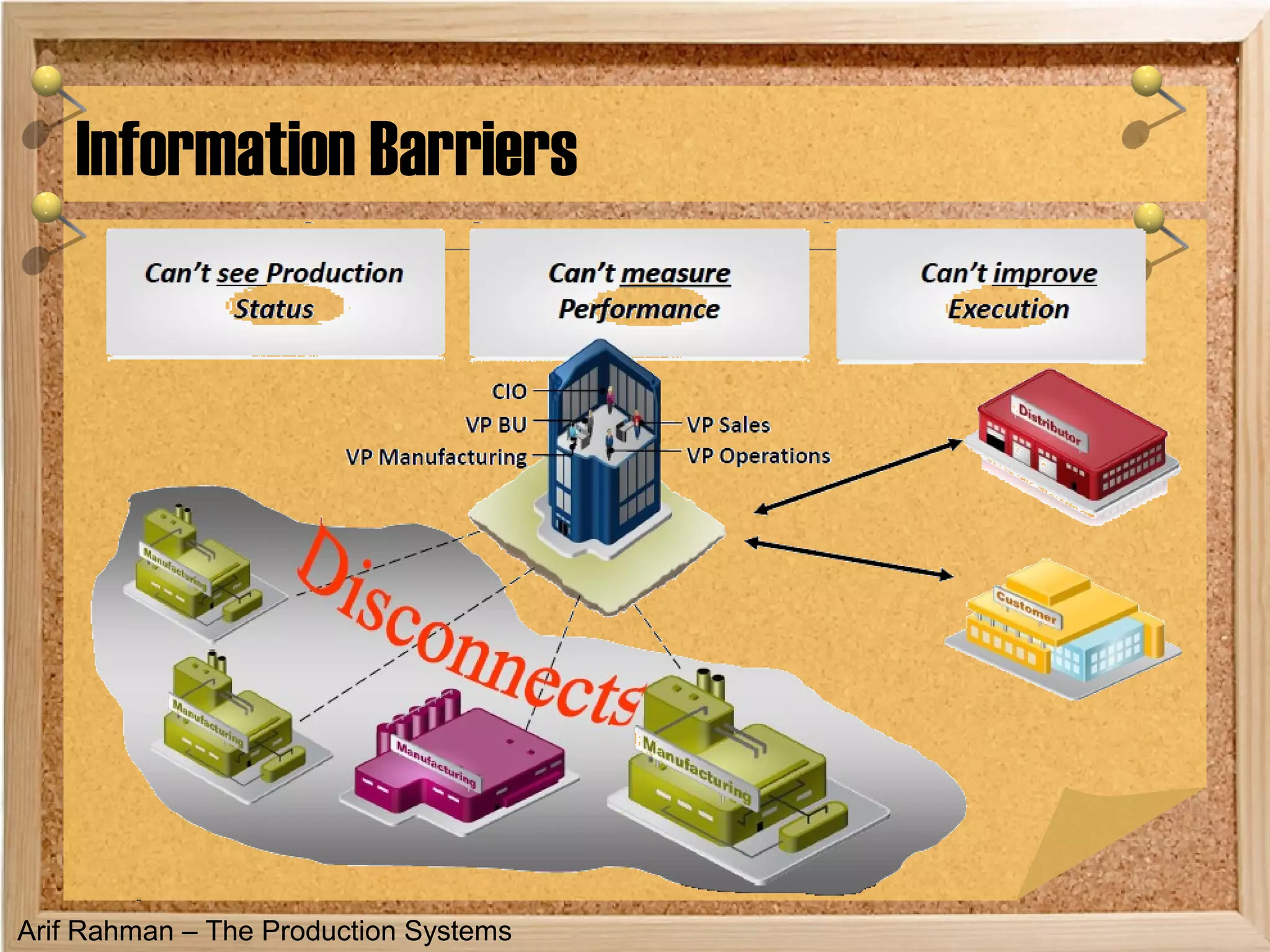
Information Barriers
Arif Rahman – The Production Systems
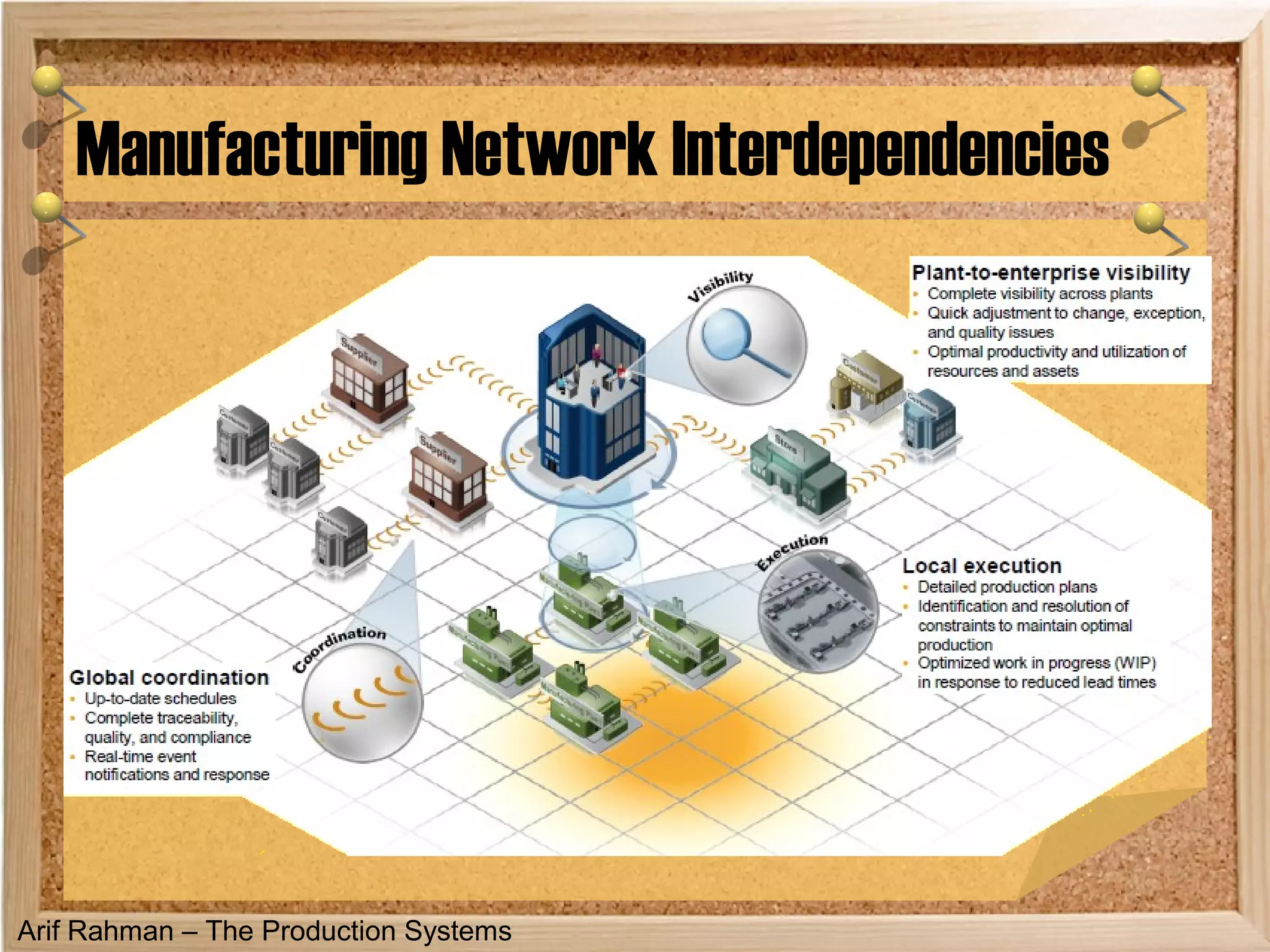
Manufacturing Network Interdependencies
Arif Rahman – The Production Systems
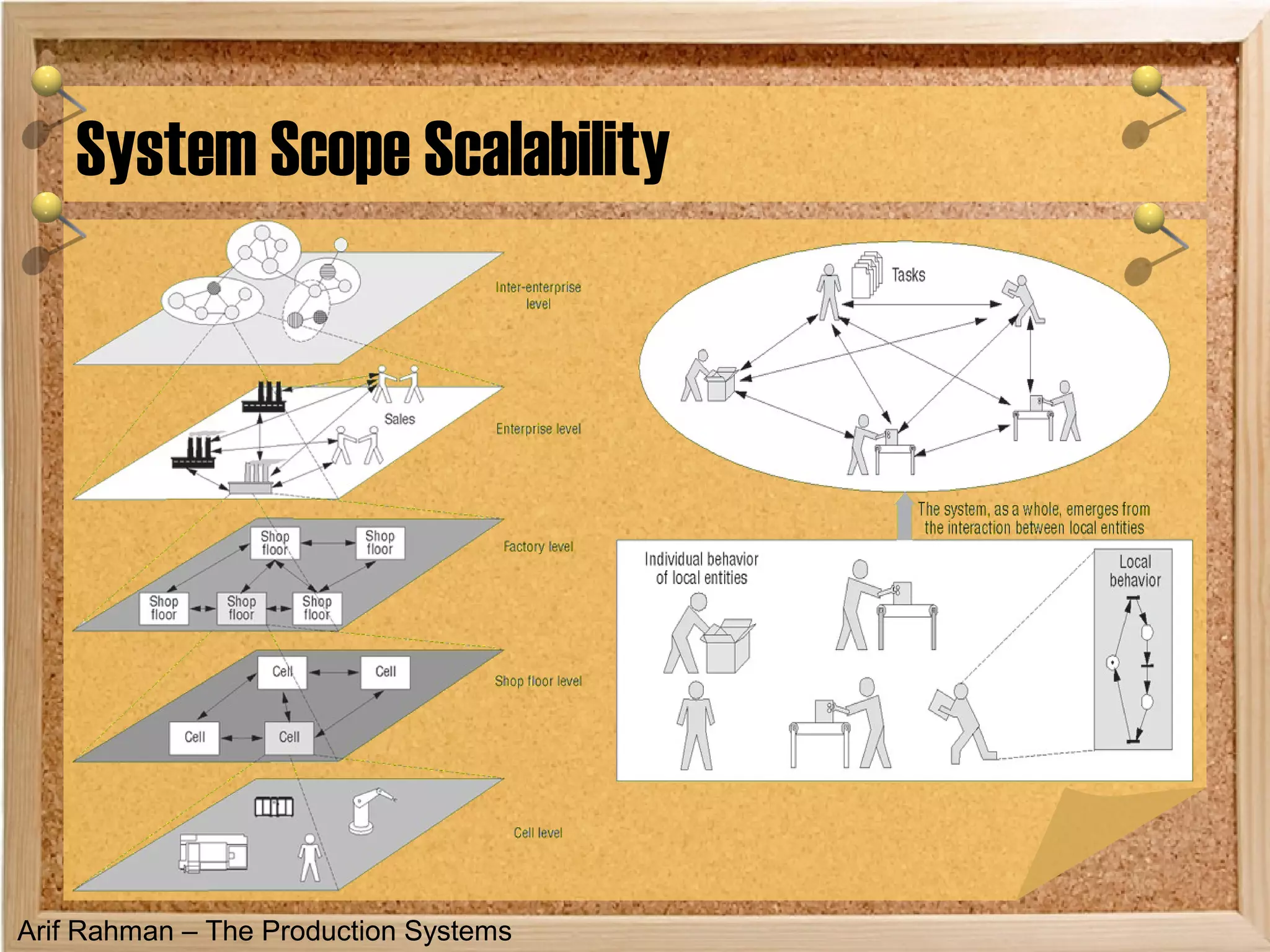
System Scope Scalability
Arif Rahman – The Production Systems
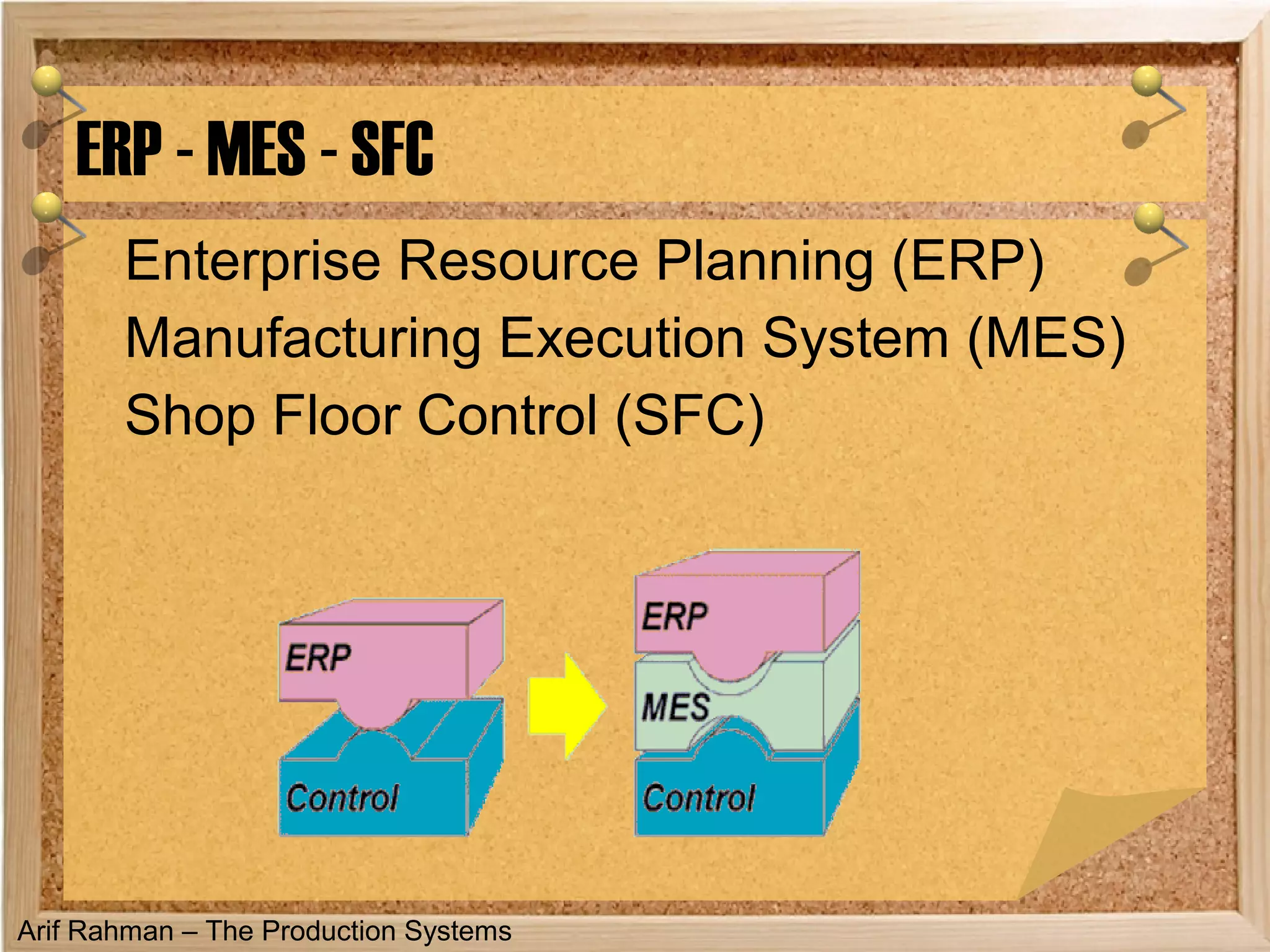
Enterprise Resource Planning (ERP)
Manufacturing Execution System (MES)
Shop Floor Control (SFC)
ERP - MES - SFC
Arif Rahman – The Production Systems
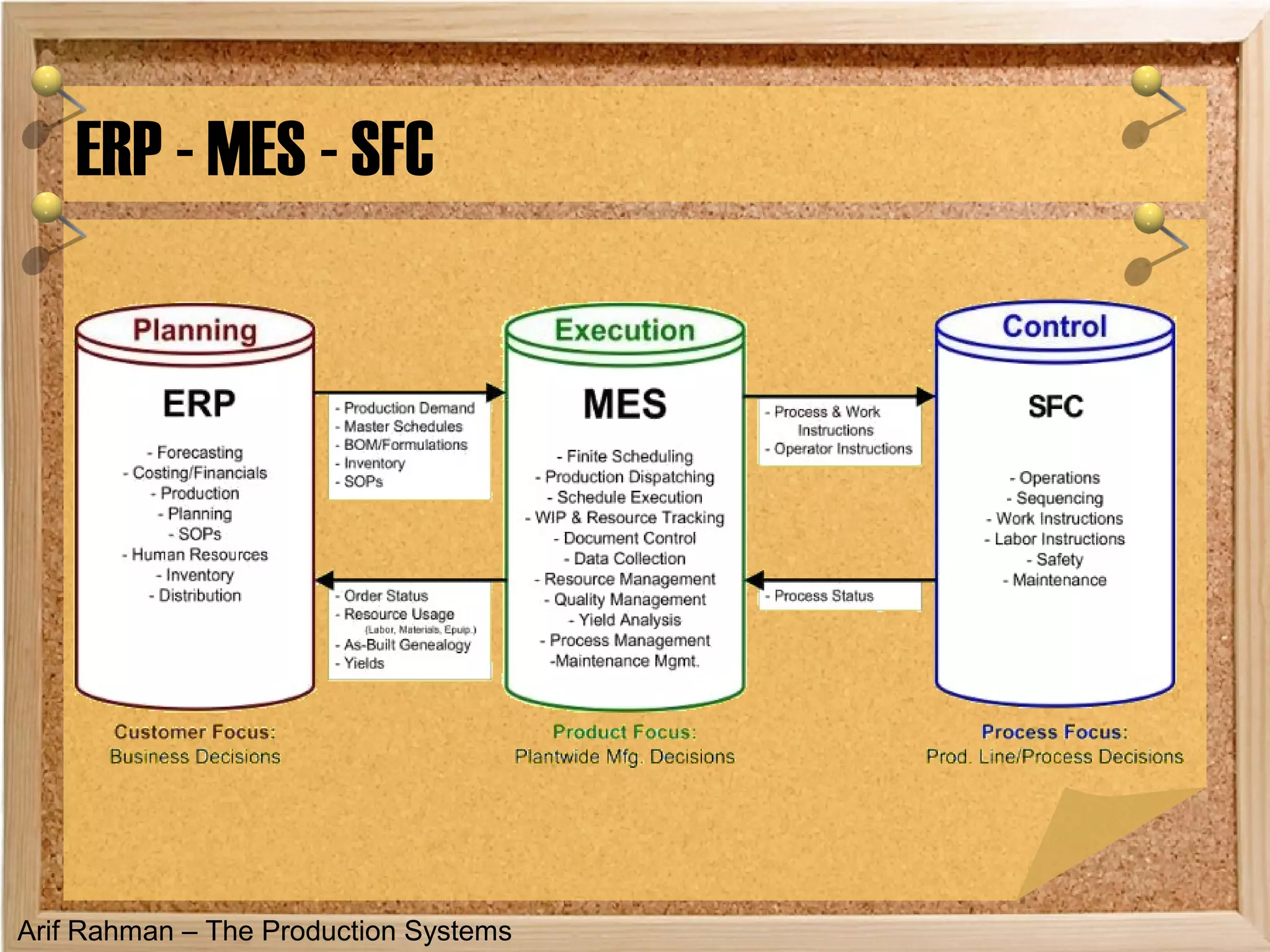
ERP - MES - SFC
Arif Rahman – The Production Systems
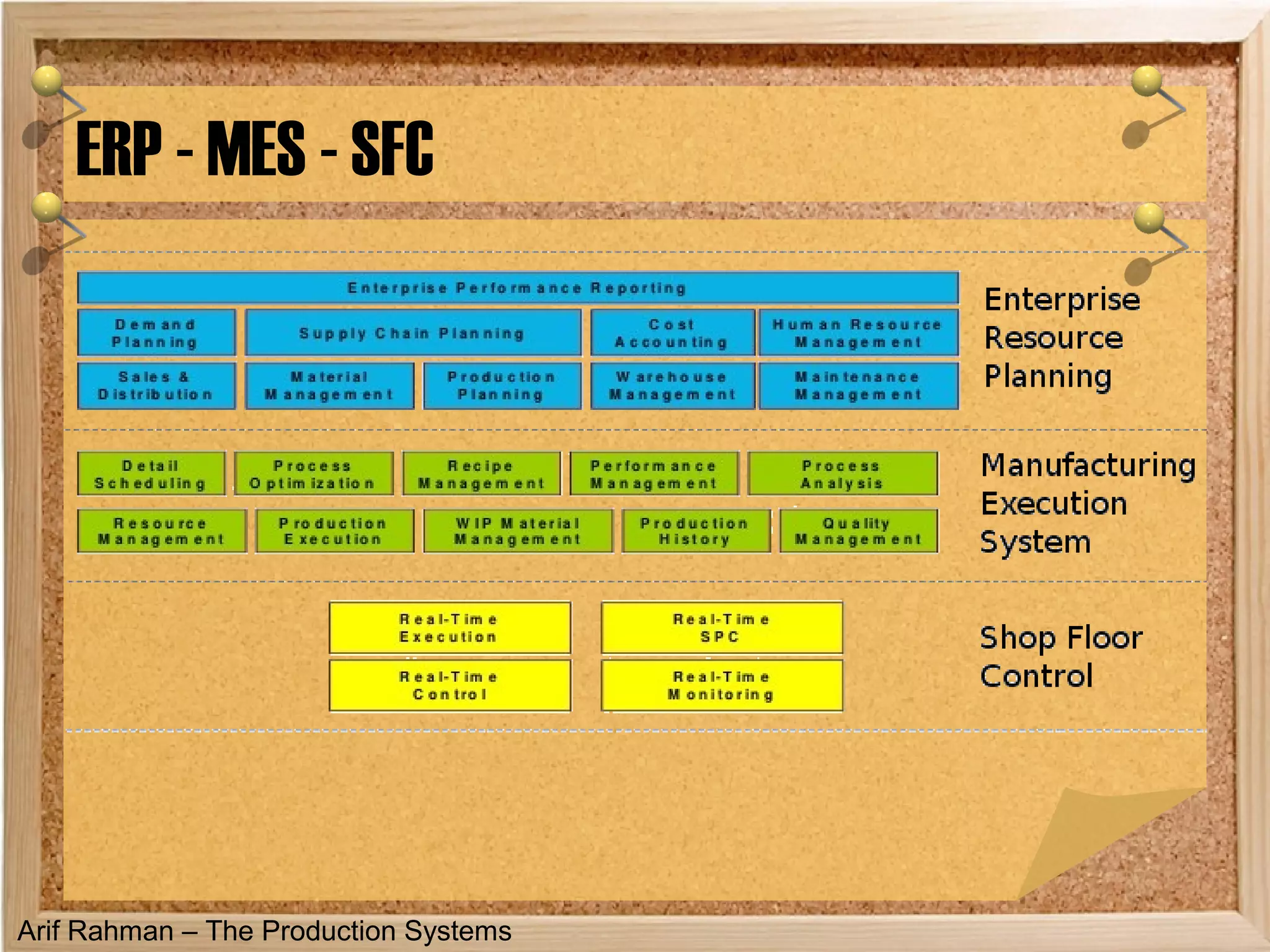
ERP - MES - SFC
Arif Rahman – The Production Systems
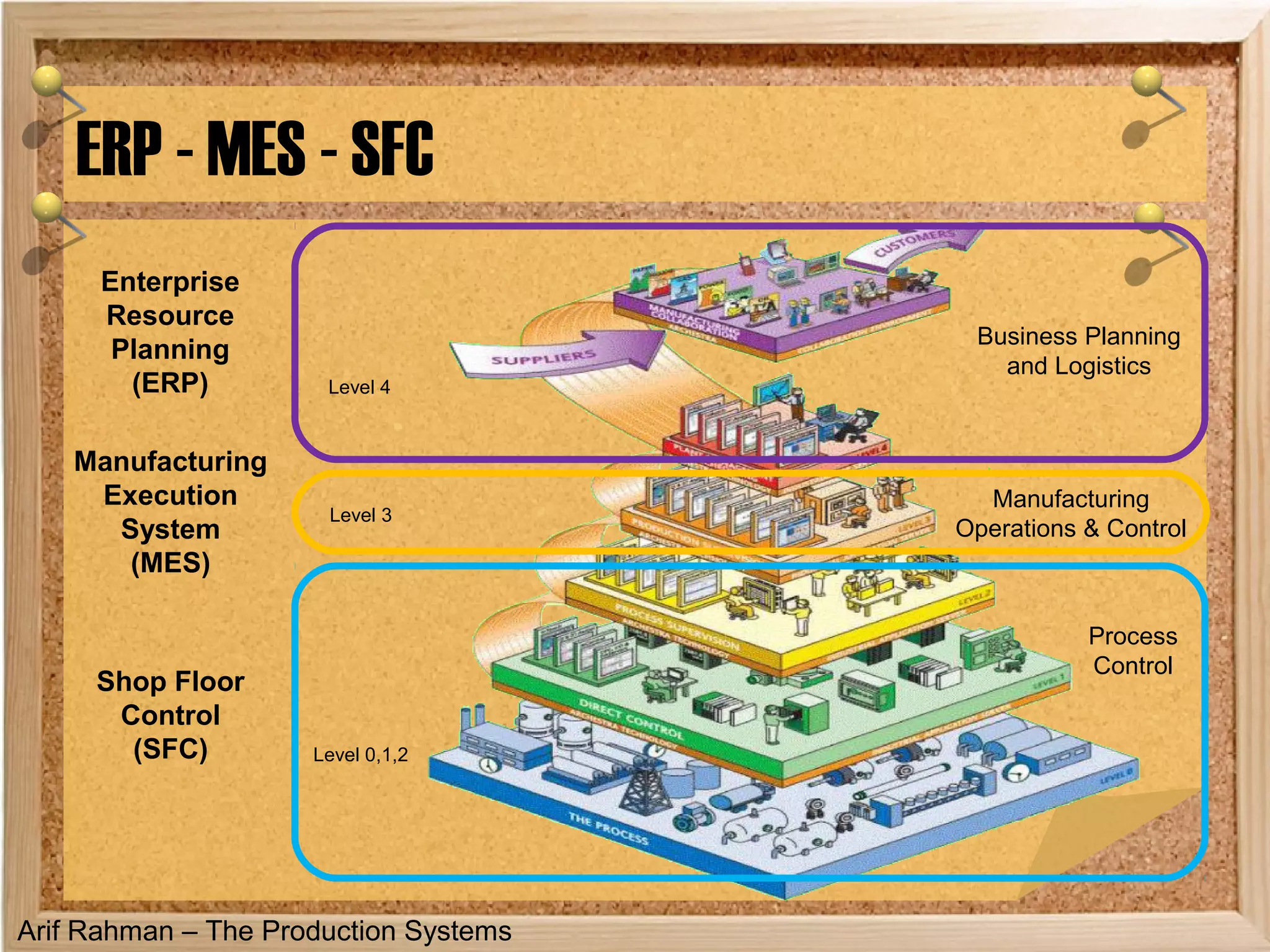
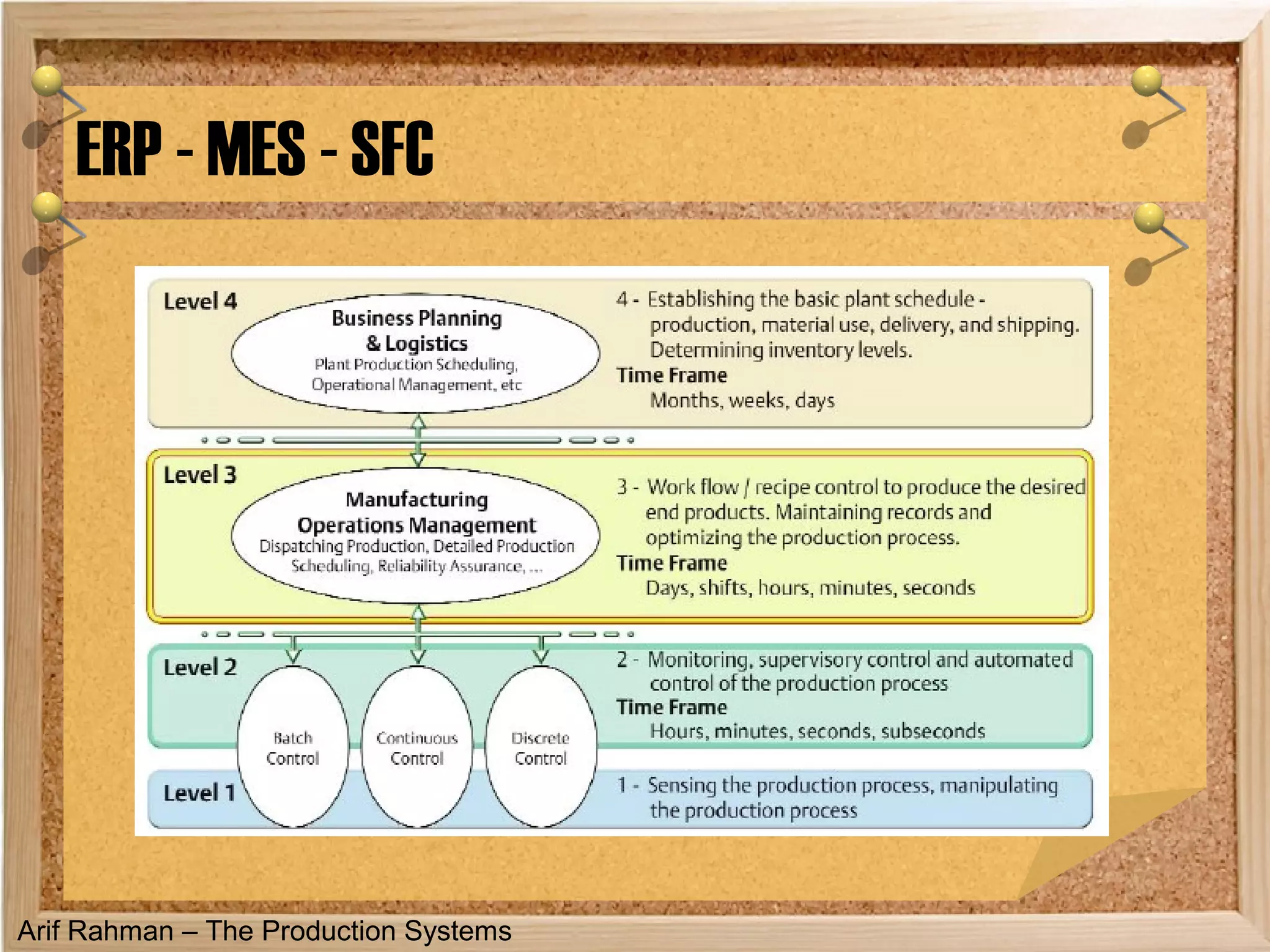
ERP - MES - SFC
Business Planning
and Logistics
Manufacturing
Operations & Control
Process
Control
Enterprise
Resource
Planning
(ERP)
Manufacturing
Execution
System
(MES)
Shop Floor
Control
(SFC)
Level 4
Level 3
Level 0,1,2
Arif Rahman – The Production Systems
ERP - MES - SFC
Arif Rahman – The Production Systems
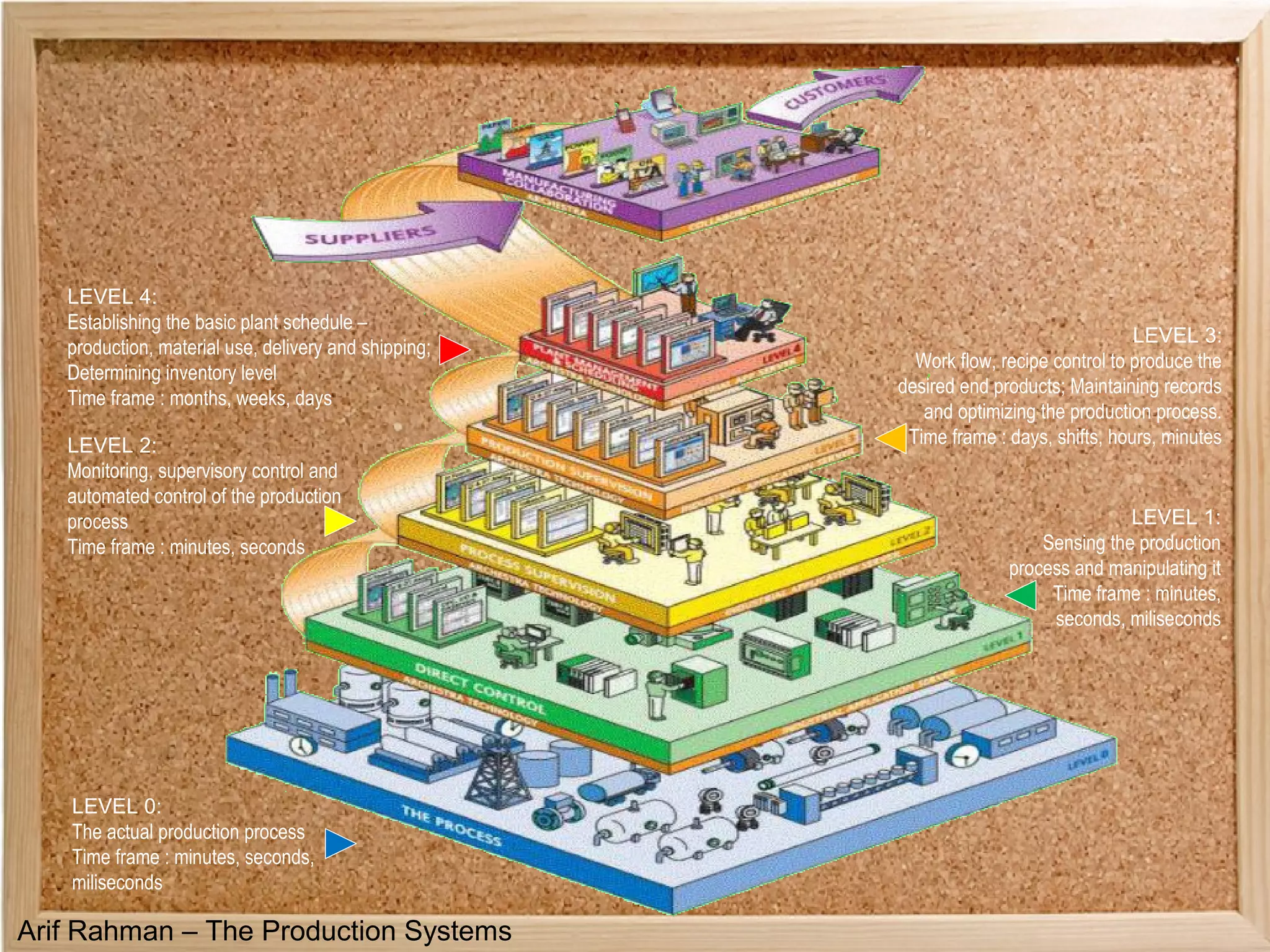
LEVEL 4:
Establishing the basic plant schedule –
production, material use, delivery and shipping;
Determining inventory level
Time frame : months, weeks, days
LEVEL 3:
Work flow, recipe control to produce the
desired end products; Maintaining records
and optimizing the production process.
Time frame : days, shifts, hours, minutesLEVEL 2:
Monitoring, supervisory control and
automated control of the production
process
Time frame : minutes, seconds
LEVEL 1:
Sensing the production
process and manipulating it
Time frame : minutes,
seconds, miliseconds
LEVEL 0:
The actual production process
Time frame : minutes, seconds,
miliseconds
Arif Rahman – The Production Systems
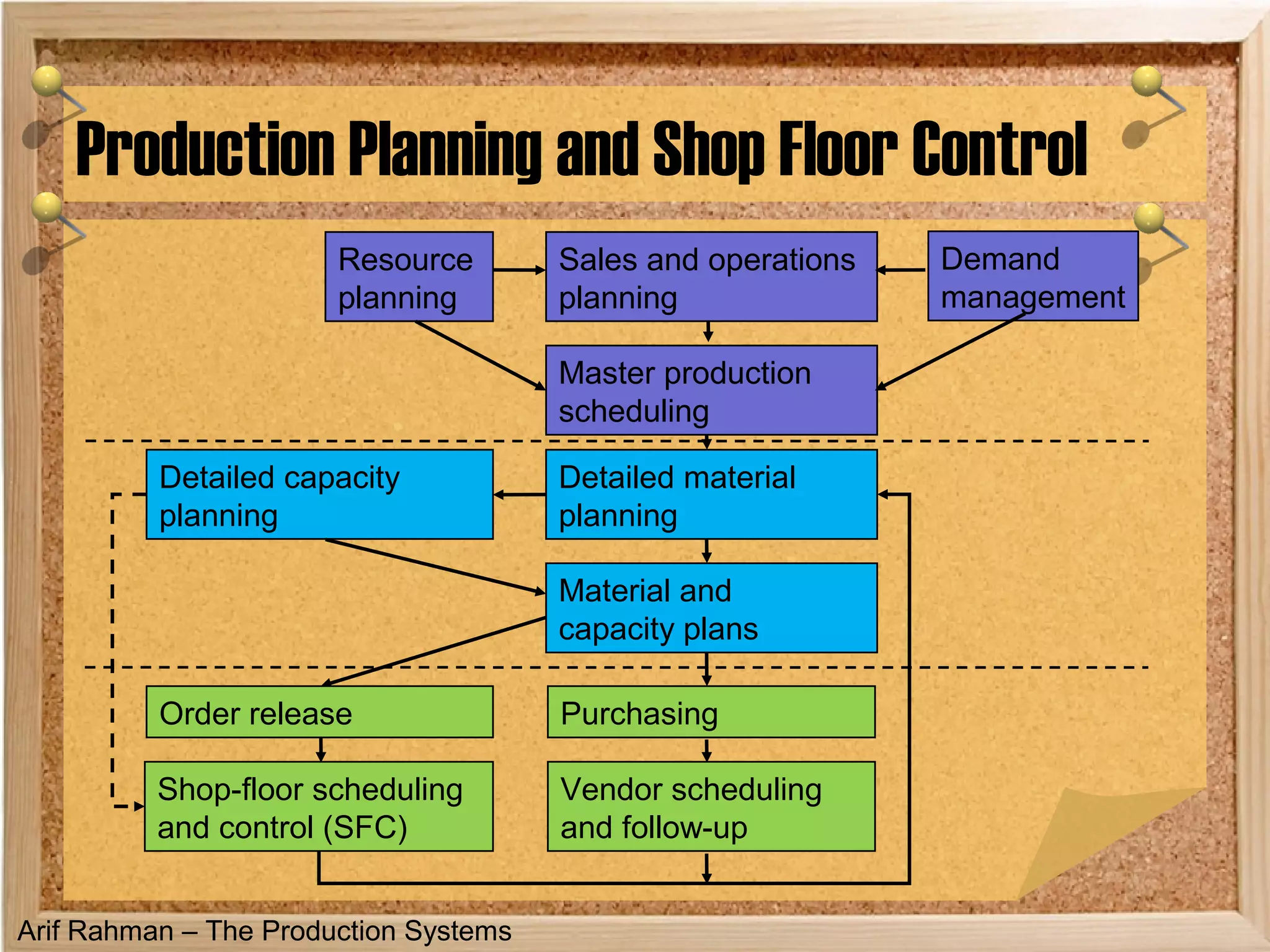
Production Planning and Shop Floor Control
Resource
planning
Sales and operations
planning
Demand
management
Master production
scheduling
Detailed material
planning
Material and
capacity plans
Shop-floor scheduling
and control (SFC)
Purchasing
Detailed capacity
planning
Vendor scheduling
and follow-up
Order release
Arif Rahman – The Production Systems
Purchasing is responsible for establishing
and controlling flow of raw materials into
the factory
Shop Floor Control is responsible for
planning & controlling flow of work through
the factory
Purchasing and Shop Floor Control
Arif Rahman – The Production Systems
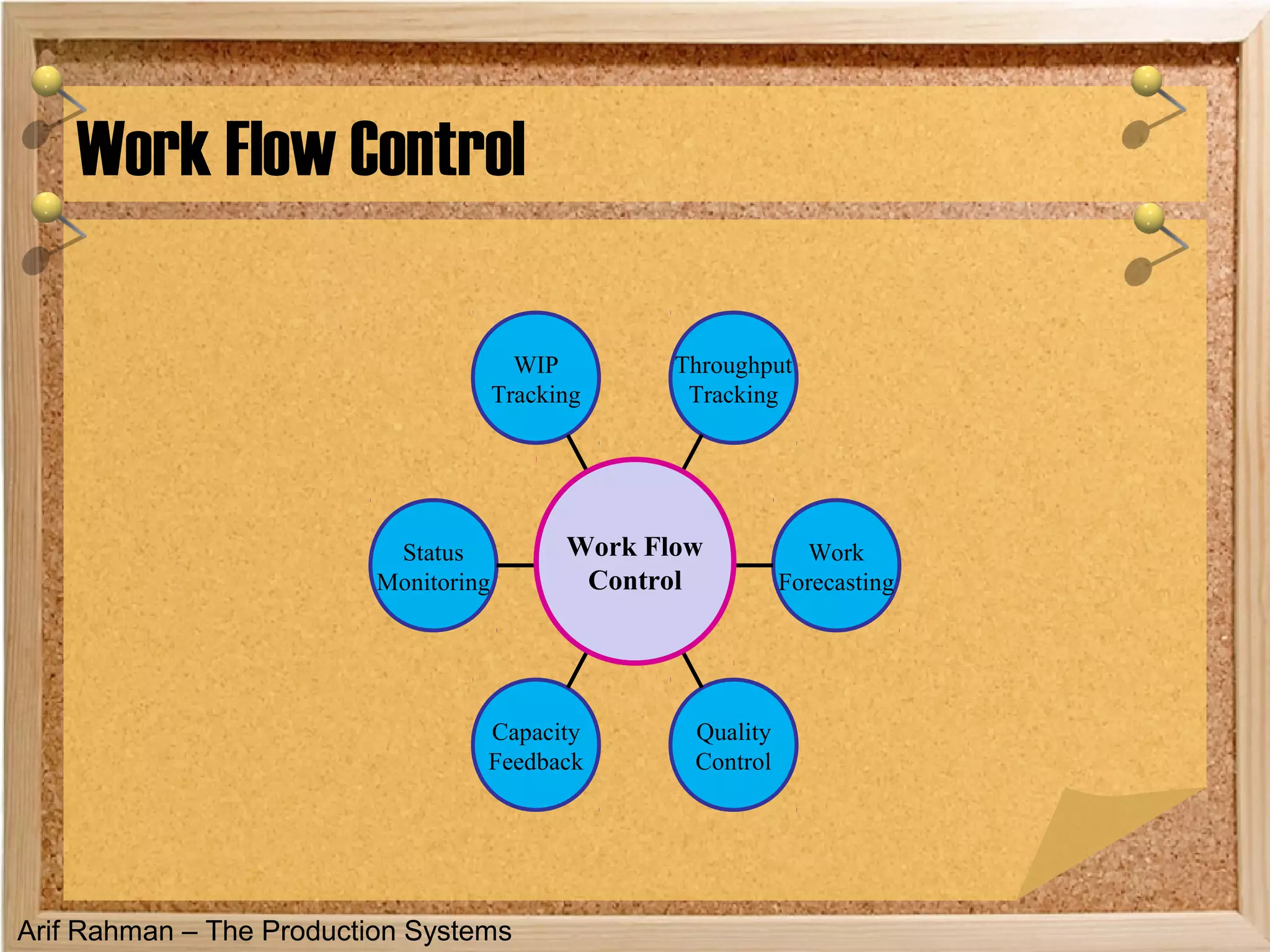
Work Flow Control
WIP
Tracking
Throughput
Tracking
Status
Monitoring
Work
Forecasting
Capacity
Feedback
Quality
Control
Work Flow
Control
Arif Rahman – The Production Systems
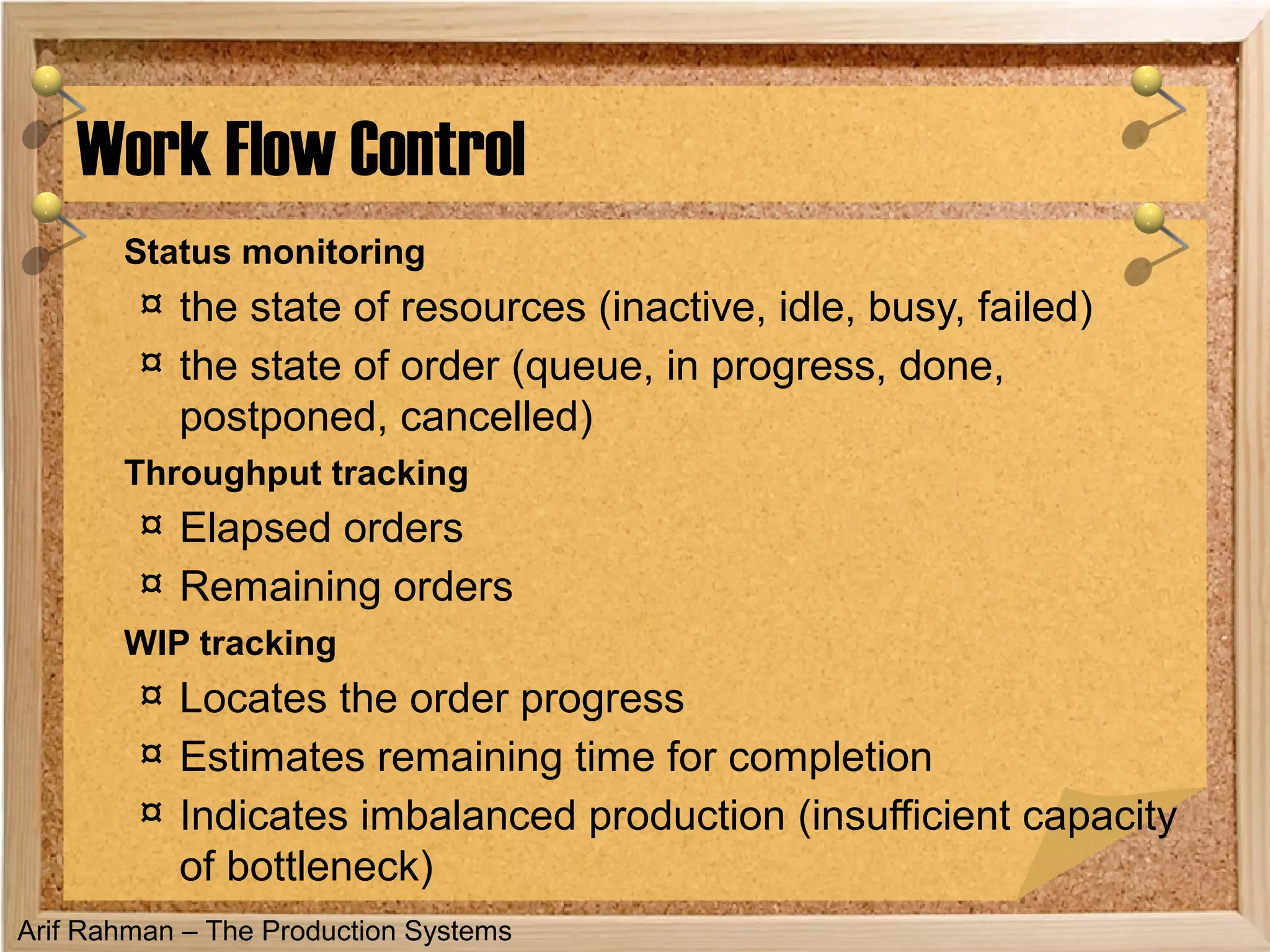
Status monitoring
¤ the state of resources (inactive, idle, busy, failed)
¤ the state of order (queue, in progress, done,
postponed, cancelled)
Throughput tracking
¤ Elapsed orders
¤ Remaining orders
WIP tracking
¤ Locates the order progress
¤ Estimates remaining time for completion
¤ Indicates imbalanced production (insufficient capacity
of bottleneck)
Work Flow Control
Arif Rahman – The Production Systems
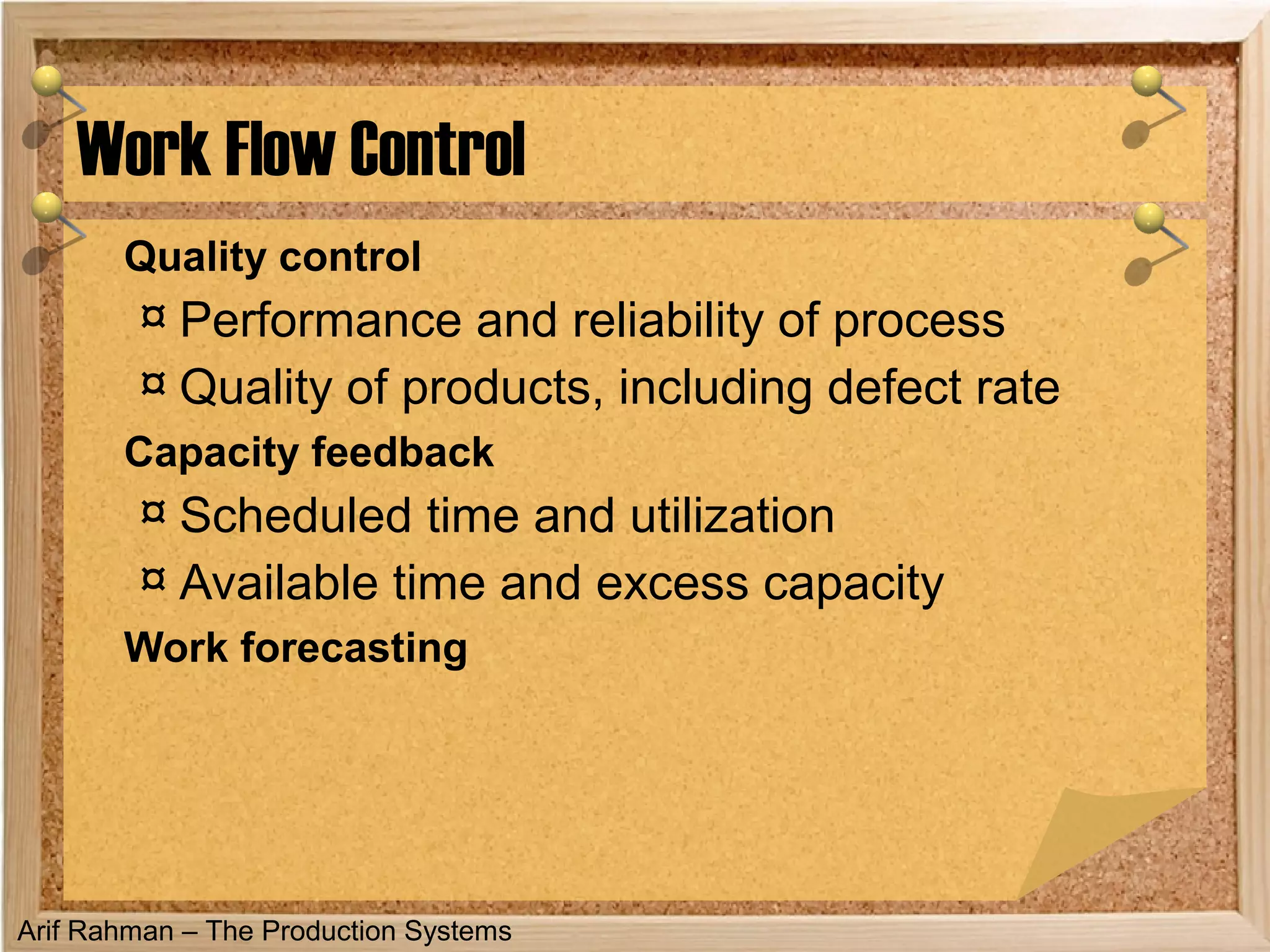
Quality control
¤ Performance and reliability of process
¤ Quality of products, including defect rate
Capacity feedback
¤ Scheduled time and utilization
¤ Available time and excess capacity
Work forecasting
Work Flow Control
Arif Rahman – The Production Systems
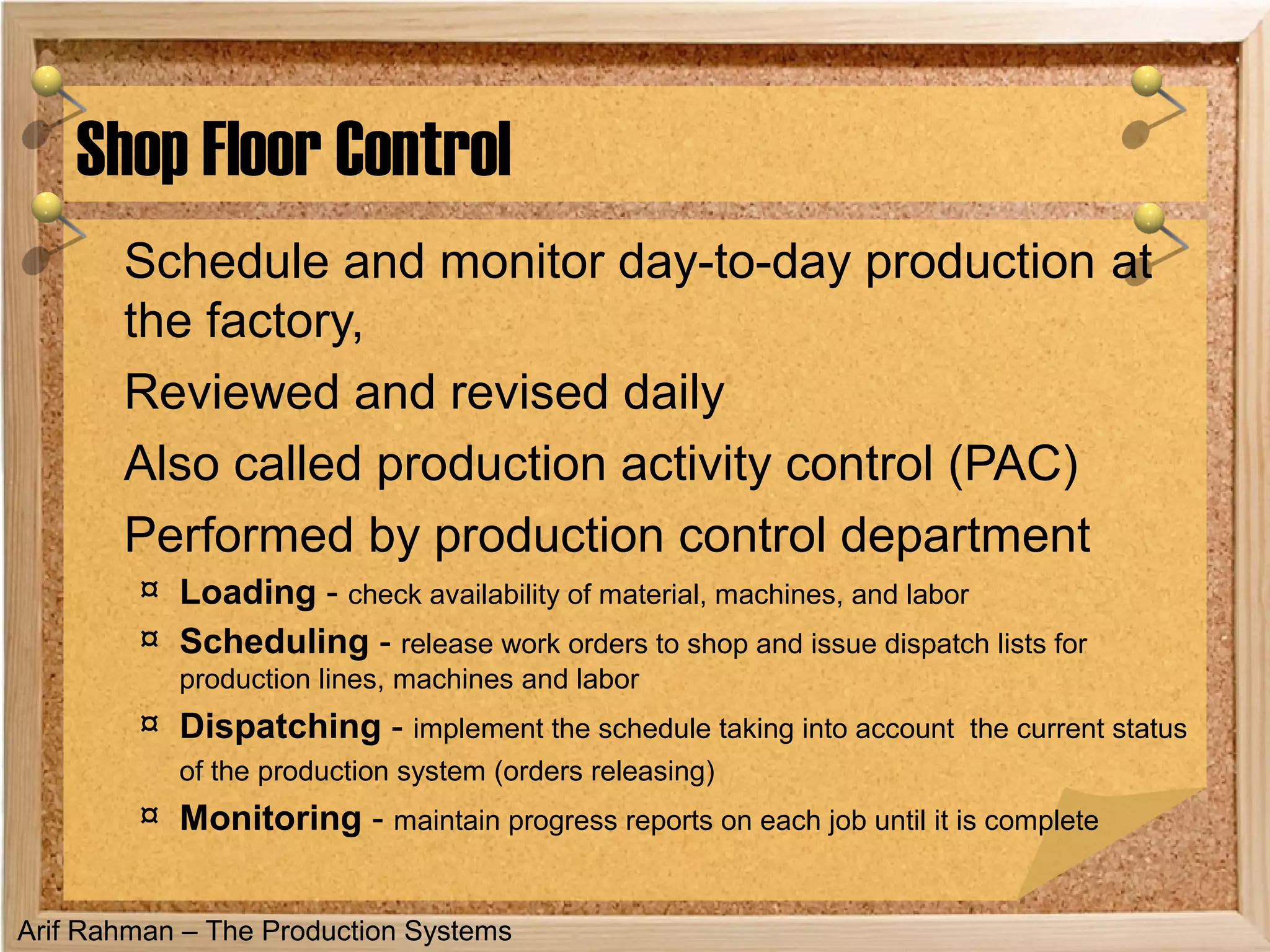
Schedule and monitor day-to-day production at
the factory,
Reviewed and revised daily
Also called production activity control (PAC)
Performed by production control department
¤ Loading - check availability of material, machines, and labor
¤ Scheduling - release work orders to shop and issue dispatch lists for
production lines, machines and labor
¤ Dispatching - implement the schedule taking into account the current status
of the production system (orders releasing)
¤ Monitoring - maintain progress reports on each job until it is complete
Shop Floor Control
Arif Rahman – The Production Systems
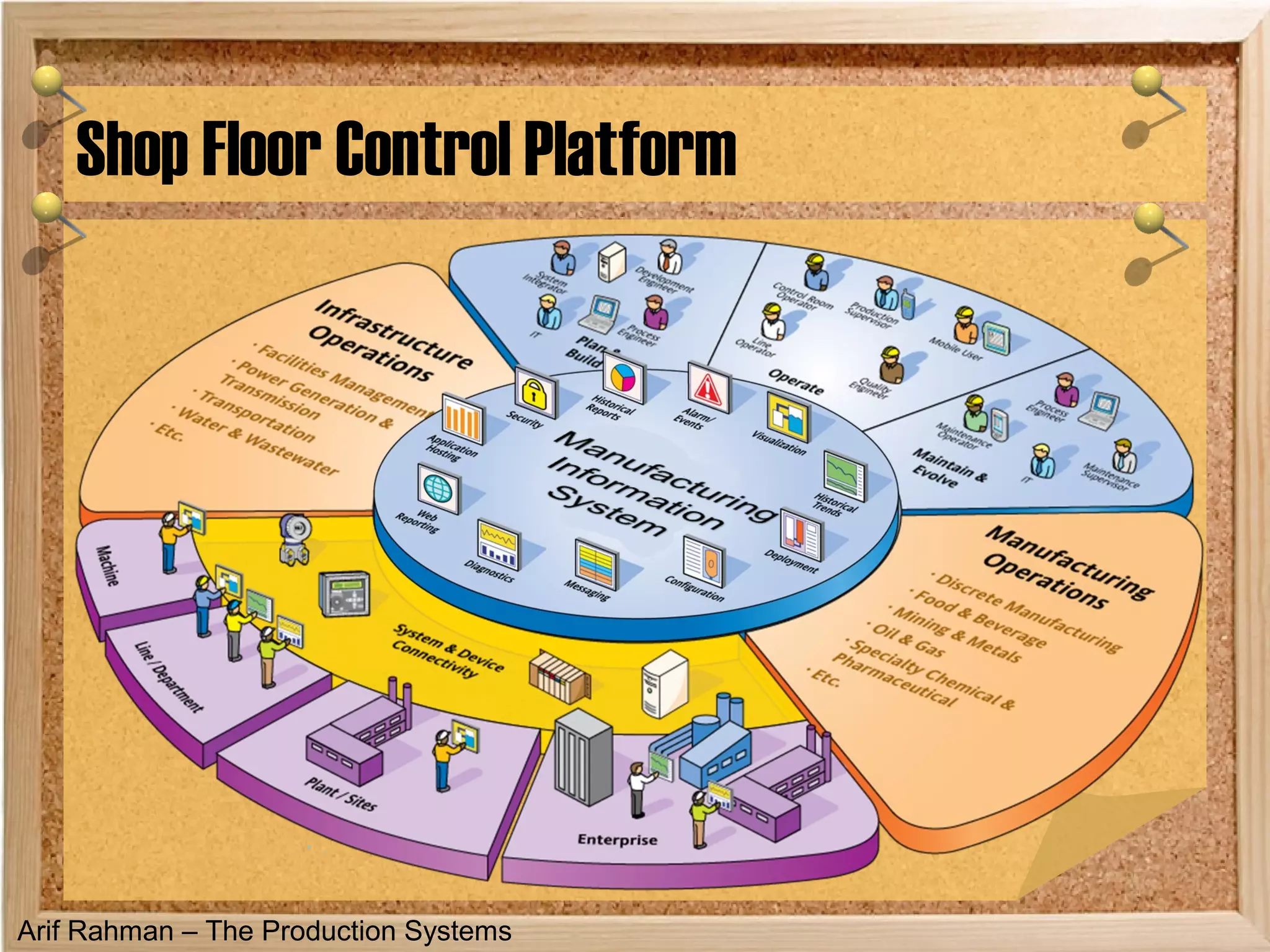
Shop Floor Control Platform
Arif Rahman – The Production Systems
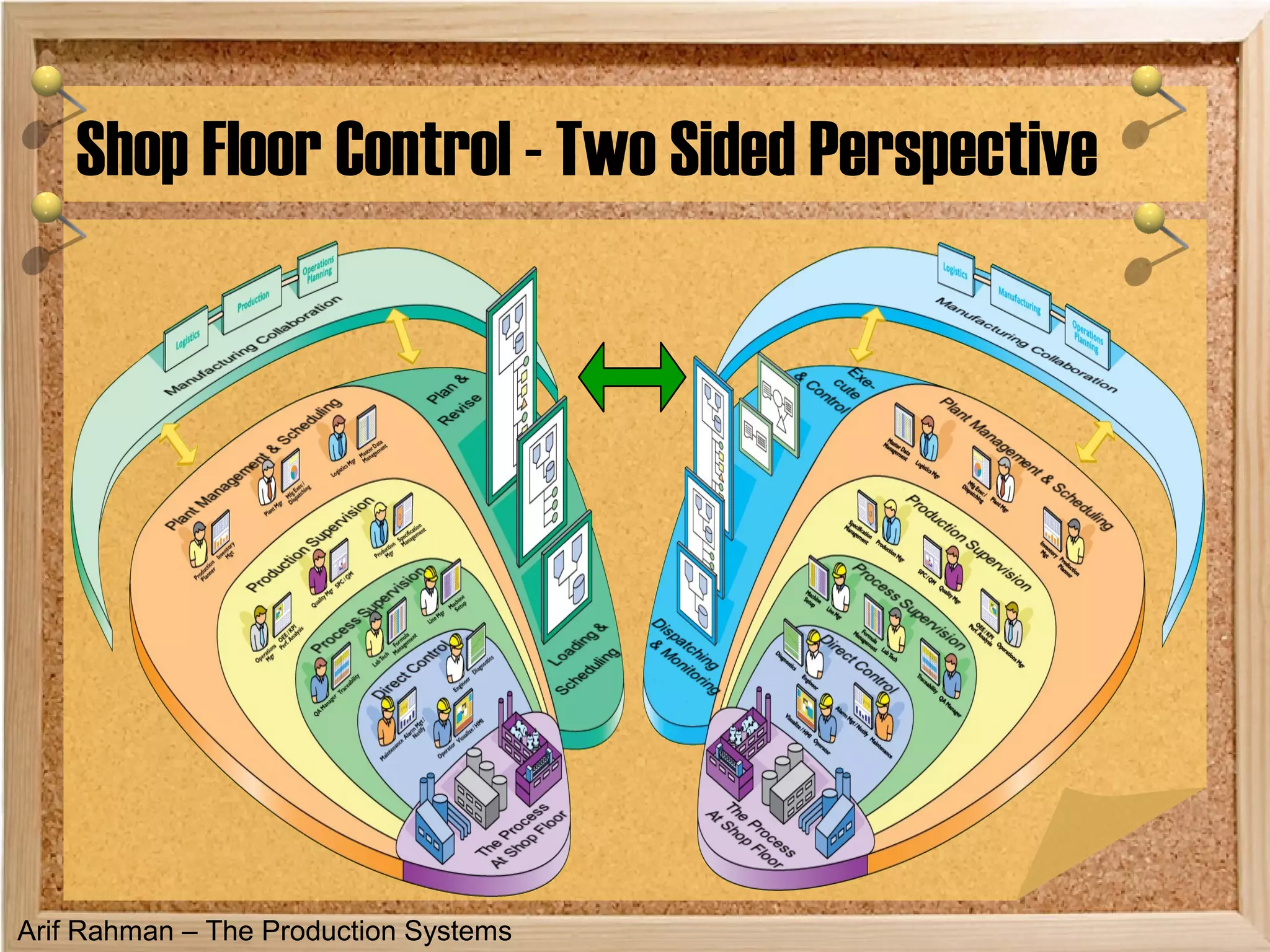
Shop Floor Control - Two Sided Perspective
Arif Rahman – The Production Systems
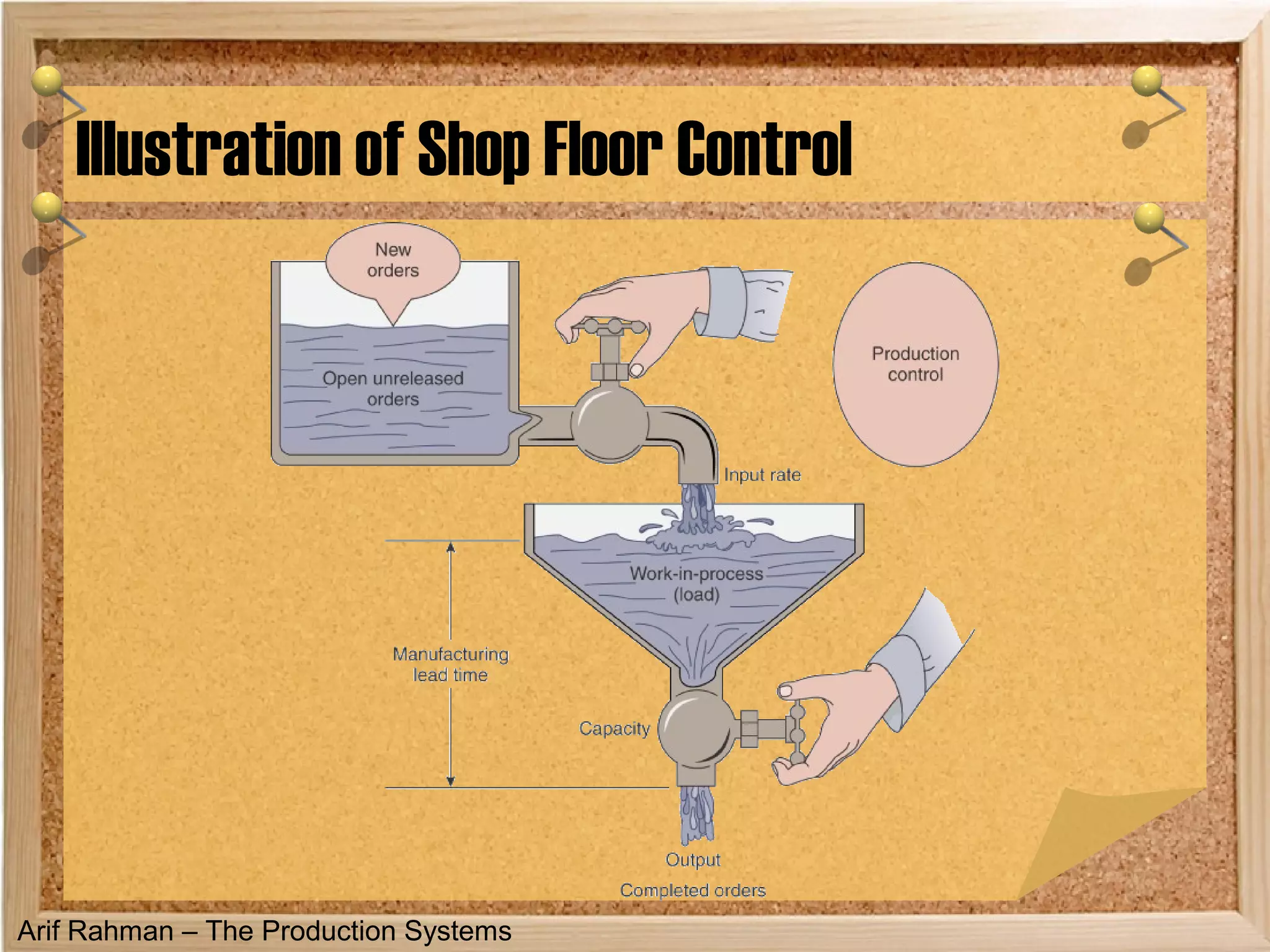
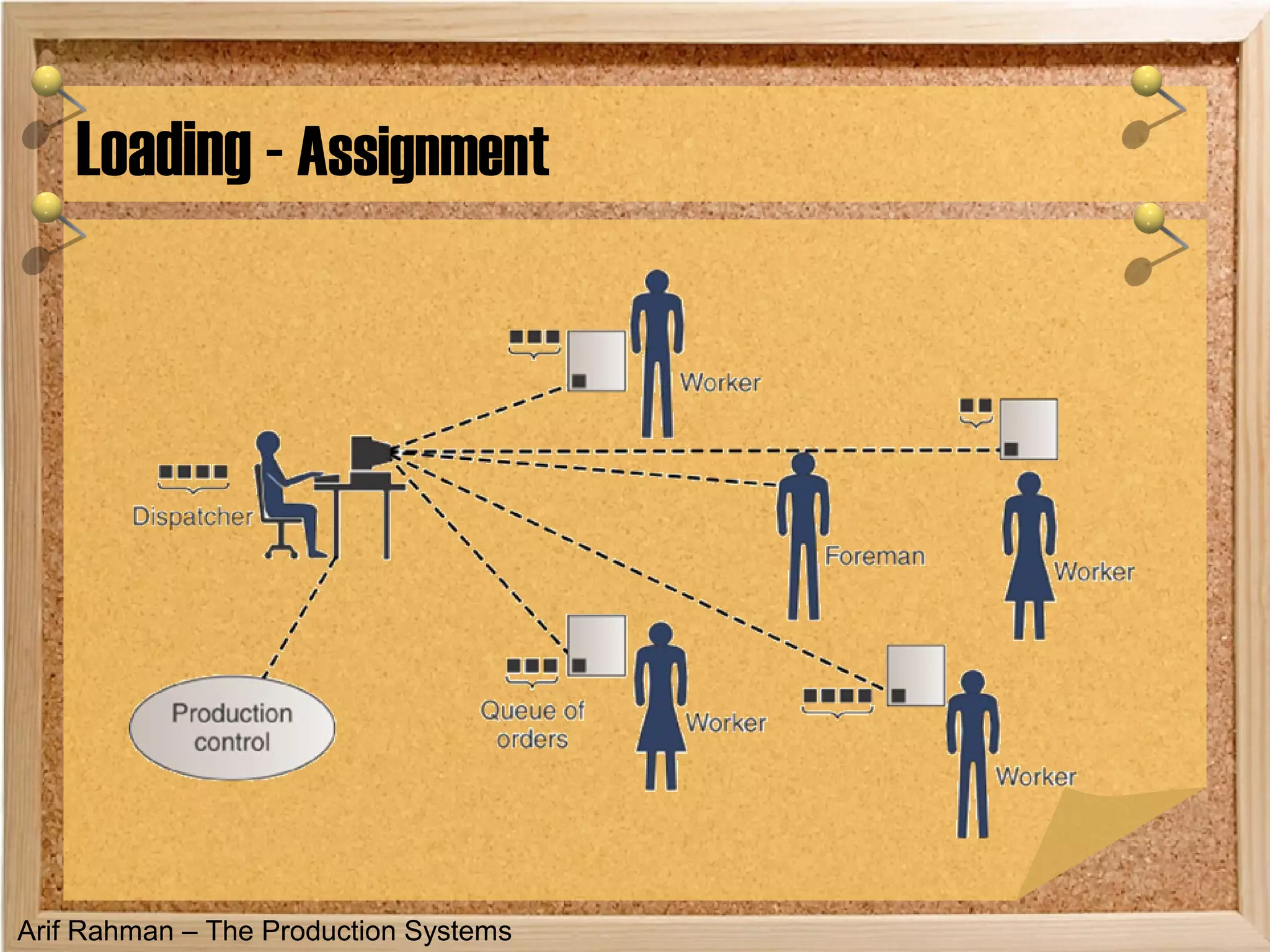
Illustration of Shop Floor Control
Arif Rahman – The Production Systems
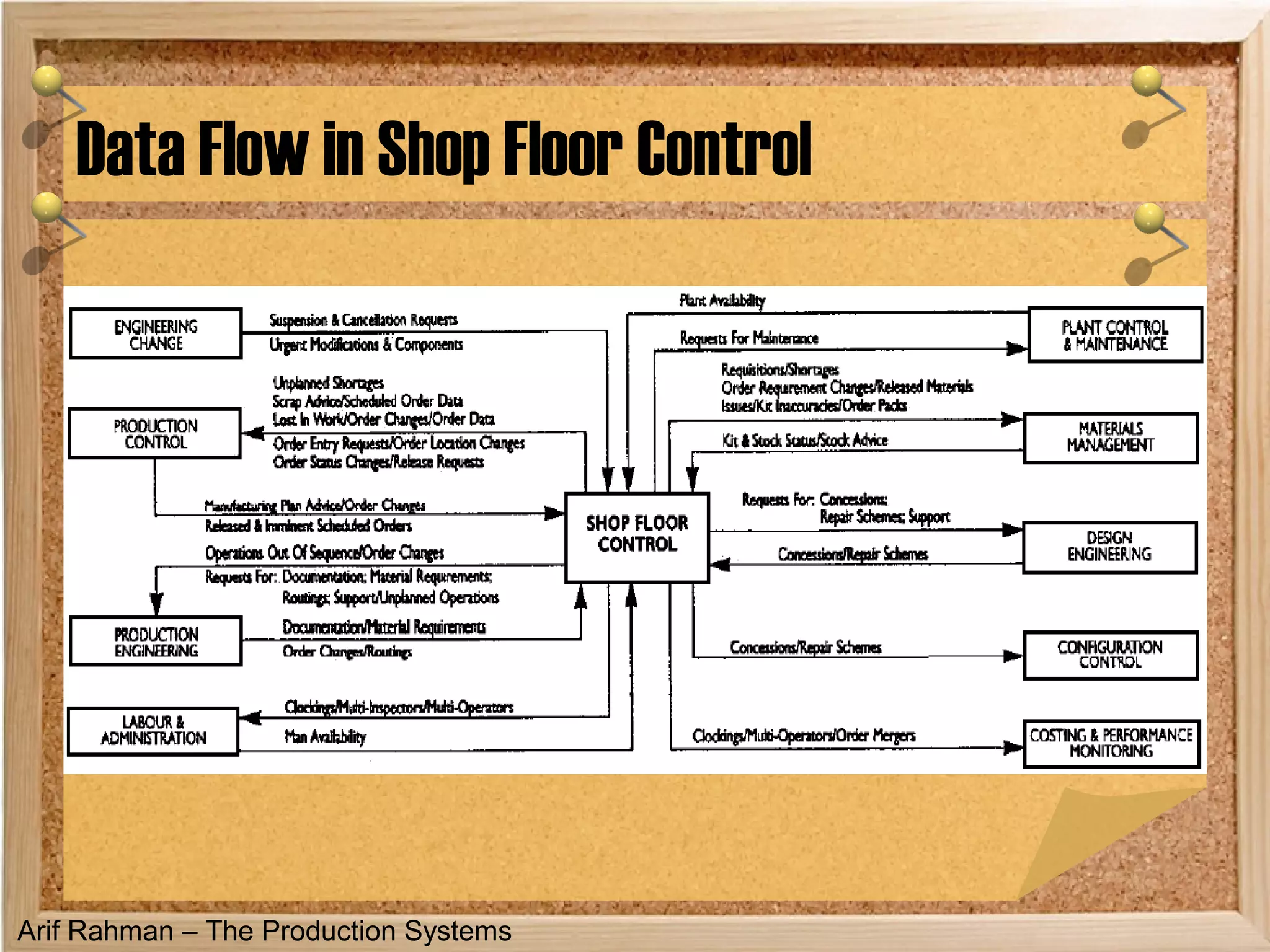
Data Flow in Shop Floor Control
Arif Rahman – The Production Systems
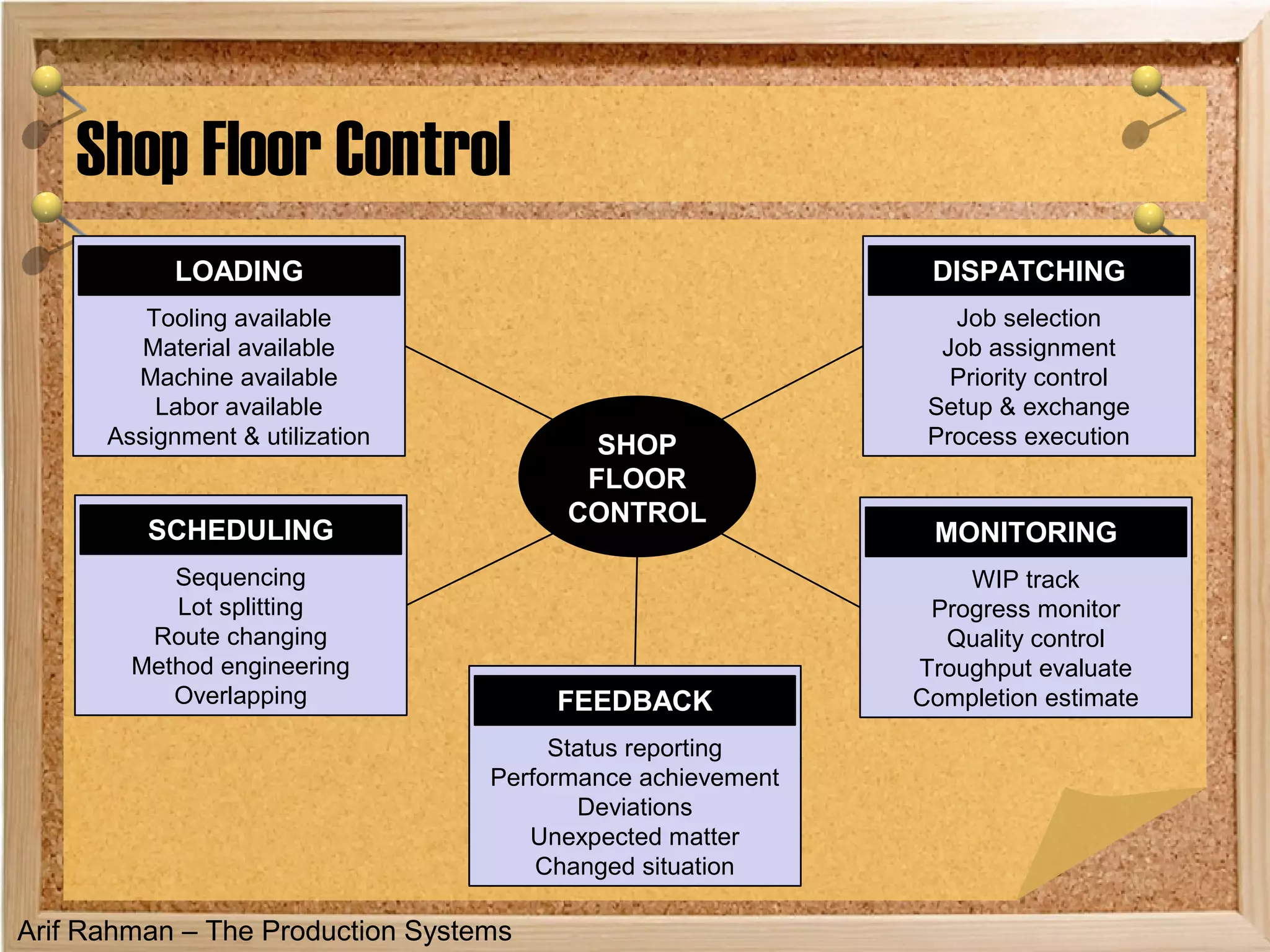
Shop Floor Control
Tooling available
Material available
Machine available
Labor available
Assignment & utilization
LOADING
Sequencing
Lot splitting
Route changing
Method engineering
Overlapping
SCHEDULING
Job selection
Job assignment
Priority control
Setup & exchange
Process execution
DISPATCHING
WIP track
Progress monitor
Quality control
Troughput evaluate
Completion estimate
MONITORING
Status reporting
Performance achievement
Deviations
Unexpected matter
Changed situation
FEEDBACK
SHOP
FLOOR
CONTROL
Arif Rahman – The Production Systems
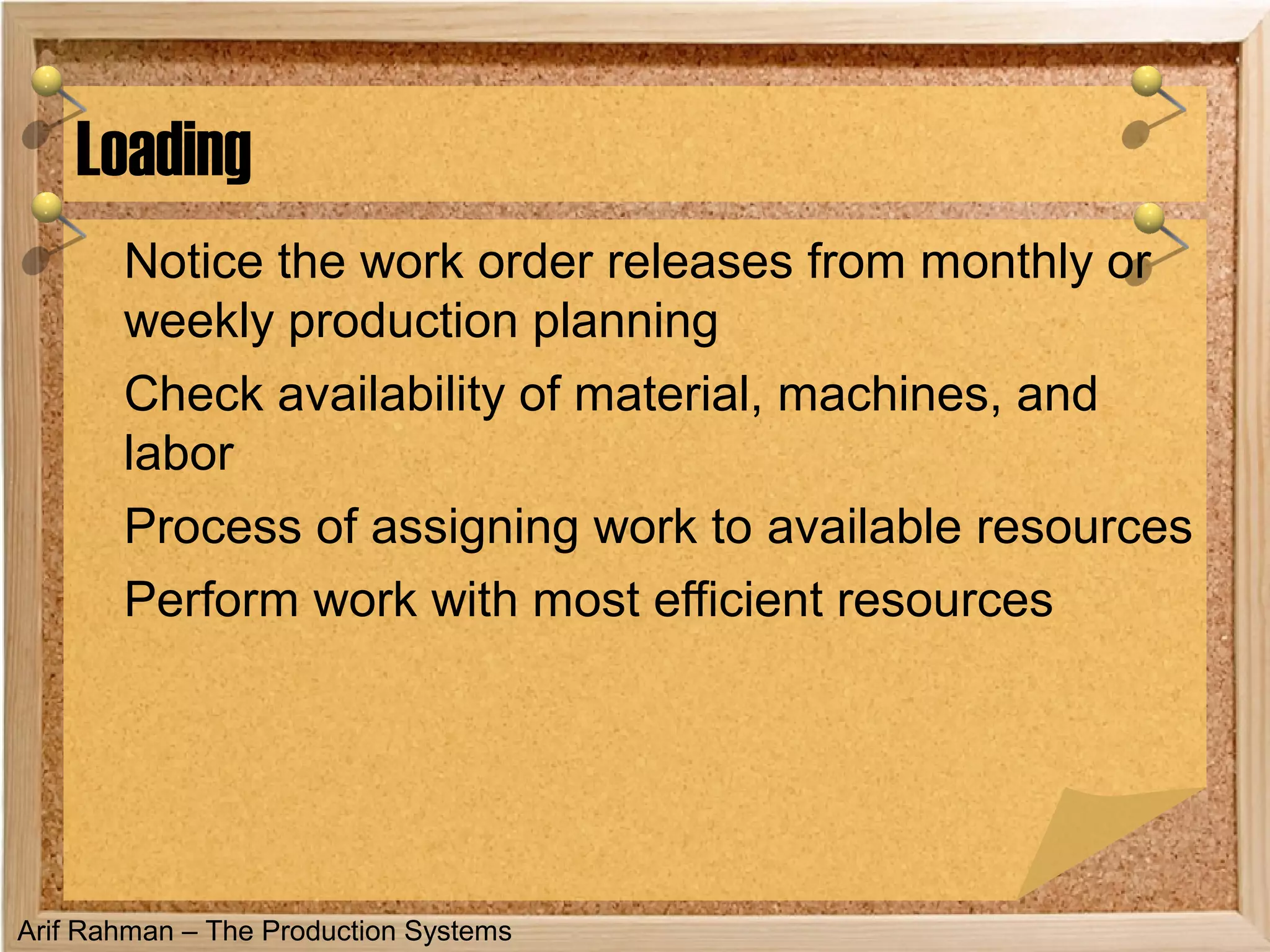
Loading
Arif Rahman – The Production Systems
Notice the work order releases from monthly or
weekly production planning
Check availability of material, machines, and
labor
Process of assigning work to available resources
Perform work with most efficient resources
Loading
Arif Rahman – The Production Systems
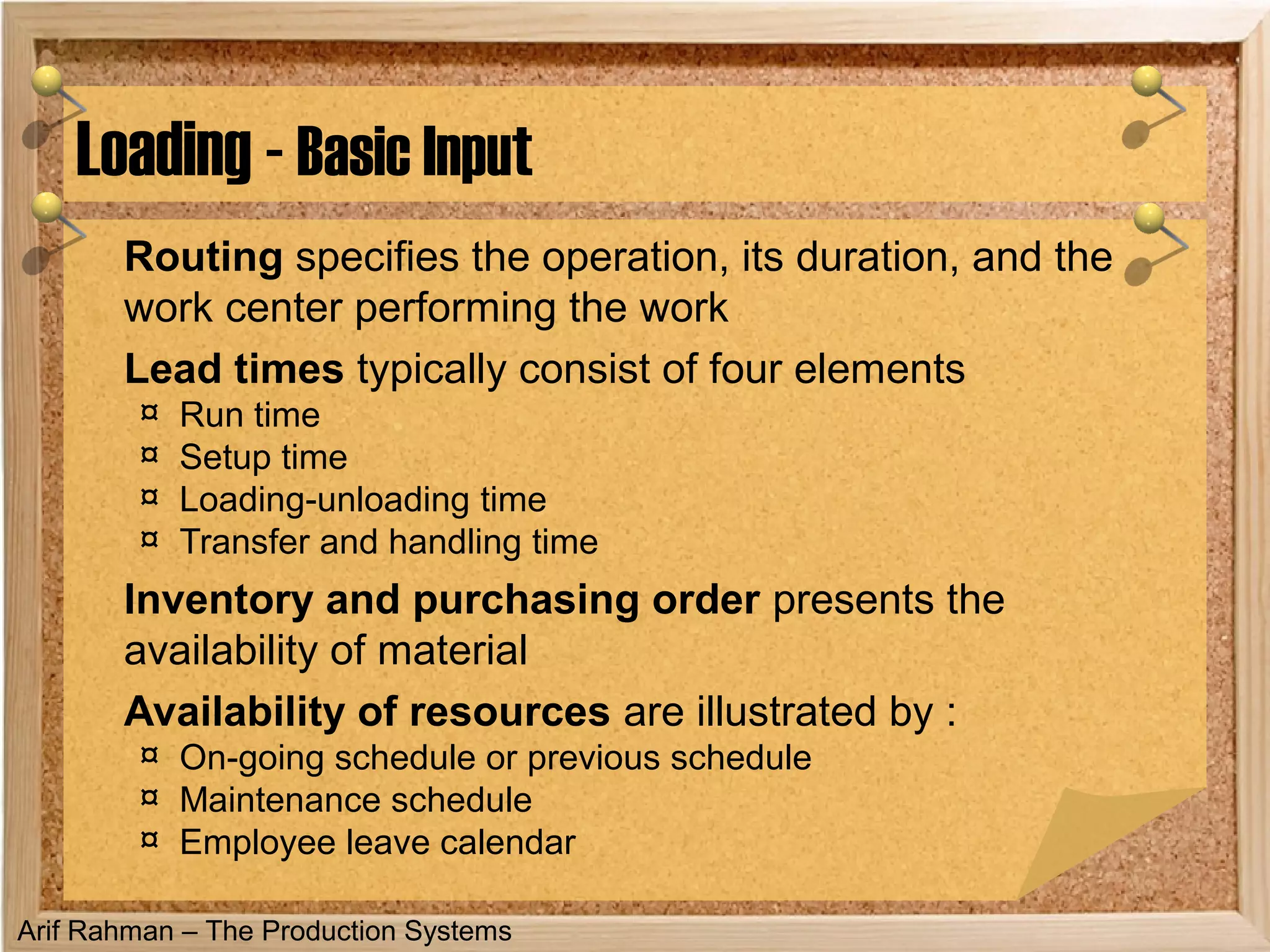
Routing specifies the operation, its duration, and the
work center performing the work
Lead times typically consist of four elements
¤ Run time
¤ Setup time
¤ Loading-unloading time
¤ Transfer and handling time
Inventory and purchasing order presents the
availability of material
Availability of resources are illustrated by :
¤ On-going schedule or previous schedule
¤ Maintenance schedule
¤ Employee leave calendar
Loading - Basic Input
Arif Rahman – The Production Systems
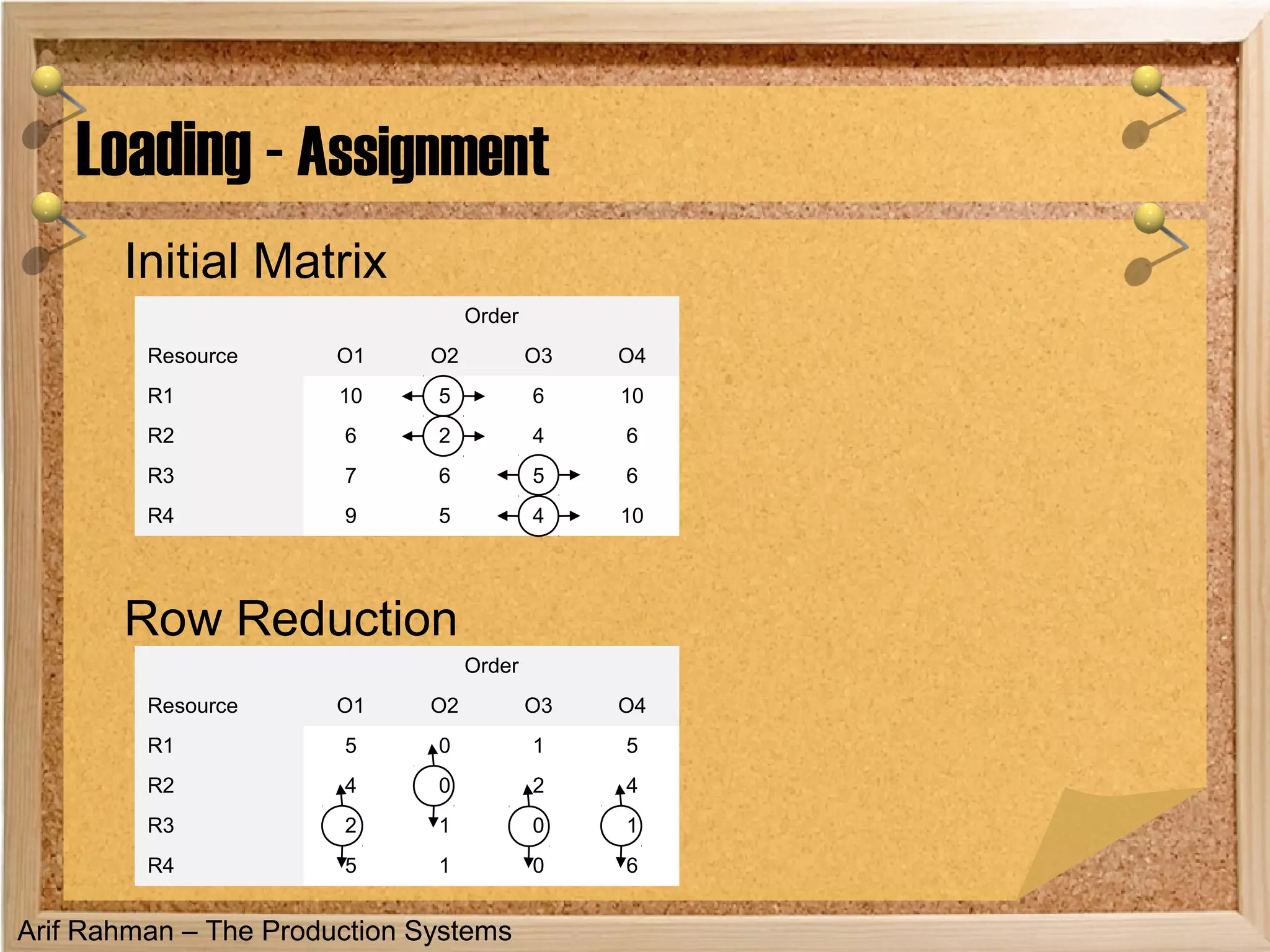
Use assignment method of operation research to
determine allocation
Hungarian Algorithm
Loading - Assignment
1. Perform row reductions
– subtract minimum value in each row
from all other row values
2. Perform column reductions
– subtract minimum value in each
column from all other column values
3. Cross out all zeros in matrix
– use minimum number of horizontal
and vertical lines
4. If number of lines equals number of
rows in matrix, then optimum
solution has been found. Make
assignments where zeros appear
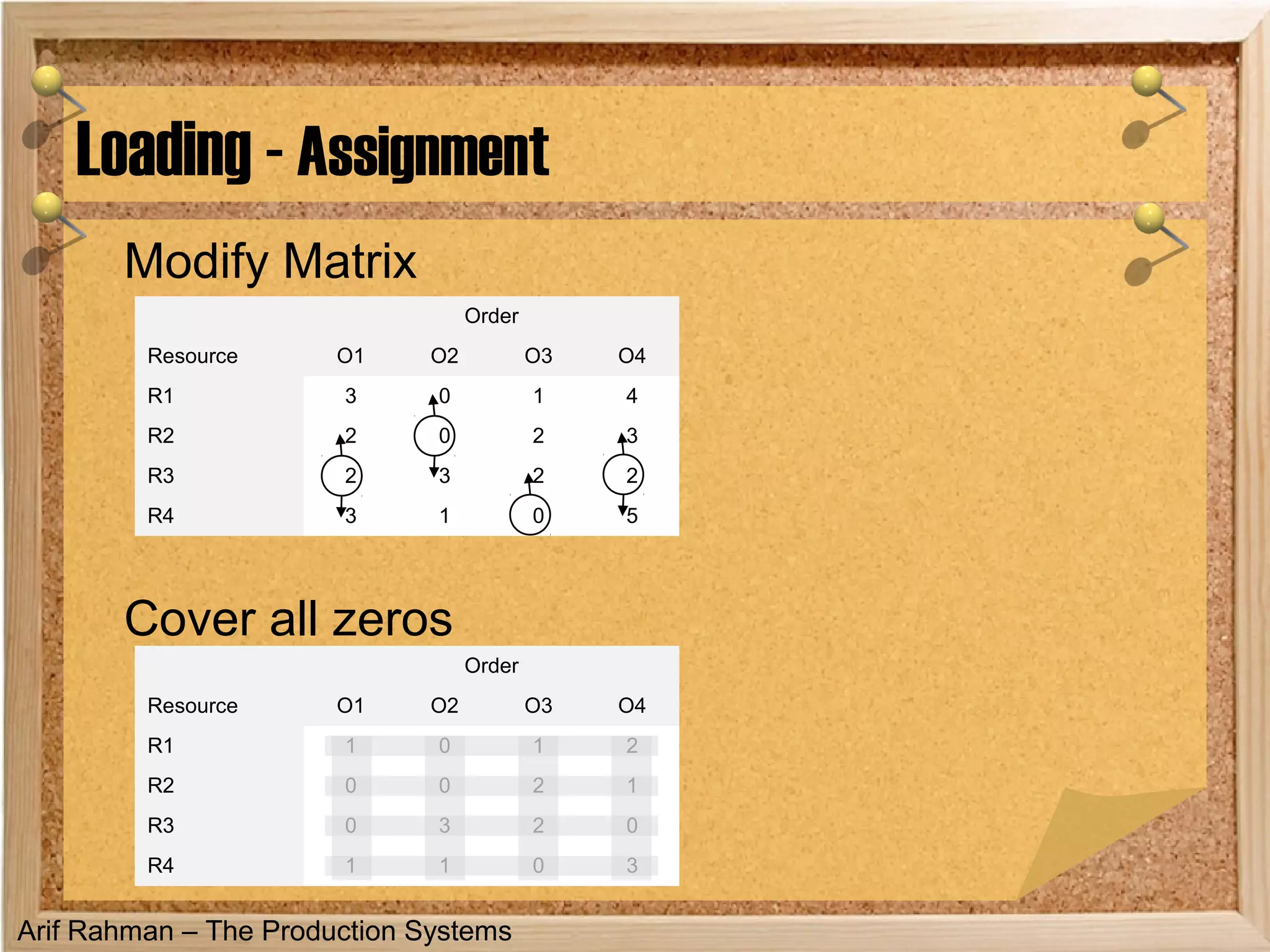
‾ Else modify matrix:
‾ subtract minimum uncrossed value
from all uncrossed values
‾ add it to all cells where two lines
intersect
‾ other values in matrix remain
unchanged
4. Repeat steps 3 and 4 until
optimum solution is reached
Arif Rahman – The Production Systems
Initial Matrix
Row Reduction
Loading - Assignment
Order
Resource O1 O2 O3 O4
R1 10 5 6 10
R2 6 2 4 6
R3 7 6 5 6
R4 9 5 4 10
Order
Resource O1 O2 O3 O4
R1 5 0 1 5
R2 4 0 2 4
R3 2 1 0 1
R4 5 1 0 6
Arif Rahman – The Production Systems
Column reduction
Cover all zeros
Loading - Assignment
Order
Resource O1 O2 O3 O4
R1 3 0 1 4
R2 2 0 2 3
R3 0 1 0 0
R4 3 1 0 5
Order
Resource O1 O2 O3 O4
R1 3 0 1 4
R2 2 0 2 3
R3 0 1 0 0
R4 3 1 0 5
+2
Arif Rahman – The Production Systems
Modify Matrix
Cover all zeros
Loading - Assignment
Order
Resource O1 O2 O3 O4
R1 3 0 1 4
R2 2 0 2 3
R3 2 3 2 2
R4 3 1 0 5
Order
Resource O1 O2 O3 O4
R1 1 0 1 2
R2 0 0 2 1
R3 0 3 2 0
R4 1 1 0 3
Arif Rahman – The Production Systems
Final Matrix
Solution
Loading - Assignment
Order
Resource O1 O2 O3 O4
R1 1 0 1 2
R2 0 0 2 1
R3 0 3 2 0
R4 1 1 0 3
Order
Resource O1 O2 O3 O4
R1 10 5 6 10
R2 6 2 4 6
R3 7 6 5 6
R4 9 5 4 10
Arif Rahman – The Production Systems
Loading - Assignment
Arif Rahman – The Production Systems
The allocation of jobs to work centers is
called shop loading
Loading methods :
¤ Infinite loading – It does not take into consideration
the limited capacity of the facility. Scheduling with
unlimited capacity
¤ Finite loading – assigns jobs to work centers
without regard to capacity limitations. Scheduling with
limited capacity. It takes into consideration the limited
capacity of each work center.
Shop Loading
Arif Rahman – The Production Systems
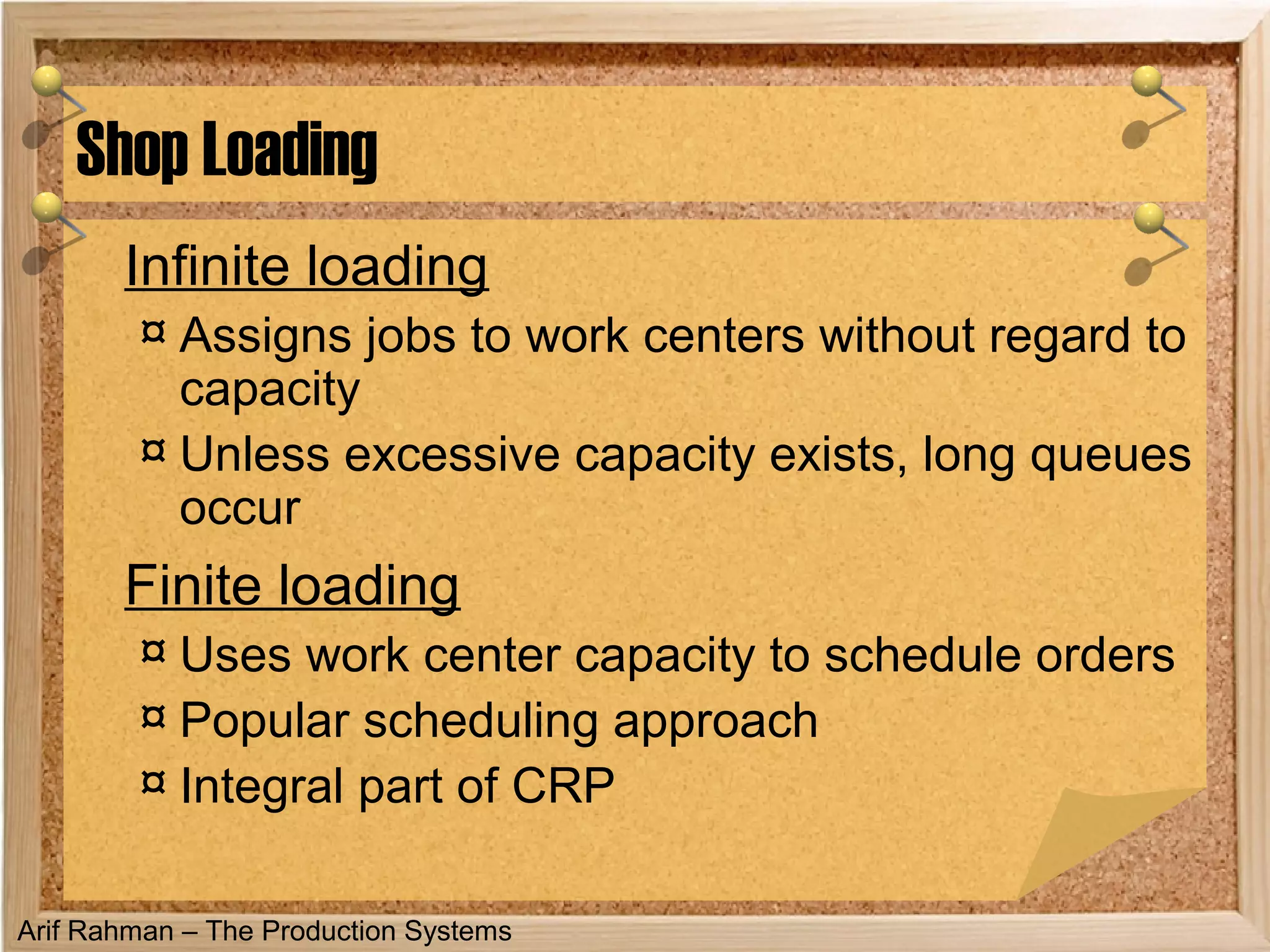
Infinite loading
¤ Assigns jobs to work centers without regard to
capacity
¤ Unless excessive capacity exists, long queues
occur
Finite loading
¤ Uses work center capacity to schedule orders
¤ Popular scheduling approach
¤ Integral part of CRP
Shop Loading
Arif Rahman – The Production Systems
Shop Loading
Capacity
Time period651 2 3 4
under
over
INFINITE LOADING (without regard for capacity)
Arif Rahman – The Production Systems
Shop Loading
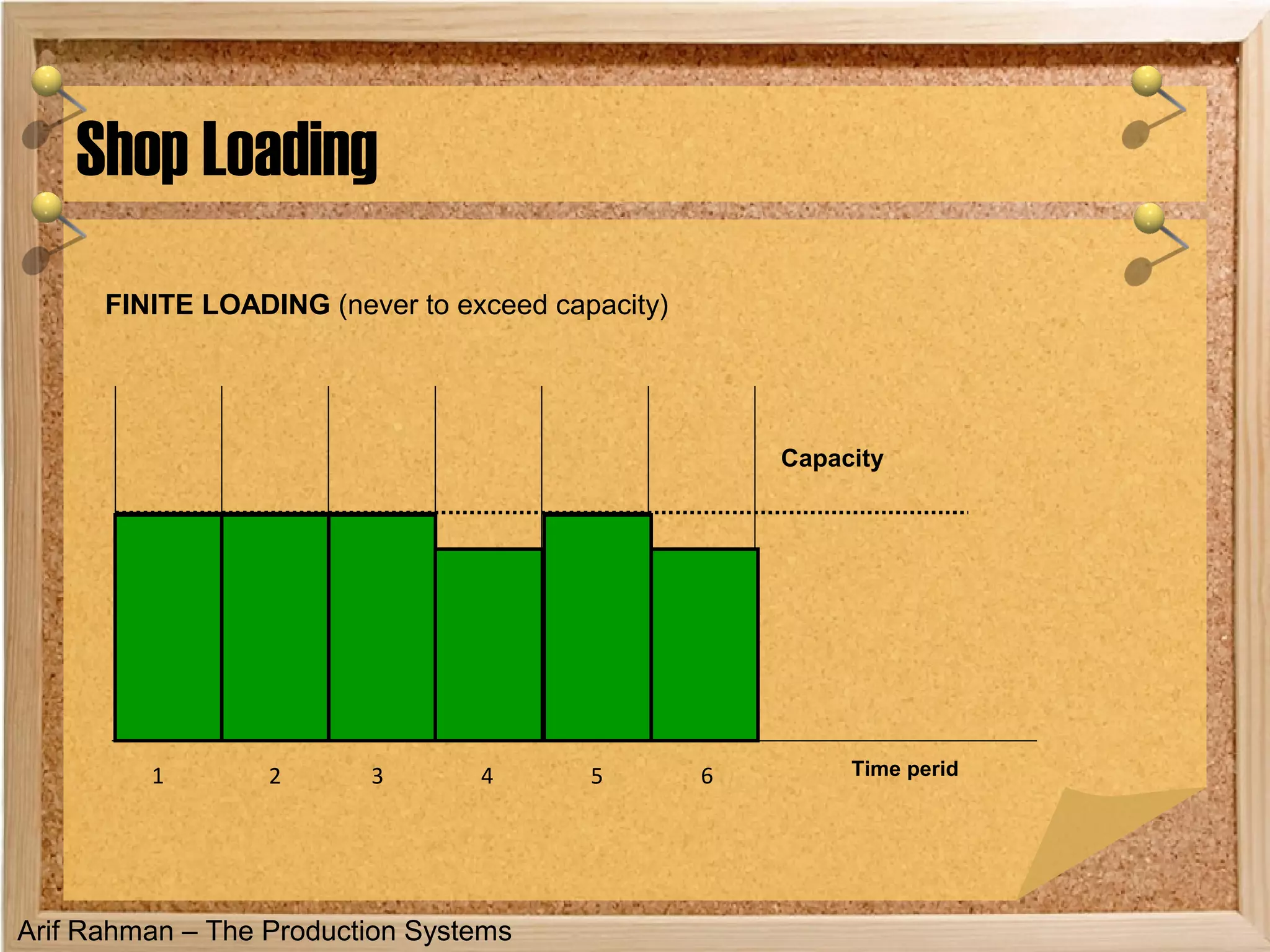
FINITE LOADING (never to exceed capacity)
Capacity
Time perid651 2 3 4
Arif Rahman – The Production Systems
Scheduling
Arif Rahman – The Production Systems
Developing detailed schedule based on
timely knowledge and data which will
ensure that all the production
requirements are fulfilled
Allocating orders, equipment, and
personnel to work center or other specified
locations
Scheduling
Arif Rahman – The Production Systems
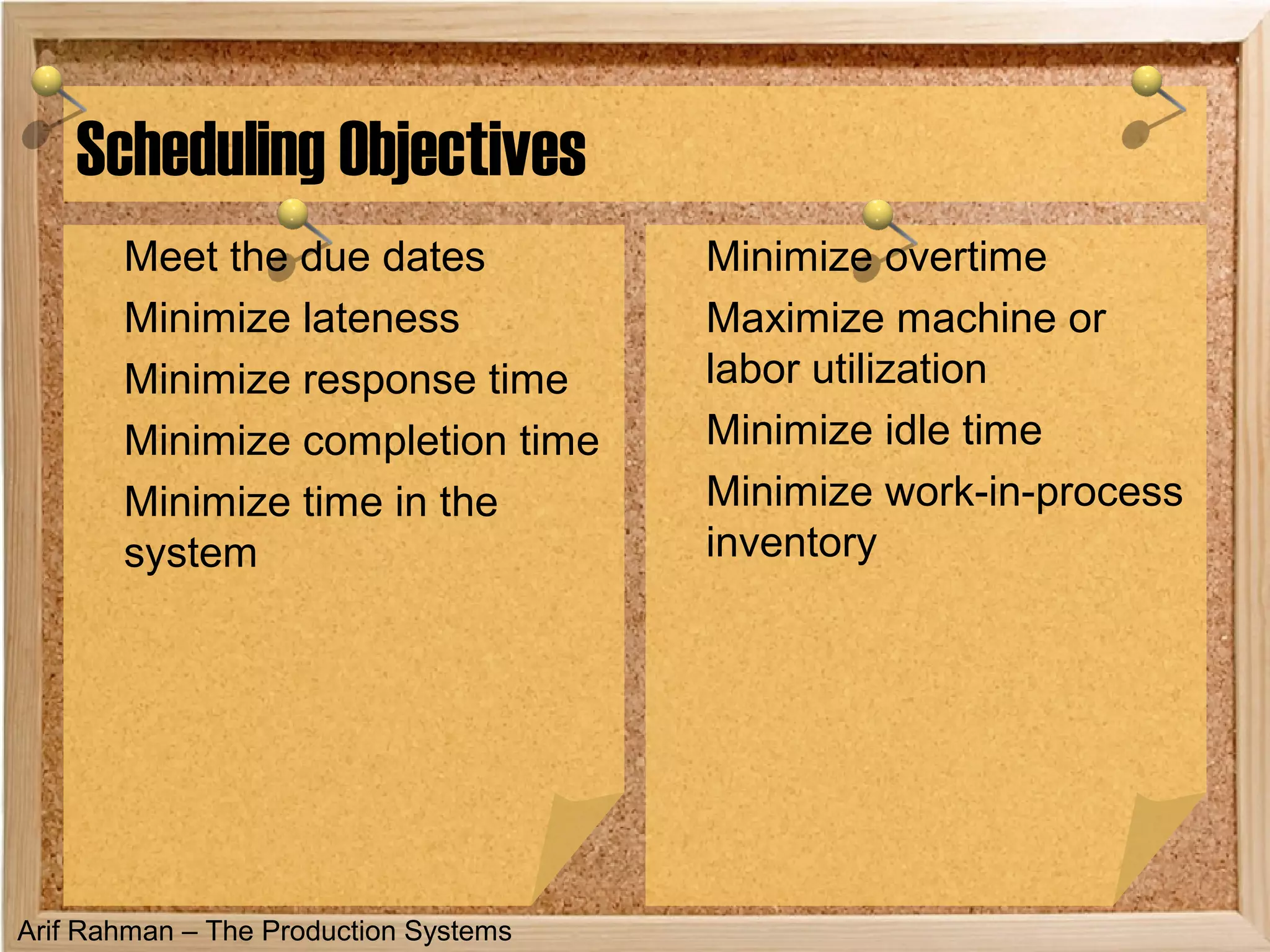
Scheduling Objectives
Meet the due dates
Minimize lateness
Minimize response time
Minimize completion time
Minimize time in the
system
Minimize overtime
Maximize machine or
labor utilization
Minimize idle time
Minimize work-in-process
inventory
Arif Rahman – The Production Systems
Flow time (completion time)
¤ Time for a job to flow through system
Makespan
¤ Time for a group of jobs to be completed
Tardiness
¤ Difference between a late job’s due date and
its completion time
Number of tardy jobs
¤ The number of late jobs exceed due date
Scheduling Performance Measures
Arif Rahman – The Production Systems
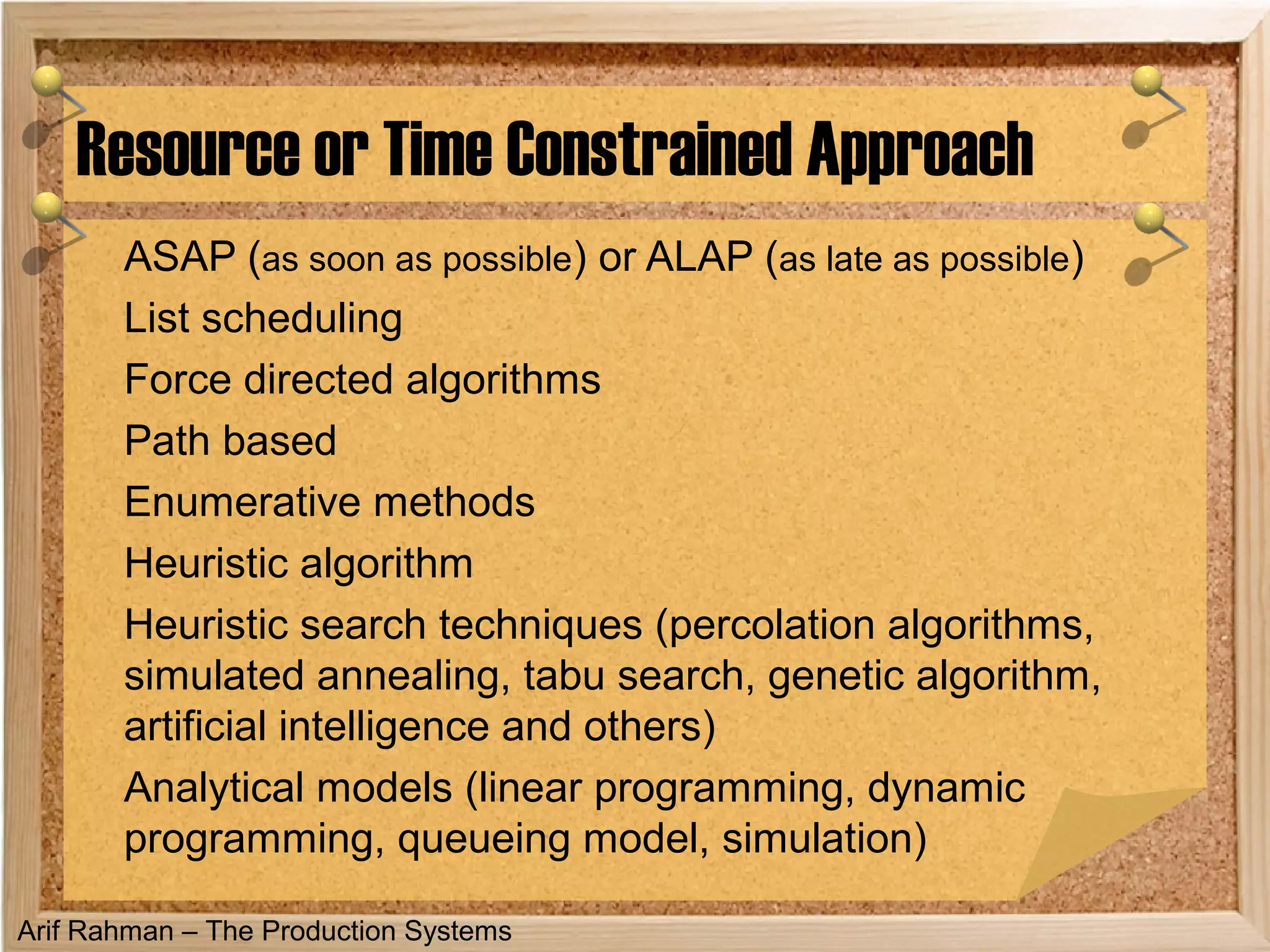
ASAP (as soon as possible) or ALAP (as late as possible)
List scheduling
Force directed algorithms
Path based
Enumerative methods
Heuristic algorithm
Heuristic search techniques (percolation algorithms,
simulated annealing, tabu search, genetic algorithm,
artificial intelligence and others)
Analytical models (linear programming, dynamic
programming, queueing model, simulation)
Resource or Time Constrained Approach
Arif Rahman – The Production Systems
FCFS - first-come, first-served
LCFS - last come, first served
CUSTPR - highest customer priority
SETUP - similar required setups
SPT - shortest processing time
LPT - longest processing time
EDD - earliest due date
SLACK - Minimum slack
CR - smallest critical ratio
Random order
Priority Rule of Scheduling
Arif Rahman – The Production Systems
Minimum Slack
Smallest Critical Ratio
Priority Rule of Scheduling
Slack = time remaining – processing time
= (due date – today’s date) – processing time
Critical Ratio =
time remaining
processing time
=
(due date – today’s date)
processing time
Arif Rahman – The Production Systems
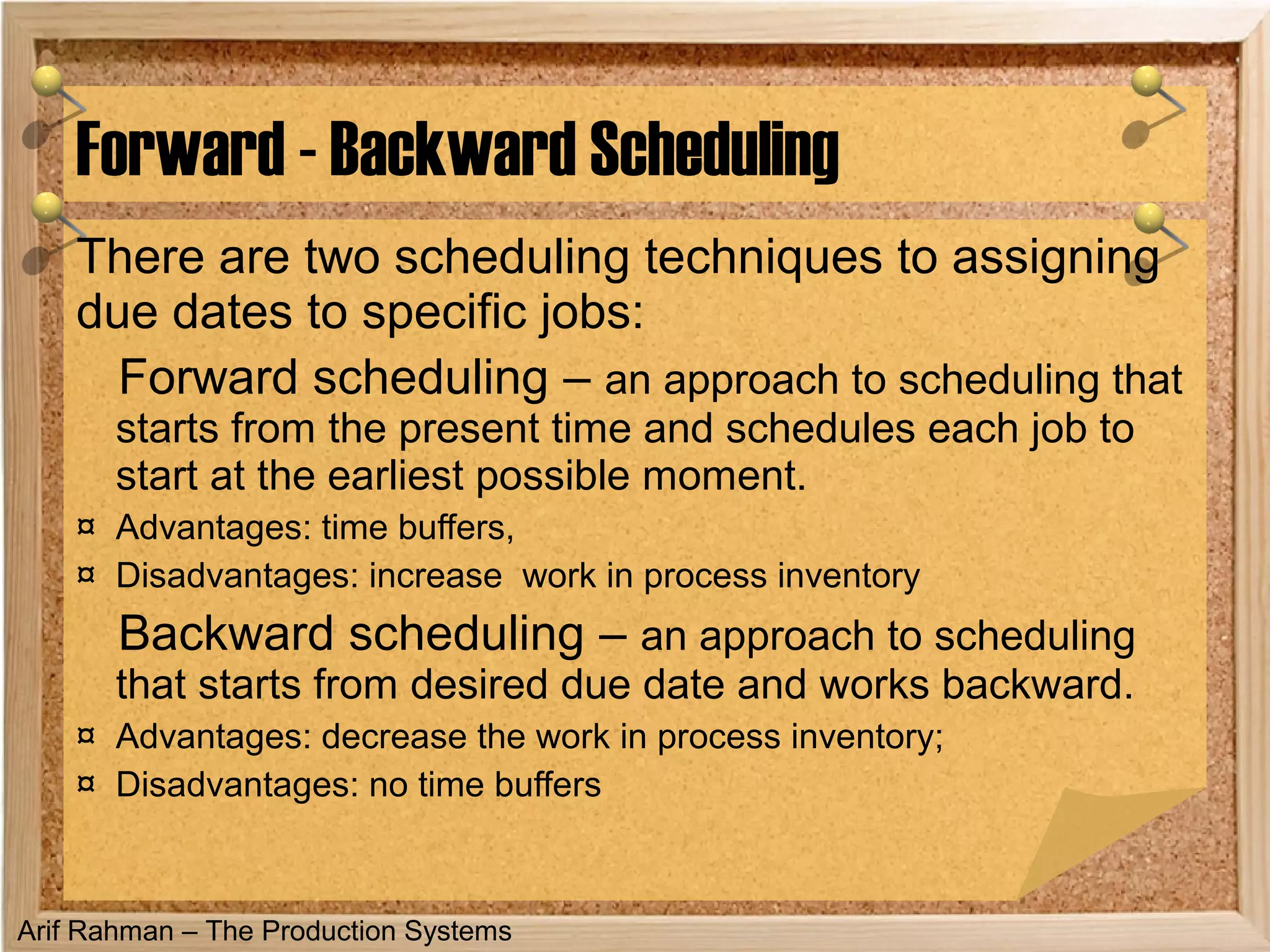
There are two scheduling techniques to assigning
due dates to specific jobs:
Forward scheduling – an approach to scheduling that
starts from the present time and schedules each job to
start at the earliest possible moment.
¤ Advantages: time buffers,
¤ Disadvantages: increase work in process inventory
Backward scheduling – an approach to scheduling
that starts from desired due date and works backward.
¤ Advantages: decrease the work in process inventory;
¤ Disadvantages: no time buffers
Forward - Backward Scheduling
Arif Rahman – The Production Systems
Forward scheduling
¤ Jobs are given earliest available time slot in operation
¤ excessive WIP usually results
Backward scheduling
¤ Start with promise date and work backward through
operations reviewing lead times to determine when a
job has to pass through each operation
¤ Less WIP but must have accurate lead times
Forward - Backward Scheduling
Arif Rahman – The Production Systems
Forward - Backward Scheduling
Today Due Date
B
Forward Scheduling
Today Due Date
B E
Backward Scheduling
E
Arif Rahman – The Production Systems
Visual scheduling tool
Graphical representation of scheduling
information
Show dependencies between tasks,
personnel, and other resources allocations
Track progress towards completion
Gantt Chart
Arif Rahman – The Production Systems
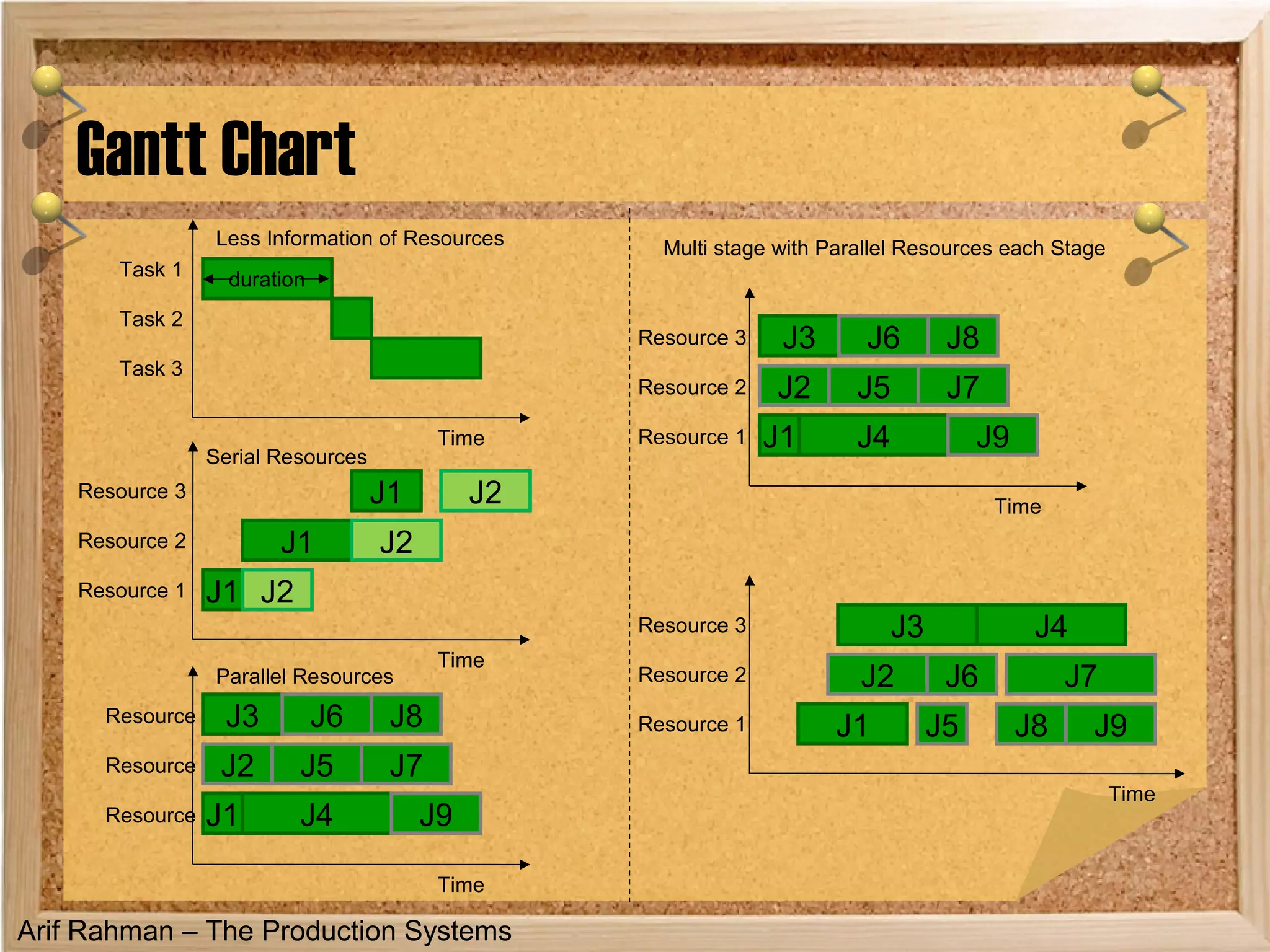
Gantt Chart
Task 1
Task 2
Task 3
Time
Resource 3
Resource 2
Resource 1
J1
J1
J1
Time
J2
J2
J2
Resource 3
Resource 2
Resource 1
J3
J1 J4
Time
J2 J5
J6
J7
J8
J9
Less Information of Resources
Serial Resources
Parallel Resources
Multi stage with Parallel Resources each Stage
Resource 3
Resource 2
Resource 1
J3
J1 J4
Time
J2 J5
J6
J7
J8
J9
Resource 3
Resource 2
Resource 1
J3
J1
J4
Time
J2
J5
J6 J7
J8 J9
duration
Arif Rahman – The Production Systems
Gantt Chart
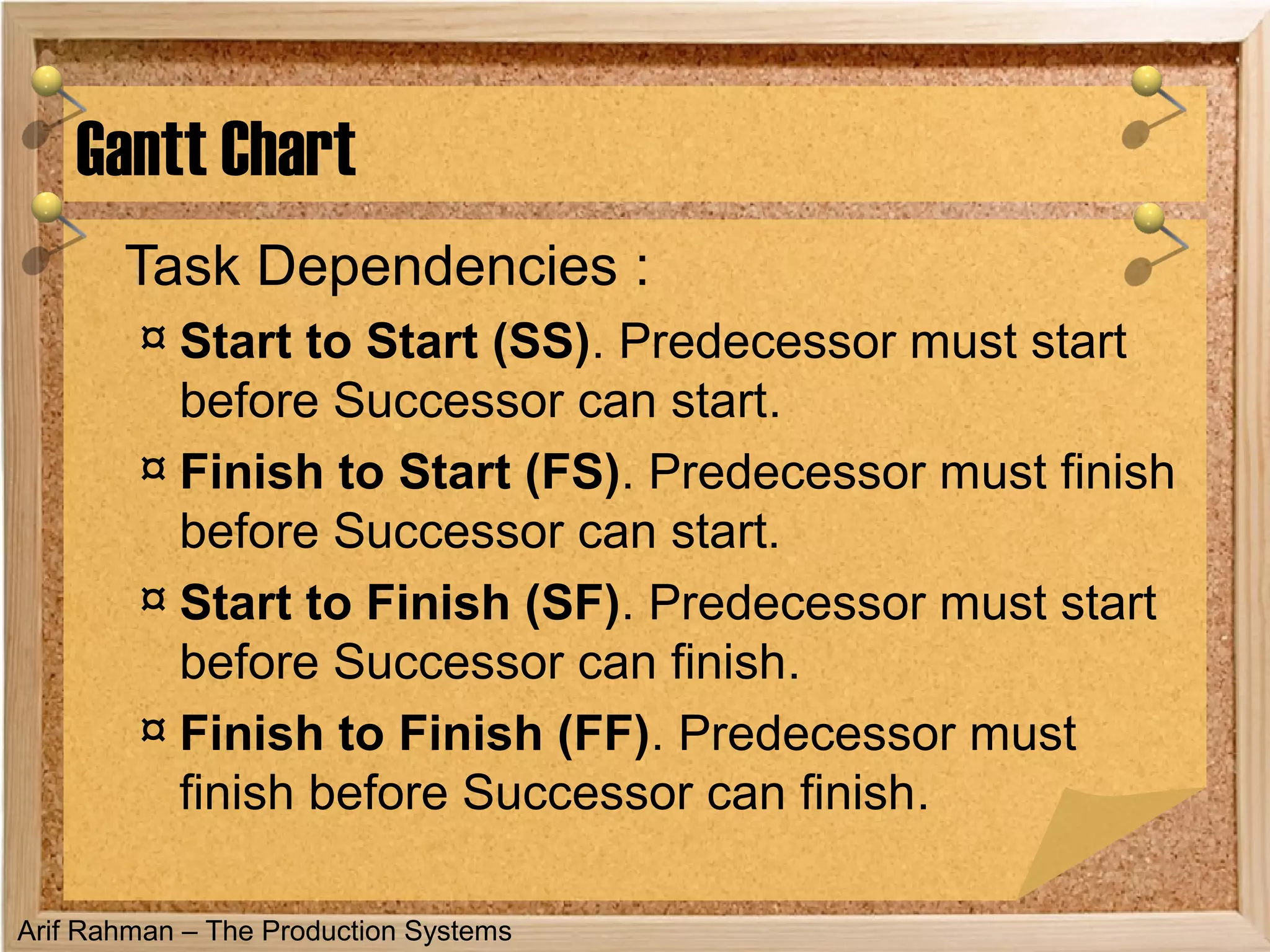
Task Dependencies :
¤ Start to Start (SS). Predecessor must start
before Successor can start.
¤ Finish to Start (FS). Predecessor must finish
before Successor can start.
¤ Start to Finish (SF). Predecessor must start
before Successor can finish.
¤ Finish to Finish (FF). Predecessor must
finish before Successor can finish.
Arif Rahman – The Production Systems
Gantt Chart
Arif Rahman – The Production Systems
Lag is the amount of time whereby a
successor activity will be delayed with
respect to a predecessor activity.
Lead is the amount of time whereby a
successor activity can be advanced with
respect to a predecessor activity.
Gantt Chart
Arif Rahman – The Production Systems
Dispatching
Arif Rahman – The Production Systems
Dispatching is sending the order to a
particular resource or destination for a
particular reason to execute and finish it
quickly and efficiently without wasting
time.
It implements the schedule taking into
account the current status of the
production system
Dispatching
Arif Rahman – The Production Systems
Local rule. It is concerned with the local available
information.
Global rule. It is used to dispatch jobs using all
information available on the shop floor.
Static rule. It do not change over time, and ignore the
status of the shop floor.
Dynamic rule. It is time dependent, and change
according to the status of the shop floor.
Forecast rule. It is used to give priority to jobs
according to what the job is going to come across in the
future and according to the situation at the local
machine.
Dispatching Rule
Arif Rahman – The Production Systems
Timely Production Board
Arif Rahman – The Production Systems
To Do List Board
Arif Rahman – The Production Systems
Monitoring
Arif Rahman – The Production Systems
Information System
Performance Dashboard
Gantt Chart
Monitoring
Arif Rahman – The Production Systems
Information System
Arif Rahman – The Production Systems
Performance Dashboard
Arif Rahman – The Production Systems
Gantt Chart
Arif Rahman – The Production Systems 60
It’s end of slides…
… Any question ?

09 shop floor control

  • 1.
    Arif Rahman –The Production Systems Slide 9 Shop Floor Control Arif Rahman, ST MT
  • 2.
    Arif Rahman –The Production Systems Information Barriers
  • 3.
    Arif Rahman –The Production Systems Manufacturing Network Interdependencies
  • 4.
    Arif Rahman –The Production Systems System Scope Scalability
  • 5.
    Arif Rahman –The Production Systems Enterprise Resource Planning (ERP) Manufacturing Execution System (MES) Shop Floor Control (SFC) ERP - MES - SFC
  • 6.
    Arif Rahman –The Production Systems ERP - MES - SFC
  • 7.
    Arif Rahman –The Production Systems ERP - MES - SFC
  • 8.
    Arif Rahman –The Production Systems ERP - MES - SFC Business Planning and Logistics Manufacturing Operations & Control Process Control Enterprise Resource Planning (ERP) Manufacturing Execution System (MES) Shop Floor Control (SFC) Level 4 Level 3 Level 0,1,2
  • 9.
    Arif Rahman –The Production Systems ERP - MES - SFC
  • 10.
    Arif Rahman –The Production Systems LEVEL 4: Establishing the basic plant schedule – production, material use, delivery and shipping; Determining inventory level Time frame : months, weeks, days LEVEL 3: Work flow, recipe control to produce the desired end products; Maintaining records and optimizing the production process. Time frame : days, shifts, hours, minutesLEVEL 2: Monitoring, supervisory control and automated control of the production process Time frame : minutes, seconds LEVEL 1: Sensing the production process and manipulating it Time frame : minutes, seconds, miliseconds LEVEL 0: The actual production process Time frame : minutes, seconds, miliseconds
  • 11.
    Arif Rahman –The Production Systems Production Planning and Shop Floor Control Resource planning Sales and operations planning Demand management Master production scheduling Detailed material planning Material and capacity plans Shop-floor scheduling and control (SFC) Purchasing Detailed capacity planning Vendor scheduling and follow-up Order release
  • 12.
    Arif Rahman –The Production Systems Purchasing is responsible for establishing and controlling flow of raw materials into the factory Shop Floor Control is responsible for planning & controlling flow of work through the factory Purchasing and Shop Floor Control
  • 13.
    Arif Rahman –The Production Systems Work Flow Control WIP Tracking Throughput Tracking Status Monitoring Work Forecasting Capacity Feedback Quality Control Work Flow Control
  • 14.
    Arif Rahman –The Production Systems Status monitoring ¤ the state of resources (inactive, idle, busy, failed) ¤ the state of order (queue, in progress, done, postponed, cancelled) Throughput tracking ¤ Elapsed orders ¤ Remaining orders WIP tracking ¤ Locates the order progress ¤ Estimates remaining time for completion ¤ Indicates imbalanced production (insufficient capacity of bottleneck) Work Flow Control
  • 15.
    Arif Rahman –The Production Systems Quality control ¤ Performance and reliability of process ¤ Quality of products, including defect rate Capacity feedback ¤ Scheduled time and utilization ¤ Available time and excess capacity Work forecasting Work Flow Control
  • 16.
    Arif Rahman –The Production Systems Schedule and monitor day-to-day production at the factory, Reviewed and revised daily Also called production activity control (PAC) Performed by production control department ¤ Loading - check availability of material, machines, and labor ¤ Scheduling - release work orders to shop and issue dispatch lists for production lines, machines and labor ¤ Dispatching - implement the schedule taking into account the current status of the production system (orders releasing) ¤ Monitoring - maintain progress reports on each job until it is complete Shop Floor Control
  • 17.
    Arif Rahman –The Production Systems Shop Floor Control Platform
  • 18.
    Arif Rahman –The Production Systems Shop Floor Control - Two Sided Perspective
  • 19.
    Arif Rahman –The Production Systems Illustration of Shop Floor Control
  • 20.
    Arif Rahman –The Production Systems Data Flow in Shop Floor Control
  • 21.
    Arif Rahman –The Production Systems Shop Floor Control Tooling available Material available Machine available Labor available Assignment & utilization LOADING Sequencing Lot splitting Route changing Method engineering Overlapping SCHEDULING Job selection Job assignment Priority control Setup & exchange Process execution DISPATCHING WIP track Progress monitor Quality control Troughput evaluate Completion estimate MONITORING Status reporting Performance achievement Deviations Unexpected matter Changed situation FEEDBACK SHOP FLOOR CONTROL
  • 22.
    Arif Rahman –The Production Systems Loading
  • 23.
    Arif Rahman –The Production Systems Notice the work order releases from monthly or weekly production planning Check availability of material, machines, and labor Process of assigning work to available resources Perform work with most efficient resources Loading
  • 24.
    Arif Rahman –The Production Systems Routing specifies the operation, its duration, and the work center performing the work Lead times typically consist of four elements ¤ Run time ¤ Setup time ¤ Loading-unloading time ¤ Transfer and handling time Inventory and purchasing order presents the availability of material Availability of resources are illustrated by : ¤ On-going schedule or previous schedule ¤ Maintenance schedule ¤ Employee leave calendar Loading - Basic Input
  • 25.
    Arif Rahman –The Production Systems Use assignment method of operation research to determine allocation Hungarian Algorithm Loading - Assignment 1. Perform row reductions – subtract minimum value in each row from all other row values 2. Perform column reductions – subtract minimum value in each column from all other column values 3. Cross out all zeros in matrix – use minimum number of horizontal and vertical lines 4. If number of lines equals number of rows in matrix, then optimum solution has been found. Make assignments where zeros appear ‾ Else modify matrix: ‾ subtract minimum uncrossed value from all uncrossed values ‾ add it to all cells where two lines intersect ‾ other values in matrix remain unchanged 4. Repeat steps 3 and 4 until optimum solution is reached
  • 26.
    Arif Rahman –The Production Systems Initial Matrix Row Reduction Loading - Assignment Order Resource O1 O2 O3 O4 R1 10 5 6 10 R2 6 2 4 6 R3 7 6 5 6 R4 9 5 4 10 Order Resource O1 O2 O3 O4 R1 5 0 1 5 R2 4 0 2 4 R3 2 1 0 1 R4 5 1 0 6
  • 27.
    Arif Rahman –The Production Systems Column reduction Cover all zeros Loading - Assignment Order Resource O1 O2 O3 O4 R1 3 0 1 4 R2 2 0 2 3 R3 0 1 0 0 R4 3 1 0 5 Order Resource O1 O2 O3 O4 R1 3 0 1 4 R2 2 0 2 3 R3 0 1 0 0 R4 3 1 0 5 +2
  • 28.
    Arif Rahman –The Production Systems Modify Matrix Cover all zeros Loading - Assignment Order Resource O1 O2 O3 O4 R1 3 0 1 4 R2 2 0 2 3 R3 2 3 2 2 R4 3 1 0 5 Order Resource O1 O2 O3 O4 R1 1 0 1 2 R2 0 0 2 1 R3 0 3 2 0 R4 1 1 0 3
  • 29.
    Arif Rahman –The Production Systems Final Matrix Solution Loading - Assignment Order Resource O1 O2 O3 O4 R1 1 0 1 2 R2 0 0 2 1 R3 0 3 2 0 R4 1 1 0 3 Order Resource O1 O2 O3 O4 R1 10 5 6 10 R2 6 2 4 6 R3 7 6 5 6 R4 9 5 4 10
  • 30.
    Arif Rahman –The Production Systems Loading - Assignment
  • 31.
    Arif Rahman –The Production Systems The allocation of jobs to work centers is called shop loading Loading methods : ¤ Infinite loading – It does not take into consideration the limited capacity of the facility. Scheduling with unlimited capacity ¤ Finite loading – assigns jobs to work centers without regard to capacity limitations. Scheduling with limited capacity. It takes into consideration the limited capacity of each work center. Shop Loading
  • 32.
    Arif Rahman –The Production Systems Infinite loading ¤ Assigns jobs to work centers without regard to capacity ¤ Unless excessive capacity exists, long queues occur Finite loading ¤ Uses work center capacity to schedule orders ¤ Popular scheduling approach ¤ Integral part of CRP Shop Loading
  • 33.
    Arif Rahman –The Production Systems Shop Loading Capacity Time period651 2 3 4 under over INFINITE LOADING (without regard for capacity)
  • 34.
    Arif Rahman –The Production Systems Shop Loading FINITE LOADING (never to exceed capacity) Capacity Time perid651 2 3 4
  • 35.
    Arif Rahman –The Production Systems Scheduling
  • 36.
    Arif Rahman –The Production Systems Developing detailed schedule based on timely knowledge and data which will ensure that all the production requirements are fulfilled Allocating orders, equipment, and personnel to work center or other specified locations Scheduling
  • 37.
    Arif Rahman –The Production Systems Scheduling Objectives Meet the due dates Minimize lateness Minimize response time Minimize completion time Minimize time in the system Minimize overtime Maximize machine or labor utilization Minimize idle time Minimize work-in-process inventory
  • 38.
    Arif Rahman –The Production Systems Flow time (completion time) ¤ Time for a job to flow through system Makespan ¤ Time for a group of jobs to be completed Tardiness ¤ Difference between a late job’s due date and its completion time Number of tardy jobs ¤ The number of late jobs exceed due date Scheduling Performance Measures
  • 39.
    Arif Rahman –The Production Systems ASAP (as soon as possible) or ALAP (as late as possible) List scheduling Force directed algorithms Path based Enumerative methods Heuristic algorithm Heuristic search techniques (percolation algorithms, simulated annealing, tabu search, genetic algorithm, artificial intelligence and others) Analytical models (linear programming, dynamic programming, queueing model, simulation) Resource or Time Constrained Approach
  • 40.
    Arif Rahman –The Production Systems FCFS - first-come, first-served LCFS - last come, first served CUSTPR - highest customer priority SETUP - similar required setups SPT - shortest processing time LPT - longest processing time EDD - earliest due date SLACK - Minimum slack CR - smallest critical ratio Random order Priority Rule of Scheduling
  • 41.
    Arif Rahman –The Production Systems Minimum Slack Smallest Critical Ratio Priority Rule of Scheduling Slack = time remaining – processing time = (due date – today’s date) – processing time Critical Ratio = time remaining processing time = (due date – today’s date) processing time
  • 42.
    Arif Rahman –The Production Systems There are two scheduling techniques to assigning due dates to specific jobs: Forward scheduling – an approach to scheduling that starts from the present time and schedules each job to start at the earliest possible moment. ¤ Advantages: time buffers, ¤ Disadvantages: increase work in process inventory Backward scheduling – an approach to scheduling that starts from desired due date and works backward. ¤ Advantages: decrease the work in process inventory; ¤ Disadvantages: no time buffers Forward - Backward Scheduling
  • 43.
    Arif Rahman –The Production Systems Forward scheduling ¤ Jobs are given earliest available time slot in operation ¤ excessive WIP usually results Backward scheduling ¤ Start with promise date and work backward through operations reviewing lead times to determine when a job has to pass through each operation ¤ Less WIP but must have accurate lead times Forward - Backward Scheduling
  • 44.
    Arif Rahman –The Production Systems Forward - Backward Scheduling Today Due Date B Forward Scheduling Today Due Date B E Backward Scheduling E
  • 45.
    Arif Rahman –The Production Systems Visual scheduling tool Graphical representation of scheduling information Show dependencies between tasks, personnel, and other resources allocations Track progress towards completion Gantt Chart
  • 46.
    Arif Rahman –The Production Systems Gantt Chart Task 1 Task 2 Task 3 Time Resource 3 Resource 2 Resource 1 J1 J1 J1 Time J2 J2 J2 Resource 3 Resource 2 Resource 1 J3 J1 J4 Time J2 J5 J6 J7 J8 J9 Less Information of Resources Serial Resources Parallel Resources Multi stage with Parallel Resources each Stage Resource 3 Resource 2 Resource 1 J3 J1 J4 Time J2 J5 J6 J7 J8 J9 Resource 3 Resource 2 Resource 1 J3 J1 J4 Time J2 J5 J6 J7 J8 J9 duration
  • 47.
    Arif Rahman –The Production Systems Gantt Chart Task Dependencies : ¤ Start to Start (SS). Predecessor must start before Successor can start. ¤ Finish to Start (FS). Predecessor must finish before Successor can start. ¤ Start to Finish (SF). Predecessor must start before Successor can finish. ¤ Finish to Finish (FF). Predecessor must finish before Successor can finish.
  • 48.
    Arif Rahman –The Production Systems Gantt Chart
  • 49.
    Arif Rahman –The Production Systems Lag is the amount of time whereby a successor activity will be delayed with respect to a predecessor activity. Lead is the amount of time whereby a successor activity can be advanced with respect to a predecessor activity. Gantt Chart
  • 50.
    Arif Rahman –The Production Systems Dispatching
  • 51.
    Arif Rahman –The Production Systems Dispatching is sending the order to a particular resource or destination for a particular reason to execute and finish it quickly and efficiently without wasting time. It implements the schedule taking into account the current status of the production system Dispatching
  • 52.
    Arif Rahman –The Production Systems Local rule. It is concerned with the local available information. Global rule. It is used to dispatch jobs using all information available on the shop floor. Static rule. It do not change over time, and ignore the status of the shop floor. Dynamic rule. It is time dependent, and change according to the status of the shop floor. Forecast rule. It is used to give priority to jobs according to what the job is going to come across in the future and according to the situation at the local machine. Dispatching Rule
  • 53.
    Arif Rahman –The Production Systems Timely Production Board
  • 54.
    Arif Rahman –The Production Systems To Do List Board
  • 55.
    Arif Rahman –The Production Systems Monitoring
  • 56.
    Arif Rahman –The Production Systems Information System Performance Dashboard Gantt Chart Monitoring
  • 57.
    Arif Rahman –The Production Systems Information System
  • 58.
    Arif Rahman –The Production Systems Performance Dashboard
  • 59.
    Arif Rahman –The Production Systems Gantt Chart
  • 60.
    Arif Rahman –The Production Systems 60 It’s end of slides… … Any question ?