©2008 Pearson Education, Inc., Upper Saddle River, NJ. All rights reserved. This material is protected under all copyright laws as they currently exist.
No portion of this material may be reproduced, in any form or by any means, without permission in writing from the publisher. For the exclusive use of adopters of the book
Automation, Production Systems, and Computer-Integrated Manufacturing, Third Edition, by Mikell P. Groover.
Ch 3 Manufacturing Models
and Metrics
Learning Objectives:
By the end of the lecture the student should be able to:
Apply mathematical models of production
performance problems.
Explain the concepts of fixed and variable
manufacturing costs
©2008 Pearson Education, Inc., Upper Saddle River, NJ. All rights reserved. This material is protected under all copyright laws as they currently exist.
No portion of this material may be reproduced, in any form or by any means, without permission in writing from the publisher. For the exclusive use of adopters of the book
Automation, Production Systems, and Computer-Integrated Manufacturing, Third Edition, by Mikell P. Groover.
Production Concepts and
Mathematical Models
Production rate Rp
Production capacity PC
Utilization U
Availability A
Manufacturing lead time MLT
Work-in-progress WIP
©2008 Pearson Education, Inc., Upper Saddle River, NJ. All rights reserved. This material is protected under all copyright laws as they currently exist.
No portion of this material may be reproduced, in any form or by any means, without permission in writing from the publisher. For the exclusive use of adopters of the book
Automation, Production Systems, and Computer-Integrated Manufacturing, Third Edition, by Mikell P. Groover.
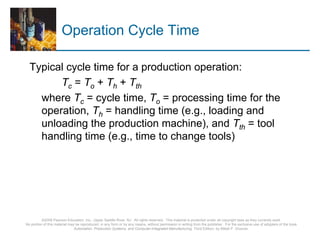
Operation Cycle Time
Typical cycle time for a production operation:
Tc = To + Th + Tth
where Tc = cycle time, To = processing time for the
operation, Th = handling time (e.g., loading and
unloading the production machine), and Tth = tool
handling time (e.g., time to change tools)
©2008 Pearson Education, Inc., Upper Saddle River, NJ. All rights reserved. This material is protected under all copyright laws as they currently exist.
No portion of this material may be reproduced, in any form or by any means, without permission in writing from the publisher. For the exclusive use of adopters of the book
Automation, Production Systems, and Computer-Integrated Manufacturing, Third Edition, by Mikell P. Groover.
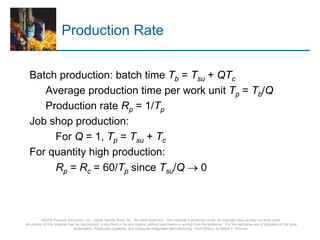
Production Rate
Batch production: batch time Tb = Tsu + QTc
Average production time per work unit Tp = Tb/Q
Production rate Rp = 1/Tp
Job shop production:
For Q = 1, Tp = Tsu + Tc
For quantity high production:
Rp = Rc = 60/Tp since Tsu/Q → 0
©2008 Pearson Education, Inc., Upper Saddle River, NJ. All rights reserved. This material is protected under all copyright laws as they currently exist.
No portion of this material may be reproduced, in any form or by any means, without permission in writing from the publisher. For the exclusive use of adopters of the book
Automation, Production Systems, and Computer-Integrated Manufacturing, Third Edition, by Mikell P. Groover.
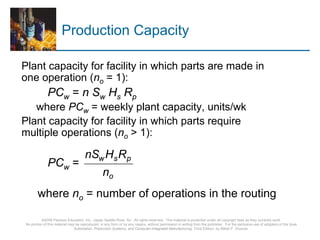
Production Capacity
Plant capacity for facility in which parts are made in
one operation (no = 1):
PCw = n Sw Hs Rp
where PCw = weekly plant capacity, units/wk
Plant capacity for facility in which parts require
multiple operations (no > 1):
PCw =
where no = number of operations in the routing
o
psw
n
RHnS
©2008 Pearson Education, Inc., Upper Saddle River, NJ. All rights reserved. This material is protected under all copyright laws as they currently exist.
No portion of this material may be reproduced, in any form or by any means, without permission in writing from the publisher. For the exclusive use of adopters of the book
Automation, Production Systems, and Computer-Integrated Manufacturing, Third Edition, by Mikell P. Groover.
Utilization and Availability
Utilization: U =
where Q = quantity actually produced, and PC = plant
capacity
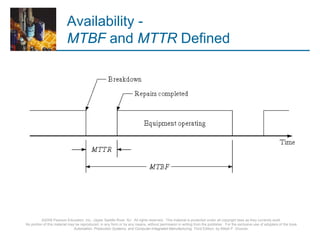
Availability: A =
where MTBF = mean time between failures, and
MTTR = mean time to repair
PC
Q
MTBF
MTTRMTBF −
©2008 Pearson Education, Inc., Upper Saddle River, NJ. All rights reserved. This material is protected under all copyright laws as they currently exist.
No portion of this material may be reproduced, in any form or by any means, without permission in writing from the publisher. For the exclusive use of adopters of the book
Automation, Production Systems, and Computer-Integrated Manufacturing, Third Edition, by Mikell P. Groover.
Availability -
MTBF and MTTR Defined
©2008 Pearson Education, Inc., Upper Saddle River, NJ. All rights reserved. This material is protected under all copyright laws as they currently exist.
No portion of this material may be reproduced, in any form or by any means, without permission in writing from the publisher. For the exclusive use of adopters of the book
Automation, Production Systems, and Computer-Integrated Manufacturing, Third Edition, by Mikell P. Groover.
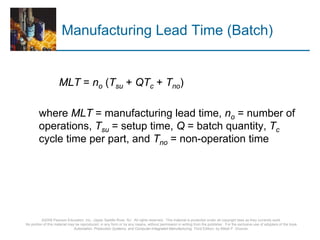
Manufacturing Lead Time (Batch)
MLT = no (Tsu + QTc + Tno)
where MLT = manufacturing lead time, no = number of
operations, Tsu = setup time, Q = batch quantity, Tc
cycle time per part, and Tno = non-operation time
©2008 Pearson Education, Inc., Upper Saddle River, NJ. All rights reserved. This material is protected under all copyright laws as they currently exist.
No portion of this material may be reproduced, in any form or by any means, without permission in writing from the publisher. For the exclusive use of adopters of the book
Automation, Production Systems, and Computer-Integrated Manufacturing, Third Edition, by Mikell P. Groover.
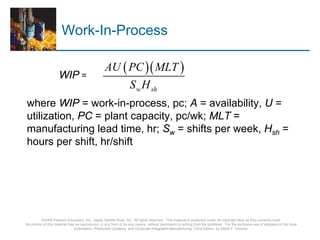
Work-In-Process
WIP =
where WIP = work-in-process, pc; A = availability, U =
utilization, PC = plant capacity, pc/wk; MLT =
manufacturing lead time, hr; Sw = shifts per week, Hsh =
hours per shift, hr/shift
( )( )
w sh
AU PC MLT
S H
©2008 Pearson Education, Inc., Upper Saddle River, NJ. All rights reserved. This material is protected under all copyright laws as they currently exist.
No portion of this material may be reproduced, in any form or by any means, without permission in writing from the publisher. For the exclusive use of adopters of the book
Automation, Production Systems, and Computer-Integrated Manufacturing, Third Edition, by Mikell P. Groover.
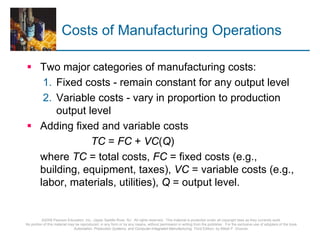
Costs of Manufacturing Operations
Two major categories of manufacturing costs:
1. Fixed costs - remain constant for any output level
2. Variable costs - vary in proportion to production
output level
Adding fixed and variable costs
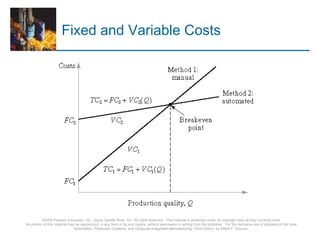
TC = FC + VC(Q)
where TC = total costs, FC = fixed costs (e.g.,
building, equipment, taxes), VC = variable costs (e.g.,
labor, materials, utilities), Q = output level.
©2008 Pearson Education, Inc., Upper Saddle River, NJ. All rights reserved. This material is protected under all copyright laws as they currently exist.
No portion of this material may be reproduced, in any form or by any means, without permission in writing from the publisher. For the exclusive use of adopters of the book
Automation, Production Systems, and Computer-Integrated Manufacturing, Third Edition, by Mikell P. Groover.
Fixed and Variable Costs
©2008 Pearson Education, Inc., Upper Saddle River, NJ. All rights reserved. This material is protected under all copyright laws as they currently exist.
No portion of this material may be reproduced, in any form or by any means, without permission in writing from the publisher. For the exclusive use of adopters of the book
Automation, Production Systems, and Computer-Integrated Manufacturing, Third Edition, by Mikell P. Groover.
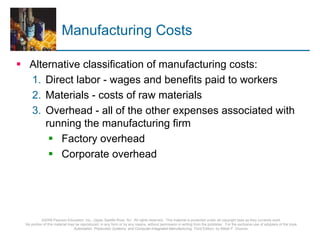
Manufacturing Costs
Alternative classification of manufacturing costs:
1. Direct labor - wages and benefits paid to workers
2. Materials - costs of raw materials
3. Overhead - all of the other expenses associated with
running the manufacturing firm
Factory overhead
Corporate overhead
©2008 Pearson Education, Inc., Upper Saddle River, NJ. All rights reserved. This material is protected under all copyright laws as they currently exist.
No portion of this material may be reproduced, in any form or by any means, without permission in writing from the publisher. For the exclusive use of adopters of the book
Automation, Production Systems, and Computer-Integrated Manufacturing, Third Edition, by Mikell P. Groover.
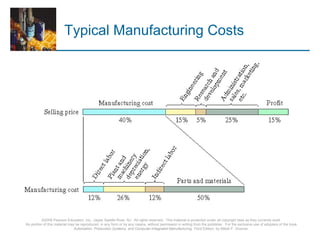
Typical Manufacturing Costs
©2008 Pearson Education, Inc., Upper Saddle River, NJ. All rights reserved. This material is protected under all copyright laws as they currently exist.
No portion of this material may be reproduced, in any form or by any means, without permission in writing from the publisher. For the exclusive use of adopters of the book
Automation, Production Systems, and Computer-Integrated Manufacturing, Third Edition, by Mikell P. Groover.
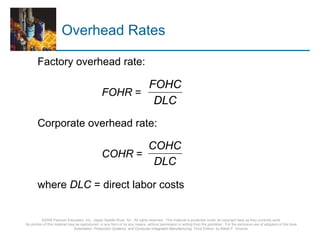
Overhead Rates
Factory overhead rate:
FOHR =
Corporate overhead rate:
COHR =
where DLC = direct labor costs
DLC
FOHC
DLC
COHC

Manufacturing models and metrics costs

  • 1.
    ©2008 Pearson Education,Inc., Upper Saddle River, NJ. All rights reserved. This material is protected under all copyright laws as they currently exist. No portion of this material may be reproduced, in any form or by any means, without permission in writing from the publisher. For the exclusive use of adopters of the book Automation, Production Systems, and Computer-Integrated Manufacturing, Third Edition, by Mikell P. Groover. Ch 3 Manufacturing Models and Metrics Learning Objectives: By the end of the lecture the student should be able to: Apply mathematical models of production performance problems. Explain the concepts of fixed and variable manufacturing costs
  • 2.
    ©2008 Pearson Education,Inc., Upper Saddle River, NJ. All rights reserved. This material is protected under all copyright laws as they currently exist. No portion of this material may be reproduced, in any form or by any means, without permission in writing from the publisher. For the exclusive use of adopters of the book Automation, Production Systems, and Computer-Integrated Manufacturing, Third Edition, by Mikell P. Groover. Production Concepts and Mathematical Models Production rate Rp Production capacity PC Utilization U Availability A Manufacturing lead time MLT Work-in-progress WIP
  • 3.
    ©2008 Pearson Education,Inc., Upper Saddle River, NJ. All rights reserved. This material is protected under all copyright laws as they currently exist. No portion of this material may be reproduced, in any form or by any means, without permission in writing from the publisher. For the exclusive use of adopters of the book Automation, Production Systems, and Computer-Integrated Manufacturing, Third Edition, by Mikell P. Groover. Operation Cycle Time Typical cycle time for a production operation: Tc = To + Th + Tth where Tc = cycle time, To = processing time for the operation, Th = handling time (e.g., loading and unloading the production machine), and Tth = tool handling time (e.g., time to change tools)
  • 4.
    ©2008 Pearson Education,Inc., Upper Saddle River, NJ. All rights reserved. This material is protected under all copyright laws as they currently exist. No portion of this material may be reproduced, in any form or by any means, without permission in writing from the publisher. For the exclusive use of adopters of the book Automation, Production Systems, and Computer-Integrated Manufacturing, Third Edition, by Mikell P. Groover. Production Rate Batch production: batch time Tb = Tsu + QTc Average production time per work unit Tp = Tb/Q Production rate Rp = 1/Tp Job shop production: For Q = 1, Tp = Tsu + Tc For quantity high production: Rp = Rc = 60/Tp since Tsu/Q → 0
  • 5.
    ©2008 Pearson Education,Inc., Upper Saddle River, NJ. All rights reserved. This material is protected under all copyright laws as they currently exist. No portion of this material may be reproduced, in any form or by any means, without permission in writing from the publisher. For the exclusive use of adopters of the book Automation, Production Systems, and Computer-Integrated Manufacturing, Third Edition, by Mikell P. Groover. Production Capacity Plant capacity for facility in which parts are made in one operation (no = 1): PCw = n Sw Hs Rp where PCw = weekly plant capacity, units/wk Plant capacity for facility in which parts require multiple operations (no > 1): PCw = where no = number of operations in the routing o psw n RHnS
  • 6.
    ©2008 Pearson Education,Inc., Upper Saddle River, NJ. All rights reserved. This material is protected under all copyright laws as they currently exist. No portion of this material may be reproduced, in any form or by any means, without permission in writing from the publisher. For the exclusive use of adopters of the book Automation, Production Systems, and Computer-Integrated Manufacturing, Third Edition, by Mikell P. Groover. Utilization and Availability Utilization: U = where Q = quantity actually produced, and PC = plant capacity Availability: A = where MTBF = mean time between failures, and MTTR = mean time to repair PC Q MTBF MTTRMTBF −
  • 7.
    ©2008 Pearson Education,Inc., Upper Saddle River, NJ. All rights reserved. This material is protected under all copyright laws as they currently exist. No portion of this material may be reproduced, in any form or by any means, without permission in writing from the publisher. For the exclusive use of adopters of the book Automation, Production Systems, and Computer-Integrated Manufacturing, Third Edition, by Mikell P. Groover. Availability - MTBF and MTTR Defined
  • 8.
    ©2008 Pearson Education,Inc., Upper Saddle River, NJ. All rights reserved. This material is protected under all copyright laws as they currently exist. No portion of this material may be reproduced, in any form or by any means, without permission in writing from the publisher. For the exclusive use of adopters of the book Automation, Production Systems, and Computer-Integrated Manufacturing, Third Edition, by Mikell P. Groover. Manufacturing Lead Time (Batch) MLT = no (Tsu + QTc + Tno) where MLT = manufacturing lead time, no = number of operations, Tsu = setup time, Q = batch quantity, Tc cycle time per part, and Tno = non-operation time
  • 9.
    ©2008 Pearson Education,Inc., Upper Saddle River, NJ. All rights reserved. This material is protected under all copyright laws as they currently exist. No portion of this material may be reproduced, in any form or by any means, without permission in writing from the publisher. For the exclusive use of adopters of the book Automation, Production Systems, and Computer-Integrated Manufacturing, Third Edition, by Mikell P. Groover. Work-In-Process WIP = where WIP = work-in-process, pc; A = availability, U = utilization, PC = plant capacity, pc/wk; MLT = manufacturing lead time, hr; Sw = shifts per week, Hsh = hours per shift, hr/shift ( )( ) w sh AU PC MLT S H
  • 10.
    ©2008 Pearson Education,Inc., Upper Saddle River, NJ. All rights reserved. This material is protected under all copyright laws as they currently exist. No portion of this material may be reproduced, in any form or by any means, without permission in writing from the publisher. For the exclusive use of adopters of the book Automation, Production Systems, and Computer-Integrated Manufacturing, Third Edition, by Mikell P. Groover. Costs of Manufacturing Operations Two major categories of manufacturing costs: 1. Fixed costs - remain constant for any output level 2. Variable costs - vary in proportion to production output level Adding fixed and variable costs TC = FC + VC(Q) where TC = total costs, FC = fixed costs (e.g., building, equipment, taxes), VC = variable costs (e.g., labor, materials, utilities), Q = output level.
  • 11.
    ©2008 Pearson Education,Inc., Upper Saddle River, NJ. All rights reserved. This material is protected under all copyright laws as they currently exist. No portion of this material may be reproduced, in any form or by any means, without permission in writing from the publisher. For the exclusive use of adopters of the book Automation, Production Systems, and Computer-Integrated Manufacturing, Third Edition, by Mikell P. Groover. Fixed and Variable Costs
  • 12.
    ©2008 Pearson Education,Inc., Upper Saddle River, NJ. All rights reserved. This material is protected under all copyright laws as they currently exist. No portion of this material may be reproduced, in any form or by any means, without permission in writing from the publisher. For the exclusive use of adopters of the book Automation, Production Systems, and Computer-Integrated Manufacturing, Third Edition, by Mikell P. Groover. Manufacturing Costs Alternative classification of manufacturing costs: 1. Direct labor - wages and benefits paid to workers 2. Materials - costs of raw materials 3. Overhead - all of the other expenses associated with running the manufacturing firm Factory overhead Corporate overhead
  • 13.
    ©2008 Pearson Education,Inc., Upper Saddle River, NJ. All rights reserved. This material is protected under all copyright laws as they currently exist. No portion of this material may be reproduced, in any form or by any means, without permission in writing from the publisher. For the exclusive use of adopters of the book Automation, Production Systems, and Computer-Integrated Manufacturing, Third Edition, by Mikell P. Groover. Typical Manufacturing Costs
  • 14.
    ©2008 Pearson Education,Inc., Upper Saddle River, NJ. All rights reserved. This material is protected under all copyright laws as they currently exist. No portion of this material may be reproduced, in any form or by any means, without permission in writing from the publisher. For the exclusive use of adopters of the book Automation, Production Systems, and Computer-Integrated Manufacturing, Third Edition, by Mikell P. Groover. Overhead Rates Factory overhead rate: FOHR = Corporate overhead rate: COHR = where DLC = direct labor costs DLC FOHC DLC COHC