Single Nucleotide Polymorphisms (SNPs)
By
KAUSHAL KUMAR SAHU
Assistant Professor (Ad Hoc)
Department of Biotechnology
Govt. Digvijay Autonomous P. G. College
Raj-Nandgaon ( C. G. )
Synopsis
•Introduction
•Some Facts
•Types of SNPs
•SNPs act as gene markers
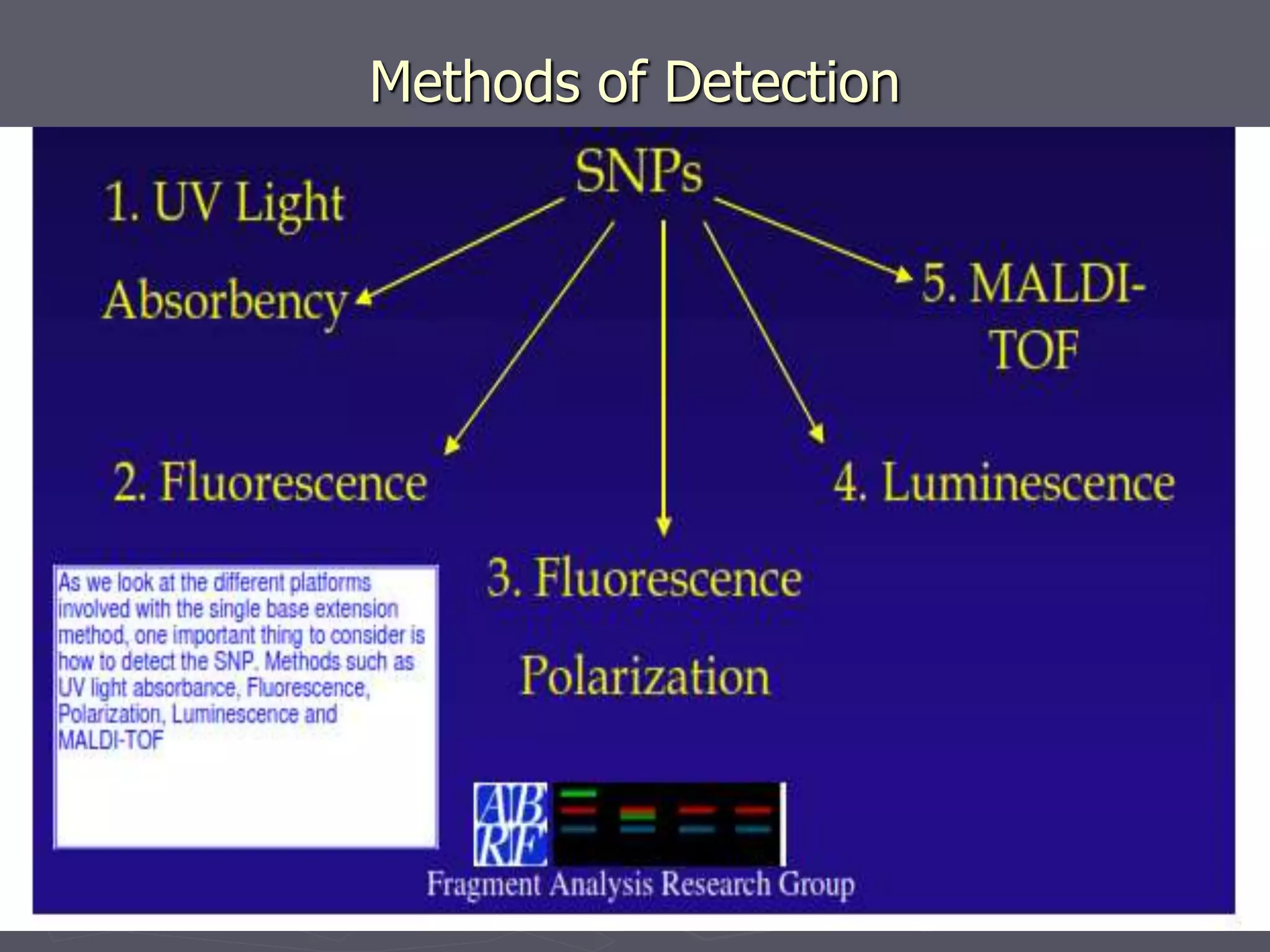
•Methods of Detection
•Techniques to detect SNPs
Allelic Specific Cleavage
Differential Hybridization
Single Base Extension or minisequencing
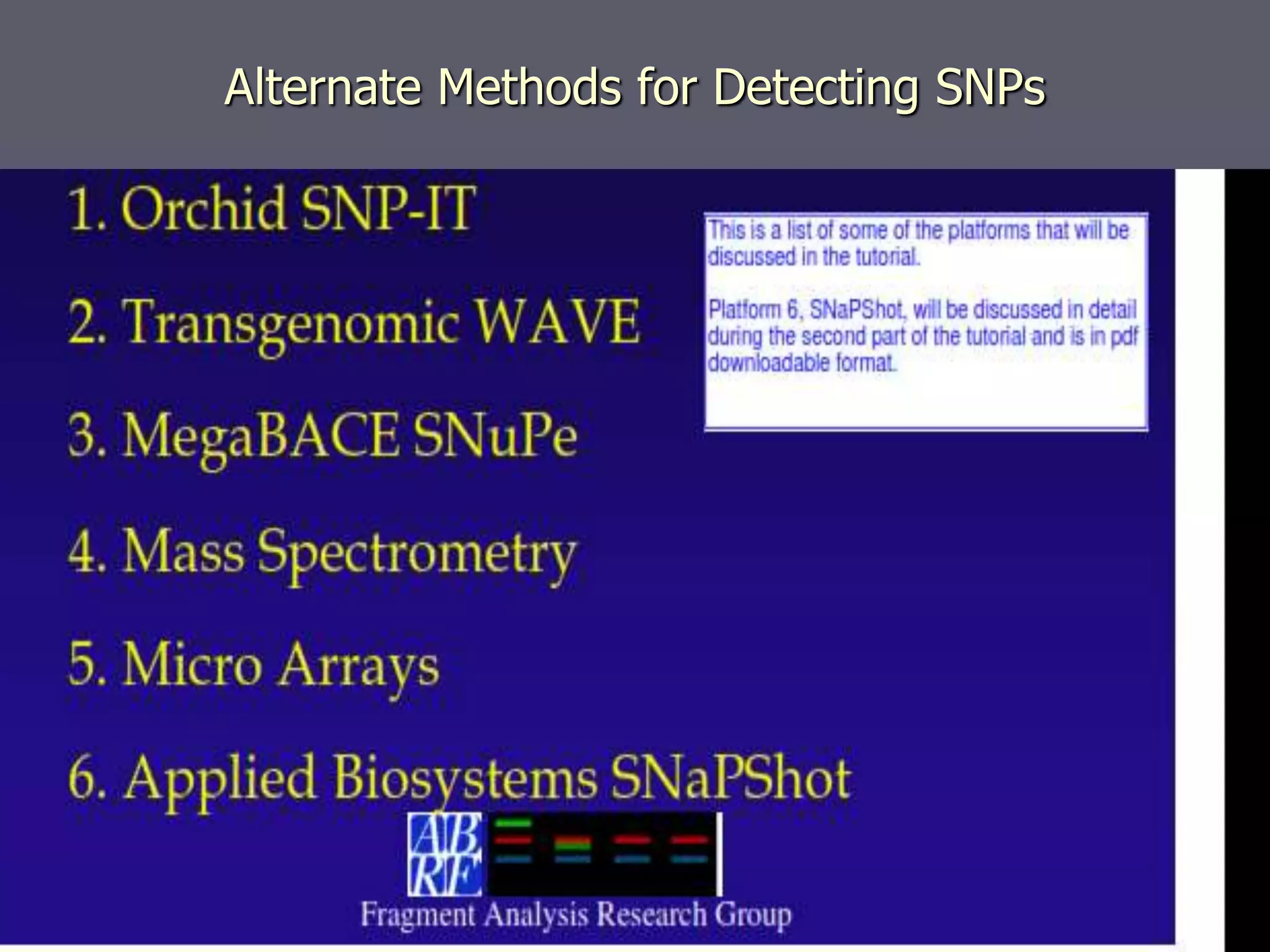
•Alternate Methods for Detecting SNPs
Mass Spectrometry
Microchips
•SIGNIFICANCE OF SNPs
•HAPLOTYPE
•ADVANTAGES
•Are SNP data available to the public?
•Some important SNP database Resources
•CONCLUSION
•References
What is SNP ?
►A SNP is defined as a single base change in
a DNA sequence that occurs in a significant
proportion (more than 1 percent) of a large
population.
Some Facts
► In human beings, 99.9 percent bases are same.
► Remaining 0.1 percent makes a person unique.
 Different attributes / characteristics / traits
►how a person looks,
►diseases he or she develops.
► These variations can be:
 Harmless (change in phenotype)
 Harmful (diabetes, cancer, heart disease, Huntington's
disease, and hemophilia )
SNP facts
► SNPs are found in
 coding and (mostly) noncoding regions.
► Occur with a very high frequency
 about 1 in 1000 bases to 1 in 100 to 300 bases.
► The abundance of SNPs and the ease with which they can
be measured make these genetic variations significant.
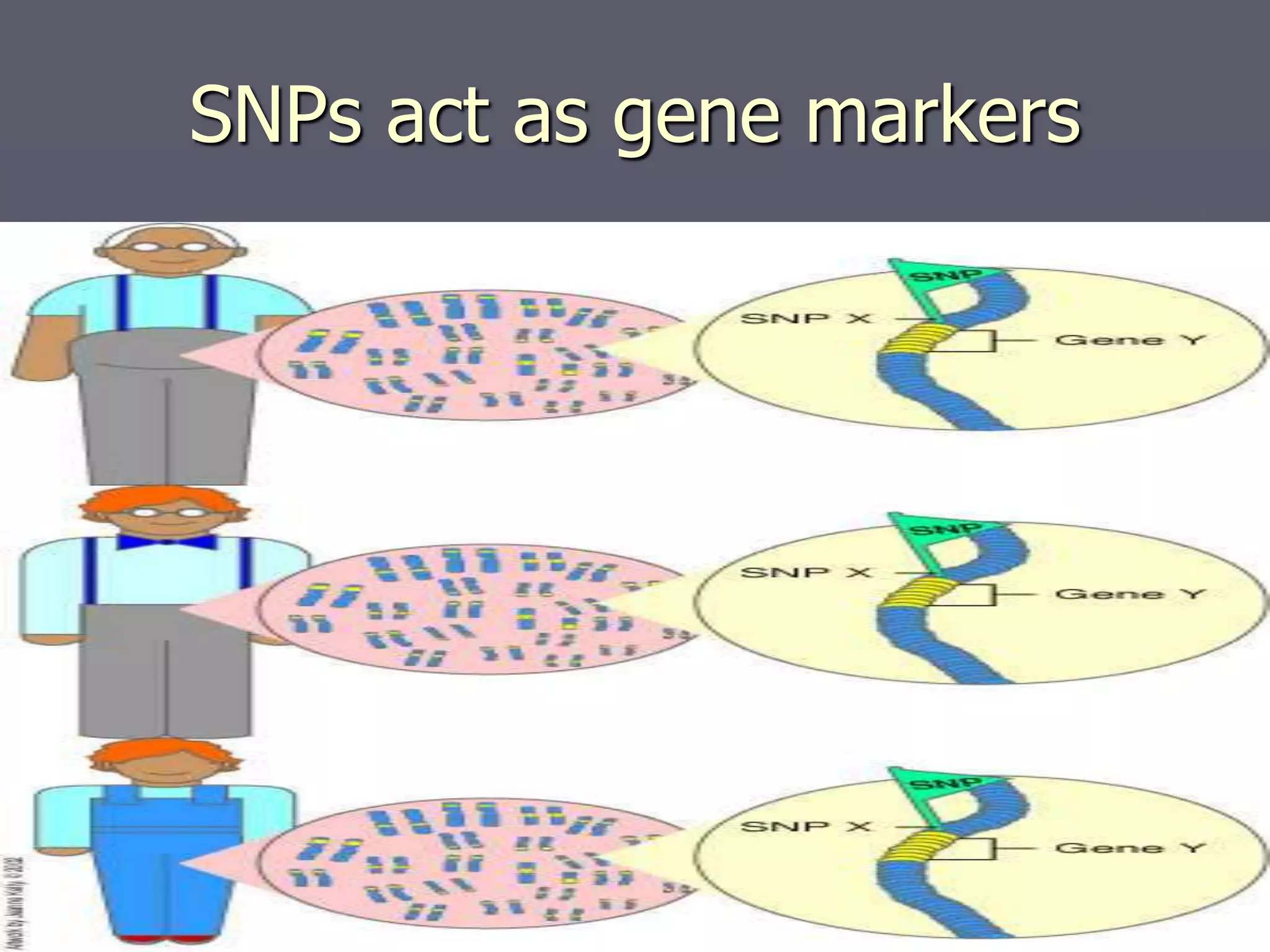
► SNPs close to particular gene acts as a marker for that
gene.
► SNPs in coding regions may alter the protein structure
made by that coding region.
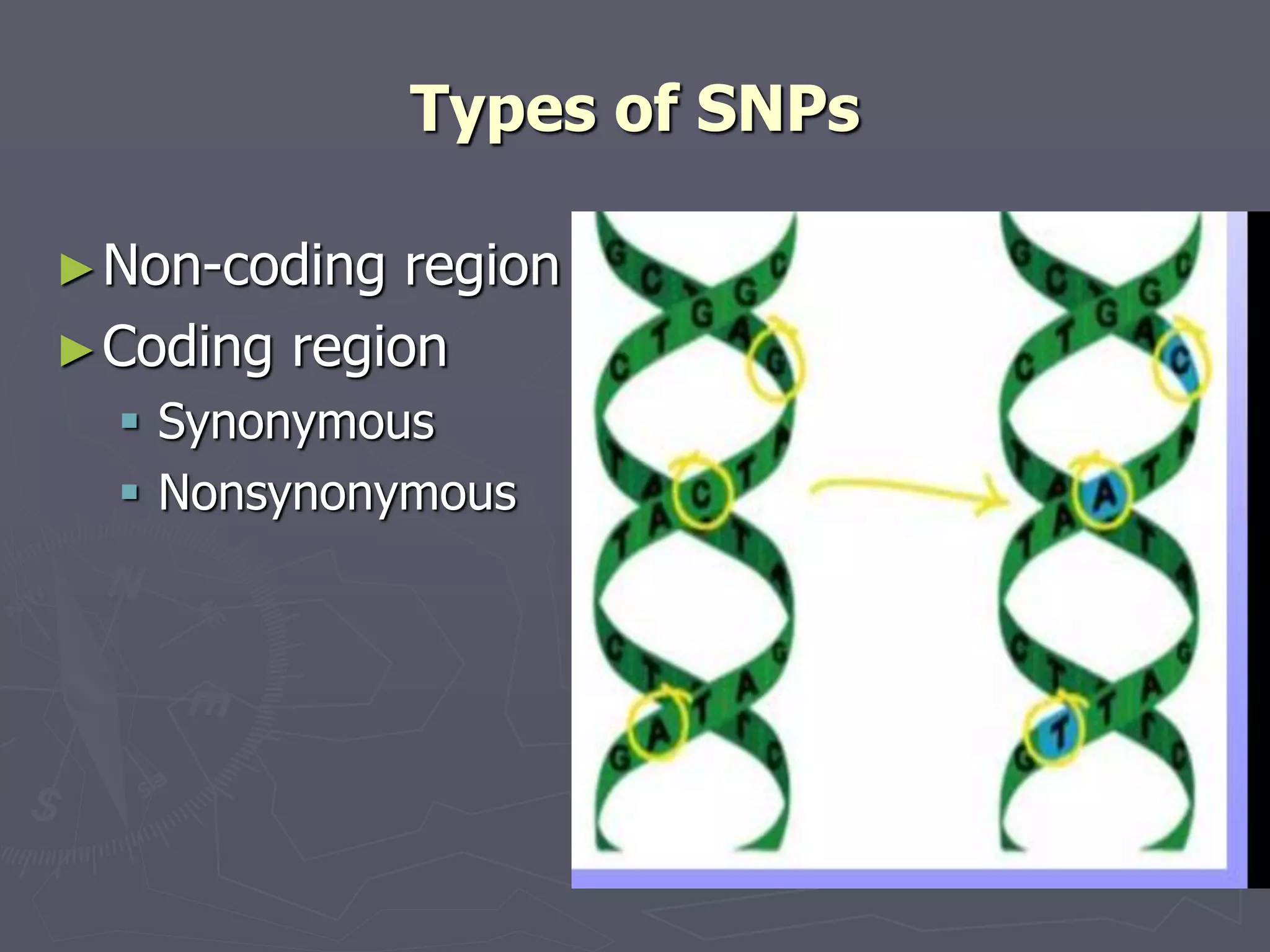
Types of SNPs
►Non-coding region
►Coding region
 Synonymous
 Nonsynonymous
SNPs act as gene markers
Techniques to detect SNPs
(SNP Genotyping)
► 1. Allelic Specific Cleavage is one method. Allelic specific cleavage
involves annealing a wild type fragment to fragment with a suspected
SNP. The double stranded product is then treated with a specific
endonuclease. If a single stranded mismatch is present then the
fragment will not cleave.
► 2. Differential Hybridization involves a labeled oligonucleotide (probe)
to anneal to the area with a suspected SNP. A base mismatch leads to
an unstable product.
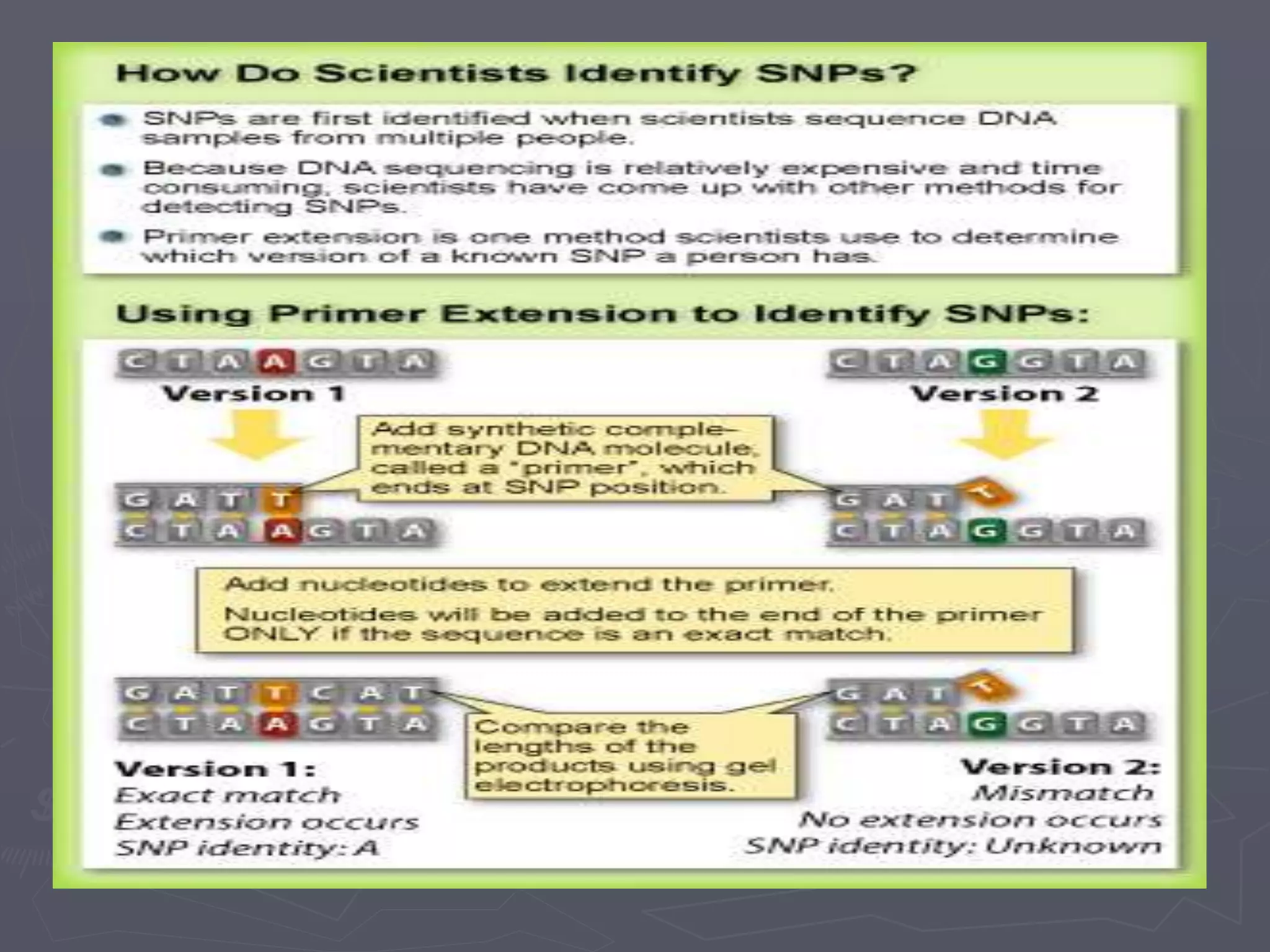
► 3. Single Base Extension or minisequencing is a third method used to
identify a known SNPs. A primer is annealed one base upstream from
the base to be determined and extended by one base with a labeled
ddNTP ending extension. The final product is separated by one of
several methods.
Methods of Detection
Alternate Methods for Detecting SNPs
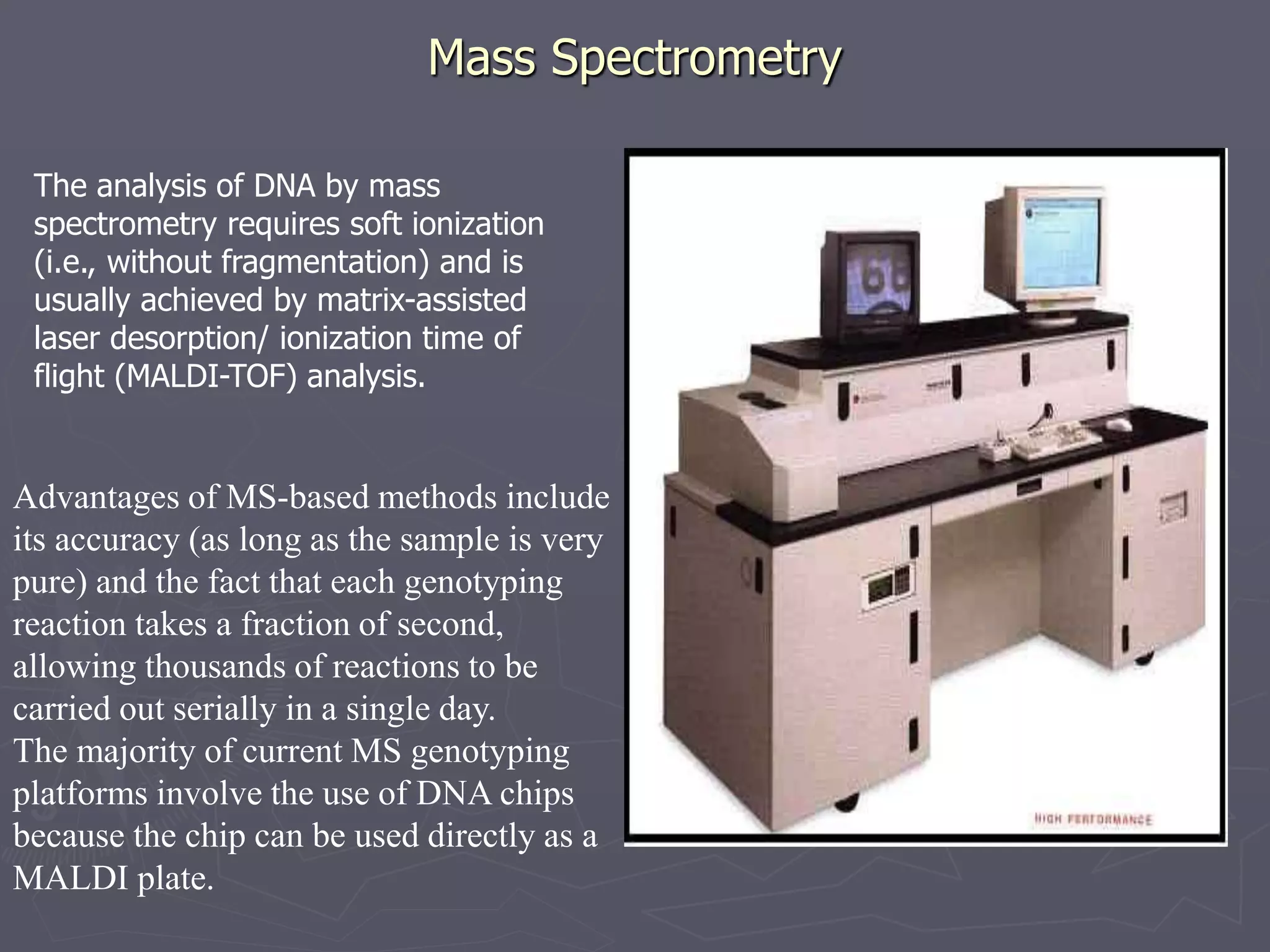
Mass Spectrometry
The analysis of DNA by mass
spectrometry requires soft ionization
(i.e., without fragmentation) and is
usually achieved by matrix-assisted
laser desorption/ ionization time of
flight (MALDI-TOF) analysis.
Advantages of MS-based methods include
its accuracy (as long as the sample is very
pure) and the fact that each genotyping
reaction takes a fraction of second,
allowing thousands of reactions to be
carried out serially in a single day.
The majority of current MS genotyping
platforms involve the use of DNA chips
because the chip can be used directly as a
MALDI plate.
Microchips
• Silicon chip has thousands of oligo
probes
attached to it
– Exact position of each probe is
known
– Probes are allele specific
• PCR products are labeled with
fluorescent dyes
• Washed over microchips
• Product will bind to specific probe
based
on complimentary base pairing
– Position of label will show which
probe bound
SIGNIFICANCE OF SNPs
 IN DISEASE DIAGNOSIS
 IN DRUG DISCOVERY & DEVELOPMENT
 IN DRUG RESPONSES
ALL THESE ASPECT WILL HELP TO LOOK FOR MEDICATION &
DIAGNOSIS AT INDIVIDUAL LEVEL
Are SNP data available to the public?
► SNP data were made available through a consortium website at
quarterly intervals during the project's first year and at monthly
intervals during the second year. This cycle of releases ceased in fall
2001 once the discovery phase was finished, but with recent additions
of genotype and allele frequency information, new data were released
in fall 2002.
► Besides the TSC website, SNP data are also available from the
following resources:
► dbSNP database - From the National Center for Biotechnology
Information (NCBI).
► HGVbase (Human Genome Variation Database) - A human gene-based
polymorphism database.
Some important SNP database Resources
1. dbSNP (http://www.ncbi.nlm.nih.gov/SNP/)
LocusLink (http://www.ncbi.nlm.nih.gov/LocusLink/list.cgi)
2. TSC (http://snp.cshl.org/)
3. SNPper (http://snpper.chip.org/bio/)
4. JSNP (http://snp.ims.u-tokyo.ac.jp/search.html)
5. GeneSNPs (http://www.genome.utah.edu/genesnps/)
6. HGVbase (http://hgvbase.cgb.ki.se/)
7. PolyPhen (http://dove.embl-heidelberg.de/PolyPhen/)
OMIM (http://www.ncbi.nlm.nih.gov/entrez/query.fcgi?db=OMIM)
8. Human SNP database
(http://www-genome.wi.mit.edu/snp/human/)
CONCLUSION
Recent developments include the use of
electrostringent hybridization arrays, where
electric currents are used to increase the speed
and sensitivity of hybridization, and the
detection of allele-specific products based on
their electrochemical properties when
hybridized to oligonucleotide probes attached to
minute electrodes.
References
•Principles Of Gene Manipulation And Genomics-S.B.
Primrose and R.M. Twyman.—7th ed.
www.wikipedia.org/
•Principle of Biochemistry :- David L. Nelson and
Michael M. Cox
•Internet source

Single nucleotide polymorphism, (SNP)

  • 1.
    Single Nucleotide Polymorphisms(SNPs) By KAUSHAL KUMAR SAHU Assistant Professor (Ad Hoc) Department of Biotechnology Govt. Digvijay Autonomous P. G. College Raj-Nandgaon ( C. G. )
  • 2.
    Synopsis •Introduction •Some Facts •Types ofSNPs •SNPs act as gene markers •Methods of Detection •Techniques to detect SNPs Allelic Specific Cleavage Differential Hybridization Single Base Extension or minisequencing •Alternate Methods for Detecting SNPs Mass Spectrometry Microchips •SIGNIFICANCE OF SNPs •HAPLOTYPE •ADVANTAGES •Are SNP data available to the public? •Some important SNP database Resources •CONCLUSION •References
  • 3.
    What is SNP? ►A SNP is defined as a single base change in a DNA sequence that occurs in a significant proportion (more than 1 percent) of a large population.
  • 4.
    Some Facts ► Inhuman beings, 99.9 percent bases are same. ► Remaining 0.1 percent makes a person unique.  Different attributes / characteristics / traits ►how a person looks, ►diseases he or she develops. ► These variations can be:  Harmless (change in phenotype)  Harmful (diabetes, cancer, heart disease, Huntington's disease, and hemophilia )
  • 5.
    SNP facts ► SNPsare found in  coding and (mostly) noncoding regions. ► Occur with a very high frequency  about 1 in 1000 bases to 1 in 100 to 300 bases. ► The abundance of SNPs and the ease with which they can be measured make these genetic variations significant. ► SNPs close to particular gene acts as a marker for that gene. ► SNPs in coding regions may alter the protein structure made by that coding region.
  • 6.
    Types of SNPs ►Non-codingregion ►Coding region  Synonymous  Nonsynonymous
  • 7.
    SNPs act asgene markers
  • 8.
    Techniques to detectSNPs (SNP Genotyping) ► 1. Allelic Specific Cleavage is one method. Allelic specific cleavage involves annealing a wild type fragment to fragment with a suspected SNP. The double stranded product is then treated with a specific endonuclease. If a single stranded mismatch is present then the fragment will not cleave. ► 2. Differential Hybridization involves a labeled oligonucleotide (probe) to anneal to the area with a suspected SNP. A base mismatch leads to an unstable product. ► 3. Single Base Extension or minisequencing is a third method used to identify a known SNPs. A primer is annealed one base upstream from the base to be determined and extended by one base with a labeled ddNTP ending extension. The final product is separated by one of several methods.
  • 10.
  • 11.
    Alternate Methods forDetecting SNPs
  • 12.
    Mass Spectrometry The analysisof DNA by mass spectrometry requires soft ionization (i.e., without fragmentation) and is usually achieved by matrix-assisted laser desorption/ ionization time of flight (MALDI-TOF) analysis. Advantages of MS-based methods include its accuracy (as long as the sample is very pure) and the fact that each genotyping reaction takes a fraction of second, allowing thousands of reactions to be carried out serially in a single day. The majority of current MS genotyping platforms involve the use of DNA chips because the chip can be used directly as a MALDI plate.
  • 13.
    Microchips • Silicon chiphas thousands of oligo probes attached to it – Exact position of each probe is known – Probes are allele specific • PCR products are labeled with fluorescent dyes • Washed over microchips • Product will bind to specific probe based on complimentary base pairing – Position of label will show which probe bound
  • 14.
    SIGNIFICANCE OF SNPs IN DISEASE DIAGNOSIS  IN DRUG DISCOVERY & DEVELOPMENT  IN DRUG RESPONSES ALL THESE ASPECT WILL HELP TO LOOK FOR MEDICATION & DIAGNOSIS AT INDIVIDUAL LEVEL
  • 15.
    Are SNP dataavailable to the public? ► SNP data were made available through a consortium website at quarterly intervals during the project's first year and at monthly intervals during the second year. This cycle of releases ceased in fall 2001 once the discovery phase was finished, but with recent additions of genotype and allele frequency information, new data were released in fall 2002. ► Besides the TSC website, SNP data are also available from the following resources: ► dbSNP database - From the National Center for Biotechnology Information (NCBI). ► HGVbase (Human Genome Variation Database) - A human gene-based polymorphism database.
  • 16.
    Some important SNPdatabase Resources 1. dbSNP (http://www.ncbi.nlm.nih.gov/SNP/) LocusLink (http://www.ncbi.nlm.nih.gov/LocusLink/list.cgi) 2. TSC (http://snp.cshl.org/) 3. SNPper (http://snpper.chip.org/bio/) 4. JSNP (http://snp.ims.u-tokyo.ac.jp/search.html) 5. GeneSNPs (http://www.genome.utah.edu/genesnps/) 6. HGVbase (http://hgvbase.cgb.ki.se/) 7. PolyPhen (http://dove.embl-heidelberg.de/PolyPhen/) OMIM (http://www.ncbi.nlm.nih.gov/entrez/query.fcgi?db=OMIM) 8. Human SNP database (http://www-genome.wi.mit.edu/snp/human/)
  • 17.
    CONCLUSION Recent developments includethe use of electrostringent hybridization arrays, where electric currents are used to increase the speed and sensitivity of hybridization, and the detection of allele-specific products based on their electrochemical properties when hybridized to oligonucleotide probes attached to minute electrodes.
  • 18.
    References •Principles Of GeneManipulation And Genomics-S.B. Primrose and R.M. Twyman.—7th ed. www.wikipedia.org/ •Principle of Biochemistry :- David L. Nelson and Michael M. Cox •Internet source