RITHIKA. R. S,
I – M.Sc. BIOINFORMATICS
SRI KRISHNA ARTS AND SCIENCE
COLLEGE, COIMBATORE.
THIRD GENERATION
SEQUENCING (Ion torrent,
Pacbio RS and Oxford Nano pore
sequencing )
THIRD GENERATION SEQUENCING
 Third generation sequencing is also known as
long-read sequencing.
 In NGS, DNA is fragmented into tiny bits,
amplified, and then sequenced.
 But, Third-generation sequencing methods will
not break or amplify DNA; instead, they sequence
a single DNA molecule directly.
ADVANTAGES OF THIRD GENERATION
SEQUENCING
 Third generation sequencing technologies offer the
capability for single molecule real-time sequencing of
longer reads, and detection of DNA modification without
any assay.
 The main advantage for third-generation sequencing
technologies in metagenomics is their speed of sequencing
in comparison to second generation techniques.
 Third generation sequencing technologies have
demonstrated promising prospects in solving the problem of
transcript detection as well as mRNA abundance estimation
at the level of transcripts.
 Third generation sequencing currently faces
important challenges mainly,
 Error rates are still much higher compared to second
generation sequencing.
 This is generally due to instability of the molecular
machinery involved.
Limitations of third generation
sequencing
1. Ion torrent sequencing
2. Pacbio sequencing (Pacific Biosciences)
3. Oxford nanopore sequencing
THIRD GENERATION
SEQUENCING TECHNOLOGIES
ION TORRENT SEQUENCING
 Ion torrent sequencing is otherwise
known as ion proton sequencing.
 In this method, the sequencing is
rapid and the data acquired is
reliable.
Principle involved…
 Ion Torrent technology works on the principle of detection of
hydrogen ion release during incorporation of new nucleotides
into the growing DNA template.
 Ion Torrent uses a high-density array of micro-machined wells
to perform nucleotide incorporation in a massively parallel
manner.
 Beneath the wells is an ion-sensitive layer followed by a
proprietary ion-sensor. Beneath the wells is an ion-sensitive
layer followed by a proprietary ion-sensor.
 Hydrogen ions are detected on ion-semiconductor sequencing
chips. These ion semiconductor chips are designed and
manufactured like any other semiconductor chips used in
electronic devices.
 he transistors and circuits are then pattern-transferred and
subsequently etched onto the wafers using photolithography.
This process is repeated 20 times or more creating a multi-layer
system of circuits.
 Ion torrent generates a total data output of around 10–1,000
MB, depending upon the type of ion semiconductor
sequencing chip used.
Principle involved…
Advantages…
 Ion Torrent generates read lengths of around 200 bp
 Due to lower costs, Ion Torrent can be a good choice in some cases.
 The short run time of this technique enables multiple runs for generation of
more data in a given time.
Limitations…
 The read length of 200 bp is too short when compared with others emerging
sequencing technologies.
 In this case, Ion torrent sequencing lags behind in total data output.
PACIBIO SEQUENCING
• Single-molecule, real-time sequencing developed by Pacific BioSciences offers
longer read lengths than the second-generation sequencing (SGS) technologies.
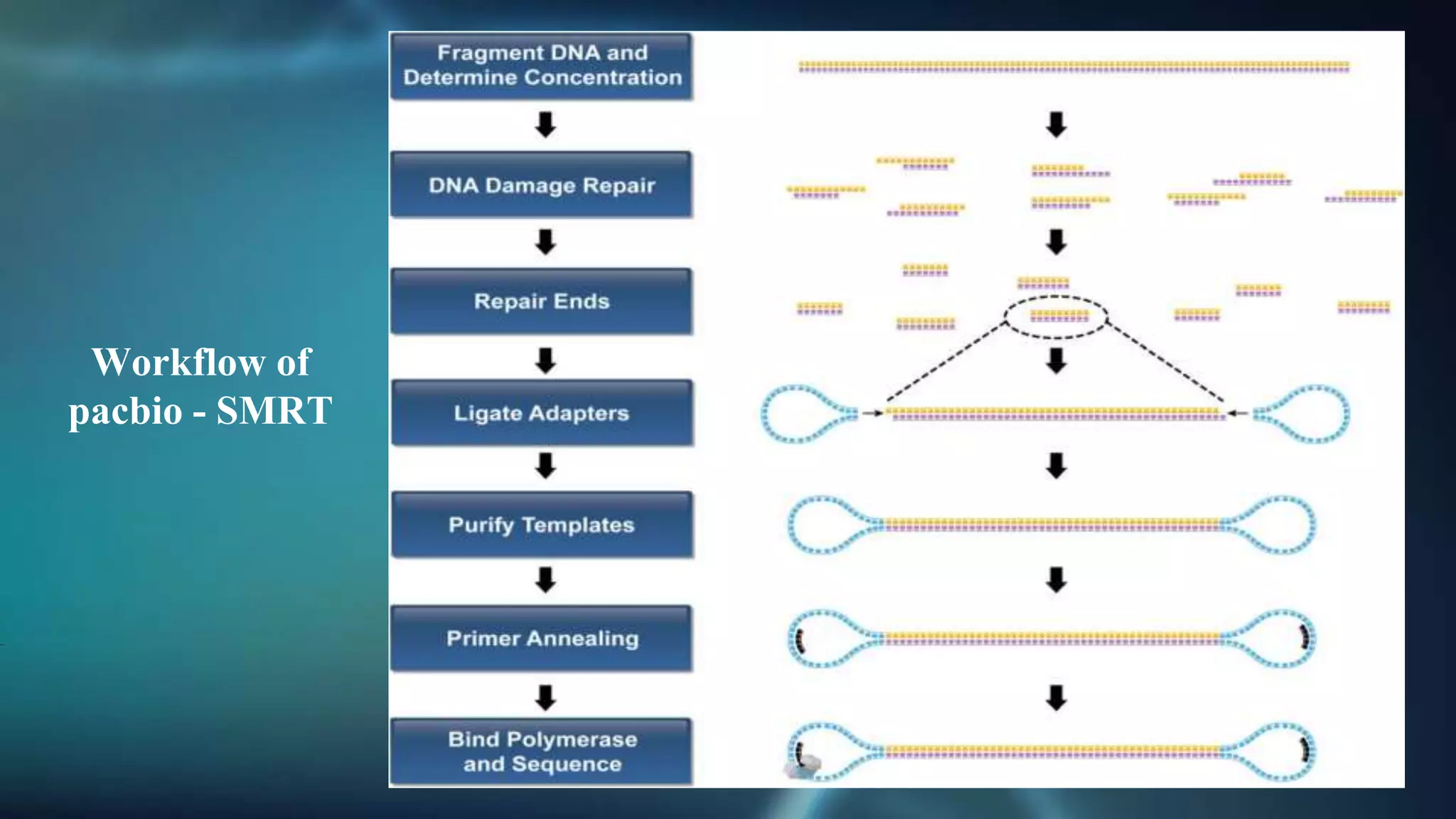
• PacBio sequencing captures sequence information during the replication process
of the target DNA molecule. The template, called a SMRTbell, is a closed,
single-stranded circular DNA that is created by ligating hairpin adaptors to both
ends of a target double-stranded DNA (dsDNA) molecule
1. Does not requires PCR amplification, can easily
cover high-GC and high-repeat regions, and is
more accurate in quantifying low-frequency
mutation.
2. Average read length is 8-15kb and up to 40-70kb.
3. time-effective at the rate of 10 nt per second.
4. High accuracy: the consensus accuracy of PacBio
SMRT sequencing can be greater than 99.999%.
5. Pacbio sequencing is a method for real-time
sequencing and does not require a pause between
read steps.
Features…
Workflow of
pacbio - SMRT
Sequencing via Light pulses
ADVANTAGES…
 Closes gaps and completes genomes due to longer reads
 Identifies non-SNP SVs
 Identifies full-length transcript isoforms without need for a
reference genome
 Detects novel isoforms and fusion events
 Detects epigenetic motifs in low coverage settings and
with mixed genomes
● The PACBIO SMRT system seems awesome, but it’s not without some
drawbacks. One of the major problems is that the flow cell is not as high
throughput when compared to the Illumina platform. The problem is that not
all of the ZMWs will carry out successful sequencing reactions.
● Another problem is that the sequencing error rate produced using PACBIO
SMRT is still high compared to the Illumina platform
LIMITATIONS…
 PacBio SMRT sequencing can be used for genomic de
novo sequencing to get high quality genome sequences,
 Obtaining full transcriptome information,
 Detecting alternative splicing isoforms, diverse mutations in
target regions
 Epigenetic modifications
APPLICATIONS…
Nanopore sequencing is a unique, scalable
technology that enables direct, real-time analysis of long
DNA or RNA fragments.
It works by monitoring changes to an electrical
current as nucleic acids are passed through a protein
nanopore.
The resulting signal is decoded to provide the
specific DNA or RNA sequence.
NANOPORE SEQUENCING
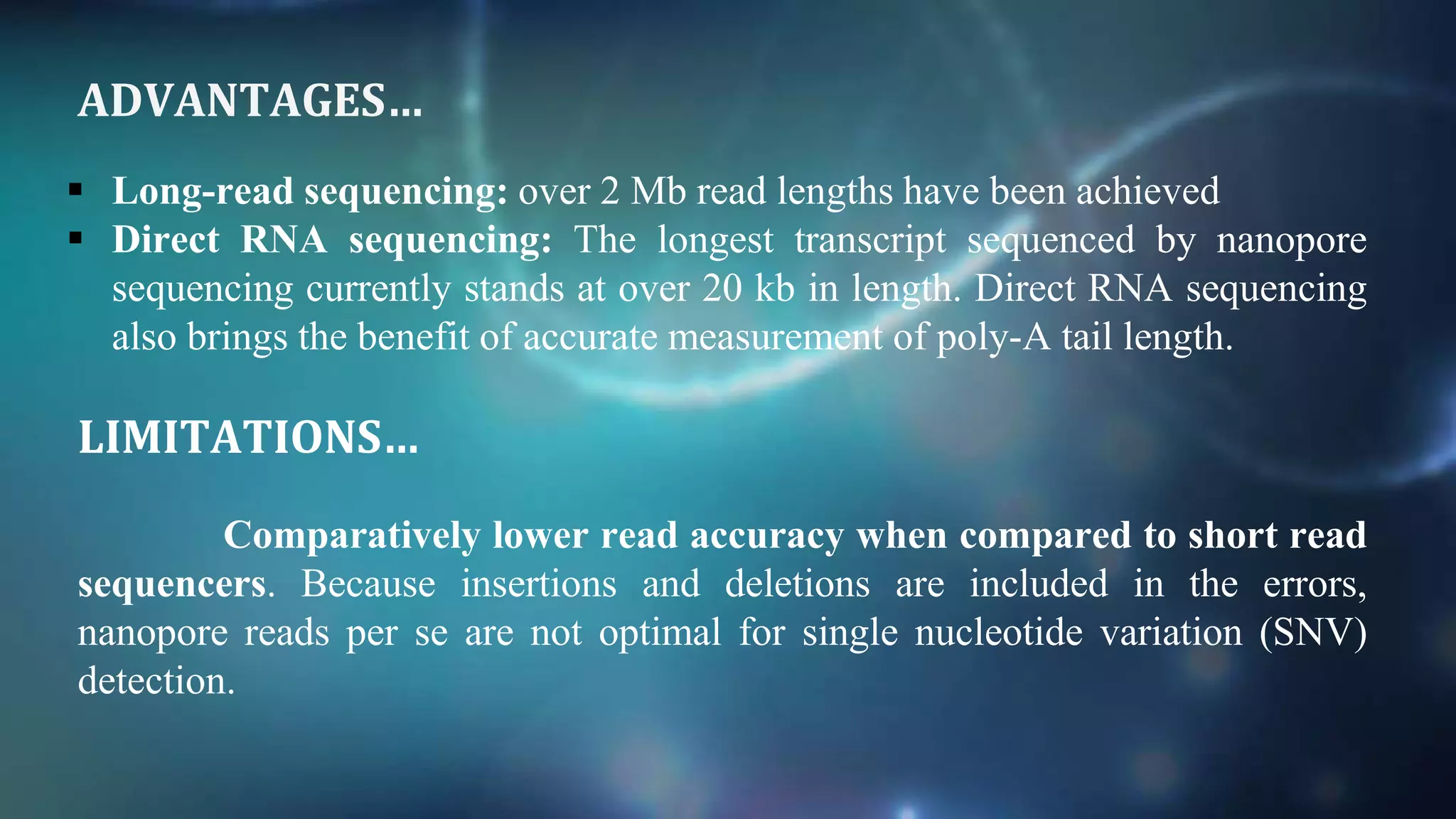
The principle of operation of the nanopore sequence
technique is the analysis of the DNA strand directly as the
molecule is drawn through a tiny pore suspended in a
membrane. Changes in electrical current, or tunneling currents,
are used to read off the chain of bases
PRINCIPLE INVOLVED…
ADVANTAGES…
 Long-read sequencing: over 2 Mb read lengths have been achieved
 Direct RNA sequencing: The longest transcript sequenced by nanopore
sequencing currently stands at over 20 kb in length. Direct RNA sequencing
also brings the benefit of accurate measurement of poly-A tail length.
Comparatively lower read accuracy when compared to short read
sequencers. Because insertions and deletions are included in the errors,
nanopore reads per se are not optimal for single nucleotide variation (SNV)
detection.
LIMITATIONS…
APPLICATIONS…
 Nanopore sequencing is being applied in genome
assembly
 Full-length transcript detection and base
modification detection
 Rapid clinical diagnoses
 Outbreak surveillance
THANK YOU

THIRD GEN SEQUENCING.pptx

  • 1.
    RITHIKA. R. S, I– M.Sc. BIOINFORMATICS SRI KRISHNA ARTS AND SCIENCE COLLEGE, COIMBATORE. THIRD GENERATION SEQUENCING (Ion torrent, Pacbio RS and Oxford Nano pore sequencing )
  • 2.
    THIRD GENERATION SEQUENCING Third generation sequencing is also known as long-read sequencing.  In NGS, DNA is fragmented into tiny bits, amplified, and then sequenced.  But, Third-generation sequencing methods will not break or amplify DNA; instead, they sequence a single DNA molecule directly.
  • 3.
    ADVANTAGES OF THIRDGENERATION SEQUENCING  Third generation sequencing technologies offer the capability for single molecule real-time sequencing of longer reads, and detection of DNA modification without any assay.  The main advantage for third-generation sequencing technologies in metagenomics is their speed of sequencing in comparison to second generation techniques.  Third generation sequencing technologies have demonstrated promising prospects in solving the problem of transcript detection as well as mRNA abundance estimation at the level of transcripts.
  • 4.
     Third generationsequencing currently faces important challenges mainly,  Error rates are still much higher compared to second generation sequencing.  This is generally due to instability of the molecular machinery involved. Limitations of third generation sequencing
  • 5.
    1. Ion torrentsequencing 2. Pacbio sequencing (Pacific Biosciences) 3. Oxford nanopore sequencing THIRD GENERATION SEQUENCING TECHNOLOGIES
  • 6.
    ION TORRENT SEQUENCING Ion torrent sequencing is otherwise known as ion proton sequencing.  In this method, the sequencing is rapid and the data acquired is reliable.
  • 7.
    Principle involved…  IonTorrent technology works on the principle of detection of hydrogen ion release during incorporation of new nucleotides into the growing DNA template.  Ion Torrent uses a high-density array of micro-machined wells to perform nucleotide incorporation in a massively parallel manner.  Beneath the wells is an ion-sensitive layer followed by a proprietary ion-sensor. Beneath the wells is an ion-sensitive layer followed by a proprietary ion-sensor.
  • 8.
     Hydrogen ionsare detected on ion-semiconductor sequencing chips. These ion semiconductor chips are designed and manufactured like any other semiconductor chips used in electronic devices.  he transistors and circuits are then pattern-transferred and subsequently etched onto the wafers using photolithography. This process is repeated 20 times or more creating a multi-layer system of circuits.  Ion torrent generates a total data output of around 10–1,000 MB, depending upon the type of ion semiconductor sequencing chip used. Principle involved…
  • 9.
    Advantages…  Ion Torrentgenerates read lengths of around 200 bp  Due to lower costs, Ion Torrent can be a good choice in some cases.  The short run time of this technique enables multiple runs for generation of more data in a given time. Limitations…  The read length of 200 bp is too short when compared with others emerging sequencing technologies.  In this case, Ion torrent sequencing lags behind in total data output.
  • 10.
    PACIBIO SEQUENCING • Single-molecule,real-time sequencing developed by Pacific BioSciences offers longer read lengths than the second-generation sequencing (SGS) technologies. • PacBio sequencing captures sequence information during the replication process of the target DNA molecule. The template, called a SMRTbell, is a closed, single-stranded circular DNA that is created by ligating hairpin adaptors to both ends of a target double-stranded DNA (dsDNA) molecule
  • 11.
    1. Does notrequires PCR amplification, can easily cover high-GC and high-repeat regions, and is more accurate in quantifying low-frequency mutation. 2. Average read length is 8-15kb and up to 40-70kb. 3. time-effective at the rate of 10 nt per second. 4. High accuracy: the consensus accuracy of PacBio SMRT sequencing can be greater than 99.999%. 5. Pacbio sequencing is a method for real-time sequencing and does not require a pause between read steps. Features…
  • 12.
  • 13.
  • 14.
    ADVANTAGES…  Closes gapsand completes genomes due to longer reads  Identifies non-SNP SVs  Identifies full-length transcript isoforms without need for a reference genome  Detects novel isoforms and fusion events  Detects epigenetic motifs in low coverage settings and with mixed genomes
  • 15.
    ● The PACBIOSMRT system seems awesome, but it’s not without some drawbacks. One of the major problems is that the flow cell is not as high throughput when compared to the Illumina platform. The problem is that not all of the ZMWs will carry out successful sequencing reactions. ● Another problem is that the sequencing error rate produced using PACBIO SMRT is still high compared to the Illumina platform LIMITATIONS…
  • 16.
     PacBio SMRTsequencing can be used for genomic de novo sequencing to get high quality genome sequences,  Obtaining full transcriptome information,  Detecting alternative splicing isoforms, diverse mutations in target regions  Epigenetic modifications APPLICATIONS…
  • 17.
    Nanopore sequencing isa unique, scalable technology that enables direct, real-time analysis of long DNA or RNA fragments. It works by monitoring changes to an electrical current as nucleic acids are passed through a protein nanopore. The resulting signal is decoded to provide the specific DNA or RNA sequence. NANOPORE SEQUENCING
  • 18.
    The principle ofoperation of the nanopore sequence technique is the analysis of the DNA strand directly as the molecule is drawn through a tiny pore suspended in a membrane. Changes in electrical current, or tunneling currents, are used to read off the chain of bases PRINCIPLE INVOLVED…
  • 19.
    ADVANTAGES…  Long-read sequencing:over 2 Mb read lengths have been achieved  Direct RNA sequencing: The longest transcript sequenced by nanopore sequencing currently stands at over 20 kb in length. Direct RNA sequencing also brings the benefit of accurate measurement of poly-A tail length. Comparatively lower read accuracy when compared to short read sequencers. Because insertions and deletions are included in the errors, nanopore reads per se are not optimal for single nucleotide variation (SNV) detection. LIMITATIONS…
  • 20.
    APPLICATIONS…  Nanopore sequencingis being applied in genome assembly  Full-length transcript detection and base modification detection  Rapid clinical diagnoses  Outbreak surveillance
  • 21.